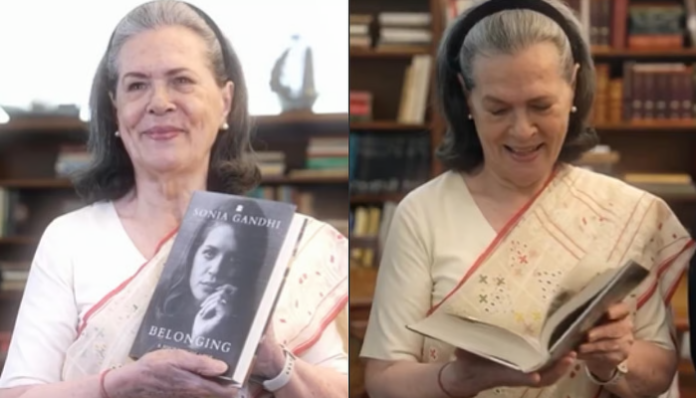
Sonia Gandhi’s memoir, “Belonging: A Journey of Love,” has been embroiled in controversy since its release on 10th November (Tuesday). From distorting established historical accounts to downplaying her party’s role in triggering unrest in the country, it has repeatedly made headlines for all the wrong reasons. Now, the latest backlash centres on yet another blatant attempt at Muslim appeasement, a longstanding feature of the political approach adopted by Sonia Gandhi and her Indian National Congress.
She blamed “caste riots” for the deaths of family members of the party’s national president, Mallikarjun Kharge, instead of naming the Razakars, who were responsible for the brutality. The Hyderabad Nizam’s militia had set off an unprecedented wave of violence against Hindus under his patronage. However, Sonia Gandhi asserted, “When he was just seven years old, his home and family had been set on fire in caste riots, leaving him and his father.”
Meanwhile, Kharge had already acknowledged that the Razakars “attacked our house as well because it was near the road. My mother was killed when they set fire to our place. My brother died, my sister died, and my uncle passed away too,” while talking to Kapil Sibal. He also spoke about how the Razakars had perpetrated an orgy of violence, massacring Hindus and setting their homes on fire.
Moreover, the Nizam’s anti-Hindu policies and the persecution unleashed under his regime are well documented. The Hindu community suffered killings, rape, looting and arson, with many families forced to abandon their homes to save their lives. This continued until the Indian Army intervened and brought the Nizam’s rule to an end.
Sonia Gandhi’s communal bias predictably blinded her to the facts as she hoped to kill two birds with one stone: shielding the Razakars while stoking divisions within the Hindus and painting them as aggressive casteists.
Disputed: Sonia Gandhi’s memoir on Godhra train burning
Sonia Gandhi’s memoir likewise tried to protect another group of radicals, this time those in Gujarat who set fire to the Sabarmati Express at Godhra. She described the deliberate burning of 59 karsevaks aboard the train as “disputed” while conveniently placing the blame for the riots that followed entirely on the Bajrang Dal, Rashtriya Swayamsevak Sangh (RSS), then Gujarat Chief Minister Narendra Modi and Bharatiya Janata Party (BJP).
On the other hand, 31 culprits had been convicted for their involvement in the attack, as eyewitnesses and survivors also recorded their testimonies. Slogans such as “Burn down Hindu infidels,” “Pakistan Zindabad” and “Hindustan Murdabad” were raised when the Islamists arrived armed with dangerous weapons to carry out their pre-planned conspiracy.
However, truth has seldom stood in the way of opposition leaders and their ecosystem in pushing their political agenda, and the Rajya Sabha MP has long mastered this art. She further expressed that the unrest in Gujarat “shook the country” but seemed utterly unmoved by the horrific deaths of Hindu victims, including women and children, at the hands of the jihadis. Her sympathy clearly takes its last breath at the altar of vote-bank politics.
Sonia Gandhi mourns the demolition of the disputed structure in Ayodhya
Of course, the build-up to the memoir’s release was equally controversial, with the Chairperson of the Congress Parliamentary Party (CPP) making similar remarks aimed at appealing to India’s second-largest religious community. She shared that watching the demolition of the disputed structure in Ayodhya, also known as the Babri Masjid, on television in 1992 had brought her to tears, in an interview with “The Guardian.”
She claimed that the event made her understand that maintaining India’s secular identity would require a “long battle” and added that the BJP’s ascent and its “hardline Hindutva politics” were partly due to her party. The saffron party launched a stinging attack after the statements, charging, “This shows that Babar was in the heart of the Congress party back then, and he remains in its heart even today.”
However, the Muslim appeasement practised by the Italian-born matriarch and her party is hardly a secret. She has never shied away from favouring them regardless of their actions or conduct. Her desperation to cater to her voter base has even extended well beyond India’s borders, potentially jeopardising national interest and diplomatic efforts.
Sonia Gandhi attacks Modi government over war in Gaza
In June, Sonia Gandhi published an opinion piece in “The Indian Express” in which she harshly criticised the Modi government for refusing to take sides in the war in Gaza. She lashed out at the government for its purported “stony silence” and “inaction,” faulting it for not taking a stronger stand against Israel amid the alleged “Gaza genocide.”
Her outburst came even as New Delhi maintained a balanced approach to the conflict, repeatedly called for a peaceful resolution and extended humanitarian assistance to Palestinians. The position she advocated, however, risked undermining India’s historical diplomatic stance and straining its relationship with the Jewish state, a strategically important partner that supplies a significant share of India’s defence equipment.
The importance of this partnership was also evident during “Operation Sindoor” when the capabilities of Israeli weapons and systems were put to use in India’s military response. However, the Congress leader appeared willing to sacrifice national interest in a foreign dispute to project herself as the biggest well-wisher and supporter of the Muslim community.
Batla House encounter: Sonia Gandhi breaks down after two Indian Mujahideen terrorists are eliminated
When Sonia Gandhi is not pouring out her pain for Gaza, she is crying over slain terrorists in India. At least, that is what Congress stalwart Salman Khurshid divulged at a rally where he mentioned that she burst into tears after seeing the images of the two Indian Mujahideen terrorists neutralised in the 2008 Batla House encounter.
“When we showed her the images of the incident, she started crying bitterly and, with folded hands, she said, ‘Please do not show me these pictures. Immediately go and speak to the Wazir-e-Azam (Dr Manmohan Singh) and discuss the matter.’ I talked to him, and it was decided that the case would be further investigated,” he conveyed, causing a political storm.
However, Congress leaders later backtracked, arguing that Sonia Gandhi had never cried and was only “worried.” Seven years later, Khurshid also took a U-turn, refuting his own earlier disclosure. If this was indeed accurate, it is a window into the party’s political playbook, wherein it wishes to garner Muslim votes by being sympathetic towards terrorists.
It is noteworthy that the outfit’s founder, Yasin Bhatkal, was also present at the site but managed to run away and was eventually nabbed in 2013. Other members who similarly fled the scene were subsequently arrested and convicted.
Communal Violence Bill: Sonia Gandhi’s pet project
Sonia Gandhi chaired the National Advisory Council (NAC) that drafted the Prevention of Communal and Targeted Violence (Access to Justice and Reparations) Bill, 2011, popularly referred to as the Communal Violence Bill during the United Progressive Alliance (UPA)-II government. It effectively painted a target on the backs of Hindus by labelling them the dominant community and placing the burden of blame on them in any instance of communal violence, regardless of who had actually instigated it.
The likes of Shabnam Hashmi, Harsh Mander, John Dayal and other elements of the Islamo-leftist nexus and its cheerleaders made up the 32-member group which was given the responsibility of producing the draft.
The bill drew strong protests from both the BJP and Hindu organisations, which pointed out that it targeted Hindus while exempting Muslims from scrutiny because the Congress wanted to secure their votes. As a result, the legislation could never be passed due to the firm resistance.
Conclusion
Sonia Gandhi and her party have an extensive history of pandering to the Muslim community, from the infamous Shah Bano case, in which a divorced woman was denied her rights to please hardliners, to Chief Minister Anumula Revanth Reddy’s declaration that “Congress means Muslims and Muslims mean Congress.”
The Karnataka government has routinely come under fire for rolling out schemes for such appeasement, even at the expense of the state exchequer. Notably, the AK Antony Committee report had identified the same reason for the party’s electoral debacle in the 2014 general elections, interestingly, prior to which the Congress government transferred 123 properties to the Waqf Board before being removed from power.
However, the party’s political priorities remain unchanged. If anything, the campaign to consolidate Muslim support has intensified, with Congress and its leadership vying to draw as many voters as possible amid fierce competition from other opposition parties who are also fighting for their supposed share of political attention from the community.
Therefore, Sonia Gandhi’s fresh bid to dismiss the suffering of Hindus, vilify the community, while once again trying to court Muslim endorsement, especially Islamists, is merely an extension of a familiar political strategy that she and the grand old party have repeatedly revived over the years.