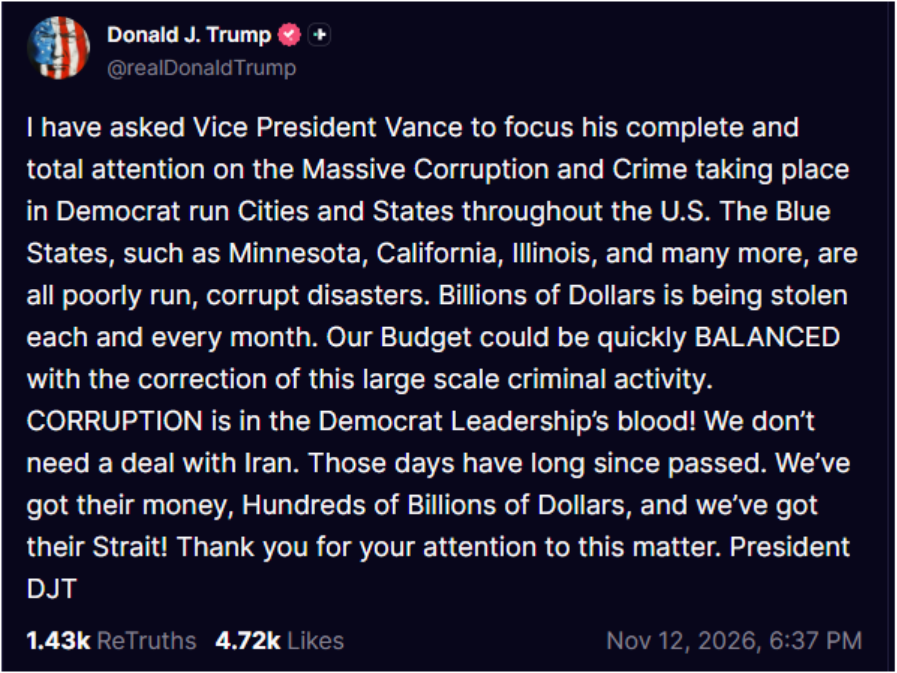
On 12th November, US President Donald Trump announced that the country does not need a deal with Iran anymore and boasted of having secured leverage over “hundreds of billions” in Iranian funds and control of the Strait of Hormuz. Trump asked Vice President JD Vance, who was at the forefront of the diplomatic efforts during negotiation talks with Iran, to shift his focus to alleged corruption and crime in Democrat-run cities and states across the US.
“I have asked Vice President Vance to focus his complete and total attention on the Massive Corruption and Crime taking place in Democrat run Cities and States throughout the U.S. The Blue States, such as Minnesota, California, Illinois, and many more, are all poorly run, corrupt disasters. Billions of Dollars is being stolen each and every month. Our Budget could be quickly BALANCED with the correction of this large scale criminal activity. CORRUPTION is in the Democrat Leadership’s blood! We don’t need a deal with Iran. Those days have long since passed. We’ve got their money, Hundreds of Billions of Dollars, and we’ve got their Strait!” Trump wrote.
Donald Trump’s “no deal with Iran” statement comes just days after the Republicans suffered a massive defeat in the midterm elections.
The nine-month Israel-US military campaign against Iran that began in February 2026 witnessed a naval blockade, economic pressure campaign, a military and economic stalemate, deaths, destruction, global energy price hikes, and war’s global and domestic costs for the warring nations, particularly the US.
In the US, the war against Iran remained unpopular. While the Trump administration in the US and the Netanyahu government in Israel eyed a regime change and full dismantlement of Iran’s nuclear programme, Trump’s party lost midterm elections, and the Netanyahu-led bloc suffered a setback in the recently concluded Knesset election.
Trump changes tone on Iran after midterm drubbing?
Trump’s “no deal with Iran” rhetoric marks a sharp public reversal on the need for a deal with Iran after months of negotiations failed.
Asking JD Vance to devote his attention to domestic crime and corruption issues comes after the Vice President publicly blamed the war and Trump acknowledged it as a factor for the midterm’s setback.
In fact, The Wall Street Journal reported on Wednesday that Vance was considering holding direct talks with the top Iranian security official to end the conflict.
Many are interpreting Trump’s call to Vance to focus on domestic issues as his removal from US’s foreign policy decision-making.
Trump appears to be searching for an off-ramp while projecting strength in his classic style without having to immediately order large-scale fresh strikes on Iran.
While the timing of the messaging is interesting, Trump has long oscillated publicly on Iran.
Although Trump is now saying that there is no need for a deal with Iran, just two days ago, he signalled that the war with Iran was “militarily… effectively over” or would end “fairly soon,” further major strikes were “quite unlikely” or “highly unlikely” if talks progressed, there was “positive momentum” toward ending the conflict, and he hoped for a favourable deal.
It is the same Trump who went from threatening
“a whole civilisation would die tonight” to deploying his officials to negotiation talks in Islamabad. The midterm election loss reflects the political cost of the prolonged conflict with Iran, apparently prompting Trump to hint that he may no longer be interested in re-escalating the war in West Asia.
After Trump’s post, markets reacted with declining stock futures, consistent with heightened uncertainty.
This uncertainty and Trump’s oscillating rhetoric leave many questions.
- Is the US officially discontinuing all diplomatic efforts to secure a deal with Iran?
- Is Trump keen on maintaining the status quo with a harder edge?
- Or is it a signal of imminent full war resumption?
Let’s address these questions one by one. First, Trump’s remark does not announce an end to all talks or mediation efforts. It rather declares that the US does not ‘need’ a deal since leverage already exists in the form of Iranian funds, frozen assets, and supposed control of the Strait of Hormuz.
Trump is, apparently, telling his supporter base that the US is ‘winning’ and it is Tehran that needs to come further towards the US and agree to the White House’s terms, especially the ‘non-negotiable’ nuclear program.
Mentioning JD Vance and asking him to divert his attention from the visible high-level diplomatic track to domestic issues in Democrat-run states indicates that Trump is aware of the discontent of his support base over the US’s prolonged involvement in the Iran war.
This, however, does not essentially mean a discontinuation of quiet or backdoor communications and negotiations between the US and Iran.
For now, economics over combat is expected to remain the US’s approach.
Second, maintaining the status quo seems a more realistic approach. Trump’s post also boasts of having leverage in the form of the Hormuz blockade and economic strangulation.
While the outgoing Israeli Prime Minister Benjamin Netanyahu is reported to have been consistently pressuring Trump to resume strikes on Iran, Trump is not keen on launching immediate major combat operations.
This is due to both the domestic unpopularity of US involvement in the Iran war and the Gulf countries being against fresh escalations.
Third, Trump’s “We’ve got their Strait” remark asserts control and projects strength, suggesting that the US is already having the upper hand and thus only needs to keep the “locked and loaded” option open instead of resuming a full war.
A war with Iran would have benefited Trump both in terms of geopolitical and electoral interests only if it remained short and resulted in Iran’s indisputable defeat.
But as things have not played out the way Trump-Netanyahu calculated, with Trump’s party getting weakened in Congress and Netanyahu losing power, it is highly likely that the US will maintain a “keep the pressure, claim victory and de-emphasise deal-making” approach to project strength domestically.