

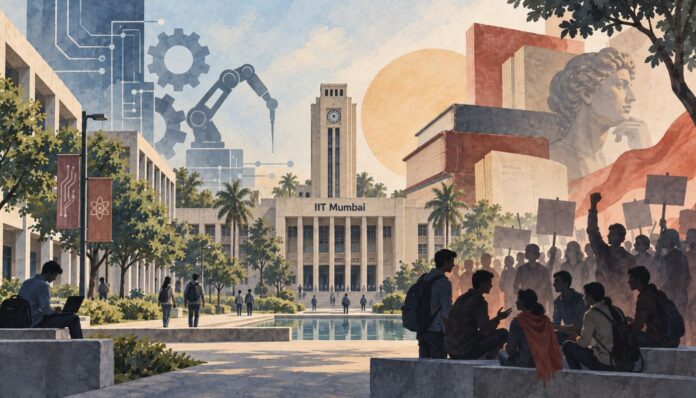
The IIT Bombay controversy following the death of second-year BTech student Sahil Wakode has reopened questions about the growing role of humanities and identity politics inside India’s premier technology institutions. Wakode died hours after he was reportedly caught using ChatGPT during an examination. His family alleged caste-based harassment by Professor Suryanarayana Doolla, leading to protests, an SC/ST Act case and Doolla losing his administrative position. Subsequent faculty support, CCTV footage and statements from Wakode’s friend complicated the initial narrative, while Left and Ambedkarite activists became prominent in the campus mobilisation.
The broader argument traces how sections of humanities and social sciences evolved from studying society to actively seeking its transformation. Beginning with Marx and the Frankfurt School, and later expanding through thinkers such as Michel Foucault and through feminist, postcolonial, critical race and queer theories, academic frameworks increasingly centred power, oppression, identity, hierarchy and structural discrimination.
Western universities provide examples of how such theories moved from classrooms into institutional politics. Yale, Middlebury, Evergreen State College, Berkeley and Stanford witnessed major controversies involving race, speech, identity and ideological activism. DEI requirements also became part of faculty recruitment, while movements such as Rhodes Must Fall expanded from symbolic protests into broader demands for institutional transformation. Some elite Western universities, including Harvard, have since moved towards greater institutional neutrality.
India’s IITs originally included humanities to broaden engineering education, but their role has expanded considerably. IIT Bombay now runs postgraduate and doctoral programmes across several humanities and social-science disciplines. IIT Madras launched an integrated MA programme in 2006 and today offers postgraduate courses in Development Studies, Economics, English Studies and Public Policy. NEP 2020 further encourages IITs to become multidisciplinary institutions with greater arts and humanities presence.
The central concern is whether IITs need autonomous humanities ecosystems at all. India already has a vast humanities education network, while IITs remain relatively rare institutions built around technological excellence. Engineers can be taught ethics, communication, economics, psychology and social awareness without turning technology institutes into general universities. The IIT Bombay episode highlights the risk that expanding humanities ecosystems may also bring ideological activism, identity-based mobilisation and campus politicisation into institutions created primarily for science and technology.
Read the full article on Chapter One Magazine.


