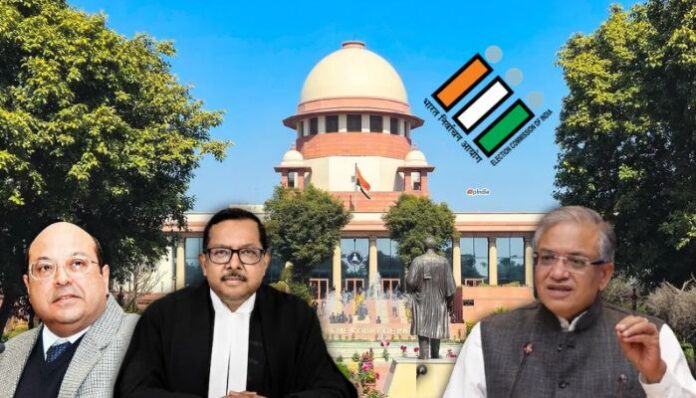
The Special Intensive Revision (SIR) of electoral rolls across the country has somehow rattled not only the Opposition parties, their unofficial media and activist B-teams, but also a few retired and sitting judges. Sitting Supreme Court judge Justice Ujjal Bhuyan and ex-judge Justice Rohinton Nariman amplified an alarmist narrative around the SIR.
The speeches of these judges landed just days before the Supreme Court hearing on 5th October, on pleas questioning Chief Election Commissioner Gyanesh Kumar’s functioning and seeking to invalidate the SIR.
Rohinton Nariman misrepresents data to claim ‘voters’ right to vote in peril
On 27th September 2026, the Hinduphobic former judge Rohinton Nariman delivered a speech titled “The Constitution and the Common Man” at Rajkot’s Rajkumar College. Nariman claimed that the right to vote, “the heart of our Constitution, the heart of our democracy,” is “at great peril”
Casting aspersions on the integrity of the Election Commission, Nariman said, “You cannot have an election commission which functions or malfunctions like this.”
Speaking about the SIR in West Bengal, Nariman claimed that 90 lakh voters were “disenfranchised”.
“In the West Bengal election, 90 lakh voters, an astounding figure, were disenfranchised. Now, 90 lakh voters getting disenfranchised didn’t somehow move the Supreme Court enough to stay this so that these 90 lakh voters were out when the Bengal election took place,” Nariman said.
He added that of those ‘disenfranchised’, “some 22 lakh voters actually filed appeals; the others have all seemed to have accepted. There must be poor people… who don’t have the wherewithal or the access to justice.”
Rohinton Nariman further claimed that of these 22 lakh voters, “some one lakh voter appeals” were decided, “93% [were] in favour of the voter. So can you imagine, this was a completely illegal knocking out of the common man… in order that a government obtains what it wants. And in West Bengal, we saw it oust the Government of the day and bring in the Government of the Centre. Now, these are very, very disturbing things that are happening in our country today.”
“Very, very disturbing things happening in our country. 90 lakh voters were disenfranchised in WB polls, this was completely illegal.” – Rohinton Fali Nariman, former SC judge & Solicitor General of India on voter deletion in WB polls https://t.co/UP1QQ0z2II
— News Arena India (@NewsArenaIndia) October 5, 2026
Amidst the political attacks on CEC Gyanesh Kumar, Rohinton Nariman also called the current law placing the Election Commissioner appointments largely in the hands of the Central government of the day a “red flag”. He further urged the Supreme Court to decide the challenge to the Chief Election Commissioner and Other Election Commissioners Act quickly.
Nariman also cited the dubious Indian Express report which claimed that two Election Commissioners had objected to decisions taken by the Chief Election Commissioner, followed by what he called a “patch-up.”
Nariman gives an alarmist spin to West Bengal SIR data
While politically useful to attack the CEC and the BJP, Nariman’s claim that 90 lakh voters were outrightly “disenfranchised” is wrong. Mere initial removal from the electoral roll during SIR does not automatically mean 90 lakh voters were disenfranchised.
Deleted voters were not singled out based on their caste, religion, gender, or political leanings. Electoral rolls contain the dead, duplicates, migrants, and persons otherwise ineligible for inclusion. This is precisely why Special Intensive “Revision” is conducted.
The SIR provides for the restoration of draft deletions through claims and objections before tribunals. In fact, the distinction between draft deletion and final exclusion after the prescribed process is not a minor technicality but central to the objective of conducting SIR.
The Election Commission informed the Supreme Court earlier that the judicial officer in the West Bengal SIR adjudication ordered the deletion of 27.16 lakh names, and of these, 22.21 lakh deleted voters filed appeals seeking restoration.
The fact that 93% of roughly 1.2 lakh decided appeals succeeded does not establish that 90 lakh deletions were “completely illegal” or that SIR is a threat to electoral democracy.
Nariman relied on extrapolation from a fraction of the cases to allege that citizens were knocked out “in order that a government obtains what it wants”.
There is no evidence that there is any electoral conspiracy behind 90 lakh initial deletions or eventual restoration of thousands of names, to manipulate electoral rolls in the favour of the BJP that emerged victorious in the state assembly elections in May this year.
The West Bengal SIR process operated under Supreme Court directions that created the appellate tribunals. Apparently, Nariman’s chagrin is that the BJP won Bengal elections.
This must not be forgotten: West Bengal recorded a voter turnout of more than 93%. How is it that a state supposedly devastated by mass ‘disenfranchisement’ went on to record the highest electoral turnout in the state since independence?
In the 20 Assembly seats that recorded the highest voter deletions, TMC won 13, BJP won 6, and one seat was won by Congress. If the SIR or voter deletions were systematically designed to damage the TMC and benefit the BJP, then how did TMC dominate the highest-deletion constituencies? Clearly, data debunks ‘ECI did partisan engineering’ claims.
Electoral outcomes vary because of local candidate strength, caste and communal equations, anti-incumbency, organisational machinery, turnout behaviour, and regional political trends. Blaming SIR as the sole driver of the defeat of anti-BJP leaders or political parties is nothing but political rhetoric.
Justice Ujjal Bhuyan invokes Article 326 and Article 14 to cast aspersions on the motive of the SIR
While former judge Rohinton Nariman peddling an alarmist and conspiratorial narrative around the SIR is understood given his ideological biases against the BJP, a sitting Supreme Court judge, Justice Ujjal Bhuyan portraying voter deletions post SIR as “intrinsically arbitrary” is outrageous.
On 4th October, Justice Ujjal Bhuyan delivered the valedictory address at the 19th NALSAR-Justice B.R. Sawhne Memorial Moot Court Competition in Hyderabad.
During his address, Justice Bhuyan said that any process that ‘disenfranchises’ “millions of Indian citizens, making them ‘second-class’ citizens in their own country” by denying them the vote is “intrinsically arbitrary.”
Without explicitly naming the SIR exercise, Bhuyan invoked Article 14, which guarantees the right to equality, and Article 326, which provides for universal adult suffrage.
Justice Bhuyan said, “No amount of whataboutery can justify it. It strikes at the very heart of the Constitution, and I would go to the extent of saying that it is a negation of the constitutional order which we have adopted under the Constitution of India.”
ODD. The SC speaking through one bench and contradicting itself through another Judge? SC Judge Justice Ujjal Bhuyan says any "process" that “disenfranchises millions” is “intrinsically arbitrary” and strikes at the heart of the Constitution. CONTRADICTION! WHAT IS “INTRINSICALLY ARBITRARY” ABOUT A "PROCESS" THAT THE SUPREME COURT ITSELF HAS ALREADY CLEARED? The SC has upheld SIR, recognising the ECI’s power to undertake electoral-roll revision, subject to safeguards. If the "process" is "ARBITRARY" then mass exclusion IS NOT AUTOMATICALLY EQUAL TO disenfranchisement. IS IT?
— Rahul Shivshankar (@RShivshankar) October 5, 2026
Bhuyan went as far as to assert that “no authority can do it; no court can condone it”.
He further said that the Indian Constitution does not provide for two classes of citizens: citizens with voting rights and citizens without voting rights.
“Except in the case of a dead voter, the name of a voter once enlisted in the electoral roll cannot be deleted without notice and hearing,” Justice Bhuyan said.
He also claimed that detaching the right to vote from citizenship is like “taking out the soul from the body.”
Justice Bhuyan linked universal adult suffrage to the basic structure.
Justice Bhuyan insinuated that other than the case of dead voters, names from electoral rolls should not be struck down and that such deletions would amount to arbitrary disenfranchisement.
However, Article 326 of the Indian Constitution provides for adult suffrage subject to disqualifications under law. Similarly, the Representation of the People Act and Election Commission rules have long authorised revision, including deletion after notice in defined cases.
Contrary to the ‘intrinsically arbitrary disenfranchisement’ framing, the ECI has informed the Supreme Court earlier that the voter names were not removed without the prescribed process.
While the question of whether logical discrepancy flags meet the standard remains sub judice, labelling large-scale revision itself as “negation of the constitutional order” regardless of grounds or remedies goes beyond what Articles 14 and 326 state.
Lakhs of voter deletions in SIR have not happened for the first time
Reports suggest that around 13 crore voter names were deleted from electoral rolls across the country after SIR in various states and UTs. While 13 crore in itself is not a small number, the sheer size of the ‘deleted’ number of names does not automatically mean eligible voters were illegally disenfranchised en masse, as Justices Rohinton Nariman and Ujjal Bhuyan are insinuating.
In fact, during the SIR exercise in 2004, in Andhra Pradesh alone, 93.4 lakh voters were deleted, bringing down the state’s voting-eligible population from 70% to 63%.
Back then, the Election Commission’s legal counsel for S.K. Mendiretta had said that, among other factors, the fact that SIR was not conducted in Andhra Pradesh for many years. In addition, he said that people moved as voters to the new place without getting their names removed from the previous roll.
Similar issues have been flagged by the ECI during the recent SIR exercise, which has been held across the country after 21 years. Yet, in 2004, nobody declared SIR a threat to democracy or cast doubts on the integrity of the then CEC.
In fact, just recently, Keralam Congress leaders Mathew Kuzhalnadan and Shashi Tharoor boasted that the SIR exercise helped the UDF win the Assembly elections, as thousands of bogus voters were weeded out.
“Of course, the SIR process also removed a lot of fake voters, which, in some constituencies at least, were managed by the CPI(M). So that also helped us,” Kuzhalnadan said as his party won 99 of the 140 seats in Keralam.
“…in Kerala, I suspect the Congress benefited from the deletions because the CPIM was long a past master of double, triple, quadruple enrollment… That used to happen. So they were eliminated by the SIR…” Tharoor said in May this year.
While SIR removing fake voters from electoral rolls helped Congress-led UDF sweep Keralam elections, nobody then alleged that the ECI or CEC Gyanesh Kumar ‘manipulated’ electoral rolls in Congress’s favour or that there was a conspiracy. Apparently, the chagrin is not SIR or voter deletions, but the victories of the BJP in states where incumbent governments are led by non-NDA parties.