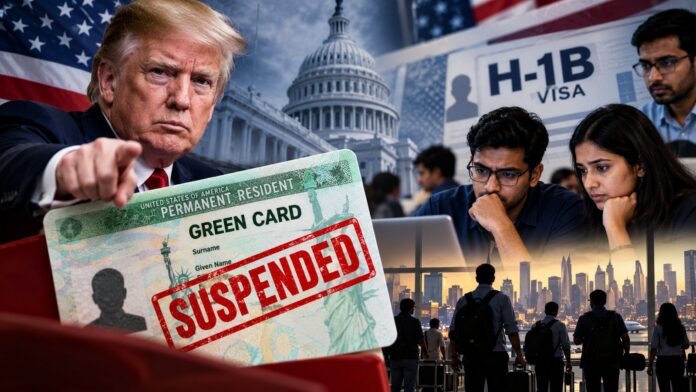
The Trump administration’s latest immigration crackdown has triggered fresh concerns among Indian professionals working in the United States. Washington has suspended eight major technology companies from a programme used to sponsor foreign employees for permanent residency, raising questions about whether thousands of Indians could be forced to reconsider their American dream.
The companies affected include Tata Consultancy Services (TCS), Infosys, Wipro, HCLTech, Cognizant, Capgemini, Microsoft and Adobe. The action, announced on October 8, 2026, targets the Permanent Labour Certification programme, commonly known as PERM, amid allegations of fraud and misuse of employment-based immigration procedures.
But before the news sparks panic among Indian IT professionals, one crucial distinction needs to be understood: the US government has targeted a route to green cards, not the H-1B visa programme itself.
Indians already working legally in America on valid H-1B status do not automatically lose their right to work because their employers have been suspended from the PERM process. The move does not, by itself, cancel existing H-1B visas, invalidate approved H-1B petitions or require Indian employees to pack their bags and return home.
India’s Ministry of External Affairs (MEA) clarified on October 9 that the suspension would not, by itself, affect the validity of existing H-1B visas or the status of H-1B holders and their dependents. It acknowledged, however, that eligible employees could face consequences for their green card applications.
In other words, the immediate concern is the route to permanent residency, not an automatic loss of permission to work in America.
What exactly has the Trump administration suspended?
To understand the implications, it is necessary to distinguish between the two principal immigration pathways involved.
The H-1B visa allows American employers to hire eligible foreign professionals for speciality occupations, subject to the programme’s requirements. It is a temporary employment-based immigration category.
A green card, on the other hand, grants lawful permanent resident status, allowing an individual to live and work permanently in the United States, subject to the applicable laws.
PERM is an important step in the employment-based green card process for many foreign workers. Before sponsoring an employee for certain employment-based immigrant categories, an employer must generally obtain labour certification from the US Department of Labour.
The employer is required to demonstrate that it has tested the American labour market and that hiring the foreign worker will not adversely affect the wages and working conditions of similarly employed American workers.
Once the labour certification is approved, the employer can generally proceed with an immigrant petition before US Citizenship and Immigration Services (USCIS), followed by the remaining steps required for permanent residency.
The administration’s action against the eight technology companies restricts their participation in this process while the government investigates alleged violations. The precise treatment of pending cases and the duration of the suspension will determine the extent of the disruption.
What the action does not establish, however, is a blanket ban on employing Indian nationals or a cancellation of every immigration benefit associated with these companies.
The distinction is significant because the US immigration system operates through separate visa categories and procedures. Restricting access to one stage of the green card process does not automatically terminate a worker’s status under another category.
Why Indian H-1B workers need not panic
Consider an Indian software engineer employed by Microsoft on a valid H-1B petition. The employee continues working in the approved role and maintains lawful immigration status. If Microsoft is unable to initiate a new PERM application during the suspension, the employee’s existing H-1B status does not automatically disappear.
The same principle applies to eligible H-1B workers employed by TCS, Infosys, Wipro, HCLTech, Cognizant and Capgemini.
The suspension, by itself, does not revoke their H-1B status, make their employment unlawful or require them to leave the country.
Nor does the action automatically cancel an already-issued green card. Permanent residents hold a different immigration status from H-1B workers, and a restriction on an employer’s ability to initiate PERM proceedings is not, on its own, a cancellation of that status.
However, this distinction should not be mistaken for a blanket guarantee that every affected employee will remain unaffected. H-1B status is subject to its own rules. An employment termination, an expired petition or another immigration violation can have separate consequences.
The relevant point is that the PERM suspension itself does not cancel an existing H-1B visa or automatically strip an employee of lawful status.
The real casualty could be the green card dream.
While the immediate threat to existing H-1B status is limited, the suspension could prove consequential for Indians seeking permanent residency.
For many Indian professionals, the H-1B visa is not the final destination. It is the first step towards building a long-term life in the United States. They work for years, pay taxes, establish families and plan their futures around the possibility of eventually securing a green card.
The PERM process is often an essential part of that journey.
An employee whose employer has not yet filed a PERM application could face a delay before the green card process can begin. Those with pending applications could also face uncertainty over how their cases will be handled during the suspension.
The consequences will depend on the stage of the application, the relevant immigration rules and the government’s eventual treatment of individual cases.
This is particularly important for Indian nationals because employment-based green cards are subject to per-country limits. India has faced substantial backlogs in several employment-based immigration categories, leaving many applicants waiting years for permanent residency.
For workers already caught in these backlogs, an additional delay at the labour certification stage could complicate long-term immigration planning.
But it would be inaccurate to claim that every Indian employee working for the eight companies will suffer the same consequences. Many may not be pursuing employer-sponsored green cards at all. Others may already have progressed beyond the PERM stage.
The impact is therefore likely to be concentrated among workers whose permanent residency applications depend on actions their employers can no longer take during the suspension.
The six-year H-1B limit: Where the situation could become complicated
There is one category of workers for whom the suspension could have more serious indirect implications: those approaching the maximum period of H-1B stay.
H-1B status is generally subject to a six-year limit, although qualifying workers can obtain extensions beyond that period under specific circumstances.
For example, eligible workers may qualify for one-year extensions beyond the six-year limit if the required labour certification or immigrant petition was filed at least 365 days earlier. Certain workers with approved I-140 immigrant petitions may also qualify for extensions of up to three years when an immigrant visa is unavailable because of the applicable green card backlog.
This is where the PERM suspension could complicate matters.
A worker who has not yet initiated the green card process and is approaching the end of the six-year H-1B period may have fewer options if the employer cannot file the required paperwork in time. Whether an extension is available will depend on the individual’s immigration history, filing dates and eligibility under the applicable rules.
This is a genuine concern, but it is not the same as saying that all Indian H-1B workers employed by the affected companies will lose their status.
The distinction between direct and indirect consequences matters. The suspension does not automatically cancel existing visas, but it could disrupt immigration planning for some employees who rely on the green card process to qualify for future extensions.
Indian IT companies are not necessarily facing an operational crisis
The suspension also raises questions about its potential impact on Indian IT companies operating in the United States.
However, the consequences for corporate operations must be separated from those for individual employees.
Nasscom, the industry body representing Indian technology companies, has highlighted the industry’s reduced dependence on H-1B visas over the years as firms expanded local hiring in the United States. TCS has also indicated that the suspension would not materially affect its workforce strategy or customer engagements, pointing to the limited number of PERM applications it had made in recent years.
These statements suggest that the immediate operational consequences for the wider Indian IT industry may be contained, although the experience of individual workers could vary.
Companies that rely less heavily on new PERM applications may face limited disruption to their overall workforce plans. Employees already in the United States on valid H-1B status can continue working under the terms of their approved petitions, provided they continue to meet the relevant requirements.
Nevertheless, industry-wide assessments do not eliminate the uncertainty facing employees whose green card applications are already underway.
The suspension could create administrative complications, delay permanent residency plans, and force affected workers to reconsider their long-term options if the restrictions remain in place.
What should Indian professionals do now?
For Indian workers employed by the eight companies, the first step is to establish whether their immigration plans actually depend on the suspended PERM process.
Those working legally on valid H-1B status should not assume that their visas have been cancelled or that they must leave the country.
Employees pursuing permanent residency should ask their employer’s immigration team to clarify the status of their applications, whether any filings have been affected, and what alternatives may be available under existing immigration rules.
Workers approaching the six-year H-1B limit should be particularly careful. They may need individual legal advice to determine whether they qualify for an extension and whether the suspension changes their options.
The government could also clarify how pending applications will be treated and whether the affected employers will eventually regain access to the programme. Until then, sweeping predictions about the fate of every Indian worker would be premature.
A setback for settlement plans, not a blanket ban on Indians working in America
The Trump administration’s latest action reflects a tougher approach towards employment-based immigration and the use of foreign labour by American companies. Its stated objective is to investigate alleged abuses and protect American workers.
The immediate consequences, however, must be assessed on the basis of what has actually been suspended.
The PERM restrictions could delay green card applications and disrupt the long-term settlement plans of Indian professionals employed by the affected companies. For some, especially those approaching the H-1B limit, the indirect implications could be significant.
But the announcement does not amount to a blanket cancellation of H-1B visas, nor does it automatically render the employment of Indian professionals unlawful.
The headline distinction is simple: the United States has restricted an important route to permanent residency for employees sponsored by eight technology companies; it has not, through this action alone, ordered Indian H-1B workers to leave the country.
For thousands of Indians already working legally in America, there is no reason to assume that their immediate right to work has vanished overnight. The uncertainty concerns how quickly, and through which available routes, some of them will be able to turn temporary employment into permanent residency.
That is a serious setback for those waiting for a green card. It is not the same as shutting the door on every Indian professional working in the United States.