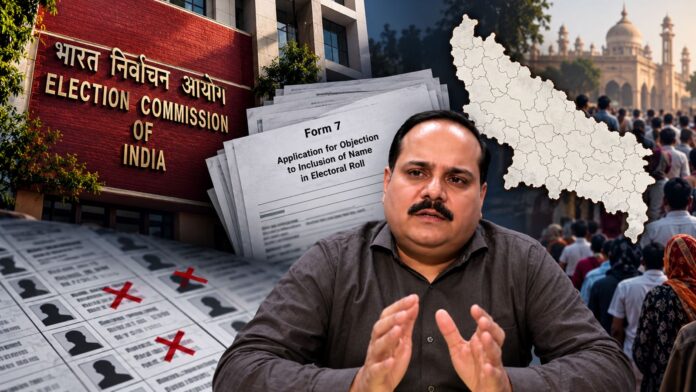
Uttar Pradesh Chief Electoral Officer (CEO) Navdeep Rinwa has strongly refuted allegations made by The Reporters’ Collective that the Election Commission of India (ECI) used its ERONET software to facilitate the arbitrary deletion of nearly 86,000 voters from the state’s electoral rolls during the Special Intensive Revision (SIR) exercise.
Rejecting the investigative report’s findings as misleading and factually incorrect, Rinwa issued a detailed, point-by-point clarification, maintaining that the electoral roll revision was conducted in accordance with statutory provisions and established procedures.
The controversy erupted after The Reporters’ Collective alleged that the ECI’s ERONET software had automatically generated 85,854 Form 7 applications bearing election officials’ digital signatures, without specifying the grounds for deletion. The report also questioned the timing of these applications, alleged irregularities in bulk objections, and raised concerns about the possible targeting of minority voters.
However, the Uttar Pradesh CEO maintained that the report had misrepresented administrative actions taken following statutory inquiries as arbitrary attempts to disenfranchise voters.
85,854 Form 7 entries generated after hearings and formal orders, clarifies CEO
Addressing the central allegation concerning the automatic generation of 85,854 Form 7 entries, Rinwa explained that these were not fresh objections seeking the removal of voters. Instead, they represented the administrative implementation of decisions taken by Electoral Registration Officers (EROs) and Assistant Electoral Registration Officers (AEROs) after completing the prescribed verification process.
सोशल मीडिया पर प्रसारित भ्रामक खबर "ECI सोफ्टवेयर में फॉर्म-7 ऑटोजनरेट करके डिलीट किया गया" के संबंध में मुख्य निर्वाचन अधिकारी श्री नवदीप रिणवा की बाइट @ECISVEEP @SpokespersonECI @ANINewsUP @PTI_News @ians_india @DDNewsUP @AIRNewsHindi https://t.co/NUZZXhfYNG
— CEO Uttar Pradesh (@ceoup) October 9, 2026
According to the clarification, when the draft electoral roll was published on January 6, 2026, it contained approximately 12.55 crore electors. Of these, nearly 3.26 crore entries required further verification, including 2.22 crore electors with logical discrepancies and another 1.04 crore whose details could not be mapped.
Rinwa explained that EROs and AEROs were empowered under the Registration of Electors Rules, 1960, to initiate suo motu inquiries into such cases.
He maintained that the electors concerned were served physical notices identifying the discrepancies or mapping deficiencies in their records. They were also allowed to submit supporting documents and establish their eligibility during the prescribed hearing process.
Where an elector was found ineligible following the inquiry, the concerned officer passed a reasoned, or speaking, order explaining the decision.
These orders were subsequently uploaded to ERONET, following which the relevant entries were marked for deletion.
The CEO clarified that the system-generated Form 7 entries merely reflected decisions already taken through the prescribed quasi-judicial process. Since the grounds for the decisions had been recorded in notices and formal orders, their absence from the automatically generated entries did not, according to him, establish that voters had been removed without justification.
Why were thousands of deletion entries recorded after the March 6 deadline?
The investigative report also alleged that election authorities had entertained 87,127 officer-initiated deletion requests and more than 1.10 lakh individual submissions after March 6, 2026, the deadline for filing claims and objections.
Rinwa disputed this interpretation, drawing a distinction between the deadline for submitting fresh objections and the subsequent disposal of cases already under consideration.
He explained that although March 6 marked the end of the claims and objections filing period, hearings and quasi-judicial proceedings were permitted to continue beyond that date under the notified SIR schedule.
According to the CEO, hearings continued until approximately March 15, after which EROs and AEROs issued final orders in the latter half of March.
The Form 7 entries appearing in ERONET during this period, he maintained, were generated as part of the administrative implementation of those orders rather than through the acceptance of fresh, time-barred objections.
Consequently, Rinwa rejected the suggestion that the dates on which these entries appeared in the software necessarily demonstrated violations of the statutory deadline.
Allegations of targeted voter deletions rejected; CEO cites scale of bulk objections
The CEO also rejected allegations that the deletion mechanism had been used to systematically target voters belonging to minority communities.
Responding to concerns about bulk Form 7 submissions, Rinwa referred to figures cited in the investigative report itself.
According to those figures, only 198 individuals across Uttar Pradesh had submitted 10 or more Form 7 applications, involving approximately 4,700 voters.
Rinwa contrasted these numbers with the state’s electorate of more than 13.39 crore voters, arguing that the figures did not substantiate allegations of a widespread, coordinated campaign to remove voters from the electoral rolls.
However, the CEO’s response focused on the limited number of bulk submissions and their administrative treatment, rather than presenting a separate demographic analysis of the affected voters.
All 188 objections filed under ‘Reshma’ in Tarabganj were rejected
The clarification also addressed a specific case highlighted by The Reporters’ Collective, involving 188 Form 7 objections allegedly submitted under the name “Reshma” in the Tarabganj Assembly constituency on January 31, 2026.
The investigative report had cited the incident while questioning the safeguards against mass objections and potentially fraudulent attempts to remove voters.
Rinwa stated that election authorities had already identified the irregularity and rejected all 188 applications during scrutiny.
He further pointed out that the CEO’s office had issued instructions to field officials on January 31, 2026, specifically addressing the issue of bulk Form 7 submissions.
Under these instructions, officials were directed not to entertain bulk objections and to accept applications only when submitted individually or in respect of immediate family members, in accordance with the applicable procedure.
The CEO cited the rejection of the Tarabganj applications as evidence that the scrutiny mechanism had prevented questionable objections from resulting in voter deletions.
ECI’s October 2025 instructions were publicly available, says CEO
Rinwa also challenged the report’s suggestion that the Election Commission had relied on undisclosed instructions to carry out the electoral roll revision.
He maintained that the SIR instructions issued on October 27, 2025, had been available on the Election Commission’s official website under the “Instructions” section since their issuance.
According to the CEO, the allegation that these directions were concealed from public scrutiny was therefore incorrect.
He reiterated that the revision exercise was governed by the Constitution of India, the Representation of the People Act, 1950, the Registration of Electors Rules, 1960, and the Electoral Roll Manual.
UP CEO maintains SIR followed due process
Concluding his clarification, Rinwa asserted that the Special Intensive Revision exercise in Uttar Pradesh had been conducted in accordance with the applicable legal framework, with prescribed safeguards for verification, hearings and the disposal of objections.
He maintained that the electoral rolls were updated only after following the established procedure and rejected allegations that the Election Commission had used its software to arbitrarily remove eligible voters.
The CEO also reaffirmed the Election Commission’s commitment to conducting future electoral processes in a transparent, peaceful and impartial manner.
The clarification directly challenges the central conclusions of The Reporters’ Collective investigation. While the report raised questions about automatically generated deletion entries, statutory deadlines and safeguards against misuse, the CEO’s response maintains that the disputed records were the outcome of documented administrative and quasi-judicial proceedings rather than evidence of unlawful voter deletions.