The latest controversy surrounding AISA president Neha Bora is not an isolated outburst. It is the visible tip of a deeper ideological iceberg that the left-liberal ecosystem and the Congress Party have nurtured for decades. Her vulgar generalisation about temple priests and her claim that temples are sites of predation is outright Hindu hatred.
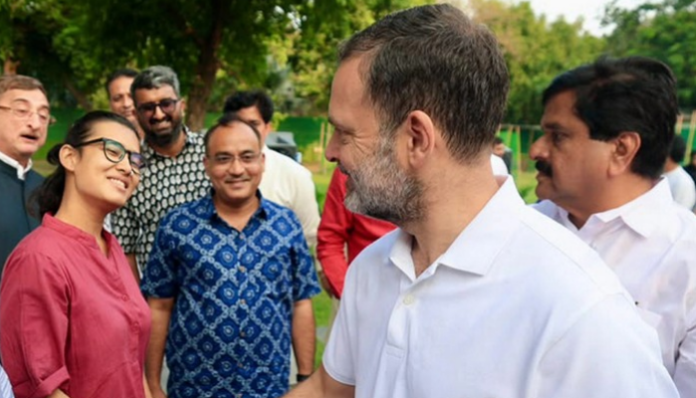
Bora has been repeatedly seen alongside Rahul Gandhi and Priyanka Gandhi Vadra, given proximity and legitimacy by the Congress leadership. Rahul Gandhi himself laid the groundwork years ago by equating temple worship with molestation.
Bora’s affiliation with the Congress and the Rahul Gandhi-inspired ecosystem made her rhetoric predictable. This is not a fringe gaffe; it is the party’s hostility to Hindu society speaking through its proxies.
Neha Bora’s Hindu Hate: A calculated assault on the temple
Neha Bora’s hatred for Hindus is widely known. During a recent interview, she said, “Gareeb, shoodra, pashu, nari taadna ke adhikari hai”. She emphasised the word “taadan”, which means chastisement according to her (Her Translation: The poor, Shudras, animals, and women are deserving of chastisement), but her statement is pure propaganda because the Hindi word ‘taadan’ means “To look after/Care”. So the real translation is ” The poor, the Shudras, animals, and women are entitled to care.
She further spewed venom in Hindu hate: “Mandiro main pujaari rape karte hai” (Translation: priests commit rapes inside temples); later, she said women, including Brahmin women, are unsafe under what she called the “Brahmanical system”.
She tried to paint an entire class of Hindu religious functionaries as predators. This is not a call for women’s safety. It is a deliberate desecration of the temple as an institution, using the language of feminism as a sham for Hinduphobia.
Shocked to Listen the Hindu Hate of Neha Bora Without Any Fear. "Pujari rapes women in Temples" "Women needs protection from Brahmans" This women was given stage by Rahul Gandhi. With her Rahul Will Win UP Elections? https://t.co/Cf3tnm7Ssp
— Dear Men (@DearMenLife) November 2, 2026
Bora the “poster girl” of Rahul Gandhi’s politics and noting that her words echo Gandhi’s own past utterances. The Congress’s reflexive rejection of the charge rings hollow when its own leaders have spent years cultivating exactly this vocabulary. Bora is not a fringe figure; she has been seen alongside Rahul Gandhi and other opposition leaders during protests.
When a party marches shoulder to shoulder with those who slander the faithful, it cannot later claim plausible deniability. The temple is the beating heart of Hindu civilisational life. To reduce it to a site of criminality, without evidence and with sweeping generalisation, is not critique; it is incitement. And the ecosystem that amplifies such voices while claiming to fight “hatred” stands exposed as the very engine of anti-Hindu prejudice.
Rahul Gandhi’s ‘Mandir’ canard: The original sin
Bora was “inspired by Rahul Gandhi” rests on a specific and damning history. Gandhi reportedly said that “mandiro main ladkiyon ke sath ched chad hoti hai” (Translation: that girls are molested inside temples). This is not a stray remark from a political novice. It is a pattern.
In 2014, reacting to a horrific gang rape in Delhi, Gandhi framed the crime through a bizarre equivalence: people who go to temples to worship goddesses also molest women on buses. The implication of this remark is unmistakable: the temple, the most sacred space in Hindu life, is no better than a site of sexual violence.
He also supported Indian students being taught Phule’s book Gulamgiri (slavery). This book contains highly objectionable references to Hindu scriptures and deities in the name of “deconstructing” the religion. This includes Lord Brahma, who is not only subjected to deeply derogatory language but is also falsely accused of having sexual intercourse with his consort, Goddess Saraswati, who is wrongfully described as his daughter.
मोदी जी सामाजिक न्याय और बराबरी के ख़िलाफ़ हैं। उनका पूरा सिस्टम शिक्षा से नफ़रत करता है, क्योंकि वे नहीं चाहते कि छात्र सोचें या सवाल पूछें। इसका ताज़ा सबूत देखिए। एक गुमनाम ट्वीट में बाबासाहेब अंबेडकर की "जाति का विनाश", ज्योतिबा फुले की "गुलामगिरी" जैसी कई ज़रूरी किताबों को युवाओं के दिमाग़ में "ज़हर" भरने वाला बताया गया। अगले ही दिन, रविवार को, PMO के निर्देश पर शिक्षा मंत्रालय ने सभी केंद्रीय विश्वविद्यालयों से सिलेबस की जानकारी माँगी, और पूछा कि इन कोर्स में कितने छात्र पढ़ रहे हैं। बेहद चौंकाने वाली बात है कि युवाओं के पेपर लीक, बेरोज़गारी और सुरक्षा के सवालों पर चुप रहने वाले प्रधानमंत्री, इंटरनेट ट्रोल्स के इशारे पर फ़ौरन काम करते हैं।
— Rahul Gandhi (@RahulGandhi) September 30, 2026
This is not progressive politics. It is the recycling of colonial tropes that portrayed Hindu worship as degraded and Hindu men as inherently predatory. Gandhi’s defenders will argue he was speaking about patriarchy. But patriarchy exists in every community and every institution; singling out the temple for this rhetorical treatment while never applying the same sweeping indictment to other religious spaces such as mosques, madrasas, and churches.
Hindus see women as Shakti and worship them as a goddess. while muslims use derogatory terms for women, like maal-e-ganimat (war booty/Sex Slave) mentioned in Surah Al- Ahzab (Chapter 33:50) of the Quran and according to the Bible (Deuteronomy 21:10–14), a Christian can make a war captive non-Christian woman his sex slave.
Students are often sexually assaulted in madrasas, including male students as well. lot of stories around the world have surfaced about Christian pastors molesting children, but Rahul Gandhi never commented on that. It reveals selective contempt, hypocrisy, and outright Hindu hate.
Hindu Hater ‘Pastor Ponniah’ and the ‘Bharat Jodo’ double standard
If further proof were needed that Rahul Gandhi’s commitment to “Bharat Jodo” excludes Hindus, the Bharat Jodo Yatra’s encounter with Pastor George Ponniah provides it. During the Yatra in Kanyakumari, Gandhi met the Hindu-hating Catholic priest and asked him whether Jesus Christ is a form of God.
Ponniah’s reply, captured on video, was that “Jesus is the real God…not like Shakti”. The pastor had a documented history of anti-Hindu provocation; he had been arrested for hate speech and had previously said he wears shoes so that “impurities of Bharat Mata should not contaminate us”.
"Jesus Christ is the real God, not like Shakti", controversial Tamil pastor in meeting with Rahul Gandhi Read @ANI Story | https://t.co/ugDTHRHHW5 #RahulGandhi #Congress #BharatJodoYatra #GeorgePonnaiah https://t.co/hGOyf5e4Me
— ANI Digital (@ani_digital) September 10, 2022
Gandhi’s defenders called the controversy a BJP “hate factory” invention. But the video was not fabricated. The pastor’s words were not ambiguous. And Gandhi’s decision to platform such a figure, to sit with him, to amplify his voice, to treat him as a partner in “so-called uniting” India, sent a clear message: Hindu sentiment is expendable in the pursuit of vote-bank alliances.
The Yatra was marketed as a so-called healing exercise. For Hindus who watched their goddesses dismissed as false and their motherland insulted, it looked like anything but. A leader who genuinely sought to bridge communities would not choose as his interlocutor a man who had built a reputation on denigrating the Hindu faith. The Ponniah episode was not a media smear. It was a clear hatred towards Hindus and Hindu culture.
The ‘Hindu Terror’ fabrication: Congress’s Hinduphobic agenda
The most enduring indictment of the Congress’s attitude toward Hindus is not a single remark or a single meeting. It is the deliberate, institutional campaign to construct a fictitious category called “Hindu terror” and to pin the worst Islamist atrocity in modern Indian history—the 26/11 Mumbai attacks on the RSS.
During the UPA years, senior Congress leaders, including P. Chidambaram and Sushilkumar Shinde, mainstreamed the terms “Hindu terror” and “saffron terror”. But the rot went deeper. After the 2008 Mumbai attacks, Congress leader Digvijaya Singh publicly suggested that the RSS might have been responsible.
A fake claim so perverse that Union Home Minister Amit Shah later recalled it in Parliament as proof of the Congress’s willingness to absolve Pakistan and indict Hindus. Former Mumbai Police Commissioner Rakesh Maria later revealed that Lashkar-e-Taiba had conspired to present 26/11 as a “Hindu terror” plot.
Congress and the terrorists shared an identical agenda in coining the phrase. After the Malegaon blast, the Congress government attempted to paint all Hindus as terrorists, targeting RSS office-bearers in a planned manner.
This is not ancient history. It is the political soil in which Neha Bora’s remarks took root. A party that spent years telling the nation that Hindus are terrorists, that the Sangh, the temple, the saffron flag were synonymous with violence.
The “Hindu terror” thesis was the intellectual scaffolding. Bora’s slander is the finished building. And Rahul Gandhi, who now poses as a champion of constitutional morality, inherited and normalised that scaffolding. His refusal to unequivocally repudiate the “Hindu terror” industry, his silence on Digvijaya Singh’s 26/11 smear, and his party’s continued indulgence of anti-Hindu rhetoric form a continuum of contempt.