

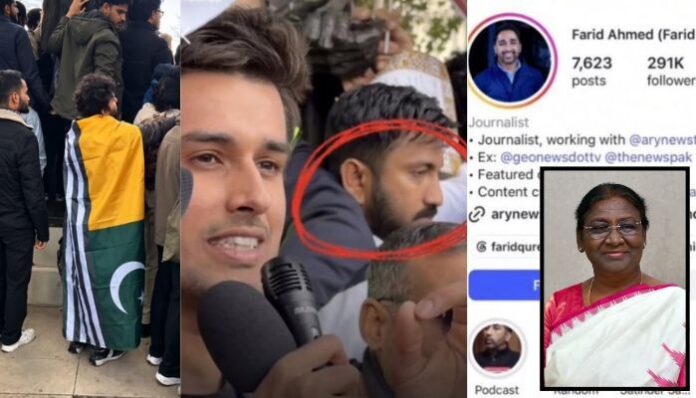
Around 50 UK-based diaspora bodies and community organisations have written an open letter to President Droupadi Murmu, raising concerns over a series of protests and anti-India mobilisations in recent weeks. The organisations have called for an investigation into extremist involvement and unlawful coordination behind the demonstrations held in London last month.
The letter, issued over the weekend, said that the protests, the groups involved and the messages being circulated during them needed to be examined. Among the organisations that signed the letter are the Hindu Community Organisations Group, Indian Diaspora in the UK (IDUK), Friends of India Society International (FISI) UK and Indian National Students Association (INSA) UK.
“The sequence of these demonstrations, the organisations involved, and the messages being advanced warrant serious scrutiny, particularly where political mobilisation overseas risks being used to delegitimise India’s democratic institutions or foster hostility towards the country and its elected leadership,” the letter stated.
A group of 50 UK-based Indian diaspora organisations has written an open letter to President Droupadi Murmu, raising concerns over recent anti-India protests in London. The groups have called for an investigation into alleged extremist involvement and possible coordination with separatist networks. The letter highlights demonstrations held outside the Indian High Commission on October 16 and at Parliament Square on October 17, which was addressed by social media influencer Dhruv Rathee. #IndianDiaspora #DroupadiMurmu #UnitedKingdom #AntiIndiaProtests #LondonProtests #IndiaTodaySocial
— IndiaToday (@IndiaToday) November 11, 2026
Groups raise concerns over extremist links
The signatories also raised concerns over the presence or involvement of Pakistani and Bangladeshi Islamist organisations, along with Khalistani terrorists, in the protests and wider anti-India mobilisation.
They called on the competent authorities to examine any evidence of coordination or support between such groups and political or advocacy organisations. “Any credible evidence of coordination, material support, or collaboration between such networks and political or advocacy organisations should be examined impartially by the competent authorities,” the letter said.
At the same time, the organisations acknowledged that peaceful protests and criticism of the government are legitimate democratic rights. However, they argued that these freedoms should not be used to justify intimidation, incitement, disinformation or the promotion of violence. “While peaceful protest and legitimate criticism are essential features of any democracy, these freedoms must not become a shield for incitement, intimidation, deliberate disinformation, communal polarisation, or the promotion of violence,” the letter stated.
The groups added that disagreeing with an elected government was a fundamental right, but attempting to undermine constitutional institutions through unlawful means was a different matter. They said their appeal was being made in the spirit of “national responsibility”.
Two London protests highlighted in the letter
The letter specifically referred to two demonstrations held in London. The first took place on 16th October outside the Indian High Commission and was organised by the leftist group Students’ Federation of India (SFI) UK. The second demonstration was held at Parliament Square on 17th October and was addressed by anti-India YouTuber Dhruv Rathee.
These demonstrations aimed to amplify the Cockroach Janata Party (CJP) ‘s demands in India, including removing Chief Election Commissioner Gyanesh Kumar and scrapping the Special Intensive Revision (SIR) of electoral rolls.
