

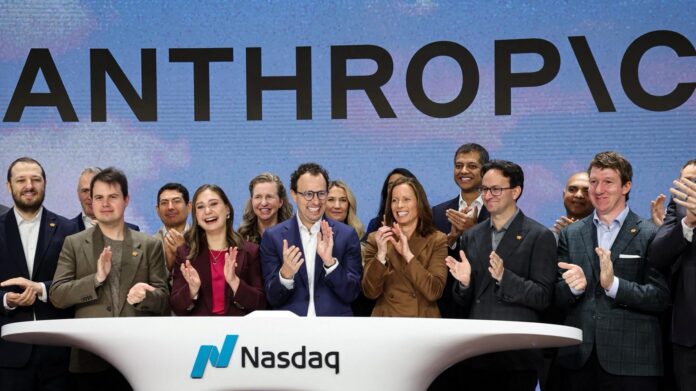
Anthropic had a record-breaking stock market opening on the Nasdaq on Thursday, November 19. The company behind the Claude chatbot began trading after raising $81.3 billion in its initial public offering (IPO).
However, the first day of its debut showed how quickly excitement could pave way for profit-making.
Anthropic priced its shares at $83, above the original range of $70 to $78, as demand prompted it to expand the offering to 980 million shares. The stock opened at $111.50, a jump of nearly 34 per cent, and briefly touched $114.99. It then lost some of those early gains to close at $97.17, still 17 per cent above the IPO price.
At the closing price, Anthropic was worth about $1.3 trillion based on outstanding shares, and roughly $1.75 trillion on a fully diluted basis. The IPO, together with a separate $26 billion private placement, made the overall transaction worth $107.3 billion.
The listing matters beyond the money raised. Anthropic is the first major frontier AI developer to enter public markets. It is the first time that public investors have gotten an opportunity to directly invest in advanced AI models. Its debut also creates a public-market reference point for valuing other companies developing AI models, chips, data centres and software.
Founded in 2021 by former OpenAI researchers, including siblings Dario and Daniela Amodei, Anthropic develops the Claude family of AI models. The company sells access to its technology through usage-based services and subscription plans, while businesses use Claude for coding, software development and workplace applications. That focus has driven rapid revenue growth.
The growth has been striking. Revenue rose from $41 million in 2023 to $386 million in 2024 and $4.59 billion in 2025. In the six months to June 2026, it reached $16.29 billion, compared with $1.16 billion in the same period a year earlier. Yet rapid growth has not removed the central question facing investors: can Anthropic make the business consistently profitable?
Building and running frontier AI systems requires huge spending on specialised chips, computing capacity, data centres and research, making it a costly affair to operate an organisation developing LLM models.
However, showcasing that it is learning from its operations and reducing costs, its operating loss narrowed to $693 million in the first half of 2026 from $2.14 billion a year earlier.
Anthropic disclosed $18.8 billion in compute spending for the first nine months of 2026, while its long-term purchase and lease commitments point to an enormous infrastructure bill ahead. If customer demand does not keep pace, those commitments could become a significant burden.
Anthropic is also competing against deep-pocketed rivals, including OpenAI, Google, Microsoft and Meta. The contest is not simply about producing the best model. Companies must attract paying customers, keep prices competitive and generate enough income to justify the cost of computing power.
The first-day rally is no promise of further gains. The wider US market fell during the session, with the Nasdaq down 2.3 per cent and the S&P 500 down 2 per cent. Anthropic’s debut therefore offered both a sign of strong demand for AI exposure and a reminder that a high-profile IPO can remain volatile.
Indian investors interested in the shares, which trade on Nasdaq under the ticker ANT, need access to an overseas investing platform and must account for applicable remittance, tax, currency and brokerage costs. Investors should focus on valuation, execution and risk rather than chase the first-day surge. Anthropic’s real test is turning demand into durable profits.
