

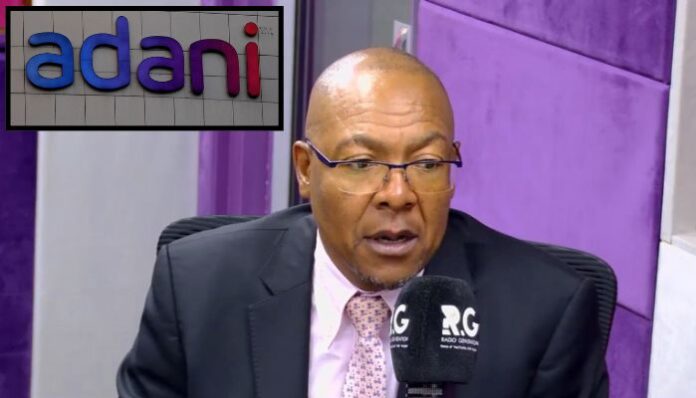
Kenyan Deputy Government Spokesperson Gabriel Muthuma has expressed regret over the cancellation of the Adani Group’s proposed airport modernisation project in Nairobi, saying that the deal was politicised to such an extent that the Indian conglomerate eventually walked away. In a recent interview with Radio Generation Kenya, published on YouTube on Friday, 20th November, Muthuma said that the Adani airport proposal had been politicised so much that the company decided to leave. He argued that the Kenyan public had been made to believe something that was not true.
Gabriel Muthuma: We have politicised things so much that sometimes we don’t know what is factual and what is not. Adani was supposed to build our airport, but we politicised the issue until he left. Today, Adani is undertaking clean energy projects in the USA. #ThePeoplesBreakfast #HomeOfHardTruths @MuthumaGabriel @SpokespersonGoK @ctmuga & @mungalambuvi
— Radio Generation (@RadioGenKe) November 20, 2026
Speaking openly about how political narratives can derail major development projects, Muthuma reflected on the intense public backlash that surrounded the proposed airport modernisation. “If we are to be honest, I think that’s the price of our instrument. We’ve politicised things so much that sometimes we don’t know what is factual and what isn’t. I mean, we don’t know what is or isn’t,” he said during the broadcast.
He pointed directly to the Adani controversy as a prime example of misinformation overpowering facts, noting, “I actually, for the first time, saw how politics can play into the hearts of the citizens. We were lied to. And it went all the way to the Senate.”
Muthuma recalled how government officials tried to explain to Parliament that a national airport could not simply be sold off, yet lawmakers pushed a completely different story to the press. “I saw the C.S. then go to Parliament with files and say, first of all, there’s no way an airport can be sold. It’s a secure installation. There’s no way. It’s a statutory body,” Muthuma explained.
“And after he finishes, a Senator walks out to the media, outside Parliament, and says, ‘No, the airport is being sold.’ Repeats,’ The airport is being sold.” He further said, many of those same Senators have now gone quiet and “cannot show face” because they know what they told the public was false.
How Kenya cancelled the $2 billion Adani airport project
Muthuma’s regrettable remarks come nearly two years after the Kenyan government cancelled the proposed $2 billion public-private partnership (PPP) project with India’s Adani Group for the modernisation and long-term operation of Nairobi’s Jomo Kenyatta International Airport (JKIA).
Between 2022 and 2024, Kenya had engaged with the Adani Group over plans to upgrade the airport. Under the proposed arrangement, Adani was expected to invest in terminal modernisation, runway expansion and other infrastructure improvements, including the construction of a second runway. In return, the company would have operated the airport under a 30-year concession.
The proposal faced strong opposition in 2024 following allegations of irregularities, lack of transparency, inadequate public consultation and concerns over the possible impact on airport employees and travellers. A campaign led by Kenyan whistleblower Nelson Amenya also brought the deal under intense public scrutiny. Airport workers threatened protests over fears of job losses and privatisation.
Kenya scraps Adani deal, awards airport project to Chinese firm at 50% higher cost
The controversy began in 2024 when Kenya considered a proposal worth around $2 billion from the Adani Group to modernise and operate JKIA. Under the proposed public-private partnership (PPP) model, Adani would have invested in expanding the airport, including building a second runway and upgrading passenger terminals. In exchange, the company would have received a 30-year operating concession. The arrangement was expected to bring private investment into a major infrastructure project without placing an immediate financial burden on Kenyan taxpayers.
However, the project unravelled after a fierce social media campaign, led prominently by France-based Kenyan whistleblower Nelson Amenya, who accused the deal of lacking transparency and bypassing public tender laws. Aviation worker unions also threatened strikes over job security, while global scrutiny from a U.S. Department of Justice (DOJ) indictment against Gautam Adani added further political pressure, despite Adani denying any wrongdoing in Kenya.
On 21st November, 2024, Kenyan President William Ruto announced that he had directed the Ministries of Transport and Energy to cancel the ongoing procurement processes involving the Adani Group. He cited information received from investigative agencies and partner countries.
Following the fallout, Kenya turned to state-owned China Communications Construction Co. (CCCC) to carry out the JKIA revamp in June 2026. Unlike Adani’s private investment model, the new $2.9 billion engineering, procurement, and construction (EPC) contract is state-funded through commercial loans and national infrastructure funds. This shift means Kenya is paying roughly 50% more, an extra $900 million, placing the financial burden directly on local taxpayers and sparking fresh debates over rising public debt.
Regret over lost opportunity as Adani expands in the U.S.
Adding to Nairobi’s frustration is the fact that the legal storm surrounding Adani in the United States eventually cleared. In May 2026, the U.S. Department of Justice permanently dropped its criminal fraud charges against Gautam Adani and his associates due to insufficient evidence, while the conglomerate moved forward with major energy and infrastructure investments in America.
For Kenyan officials, watching Adani operate smoothly in the U.S. while Kenya pays a massive premium to build its own airport feels like a self-inflicted wound. As Muthuma summed up the irony during his interview, he said, “Now, we politicised it so much that, obviously, Adani left. But all the money is corrupt. Today, Adani is doing energy projects in the U.S. Clean as a whistle. We bought into a lie.”
