

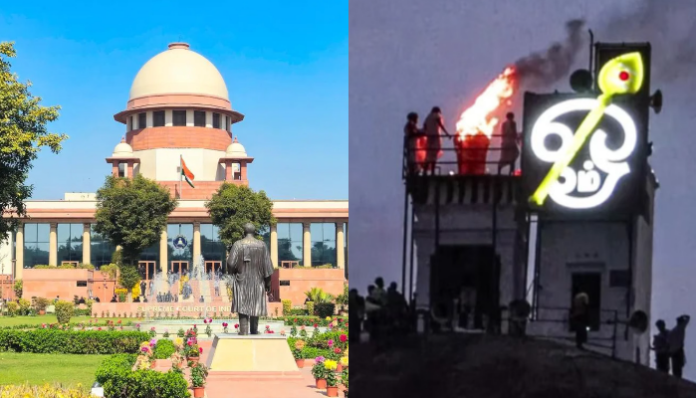
On 27th November (Friday), the Supreme Court mandated that the flame from Uchaipillaiyar Mandapam be used to light the lamp at Thiruparankundram Deepathoon. It stated that alternative means can be used if it is not burning. The order is scheduled to take effect on Saturday. The court emphasised that its directives “command obedience” and suspended the Arulmigu Subramaniaswamy temple’s board of trustees.
The Madurai District Collector and other Tamil Nadu officials have been accused of intentionally disobeying the Supreme Court’s 20th November decision allowing the lighting of the ceremonial lamp at the Deepathoon. The developments occurred during the hearing of the contempt plea.
According to the court, every devotee will be allowed to light the lamp, a religious ritual which traditionally unfolds during the Tamil month of Karthigai, at least 50 meters away from the alleged Sikandar Dargah on the hilltop on both sides. It has also asked the Central Reserve Police Force (CRPF) to guard the temple and the shrine.
Furthermore, a committee made up of retired Madras High Court Judges Justice S Vaidyanathan and Justice V Parthiban was also constituted by the court as receivers to oversee the temple’s management and guarantee that the instructions were carried out.
A bench of Justices Aravind Kumar and Vipul M Pancholi stated that the “trustees have categorically taken a stand that they would not implement the orders of this court. This is a serious infraction on their part, which is also aided by other officials.”
It further conveyed, “The resolution on its face, firstly, discloses wilful and flagrant disobedience of the interim order of this court. Secondly, it evinces a deliberate attempt to undermine the authority of this court and the undertaking to the High Court. Thirdly, what shocks this court is the Board’s statements that ‘traditions must be brought to the notice of this court.’ This court had heard the parties in detail. The statement contains an unwarranted insinuation that this court failed to comprehend the traditions of the temple. It is apt and appropriate to note that the Board has never appeared before this court or contested the matter by impugning the High Court’s order.”
The bench voiced “pain and anguish,” noting the outright violation of its ruling. It declared, “The wilful non-compliance of orders of the court, especially by the executive authorities, cannot go unnoticed and it has to be dealt with an iron hand,” adding that “otherwise it will lead to constitutional chaos.”
The court further expressed, “There is prima facie administrative chaos in the State of Tamil Nadu, at least in Madurai District.” It was likewise concerned by the seeming conformity to political leadership’s directives, remarking, “The chain of events that has unfolded in the instant case would indicate that the executive authorities seem to have acted at the dictates of their political bosses.”
The Tamil Nadu Chief Secretary has been instructed by the bench to provide a thorough affidavit that includes all correspondence between authorities about the matter and its previous judgement, including emails, phone conversations, and texts. Additionally, the bench told the Chief Secretary of Tamil Nadu to personally appear before it on the following hearing date.
The Tamil Nadu Chief Secretary, Director General of Police, Hindu Religious & Charitable Endowments Secretary and Commissioner, Madurai District Collector, Commissioner of Police, Superintendent of Police, temple administrators, and others have been served with contempt of court notices.
The court hit out that Tamil Nadu’s executive authorities cannot claim the authority to determine whether or not court orders should be followed and pronounced that personnel tasked with fulfilling the same had committed a clear breach of their constitutional obligations by intentionally disobeying them. The bench pointed out, “It obstructs the administration of justice and strikes at the very root of the rule of law.”
The court also highlighted, “An order of this court is not an invitation to negotiate. It binds the State, its officers and every statutory or religious institution functioning under the State’s law until this court itself modifies it. Any attempt to pollute the stream of justice by any person, howsoever high he may be, would not be tolerated. This is the message which we intend to convey in this order.”
The court has lifted its earlier stay on the Madras High Court’s conclusions about the Deepathoon due to noncompliance with the prior order but mentioned that the protections provided in relation to the Dargah would continue to remain in effect. The District Collector’s preliminary status report was referred to as “shedding crocodile tears” and dismissed by the bench.
