

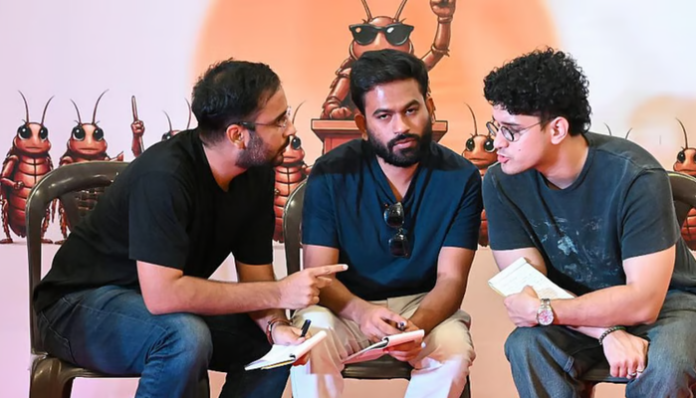
The Mumbai Police have issued lookout circulars against Cockroach Janta Party (CJP) leaders Abhijeet Dipke, Ashutosh Ranka, and Saurav Das over an unauthorised protest held in Mumbai last month. The circulars were issued regarding CJP’s “Chalo Mumbai” protest, held at Shivaji Park in Dadar on October 2, 2026, under the guise of demanding the resignation of Chief Election Commissioner Gyanesh Kumar over alleged irregularities in the Special Intensive Revision (SIR).
The circulars were issued to prevent the CJP leaders from leaving the country in light of a case registered against them for organising the Mumbai protest without permission. The CJP’s unauthorised protest was attended by over 4,000 people, including actors Naseeruddin Shah and Shabana Azmi. The police named the three CJP leaders and over 400 supporters in its FIR registered on October 3, 2026, for unlawful assembly and violating police orders.
As a result of the lookout circular, on November 23, 2026, Saurav Das was stopped at Delhi airport as he was about to board a flight to the UK. Subsequently, Das approached the Delhi High Court against the circular, but his plea was rejected by the court, which sought details of the circular.
The central government informed the court that LOC against Das was issued on the request of the Mumbai Police. It added that Chennai Regional Passport Office had issued a notice to Das over discrepancies regarding his birthplace on his passport. Additional Solicitor General Chetan Sharma, appearing for the Centre, submitted before the bench that discrepancies emerged in Das’s educational background, residential address, and parentage had surfaced during record checks. He said that these inconsistencies could have implications regarding his citizenship status.
Das’s counsel, Senior Advocate Akhil Sibal, claimed before the court that his client had no information about the lookout circular issued against him.
CJP spearheaded a potential regime change operation
The CJP had been at the forefront of a possible regime change operation, as confessed by Prashant Bhushan and Neha Bora, who later took a U-turn after backlash, against the Modi government, backed by the opposition parties.
Earlier in June, the CJP organised a protest at the Jantar Mantar in the name of opposing the NEET exam paper leak. The protest concluded after the resignation of the then Education Minister Dharmendra Pradhan.
But the party then went on to organise another unauthorised agitation demanding the resignation of the CEC for some alleged irregularities in the SIR undertaken by the Election Commission. The party’s agitation was supported by the Opposition parties, which had been opposing the SIR exercise, which was upheld by the Supreme Court.
The CJP’s recent protest gimmicks started with the call for protest in Mumbai on October 2, 2026, followed by another call for protest in Delhi on October 10, 2026, for which permission was not granted by the Delhi Police.
Nonetheless, the CJP leaders went ahead with the protest and were detained by the Delhi Police at the Indira Gandhi International Airport on October 10, 2026. They were released a day later after signing a peace bond before an executive magistrate, undertaking not to engage in activities disturbing peace.
However, CJP violated the peace bond by committing trespass at Jantar Mantar on October 13, 2026, which had been denotified as a designated protest site by the authorities. The two CJP leaders were detained and sent to five days’ judicial custody by the court.
Subsequently, the CJP called for a “Lehra Do Tiranga” rally at Connaught Place in Delhi, which led to the detention of Abhijeet Dipke on October 16, 2026. Dipke was released on conditional bail a day later after signing a peace bond for a second time. Ranka and Das were also released after giving fresh undertakings and ₹50,000 bonds
