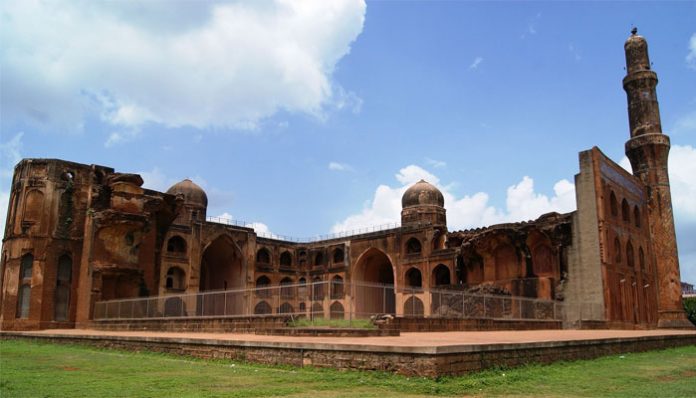
On October 6, a video of Hindus offering prayers at the Mahmood Gewan Madarsa, Bidar, Karnataka, went viral on social media. The police booked nine Hindus merely for entering the mosque and offering prayers. The mosque in question is located inside Mahmood Gewan Madarsa. A Twitter user Bharadwajagain laid down an informative thread to show that the Madarsa was previously a Hindu temple. Interestingly, Hindus never stopped offering prayers at the Madarsa to keep the spirit of the temple alive.
Bharadwaj quoted another Twitter user, a Hindustan Times journalist Arun Dev, who had tweeted, “A group of men shouting “Jai Sri Ram” entered a 550 + year of Madarasa in Bidar, threw kumkum and performed puja. Surprisingly (or not), most news channels are not reporting on this.” As a counter, Bharadwaj wrote, “This Madrasa was once a Hindu temple. A Persian Tyrant, Mahmud Gawan, became Bahmani Prime minister. He urged the king to kill Brahmins as an act of piety. He built this Madrasa after destroying the temple. The local Hindus never stopped their tradition of performing puja every year.”
This Madrasa was once a Hindu temple.
— Mr.B (@BharadwajAgain) October 9, 2022
A Persian Tyrant, Mahmud Gawan became Bahmani Prime minister. He urged the king to kiII Brahmins as an act of piety.He built this Madrasa after destroying temple.
The local Hindus never stopped their tradition of performing Puja every year. https://t.co/ZHRdkgXYqE
The building was constructed in the Indo-Islamic architectural style of Deccan. In 2014, UNESCO added it to the tentative list of world heritage sites. However, Bharadwaj added that the site had a blood-stained history.
Bahmanis were self-proclaimed Persians. Notably, contrary to their claims, there was a possibility that all of them were Hindu converts and their founder Hasan Gangu had a Hindu background. It is important to note that initially, Bahmanis restrained themselves from killing Brahmins. However, it all changed with the arrival of Mahmood Gawan in the scene.
Despite their self-proclaimed claims of Persian origins,the Bahmanis were local Hindu converts.Their founder Hasan Gangu had possible Hindu background.
— Mr.B (@BharadwajAgain) October 9, 2022
Hence,they carried forth many beliefs of their former religion.
The Bahmanis would not kiII (civilian non-combatant) Brahmins.
Gawan was a foreigner, and he had no such belief system. He was not against the idea of killing Brahmins or destroying temples. Rather, he urged the Bahmani king to destroy the temples and kill the Brahmins. According to him, it was a pious act. After the Bahmani king killed Brahmins under Gawan’s influence, he bestowed upon the king the title of Ghazi.
Mahmood Gewan Madarsa in Bidar in Karnataka was originally a Hindu temple which was destroyed by Mahmood Shah
Ferishta says by following the advice of Gawan, Mahmud Shah became the first king of among Bahmanis to slay a Brahmin.
— Mr.B (@BharadwajAgain) October 9, 2022
However, many Deccanis feared this act was very inauspicious. They believed that it would bring about the decline of Bahmani empire.
Soon enough, it happened. pic.twitter.com/mSWTrTSNQU
Furthermore, as per the records, he then gave the orders to erect a mosque on the foundation of the temple. Following his actions, Mahmood Gawan states that as Mahmood Shah had killed the infidels (Brahmins) with his own hands, he “might fairly assume the title of Ghazi” that was something to be “proud” of for them.
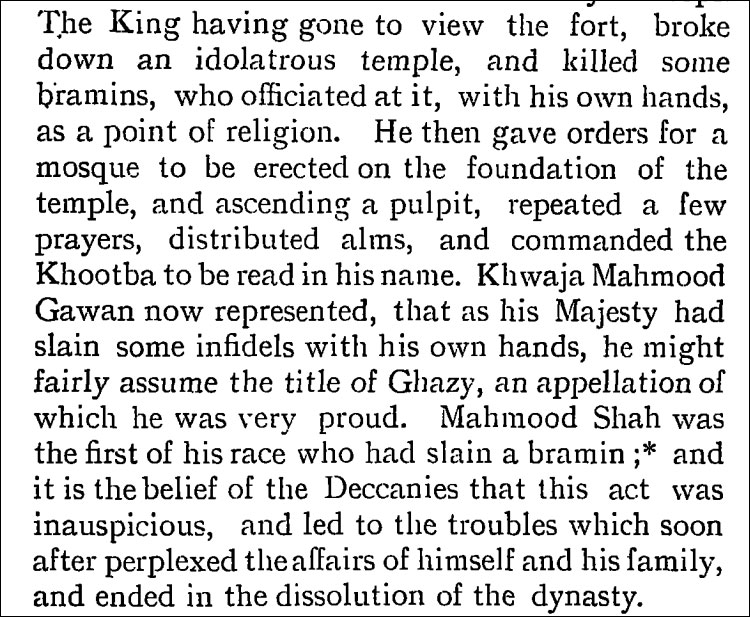
It was on record in Tarikh-I-Ferishta that Mahmood Shah was the first of his race to kill Brahmins. Before him, it was believed by the Deccanies that killing Brahmins was inauspicious, something that Hindu kings have always believed, as per the Sacred texts. It further noted that this act of killing Brahmins “led to the troubles which soon after perplexed the affairs of himself and his family, and ended in the dissolution of the dynasty.”
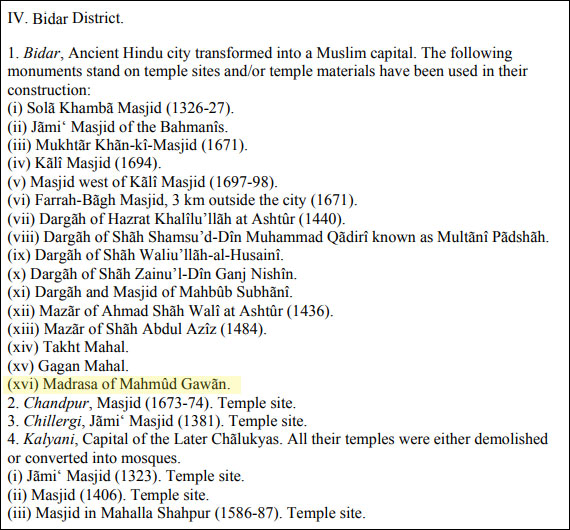
Notably, the monument found its place in Sitaram Goel’s book “Hindu Temples: What Happened To Them”. In Volume I of the book under Bidar district, the Madarsa has been named as a monument built on the remains of a Hindu temple site.
Hindus continued to offer prayers for centuries
Though the temple was destroyed and a Madarsa was built in its place, the Hindus in the region never stopped praying at the temple. It is pertinent to note that the police have gone on the record to say that Hindus offering puja at the Mahmood Gewan Madarsa and Mosque on Vijaydashmi is an event that takes place every year. They have also clarified that contrary to what Muslim leaders like Asaduddin Owaisi are claiming, nobody attempted to break the lock of the mosque to enter it illegally.