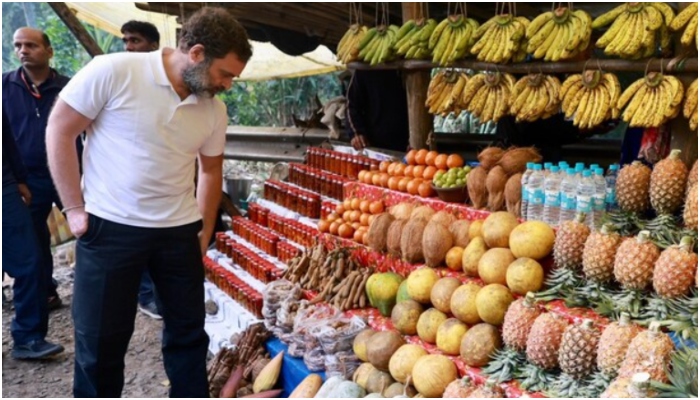
Congress leader Rahul Gandhi, who is visiting Meghalaya as part of his Bharat Jodo Nyay Yatra, has become a lover of the state’s pineapples, claiming they are the best he has ever tasted. While praising the pineapples in Meghalaya, he lied and indicated that the infrastructural development had not reached the state to make it economically and socially stable. Gandhi also questioned why the fruits from the state were not being exported to other countries.
“Today, while driving here, we stopped and tasted some pineapples. A daughter and a mother were selling pineapples on the side of the road. In my entire life, I have never had such delicious pineapples. Immediately after I had it, I called up my mother and said I am bringing some of the best pineapples in the world for you,” the Congress leader said.
Rahul Gandhi went on to ask, “Why isn’t the best-tasting pineapple in the world available to the entire world, and why are the farmers in the states not benefiting from selling it to the rest of the world?” He indicated that the world can’t have these pineapples because infrastructure has not been developed.
In my entire life, I have never tasted a pineapple more delicious than what I tasted here in Meghalaya.
I have a few questions:
1. Why isn't the best-tasting pineapple available to the entire world? 2. Why is the best-tasting pineapple in the world not being sold in London,… pic.twitter.com/qlPIXh18Mf
The Congress leader stated that we must create a new vision for India that offers farmers and small businesses with facilities to export their products around the world. Rahul Gandhi eventually attempted to spread false information against the current ruling government ahead of the 2024 General Elections. He indicated that the citizens of the state were not benefiting due to a lack of infrastructural development.
However, Gandhi ignored the fact that India has been exporting pineapples from Meghalaya to various places in the Gulf. The state government in August 2023 stated that the pineapples from the state have been gaining more and more popularity within and outside the country. Malls across Dubai, Abu Dhabi, Sharjah, and Kuwait have been selling these pineapples.
Meghalaya offers a vast range of agroclimatic conditions, resulting in a wide range of agricultural and horticultural goods. These crops, which are farmed in traditional ways by local populations, are typically naturally organic. These elements contribute to the state’s produce gradually becoming known for its particular quality and taste. Produce such as Lakadong turmeric, GI-tagged Khasi mandarin, and Kew pineapples are more popular in Meghalaya.
Meghalayan pineapples have significantly lower pesticide and heavy metal residues than mainland Indian pineapples. In addition, they taste less acidic and much sweeter. Pineapples have a Brix value of 16-18, indicating their sweetness. Pineapples are Meghalaya’s One District One Product for the Ri Bhoi and East Garo Hills districts.
The spectacular display celebrating the Azadi Ka Amrit Mahotsav at Abu Dhabi’s Al-Wahda Mall featured the tastiest pineapples from Meghalaya as the centerpiece. The prominent Lulu Group is marketing these pineapples in several Gulf markets.
As per the reports, these pineapples’ trip from the verdant slopes of the Garo Hills to the sandy coastline of the UAE has been both arduous and fruitful. Jamge Integrated Village Cooperative Society (IVCS) from Songsak C&RD Block in Meghalaya’s East Garo Hills district has successfully exported pineapples in collaboration with the Department of Agriculture & Farmers’ Welfare and the Meghalaya Basin Management Agency (MBMA).
The government recognises the importance that processing perishable horticulture produce (such as pineapples) can play in increasing shelf life and accessing new markets. Efforts are also being made to increase processing capacity and infrastructure in the state through local farmer collectives.
The government is also training farmer collectives on how to aggregate, grade, sort, and package pineapples for regular export. Over 5.2 MT of pineapples from these farmer collectives have been distributed to Reliance outlets in Assam in three weeks. Ringgi Demdema Organic Farmer Producer Company from West Garo Hills has also engaged in similar marketing activities for a 12 MT cargo to Varanasi via ‘DeHaat Seeds to Market’.
Meghalaya contributes over 8% of India’s pineapple production, making it a key player in India’s agriculture map. Beyond its focus on pineapple, the Government of Meghalaya has launched several programs to enhance farmer lives and double their revenue. So far, mission mode interventions have been used for a variety of products such as Lakadong turmeric, honey, aroma, ginger, spice, pepper, Khasi Mandarin, piggery, and more. In addition, to improve value chain support, the government has established approximately 200 CMC as one-stop shops for assisting farmers, and primary farmgate infrastructure is being built to serve as nodes for produce aggregation, processing, and marketing in the project’s villages and clusters.
Earlier on January 22, Monday, PM Narendra Modi completed the Pran Pratishtha of Ram Lalla in Ayodhya’s Bhavya Ram Mandir. Several saints, seers and dignitaries from all walks of life reached Ayodhya to celebrate Shri Ram Lalla’s homecoming. Now that the Pran Pratishtha ceremony is completed, all these guests will visit various places in Ayodhya under tight security. One such must-visit place in Ayodhya is the Mani Parvat.
At a distance of 3 km from Ayodhya Junction, Mani Parvat is a tiny hillock situated in Kami Ganj in Ayodhya. It is one of the popular religious places to visit in the holy town. According to Ramayana, to heal Lakshman, who had been injured in a battle by Ravana’s son Meghnath, Lord Hanuman is said to have uprooted a whole mountain that had the revitalizing sanjeevani booti. It’s thought that a portion of the mountain fell in Ayodhya. This mound or the hillock came to be known as Mani Parvat. Mani Parvat lies close to another hill called Sugriv Parvat.
Besides this, there exist numerous legends from the region that describe the origins of the Mani Parvat. Some believe that King Janak, the father of Goddess Sita had gifted a lot of gold and jewels to Sita when she got married to Lord Ram. Raja Dashrath, however, was not greedy for the wealth Sita got with her and ordered that it be stored in the southern direction of the Ram Koth. The quantity of the jewels was so much that they transformed into a hill and this hill came to be known as Mani Parvat.
Another story is that Mata Sita once urged Prabhu Shri Ram to provide her with a place where she could hang around with her sakhis (friends). Shri Ram, in turn, asked Garud to get a portion of a hill from the Vaikunth parvat. As ordered by his master, Garud brought a small hillock from the Vaikunth Parvat and placed it in Ayodhya. This hill was then used to store all the jewels King Janak gifted Sita and started being referred to as Mani (Jewels) Parbat (Hill). Over time, several attempts have been made to deface this sacred site.
According to legend, Lord Buddha gave his sermons about the Law of Dharma from Mani Parvat during his six-year sojourn in Ayodhya. The hillock also houses a stupa built by Emperor Ashoka and a Buddhist monastery.
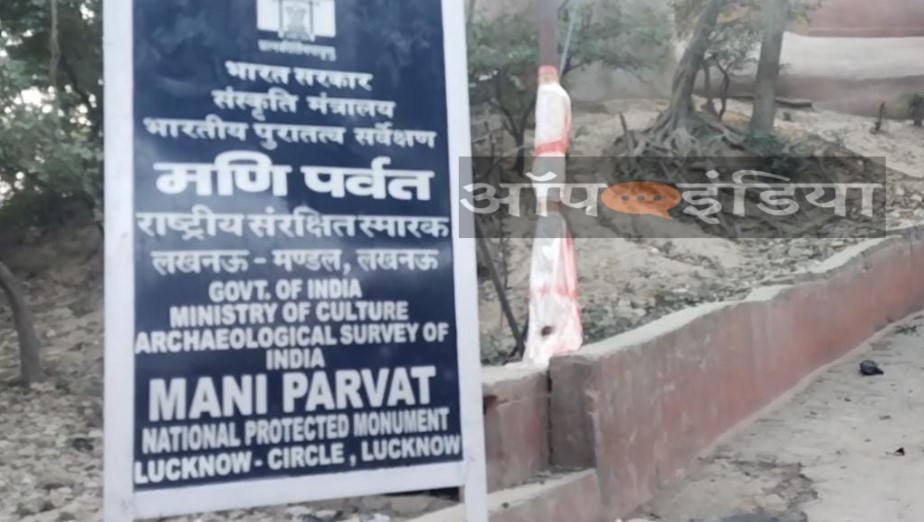
The OpIndia team visited this spectacular place in the holy town. Mani Parvat is protected by the Archaeological Survey of India (ASI) and is built at 65 feet above sea level. The priest at the Mani Parvat Temple here, while speaking to OpIndia, said that this was the same spot where Lord Ram and Goddess Sita enjoyed swinging together. Until today, every year, during the month of Shravan, the ‘Jhulan Utsav’ of Ram Sita which is celebrated all across Ayodhya, begins from Mani Parvat.
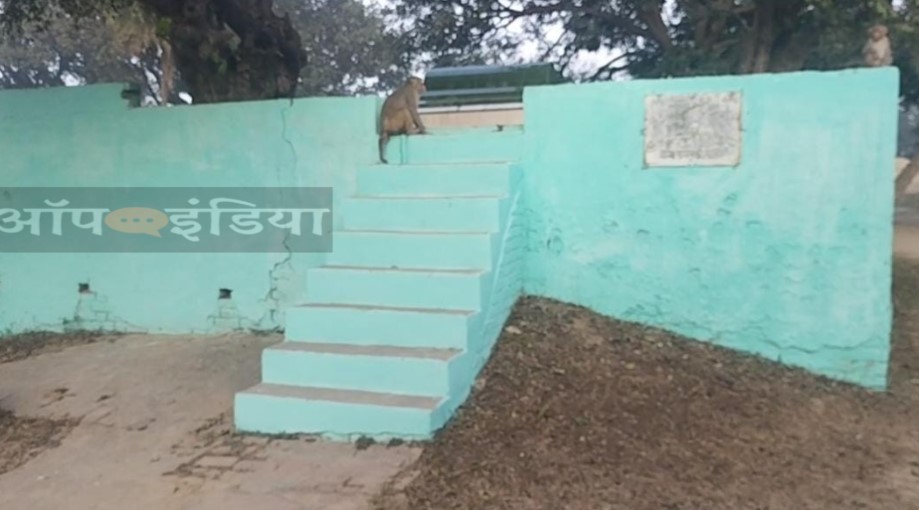
When the OpIndia crew visited this holy location, we were horrified to discover dargahs constructed on three of its sides. By looking at the construction and the paint on the walls, one could easily make out that these structures had come up recently. Besides, we saw that the construction of a new dargah was also underway. We also saw many concrete graves made over some ancient structures in the vicinity.
Image source: Hindi OpIndia
Folk songs on holy Mani Parvat are still sung by women in Ayodhya and the nearby villages. One of these folk tunes has the words “Jhalua pada mani parvat pay… Jhulay jabay na hum sakhi”, which can be roughly translated as “I’ll go to Maniparvat and swing with my friends because there’s a swing there.” These folk songs were played on tape recorders in every home back in the old days. You may still listen to these old folk tunes on YouTube. Devotees from around the nation gather for a fair on Maniparvat every Sawan, even today.
Hazrat Sheesh Alhai Salam’s mazar situated on the southern fringe of Mani Parvat Temple.
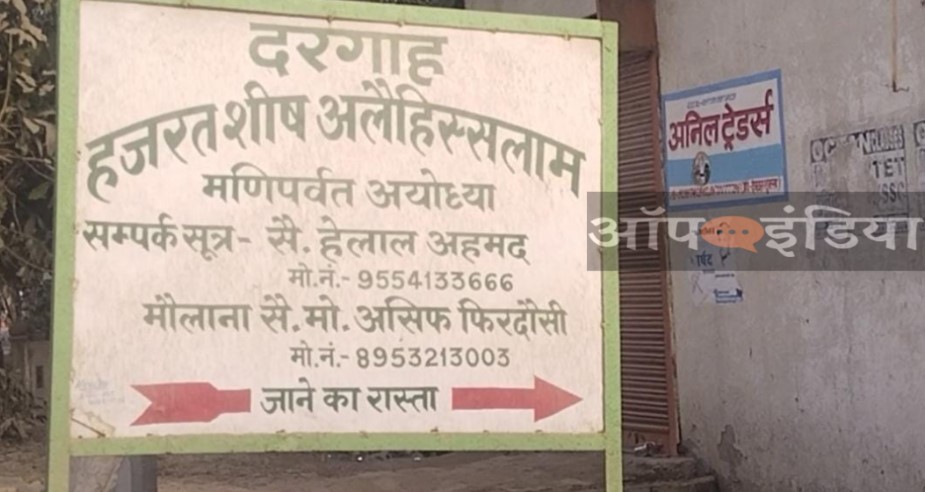
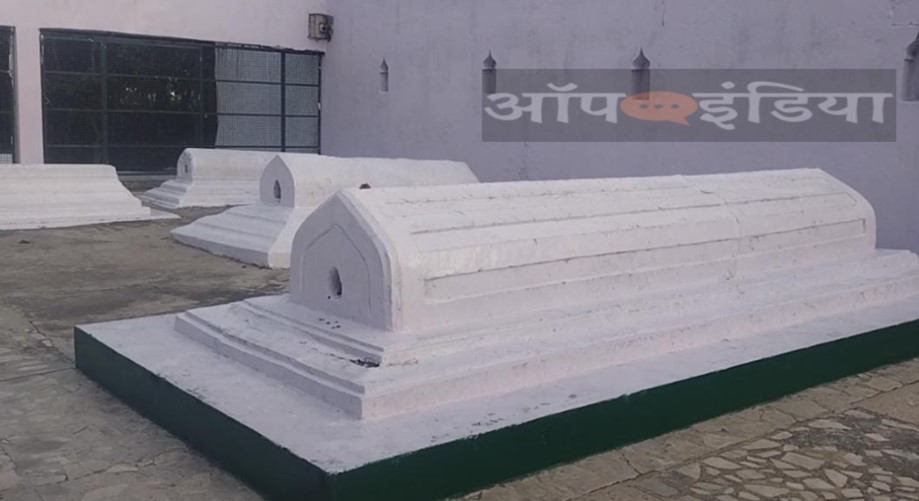
The Hazrat Sheesh Alaihis Salam Dargah is located on the southern side of the temple in Mani Parvat. This dargah is less than a hundred meters away from this sacred site. Saying that this place is almost adjacent to the Mani Parvat temple boundary wall would not be incorrect.
Moreover, a signboard bearing the name and directions to the dargah has been installed on the main road. The names and mobile numbers of Maulana Mohammad Asif Firdausi and Halal Ahmed are also mentioned on the board.
We saw a Maruti Ertiga car parked outside the dargah with a Gujarat registration number. All sides of this white dargah were surrounded by concrete walls. Notably, extensive clearance work was taking place in the Dargah’s environs leading to the Dargah’s expansion.
Image source: Hindi OpIndia
More than half a dozen tombs are made along the boundary
There were roughly five Muslim individuals inside the Dargah when the OpIndia team went in. This dargah is composed of at least five distinct sections, each housing more than six tombs. Some of these tombs were about the size of an average human being, while the length of one particular tomb was about 10 feet.
These tombs had names of Hazrat Baba Jalil Naqshbandi, Naziruddin Qadri Baghdadi Mazar, Iran’s Princess Hazrat Biwi Syeda Zahida, Hazrat Sheesh Mazar, Hazrat Sheesh Ki Begum and her children etc. inscribed on them. When we visited the tomb, we learned that Princess Syeda Zahida of Iran had visited this place and settled here after that.
Image source: Hindi OpIndia
Hazrat Sheesh’s dargah has existed since the world came into existence: Local Khadim makes bizarre assertions
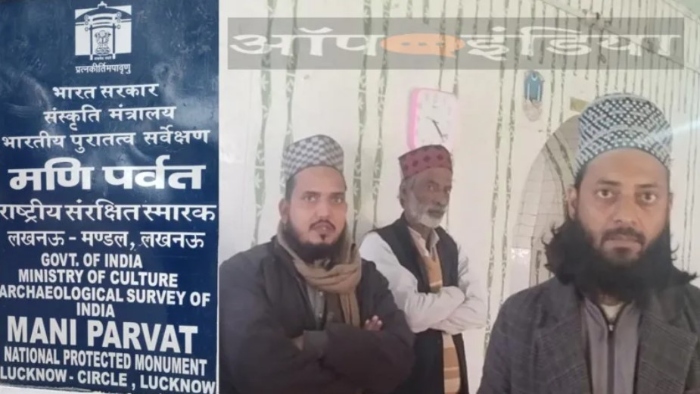
This place’s Khadim claimed that the Dargah has existed since the creation of the universe. According to him, Hazrat Sheesh is the third son of his prophet Hazrat Adam and the first human being in mankind. He made another bizarre claim that Hazrat Sheesh was seventy yards (210 feet) tall which is almost the height of Mani Parvat.
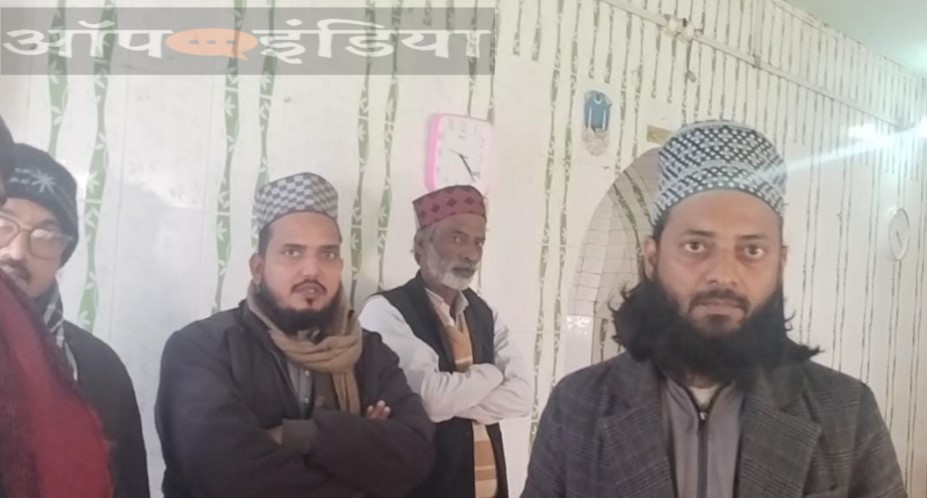
The Khadim further said that Hazrat Sheesh’s grave ought to be as old as the Mani Parvat. Khadim added that visitors to the Dargah came from all around the country and outside as well. Khadim asserted that these individuals also included local leaders. Every year, Urs is also held here. Funds are provided to the staff of this dargah to support its upkeep.
Khadim and his aides (Image source: Hindi OpIndia)
Kotwal Baba’s dargah on the eastern side of Mani Parvat Mandir
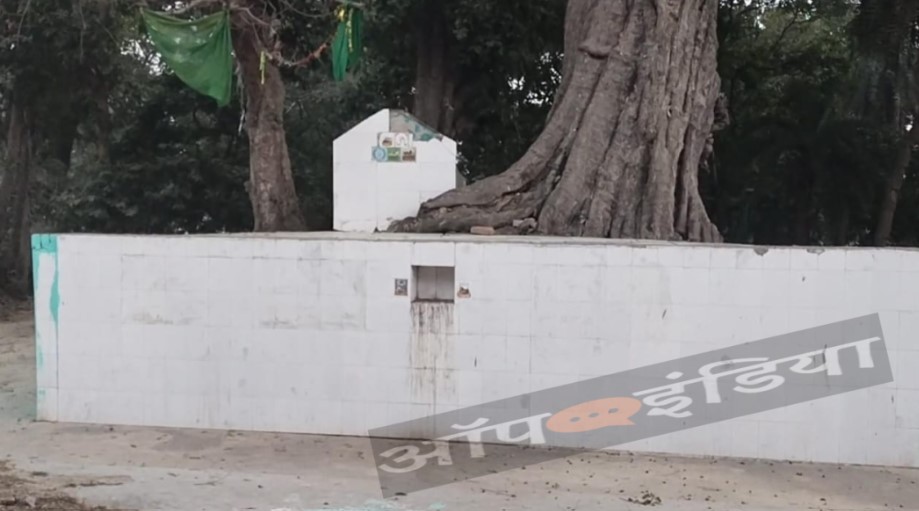
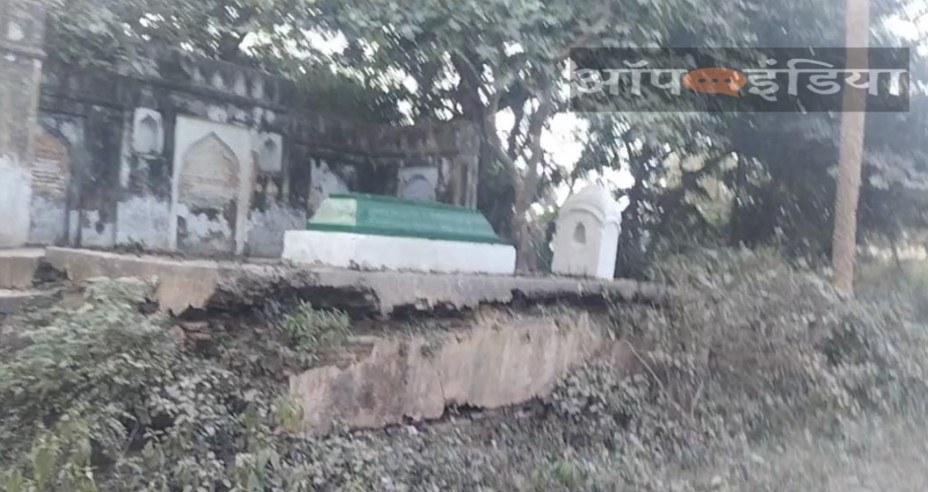
Another dargah was discovered in Maniparvat’s eastern region when OpIndia was exploring the area. This Dargah was constructed by enveloping a tree. They had built a high platform and placed a concrete tomb on it. Named, the Dargah of Kotwal Baba, the structure had been painted green and a new chadar was placed on it. A tap had also been installed in the tomb.
Kotwal Baba Dargah (Image source: Hindi OpIndia)
Another tomb named Syed Shah Baba was also constructed next to Dargah of Kotwal Baba. A Muslim woman looks after these dargahs. The woman said that both the dargahs were built by her husband while he was alive. At present the woman is getting a pension from the government.
Syed Shah Baba mazar (Image source: Hindi OpIndia)
While talking to locals we learnt that Kotwal Baba was a former police officer who had been posted at the Ayodhya police station. The house of the woman who takes care of these two dargahs was about 3 kilometres away from here. Moreover, we learnt that every year, Urs is celebrated at the Kotwal Baba dargah in which a lot of donations are collected. It is claimed that people from as far as Nepal visit this Dargah.
It is said, that the caretakers of the dargah are gradually removing all the trees from the forest that borders this dargah.
On the northern fringe of Mani Parvat lies the Shamshuddin Shah Baba mazar
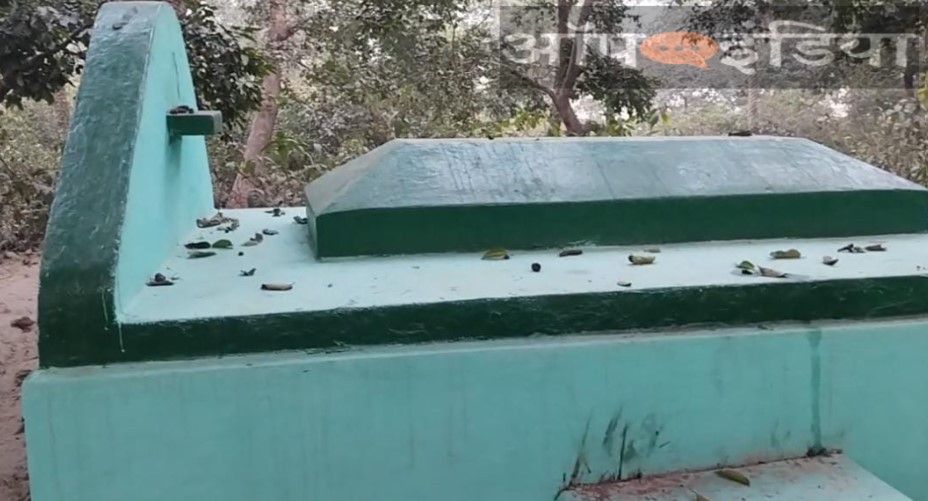
On the northern side of Mani Parvat, there is another dargah called Hazrat Ali Syed Shamshuddin Shah Baba. This dargah is also constructed surrounding a tree. This Dargah is situated at the foot of the stairs that descend from Mani Parvat. It is constructed on a high cemented platform and is also painted green. There are stairs leading up to the high cement platform.
There’s a green sheet covering the tomb made on an elevated structure. In the open space next to Dargah Hazrat Ali Syed Shamshuddin Shah Baba, another dargah has been constructed. Though the name board of this particular shrine is not visible it appeared well maintained. We could not, however, spot any caretakers at either of these places.
Hazrat Ali Syed Shamshuddin Shah Baba mazar (Image source: Hindi OpIndia)
Mass graves found in this region
Between Sheesh, Shamshuddin, and Kotwal Baba, the three dargahs mentioned above, hundreds of graves made of concrete are visible. By the look of it, one can make out that these have been recently constructed. Below these newly constructed tombs, one can also see some old constructions. Additionally, there are some Arabic inscriptions on these tombs. These tombs appeared to be freshly painted in green.
The caretaker of Hazrat Sheesh Dargah claimed that the entire area is a functioning graveyard where local Muslims are still buried. In a nutshell, Mani Parvat’s western and southern regions are home to mass graves.
Tombs built on old constructions (Image source: Hindi OpIndia)
New dargah coming up in Ganesh Kund
While the present administration is working around the clock to modernise Ayodhya, preparation to build new dargahs inside the pilgrimage destination is also happening in full swing. When the OpIndia team was exploring the area near the Kotwal Baba Dargah we noticed another area called the Ganesh Kund. Ganesh Kund has recently been beautified by the Uttar Pradesh Government Tourism Department.
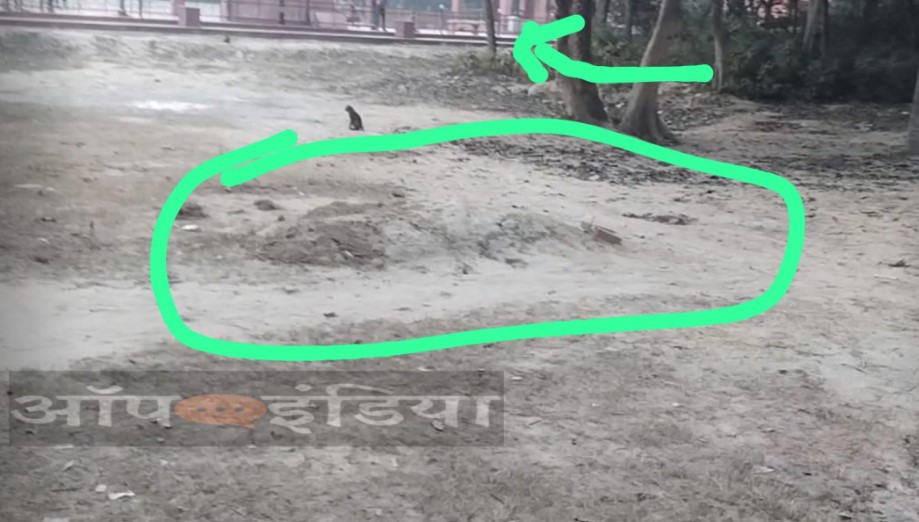
In one location, close to Ganesh Kund, we noticed that some soil was dug out. This pile of soil was in the shape of a grave. The woman caretaker of the Kotwal Shah Dargah came over to us when we were inspecting this location and advised us not to touch the soil.
The arrow pointing at Ganesh Kund, the area encircled is where the earth had been excavated was coming up (Image Source: Hindi OpIndia)
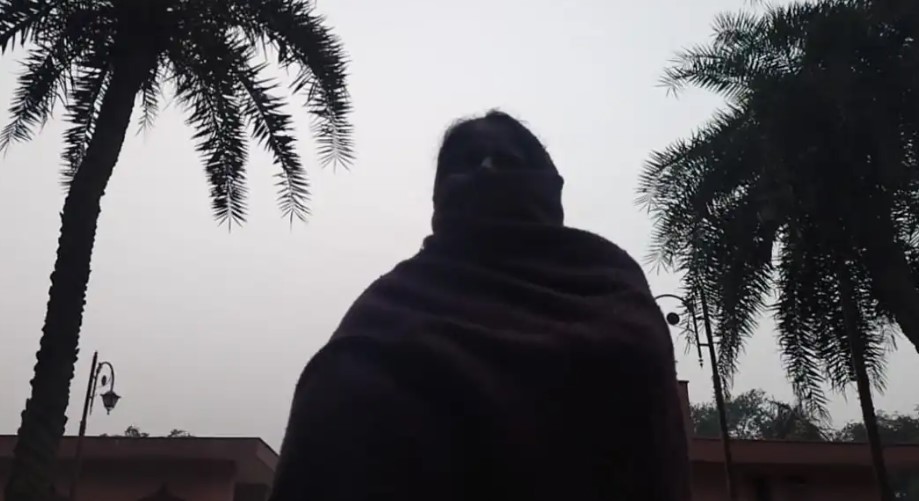
The woman said that she wants to build a new dargah at that place, for which money is being raised. The Dargah has already been named Rahmatullah. The woman also claimed that the dream of building Rahmatullah Dargah was that of her late husband, which she wanted to fulfil.
Dargah caretaker (Image Source: Hindi OpIndia)
PAC wing of the UP Police has a large camp next to these tombs
The OpIndia team explored Maniparvat and its environs. The woman looking after Kotwal Shah claimed that there were many more tombs hidden in the shrubs. Adjacent to these shrines are other revered and mythological sites such as Ganesha and Vidyakund, which have a direct connection to Lord Rama. All of them are located in Ayodhya’s primary pilgrimage area or religious city area.
The PAC wing of the Uttar Pradesh Police has a large camp next to these tombs. This camp serves as the soldiers’ housing, parking lot, and storage facility for weapons. Mani Parvat, which is surrounded by mazar on three sides, is not only sacred to Hindus but also highly sensitive to security issues.
Dargah Hazrat Sheesh near Mani Parvat and the Dargah close to Dasharatha Samadhi maintained by the same Muslim family
In its ground report dated January 2, 2024, OpIndia disclosed the existence of a dargah 14 kilometres from Ayodhya City, close to the Raja Dashrath Samadhi site. Subsequently, OpIndia reported that Dargah’s name, Belhari Sharif, originated from its association with the mythological region of Bilwarhari Sharif.
An investigation into the vast Dargah Hazrat Sheesh near Mani Parvat has yielded new information. The family of this Dargah’s Khadim also maintains the Dargah close to Dasharatha Samadhi. Put simply, the same Muslim family is in charge of the dargahs constructed at two different religious places in the holy town of Ayodhya.
On 21st January, tech billionaire Elon Musk criticised the current structure of the United Nations bodies and called for the need for reform. His remarks reignited the debate on the representations in the United Nations Security Council (UNSC) as he specifically highlighted the absence of India, the world’s most populous country, from the permanent membership of the UNSC. Calling this omission “absurd”, Musk also advocated for the inclusion of representation from African countries.
He wrote, “At some point, there needs to be a revision of the UN bodies. The problem is that those with excess power don’t want to give it up. India not having a permanent seat on the Security Council, despite being the most populous country on Earth, is absurd. Africa collectively should also have a permanent seat in.”
At some point, there needs to be a revision of the UN bodies.
Problem is that those with excess power don’t want to give it up.
India not having a permanent seat on the Security Council, despite being the most populous country on Earth, is absurd.
Musk’s supporting India’s inclusion in the UNSC resonates with the country’s long-standing campaign for a permanent seat in the UN body. Notably, President Joe Biden has repeatedly called for giving India a permanent seat in the UNSC. In September 2023, when President Biden was in India for a G20 meeting, he supported India’s permanent representation in the UNSC. In 2021 as well, President Biden reiterated US support for India’s permanent seat at the UNSC. Apart from the US, the UK has also reiterated its support for India’s permanent representation at the UN body.
The Tesla and Space X CEO also advocated for Africa’s representation at the highest level and suggested that the continent should have a permanent seat collectively in the Council. His statement resonated with the wider criticism that the current composition of the UNSC does not reflect the geopolitical realities of the 21st century. Notably, in January 2023, during his visit to India, United Nations General Assembly (UNGA) President Csaba Korosi said that the UN Security Council needs to be reformed. Korosi stressed the need for reform in the council’s size, composition, and regulations.
At present, the US, the UK, France, Russia and China hold permanent seats at the United Nations Security Council and it has remained unchanged since the end of World War II. The geopolitical realities have changed extensively since then, especially in terms of India’s influence on global platforms.
Though Musk’s statements do not directly influence the policies of the United Nations, they add a prominent voice to the ongoing discourse about the need for reform in the structures of the UN bodies. The comments from business community leaders like Musk draw attention and possibly catalyse further dialogue among global leaders and the international community.
The Indian stock market has pipped Hong Kong to become the fourth-highest equity market globally, Bloomberg reported.
The combined value of shares listed on Indian exchanges reached USD 4.33 trillion as of Monday’s close, versus USD 4.29 trillion for Hong Kong, according to data compiled by Bloomberg.
India’s stock market capitalization crossed USD 4 trillion for the first time on December 5, 2023, with about half of that reportedly coming in the past four years.
The top three stock markets are the US, China, and Japan.
Cumulatively, the past 12 months have been stellar for investors who parked their money in Indian stocks. Though there has been some turbulence, the calendar year 2023 gave handsome monetary dividends to stock market investors. In 2023 itself, Sensex and Nifty gained 17-18 per cent, on a cumulative basis. They gained a mere 3-4 per cent each in 2022.
Hong Kong’s benchmark Hang Seng Index cumulatively declined 32-33 per cent over the past year, data showed.
Firm GDP growth forecast, inflation at manageable levels, political stability at the central government level, and signs that the central banks the world over are done with their monetary policy tightening have painted a bright picture for India – which many agencies have termed to be the fastest-growing major economy.
The strong inflow of funds from foreign portfolio investors (FPIs) lately also supported the stocks to march towards all-time highs. Notably, foreign portfolio investors have again trained their sight towards India, becoming net buyers in the country’s stock market. In the process, it helped Indian benchmark stock indices taste their all-time highs recently.
India, which last year became the most populous country has positioned itself as an alternative to China, attracting fresh capital from global investors and companies alike, thanks to its stable political setup and a consumption-driven economy that remains among the fastest-growing of major nations, the Bloomberg report said.
As Indian stocks rallied, it coincided with a historic slump in Hong Kong, where some of China’s most influential and innovative firms are listed.
According to the news report, stringent anti-COVID-19 curbs, regulatory crackdowns on corporations, a property-sector crisis and geopolitical tensions with the West have all combined to erode China’s appeal as the world’s growth engine.
According to the news report, new listings have dried up in Hong Kong, with the Asian financial hub losing its status as one of the world’s busiest venues for initial public offerings (IPOs).
Moreover, Indian stock indices traded sharply higher Tuesday at the opening bell and were just shy of their all-time highs.
Benchmark indices–Sensex and Nifty–were 0.7-0.8 per cent higher from the Saturday closing. Among the widely-tracked Nifty 50 stocks, 39 advanced and the rest 11 declined at the opening bell. (ANI)
A United Nations report released on Monday (22nd January) asserts that Afghan women who are single or lack a male guardian are having their access to employment, travel, and healthcare restricted by the Taliban.
In one case, officials from the Vice and Virtue Ministry encouraged a woman to marry if she wanted to keep her employment at a healthcare facility, claiming it was unsuitable for an unmarried woman to work.
Despite initially pledging more moderate leadership, the Taliban restricted women from most spheres of public life and prevented females from attending school beyond sixth grade as part of harsh restrictions adopted after gaining power in 2021.
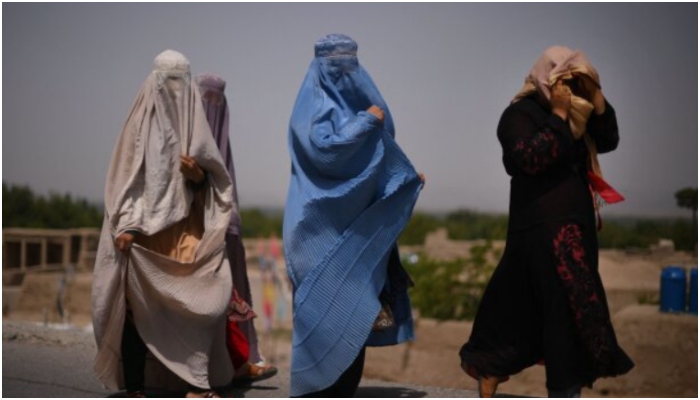
They have also closed beauty salons and begun enforcing a dress code, arresting women who do not adhere to their version of hijab, or Islamic headscarf. In May 2022, the Taliban issued an order requiring women to only expose their eyes and advising them to wear the head-to-toe burqa, similar to restrictions imposed under the Taliban’s previous administration from 1996 to 2001.
UN spokesperson Stephane Dujarric commented on the recent UN report. He stated that women in Afghanistan are facing horror and that it is unimaginable to have a life there.
According to the United Nations Assistance Mission in Afghanistan’s most recent quarterly report, which covers the period from October to December of last year, the Taliban are tightening down on Afghan women who are single or do not have a male guardian, or mahram, with them.
There are no official rules in Afghanistan governing male guardianship, although the Taliban have stated that women cannot move or go beyond a certain distance without the presence of a man connected to them by blood or marriage.
Last October, three female healthcare workers were jailed for going to work without a mahram. According to the report, they were released after their families signed a written agreement promising not to repeat the conduct.
Since December, the Vice and Virtue Ministry in Paktia province has prohibited women without ‘mahrams’ (male guardian) from accessing healthcare facilities. It inspects health establishments around the province to guarantee compliance.
The ministry, which acts as the Taliban’s morality police, also enforces hijab and mahram rules for women who visit public areas, offices, and educational institutions via checkpoints and inspections.
“In December, in Kandahar province, ministry officials visited a bus terminal to ensure women were not traveling long distances without mahrams and instructed bus drivers not to permit women to board without one,” the UN said.
Women have also been imprisoned for purchasing contraception, something the Taliban does not officially prohibit.
Meanwhile, the Taliban’s chief spokesman, Zabihullah Mujahid refuted the UN report and claimed that the report has been crafted based on misunderstanding. He also accused the UN mission of ignoring or criticizing Islamic law, or Shariah.
“With an Islamic government in power in Afghanistan, it must “fully implement all aspects of Shariah for both men and women. This means enforcing rules for the hijab, male guardianship, and gender segregation for women in education and employment,” Mujahid said in a statement.
“If UNAMA criticizes these cases or considers explicit Islamic rulings as an act against human rights, then it is an insult to the beliefs of a people,” he added.
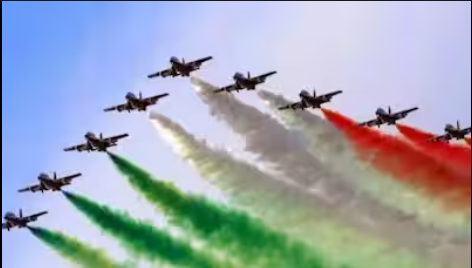
The ‘Tangail’ formation that will be flown during the Republic Day flypast will include the heritage aircraft Dakota flanked by two Dornier Do-228 aircraft which will be flying using a blended mixture of Aviation Turbine Fuel and Biofuel, the Indian Air Force (IAF) said on Tuesday.
The ‘Tangail’ formation will reenact the successful airdrop in which Indian Air Force personnel were dropped in parachutes on December 11, 1971, which marked the first airdrop of Indian security forces on hostile territory during the India-Pakistan war.
In addition to this, made-in-India weapon systems and platforms would also be among the main attractions in this year’s Republic Day parade from the Indian Army including the LCH Prachand chopper, Pinaka multi-barrel rocket launchers and Nag anti-tank missiles.
The LCH Prachand is the first indigenous Multi-Role Combat Helicopter designed and manufactured by HAL. It has potent ground attack and aerial combat capability. The helicopter possesses modern stealth characteristics, robust armour protection and formidable night attack capability. Onboard advanced navigation system, guns tailored for close combat and potent air to air missiles make the LCH especially suited for the modern battlefield.
NAG has been developed by DRDO to engage highly fortified enemy tanks in day and night conditions. The missile has “Fire & Forget” “Top Attack” capabilities with passive homing guidance to defeat all MBTs equipped with composite and reactive armour.
The NAG missile carrier NAMICA is a BMP II based system with amphibious capability. The latest armoured vehicles and specialist vehicles produced by the Indian industry indigenously are also going to be showcased at the parade where French President Emmanuel Macron will be the chief guest, Army officials said.
The Quick Fighting Reaction Vehicle, Light Specialist Vehicle and the All-Terrain Vehicle would be marching on the Kartavya Path this year. The weapon systems would also include the T-90 tank, BMP-2 infantry combat vehicle, c, Drone jammers, Advanced Sarvatra bridge, Medium Range Surface to Air Missile launcher and multi-function radar, they said.
Swathi Weapon Locating Radar, is an indigenously designed WLR which is capable of locating guns, mortars and rockets firing own troops, thereby facilitating their destruction through Counter Bombardment by own firepower resources. This will enable troops to carry out their operational tasks without any interference from the enemy and also provide them safety against enemy fire.
Along with the Light Combat Helicopter, the Indian Army would also be showcasing the weaponised version of the ALH Dhruv choppers which is also known as the Rudra. The weapon systems to be showcased at the parade also include the Pinaka and the Swathi radar which have been successfully exported to foreign customers by Indian entities. Both have been developed by the DRDO.
The enhanced range version of Pinaka Rocket System can destroy targets at distances up to 45 kms. The rocket system has been developed jointly by Pune based Armament Research and Development Establishment (ARDE) and High Energy Materials Research Laboratory (HEMRL).
The Army is also going to showcase the growing role of women in defence forces as 60 of its women soldiers are going to be part of the tri-services all-women marching contingent which would include women from the Air Force and Navy too. (ANI)
(This news report is published from a syndicated feed. Except for the headline, the content has not been written or edited by OpIndia staff)
On 22nd January, a man named Divya Yashasvi was arrested by Pilibhit Police for using derogatory language against Bhagwan Ram and Mata Sita on social media. Yashasvi, who calls himself “a brutal atheist” published multiple derogatory posts on the social media platform X (formerly) Twitter leading to outrage. Notably, both incidents happened on the day of Ram Mandir Pran Pratishtha.
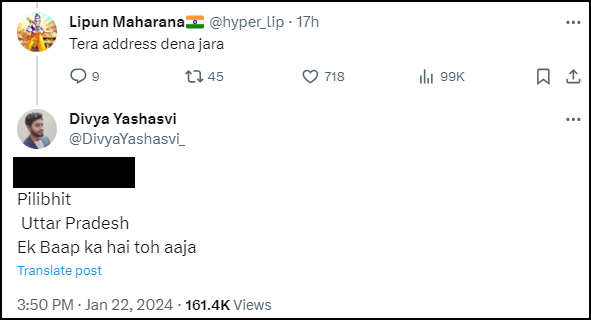
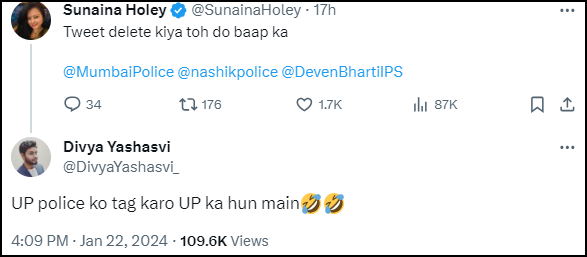
Several social media users tagged UP Police and Pilibhit Police under his posts after which police swung into action and traced his location. Interestingly, in one of the posts, he published his address and in another one, he challenged everyone to tag Pilibhit Police.
Divya published his address openly challenging social media users. Source: X
Divya urged social media users to tag UP Police expecting no action would be taken against him. Source: X
Responding on social media, Pilibhit Police confirmed that Yashasvi was arrested and an FIR was registered against him at Sunghadi Police Station under relevant Sections of the Indian Penal Code (IPC). Some of his posts were marked by X as a violation of the Rules but the posts were not removed by the time this report was published. Further investigation into the matter is underway.
सम्बन्धित व्यक्ति की पहचान कर पुलिस हिरासत में ले लिया गया है, अग्रिम वैधानिक कार्यवाही की जा रही है।
In a similar matter, a man from a “particular community” was arrested in Ghaziabad for walking a dog with a tag of Shri Ram on the animal’s neck. Reports suggest that Kaushambi Police received a complaint that a person from the Muslim community was walking a dog with a tag of Shri Ram on the animal’s neck.
When police reached the area, they found the complaint to be true. The culprit was immediately arrested by the Police and further investigation into the matter was underway.
After the ‘Pran Pratishtha’ ceremony of Ram Lalla that concluded in Ayodhya on Monday, a heavy rush of devotees throng at the main gate of Shri Ram Temple to offer prayers on Tuesday.
Devotees have gathered in large numbers since 3 a.m. to offer prayers and have Darshan of Shri Ram Lalla on the first morning after the Pran Pratishtha ceremony.
#WATCH | Uttar Pradesh: Devotees gathered at Shri Ram temple on the first day after the Pran Pratishtha ceremony in Ayodhya. pic.twitter.com/ne925o7m7t
The grand Ram Temple in Ayodhya has been made open to the public from today.
The ‘Pran Pratishtha’ of Shri Ram Lalla in Ayodhya was held amid unbridled celebrations, with Prime Minister Narendra Modi performing the main rituals officiated by a select complement of priests.
Celebrations were also held across the country to mark Lord Ram’s return to this throne.
#WATCH | Ayodhya, Uttar Pradesh: Heavy rush outside the Ram Temple as devotees throng the temple to offer prayers and have Darshan of Shri Ram Lalla on the first morning after the Pran Pratishtha ceremony pic.twitter.com/gQHInJ5FTz
Meanwhile, ‘Ram Nagri’ Ayodhya also grabbed global eyeballs, with earthen lamps or diyas lit up on a massive scale and crackers going up and dazzling the night sky in different parts of the city.
Visuals also showed celebrations unfolding at the famous Saryu Ghat, with beaming locals expressing their devotion to Ram Lalla.
The ‘Pran Pratishtha’ ceremony of Lord Ram was held at 12.29 pm on Monday, with the main rituals performed by Prime Minister Narendra Modi. The ceremonial journey leading up to the Pran Pratishtha included a seven-day ritual that commenced on January 16.
The ceremony was attended by representatives of all major spiritual and religious sects in the country. People from all walks of life, including representatives of various tribal communities, also attended the ceremony.
The idol of Ram Lalla was unveiled after the ‘Pran Pratistha’ rituals were performed.
Built-in the traditional Nagara style, Shri Ram Janmbhoomi Mandir has a length (east-west) of 380 feet and a width of 250 feet. It stands 161 feet above the ground and is supported by a total of 392 pillars and 44 doors. The pillars and walls of the temple showcase intricately sculpted depictions of Hindu deities, Gods, and Goddesses.
In the sanctum sanctorum on the ground floor, the childhood form of Bhagwan Shri Ram (the idol of Shri Ramlalla) is enthroned. (ANI)
(This news report is published from a syndicated feed. Except for the headline, the content has not been written or edited by OpIndia staff)
On Monday (22nd January), a man named Romeo Nance went on a shooting spree at two different homes in Joliet city in Illinois in the United States.
As per reports, the home invasion resulted in the deaths of 7 people. The 23-year-old shooter lived in the neighbourhood of 2200 block of West Acres Road in Joliet where the mass shooting took place.
While speaking about the matter, local police chief Bill Evans said, “A total of seven people were found shot to death…”I’ve been a policeman 29 years. This is probably the worst crime scene I’ve ever been associated with.”
In a tweet, the Joliet Police Department said, “At this moment, Detectives and Officers are conducting an active homicide investigation after Officers located multiple deceased individuals who had sustained gunshot wounds in two homes in the 2200 block of West Acres Road.”
Romeo Nance has been on the run from law enforcement authorities. He is believed to be driving a red Toyota Camry. The police warned the public that the accused should be regarded as ‘armed and dangerous.’
They have now sought information about the whereabouts of Romeo Nance. Reportedly, the police recovered 5 bodies from one residence in West Acres Road and two bodies from another home in the vicinity.
JUST IN: A manhunt is currently underway for Romeo Nance who allegedly killed 8 people in what the local police chief says is "the worst crime scene" he has ever seen.
An investigation was launched into Nance on Sunday in Joliet, Illinois after 2 separate shootings.
Dan Jungles, Deputy Chief of Special Operations for the Will County, informed, “They knew that the house across the street was related to the individuals that resided at that house. “They walked over there, and that’s when they discovered the blood and made entry into the house to look for injured individuals.”
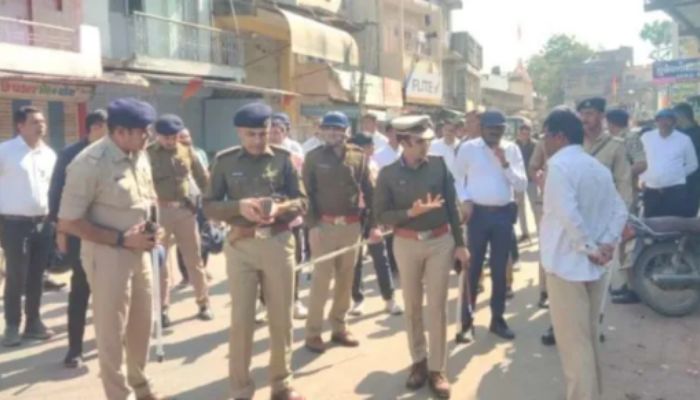
Gujarat Police have initiated stern action on the stone pelting incident on Shri Ram’s Shobha Yatra that took place in Kheralu, Mehsana district on Sunday (21st January). The Kheralu Police has filed an FIR in this case and booked 32 individuals from the Muslim community. Earlier, 15 accused were arrested in a combing operation following the stone pelting incident in the night.
The complainant has been filed by PSI J.K. Gadvi of Kheralu Town police station. According to media reports, the complaint states that the accused hatched a planned conspiracy and pelted stones at the Shobha Yatra of Lord Shri Ram in Kheralu. For this, stones were collected on the rooftops of the houses of Belim Vas, which is a Muslim locality. Additionally, carrying swords and other weapons in hand, they attacked the devotees involved in the Shobha Yatra.
According to the complaint, the accused, armed with weapons, ran after those involved in the Shobha Yatra and damaged the tractors involved in the yatra. They also hit some devotees involved in the yatra with swords, one of whom sustained serious injuries. While PSI Gadvi was also injured due to stone pelting.
A case has been registered against 32 persons belonging to the Muslim community under sections 143, 147, 148, 149, 307, 332, 323, 337, 506(2), 120B, 427 of the IPC and sections 135 of the Gujarat Police Act. The police are conducting further investigation in the case.
The police conducted a combing operation on Sunday night (January 21, 2024) and arrested 15 accused. The search for the rest of the accused is currently underway.
Informing about the action, Kheralu Police PSI SG Shripal told OpIndia that a case has been registered against 32 persons in this regard at night and 15 of them have been arrested while the search for the rest is currently underway. They too will be nabbed soon. According to him, as soon as the yatra reached the spot, stones were pelted on the yatra. It is also suspected to be a premeditated conspiracy which is the subject of investigation.
The incident took place on Sunday (January 21, 2024) a procession of Lord Ram was taken out in Kheralu of Mehsana ahead of the grand consecration ceremony in Ayodhya at Shri Ram’s birthplace. A large number of Ram devotees including women and children had joined the Shobha yatra. Meanwhile, the Kheralu police also joined the Yatra to ensure that no untoward incident took place.
But when the Shobha Yatra reached the mosque in the Hatadiya area, stone pelting was reported with people throwing stones from their rooftops in the Muslim neighbourhood.
Hindu organisations involved in the yatra told OPIndia that stones pelting on the Yatra was started when it reached near the mosque in a Muslim-dominated area. Due to this, there was a stampede and some people were also injured.