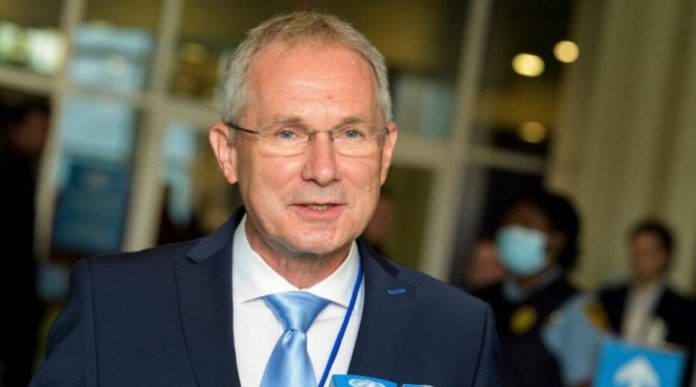
United Nations General Assembly (UNGA) President Csaba Korosi, who is on a visit to Delhi, said on Monday that the UN Security Council needs to be reformed. Korosi stressed the need for reform in the council’s size, composition, and regulations.
The Hungarian diplomat who assumed his role as President of the UN General Assembly (UNGA) in September 2022, arrived in India on Sunday on a three-day visit at the invitation of External Affairs Minister S Jaishankar.
“It is quite obvious that the Security Council needs to be reformed. Its size, its composition, its methods, its regulations need to be reformed. For 13 years the negotiating process has been going on,” Korosi said while delivering the 40th Sapru House Lecture on ‘Solution through Solidarity, Sustainability and Science at the UN’ in New Delhi.
Korosi said that the balance of power in the world is changing. “It is an Oslo understanding that countries and leaders of the world are demanding that the Security Council should be reformed,” he said.
He said extraordinary powers have been placed on the Security Council. “What if one of the permanent members has power and is the one who is attacking its neighbour,” Korosi asked.
He said that since the beginning of the war in Ukraine, the Security Council has not been able to take any concrete decision.
The UNGA president said UN sanctions could only be issued and imposed by the security council. “The more the council is divided, the more are the chances that on certain issues of sanctions or other big challenges, there will be no agreement and no decisions in the security council,” Korosi said.
He said that India is particularly interested in counter-terrorism and he is happy that in the last few months, there has been progress in the field.
Korosi said that he hopes India’s G20 leadership will help take the world closer to finding some solutions as only cooperation can save the world from the worst.
“G20 was created in a time of a major crisis. It was a financial meltdown and the G20 was created to launch action. It is up to the members of the G20, to run this platform to lead the world,” Korosi said.
Korosi on Monday also lauded India’s calls for peace in Ukraine and across the world.
“We are approaching the first anniversary of the war in Ukraine that caused suffering and displacement. A war that has unleashed an energy and food crisis across the globe. I commend India for your calls for peace in Ukraine and across the world,” Korosi said.
(This news report is published from a syndicated feed. Except for the headline, the content has not been written or edited by OpIndia staff)