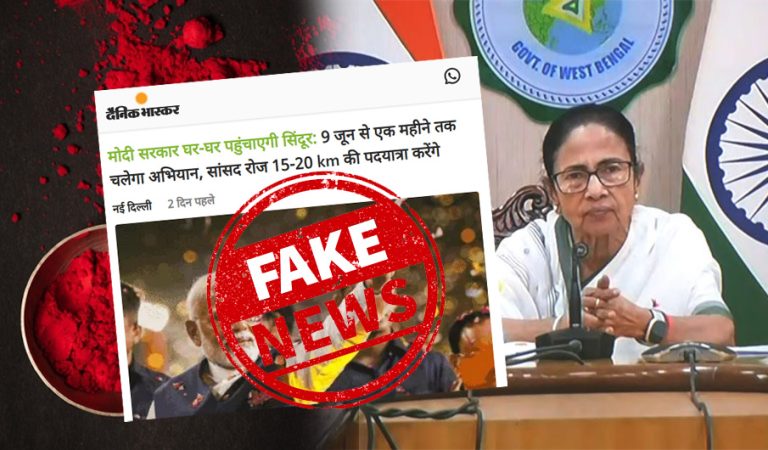
The Bharatiya Janata Party (BJP) has denied media reports claiming that the party is visiting house to house to distribute sindoor (vermilion). Referring to a report published by Hindi daily Dainik Bhaskar, BJP’s national IT cell head Amit Malviya called it fake news, and slammed the opposition for amplifying the same.
The report titled “Modi government will deliver vermilion to every home: Campaign to run for one month from 9th June, MPs will walk 15-20 km every day,” claimed that sindoor will gifted to women by BJP leaders during the campaign. The report stated that the campaign will start on 9th June, the day PM Modi took oath as PM for the third term. Dainik Bhaskar cited an unnamed BJP leader for the claim.
A similar claim was made by Zee News in its report on BJP’s plan to celebrate the third anniversary. The report stated, “The Bharatiya Janata Party (BJP) is launching ‘Operation Sindoor’ on June 9, coinciding with Prime Minister Narendra Modi’s third oath-taking, to highlight the achievements of the Modi 3.0 government nationwide. As part of this month-long public outreach, BJP aims to connect with every household, particularly by gifting vermillion to women and distributing informative pamphlets.”
Some other media outlets also carried the same claim.
However, now BJP leader Amit Malviya has clarified that it is fake news, and the party has not planned to distribute vermillion among women. He posted on X, “Many people are reacting on social media based on this #FakeNews published in Dainik Bhaskar.”
बहुत सारे लोग भास्कर में प्रकाशित इस #FakeNews के आधार पर सोशल मीडिया पर अपनी प्रतिक्रिया दे रहे हैं। लेकिन हद तो तब हो गई जब पश्चिम बंगाल की मुख्यमंत्री, एक अधिकृत सरकारी मंच से, एक ट्रोल की तरह इस आधारहीन खबर को लेकर राजनीति करने लगीं।
Malviya also slammed West Bengal CM Mamata Banerjee over her attack on PM Modi using the fake news, and said, “But the real absurdity began when the Chief Minister of West Bengal, from an official government platform, started politicizing this baseless report like a troll.”
Mamata Banerjee made a statement accusing PM Modi using Operation Sindoor for his political benefits, and said that PM was selling Sindoor. She further alleged that Modi is pretending to be husband of everybody, and asked why he is not giving Sindoor to his wife first. She added, “You are not husband of everybody, why you are not giving to you wife first?”
The Bengal CM also alleged that while PM Modi sent opposition leaders to various countries to place India’s side on the conflict against Pakistan, the PM himself was roaming inside the country.
"Modi is pretending to be the husband of everybody. Why isn't he giving sindur to his wife first?”Mamata Banerjee's comment about the PM lacks respect and dignity.
Actually she doesn’t understand the margin between a father and a husband because she is inspired by ISLAM where… pic.twitter.com/AS9JnxzHtr
Referring to her comments, Malviya said, “Mamata Banerjee should be concerned about the deteriorating condition of her own state and refrain from making ridiculous statements on sensitive issues like national security. West Bengal is burning in the fire of communal tensions, women are not safe, the unemployed have no jobs — these should be Mamata Banerjee’s priorities.”
Referring to comments of Congress spokespersons on the issue, Amit Malviya said, “they are frivolous people. It would be unreasonable to expect anything better from them.” Congress spokesperson Supriya Shrinate posted a video on social media saying that women put vermillion on their hair partings in only their husband’s name, and asked who are the BJP workers that will distribute vermillion among women.
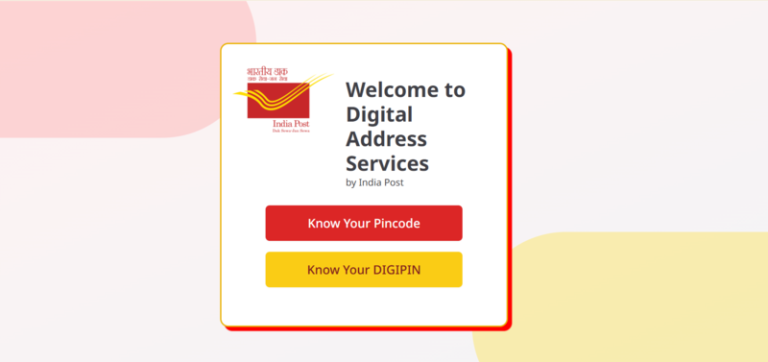
Taking a significant leap towards achieving the vision of Digital India, the Department of Posts, Ministry of Communications, launched two transformative digital platforms- ‘Know Your DIGIPIN’ and ‘Know Your PIN Code’ on Tuesday (27th May). The move marks an important milestone in the direction of modernising India’s addressing system and geospatial governance.
The platforms have been launched as part of the National Geospatial Policy 2022, which aims to project India as a global leader in the geospatial sector.
What is DIGIPIN
DIGIPIN is part of the postal department’s vision to offer Address-as-a-Service (AaaS), which includes a range of services associated with address data management to support secure and efficient interactions between users, government entities, and private sector organisations. The department took the initiative to establish a standardised, geo-coded addressing framework in India, aimed at simplifying address identification and facilitating citizen-centric delivery of public and private services. The platform has been developed by the Department of Posts in collaboration with IIT Hyderabad, the National Remote Sensing Centre (NRSC) and the Indian Space Research Organisation (ISRO).
Image via X/Sougat Chakraborty
Officially reviewed and adopted by the Thematic Working Group on Address under the National Geospatial Policy 2022, DIGIPIN is now available to all Ministeries, State governments, institutions for integration into the workflows, and users for their own use.
How does DIGIPIN work
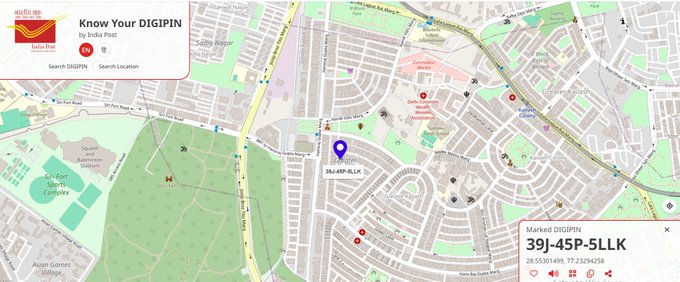
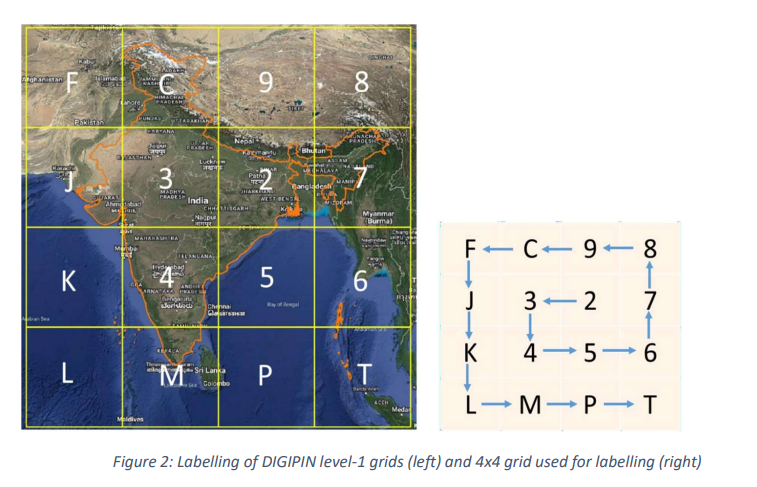
DIGIPIN or the Digital Postal Index Number is an open-source, interoperable, geo-coded, grid-based digital address system. It simplifies locating places by dividing the entire geography of India into precise 4×4 meter units where each grid is assigned a unique 10-character alphanumeric code based on longitude and latitude coordinates. It is a permanent digital address that will not change even if the names of the streets, localities or places change. The platform will prove to be helpful in precise location of areas which are unstructured, constantly changing or no address rural regions, forests, and oceans. This will ensure last-mile delivery in remote areas which otherwise can’t be located with an address.
Image via X/Sougat Chakraborty
DIGIPIN provides a digital representation for a physical location along with a stable location identification. It complements the existing location system by adding precision, stability and permanency. DIGIPIN for a location can be retrieved by visiting the ‘Know Your DIGIPIN’ portal which generates a unique 10-character pin using precise coordinates. The portal does not store any personal information ensuring user privacy.
By providing improved location accuracy, DIGIPIN will help ensure accurate service delivery across multiple sectors and will also reduce emergency response period. Since it is open-source, a complete repository of the DIGIPIN technical documentation and source code is available on GitHub.
‘Know your PINCODE’
In order to modernise the existing 6-digit PIN Code system that has been in use since 1972, the Department of Posts undertook a national geofencing exercise across all postal jurisdictions to geo-reference all the pin code boundaries of the country. As a result, the Department launched the ‘Know Your PIN Code’ portal which makes use of the Global Navigation Satellite System (GNSS)-based location features to enable users to identify the correct pin code of a location. The portal also allows user to provide feedback for continuous improvement of the dataset. The complete geo-fenced PIN Code boundary data has been published on the Open Government Data Platform under the title “All India PIN Code Boundary geo-json”.
Image via X/Sougat Chakraborty
The Department of Posts has invited active feedback from citizens on ‘Know Your DIGIPIN’ and ‘Know Your PIN Code’ portals so that their services can be further refined.
Speaking on the occasion of the launch of the two platforms, Vandita Kaul, Secretary, Department of Posts, said, “The launch of these two applications reflects our government’s unwavering commitment to digital transformation and precision governance. DIGIPIN, in particular, will redefine how we perceive addresses, ensuring that every citizen, even in the remotest part of the country, is digitally locatable and serviceable. These applications are a testimony to the Department’s continued efforts to modernise infrastructure and meet the evolving expectations of citizens and all other stakeholders”.
National Geospatial Policy 2022
The policy was launched by the Government of India in Decemeber 2022, with a long-term vision of liberalising and democractising the access to geospatial data, fostering innovation and enabling its widespread use across governance, businesses and academia. It seeks to ensure that geospatial database generated with public funds are openly accessible. One of the important goals of the policy is to establish a high-resolution topographical survey and mapping system by 2030 along with a highliy accurate Digital Elevation Model (DEM) for the entire country.
The policy recognises the significant role that geospatial technology can play in governance, economic growth, and societal development. Therefore, it focuses on strengthening institutional frameworks, enhacning national and state-level coordination to develeop a vibrant geospatial ecosystem.
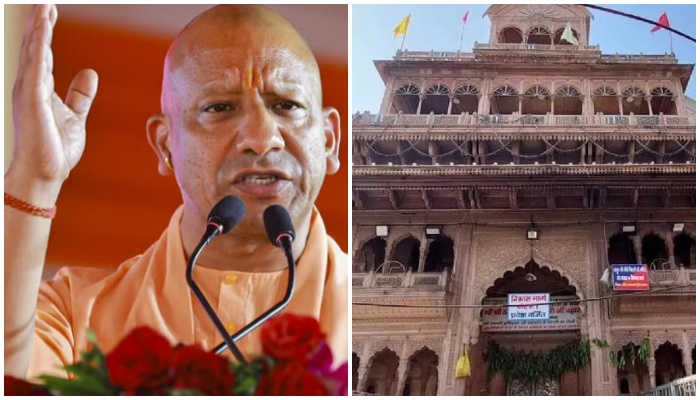
The Supreme Court on Tuesday (27th May) lashed out at the Uttar Pradesh government saying that the government was interfering in the case concerning the management of the Banke Bihari temple in Vrindavan, which the Apex Court described as a private litigation. The remarks came during the hearing of an petition challenging a previous order passed by the Supreme Court allowing the Uttar Pradesh government to utilise the temple funds for purchasing 5 acres of land around the temple for the development of a corridor.
A bench of Justices VB Nagarathna and Satish Chandra Sharma was hearing the petition filed by a temple priest seeking modification of the Supreme Court order. A displeased Justice Nagarathna said that the state’s interference in a private litigation would lead to the breakdown of the rule of law. “Was the State a party to the proceedings? In what capacity has it entered the dispute? If states start interfering in private disputes, there will be a complete breakdown of the rule of law. You can not hijack the litigation,” Justice Nagarathna told the counsel representing the state government who sought impleadment in the case. Justice Nagarathna expressed concern over the state government filing an impleadment in a private litigation and said that it can do development work without being party to the litigation.
Notably, Justice Sharma, who was part of the bench, had authored the Supreme Court order permitting the Uttar Pradesh government to utilise the temple funds.
Petitioner challenged the SC’s order, opposed the redevelopment project, and Kapil Sibal represented him
The petitioner Devendra Nath Goswami, represented by Senior Advocate Kapil Sibal, was seeking the permission to be made party in the case. Sibal argued before the court that the UP government was allowed to use the temple funds without making Goswami a party. Goswami submitted before the court that he was a lineal descendant of the Banke Bihari temple’s founder Swami Hari Das Goswami and that his family has been managing the affairs of the temple for the last 500 years.
Goswami also challenged the temple corridor redevelopment project, claiming that the implementation of project was unfeasible and that any attempt for the redevelopment of the temple premises without the involvement of the inputs of those who were historically and operationally associated with the temple’s functioning would lead to administrative chaos.
Additionally, Senior Advocate Sibal pointed out that the order allowing the state to use temple funds was passed in a case a separate case filed regarding Giriraj temple. “How can you, by an order in another petition, direct that a private temple’s earnings be handed over to the government?” Sibal questioned. He argued that the order was passed in an intervention petition filed by the state government in a special leave petition that was not related to the case. He contended that the intervention of the Uttar Pradesh government was improper and legally unsound.
What order did the Supreme Court pass?
On 15th May, a bench of Justices Bela M Trivedi and Satich Chandra Sharma passed an order permitting the state government to utilise temple funds for acquiring land for the implementation of the ₹500 crore Shri Banke Bihari Temple Corridor development plan. The Supreme Court order modified an Allahabad High Court order passed in a PIL, which prohibited the purchase of the land around the temple using temple funds.
After taking note of the records placed by the state government regarding the proposed development project, the Supreme Court granted the permission to purchase the land on the condition that the land will be registered in the name of the deity or the temple trust and will be used for building public amenities like parking facilities, accommodation for devotees, toilets, security posts and other logistical support infrastructure.
The apex court’s approval to the state government’s development plan for the Shri Banke Bihari Temple Corridor came particularly in light of incidents such as the 2022 stampede at the Banke Bihari Temple.
The top court also took note of maladministration in temples in the Braj region and emphasised that effective temple governance is not only a legal requirement but also a matter of public and spiritual welfare. It further directed the Civil Judge (Senior Division), Mathura, to appoint a Receiver having relevant adequate administrative experience, historical, religious and social background, preferably belonging to the Vaishnav Sampradaya.
State government set up Trust to handle temple funds, ensure better crowd management
The counsel appearing for the state government submitted before the top court that the state government passed an ordinance on 26th May to form a trust for the purpose of overseeing the work of the development project. He pointed out that the trust will be handling the temple funds and not the state government. “Now the enactment has come into force. Funda are with the Trust and not with the state,” submitted the state’s counsel before the court.
The Uttar Pradesh Shri Bankey Bihari Ji Mandir Nyas Adhiniyam 2025 states that the Trust will ensure that the religious rituals, practices, festivals, and puja at Banke Bihari Temple continue without any interference or changes. The trust will only oversee the appointment of priests, ensure the security of devotees, and supervise work on the proposed corridor. The baord will habe 18 members, with 11 nominated ones and 7 ex officio members, including 2 from the temple’s traditional Goswami priests. Non-Hindus will not be appointed in the board.
Currently, devotees at the temple have to navigate through extremely narrow lanes without proper amenities. The 2022 stampede incident drew the government’s attention to decide on better management for the temple and the surrounding areas. On busy day, the temple sees lakhs of devotees, risking major incidents. The Trust hopes to prevent untoward incidents in the future and ensure that the lakhs of devotees arriving at the Banke Bihari temple experience a safer environment with proper amenities.
The Apex Court directed the counsel for the state to place on record a copy of the Ordinance and directed the concerned Principal Secretary to file an affidavit by 29th July.
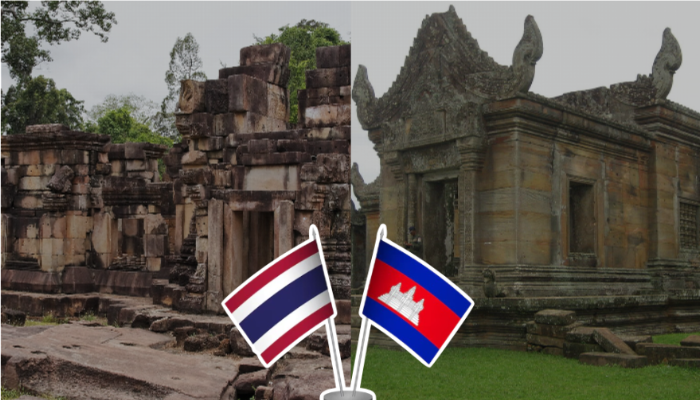
A violent conflict has recently erupted between Thailand and Cambodia over a contested territory along their border which both countries claim as their own. This region holds significant cultural value for both countries and is home to an ancient Hindu temple which is 900 years old and has an auspicious Shiva Lingam, in the Preah Vihear province.
A Cambodian soldier was killed in a firefight that took place between Cambodian and Thai troops on the morning of 28th May. The instance reportedly occurred in Techo Morakot village, located in the Morakot commune of Choam Ksan district. This clash followed a prolonged period of increasing tensions between the two countries.
According to the Ministry of Defense of Cambodia, the incident, which was labeled as “unprovoked,” transpired after Thai troops launched an initial offensive against a position that had been occupied by Cambodian forces for a considerable duration. The Royal Thai Army, in a statement, claimed that the Cambodian soldiers initiated the firing and they responded accordingly.
The country’s minister of defense Phumtham Wechayachai stated, “I have been informed that the return fire was necessary to defend ourselves and protect Thailand’s sovereignty. I have instructed caution. Although the ceasefire holds, both sides continue to face each other.”
Thailand asserted that its troops were attacked while attempting to persuade Cambodian troops to withdraw from establishing a post in a contested area. “Cambodian forces misunderstood the situation and started using weapons, so Thai forces retaliated,” Thai army spokesman Major General Winthai Suvaree mentioned.
“This clash is not something Cambodia desires. We will continue discussions with the Thai Ministry of Defense to find a mutual solution that will quickly return the situation to normal and prevent such incidents from occurring again,” expressed Cambodia’s Defense Ministry.
Prime Minister of Cambodia, Hun Manet addressed the nation on 29th May and declared that he did not want a war between Cambodian and Thai military, stating that people should not “panic over unverified material being circulated,” in a written statement. “For this reason, I hope that the upcoming meeting between the Cambodian and Thai army commanders will produce positive results to preserve stability and good military communication between the two countries, as we have done in the past,” he expressed.
He further mentioned, “Even though I am in Japan, the command system and hierarchy for major military operations such as troop movements remain under my full responsibility as prime minister.” The clash continued for approximately 10 minutes until the local commanders communicated with one another and issued a ceasefire order. Afterward, the Southeast Asian neighbours decided to withdraw troops from the region.
The next two weeks would see the formation of a Joint Boundary Committee to “solve the problem of the border conflict.” The commanders agreed to use “existing mechanisms to resolve disputes,” according to the Royal Cambodian Army, although it will not withdraw its forces from the conflict zone.
The contentious border between Thailand and Cambodia
The border, which is more than 800 kilometers (500 miles) long and was mainly drawn during the French colonization of Indochina, has been the subject of a long-running dispute between the neighbors, leading to armed conflicts, notably one that happened in 2008 close to the historic temple was inducted as a UNESCO (United Nations Educational, Scientific and Cultural Organization) World Heritage Site that year.
A confrontation also broke out along the border in 2011, close to the 11th-century temple and resulted in multiple deaths as well as injuries. There have been at least 28 fatalities as a result of the years of intermittent violence. The fresh tensions were originated in February when Cambodian troops and their families sung the country’s national anthem inside Prasat Ta Moan Thom temple. Thai soldiers who were stationed nearby confronted them. An intense verbal exchange between the two sides was captured on camera by a Thai person and went viral online.
Although a peaceful resolution is Cambodia’s top priority, Prime Minister Hun Manet of Cambodia warned in March that if Thai soldiers infringed on Cambodian sovereignty, the nation would be prepared to employ military force. After a conference in May, military leaders from Thailand and Cambodia decided to keep troops in their current locations and only place five of each nation’s soldiers directly at the temple site in order to avoid more skirmishes.
The ancient temple
The Preah Vihear in Cambodia transcends the contemporary Southeast Asian republics. The majority of the temple’s surviving portions are from the Khmer Empire’s heyday, the 11th and 12th centuries. Modern Cambodians, who still call themselves Khmers, have direct ancestry from the Khmer people. They reigned from the 9th to the 15th century over most of mainland Southeast Asia, including what is now Thailand (formerly known as Siam) and built the spectacular complex at Angkor Wat.
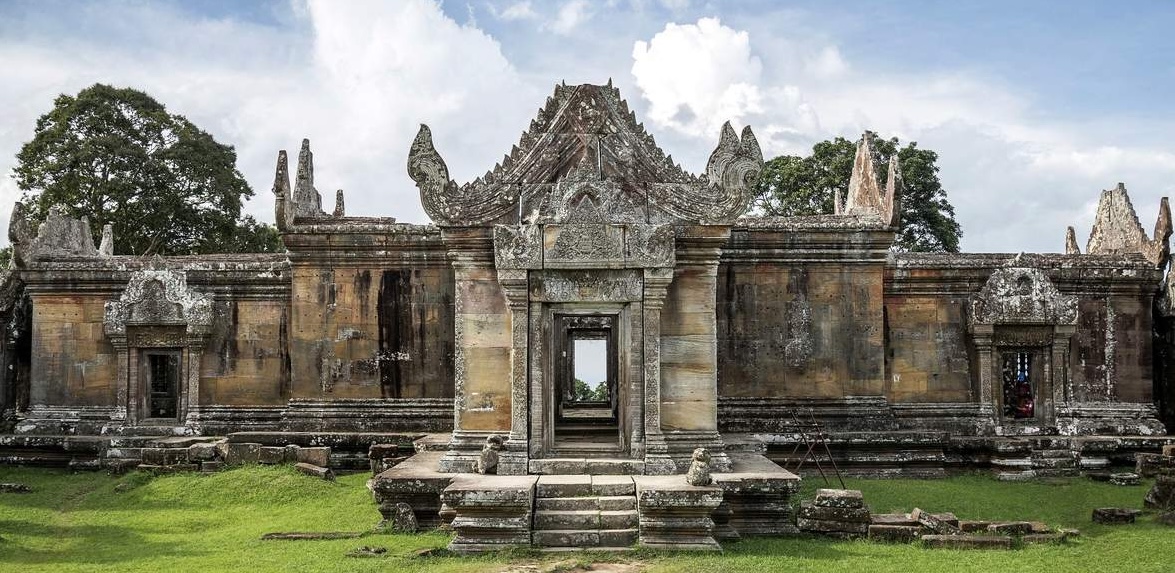
Preah Vihear Shiva Temple (Image Credits: Klook)
Khmer temples are known for their remarkable architecture. The influence of Hinduism, the primary religion of the Khmer monarchs at that time is evident in the temple. Additionally, it incorporates aspects of Buddhism, which subsequently gained popularity in the region. Preah Vihear has not always been governed by Cambodia, despite its Khmer heritage. The Siamese kingdoms and the contemporary Thai state that replaced them have occasionally controlled or occupied the region it now inhabits.
Prasat Ta Moan Thom or Ta Moan is also situated right on the disputed border between the provinces of Surin in Thailand and Oddar Meanchey in Cambodia. Friction between the two countries has frequently arisen because of its location in the Dangrek Mountains. It was constructed as a Hindu shrine and devoted to Lord Shiva. It is older than its two companion temples, Prasat Ta Muen and Prasat Ta Muen Tot. Its significance as a hallowed place of worship was demonstrated by the discovery of a natural Shiva lingam inside its main chamber.
This Hindu temple is the most expansive of the three temples located in its vicinity. It sits on one of the routes of the Dangrek Mountains, a key location that divides the Cambodian plains from Thailand’s Khorat plateau. The temple has a rectangular design and is primarily composed of laterite, a hardy red soil, with some sandstone components.
Interestingly, unlike most Khmer temples which are orientated toward east, its main entrance faces south. The temple complex lies in a region where Thailand and Cambodia do not yet have a clear border and hence it is claimed by both nations which results in a frequent military presence and sporadic violence.
The historical dispute
Preah Vihear and adjacent regions were taken by Thailand in 1941 as part of a military alliance with Japan. It once again changed hands following the defeat of the French colonial forces in 1953, after its return to France. In 1954, Thai forces replaced the leaving French troops in the region as a newly independent Cambodia attempted to stand alone. Five years later, Cambodia complained and brought a case before the International Court of Justice (ICJ).
Preah Vihear Temple is located at the heart of the Thailand-Cambodia border dispute
In 1962, the International Court of Justice (ICJ) ruled 9 to 3 in favor of Cambodia after concluding that the Thai people had accepted the French border demarcation for nearly 50 years. Preah Vihear was essentially off-limits for many years following the 1963 handover because of heavy mining and struggle for control by Khmer Rouge guerrillas and other groups. It wasn’t until the Khmer Rouge organization disintegrated in the late 1990s that the site was opened to tourists.
The governments of Thailand and Cambodia implemented policies in the ensuing years to improve the accessibility for tourists and religious pilgrims. However, when Cambodia attempted to register Preah Vihear as a UNESCO World Heritage Site in 2008, the enduring ownership controversy resurfaced. The Thai government raised an objection, arguing that the proposal mentioned Thai-owned territory surrounding the temple.
The administration of Prime Minister Samak Sundaravej agreed to a revised Cambodian application and signed a communique with the country. However, the Samak government withdrew the support due to strong domestic criticism. As UNESCO considered the application, the situation deteriorated further. Foreign Minister Noppadon Pattama was sued by opposition members in Thailand, who maintained that the communique he had signed with Cambodia was unlawful.
The Thai Constitutional Court upheld the charge, nevertheless, the next day, Cambodia’s bid for Preah Vihear was accepted by UNESCO. Tensions reached dangerous heights as Noppadon stepped down and Cambodians rejoiced. As Thai demonstrations erupted, Cambodia blocked the border to Preah Vihear. Hundreds of Thai and Cambodian soldiers were positioned nearby within a week, many of them in disputed regions right next to the temple.
Similar scenes were witnessed again in 2011 when over a dozen individuals including soliders were killed and many others were wounded as well as nearly 100,000 villagers were forced to leave as a result of a multi-day conflict between Thai and Cambodian military. Both nations accused each other. Cambodia claimed that Thai troops entered officially recognized Cambodian territory before dawn and started shooting rockets and weapons, forcing them to counterattack. Cambodia fired first, according to Thailand, whose troops had been on a regular patrol in the region.
Cambodia requested the ICJ to interpret the 1962 judgment in April 2011, pointing out that although Thailand acknowledges Cambodia’s sovereignty over the temple itself, it does not seem to accept the latter’s sovereignty over the area surrounding the temple. Therefore, in 2013, the court unanimously decided that Thailand must remove its troops from the Preah Vihear promontory since Cambodia held authority over the entire region.
Additionally, it confirmed that the temple, which was added on UNESCO’s 2008 World Heritage List, is a place of religious and cultural importance to the local populace. Thailand and Cambodia, both parties to the World historic Convention, are required to work together to conserve the monument as a world historic site, the court observed and added that it is mandatory for every state to refrain from “taking any deliberate measures which might damage directly or indirectly” such legacy.
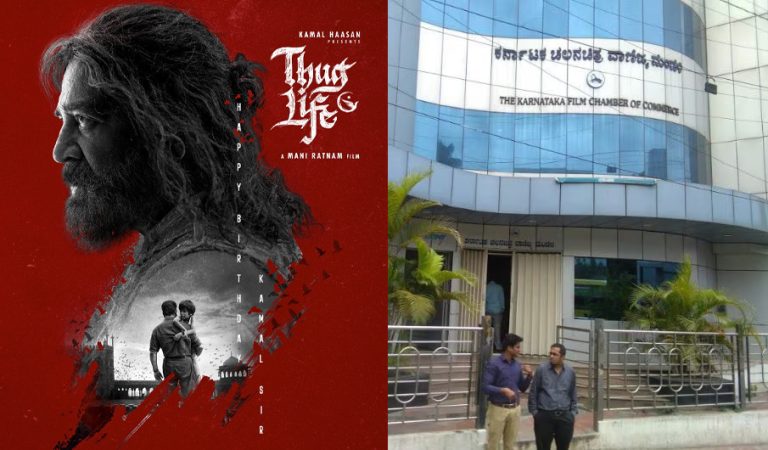
The Karnataka Film Chamber of Commerce (KFCC) has banned the release of Kamal Haasan starrer Thug Life over the actor’s controversial remark about the Kannada language during the audio launch of his movie in Chennai last week.
During the media interaction in Bengaluru on Friday, Sa Ra Govindu, representative of KFCC, said that they have decided to ban the release of Kamal Haasan starrer ‘Thug Life’ in Karnataka as they stand firm with Karnataka Rakshana Vedike and other Kannada organisations for their demands of halting the release of the film until the actor issues a pubic apology.
The KFCC representative said that Kamal Haasan has not issued an apology yet for hurting the sentiments of Kannada people during his promotional event in Chennai.
He said, “When there is pressure, I have to do. Even Karnataka Rakshana Vedike were present; whatever they say, we should do it. Even they would speak about it. Definitely, there is no ‘Sorry’ term being specified anywhere by Kamal Hassan. We will surely not release the film. We (KFCC) will stand with Rakshina Vedike and other Kannada organisations.”
Kamal Haasan and his movie ‘Thug Life’ came under the radar of controversy in Karnataka after the actor reportedly stated that “Kannada is born out of Tamil” during a promotional event in Chennai.
Following it, the protests were held near the INOX cinema hall in Karnataka’s Belagavi against Kamal Haasan. The protests were organised by the Karnataka Rakshana Vedike organisation, which expressed its anger and demanded the actor’s apology over the issue.
On Wednesday, the Karnataka Chief Minister Siddaramaiah criticised Kamal Haasan following his reported remark about the Kannada language, stating that he was not aware of the “long-standing” history of the language.
“Kannada has a long-standing history. Poor Kamal Haasan, he is unaware of it,” the Karnataka CM said.
Congress MLA from Karnataka Rizwan Arshad expressed his disappointment over Haasan’s remark, calling it unfortunate and questioning the necessity of such a debate at a time when national unity is paramount.
“What kind of a debate is this? The Kannada language has a history of thousands of years… Kannada and Tamil are ancient languages and part of our country’s foundation… Is this debate necessary at a time when all of us have to be united? … I did not expect Kamal Haasan to make such a statement. It is unfortunate,” Arshad said.
‘Thug Life’ is directed by Mani Ratnam and stars Kamal Haasan, Trisha Krishnan and Silambarasan TR in the lead roles.
(This news report is published from a syndicated feed. Except for the headline, the content has not been written or edited by OpIndia staff)
The civil mock drills under Operation Shield will be conducted in India on 31st May 2025 in states and union territories along the International Border and Line of Control (LoC). The mock drills, earlier scheduled for 29th May, were postponed due to administrative reasons. However, the authorities have confirmed preparedness to conduct the mock drills on the revised date.
The drills will be conducted in the states of Rajasthan, Haryana, Punjab and Gujarat, along with the Union Territories of Jammu and Kashmir and Chandigarh. The civil mock drills have been announced in the wake of mounting tensions with the hostile neighbour Pakistan after India conducted Operation Sindoor in the aftermath of Pakistan-backed Pahalgam terror attack.
Through an official order, the Indian government has mandated that on May 31, the Civil Defence Exercise Operation Shield be carried out in every district of the states and Union Territories along the western border.
Why are civil mock drills being conducted
The civil mock drills are being conducted after the authorities found several improvement areas in civil defence preparedness in the nation’s most vulnerable regions during the 7th May civil defence exercise. In order to address these gaps, the necessary directives were issued, which resulted in the use of emergency powers and funding agreements via the SDRF.
What will happen during Operation Shield
Under Operation Shield, local administration stakeholders, volunteers, and Civil Defence wardens will help in civil defence efforts. The volunteers will be mobilised from organisations like Bharat Scouts and Guides, NYKS, NCC, and NSS. There will be simulated missile attacks, drone incursions, and air raids. Moreover, a deployment of centrally controlled air raid sirens and the activation of hotlines between the Air Force and Civil Defence Control Rooms would take place. All civilian buildings will be subject to complete blackout procedures, with the exception of emergency and vital services.
There will be a simulation of a military station attack by enemy drones, calling for coordination between the Station Commander and Civil Administration for the evacuation of families to safer locations.
In addition, twenty victim evacuation simulations will be rehearsed. The mock drills will also involve the augmentation of medical teams in reaction to mass injuries, and 30 units of blood will be procured for the injured.
The Indian Army has called for the urgent deployment of Border Wing Home Guards to assist certain Armed Forces units as part of the Rear Area Security Plan.
Exercises for de-induction and mobilisation before deployment to Indian Army operational sites will also be conducted.
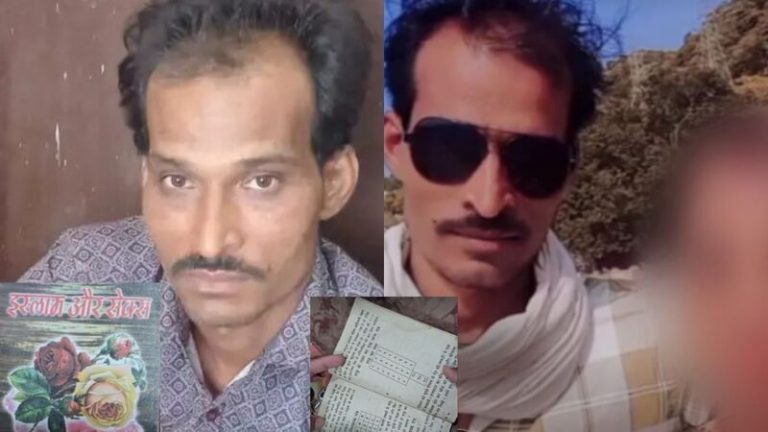
Madhya Pradesh police arrested a Muslim man named Mubarak Mansuri in Baloda village in Garoth, Madhya Pradesh on 22nd May, for allegedly performing occult practices and sexually abusing Hindu women. Mansuri is said to have targeted dozens of Hindu women by luring them through his occult practices. The matter came to light after the family of one of the women filed a complaint against him.
According to Dainik Bhaskar, Mansuri declared a man as mentally unfit and had obscene conversations with the man’s sister-in-law. On finding out about this, the man’s family informed the police who arrested Mansuri.
Mansuri portrayed himself as a Hindu Tantrik
Mubarak Mansuri, a Muslim, used to portray himself as a Hindu and even forged an Aadhar card. He has been involved in occult practices for over 10 years. He used to specifically target vulnerable Hindu women who approached him seeking remedies for their problems. He used to sedate the women and rape them when they fell unconscious. Police seized incriminating material from his possession including books related to occult practices, pornographic literature and unlabelled medicine and aphrodisiacs.
Garoth Station House Officer, Harish Malviya said, “The accused was arrested as soon as the complaint was received. Investigation revealed that the accused had made fake Aadhar cards and other documents to hide his identity. Investigations are being conducted to find out how many people he has targeted so far.”
What the complainant family said
The members of the family who filed the complaint against Mansuri said that they were initially afraid to raise their voice. They said that he targeted around 25-30 women in the village but no one called him out.
‘We are a joint family. We have been living here for generations. About 30 years ago, a Muslim family came and settled in the village. Mubarik Mansuri is a member of the family. When he came to the village with his parents, he must have been eight to ten years old. Now he is about 34 years old,” said a member of the family. Mansuri started practicing black magic and gained the trurst of the villagers over the years. His followers included mostly women.
“About three-four years ago, my elder brother had some problem in his head. He was taken to many doctors but nothing helped. When we got tired, for the past few days Bhabhi (sister-in-law) started going to a Tantrik for brother’s treatment. We did not like this but what could we do? We had lost hope from everywhere. My brother was her husband so we could not say much. We thought that she was doing everything for brother only. Bhabhi used to stay at the tantrik’s place for many hours. When asked, she used to say that exorcism is done, that is why it takes time. The tantrik used to give her some medicine to feed to the brother,” said the brother of the man declared as mentally unfit by Mansuri.
The family claimed that the condition of the man kept getting worse after taking the medicines given by Mansuri. They tried to talk to his wife about this but she was not willing to listen. Subsequently, one day, she forgot her mobile phone at home which had her objectionable pictures with Mansuri. Her family confronted her and filed a complaint with the police on 20th May.
Hindu organisations demand action
Members of several Hindu organisations staged protests against the incident and demanded the demolition of the house of the accused. They submitted a memorandum to the SDM and demanded strict action against Mansuri.
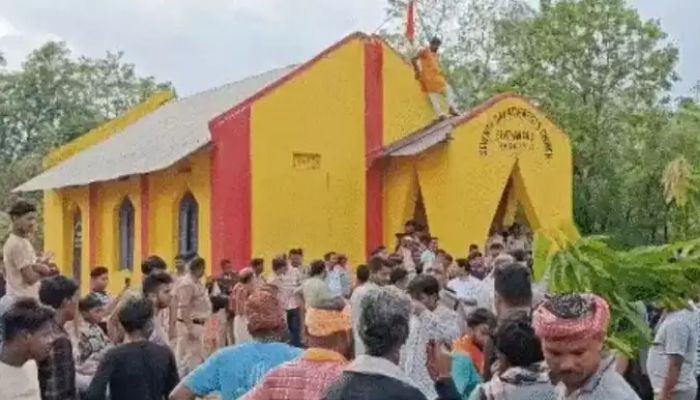
In Chhattisgarh’s Raigarh, an under-construction Hanuman temple has been illegally demolished using a JCB. Nirmal Sarathi, a resident of Bhatanpali village, has been accused of demolishing the temple. Reports say that he ran over the temple with a JCB even before the Pran Pratishtha on 28th May. The Hanuman temple was being built in front of Nirmal Sarathi’s house.
According to reports, Nirmal Sarathi was suffering from an illness after which he started going to Christian congregations. Even though he used to oppose the church earlier, he decided to convert after that.
After conversion, he started demanding removal of the temple. Earlier as well, he had come to the temple with a shovel to vandalise it but after people convinced him, he agreed to back down and leave the temple alone.
As per the locals, Nirmal’s son was also involved in demolition of the temple. According to the reports, 20-22 years ago, Nirmal himself was opposing the church built in the village. He was at the forefront of the opposition to the church. To protest against the church, he even donated money to start the construction of the Hanuman temple. The work of the temple was almost complete but the Pran Pratishtha was yet to take place.
Meanwhile, activists of Hindu organisations reached the spot and held a protest. Angry activists broke the cross of the church built in front of the temple. Police took 6 people into custody in the case and brought them to the police station.
A landlord in Ontario, Canada is suffering from serious mental stress just because he made the mistake of renting out his house to a bunch of Khalistanis. The landlord, Raman Kumar, had to move to US for work, had to move to the US for work, so he decided to rent out his house in Canada to 5 people in September last year, little did he know what a mistake he was making.
The 5 people turned out to be supporters of the separatist Khalistani movement in India. They paid the rent for the first 3 months, but since January 2025, they have not paid any rent. At 3,300 Canadian Dollars a month, the pending rent is now 16,500 Canadian Dollars (Around 10 lakh 20 Thousand Rupees). In addition to that, these tenants have not paid for any utilities, be it water, electricity, or any other charges, adding to further loss for landlord Raman Kumar who has to make these payments.
The tenants have also installed a Khalistani flag right at the entrance of the house. The landlord’s misery was brought to light by independent journalist Nitin Chopra through social media.
Sharing Raman’s ordeal, Chopra wrote on X, “Another Victim Landlord in #Ontario Tenants have not paid rent since Jan 2025, not paying Utilities bill either What a Landlord should do? When can we fix the system ? Enough is Enough!”
Expressing his frustration, Raman Kumar said, “I’m paying the mortgage, property tax, and insurance out of my own pocket. This is putting me under extreme mental stress. I myself live in a rented house (in the us) and have my own expenses. These tenants are making my life miserable.”
When asked about the Khalistani flag, Raman said that it was put up without his permission. He further said, “I am very scared by these kinds of activities, and the neighbourhood is also unhappy. Authorities need to intervene. We’ve always lived peacefully as a community, and this is creating unnecessary tensions.”
In the visuals shared by Nitin Chopra, one can also see that the garbage is overflowing outside the house now, and the Khalistani tenants have no problem living in filth around them, and don’t make any effort to clean the space.
Raman Kumar also shared that he suspects way more than 5 people are now living in his house as he sees a number of people coming and going from the house at all hours. He said that his neighbours are also upset with the behaviour of these tenants but there is little he can do due to the existing rules in Canada where the legal process is right now painstakingly slow. Even though he is following the legal process, Raman says it may be several months before he gets any justice.
Raman appealed to the authorities to change the existing rules so that the landlords have some recourse when they run into such tenants.
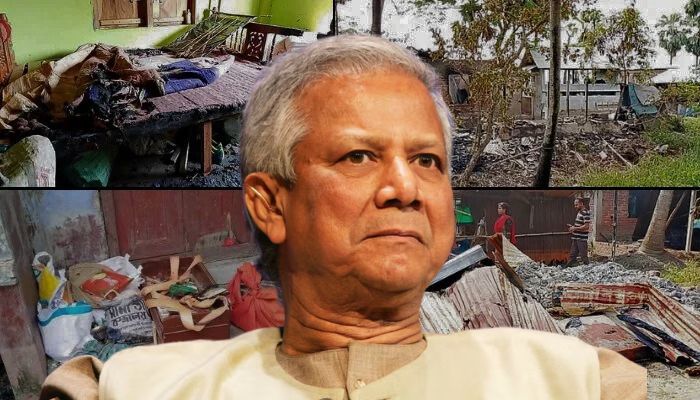
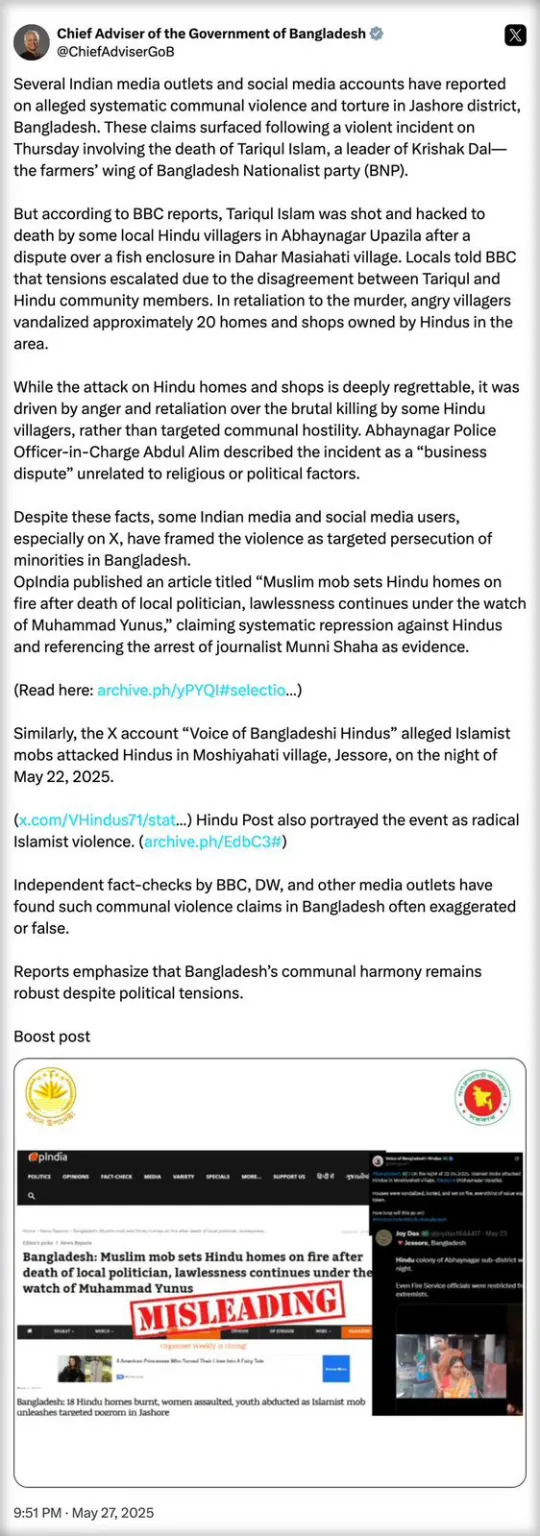
In a major development, Muhammad Yunus has deleted the tweet wherein he blamed OpIndia for ‘misleading’ about the arson attacks on Hindu homes in Abhaynagar upazila in Jessore district of Bangladesh.
In a tweet on Tuesday (27th May), the ‘chief advisor’ to the interim government of Bangladesh had claimed, “Opindia published an article titled “Muslim mob sets Hindu homes on fire after death of local politician, lawlessness continues under the watch of Muhammad Yunus,” claiming systematic repression against Hindus and referencing the arrest of journalist Munni Shaha as evidence.”
Muhammad Yunus, who came to power through a US-backed regime changed operation, tried to downplay the collective punishment meted out to the Hindu community by Muslim mobs as the result of ‘anger and retaliation’ and not ‘targeted communal hostility.’
Screengrab of the now deleted tweet of Muhammad Yunus
OpIndia had explained how Yunus vindicated our report but desperately attempted to whitewash the torture and systematic communal violence in Jessore.
Mohammad Yunus, the caretaker chief of #Bangladesh, specifically targeted #OpIndia and our reportage about atrocities against Hindus. He also justified the violence against Hindus.
OpIndia’s Editor-in-Chief, Nupur J Sharma, had additionally lambasted Muhammad Yunus and his sinister attempt to pass off the anti-Hindu violence in Jessore as isolated incident. She had highlighted how Islamists have been emboldened under his regime, with violent mobs seemingly having a free hand to persecute religious minorities.
Having realised that his tweet aimed at negating OpIndia report exposed his own Islamist nature, the ‘chief advisor’ to the interim government of Bangladesh deleted his controversial tweet.