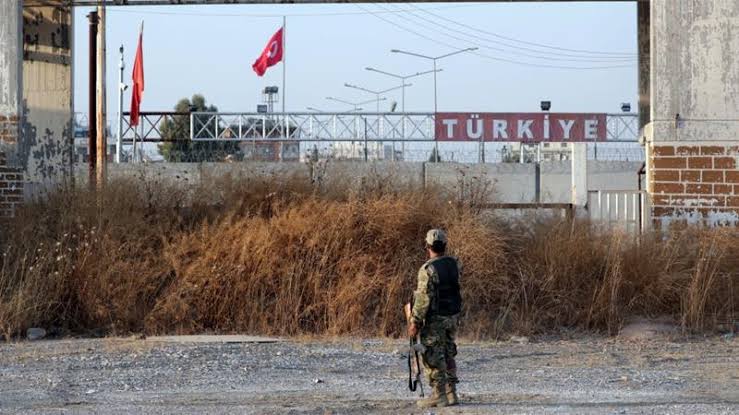
The government of India has issued a travel advisory for travellers visiting Turkey, asking them to exercise utmost caution while travelling to the country amidst the deteriorating Turkey-Syria offensive. The embassy has also furnished helpline numbers for those who might need assistance.
Soon after the US proceeded on a hasty and unexpected withdrawal of its troops from northern Syria, Turkey began its offensive against the Kurdish fighters who had been until then in alliance with the United States to fight against the Islamic State (ISIS).
Turkey treats Kurdish fighters as terrorists and to ward them off, they recently agreed on a deal with Russian President Vladimir Putin, aimed at keeping Kurdish fighters away from Syria’s borders with Turkey. The deal comes at a time when there is a pause in the Turkish offensive after a fragile ceasefire was agreed with the intervention by the US. According to the deal, Syrian and Russian forces will immediately oversee a withdrawal of Kurdish forces and set out plans for joint Turkish-Russian patrols along the border next week.
A ceasefire mediated by the US was set to expire on Tuesday evening, following which Ankara had issued a fresh threat of re-launching its offensive against the Kurdish fighters. It said there was “no need” for ceasefire now.
Amidst this worsening situation, the Indian government had preemptively issued a travel advisory for its citizens to either avoid travelling to Turkey or exercise extreme caution while travelling to the country engaged in war.
Former Karnataka Chief Minister and senior Congress leader Siddaramaiah took to Twitter today to slam the Free Trade Agreement that the government has decided to sign with ASEAN countries under RCEP.
.@narendramodi govt’s proposal to sign free trade agreement of dairy products under RCEP is against the interests of our farmers and this shall be vehemently opposed.
Siddaramaiah, using the hashtag #IOpposeRCEP said that the Modi government’s proposal to sign Free Trade Agreement (FTA) of Dairy products under RCEP is against the interests of farmers and it shall be vehemently opposed by Congress.
“More than 10 crore farmers are dependent on dairy farming for their livelihood. Import of cheap products will hurt them and inturn cause rural distress. Karnataka alone produces more than 86 lakh litres of milk and other dairy products. Under Ksheera Dhare, we had increased the subsidy to producers to ₹5 per litre. We also launched Ksheera Bhagya to ensure full utilisation of excess milk & address malnourishment issues in Children. FTA will only nullify all these. Dairy products of Australia & New Zealand are much cheaper which will make it difficult for our farmers to compete in the market. This will perish their livelihood which was strengthened after the White revolution. The objective of Int’l relations should be to enable domestic transformation by accelerating growth, preserving autonomy &protecting our people’s interests. Unfortunately, under Narendra Modi, it is collusion with cronies, submit to foreigners & kill common man”, said Siddaramaiah.
He also said that he thanks Sonia Gandhi for deciding to join the fight against RCEP and raise the issue in the parliament.
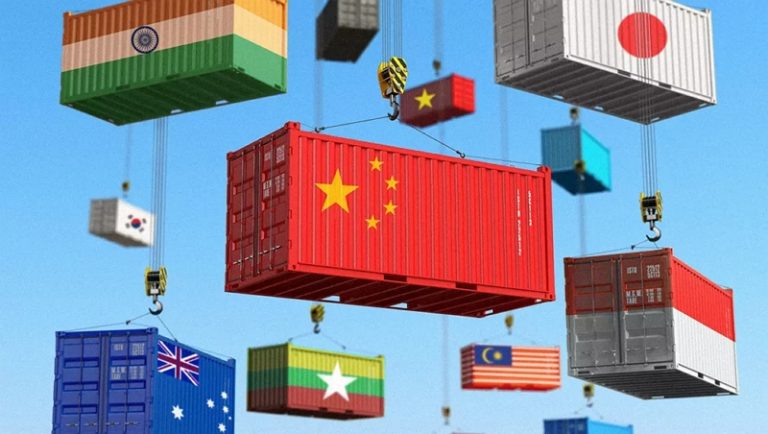
The RCEP is a proposed free trade agreement (FTA) between the ten member states of the Association of Southeast Asian Nations (ASEAN) ( Brunei, Cambodia, Indonesia, Laos, Malaysia, Myanmar, the Philippines, Singapore, Thailand, Vietnam) and its six FTA partners (China, Japan, India, South Korea, Australia and New Zealand).
RCEP is the world’s largest economic bloc, covering nearly half of the global economy and is estimated that by 2050 the GDP of RCEP member states is likely to amount to nearly 250 trillion USD with the combined GDPs of India and China making up more than 75 per cent of the amount.
The previous FTA agreements and the cost to India
It was in 2009 that India had signed a multilateral FTA with the ASEAN bloc under the Congress government. The current negotiations for RCEP were necessitated after the revenue department of the government found that India’s trade deficits owing to its various FTAs were far greater than the trade it brought in.
It was found, that India’s major FTAs constituted only 11 per cent of the total trade and up to 23 per cent of trade deficit.
Officials have pointed out that India’s trade balance is turning more unfavourable for most FTAs. It has doubled since 2011 to Rs 12.86 trillion in 2018-19.
Among the current FTAs with significant trade deficits for India, five are with countries from the 10-nation Association of the Southeast Asian Nations (ASEAN) bloc. In 2009, India had signed a multilateral FTA with the ASEAN bloc itself, which has seen imports go up at a much faster clip than exports. Exports to the 10 economies stood at $37.4 billion in 2018-19, up by 9 per cent year on year. On the other hand, imports were higher at $59.31 billion, up by 25 per cent from the previous year’s $47.13 billion.
Earlier this month, India and the ASEAN agreed to review the pact amid criticism from the domestic industry.
According to the report, due to its FTAs, India has had to let go of revenue that has more than doubled to nearly Rs 26,000 crore in 2018-19.
As per the agreement signed by India with the ASEAN bloc, it was agreed to open respective markets by progressively reducing and eliminating import duties on 76.4 per cent of all goods.
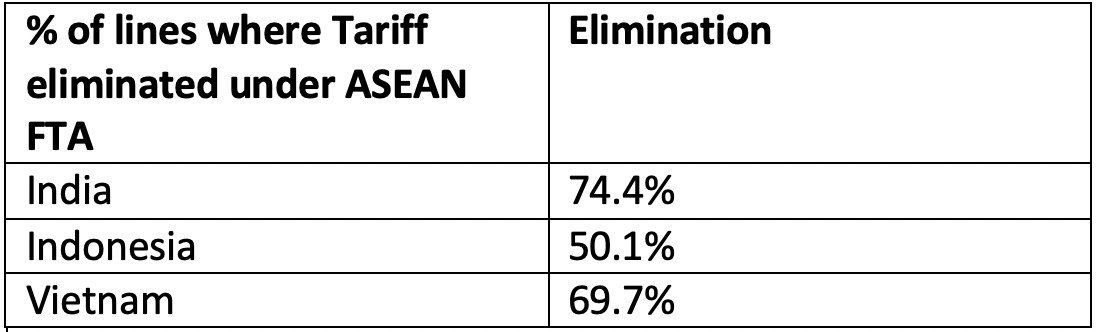
As seen below, India’s concessions to countries such as Vietnam and Indonesia are disproportionate under the Asean FTA, which is against the principle of equity. While India agreed to eliminate more than 74% of tariff lines, Indonesia agreed to about 50% and Vietnam 70%. Such tilts are the main cause of concern for the Indian industry.
Tariff during Congress rule
Current RCEP
The current RCEP talk has been in the offing since 2012 when the Congress government was in power, but as policy paralysis struck, there was not much progression in the discussions.
During a meeting earlier in October, India had negotiated a 10% advantage over China for tariff removal. This advantage for India will mean that its exporters can access 10% more Chinese product lines without facing tariff barriers.
At that time, officials had said, “India will not repeat the mistakes of the past. The Asean FTA has been tilted in favour of countries like Vietnam and Thailand. India’s trade deficit with Asean has soared since the FTA has become operative in 2010”.
Domestic Interests
Minister Piyush Goyal had just two days ago on 21st October 2019 assured that the interests of the domestic industry will be given priority while negotiating the RCEP. “Every interest of domestic industry and the people of India has to be protected before we execute any free-trade agreement”, he had told reporters.
Government sources have reiterated the same. They said that the previous deals that Congress struck had hurt India and that the current negotiations are going to ensure that domestic farmers don’t lose out. The sources also said that India had lost substantial revenue to the previous agreements with ASEAN bloc and the aim is to get a better deal for India.
Discussion with stakeholders
The government has also held varied discussions with hundreds of stakeholders from the industry with regards to the RCEP negotiations.
A PIB notification from the Government of India read:
Department of Commerce also entrusted three autonomous think tanks viz. Indian Council for Research on International Economic Relations (ICRIER), IIM Bangalore and Centre for Regional Trade (CRT), New Delhi for making independent studies on RCEP with exhaustive consultations with stakeholders across the country. Stakeholders’ inputs have been received in person from the Industry Associations/individual industries or industry clusters, by post and email.
Piyush Goyal himself tweeted that before entering into any trade agreement, the Modi government will ensure that domestic interests are protected.
Government sources have thus said that the RCEP agreement will be far better placed to protect domestic interests than the previous deals signed by the Congress government with ASEAN bloc and that any decision is only being taken after wide consultations with stakeholders from the industry.
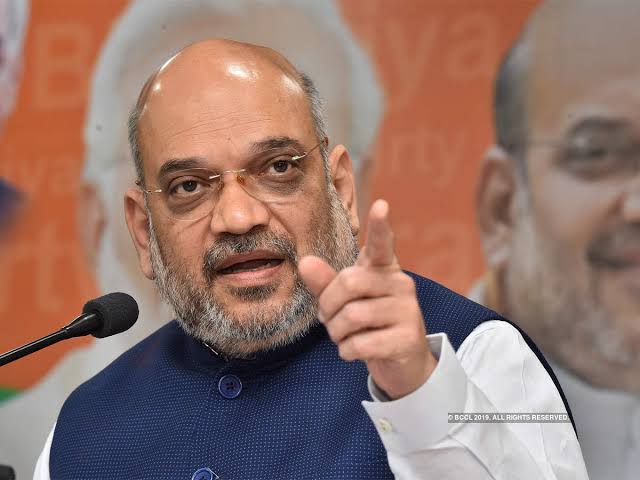
Union Home Minister Amit Shah has directed the Director-Generals of all Central Armed Police Forces (CAPF) and Assam Rifles to ensure that jawans get to stay with their families for at least 100 days in a year.
According to a report in Times of India, Union Home Minister Amit Shah has directed the CAPFs to undertake a mega manpower planning and ensure that around 7 lakh jawans get to spend at least 100 days with their families in a year.
Reportedly, Amit Shah was given a presentation last month about the functioning of the CAPFs. Following the presentation, the Union Home Minister directed that the deployment details of the troops of these forces should be digitised so that better manpower rationalisation can be done.
The Union home ministry has now asked all the chiefs or Directors General (DG) of forces like CRPF, BSF, CISF, ITBP, SSB and Assam Rifles to undertake the exercise and implement a plan where a jawan or a constable spend 100 days with his family.
If the new orders are implemented, the jawans will be posted to their nearest units, which will allow them to travel and stay with their families when there are no operational duties, a senior official said.
The senior official added that the force chiefs have been asked to assess and prepare reports of their additional manpower so that the over-all deployment of a CAPF unit is not affected.
The digitisation of data, as compared to the current system of keeping in paper file format, allows the force headquarters to easily rotate and deploy their troops. This system will also help in addressing the grievances of personnel regarding their transfer and posting to a place near to their family, the official said.
Reportedly, the forces have been given a deadline of two months to accomplish the task.
Speaking to the media, KK Sharma, former Border Security Force Chief had said last year that an average jawan of his force only gets to spend about 2.5 months or 75 days in a year with his family and if one has a service of about 30 years, then this figure comes to about five years in the entire job period.
Horrific details have emerged from the post-mortem report in the Kamlesh Tiwari murder case, which reveals that the Hindu leader Kamlesh Tiwari was stabbed 15 times and was also once by the Islamists, reports India Today.
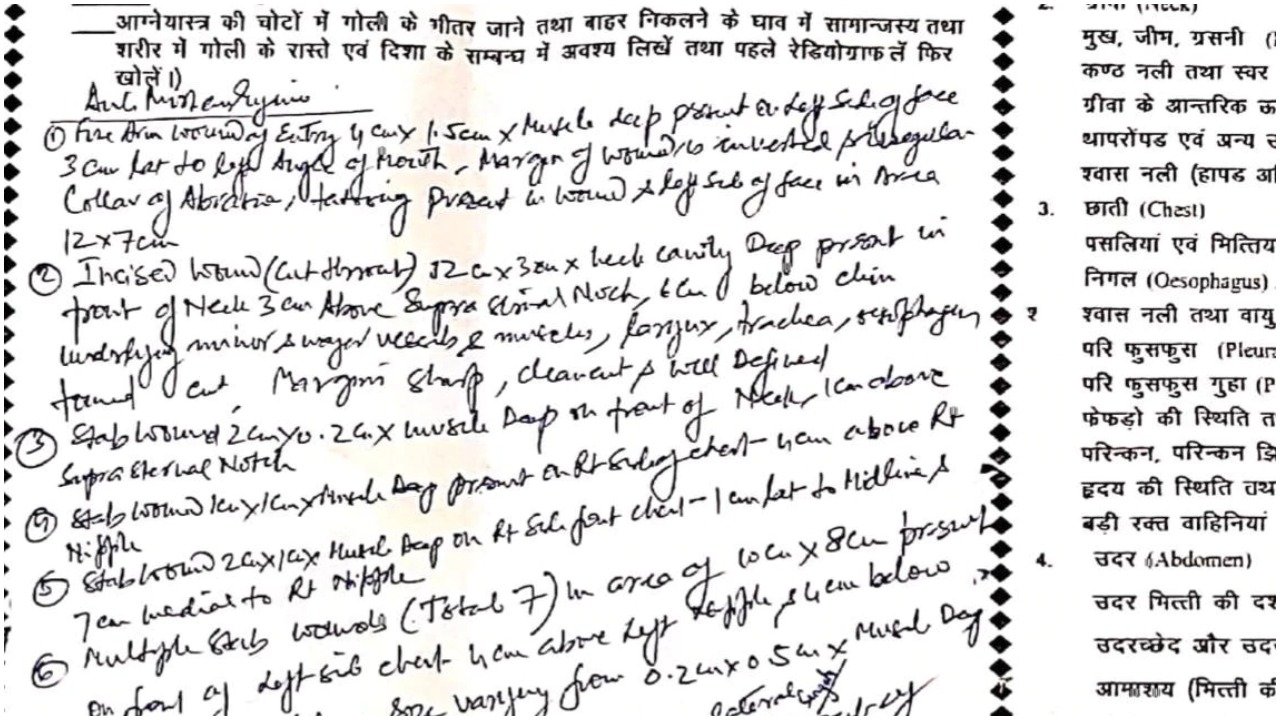
According to the reports, the post-mortem report has revealed that Kamlesh Tiwari was stabbed 15 times. The Islamists had stabbed him in the upper part of the body from jaws to the chest. The wounds were inflicted within 10 cm of each another. The post-mortem report suggests that there were two deep cut marks on the neck points to attempt to slit his throat.
The post-mortem report of Kamlesh Tiwari/ Image Source: India Today
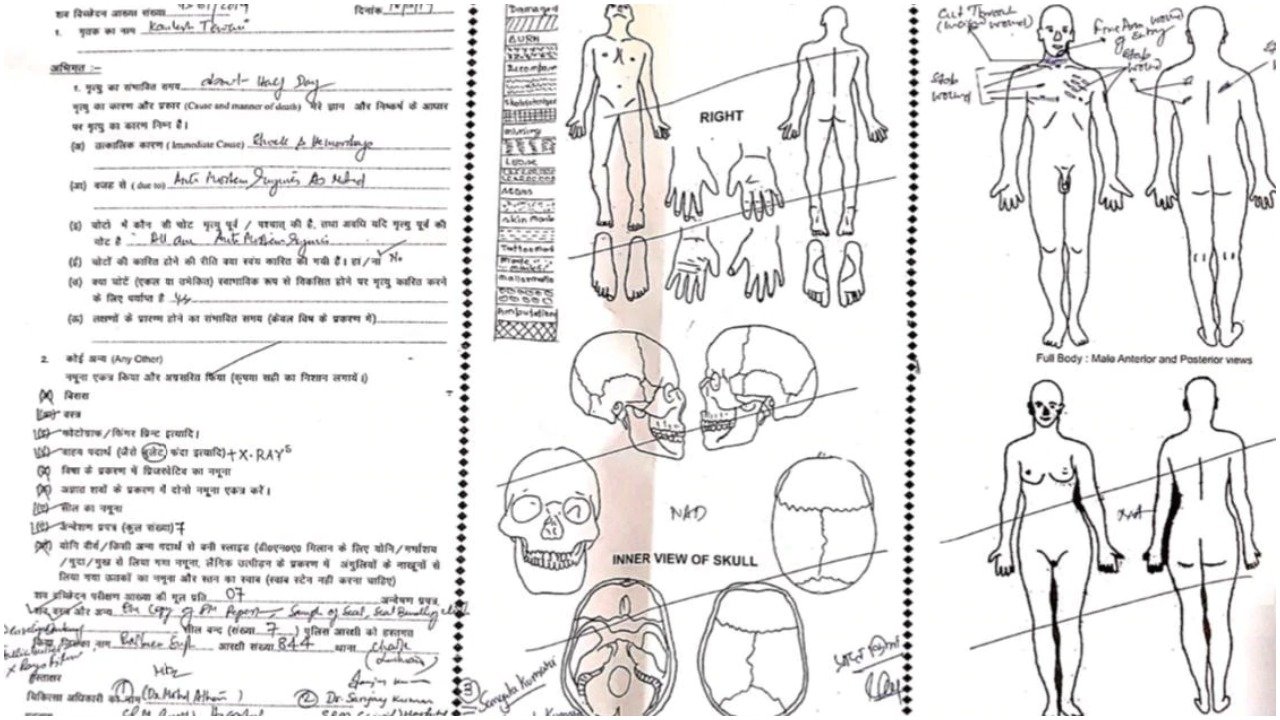
Reportedly, the attackers had also shot him once to make sure that he dies in the attack. The bullet was fired in his face. The doctors conducting a post-mortem on Kamlesh Tiwari’s body found a point 32 bullet on the backside of the skull.
Post-mortem report of Kamlesh Tiwari/ Image Source: India Today
Kamlesh Tiwari, the Hindu Samaj Party leader was murdered in Lucknow on October 18 when the assailants came to meet him on the pretext of working for his outfit. He was murdered at his home in Naka Hindola area in Lucknow.
Last night, in a major breakthrough, the Gujarat ATS had nabbed Ashfaq and Moinuddin, the two prime accused in the case from Gujarat-Rajasthan border. A team led by DIG ATS Himanshu Shukla arrested Ashfaqhussain Jakirhussain Shaikh, a medical representative in a pharma company and Moinuddin Khurshid Pathan, who worked as a food delivery boy. The duo was caught after they approached their family members after they ran out of the money they had.
Kamlesh Tiwari, a former Hindu Mahasabha leader, was assassinated at his Lucknow office by Ashfaq and Moinuddin from Surat. The Uttar Pradesh police and Gujarat ATS sprung into action to blow the lid off a Surat-based Jihadi group that was indoctrinated by one of the accused who planned the murder, Maulana Mohsin Sheikh.
Two other conspirators, Rashid Pathan and Faizan have been arrested. While Ashfaq and Moinuddin will be handed over to the UP Police for further investigation, the other three accused have already been sent to UP on transit remand.
The BJP’s push for honouring one of the country’s greatest heroes – Veer Savarkar, with a Bharat Ratna has again exposed fault lines within the Congress party. The interim president Sonia Gandhi is reportedly upset as senior leaders in the party are expressing a conflicting opinion on the issue.
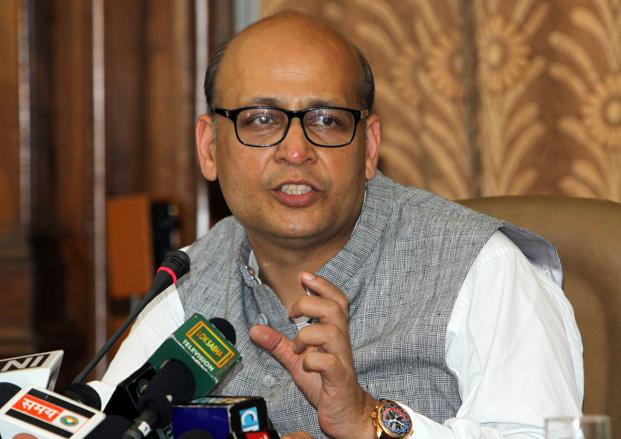
After BJP pitched the idea of a Bharat Ratna on Savarkar, Congress national spokesperson and Rajya Sabha member Abhishek Singhvi on Monday had called Hindutva ideologue Vinayak Damodar Savarkar an accomplished man who played a part in the freedom struggle and went to jail for the country.
I personally don’t subscribe to Savarkar’s ideology but that doesn’t take away the fact that he was an accomplished man who played part in our freedom struggle, flights for Dalit rights and went to jail for the country. #NeverForget
Speaking to News18, Abhishek Manu Singhvi had even said that someone cannot deny that Savarkar was a nationalist. He added, “No less than a person that Dr Manmohan Singh has said that those who ascribe villainy to Savarkar from the Congress are not right. Indira Gandhi would not have written that letter. Dr Manmohan Singh would not have said so.”
Following his appreciation for Veer Savarkar, the Congress party and its ecosystem were dejected and angry against the party leader Singhvi for expressing his viewpoint on Savarkar.
Some media reports claim that the Congress high command is upset with party leader Abhishek Manu Singhvi for praising Vinayak Damodar Savarkar on the crucial day of assembly election in Maharastra and Haryana.
An India Today report suggests that Abhishek Manu Singhvi received a call from a senior party leader about his tweet and its timing. It claims that the call was made at the behest of Congress President Sonia Gandhi who was reportedly not pleased with Singhvi’s tweet.
With party leadership taking a strong note on his tweets on Savarkar, the Rajya Sabha MP Singhvi shifted to the damage control mode, as he gave a series of explanation stating that every word he tweeted was his personal view and not the official line of the party.
Later, Singhvi had to put out another tweet toning down his praise on Savarkar. “The strength of Indian thinking has been inclusive. Many strands of the freedom movement have existed-one can’t agree with the jingoism or violent elements of Savarkar’s nationalism nor with his vicious anti-Gandhism but one can accept that he was imbued by nationalist motives,” Abhishek Manu Singhvi said in another tweet.
The strength of Indian thinking has been inclusive. Many strands of the freedom movement have existed—one cnot agree with the jingoism or violent elements of #Savarkar’s nationalism nor with his vicious anti #Gandhism but one can accept that he was imbued by nationalist motives.
Since the abrogation of Article 370, the Congress party has become a divided house as senior leaders are seen making contradictory remarks on sensitive issues. The party had faced similar embarrassing situation after many leaders came out in support of abrogation of Article 370 by the Centre despite the party taking an opposite stand against the BJP-ruled government’s decision.
Senior Congress leaders like Salman Khurshid had concurred with the BJP government’s epoch-making move claiming Congress too would have aspired to revoke the Article 370.
Former Haryana CM Deepender Hooda too had extended his support for the abrogation saying that Jammu and Kashmir is an integral part of India and such a move will be beneficial to Kashmiris. Jyotiraditya Scindia too had voiced his support over the central government’s decision to abrogate Article 370.
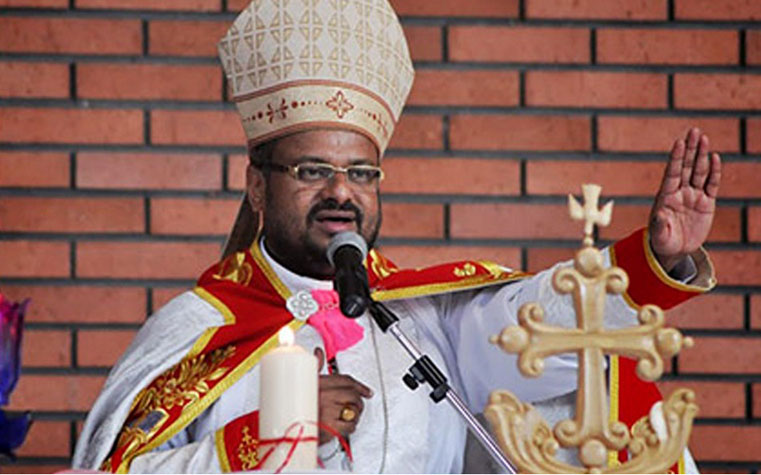
Kerala Court has summoned Bishop Franco Mulakkal who will be facing a trial November 11 onward. The charges against him will be read out in the court. This comes on a day a nun has lodged a complaint was lodged by a nun with the Kerala Women’s Commission alleging mental harassment in connection with the case concerning rape accused Bishop Franco Mulakkal, who is accused of raping a 44-year-old nun.
In her complaint, the nun has alleged that Mulakkal and his men are using social media platforms in order to defame her. She said the videos put up on social media platforms shows some photographs of the rape victim.
“The videos are intended to disrespect, abuse, intimidate and influence the witness, victim and the investigation team,” the complainant said.
Reportedly, the aggrieved nun stated that such actions are a violation of the bail conditions laid down by the Kerala High Court and sought intervention from the state women commission in the matter.
Franco Mulakkal, Bishop of the Roman Catholic Diocese of Jalandhar, was accused of raping a 44-year-old nun at a guest house in Kuravilangad in May 2014 and subsequent sexual exploitations afterwards. The nun had registered a complaint on June 2018 and has also claimed that despite her complaints, the church took no action on the bishop.
In July, Sister Anupama, one of the five nuns who led the protests against Bishop Franco last year, had alleged that there are efforts being carried out to sabotage evidence to protect rape-accused Bishop Franco Mulakkal.
In a bid to silence the protesting nurse, the Franciscan Clarist Congregation (FCC) had written to the family of another protesting nun – Sister Lucy Kalapurakkal to take her back home after she was expelled from the congregation. Sister Lucy Kalapurakkal had last year supported the victim nun and had demanded the arrest of rape-accused Bishop Franco Mulakkal, who headed the Roman Catholic Diocese in Jalandhar.
The four nuns who had supported the rape survivor nun were asked to leave the Kuravilangad convent, and go to convents, previously assigned to them. Apart from threats and intimidation, Father Kuriakose who had testified against Bishop Franco was found dead under mysterious circumstances.
Note: The report has been updated with latest information.
Delhi traffic may have been the cause of worry for its citizens, but for a 21-year-old Rijwal from Shimla, it became a boon recently. Rijwal was kidnapped by some criminals in his own car. As per reports, the 4 kidnappers had snatched his car keys, had taken him hostage in his own car parked in Janakpuri and were fleeing.
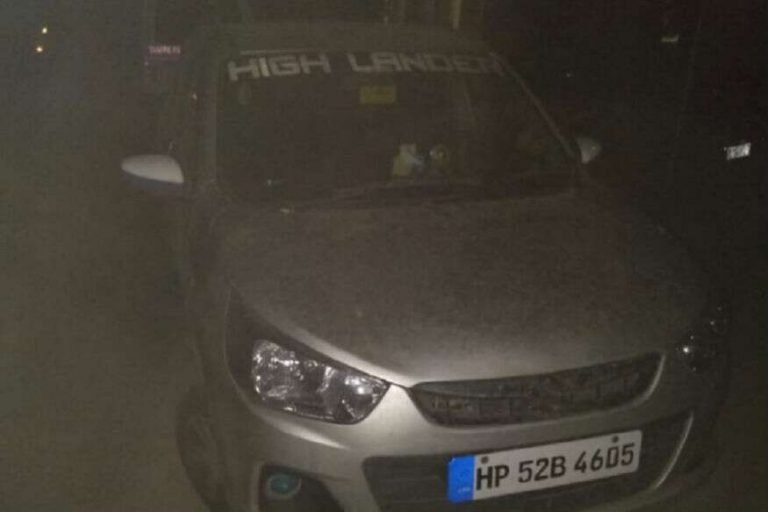
As per reports, Rijwal’s brother called the police to report the kidnapping. After receiving information from him about the details of the car, including the fact that the car has ‘Highlander’ written on it on the front, Delhi police had swung into action.
Within minutes, the car was located at Uttam Nagar. It was stuck in the West Delhi traffic. A Delhi police PCR vehicle spotted it.
As the policemen approached the car, three of the kidnappers fled away abandoning the car and their victim. However, a fourth kidnapper named Ravi was apprehended. The 1650 rupees that the kidnappers had stolen from Rijwal were also recovered.
Delhi police have registered a case under relevant sections under the Indian Penal Code.
Rijwal is reportedly a resident of Shimla who had come to study in an institute in Delhi. DGP Sharat Sinha has informed that the victim and his brother had come from Himachal Pradesh for admission in an institute in Delhi on 18 October. Rijwal’s brother, who was waiting outside the institute, had seen that some kidnappers were taking his brother away in his car and had alerted the police.
Upon Akshay’s information in the call at 100 number, Delhi police’s ASI Devendra Singh, and constables Ms Gomti and Deepak had started searching for the car on the road towards Uttam Nagar. The Himachal number plate and the ‘Highlander’ written on the front had made the car easy to spot.
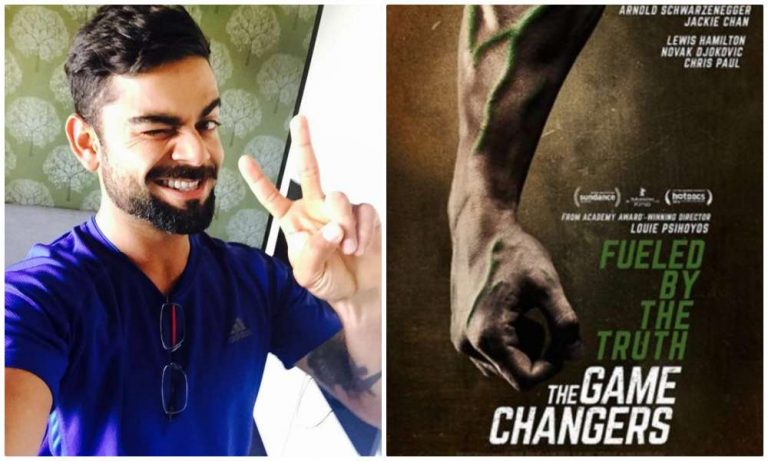
Cricketer Virat Kohli took to Twitter to talk about a Netflix documentary ‘The Game Changers’ which documents how athletes’ performance is hindered by consumption of any sort of animal products like meat, milk and eggs. The documentary talks about how not only these products have an adverse effect on their performance but it also could lead to an early death.
Saw game changers on Netflix. Being a vegetarian athlete has made me realise what I have believed all these years regarding diet was a myth. What an amazing documentary and yes I’ve never felt better in my life after I turned vegetarian.
Taking to Twitter, Kohli said that watching The Game Changers on Netflix only reaffirmed his faith in the vegetarian diet he has been following since a few years. “Being a vegetarian athlete has made me realise what I have believed all these years regarding diet was a myth,” Virat Kohli said.
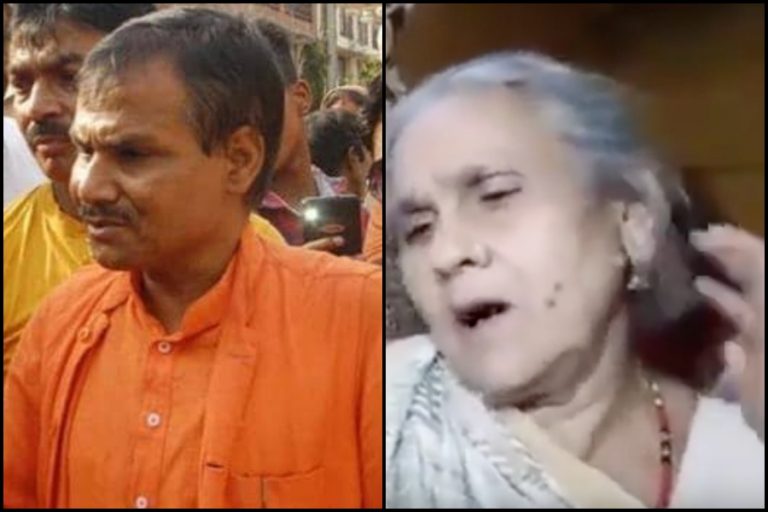
In a major breakthrough in the Kamlesh Tiwari murder case, Gujarat ATS has nabbed Ashfaq and Moinuddin, the two prime accused in the case from Gujarat-Rajasthan border late last night on Tuesday. The mother of Kamlesh Tiwari has reacted to the arrests now and said that she demands the death penalty for the accused who murdered her son.
The mother of Kamlesh Tiwari further said that she always appreciates the Yogi Adityanath government and since she has lost a young son, something or the other slips out of the mouth in grief.
She said is happy and satisfied with the investigation of the case but she wants that the killers of her son, Kamlesh Tiwari be hanged till death.
Earlier, the anguished mother of Kamlesh Tiwari, after her son was brutally murdered by Islamists, had displayed angst against the Yogi government. She had said that they have no faith in the administration.
She had said earlier that Kamlesh Tiwari got several fatwas and threats when Akhilesh Yadav’s government was in power, but he was not touched. Today, when Yogi Adityanath is in power, he has been killed. She said no matter what, Yogi Adityanath will have to get justice. She said the saga of threats has been going on since the time of Azam Khan, but he was killed in the Yogi era. In her anguished cries of losing her son, Kamlesh Tiwari’s mother demanded justice from the Yogi government.
The two individuals standing in the background then chimed in that the accused should not be turned into guests and fed in jails for long. They said that the process to award them the death penalty should be swift.
Recently, after meeting Chief Minister Yogi Adityanath the wife of slain Hindu leader Kamlesh Tiwari had said that the Chief Minister has assured swift action in the case.
On 18th October 2019, Hindu leader Kamlesh Tiwari was brutally murdered for his 2015 comments where he had allegedly insulted the Prophet of Islam. The Uttar Pradesh police and Gujarat ATS sprung into action to blow the lid off a Surat-based Jihadi group that was indoctrinated by one of the accused who planned the murder, Maulana Mohsin Sheikh. Two other conspirators, Rashid Pathan and Faizan were arrested. The Gujarat ATS had declared the names of the murderers as Moinuddin and Ashfaq who have now been arrested.
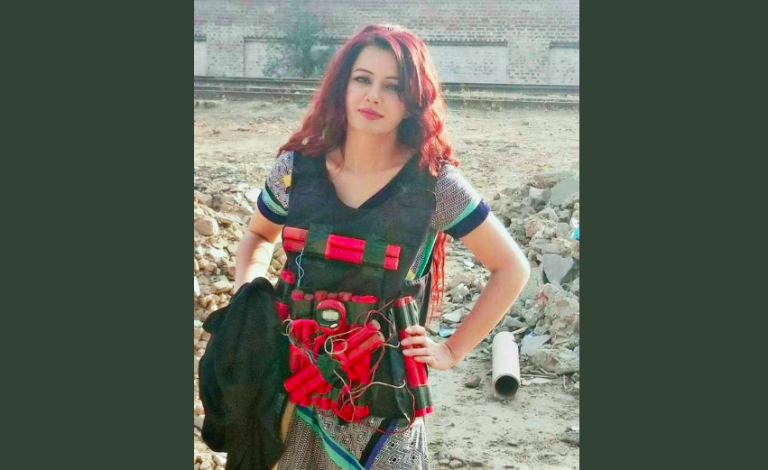
Pakistani folk singer Rabi Pirzada, who had once threatened a snake attack against Indians, especially PM Modi after the abrogation of Article 370, on Tuesday yet again displayed her deranged state of mind.
In a tweet, Rabi Pirzada threatened PM Modi of a suicide attack against him as she posed to a photo by wearing a ‘suicide vest’. Implying her wish to kill PM Modi, singer Pirzada referred him to as Hitler, while referring to herself as ‘Kashmir ki beti’
OpIndia cannot independently verify whether the suicide vest Rabi is wearing is real and in working condition.
Rabi Pirzada, who is known for her bizarre behaviour, had recently threatened PM Modi and Indians through a video in which Pirzada was seen playing with snakes, crocodile, as she claimed these are special gifts for Prime Minister Modi.
Following this, Pirzada was slapped with notice after Punjab Wildlife Department took notice of her alleged violation of law after she kept prohibited exotic animals some rare cobras, snakes, a lion and a crocodile as pets in her beauty salon in Lahore.
In January, she had gone on to buy a chicken unit after Pakistan Prime Minister Imran Khan had promised to provide poultry and livestock to women to encourage entrepreneurship in underprivileged areas. She even posted a video showing off how she successfully managed to hatch 8 desi chicks in the vicinity of her house.