Home Blog Page 6348

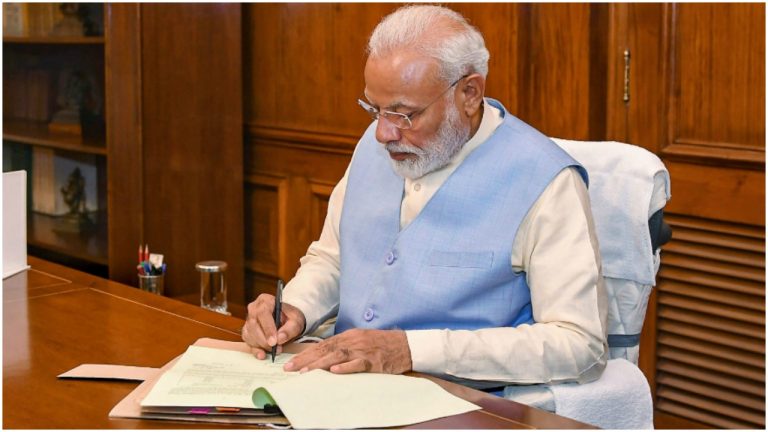
PM Modi directs union ministers to draw a ’21-Day Impactful Agenda’ for delivering citizen-centric schemes

From the very first day of his second term, Prime Minister Narendra Modi is down to serious business. In his first cabinet meeting held last week, Modi asked all his central ministers to draw up a ’21-day impactful agenda’ for delivering citizen-centric schemes in the first three months of the government’s second term.

Officials confirmed to the Economic Times that this agenda will include every ministry’s plan of delivering citizen-centric initiatives that have a direct and immediate impact on the common man.

This agenda would include a timeline that a ministry would have to adhere to. It would also include getting the minister’s nod, cabinet approval, ascertaining funding requirement and necessary arrangements.

On conditions of anonymity, an official confirmed that the ministries have been directed to frame this agenda and forward it to the Prime Minister’s Office. They have been instructed to ensure that the impact is achieved within 100 days.

The directive came last week at a meeting between Modi with all secretaries of central ministries in the presence of Union ministers Rajnath Singh, Amit Shah, Nirmala Sitharaman and Jitendra Singh, the sources said. The minutes of the meeting were sent to all ministries over the weekend.

“There are three plans every ministry has to prepare. A ‘Five-Year Vision Document’, which needs to be submitted within a month. This would specify where every secretary would like to take his ministry in the next five years. This five-year document would be broken into annual action plans with specific milestones. Every annual action plan will be broken into a monthly plan which will be monitored. But the more immediate plan would be ‘21-Day Impactful Agenda’.” This agenda would be monitored on a daily basis at the ministry level and by the sectoral experts in government think tank Niti Aayog.

The basis of this agenda is that Modi has been re-elected with the hope that he will deliver. The PM stated in the cabinet meeting that the Indian voter has outlined a vision for the next five years, and this is now an opportunity before us.

Keeping the hopes high, the prime minister further added that people were yearning for a better life and the government must focus on ensuring ease of living, and asked the officials to begin work on making India a five-trillion dollar economy.

BJP MP from Kota Om Birla to be the next Lok Sabha speaker, expected to file his nomination in the noon

As the 17th lower house sessions enter its second day, there are reports that BJP’ MP from Kota, Om Birla, the BJP has been nominated as the next Lok Sabha speaker. 10 parties including BJD and YSRCP have extended support to Birla’s nomination.


Om Birla is a two-time MP from Kota and a three-time MLA from the Kota South Assembly seat. In the recently concluded 2019 Lok Sabha elections, he defeated Ramnarain Meena of the Congress by a margin of around 2.79 lakh votes.

Birla would be replacing previous Lok Sabha Speaker, Sumitra Mahajan, who had chosen not to contest the 2019 general elections.

Earlier, names of PP Chaudhary, the ex-Union Minister of State for the Law and Justice and the Ministry of Corporate Affairs and Surinderjeet Singh Ahluwalia, MP from Durgapur Lok Sabha Constituency, West Bengal, also did the rounds but the party high command went ahead with Birla.

Meanwhile, Om Birla’s wife, Amita Birla, while speaking to ANI thanked the party for the trust bestowed upon her husband. “It is a very proud and a happy moment for us. We are very thankful to the cabinet for choosing him,” she said.


On Monday, President Ram Nath Kovind swore in the seven-term member of Parliament Virendra Kumar as the protem speaker of Lok Sabha.

Protem Speaker Virendra Kumar had then subsequently administered the oath of office to over 300 MPs on Monday.

Foreign funds sent to Islamist Asiya Andrabi were not only used to create Kashmir unrest, but also, to educate her son in Malaysia

The NIA probe has revealed that Asiya Andrabi, one of the terrorist sympathisers and pro-Pakistan separatists, had received funds from abroad and utilised them for personal gains including the funding of educational expenses of her son in Malaysia from 2011 onwards.

According to reports, the NIA has now approached the concerned authorities for providing evidence relating to certain bank accounts used by Mohammad bin Qasim, the son of Asiya Andrabi during his tenure as a student in the University.

The National Investigation Agency (NIA) has now confronted separatist leader Asiya Andrabi with the evidence related to the funding of educational expenses of her son through foreign remittances made by Zahoor Watali who is one of the influential businessmen in the Kashmir and also an accused in the terror funding case.

In a major breakthrough, the arrested separatist leaders including Asiya Andrabi had admitted their involvement in the 2017 Jammu and Kashmir terror funding case. During the NIA interrogation, she had admitted that she had been collecting funds and allocations from foreign sources for which her organisation had been organising protests by Muslim women in the valley.

Asiya Andrabi, the chief of banned secessionist organisation Dukhtaran-e-Millat was sent to NIA custody for 10 days by a Delhi court earlier this month along with Shabir Shah of Jammu Kashmir Democratic Freedom Party (JKDFP) and Masarat Aalam of Muslim League.

Masarat Alam, the poster boy of stone pelters of Kashmir has also made some significant admissions about the involvement of Pakistan in the disturbances in Kashmir. He told that Pakistan based agents channelled the funds through hawala operators which were transferred to the separatist leaders including Syed Shah Gilani who is the Chairman of All Parties Hurriyat Conference, a conglomerate of separatist parties in J&K.

‘Liberal’ World Order fallacies and the real cost of Black Liquid Gold: Those bound on erasing history cannot learn from it

The world politics in the last half a century was dominated by the ‘Black Liquid Gold’ or ‘Oil’. As our energy requirements went through the roof, the oil became ever so important, even to the extent that many of the world conflicts and wars had their roots in this black liquid. The countries with large oil reserves made a lot of money and saw their countries’ and their people’s fortunes change in a span of a few decades.

This was the same time when the ‘liberal’ world order was taking shape. In a nutshell, this world order was nothing but a misplaced belief that religious or regional identities are the root cause of all the conflicts and if the world has to move away from these violent conflicts, which cause mass killings without providing any solutions, then the regional and religious identities must diminish and class identities based on social stature and wealth should take precedence.

Some countries adopted capitalist models while others opted socialists one to bring this utopian idea to reality. As the world started becoming richer, the inherent fallacies of this idea began to surface.

The first real jolt came in the form of income inequality when people began to question the humongous wealth difference among people belonging to different trades. When a few of them were able to amass massive wealth owing to their connections and influence while most of them were unable to make their ends meet despite working more than half a day.

But did this happen the first time in the history of human civilization? Was this not always the case throughout history? Siddharth became Buddha to find an answer to this very problem, isn’t it? So why was it so intense now? Because wealth had been made the central point of existence and the only thing worth living for in the quest to erase regional and religious identities. Money started determining everything in terms of social statures, justice, equality, and all the other ‘liberal’ values that the ‘wise ones’ wanted to promote in the name of ‘liberalism’.

The humans by nature are curious and frightened creatures. They are frightened about death and are curious about the meaning of life. ‘Liberal’ values were useless when it came to answering these questions. Religions, Cultures, for all their follies, were much better equipped to address these basic questions about life and death. Wealth and worldly comforts can satisfy you only to an extent, they cannot erase these basic questions from the minds of the people.

This is where the second big jolt came to this ‘liberal’ world order. Religious and regional identities could never be erased completely but they were put in the background which meant that the vast knowledge pool of these ideologies was forgotten and was hijacked by the people and groups with vested interests. People across religions were being asked to follow rituals and practices which they did not understand and which made little sense in the present world but asking questions was made a ‘sin’.

It was a matter of time when someone with sufficient money and with a vast pool of resources would tap into this lack of intellectual bankruptcy and ‘herd mentality’ of the people. This is where Saudi Arabia and Islamists’ discovery of ‘Liquid Black Gold’ made things worse.

Every religion has different schools of thought among them, some extremist, some centrist and some more inclusive. However, Saudi Arabia and its partners represented the most abhorrent ideology among the Islamic schools of thought – the Wahabi ideology. Armed by Kuber-esque like wealth, Saudi Arabia started spreading this poisonous ideology all across the world.

The ‘liberal’ world order which had been largely successful in making religion a personal belief rather than a way to mobilize the masses, was taken aback by this aggressive propaganda to unite the Muslims all over the world based on their religion and that too which was based on the most regressive of the thoughts and practices. It simply could not counter this phenomenon.

On top of that, in its quest to appear ‘secular’ and ‘liberal’, the world establishments adopted an ‘apologist’ attitude when it came to this heinous and twisted form of Islamic teachings. The ‘liberals’ tried to portray the people asking relevant questions as racist, Islamophobic and bigots rather than addressing the very problem. This not only emboldened the dastardly forces but also made them grow in strength so much so that now across political ideologies most of the world countries agree that ‘Terrorism is the biggest threat to the world’ right now.

Now, when people are abandoning the ‘liberal’ political system all over the world, the ‘liberals’ are wondering what went wrong! They simply cannot see their own shortcomings in addressing the current world problems. They were silent and busy in victim-shaming when the world was burning around them and now they are questioning the people for opting for someone who is at least acknowledging their concerns.

On top of that, the ‘liberals’ are seen as a bunch of corrupt hypocrites who benefited the most because of this ‘greedy’ ‘liberal’ world order which put wealth as the epitome of human existence.

The establishments are being brought down, the world order is being changed, the course of world history is changing, but the privileged ones are crying foul because they simply cannot see the web of hypocrisy, lies, and moral bankruptcy that they have built around themselves in exchange for wealth and social stature which as the history suggest are as momentary as anything else. But those who are bound on erasing history cannot be expected to learn from it.

Cricket World Cup preview – England v Afghanistan: Can injury halt a win for England?

Though it should be a one-sided affair as per the form and rankings of both the teams, there are some injury-related issues for the English side as Roy is set to miss the match and no certainty for Morgan too.

England has so far easily been one of the best teams of this world cup. Having won 3 out of 4 games, they are sure to win the 4th one now. They are too strong against the likes of Afghanistan, with their batting, bowling, and fielding at their freaking best. They would be hoping for a rain-free match so that they can continue with the winning momentum.

Afghanistan has certainly disappointed everyone in this tournament. Not only they performed poorly on field, but the off the field activities also hampered their chances of winning games. First the keeper Mohammad Shahzad claimed he was fit and accused of the Afghan board dropping him without consulting and then they dropped in the most successful batsman Najibullah from the team against South Africa.

The weather is expected to have light showers during the day, a situation where teams would like to bowl first after winning the toss.

Players to watch out for

Joe Root, the leading run-scorer (279) for England in this tournament, could score another hundred. The stylish orthodox batsman has already scored two hundred in the competition. If he scores a big ton, he will surely surpass Shakib’s record of most runs (384) in this World Cup.

Rashid Khan hasn’t performed at all for the team. He and Russell have been the biggest disappointment of World Cup 2019. One of the rare players who couldn’t perform after Tendulkar predicted him as one of the players to watch out. This is the day to make a comeback as a loss here would be the end of any chance of reaching the semis.

England v Afghanistan in ODIs:

Overall: Matches 1, England Won 1, Afghanistan Won 0

World Cup: Matches 1, England won 1, Afghanistan won 0

Recent Form (most recent first): England W W L W  W, Afghanistan L L L L W

ICC Rankings: England (1), Afghanistan (10)

Upcoming Records:

Joe Root has scored 481 runs in World Cup and needs 19 more to reach the 500 runs milestone in the World Cup.

Hasmatullah Shahidi needs 44 more for 1000 Runs in ODIs, he will be the 9th Afghani player to reach the milestone.

Squads:

England: Eoin Morgan (capt), Moeen Ali, Jofra Archer, Jonny Bairstow (wk), Jos Buttler (wk), Tom Curran, Liam Dawson, Liam Plunkett, Adil Rashid, Joe Root, Jason Roy, Ben Stokes, James Vince, Chris Woakes, Mark Wood.

Afghanistan: Gulbadin Naib (capt), Aftab Alam, Asghar Afghan, Dawlat Zadran, Hamid Hassan, Hashmatullah Shahidi, Hazratullah Zazai, Mohammad Nabi, Mohammad Shahzad (wk), Mujeeb Ur Rahman, Najibullah Zadran, Noor Ali Zadran, Rahmat Shah, Rashid Khan, Samiullah Shinwari.

RJD’s gutter politics, brings out caste angle in doctors’ strike and encephalitis deaths in Bihar

Lalu Yadav’s Rashtriya Janata Dal, in an attempt to play their divisive agenda and create rifts among the masses in moments of crisis, has tried to paint the strike of doctors in Bengal and the encephalitis deaths of children in Bihar in casteist colours.

The RJD has claimed in a tweet that the Bengal doctors strike was unnecessarily highlighted by the media because the doctors who were attacked were from upper castes. It has also downplayed the rampant law and order issues and security concerns for doctors as a ‘mere beating of one or two doctors’. The party has also claimed that media and the system are not highlighting the encephalitis deaths in Bihar because the child victims are from poor backward castes.


In certain sections of media and social media, there were already attempts to brand the Bengal doctors’ strike as a ‘Savarna conspiracy’. RJD seems to be taking the exact same lines. The attempt to downplay the severity of the incident at NRS hospital where truckloads of attackers swarmed the hospital, launching vicious attacks on doctors on duty and the police negligence to bring the perpetrators to justice is also evident in the tweet.

Encephalitis has claimed over a hundred lives of children in Bihar. At the wake of a severe health crisis, RJD’s stand of bringing out the caste angle reeks of cheap political opportunism. Interestingly, when the houses of dozens of poor Dalits were torched in RJD leader Tejaswi Yadav’s own constituency, RJD had maintained a conspicuous silence.

Last year, an RJD leader and his associates had been found guilty of beating up a woman and parading her naked in Bihar’s Bihiya. Of the 15 people arrested, 6 were local RJD men. However, when the incident was first highlighted, Tejaswi Yadav was quick to blame JDU chief Nitish Kumar for it.

It is also notable here that the Yadav family had recently faced an electoral wipeout in Lok Sabha elections. The party that had once ruled Bihar and had significant clout in national level politics, could not manage to win even a single seat. Lalu Yadav’s daughter Misa Bharti was reportedly quick to take out her frustration on voters as she proceeded to cancel the projects approved under her MPLAD fund.

Bangladesh arranges Rohingyas to live on an uninhabited remote island, 21 nautical miles off the coast

The Bangladesh government is in a fix. While the government wants to shift some of the Rohingya refugees from the Cox’s Bazaar to Bhashan Char, a remote, uninhabited island situated 21 nautical miles away from the shore.

As reported by the Dhaka Tribune, the fate of the Tk 2,300 crore being undertaken by the Bangladesh Navy seems uncertain as the government and the international community including the UN are not able to reach an agreement of relocating about 1,00,000 Rohingyas from the refugee camp to the island. While the international community is in favour of decongesting the settlement, they have expressed apprehensions and is of the opinion that such relocation should take place only after the feasibility study is carried out.

As per the report, the first relocation was to take place in April this year. However, that could not take place reportedly due to the international community which is working in the camps discouraging the Rohingyas not to move to the island.

Dhaka Tribute quotes an unnamed senior foreign ministry officer of the Bangladesh Government who says that the international aid workers are fearmongering and telling Rohingyas that they will not survive on the island, due to which they are refusing to shift to the island. In fact, the Rohingyas now say that they’d rather die in the congested Cox’s Bazaar than move to the remote island.

Meanwhile, Bangladesh is also in the process of repatriating around 7,00,000 Rohingya Muslims who have fled from violence in Myanmar back to Myanmar.

India is keeping a close watch on the repatriation as there has been a rising demand of deportation of around 40,000 Rohingya Muslims who have settled in India. They are considered illegal immigrants in India. The Indian government has said that Rohingyas are a threat to the national security and are prone to radicalisation and it is willing to deport them.

Rohingya Muslims had indulged in brutal killings of Hindus in Myanmar.

Bhashan Char, which literally means ‘floating island’ emerged as an island about 20 years ago from a slit. The area was declared a forest reserve in 2013 and it regularly gets flooded between the monsoon months of June to September. The island’s area is around 10,000 acres at high tide and 15,000 acres at low tide.

It is located 21 nautical miles from Noakhali, 11 nautical miles from Jahajir Char, 4.2 nautical miles from Sandwip, 28 nautical miles from Patenga, and 13.2 nautical miles from Hatia and the only mode of commute for residents of Bhasan Char, should the Rohingyas decide to relocate to that island, will be vessels that take three to three-and-a-half hours to travel from Hatia.

No one has ever lived on the island before and was used for cattle grazing till the construction for the Rohingya settlement started.

UP: Dalit man burned to death after celebrating India’s match victory, had altercations with ‘one community’

Vinay Prakash, a 33-year-old Dalit man in UP’s Rampur Bela village in Pratapgarh was attacked and burned to death in his hut near his farm. As per reports, Vinay Prakash’s charred remains were found by his villagers along with his burned vehicle and hut.

As per reports, Vinay Prakash had watched the India-Pakistan match on Sunday night and had celebrated India’s victory. Media reports say that members of ‘one community’ had objected to the celebration and had an altercation with Prakash.

Prakash was a farmer by profession and he also herded pigs. He used to sleep in a thatched hut away from the village and near his fields. As per reports, the villagers had noticed smoke from the hut in the morning and later, Prakash’s charred remains were found inside. Some reports say that he was tied to his cot and burned inside the pig pen.

Agitated villagers had protested when the police officials from Patti station arrived at the crime scene. They were demanding compensation for Prakash’s family and immediate arrest of the culprits.

The incident has created tension in the area and police force has been deployed. Police have stated that they are awaiting post-mortem reports. Investigations into the crime are on.

Video and statistics highlights from Bangladesh v West Indies match

What an absolute remarkable win for Bangladesh against the West Indies. The victory has kept the hopes alive for Bangladesh in this tournament. They are now at the 5th position on the points table, ahead of Sri Lanka, West Indies, South Africa, Pakistan, and Afghanistan.

After winning the toss, Bangladesh decided to bowl first, on a small ground of Taunton. West Indies started poorly, losing their star batsman Chris Gayle in the 4th over. Gayle could not manage to score a run in 13 balls. A century stand partnership for the 2nd wicket between Lewis and Hope put West Indies back on track. Though Hope scored 96 (off 121 balls) for the team, it was too slow in this kind of situation. Hetmyer and Holder, in particular, smashed few sixes and scored some quick runs which eventually helped the team to score a total of 321 runs on the board.

Watch: West Indies Innings

Bangladesh had to chase the second highest score ever in World Cup history. They started well, as their openers added 52 for the first wicket. Soumya Sarkar was the first wicket to fell, an edge off Andre Russell’s short ball, to Gayle at first slip. This must have made West Indies think tanks believe that bowling short ball will help them. However, Bangladeshi batsmen were ready for this stuff, they have seen West Indian bowlers bowling the same line throughout the match against Australia and England. The batsmen started cutting and pulling the short balls for boundaries on the small ground of Taunton.

Bangladesh lost two wickets in quick succession, but Shakib and Liton Das were determined to pull off a thrilling win against the Caribbeans. The West Indian bowlers kept bowling short and wide to the batsmen, as many as 112 balls in the match of which 177 runs scored by the Bangladesh batsmen. If this wasn’t enough, they bowled 25 wides in the innings, horrifying. There was no plan ‘B’ from the West Indian bowling attack.

Shakib played sensibly and brought up his second hundred of the tournament and also became the highest run scorer during his brilliant knock of 124. On the other hand, Liton Das who was quite severe against the short balls smashed an unbeaten 94 off just 69 balls, and the pair added 189 runs in only 22 overs. Bangladesh won the match with 51 balls left in the innings.

Bangladesh Innings

STATS

  • The first win for Bangladesh against West Indies in the World Cup tournament.
  • 322 is the second highest successful chase in World Cup, Ireland chased down 328 against England in 2011.
  • 322 is also the highest successful run chase for Bangladesh in ODI.
  • Shakib Al Hasan has now 6000 runs and 250 wickets in ODI, and he is the fourth player to make this double after Jayasuriya, Kallis, and Afridi. He is the quickest to reach the double.
  • Shakib has now scored five consecutive ODI scores of 50 or more, equalling the Bangladeshi record. Tamim Iqbal was the first one to score five successive 50 plus score in ODI in 2012.

Egypt’s Islamist ex-President Mohammed Morsi dies in court where he stood trial for his connection with Hamas

Mohammed Morsi, the first democratically elected president of Egypt, collapsed in court and died on Monday while facing trial. Mohammed Morsi who was ousted by the military in 2013 after a year in office.

According to the reports, the 67-year-old Morsi had just addressed the court, speaking from the glass cage, where he was locked during court sessions and had warned that he had “many secrets” he could reveal. Within minutes of that, Morsi collapsed in the cage.

The 67-year-old Morsi was in court for a hearing on charges of espionage emanating from suspected contacts with the Palestinian Islamist group Hamas. Morsi was serving a 20-year prison sentence for a conviction after he was convicted for killing protesters during demonstrations in 2012 and a life sentence for espionage in a case related to the Gulf state of Qatar.

According to one of the defence lawyers, Kamel Madour, Morsi continued to insist that he was Egypt’s legitimate president and was demanding a special tribunal to decide his conviction.

As news of his death spread, a group of Morsi’s supporters and human rights groups raised questions about his treatment in prison. The former president was known to have been suffering from several ailments, including diabetes and liver disease.

Last year, a panel of British politicians and lawyers had concluded that Morsi had received “inadequate medical care” and found that the conditions of detention could meet the threshold for “torture.”

Morsi was also put in solitary confinement and was barred from visitors his family, who were allowed to visit only three times during that time.

The chief prosecutor of Egypt has said Morsi’s body would be examined to determine the cause of his death. However, the state TV has said he died after suffering a heart attack.

Mohammed Morsi, with the backing of the Muslim Brotherhood, Egypt’s most powerful Islamist group, won the 2012 presidential elections the country, the first free elections the country had ever seen. He was unseated on 3 July by a military coup council led by the then Defense Minister Abdel Fattah el-Sisi.