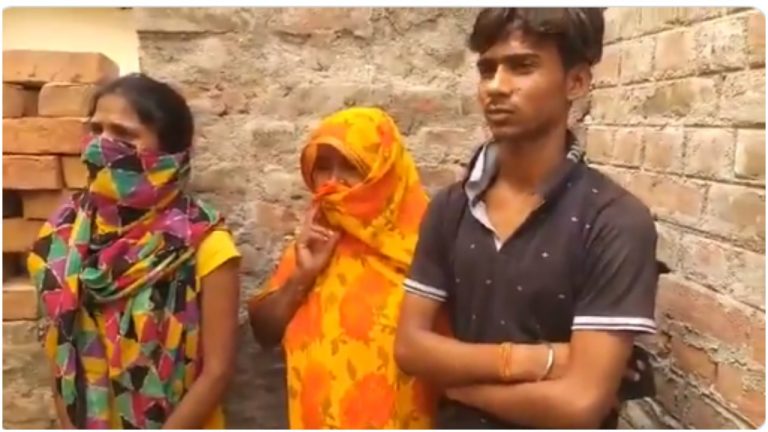
In what appears an attempt to shield the culprits, police changed the complaint of a Dalit family in Begusarai district in Bihar. According to a report by Swarajya journalist Swati Goel Sharma, the Dalit family (mother, a daughter and a son) that lives in the refinery area of Barauni Tehsil’s Nurpur village, had lodged a complaint at the Barauni outpost police station after three men barged into their home on the intervening night of June 10 and 11 and allegedly tried to sexually assault the women (the mother and the daughter) and thrashed the son. The family had submitted a written complaint in the case as no police officer was present in the police station. One of the culprits has been identified by the family as their neighbour Laddu Alam son of Feroze Alam.
Sections 447 (trespass), 341 (wrongful restraint), 323 (voluntarily causing hurt), 354A (making sexually coloured remarks) and 354B (assault or use of criminal force with the intent to disrobe) were applied among others but the Prevention of Atrocities against SCs and STs Act (SC/ST Act) was not applied.
The following day, the daughter told the Swarajya that she complained to the senior police officers who had come to meet the family, including Deputy SP Ranjan Sinha, that her complaint was distorted by the police the previous night to dilute the charges. She said that she wanted to register a fresh complaint.
Deputy SP Sinha allowed her to file another complaint and directed Suchit Kumar, the Station House Officer (SHO) of Barauni station to proceed on the new complaint. However, to the shock of the family, SHO Kumar ignored the directions given by Deputy SP Sinha and filed the FIR based on the original complaint.
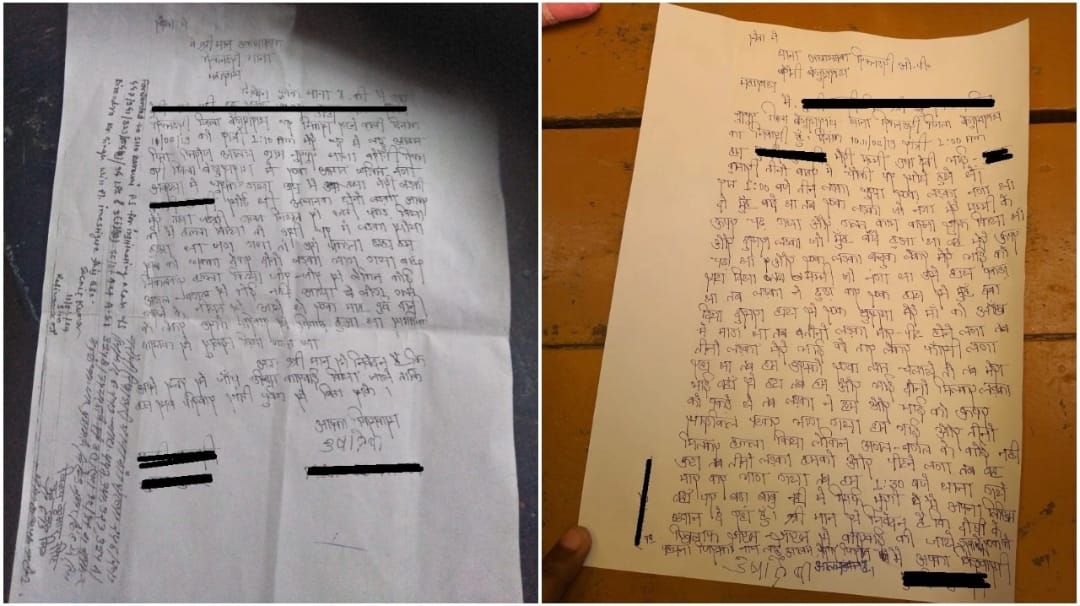
The First Complaint (Left), the Second Complaint (Right), Source: Swarajya
The family conveyed their grievance to the senior officials after which an inquiry was conducted under the circle officer. According to Awakash Kumar, SP Begusarai, serious lapse was found in the inquiry on the part of the SHO. On being found guilty, the SHO was suspended.
Based on the initial probe the police claimed that several allegations of the Dalit family including that of rape and attempt to rape have not been found to be true and that the matter is of a land dispute.
However, the mother refused the land dispute angle. The family alleged that the Muslims in the area have been pressurising the family to sell off their home for 16 lakhs, the same amount for which they bought the house of a neighbouring Hindu family, and leave the area. The Muslims had allegedly threatened the family that even the Bajrang Dal would not be able to help them. The area in which the family lives is a Muslim majority area with around 74 percent Muslims.
The family had submitted a letter of complaint to the SHO at Barauni police station last month after Firoze Alam along with his two sons including Laddu Alam attacked the family when some water spilt into the house of Alam. Worried about the safety of his family, the family’s elder son who works in Dubai had written a letter to the Indian Embassy on June 12 requesting the protection for his family.
On June 13, the National Commission for Scheduled Castes (NCSC) stepped in and sent a notice to Begusarai District Magistrate and SP informing that the Commission has taken suo moto cognisance of the case. The Commission has demanded the details of the FIRs, sections of the SC/ST Act applied, medical examination of the women, arrests in the case, copy of statements under sections 161 and 164 of the CrPC and the security and the monetary aid provided to the family.
Congratulations on a spectacular electoral victory and appointment as Cabinet Minister for Women and Child Development. You have lived up to the appellation of a giant-slayer and have stood up against the odds to carve out this win.
As concerned citizens, the authors of this article wish to draw your attention to three disturbing trends in child development, especially relating to the most vulnerable children in our society – orphans, runaways, children of the indigent and children of marginalized sections of society.
Childline services need improved monitoring
The childline services have been found to act in an arbitrary and high-handed manner. Let us point you to two aspects of the interventions that they make:
Harassment at public places
In one instance, Bihari children studying at a Veda Pathashala in Srirangam were investigated by Childline authorities. They also gave the impression in the press that these children were being trafficked. We investigated through private sources with the Pathashala in question. These children were returning home for the holidays. Most of the parents of these children could not afford to travel to Chennai and hence sent a few representatives to Chennai. The others collected their wards at Patna Railway Station. Upon their arrival at Patna, Childline Patna subsequently confirmed with the people who had come to Patna station to take charge of their wards and sent word to Childline Chennai Central. Given the background of foreign funding and the sectarian nature of NGOs running these services, we request more oversight to prevent such harassment.
Prejudiced treatment of marginalized communities
72 castes and tribes were classified by the British colonial government as Criminal Tribes, i.e., taking birth in that community was sufficient to be classified as a suspect in several crimes. The communities have been denotified, but the Indian State has not ceased its suspicion and disapproval of their frequently nomadic lifestyle.
District Childline authorities separate children as young as 7 or 8 from their parents and send them to childcare institutions in the district. In some cases, we hear of children being admitted to homes and running away from them.
In one case in Kerala, the entire band of people these children were with were removed from the State of Kerala, since the district did not have sufficient places in shelters to house these children.
Aboriginal children in Canada and Australia were separated from their parents and made wards of the State. This is no less an injustice and violation of human rights. European countries frequently harass Romani people and make them move on suspicions of crimes by these people.
The parents are charged with engaging these children in child labour or begging. In the absence of houses where the children could be left behind, the parents seem to take the children with them as they go about their usual livelihood of selling knick-knacks on pavements and other public places. If upper-middle-class women can take their children to their workplace or the small shop owners can have their children in the shop premises during summer holidays, why would the State intervene only in the case of indigent, marginalized communities?
We would insist on sensitivity training to these Childline teams as well as vetting the background of the organizations.
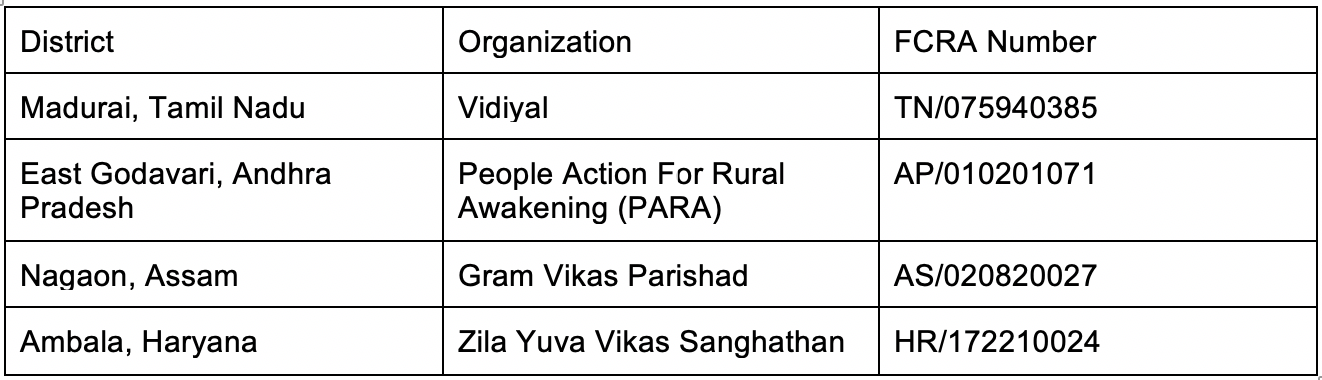
Some of these organizations have powerful vested interests abroad funding them. A small sample is shown below:
It is our earnest request that these organizations and similar foreign funded ones working in the domain of Child Rights be brought under scrutiny. Also, we need a review of penalties imposed on these organizations including
Removing empanelment from Childline
Removing FCRA registration and charitable trust status
Criminal action where required
Child Care Institutions
Media reports arrive on a regular basis about child care institutions where horrific crimes are perpetrated on the children in their care.
We suggest the following steps towards improving scrutiny of these child care institutions
Improved data gathering: The Ministry of WCD should collect a master list of CCIs across the country.
Against each CCI, the name and registration number of the trust, foundation, society or non-profit company must be registered.
The registry must be cross-linked with the Darpan Portal and registration on Darpan must be made mandatory for continued operations of child care homes.
The registry must be cross-linked with the FCRA registration database available with the Ministry of Home Affairs.
Details of key personnel, changes in the composition of the Board of Trustees and key personnel must be updated and notified to the WCD Ministry.
A comprehensive manual for the monitoring of these CCIs must be made available. The Central WCD ministry must review frequently, the monitoring mechanisms set up in the States.
The data with the WCD will be used for the following:
Prompt activation of the criminal justice system as soon as reports of wrong doing are received.
Freezing of accounts, rescinding tax exemptions of the organizations in question.
Key personnel must have passports impounded to avoid flight out of the country as in this case
Oversight over RTE monitoring and implementation
In this particular case, we point you to this article that appeared in the Indiafacts online portal in 2015.
This report proves conclusively that the entire activity of monitoring RTE compliance, following up and complaining are carried out by NGO Consortia that report into the NCPCR, which is a body set up in the WCD Ministry.
As we have seen in the last decade or so, the influence of foreign funds in our civil society has often had a malign effect on the Indian body politic.
Our humble request is to place the monitoring and implementation of such Government programmes outside the purview of FCRA funded NGOs. An appropriate modification to the rules of the FCRA may be suggested to the MHA.
Oversight and vetting in legislation
In 2017, the NCPCR under WCD ministry brought out a document to describe the powers of the Child Welfare Committee. The document included the logo of Justice and Care. JAC is a project of Waste Management Society, Yavatmal, FCRA-NGO, MH/84010051. WMS has been sent a Questionnaire by FCRA Wing (as per MoS(Home)’s reply in Lok Sabha dated 20-03-2018).
Such a questionnaire is usually the first step in an investigation. While the Ministry of Home Affairs was investigating an organization, one of its constituents, an individual by the name Adrian Phillips was a member of the committee drafting the anti-trafficking bill piloted by the Ministry of WCD.
Sufficient scrutiny is needed on individuals and organizations that are invited to participate in WCD’s legislative efforts.
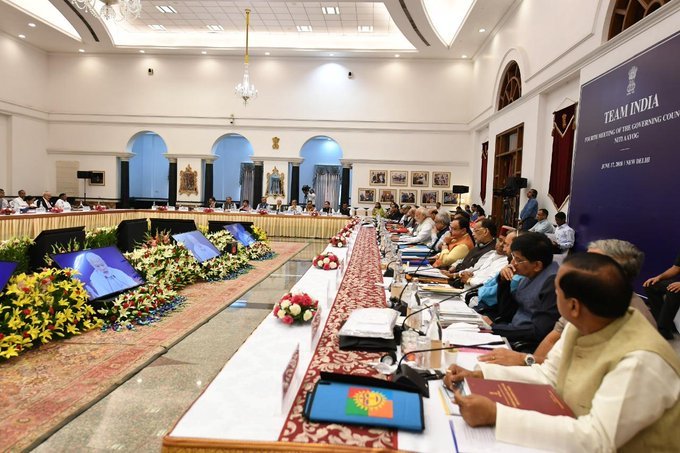
After Mamata Banerjee, Telangana Chief Minister K Chandrashekar Rao has also decided to skip today’s NITI Aayog meet. The Chief Ministers of all states were invited for a meeting to discuss the country’s development agenda for ‘New India 2022’. This would be the fifth General Council Meeting chaired by Prime Minister Modi.
According to official sources, KCR had initially intended to attend the meeting. He, however, changed his plans and wishes to meet the PM separately to invite him for the inauguration of Kaleshwaram project. On June 21st, the Telangana government would be inaugurating its prestigious Rs.80,000 crore Kaleshwaram mega irrigation and drinking water project.
The Chief Minister also wanted to meet the Prime Minister personally as he had missed the oath-taking ceremony. After having attended Andhra Pradesh CM Jagan Reddy’s oath-taking ceremony, KCR could not fly to Delhi as his aircraft was denied permission to land after 4 pm.
On the other hand, Punjab Chief Captain Minister Amarinder Singh would not be attending the meeting owing to poor health.
In a statement, it was said that the agenda of the meeting would include aspirational districts programme, transforming agriculture and security related issues with special focus on left-wing extremism (LWE) districts.
Previously West Bengal Chief Minister Mamata Banerjee decided to skip the meeting chaired by the PM. She had also said that the NITI Aayog meeting would be fruitless as they do not have any financial powers. In a 3-page letter to the PM, she had reportedly stated that it is ‘useless’ for her to attend the meet as the agenda is set by the centre without consulting the states.
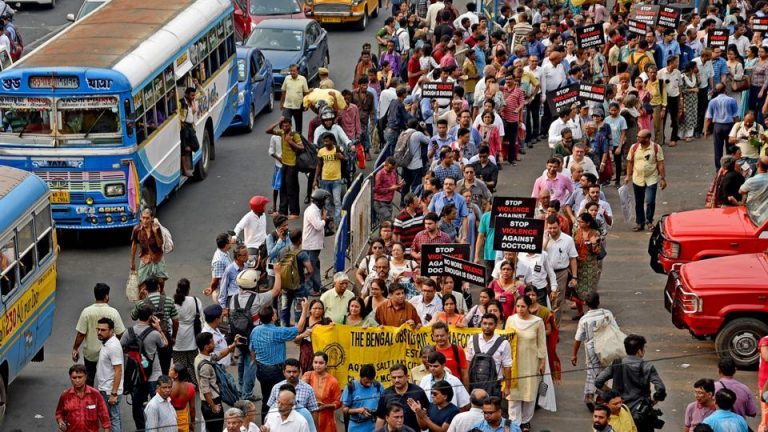
The Bengal Health crisis has acquired unfathomable proportions. It is reported now that over 700 doctors have submitted their resignations from all over the state in solidarity with the protests over the state government’s apathy towards the concerns of the medical fraternity.
Ever since Mamata Banerjee escalated matters with her threats to the medical fraternity, things have been spiralling out of control. Even as mass resignations started pouring in from medical institutions across the state on Friday, medical institutions continued to be attacked.
On Friday afternoon, the Calcutta National Medical College (CNMC) was attacked for the second time since Monday. One student had suffered a head injury as a consequence of the mob attack.
Meanwhile, the protesting Bengali junior doctors have made a chant out of Mamata Banerjee’s ‘outsider’ allegation. The chant goes:
“Who am I?”
“Outsider!”
“Who is he?”
“Outsider!”
“Who are they?”
“Outsider!”
As a consequence of the state government’s gross mismanagement of the entire issue, patients are suffering. There’s an immediate need to resolve the issue so that normal operations can begin. Senior Doctors are blaming the Trinamool government’s proclivity towards mob violence for the entire situation.
To make matters worse, Trinamool leaders themselves are being accused of threatening protesting doctors with rape and murder. Staffers at the Murshidabad Medical College and Hospital claim that that the ruling dispensation was threatening them to withdraw the strike.
There are videos circulating on social media which purportedly show the Trinamool MP from Murshidabad, Abu Taher Khan threatening the doctors at the institution. The politician, however, has denied all allegations.
This happened last evening at Murshidabad Medical College. The leader screaming at agitating junior doctors is TMC MP Abu Taher Khan Chaudhury. See how the mob that came with him is behaving.
Also witness how the fearless lady doctors of Bengal are standing up against them all? pic.twitter.com/z1m8Zekr5V
The longer this goes on, the more it will hurt the ordinary citizen. However, the ruling dispensation appears bent on intimidating the medical fraternity into submission. We had reported that Mamata Banerjee herself had derailed the ongoing discussions by threatening the doctors on Thursday, a day after constructive decisions were taken.
Politically, as well, the protests are catastrophic for Mamata Banerjee. Through her stubborn resistance towards any reconciliation, she has made it her ‘Singur Moment‘. The Doctors on strike are demanding that Banerjee meet them at the NRS Hospital. At this point, it’s the least she could do to initiate the resolution process.
The Congress government in Chhattisgarh has recently arrested a man over a social media post. Mangelal Agrawal of Musra Dongargarh, Rajnandgaon was arrested after he had shared a video which claimed that the Bhupesh Baghel government’s nexus with inverter manufacturing companies is the reason behind the rampant power cuts in Chhattisgarh.
Bhupesh Baghel’s government was so disturbed by the social media post that they had proceeded to level sedition charges on Agarwal.
The news of a man being arrested over a social media post and being charged with sedition created an uproar all over. Chhattisgarh’s Congress government, however, seems hell-bent on keeping dissenting voices muzzled.
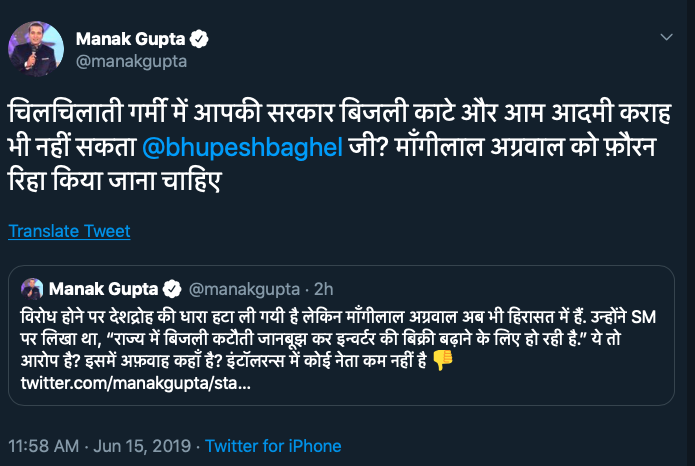
Journalist Manak Gupta had shared a Tweet, where he had stated that after widespread outrage, the sedition charges against Agarwal have been dropped but Agarwal’s post is an allegation, not a rumour. Sharing another tweet, he had stated that when the people of Chhattisgarh are suffering due to the frequent power cuts, the government is arresting people for even complaining about it. Gupta had demanded Agarwal’s immediate release.
Via Twitter
However, the Congress, who was till last week, whining over some journalist being arrested by the Yogi government in UP, has proceeded to tag Manak Gupta’s employers, News 24, and has attempted to brazen out the arrest of a man over a social media post.
Perhaps in an attempt to bully Gupta over his question to the Bhupesh Baghel government, the official handle of Chhattisgarh Congress had asked tagging his employers whether they endorse Gupta’s opinion.
.@news24tvchannel चैनल से अनुरोध है कि वह तत्काल स्पष्ट करे कि उनके एंकर @manakgupta द्वारा फैलाये जा रहे झूठ पर चैनल का क्या रुख है?
क्या यह चैनल का विचार है या एंकर का निजी विचार?
क्या इस ट्वीट को चैनल की सहमति पर झूठ फैलाने जैसे नजरिये से भी देखना उचित रहेगा? https://t.co/17ktE89Mz1
The Congress official handle has also asked whether Gupta’s tweet can be seen as the Channel is agreeing to spread lies.
It is a remarkable level of brazenness and hypocrisy displayed by a party whose president had made grandiose statements and condemned the UP government for arresting a journalist for spreading fake news and a couple of persons for running an unlicensed news channel without any official permit just days ago.
If every journalist who files a false report or peddles fake, vicious RSS/BJP sponsored propaganda about me is put in jail, most newspapers/ news channels would face a severe staff shortage.
The UP CM is behaving foolishly & needs to release the arrested journalists. https://t.co/KtHXUXbgKS
It seems Congress is oblivious and even defensive about the rights of people’s freedom of expression being trampled over in states where they are in power. Congress and Rahul Gandhi have not uttered a word against journalists and common people being arrested in states ruled by them. Worse, they seem to take the right of free speech only as a political tool and speak about it only when it is seemingly infringed in a state that is ruled by BJP.
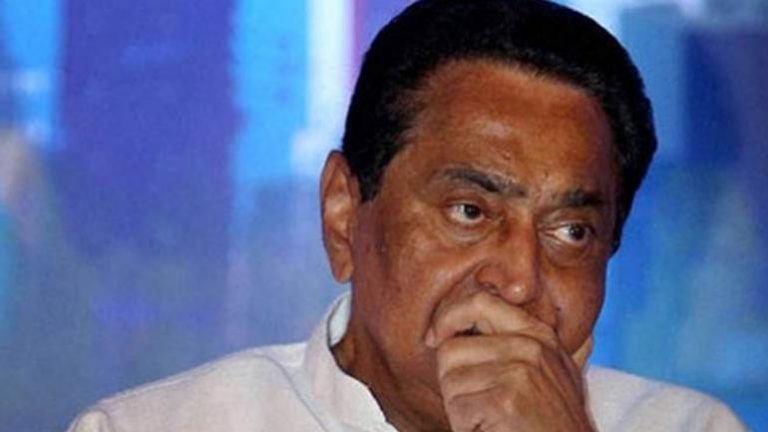
The Home Ministry has given the nod to reinvestigate old cases related to the 1984 Sikh Genocide case. MS Sirsa, the chief of Shiromani Akali Dal released a press note today hailing the Home Ministry and asserting that this reinvestigation would mean Kamal Nath, Congress leader and Madhya Pradesh CM will now be brought to book.
MS Sirsa, Shiromani Akali Dal: Now with re-investigation of the case, Kamal Nath will surely go to jail like Sajjan Kumar who too was enjoying Z+ security due to Gandhi family. His involvement in 1984 riots will be proved in the court after completion of fresh inquiry against him https://t.co/jnW6zfxlUC
Sirsa said that this order means that Kamal Nath would surely go to jail like Sajjan Kumar who was enjoying Z+ due to the Gandhi family. He said, “his involvement in 1984 riots will be proved in the court after completion of fresh enquiry against him”.
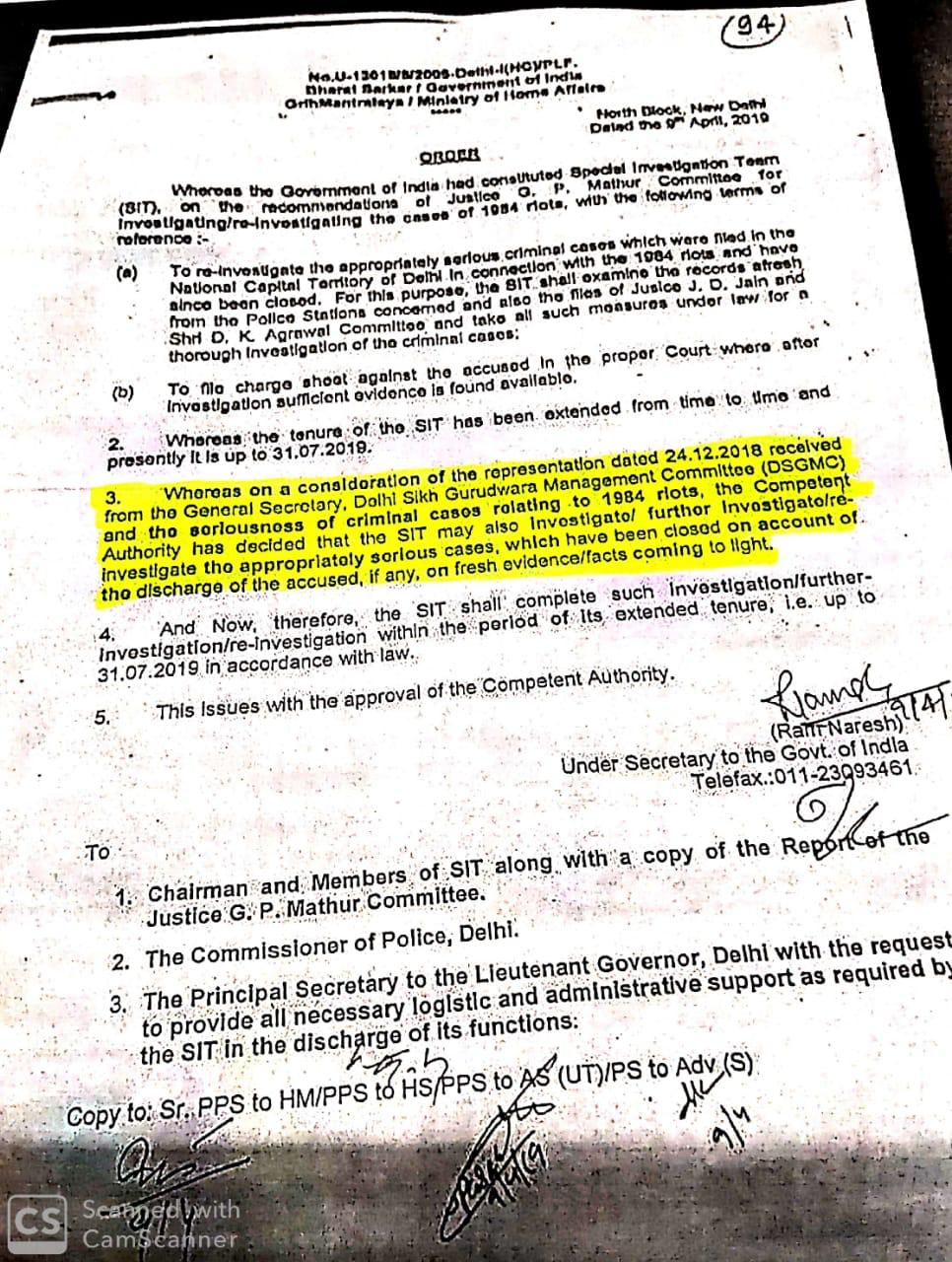
The order that Sirsa was referring to is dated April 9th 2019. The order says that the SIT should reinvestigate serious criminal cases which were filed in the National Capital Territory of Delhi in connection with the 1984 riots case and have since been closed. For this purpose, the SIT shall examine the records afresh.
Home Ministry Order
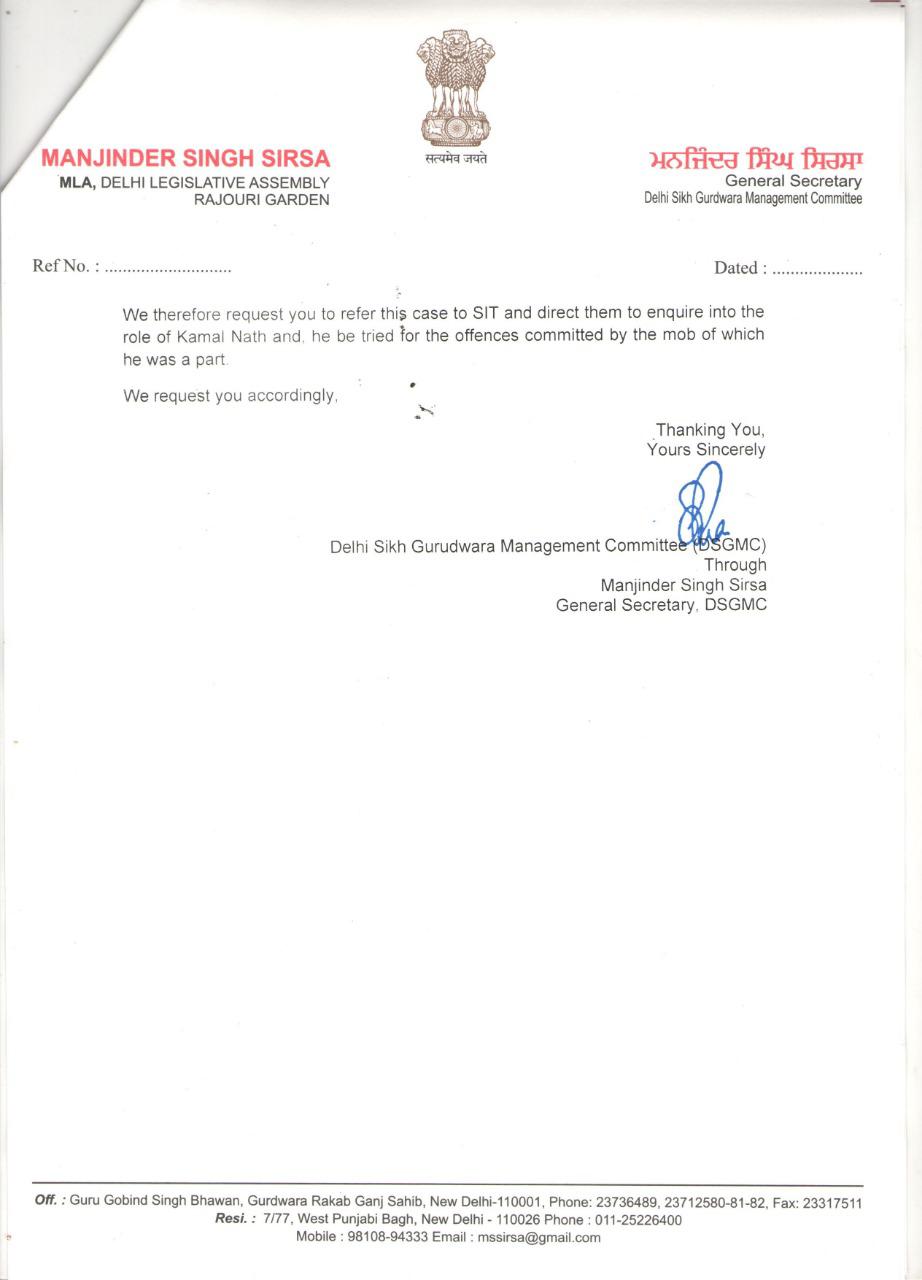
The order also says that the order has been passed in consideration of the representation made on 24th December 2018 received from the General Secretary, Delhi Sikh Gurudwara Management Committee. The order says that the SIT may investigate even cases where the accused have been discharged if any fresh information or evidence comes to light.
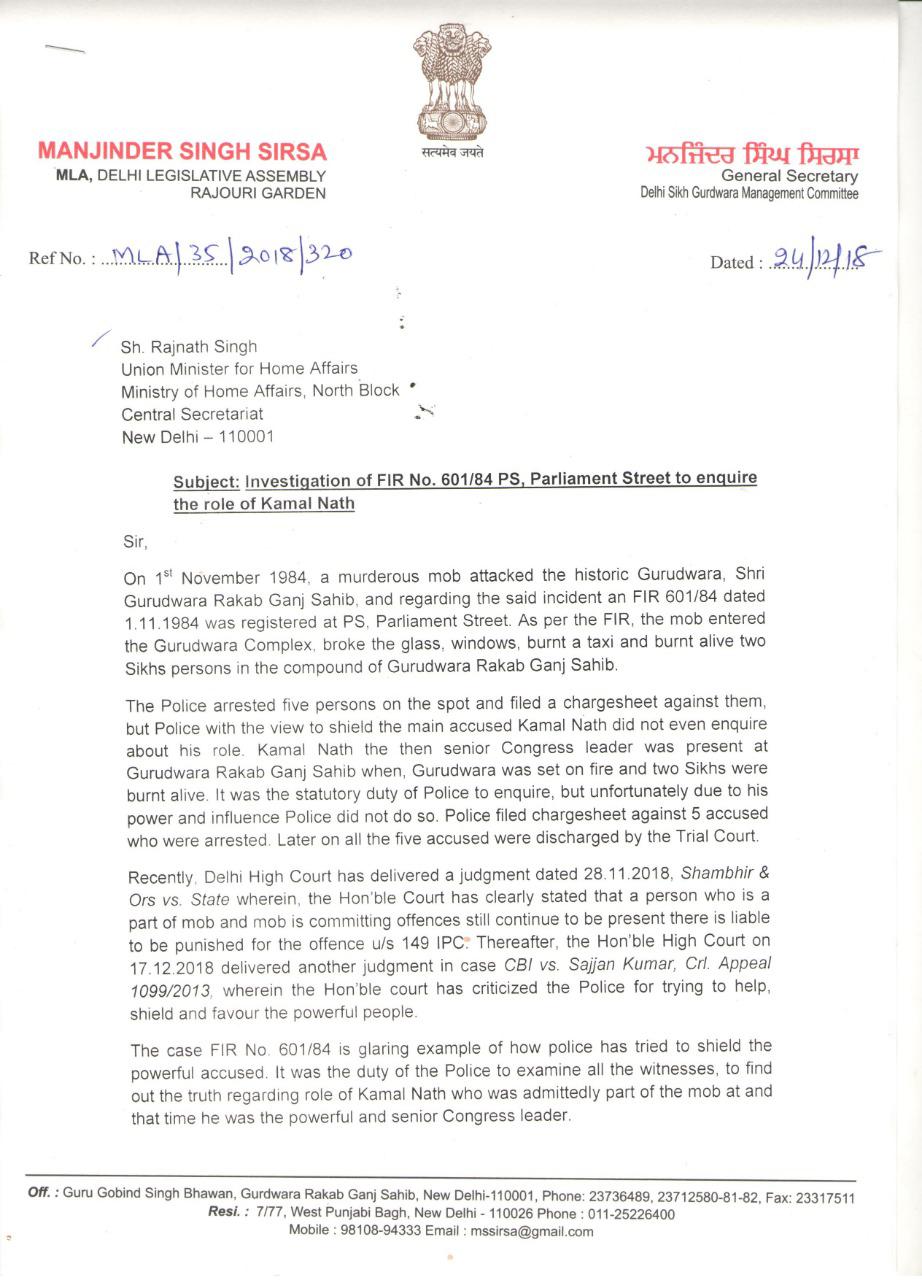
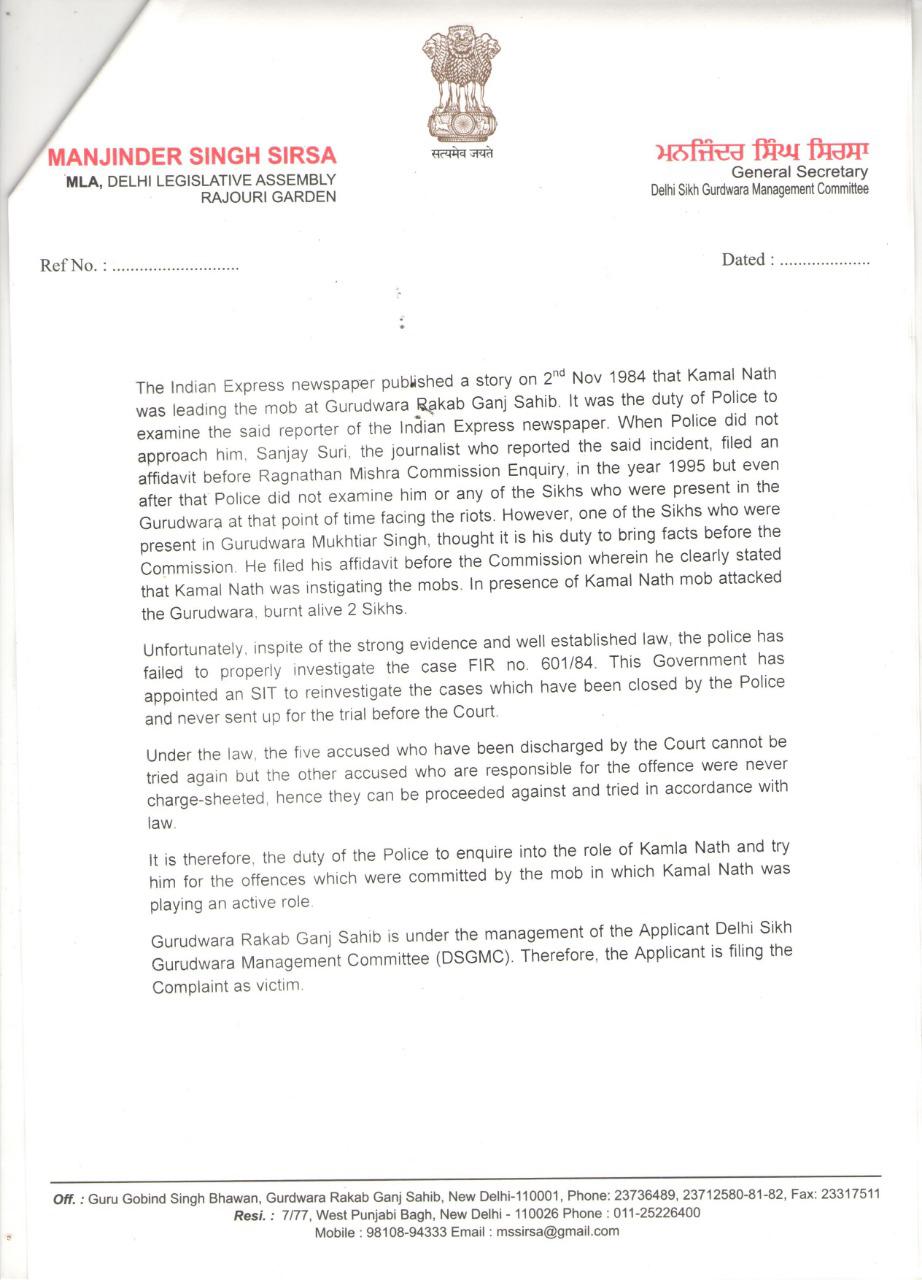
The representation that the order refers to was made by MS Sirsa. The representation spoke about the attack on Rakab Ganj Gurudwara in which Kamal Nath is said to have led the mob.
In his representation, Sirsa had said that there was clear evidence that Kamal Nath was present at the Rakab Ganj Gurudwara inciting the mob in 1984 but unfortunately the police had failed to investigate the case properly. Sirsa had said that the five people who were discharged for the crime cannot be tried in the court of law, but the real culprit was never chargesheeted and thus, it is the duty of the police and the SIT to proceed against these culprits and bring them to book.
He had said that Kamal Nath was an active participant in the mob and should be investigated.
The representation had specifically asked the Home Ministry to direct the SIT to inquire into the role of Kamal Nath.
When OpIndia reached out to MS Sirsa, he said that the order has been passed in reference to his representation and thus, it is an order to investigate Kamal Nath as well.
The language of the order certainly does seem to mean that Kamal Nath can now be reinvestigated for his alleged role in the attack of Rakbar Gang Gurudwara.
While the order was passed on 9th April, Sirsa said that he has acquired this order only now and hence, it is being reported now.
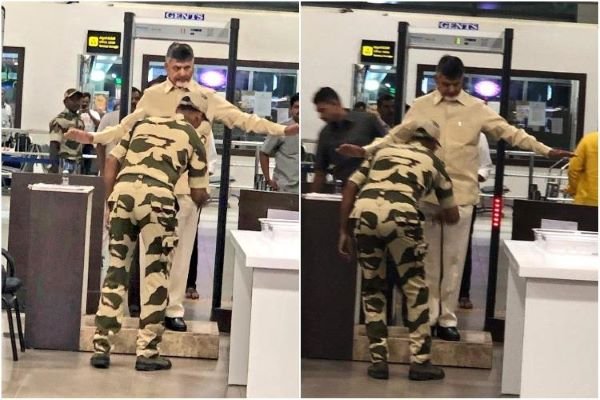
Former Chief Minister of Andhra Pradesh and current leader of opposition N Chandrababu Naidu was denied VIP access to the aircraft he was boarding and was asked to undergo frisking at Vijayawada airport.
Reportedly, airport security staff did not allow his convoy up to the aircraft. Naidu was asked to get off and undergo the regular security checks before boarding, a security guard was seen frisking him at the entrance. Following which he had to board the bus along with common passengers.
Naidu was given ‘Z plus’ category security after he was attacked by Maoists at Alipiri in Tirupati in 2003. This meant that he had 24-hour protection by 23 armed security men and escort vehicles.
The TDP has also alleged that BJP and YSR Congress Party (YSRCP) were resorting to witch-hunting while asserting that Leader of Opposition (LoP) in a state Assembly also comes with the benefits of a cabinet minister rank.
Former state Home Minister and TDP leader Chinna Rajappa said that the authorities have not only insulted the former CM but also compromised his security. He added that Naidu had never needed to face such a situation though he was in the opposition for many years. He also urged the central as well as the state government to ensure proper security for Naidu.
The TDP has had a sour relationship with the ruling YSR Congress Party after having lost in the 2019 Assembly elections. Earlier Chandrababu Naidu had decided to skip Jagan Mohan Reddy’s swearing-in ceremony despite being invited by the CM.
Noone would have thought of this kind of headline for a South Africa match that too against Afghanistan. However, that’s how it is in the current world cup scenario South Africa is just ahead of Afghanistan thanks to one point they got due to the rain against West Indies. This will be the first time these two teams play against each other in ODIs.
So far, this has been the most disastrous World Cup campaign for South Africa. Having lost the first three games, now going to face Afghanistan in a match where there is a possibility of rain throughout the day and they can’t afford another washout.
Hoping for a full match but the weather at Cardiff is expected to have a good amount of rain in the first half of the day and then passing shower during the second half, but this is a day-night match and it will start a little late. So South Africa still has a chance for a result.
South Africa is desperately looking for a win, and they are playing against the weakest team of this world cup. Their shocking performance has already let down their fans around the world. If they cannot produce a positive result in their favour then it will be bye bye for them from the World Cup.
It’s high time for them to play as a team and leave everything behind. Take one game at a time and treat every match as a knockout. They have the capability of performing, and they cannot have a better opposition to get back in form.
Afghanistan had a chance to win against Sri Lanka in the first game but lost that opportunity. Since then they look like just a traveller and have been very inconsistent in the tournament. This is mostly because they are a very young team. However, they should try to beat South Africa as the Proteas are not in great form. Afghanistan is having a problem with its star player Rashid Khan, who has not able to deliver as per his capability. If he can uplift the mood of the team with his all-around performance, there would be high chances of Afghanistan providing the biggest upset of recent times in cricket.
Players to watch out for
Rabada must be waiting to have a go at Afghanistan batsmen, with his kind of pace he can easily outdo the Afghans, and that will help South Africa not only in winning the match but also maintaining a reasonable run rate. Rabada would be excepting some help from the prime spinner Tahir from the other end.
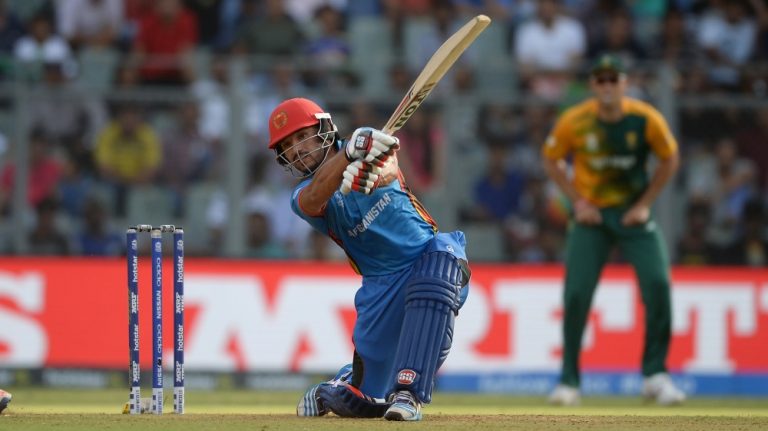
Najibullah is in form for Afghanistan. He has to cope with all the pressure and perform because others are not able to score. Afghanistan has a chance to put up a decent score on board only if he scores some runs today as well, and Najibullah would be hoping to get some support from others as well.
Afghanistan v South Africa in ODIs
Overall: Matches 0, Afghanistan 0, South Africa Won 0
World Cup: Matches 0, Afghanistan Won 0, South Africa Won 0
Recent Form (most recent first): Afghanistan L L L W L, South Africa NR L L L W
ICC Rankings: Afganistan (10), South Africa (4)
Upcoming Records
Hasmatullah Shahidi needs 54 more for 1000 Runs in ODIs, he will be the 9th Afghani player to reach the milestone.
Hashim Amla has scored 7,935 runs and needs 65 more to become the fourth South African player to reach the 8,000 runs milestone.
JP Duminy has scored 444 runs in World Cup and needs 56 more to become the ninth South African player to reach the 500 runs milestone in World Cup.
Squads
Afghanistan: Gulbadin Naib (capt), Aftab Alam, Asghar Afghan, Dawlat Zadran, Hamid Hassan, Hashmatullah Shahidi, Hazratullah Zazai, Mohammad Nabi, Mohammad Shahzad (wk), Mujeeb Ur Rahman, Najibullah Zadran, Noor Ali Zadran, Rahmat Shah, Rashid Khan, Samiullah Shinwari.
South Africa: Faf du Plessis (capt), Hashim Amla, Quinton de Kock (wk), JP Duminy, Beuran Hendricks, Aiden Markram, David Miller, Chris Morris, Lungi Ngidi, Andile Phehlukwayo, Dwaine Pretorius, Kagiso Rabada, Tabraiz Shamsi, Imran Tahir, Rassie van der Dussen.
One of the earliest signs of an Islamic onslaught in Bengal was during the late 1940s when calls for a separate Muslim nation were high. It was on 16th August 1946 that Direct Action Day was started and it is no coincidence that 16th of August was the 18th Day of Ramzan, a day when the prophet had launched the Jihad against the pagans of Mecca and massacred them in the bloody Battle of Badr proclaiming the victory over Heathens and Infidels. What is shocking is that these Noakhali riots were orchestrated by some of the most powerful Muslim Leaders who went on to hold the reigns of Pakistan.
These include Huseyn Shaheed Suhrawardy who was the then Chief Minister of Bengal and went on to become the Prime Minister of Pakistan. Suhrawardy has rightly been called the Butcher of Bengal by SwarajyaMag, played a key role in ensuring that the Calcutta Police became more Muslim by recruiting Punjabi Musalmans and Pashtuns who would turn a blind eye to the upcoming genocide in Bengal. Another key orchestrator was Khwaja Nizamuddin who later became Governor General of Pakistan gave fiery speeches on 16th of August urging violence against Hindus, with the entire Muslim League insinuating a holy Jihad against the Hindus.
The events led to the Noakhali Riots led to the deaths of over 5000-20000 Hindus and Muslims with over 75000 were displaced. Shyama Prasad Mukherjee, former Finance Minister of Bengal described the events as a planned and concerted attack by the minority community over the majority community.
The Islamisation of Bengal has been a slow and steady process, repetitive governments have chosen to ignore their rising population, rather using the community as a vote bank. First the Congress just after partition, then the communists for 30 long gruelling years and now the TMC government have just used the community for their personal gains overlooking the drastic change in population figures.
So, what exactly are these population figures? Well, for the starters the Muslim population in Bengal right after partition was close to 19.85 percent, however, in just 68 years the population of Muslims in Bengal has risen steadily to a healthy 27 percent with the next census imminent in 2 years. However, this does not include the millions of illegal immigrants majority of them Muslim who live without documents and have crossed the porous border from Bangladesh into the states of Bengal and Assam in the last few decades, the population of such Bangladeshi varies widely with different estimates putting their population anywhere from 15 million to 20 million individuals, with large number of them being based out in the State of West Bengal.
These people who speak in Bangla with a Bangladeshi Dialect are called ‘Bangal’ in West Bengal and are widely associated with being cheap labour and engaging in petty thievery and all in all acting as anti-social elements by the local populace.
The situation is so dire that out of the 23 districts that West Bengal has, almost 12 have Muslims in excess of 20 percent, 3 districts of West Bengal Malda, Murshidabad and Uttar Dijnapur are such that the Muslims outnumber the Hindus. Islam is a religion which looks down upon the use of contraceptives and practices such as polygamy lead to much higher fertility rates amongst Muslim women than that of any other religion, this has led to Islam having a much higher population growth than any other religion in the world.
Between the last decade of 2001-2011, the Hindu Population in Bengal has declined by 1.94 percent and meanwhile the Muslims have grown by 1.77 percent beating all the national trends. The Muslim population of Bengal has been growing at a much higher pace than the national average. Nationwide statistics also support the claims that Islam is on the rise, while the Hindus have declined by 0.7 percent, Muslims have increased by 0.8 percent between the period of 2001-2011.
This steady increase of Muslim population clearly reflects that the community has now become a powerful vote bank in Bengal that has been on the rise since independence, the situation has further enhanced in the last few decades as continuing CPM and TMC governments continue to cultivate the community as a vote bank and encourage the adoption of illegal immigrants into the mainstream society as well. This increase in the Muslim population has also been followed by an ever-increasing number of riots in Bengal, ranging from the riots in Malda to the ones in Baduria and the ones in Howrah.
There is also an increasing number of fatwas being issued and increasing instances of parts of Bengal being declared a part of Caliphate. However, what is even more shocking is the increasing use of radical Islam for imposing the so-called Sharia Islamic law in parts of Bengal with the State police openly condoning such activities. It was in the year 2007 that Internationally acclaimed author Taslima Nasrin was forced to flee Bengal when Muslim Leaders in Kolkata issued a Fatwa against her and announced a bounty for her head, the riots which followed to hound her out of the city were such that the army was called in to take hold of the situation. These were clear attempts by the rioters and radical Islamists to incorporate Islamic Blasphemy Laws and restrict the Freedom of Speech and Expression as Taslima Nasrin was hounded out of the ‘City of Joy’.
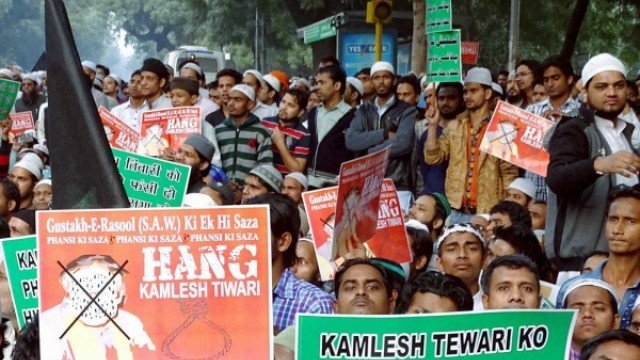
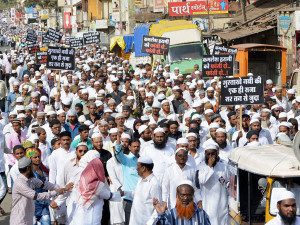
Thousands of Rioters demanding death of Kamlesh Tiwari for Blasphemy in Malda Riots. Posters read “Gustakh-E-Nabi Ki Aik Sar Tan Se Juda (Only one punishment for Blasphemy that is beheading)”
It was in 2014 that Ahmad Hassan Imran, a man red flagged by Indian Intelligence Agencies was chosen by the TMC to represent them in the Rajya Sabha, the man has been accused of instigating violence against Hindus, participating in major riots and providing shelter to terrorists. Imran is a founder and self-admitted member of the radical student group, the Student Islamic Movement of India (SIMI), a recognized terrorist organization banned by the Indian government.
The man has been a co-founder and president of the state unit of Student Islamic Movement of India, an organization banned by the government of India for its terror activities. Furthermore, he has also been involved in the establishment of Kalam, a radical magazine which has called for establishment of a Muslim state governed by Sharia, the magazine which later turned into a newspaper Dainik Kalam was sold to Saradha Group, a dubious financial entity with links to both the West Bengal Government and Mamta Banerjee. Such appointments by the Mamta Banerjee led TMC government have made the Hindu populace lose confidence in the party as it clearly has a skewered view of how secularism has to be maintained in the State of West Bengal.
The present TMC government has been so brazenly appeasing the Muslims that it has already been warned multiple times by the Calcutta High Court, read for instance the statement of Hon’ble Judge Dipankar Datta wherein he clearly calls out the TMC for appeasing the minorities: “There has been a clear endeavour on the part of the state government to pamper and appease the minority section of the public at the cost of the majority section without there being any plausible justification.”
Mamata Banerjee has taken minority appeasement to a whole another level during her reign over Bengal, right from granting of tickets to Imams and other highly regarded religious leaders of one particular community, issuing monthly salaries to Imams and Muezzins, attending annual Eid Prayers and Iftar Parties while at the same time conveniently restricting Durga Puja, a festival sacred to Hindus, designating vast majority of Muslim Communities (almost 87 percent) as Other Backward Classes despite many of them not yet designated as such by the Union Government. Universities for the minorities have been established, as have been hostels and special scholarships, along with special quotas for education and jobs. Free bicycles have been given to Muslim families, free rail passes to Muslim females and free laptops to Muslim males.
She has ensured the approval and validation of the academic degrees of 10000 previously unrecognized and Saudi funded madrasas, minarets, honorariums for imams and an exclusively Islamic township. The government under Mamta Banerjee has taken steps in the direction for the foundation of Muslim medical, technical and nursing schools with exclusive scholarships and subsidies for Muslim students, as well as Muslim-only hospitals.
Mamta Banerjee has openly spoken against the National Register of Citizens and has endorsed the illegal immigrants as well. Mamta has repeatedly taken steps that reek of authoritarianism by her pseudo secular politics of minority appeasement, the judiciary had quickly intervened and had given a sharp rap on the wrist of the TMC government when the Durga Puja Visarjan, a day sacred to all Hindus was delayed by the Government due to Muharram coinciding on the same day, however undeterred the TMC government had ignored the High Court and had gone ahead by delaying the visarjan. There were entire villages in the district of Birbhum that weren’t allowed to celebrate Durga Puja because the administration felt that it would be ‘offensive’ to the minorities.
There needs to be a clear understanding that the term ‘Secular’ does NOT mean curtailing the rights of the majority for the endearment of the minority. From changing the words Ram Dhenu to Rong Dhenu and Akashi to Asmani, TMC needs to reconsider their pseudo-secular tactics lest the sleeping Hindu in Bengal awakes.
With a 27% Muslim populace in Bengal, there is enough political incentive for the authorities to dubiously work toward the progression of an Islamist agenda. In certain areas, for example, the fringe area of Murshidabad, which is over 63% Muslim, accepted shariah is forced on all inhabitants. By far most of the political candidates, elected officials and administration are Muslim and the monetary and economic prospects for Hindus diminish as Muslims refuse to back the businesses owned by Non-Muslims. Posing with the Quran, wearing a Burqa and such minority appeasement tactics by the present TMC government has ensured that the entire Muslim vote bank continues to remain in their kitty. With just another 10 percent or so of the Hindu votes, Mamta Banerjee can easily retain power in a three-way contest in state assembly polls.
In the last decade or so there has been a stagnation in the leftist parties in Bengal, leading to a void in opposition, the BJP has stepped up at the right moment to fill that void, with her ever-rising antics and unmistakable tilt towards one community, Mamta Banerjee has ensured a highly polarised Lok Sabha Election in 2019 and this polarisation figured greatly in the results which clearly show that the people of Bengal have now chosen a viable alternative to the TMC. After coming to power the Mamta led government had manufactured a large number of cases against the CPM cadre and systematically dismantled their machinery leaving the people of the state with no alternative, the BJP has stood up as the alternative and have almost doubled their vote share in the recent elections.
The recently concluded Lok Sabha Elections of 2019 gave a clear majority to the NDA, with the alliance making major gains in the state of West Bengal compensating for the losses sustained elsewhere. The tally increased from a lowly 2 seats in 2014 to a staggering 18 seats in 2019. The vote share has also drastically increased from a respectable 16 percent in 2014 to more than 40 percent in 2019. There is a section of the so-called Bengali Intelligentsia who consider themselves superior to the rest and look down upon the politics of BJP in poor taste and undignified to the Bengali way, calling it a conspiracy of the crass, uneducated people belonging to the cow belt of the north. However, the mandate of the people has shown that they have decidedly chosen an alternative to the pseudo-secularism of Mamta Banerjee and TMC.
Bengal has historically been a land of intellectuals, gifting India well renowned social reformers, educationists and artists ranging from Vidyasagar to Rabindra Nath Tagore and Subhash Chandra Bose. However, in the land of these greats, a man should be able to stand tall, chest broad and shout Jai Shree Ram without the fear of being incarcerated or the threats of being flailed given by the Chief Minister herself. The day is not far when the streets of Kolkata will reverberate with the slogans of Joy Shree Ram and the popular mandate would have rejected the politics of pseudo-secularism and minority appeasement.
Millions of Indians today would term West Bengal chief minister Mamata Banerjee is arrogant. Or why she wouldn’t pick up the phone calls from Prime Minister Narendra Modi or returns call to state governor Keshari Nath Tripathi when the crisis is as grave as Cyclone Fani or the state is sitting on a time-bomb on doctors’ agitation?
Tens and thousands of us would also call “Didi” a fascist. Or why she would jump out of her caravan and confront people who are merely chanting “Jai Shri Ram”, a matter of greeting among India’s masses? Or why she would tell the agitating doctors to return to work within four hours or face the consequences?
Lakhs of Indians won’t deny either that she is communal in her approach, favouring Muslims and running down Hindus. Or why she would change “ramdhenu” with “rangdhenu” in textbooks? Pass the stricture that idol immersion in Durga Puja must be postponed on Muharram day?
An overwhelming number of us would also term Mamata Banerjee as an autocrat. Or why she would deny prominent opposition leaders, from Amit Shah to Yogi Adityanath, from landing on her turf for election rallies? Tear up the posters of BJP’s rallies? Pull up custom officials who have the temerity to stop her relatives at the airport?
A still bigger number of us would’ve no doubt that the only news emerging from West Bengal for so many days is violence. Mamata Banerjee and her TMC must take the blame for violent politics. So rampant is the politics of blood that 34% of seats in Panchayat elections go uncontested. Or the lynchings which take place regularly on Bengal’s streets.
None of us would also deny that Mamata Banerjee is undemocratic and unconstitutional. People (Priyanka Sharma) are jailed for posting memes on WhatsApp; professors (Rakesh Sinha) is booked for inciting violence when all he has done is to visit a temple with his mother.
Millions would nod in affirmative that Mamata Banerjee resembles a dictator in Bengal. The bureaucracy is under her thumbs; police is an extension for her coercive politics and is shielded from investigations by Central agencies. She even resists interventions of the Supreme Court. Look at the entire doctors’ agitation in West Bengal now.
Millions would’ve also heard about the ongoing Saradha, Narada and Rose Valley scams and the charges that Mamata Banerjee is corrupt. The corruption charges have engulfed her TMC party.
All too often we hear that terror network and jihadi forces are rampant in West Bengal. That terror-network Jamaat-ul-Mujahideen has taken roots in the state. The news that radicalization has taken place in madrasas in districts such as Bardhaman. That the dreaded Islamic State (IS) has named a new “emir” in West Bengal. How would Mamata Banerjee deny the allegation that she is a “secessionist” and one of India’s “tukde-tukde” gang?
Now please put all these adjectives together: arrogant, fascist, communal, autocrat, violent, undemocratic, unconstitutional, dictator, corrupt etc together. Name one person who has been called all this by India’s ecosystem in the last five years: Yes, you are right—Narendra Modi. And I challenge you to show one instance in our mainstream English media—Lutyens Media—who has ever accused Mamata Banerjee of such traits.
What is an ecosystem? The ecosystem isn’t the government in power. The ecosystem is a network of politicians, media, academicians, lawyers, bureaucrats, institutional heads, cultural czars etc who work in unison to push a particular agenda.
So think about the politicians (such as Rahul Gandhi, Mehbooba Mufti, Omar Abdullah, Akhilesh Yadav, Mayawati etc), journalists (Shekhar Gupta, Rajdeep Sardesai, Sagarika Ghose, Barkha Dutt etc), lawyers (Prashant Bhushan etc), academicians (Prof. Ram Chandra Guha, Faizan Mustafa, Rajmohan Gandhi etc) institutional heads (former Election Commissioners, Police Commissioners, Ex-Chief Justices of India who occupy the edit pages), cultural czars (Javed Akhtar, Kamal Haasan etc) etc. Look at their twitter timelines to show me if they’ve ever accused Mamata Banerjee of being communal, autocrat, corrupt or instigating lynchings etc. How is that when the rest of India has almost a similar opinion on Mamata Banerjee, these biggies who occupy our ears, eyes and minds have a completely different opinion?
It is easy for India’s ecosystem to do whataboutery. So when violence happens in Bengal, it’s both TMC and BJP who are guilty. If provocation happens, both TMC and BJP are at fault. If communal issues are flaring up, both TMC and BJP must take the blame.
But now the eco-system is in a bind. The doctors’ agitation can’t be blamed on BJP. It’s people who are rising up against Mamata Banerjee’s TMC in the state of Bengal. You can resort to propaganda against RSS and BJP, weave themes on lynchings and communalism but how do you face up to the wrath of millions. It’s the people of India who stood up to the ecosystem and showed it the mirror in the 2019 General Polls. It’s the people who are again exposing this network in rapidly deteriorating West Bengal.
As they say, you can fool some of the people all the time. But you can’t fool all the people all the time.