Home Blog Page 7169

Shutdown of Sterlite copper plant in Tamil Nadu would put 30,000 jobs at risk, claims company

The Sterlite copper plant in Thoothukudi, which was permanently closed by the Tamil Nadu government following massive citizen protests might put 30,000 jobs at risk as reported by IANS.

As per the report, the Chief Executive Officer (CEO) of Sterlite – P. Ramnath has estimated that about 30,000 direct and indirect jobs are on the line following the closure. He also claimed that small and medium industries amounting to 800, which depend on their organisation for smelter would face supply disruption.

He also claimed that besides employees, India Economy as a whole would suffer owing to the shutdown as the country’s annual import bill would rise by $2 billion. This he claimed was owing to Sterlite being one of the largest copper producers in India, with clients ranging from sectors like defence and electrics now having to rely on imports.

As reported by Swarajya, this decision to permanently seal the plant following the violent protests which resulted in the death of 13 protesters. These violent protests were mainly prompted by the proposed expansion of the plant, which would have potentially increased the plant’s total output to 4.2 lakh tonnes per year.

These protest supposedly prompted by environmental concerns had seen a lot of political slugfest with Congress President Rahul Gandhi falsely accusing PM Modi and the RSS for the protesters’ deaths.

Such a moral high ground by the Congress party was considered ironic by many owing to it being reported that it was the Congress-led UPA government between 2007 and 2012 which had backed the proposed expansion.

This backing included – approving the proposal for setting up 2×60 MW coal-based captive power plants in March 2007, environmental clearance for copper smelter’s expansion in  August 2007 and a fresh environmental clearance in 2009 for the said expansion.

Things didn’t stop at that and in July 2012, the Congress-led UPA government had permitted another construction at the plant.

BJP worker murdered allegedly for his active participation in West Bengal Panchayat elections

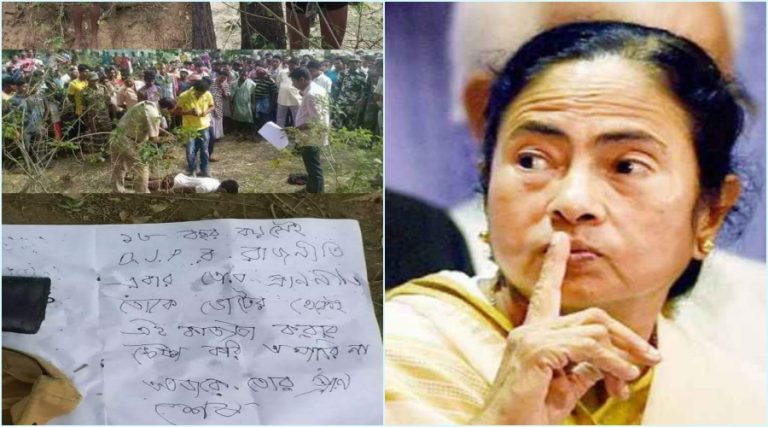
In a shocking incident, a BJP worker was found hanging from a tree in the jungle near the village of Balarampur. The area comes under the jurisdiction of Purulia police station, West Bengal. The youth has been identified as Trilochan Mahato. According to BJP, Mahato was dragged out of his house by masked goons. They have also alleged that he has been murdered because of his active participation in the recently concluded West Bengal Panchayat elections that were marred by rampant violence, rigging, booth capturing, ballot box capturing and intimidation of voters.


A note has also been found near his body that allegedly says that he has been murdered because he was in the party when he was a minor.

The information that has emerged is still unclear on many details of this murder. India Today has reported that the police faced protesting BJP workers but the body has not been recovered and investigations are underway.

While talking to India Today, the District BJP President said that all winning candidates of the Panchayat elections were holed up in the BJP party office there. He said that the violence has been happening since nominations were filed during Panchayat elections. The winning candidates have not been able to return to their house because they are being threatened. He alleged that even the police were threatening them and saying that they shouldn’t be working for BJP.

The Panchayat elections were marred by severe violence. A pregnant relative of a BJP candidate was reportedly raped by TMC goons. In another incident, a BJP supporter was publicly and brutally thrashed by a TMC Minister. Unknown gunmen had also hijacked ballot boxes to ensure free and fair elections are not held. In fact, the TMC had also won 20,000 seats uncontested because opposition candidates were not allowed to file nominations.

Hindu users ‘targeted’ with Islamic ads on Facebook and Google

You might have seen advertisements that ask you to ‘become a Muslim’ or know more about ‘how Islam is a better religion’ on some websites you visit or on platforms like Facebook. In fact, such ads could have been seen on OpIndia website too on some occasions. Some readers had ‘complained’ to us about this by writing to us:

Anti-Hindu religious conversion ad
A reader complains about Islamic propaganda ad on OpIndia

For the record, OpIndia uses Google Ads. These ads are served on the basis of algorithm that Google employs. A user’s past surfing behaviour e.g. what other websites he had visited or what terms he had searched for, etc. play a major role in the ads you see on our website or any other website displaying Google ads.

OpIndia doesn’t choose to display any particular ads to you that are served through Google Ads. Some advertiser is putting money to target you for Islamic conversion based on your virtual profile and activity. The identity of this advertiser is known only to Google and not to OpIndia. If you click on the ads, you may find more details, but we do not encourage this behaviour.

Similar ads propagating Islamic conversions have been reportedly being served on Facebook too, and recently a user shared the following information behind why such ads were being served to the readers:


The image seen in the above tweet is a piece of information provided by Facebook, which has recently tried to bring some transparency in the way ads, especially political ads, are served on their platform after the Cambridge Analytica fiasco.

As can be seen in the screenshot, Facebook has disclosed that an ad named “Truth About Islam” – which the Twitter user @Radhasureshbabu described as content advertising Islam as ‘better alternative’ to Hinduism – was ‘targeting’ people who had ‘Hinduism’ as part of their profile on Facebook.

In essence, some individual or entity is targeting users who are Hindu or are interested in Hinduism and is trying to serve them ads that propagates Islam. The details about who is funding this Islamic ad campaign was not disclosed by Facebook because the social media giant had announced last month that it will disclose who paid for the ads only for the ‘political ads’.

While it can be argued that propagating one’s religion is not illegal or unethical, this ‘targeting’ of Hindu users can prove to be controversial. Not only on Facebook, in all probabilities, Google Ads are also being served based on keywords targeted at Hindu users, making them exposed to ads that propagate Islam or other religions.

It should be noted that controversial Islamic preacher Zakir Naik also used to claim that he was only propagating Islam – which was his constitutional right –  before he started propagating openly anti-Hindu messages, and was later found indulged in anti-national activities.

Last year in September, both Facebook and Google had to face criticism for allowing ads that encouraged anti-Jewish sentiments. Anti-semitic terms were available for ‘targeting’ on both the platforms, and Facebook had announced measures to restrict such ads after the controversy broke out.

Large scale job creation strategy needs focus on low-end manufacturing

0

India is approaching a huge window of opportunity in the form of its “demographic dividend”. From 2020 to 2040, India will have a large and growing section of the population in “working age” (15 yrs to 60 yrs) giving it a bigger workforce than China’s. Deploying this large young workforce in productive areas could potentially create huge economic output in the long run.

One of the immediately available low hanging fruit with quick results is in low-end manufacturing like apparel, footwear, and leather. Currently, China has a huge 40% market share in apparel exports. India, Bangladesh, and Vietnam appear in a distant 3% to 5% range

                                                                                Source: UN Comtrade data

As per most industry reports though, due to rising labour costs, China is slowly moving away from apparel industry and shifting its focus to high-end manufacturing. With China vacating this space, a huge opportunity is up for grabs. India already has many strategic benefits which could be leveraged to quickly grow in this space. To begin with, labour cost in India is less than one-third of that in China.

                                                       Source: Federation of Indian Chambers of Commerce and Industry (FICCI)

Secondly, the raw material is easily available locally within India. India is world’s second largest cotton producer and no import would be needed. Synthetic textiles are also manufactured locally by some of India’s well-known business houses like Ambani (Reliance), Birla (Grasim) and Wadia (Bombay Dyeing). Today, most of it is exported as raw material to China which converts it into apparel and then exports the final value-added product. Local availability of cotton and synthetic textiles, coupled with low labour cost offers a huge advantage for apparel manufacturing in India which few other countries could match.

To add to it, more jobs can be created by investing in labour-intensive industries compared to automation driven industries. The data from NSSO 2012-13 indicates that every Rs. 1 lakh (INR 100k / $1.5k) investment in apparel manufacturing is expected to create 24 new jobs compared to only 0.3 in Automobiles or 0.1 in Steel

However, most of the current apparel manufacturing companies in India are unorganized and small in size. More than 90% of apparel firms have less than 50 workers. Only 15% apparel companies in China are this small. Large Chinese apparel firms employ about 10,000 employees, some going up to 30,000 employees too. Big global customers like Levi’s, H&M, GAP etc. are not likely to procure from such smaller companies in India.

Hence, a structured policy on creating large local manufacturers in sectors like leather, apparel & footwear could go a long way in creating high volume jobs in India.

In step 1, the government could invite big Indian textile companies like Bombay Dyeing, Grasim, Reliance etc. to take over these smaller units and merge them into large apparel manufacturing entities with economies of scale. Using the raw material which they already produce on their own, they could manufacture apparel in India and export large quantities to big global customers in US and EU. As indicated by industry reports, many US fashion companies are already looking for alternative sourcing destinations beyond China.

In step 2, the government could set up apparel manufacturing zones in populous regions of eastern India (UP, Bihar etc.), as they offer a large pool of human capital and the industry demands low skill level with low training cost. The government could also extend tax breaks for apparel industry as this will enable large-scale job creation.

In step 3, the government could also invite large apparel companies from China to start manufacturing in India. These companies already have an existing customer base. They could shift manufacturing to India and export from here. Benefits for China include low labour cost with easy raw material availability which keeps them competitive. Benefits for India include high volume job creation, higher economic activity and increased export revenue resulting in higher GDP. This would be a win-win for both Asian economies.


Media and its ability to give a ‘Hindu spin’ to crimes committed by Muslims

In an ideal world of media and reportage, all the crimes committed by individuals would be reported as it is, without any attempt to spin the issue. It is plentifully clear, though, that the Indian media does not operate in an ideal world and out of many, one of its crimes being its ability to “give a ‘Hindu spin’ to crimes committed by Muslims”.

As recently as last week, it was reported by leading media organisations like Mirror Now and DNA carried the following headlines – “Bengal tantrik ties up man, rapes his wife, claims he was helping a couple to conceive” and “Tantrik allegedly rapes client in front of tied husband, arrested“:

Media and its ability to give a 'Hindu spin' to crimes committed by Muslims
Headline by Mirror Now digital


Media and its ability to give a 'Hindu spin' to crimes committed by Muslims
Headline by DNA

In a general parlance, the Tantrik – practitioner of the “tantra vidya“, is mainly associated with Hinduism, leading to a perception that the crime was committed by a Hindu individual.

This though wasn’t the case and the accused was incidentally named Rahmat Ali Sheikh who apart from raping the woman also stole her valuables. Besides this, the reports claimed that the Tantrik was based out of an “ashram” thereby further appropriating the crime to Hinduism. He was arrested as soon as a complaint was filed by the couple.

Here are some other instances where the media proceeded to focus on this particular angle:

  • As per a Hindu report from April, a woman had accused a “tantrik” of raping her in Ajmer, after taking her their on the “pretext of offering prayers at a Dargah“.
  • In the same month, Times of India had carried an article titled, “Tantrik gets 10 years in jail for rape and extortion”. Like the reports mentioned above, the name of the accused was “Warsi”.

Even vernacular media has been caught using the same tricks:

  • Dainik Jagran for some reason decided to call an accused in a harassment case as “Tantrik Sufi baba” in the headline. He, in the content, was identified as later identified as Aftab.
  • Hindi News18 in its article carried the headline, “Tantrik arrested for committing misdemeanour with a minor, under the pretext of chasing away ghosts”. The tantrik was later identified as Hafiz Sajid.

Incidentally, such a misinterpretation of crimes is not limited to Muslim accused. We had reported how India Today had introduced a Christian pastor as a “Kerala priest” while reporting about his demand for jeans and t-shirts girls to drown in the sea.

It’s official : AAP government run schools are the worst in the country

It’s not me. It’s the CBSE saying this:

Untitled

The overall pass percentage in CBSE affiliated schools across the nation was 86.7%. That’s not so bad. But this is cold comfort to the kids and their parents whose future is at the mercy of Delhi government-run schools, where the pass percentage was just 69.32%!

Because the AAP always likes to be compared to the Central Government, I should point out that pass percentage in Jawahar Navodaya Vidyalayas was 98.63%, while Kendriya Vidyalayas had a pass percentage of 97.03%.

Too bad that kids in Delhi government schools could learn neither math nor economics from the fantastic calculations of Arvind Kejriwal on the subject of bullet trains, black money and scams. Nor could they learn geography from following education minister Manish Sisodia on his travels across Europe.

Untitled.png

I do not revel in reporting Delhi’s educational disaster. Yes, I am a BJP supporter and I would like to see AAP exposed. But I did not want it to be in this way. Not at the cost of innocent kids. Not at the cost of our nation’s future.

Folks who follow the news closely will remember that in recent years, riding on a lucky streak of modest improvements that were probably not statistically significant, the AAP had invested significant political capital in claiming some kind of education revolution in Delhi. This is what led to puff pieces like this old one from Ravish Kumar, which were dutifully shared by AAP trolls as you can see here:

Ravish Kumar’s droning about how education can be radically improved in “just one or two years” now feels like bitter humour. So does the cheerleading of the NDTV reporter who is raving about how the inside of a Delhi government school looks like an expensive private school.

One wonders what propaganda, what excuse, what conspiracy theory will now be invented by AAP, by Ravish Kumar and other apologists to explain why Delhi government schools are the worst in the country. That CBSE examination are rigged along with EVMs or how the question papers were printed at a press in Gujarat?

Perhaps AAP Minister Saurabh Bhardwaj will do a live demo on Delhi Assembly floor showing that it is possible for someone with a pen and paper to write ZERO on the answer booklet even if the answers are correct? Perhaps a sting operation on CBSE showing how marks of Delhi government school students are sent to students in BJP ruled states?

Expect the media to seize on such conspiracy theories and fan them to the fullest. But none of this will help the students in Delhi.

In a structural matter such as education, there is always a time lag before the impact of government efforts (or lack thereof) becomes visible. It has taken just three academic years for the disaster called AAP to trigger a collapse of the education system in Delhi.

As a corollary, it follows that as and when a new government (hopefully) takes power in Delhi, it could take another three years after that to dig the capital’s schools out of the hole. In between, five batches of bright eyed-young kids could see their futures ruined by AAP’s misgovernance. What a price to pay!

This brings to mind the lines, ‘Lamhon ne khata ki thi, sadiyon ne sazaa payi‘ (the mistake was made in an instant, but the punishment it brought endured for ages). When you are in the voting booth, it only takes a few seconds to press that button. But at that moment, the future of the nation is at your fingertips.

Actor Hina Khan asked to ‘dress appropriately’ during Ramzan

Reality show and daily soap actor Hina Khan was asked to ‘dress appropriately’ during Ramzan by radicals on her social media account. The actor had posted pictures where radical Islamists had told her she will go to hell for ‘dressing inappropriately’.

Radicals moral policing Hina Khan, saying she will go to hell.

They even tried to shame her for posting ‘such pictures’ during Ramzan.

Comments left on Hina Khan’s Instagram page

This is not the first time fundamentalists have attacked celebrities. A popular Bengali actress Nusrat Jahan was earlier insulted on Facebook for celebrating Durga Puja as it was ‘inappropriate’. Cricketer Mohammad Kaif was trolled by Muslim fundamentalists for celebrating Christmas with family. He was also attacked for doing Surya Namaskar. Cricketer Irfan Pathan, too, was told by fundamentalists that Raksha Bandhan is ‘against Islam’.

Mohammed Shami too has had his share of such incidents. In July last year he was trolled for celebrating the birthday of his daughter. They were offended especially by ‘the way Shami celebrated’ the birthday. He also in the past had to deal with angry comments for the photo of his wife in a gown.

Also it isn’t just Indian cricketers who have been plagued by such incidents. Even English cricketer Moeen Ali was trolled on Twitter for drawing a picture because he was going against the traditions of Islam.

Soon after taking oath, Karnataka CM Kumaraswamy meets leaders from radical Islamist outfit PFI

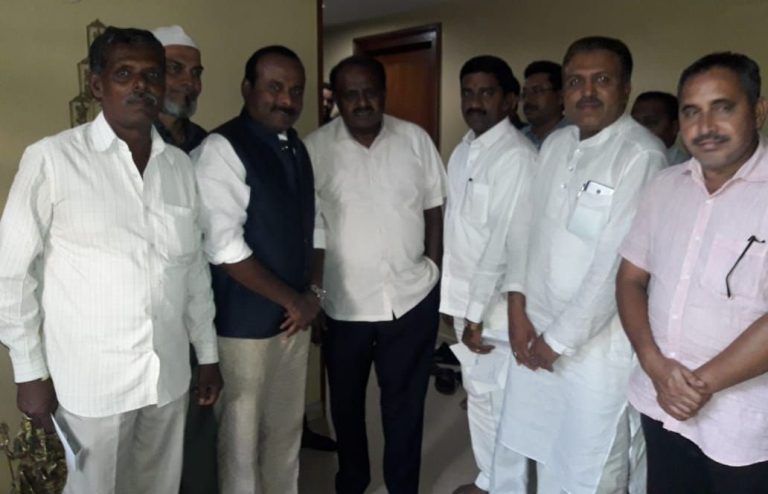
According to reports, the newly elected Chief Minister of Karnataka, H D Kumaraswamy has met with the leaders of Popular Front of India (PFI) and Social Democratic Party of India (SDPI). The Islamist outfits have been accused of involvement in anti-national activities by National Intelligence Agency.


The meeting between the leaders of Islamist outfit and the chief minister happened just after the oath-taking ceremony at the Vidhana Soudha. The leaders of JDS defended the chief minister and said that PFI and SDPI leaders had come to meet and congratulate the CM.

The Congress party had an understanding with these radical Islamist parties in the recent elections, where PFI and SDPI had withdrawn candidates to support Congress in the elections. Earlier, the same PFI was also accused of murdering an RSS worker in Bangalore.

PFI and SDPI are accused of supporting the anti-national activities earlier. Recently, NIA had filed a charge sheet against PFI members for the murder of a Hindu Munnani member. According to the charge sheet, the NIA has established a larger conspiracy behind the murder of Hindu Munnani spokesperson C Sasikumar.

The NIA had submitted a report on the PFI to the Home Ministry, claiming that the group has been involved in terror acts, including running terror camps and making bombs, and it was a fit case to be declared banned under the Unlawful Activities Prevention Act (UAPA).

Earlier, the former Vice President Hamid Ansari was also in the news for the wrong reasons after he attended a program organised by the violent Islamist organisation. The same outfit has also been accused in Hadiya’s ‘love-jihad’ cases in Kerala.

In February this year, the Jharkhand government had banned the Kerala-based PFI in the state stating that “members of this organisation are influenced by the Islamic State terror group (IS)”. Jharkhand police claimed that there were pronounced activities of the group in Pakur and Sahebganj districts of the tribal-dominated Santhal Pargana region.

CBI case against Kejriwal’s ‘anti corruption’ foot soldier for hiring architects from detective agency

The Central Bureau of Investigations officials today raided the residence of Health, PWD and Power minister of Delhi Satyendra Jain. According to reports, the raid is in connection with alleged irregularities in the hiring of a creative team by the PWD department. Various locations related to the ministers were reportedly raided by CBI officials.


The CBI has also filed an FIR against the Minister. According to reports, the PWD department under Jain had allegedly hired 24 architects through a detective agency. The detective agency reportedly had no prior experience in the field and was tasked to hire the said architects for the department. CBI had earlier initiated an inquiry against the irregularities in the hiring. The creative wing was formed in 2015 and it is also reported that the hiring of the said individuals was not sanctioned as required by the Lieutenant Governor of Delhi.

Satyendra Jain has reacted to the CBI raid stating professionals were hired for different projects and all were dismissed by the CBI.


Earlier, there were reports of AAP using its Anti Corruption Unit to spy on officials and journalists. One wonders why Satyendar Jain felt the need to hire architects from a detective agency.

Satyendra Jain’s house was also visited by CBI officials for inquiry in 2017 in relation to a money laundering case in 2017. His residence was raided by CBI pertaining to money Laundering cases in August 2017. In August 2017, the Enforcement Directorate (ED) had also filed a case against him for alleged money laundering.

Violation of norms and irregularities in hiring professionals has since long haunting AAP. Earlier this month, the LG of Delhi had declared AAP’s hiring of 14 lawyers to fight their cases as ‘invalid’. The lawyers included prominent Supreme Court lawyers like Indira Jaising and Anand Grover. The PWD department of AAP is already embroiled in an alleged 10 crore PWD scam. Anti- Corruption Bureau officials had arrested Arvind Kejriwal’s nephew Vinay Bansal earlier this month.

P Chidambaram moves Patiala House Court for anticipatory bail, court gives protection till 5th June

Scam-ridden former Union Minister P. Chidambaram, today moved an anticipatory bail plea at Patiala House Court in the Aircel-Maxis case, where he is accused of violating foreign investment protocol. Following that, Delhi’s Patiala House Court has sought a reply from Enforcement Directorate (ED) on the anticipatory bail plea.

Court has also given time to the ED to reply till 5th June and no coercive action can be taken against Chidambaram till then.


The ED in this matter has been probing the role of the then Finance Minister P Chidambaram, in granting the FIPB approval, which allegedly involved a total amount of about Rs. 3,500 crores, even though Chidambaram only had powers to approve project proposals worth Rs 600 crores. For any amount exceeding Rs 600 crores, Chidambaram was required to take an approval of the Cabinet Committee on Economic Affairs (CCEA).

Chidambaram’s son Karti too has been under scrutiny over allegations that his firm received about Rs 1.16 crores from Aircel and other companies in form of a ‘consultancy fee’.

Earlier in February, during one of the raids at his house, a classified CBI (Central Bureau of Investigation) status report ‘draft’ on the 2G scam has been reportedly found by the ED. He had also moved Supreme Court and sought protection to his right to privacy and right to live in dignity.