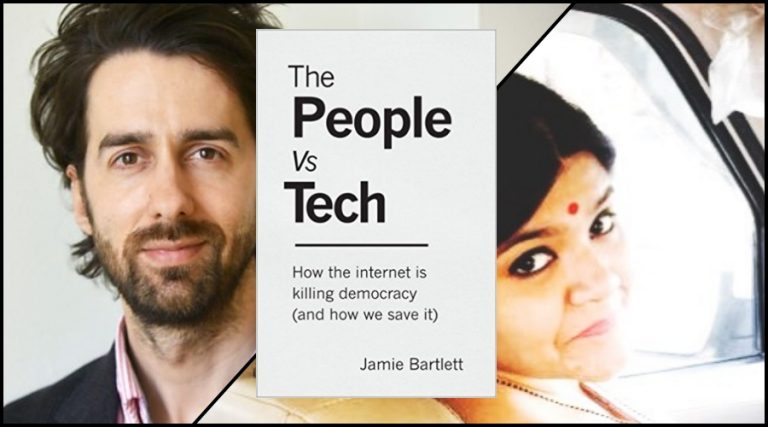
In the first episode of ‘On Point with Nupur Sharma’, the first guest was Mr Jamie Bartlett, who is a journalist and an author specialising in tech-related issues. He’s also the man who released the video of his interview with the then Cambridge Analytica CEO. More importantly, he was the one who laid to rest a portion of the many questions that we had regarding the entire fiasco when he released the photograph of Congress’ poster hanging on CEO’s Nix’s wall.
[youtube https://www.youtube.com/watch?v=hZbS9W-8dnU]
Following is the full text of the interview (the questions are italicized and the answers are in bold) :
Welcome Jamie, it’s an absolute honour to have you on this show today. Thank you so much for agreeing to do this.
Well, thanks very much for having me. Especially it’s an honour to be the first person on your new podcast. I’m delighted to be here.
I think we can just get right on to it and address the elephant in the room and then proceed to understand the finer issues. So when the Cambridge Analytica controversy broke out, the one question that all of us had, was that which Indian political party had engaged its services. Now the speculation was put to rest when you released the photograph of Indian National Congress’ poster hanging on Nix’s wall.
The Congress, in order to defend itself, floated two theories, one was that the photograph was fabricated and it was a fake and when you put that theory to rest, they said that perhaps he had their poster up on his wall because he was vetting down as a potential client. Now, in fact, Christopher Wiley himself named congress directly in his statement, so do you think the second theory holds any merit, do you think Nix would have any poster of Congress on his wall if they were just potential clients?
Let me just address the first question about the possible photoshopping of the image. You’ve got to remember, and anyone who is involved in this sculpt has got to remember that when we recorded the footage we had no idea that any of this would come out in the media. We just saw the poster on the wall, found it relatively interesting that Cambridge Analytica in our mind was clearly working with international clients and so thought it was the useful background to include a short image of it in the documentary to illustrate that this is an international company. We were not there to score political points to try to undermine anybody, we did not shoot it after Christopher Wiley’s revelations. So in a sense, it would be a remarkable thing to somehow have predicted all of this and fabricated something along these lines. So it is a fairly ludicrous suggestion, and I wouldn’t really take anybody suggesting that it was photoshopped because it was fairly easy to disapprove.
But on the second point, is it possible that Alexander Nix had a poster of the party hanging on his wall because he was kind of vetting him as a potential client, of course, first of all, you will have to ask him, but it seems fairly strange in my mind for somebody to have a poster of a political party hanging right in the middle of their office, literally directly above their head simply for a party they weren’t even working with, now again you have to ask him, not that any evidence that I have, but it does seem rather strange given that throughout the rest of his office there were a lot of posters of evidence of their work on the Trump administration campaign, which of course we know that they did do.
So the congress poster was right next to or in the vicinity of the Donald Trump poster and there is no doubt that they worked for Donald Trump.
Oh, there is no doubt that they worked for Donald Trump, I mean they had 13 staff members embedded in the Donald Trump election campaign team in San Antonio Texas, they were quite open about that, they boast about that frequently. There’s no doubt that they were working with the Trump campaign and there is no doubt that they have worked with a lot of countries around the world. Again this is something that is on them to answer rather than me, but it would be slightly strange if there was no connection.
Ok, fantastic. So know that we’ve addressed the elephant in the room we can move to understand some of the finer points
I was absolutely amazed as to how big this story became in India, you know it was a real surprise to me because it was not me who first posted this footage. Someone else on the twitter, I think had found it in a documentary and had alerted me to it and I said that’s rather interesting, so I then shared it and said by the way we did see this footage. Then I was told that people were saying it was photoshopped. At that point, I thought, hang on for a minute. I don’t have any political points to score here personally but I’m not going to let people say that this is a fake image. That’s the reason I got involved a bit more.
I think it was basically congress trying to defend itself by, you know whatever argument they could muster. So I’m glad we’ve got that out of the way because I have a lot of questions for you.
So when you talk about the digital space, the two most basic queries are these. One that it is said that something which is on the internet is always on the internet, it cannot be erased, its there forever. So when data is free for public consumption on the internet, many ask what is the harm in accessing and using that information, that’s point one.
Secondly in your upcoming book People Vs Tech, in fact,t you talk about how this entire debate might seem hypocritical because you’ve used your laptop to write your book, you’ve used Google to research your book and you’re hoping to sell your book on Amazon. So we are using technology and at the same time we are talking about its dangers and it might seem a little hypocritical. How do you rationalise this dichotomy?
Absolutely, I am a hypocrite in the sense I criticise technology and use it all the time, and I think partly that’s because it’s inescapable, there’s not really any way it functions being in the modern world effectively, especially in our jobs without relying on technology. We are kind of trapped and if we go off grid and stop refusing to use things you’re not going to get your message through to anybody.
In the book I am quite clear to say that, this is not about saying that all technology is bad and is clear that in so many aspects of our lives including some democratic ways too, these technologies have been brilliant, has been fantastic to make us more informed, wealthier and better connected with people we care about and many more wonderful personal benefits that we are aware of and the question is that whether that’s good for democracy.
I tried to narrow it down to that because there are a lot of Tech books winging and mourning about the state of the world and tech. I wanted to focus squarely on the emotion that we have this system of government that was not really designed for the digital age and that it’s causing all sorts of tension and problems, so I suppose I can be a hypocrite because I’m saying it not about whether this is good for consumers its whether its good for democracy more generally.
Your first question was that what’s the harm in taking the data and using it.
Well, firstly it depends on whether you are aware of how your data has been collected and used. I think the reason why the Cambridge Analytical story partly has gathered so much attention is that firstly there is this accusation that it has accessed a lot of data from people without their consent, they deny that of course. But the idea that millions of people data were accessed and used in a way that they had no understanding or knowledge of, I think generally speaking you can say that it’s a pretty unethical way of use of data.
More generally if you open it up I think a lot of people have suddenly realised all this time they have been creating, sharing producing all sorts of information about themselves and they have no real understanding of how this might be used. Sure they might have clicked a little box of terms and conditions but they never have really read them or understood them. I think it’s a slightly grey area because a lot of these activities are not illegal, it’s not breaking the law, we have ticked the terms and conditions, we said we would share our data but I think there’s a much bigger question that whether all of this is good for our democracy. To have insane levels of micro-targeting, and personal profiles and political parties using to target everybody, messaging about things which might not be illegal but not be good for our democracy.
So your theory is the current form of democracy is not compatible with the kind of technology and how the data is being used and we’ll come to that, but first I want to try and understand how this entire process works. So in your book, you also discussed that how social media was a quest to turn human decision making into a hard science that can be then used for business.
You also say that the entire purpose of data that is collected with quiet data brokers like Acxiom, which has information of the worth 500 billion active consumers with thousands of data points, and Facebook has a partnership with Axciom. So, while this has been going on for so long, why do you think that Cambridge Analytica actually drew the flak which it did, because it was not something which was new. Facebook has already been doing this with other data brokers, so what was so special about Cambridge Analytica, special or evil..however, you look at it.
You know how journalism works, far better than I do but sometimes it’s just a story that manages to crystalize much deeper concerns that people have and I think over the last several years people have been getting nervous and worried by the size and power of some of these companies. Repeated stories about hacking, stories about Russian disinformation, stories about hate crime and a sort of concern has been gently growing over the last few years and it almost feels like Cambridge Analytica, because it was about democracy and politics and especially because it was about Donald Trump. The election of Donald Trump which a lot of people cannot understand how it happened seems to have kind of created this, almost a bigger story, the Cambridge Analytica revelations themselves.
Bare in mind when I released the BBC documentary from which the National Congress Party’s poster came in August 2017, it said a lot of the same things but there was not the same level of outrage at all. It seems to have arrived at a particular moment where there are much bigger concerns about how society is changing. I think that’s a big part of the story and of course I think its also held by the fact that this story has an undercover footage, a former Cambridge University professor called Dr Cogan, previously called Dr Spector so it all sounds very James Bond, that’s added an exciting edge to this story, I know it sounds silly but it’s all a part of it.
So coming back to how this entire dataism works. It’s fairly innocuous data which is collected and almost weaponised. So for example, I like a bunch of movies, music artists, books etc. on Facebook. How does that information really collected and given to these brokers for insight? How is this insight sort of extracted from this innocuous data and then used by firms like Cambridge Analytica to almost sub word democracy? It all sounds very fantastical but could you explain how that works?
On first sight, it sounds impossible. How could the things you ‘liked’ on Facebooks, books you read and the movies you bought possibly be valuable to companies who are doing political campaigning? But it is because, everyone who goes online and even a lot of things we buy offline with credit cards, a lot of information like that is saved by the companies that you share that with. So your card records or your store company history, the things you’ve searched online, the things you liked online. A lot of that is stored up by the companies which are then commercially available and sold to the data brokers. Big companies which people don’t know about, to be honest, who collate all information and build profiles of individuals users.
That data can also be bought by other companies who would analyse it carefully to try to look for valuable insights for political parties. That’s basically one of the things Cambridge Analytica did. They bought up a lot of commercially available data on people. It then does all sorts of large-scale analysis to try to determine people’s personality types, voting preferences, income brackets, socio-economic consideration, and from that it can be able to say something valuable about the things they worry about how rich they are, who they would like to vote for, what things they worry about and that, of course, can then be used to target people who are thinking about the elections.
The case of Cambridge Analytica is a very good example. What they did was that they cross-referenced the Republican party voter data records with car companies. They found that people who bought American cars were much more likely to be Republican voters and could be persuaded to vote for Donald Trump. So then they looked for people who bought American cars but did not vote for Republicans last time in the last elections. So Cambridge Analytica determined that they would be a very good target group to try to fire Facebook messages at and Facebook has such incredibly good, finely tuned targeting techniques that they were able to then fire a lot of messages of both people with pro Trump messages in key districts to try to make them vote for Trump.
So this is the same concept you talk about in the book, People vs Tech. You say they make these living ‘universes’ and each ‘universe’ has a specific target group that can be barraged with different sorts of messages. My Question here is that could one political party send a different message to one ‘universe’ which is one subset of people, of voters, and then a completely contradictory message to another universe, without the two set of people knowing what the other person is being told.
Yes, exactly! It is now possible and this is the thing which worries me greatly and it is a much bigger deeper trend. You can divide people, which the Trump team did, into these clusters of possible voters, they call them Universes. So moms worried about child’s care, the teenagers worried about the gun control or whatever. And you can then target specific messages of each of those groups which means the other groups may not necessarily see what you are telling to the other people. And the kind of result is that the increasing personalisation of political messages, then somewhere they are very unaccountable.
If nobody knows what anybody else is seeing, how do you know whether its true, how do you hold the politicians to account for that. That to me, you’ve hit the nail on my head there. Everyone there in the moment, I think, is obsessing and understandably so. I am not criticising them for it but they are obsessing over whether in this particular election whether Cambridge Analytica did this particular thing with this particular party or this particular campaign. Where I think there’s a much bigger trend with all the political parties is basically involved in, which is this level of segmentation of voters and personalised targeting. Because it does mean you can say different things to different people in a way the regulators cant really check, that is a very big problem for democracy. It’s gonna surely get worse as we are going to create more and more data.
In one of your interviews, I think, I was listening to it last night, and you say democracy basically works when largely everybody understands what a political party stands for. Largely, the entire country sort of understand so this is the leader who stands for one, two and three and then based on that they make their decision. What technology and especially firms like Cambridge Analytica are doing now is taking that entire process out of the equation completely, because they can target different people with different sort of messages and there’s no common platform or common sort of ideology of the party that the voters might base their decision on. Is that what you are trying to say?
I couldn’t have put it better myself should probably listen to you saying that and use it myself in my future interviews because it is perfectly stated.
Thank you. So it’s a little fantastical how the entire CA thing blew up in one day. Since you have been tracking this story, could you tell us what was the process of this story breaking out, and then Wiley giving his statement and especially considering manipulation of the human psychology is not new, politics is basically based on propaganda. So what is that one thing, do you think that CA other than this targeted messaging that they were doing, which you think, is not compatible with democracy at all and results in the subversion of democracy?
I think there are two key claims here that have made a bit of difference in explaining probably why this company, in particular, has come up with such heavy scrutiny. The first is the allegation that it used and collected Facebook data via a third party company who had been conducting personality quiz tests on Facebook.
Do you remember a few years ago, a big fashion for filling in surveys to predict your personality on Facebook? We had a lot of them. They were really popular and they weren’t just harmless. Companies were using those survey results to try to predict personality types of people because it could be valuable for advertising. I don’t think people realised it at the time and we do now.
And so the two claims that are important here. The company that was collecting this data sold it to Cambridge Analytica. And they had not only been collecting this data of the people who completed the quiz but were collecting their friend’s data too because that was possible at that time, I think it was 2014 when all this happened. It was possible if you clicked on a survey, or did one of these app surveys on Facebook, your friend’s data could also be collected. Facebook then found out about this and demanded that the data be deleted. Cambridge Analytica that at that time that they had deleted it, they weren’t gonna use it. It was something like between 50 million. There are different estimations, but Christopher Wiley said that 50 million users’ record was collected that way including several 1000s from India, by the way. So claim number 1 is that they were using data without the correct permissions. This is what Christopher Wiley has said that they used that data and they did not delete it. Cambridge Analytica denies this vehemently. That’s number 1.
The number 2, I think is the actual research techniques themselves. So one of the things they have done is to try to predict, and they claim to be able to do this, to predict the personality types of every single American citizen or adults in other countries. That though these personality quizzes they have conducted, they claim to be able to know, whether or not somebody is neurotic, whether they are open-minded, whether they are consciences and so this is a new type of targeting. They say that they can use these insights into a person’s personality, their deepest hopes and fears of what really drives them.
To increase the effectiveness of the online adverts that they serve, analytical psychographics, and this is their big unique selling point. I think this got people very nervous because it feels like it is potentially very manipulative that the company, without your knowledge, can work out your personality and use that to target you with emotional messages. That, as far as I know, is not an illegal technique or anything, but I understand why people have founded it to be slightly sinister and slightly creepy
It is creepy, in fact extremely scary. So what they are doing is calling out to your basic fears and your basic hopes and dreams and things like that to sort of fashion their political campaign around it and the scariest part is…
Yeah..it is, isn’t it? You know what’s funny about it? When I interviewed Alexander Nix about it, he said he didn’t use it in the Trump campaign but was quite open that they have used this technique for Ted Cruz who they were working for before Donald Trump, and this is their kind of unique offer that they offered to companies and they say increases their clicks. He said, “whether you like it or not Jamie, this is the direction advertising is going. It is a fact that this is going to get better and this is the future of how online advertising will work”. So even if it’s not quite there at the moment, the fact is this is where it’s heading.
So it’s heading where all of our data, whether we like it or not, is passed off to these companies who can use it as they will.
Yes. look, this is what Alexander Nix said to me, but of course, this was all before the current outrage, and I wonder whether recent events perhaps have made people think, maybe we cant stop this..maybe we don’t need to let it so things happen. I am still wondering and trying to work out how. But this is the thing I want your listener to really consider – the amount of data we are producing is continued going to increase maybe even exponentially. When all of our home devices are connected to the internet can be spitting out data and companies like Cambridge Analytica could be taking it, analysing it and using it to target us. So we’re just at the beginning of this and, I think, that should worry people.
So coming back to Facebook, when this entire fiasco sort of came to the fore, Zuckerberg said that he didn’t fully realise the potential of what they were doing, he didn’t realise the consequences of his creation and at the same time, he sort of clubbed this entire privacy breach by saying ‘we should do more to protect your data, we should do more to filter out fake news’ and things like that. So he clubbed this extremely important issues with a lot of other issues that might not be as important and at the same time, he said he didn’t realise the consequences fully. Do you think he is being genuine and didn’t realise or is he just trying to sort of escape?
It’s very hard, very hard to look into a man’s soul when it comes to these things. But I would say it’s a bit of both actually because a lot of people have been raising the alarm about this directly to Facebook for a very long time. So this should not come as a complete shock to anybody in Facebook. And if you noticed, they wrote a blog post a couple of days ago where they said that maybe it was not 50 million Facebook users who had their data taken by Cambridge Analytica, it was maybe 87 million users and they then added that potentially every single Facebook user with a public profile have had their personal information taken by malicious actors who have been scraping their data.
A number of people have said that they were aware of this. They can see on their system when this is happening but they never did anything really about it. So I think it’s a bit of a stretch to say that they didn’t know, they are really surprised, they can’t believe it but at the same time, I think, you got to remember that a lot of people inside Facebook are real techno-utopians. I mean I really believe that the data is a social obvious good, it always gonna make better… the more data, the more network, the more connections and the more users, it’s always gonna mean things are better for people. This is a default position. So I think they can’t be sometimes slowly surprised by people using data for bad things because they are such optimist in data that they always think that people would use it for good rather than the ill.
So you know, in context there’s another term which was used very often. It’s Data Colonisation. Is that really a reality, Data Colonisation or is it just another phrase which has been hyped to generate fear and revulsion against the tech giants.
What is Data Colonisation? It’s a sort of idea that it a new form of colonialism using data
It’s difficult one for me to answer really. It’s a thing that is more for the people who consider themselves have been victims of colonisation the first time around. Again, it’s a hard one for me, but it’s definitely a case that the big tech giants have become immensely powerful and important in a lot of countries around the world, especially in a lot of developing economies, emerging economies. They use their economic weights and their political weight to make sure they are first into these economies and that’s something. I think you can call it Data Colonisation or whatever you want but it’s definitely something to be worried about.
Coming back, since we started with Congress. So there are certain examples of how they campaigned. We have an election in 2019 and India is, you know, a huge country. We keep having these state elections too. So campaigning has been fashioning around 2-3 points. I will go through them and maybe you can get a better sense of what they are really doing.
So one is playing on conflicting ideology. For example, we have a Hindu majority and Muslim minority. The messaging to Hindu majority and the messaging to the Muslim minority are vastly different, often conflicting. But they are doing that and targeting these two groups entirely differently..that’s one.
Second is, news surfaced a while ago that Indonesians and Russian bots were being used on Social Media to seemingly increase the engagement of the President of the Congress party who is also their Prime Ministerial candidate.
Thirdly, they seem to be playing of societal fault lines. They seem to be taking different sections of the society and trying to fear monger saying that your money is not safe in the banks and there’s a lot of hatred in the air, etc. For example, they would say Group A wants to kill Group B, Group B wants to kill Group C and that’s all because of the government.
So these are the basic three ideas around which they are fashioning their campaigns. Depending on what I just told you, and as an outsider who does not know the political dynamics of India, do you feel these techniques are what Cambridge Analytica would focus on theoretically?
I would re-stress my lack of detailed knowledge of Indian politics so I wouldn’t like to comment too heavily there. But if we look at the way the Cambridge Analytica generally works, I think you can make some informed views on this or informed speculations on this.
The company prides itself on segmenting audiences, so breaking people up into meaningful blocks, because it says that you can be much more effective the more that you break people into small groups. And however you do that, it doesn’t really matter to Cambridge Analytica what the country context is, it would simply try to find ways so people could be segmented. So if major segmentations across society are religious or caste or economic based, whatever it is, they, I suspect, would be looking for ways to break audiences down along those lines. Does that make sense?
That makes absolute sense.
What I am gonna say is that is like Point 1 and I think that is an informed view on how Cambridge Analytica and other companies do work and the sort of things you might expect them to do. But the second part, which I think is equally important, is they really play on emotional drivers. So the sort of adverts that they create, the contents that they create, they are very open about this, they say it works when it’s emotional. It is about appealing to people’s emotion, emotional concerns, emotional hopes. Sometimes they’re positive and sometimes they will be negative. Their everything is about emotions. An emotion, are as often, as we know are rational. They can be full of hope and optimism, but they can be full of hatred and anger and rage. And so, you put those two things together, and you are talking about very segmented targeting based on divisions in society twinned with emotional based advertising and contents. These are things, I think, are really key to understanding the sort of offer Cambridge Analytica would make and put them into your own political context and work out what that means. But I think, generally speaking, that’s quite a worrying approach to politics which is why I say again that these are slightly bigger issues than just this party or that party, it’s about how you can make politics even angrier and more divisive.
Well, you have also spoken about Privacy Laws and let me quote from your book, it’s on Page 26 :
“Without Privacy Laws which vary greatly in force from country to country, we would today live in a world of total surveillance at all times. In countries where such laws don’t exist, I fear it’s almost certain that wearable that tech smart homes and AI would create unprecedented levels of government surveillance and controls. This is not only a worry and oligarchies and autocracies, in few societies were never alone either. The data gold rush has opened up new forms of potential surveillance from democratic governments too and most liberty groups worry what that means for legitimate political debate and activism.”
So, in that context, India doesn’t really have very strict Privacy laws. In fact, we have very recently declared the Right to Privacy a fundamental right and before that, it wasn’t even that. In that context, I think a lot of people who would want to defend certain measures by certain governments would say that if I haven’t done anything wrong if I haven’t committed a crime why should I be scared of a government indulging in surveillance. So, could you explain, what it is there to really worry about?
Sure, yes! The potential for surveillance in future when every single thing is connected to the internet, where we have facial recognition technology and where every citizen can be monitored and seen, it would be bringing more and more internet-enabled devices right into our homes, in our bedrooms. It simply offers a pretty remarkable opportunity for governments who don’t care about privacy to be able to monitor their citizens all the time in brand new ways especially with the increased improvements in predictive policing. For example, the government will be able to try to predict who’s going to commit a crime before they do or the areas where crimes take place or the propensity of the people to break the law or maybe be a political activist or a radical political activist.
It just simply means that there would be brand new ways for governments to be able to control their citizens. And in countries where they don’t care much about citizen’s privacy or citizen’s rights are something to be very very worried about. And even if you are someone who thinks you have done nothing wrong and have nothing to hide. I think that might be true now by saying that I have done nothing wrong but what if some algorithm has calculated that you have a disproportionally high possibility of committing a crime because of your gender, your age or neighbourhood, your web browsing patterns. You might find yourself being on the suspicion of something that you have never even done.
And you might again say ..well I don’t mind the government, now I kinda trust them, I like them, I think they are working in my interest but what if someone else takes over? What if another government takes over you don’t like and it doesn’t agree with your politics and they suddenly have this infrastructure of mass surveillance ready to monitor you and everybody else? So this is about the longer term safeguarding of the rights of the citizens to have some degree of privacy and that matters to everybody and it doesn’t always seem it does over time but it makes sense only be apparent when it’s too late.
So what you are saying it’s not necessary surveillance which poses a risk but the possibility and the risk of that surveillance system be weaponised in the hands of a possibly vindictive government
Yes. And being used in ways that are not conducive to liberal freedoms. The problem is, and I make this quite clear in the book that at the same time the governments of the world do have to prosecute crime and they gonna have to do surveillance and monitoring not just to stop terrorism or these high profile crimes but day-to-day crimes that people are worried about especially cyber crimes, so this gonna have to be ways for the governments to do surveillance, there’s no doubt about that. But if we let it go without any kind of citizen protection then I am worried we are building an infrastructure that one day would be turned against innocent citizens too.
I have just three more questions and then I would not hold you. One is the Facebook trying to get medical records to be integrated with Facebook data and I believe that they have sort of got a hold on that but this was the original plan and at the outset, it sounds extremely scary. Could you tell us what might the possible aim be of integrating medical data? They have been in talks with for pharmaceutical companies, I believe.
I have gonna be somewhat next in this case, it’s very recent story, isn’t it, just the last couple of days. I suppose the broader context is that every single major data company and the artificial intelligence companies have realised in the last few years that medical research, a lot of features of the medical research would be in the analysis of medical data. So if you think that the last big breakthrough was Penicillin and the arrival of antibiotics, a lot of people say that the next big breakthrough is going to be data analytics in healthcare because we will be able to predict with far more accuracy whether somebody is going to have cancer or any other medical condition. And this is going to be a multi multi multi–billion dollar industry, especially with an ageing population. So I can’t say exactly about this story, I am not qualified to comment. The broader story here is that a lot of companies, Google, IBM especially are investing a fortune in the medical data records because they think it’s a very very lucrative industry in the years ahead.
And the first group to buy that data would be Insurance companies, wouldn’t they? They would love to get their hands on such data.
Insurance companies, but also national health industries, private hospitals. It is also going to be the case of health analytics firm being able to, as IBM is doing, sell access to its insight and it’s analysis to private companies, some of them are insurance companies, some of them would be private hospitals as well. So I know a lot of people would want this. Insurers are definitely gonna be one and I can see where you are going with this because, of course, this potentially opens up some quite difficult ethical questions, doesn’t it?
In the context of the developing countries like India, we have always seen a debate between environmental laws and industrialisation. It can be argued that people who have already benefited from technology are actually concerned about privacy laws, existing or proposed. But when that is put into motion, the people who are yet to benefit from whatever technology has to offer, might not really get there at all and it’s the classic Environmental Laws vs Industrialisation debate. So how do developing nations like India do to rationalise this?
That’s a really good question and it’s really difficult to answer that one and I think that’s gonna be one for you to answer and obviously not for me. I think you are right to highlight here as a great challenge but I don’t want to start coming in and lecturing what the Indian government or Indian citizens should be doing about it. But I suppose the one thing, I think is important is there’s a countervailing trend here which is that the people who have all the data and all the software and all the technology and the data analyst just get richer, richer and richer and people that do not, get poorer, poorer and poorer and that is a very important driver of a new form of inequality, and inequality of high level is generally bad for democracy. As we highlight that there’s another one in play that the way technology can fuel greater levels of inequality both between countries and within the countries and I think that’s another thing the Indian society will have to contend with.
My last question is that in conclusion to your book you talk about 20 ways to protect oneself in this age of privacy breach, with data everywhere which is being used to manipulate what we think, feel and vote. Can you tell us more about that?
Now again, there will be a specific Indian context and I don’t want to turn up and lecture, but the things that I think is important a recognition that us citizens have built these mega monopolies and it is our data that is the fuel that keeps it running. We can point fingers at other people but we are partly responsible for all of this. Our addiction to services is the reason it keeps growing.
It’s the same with online rage. I keep saying people on the internet are nasty, stupid and evil. And I realised that I am a part of the problem. I get into arguments and get angry. I contributed to the far more angry, polarised, political situation. Which we find in many countries nowadays. So we must take personal responsibility for it. Think about what you are clicking on, think about what services are you using. Whether you are happy with those services, increase your privacy settings, if not, change services. There are other services. There are other social media platforms out there. People can make decisions that will have an impact on the data industry.
And when you are getting online, and getting into a rage, getting frustrated and are ready to react, pause for a moment, think about it and maybe just calm down before adding to the noise and the fury. So while there is a need for regulation and I have put some suggestions into my book, I think there is also a need for citizens to realise that they are also responsible and they can do something about it.
Have the hate messages stopped, Jamie?
You know what’s funny about that? I had so many people say that I should get security and that now I will be called a BJP agent. I would say I had far more people saying that I should get security than I had threats. And actually, on the whole, it was relatively mild. There were a few people saying that I was a paid agent and that I was working for the BJP and their IT department or some such but it was mild.
But maybe I shouldn’t tempt fate.
But I have a lot of admiration for journalists who might actually have to worry about these things. I have admiration for some journalists in India. I know some people have been complaining about journalists to me, but I have admiration for the people who take the risk to uncover this story.
Thank you, Jamie. It was an honour talking to you. Thank you for giving us such wonderful insights into privacy breach and what data can do. Perhaps it’s time even for the Indian government to sit up and think about strict privacy laws.
Thanks for having me.