Home Blog Page 7536

6 sly digs Arnab Goswami took at ‘compromised’ media persons in his latest interview

Arnab Goswami’s latest venture “Republic” is due for its launch very soon. In the run up, Arnab gave an interview to the magazine Man’s world, where-in he slayed some of his competitors from the space of media. Here are the best comments from the interview: (you can read the full interview here)

1. When asked to explain Lutyen’s media’s bias:

Not a bias, but I think there are people in Delhi who believe that they’re the custodians of Indian journalism. And, they have been in the past, because the power centre is there and all the political magazines and newspapers are there. Now those people are too much into each other’s hair. They eat together, meet together, socialise together. And, slowly, unknowingly, or maybe knowingly, over the course of the last 30-40 years, they have become co-opted by the political class. If you go to Delhi, you will find that all those people in media who are supposed to be reporting on the politicians are wining and dining with the politicians. I’m not saying they’ve become corrupt — that may be too strong a word, but they have become compromised. They’ve become co-opted. That’s what I mean by the Lutyens’s media. I don’t necessarily mean people who are staying in that three-kilometre zone in Delhi, even though a lot of them do.

I hear stories about ill-gotten wealth. I hear about editors having massive farmhouses worth hundreds of crores in Chhatarpur. You cannot make that kind of money through an honest journalist’s income.

hmm… who are these journalists he is referring to? We won’t hazard a guess as they are known to sue.

2. Further elaborating the above point:

I’m going to continue to question them. Because the Nira Radia tapes episode showed that there was a direct link between some journalists who were acting as mediators for corporate houses and politicians. I think that’s very unfortunate. We can’t live in denial anymore about what’s happening in our own profession.

Is Barkha going to throw a fit again, or will Vir Sanghvi do it now?

3. Not coy anymore, on Barkha Dutt:

I feel Barkha Dutt should check her facts. Barkha Dutt was openly praised by a person called Hafiz Saeed. While I’m nobody to comment on people, if people begin to distract attention from the praise of Hafiz Saeed by imagining that I’ve taken their name — these people should first stop imagining I’ve taken their name. I have made a comment against the media that speaks against the nation. If anyone begins to believe that the reference is against them, then they should ask themselves why they feel that way. I have never taken any names. It’s what you call the guilty conscience of some journalists. That journalist in question must ask themselves, ‘Why is Hafiz Saeed praising me?’ Is it because that Indian journalist has done a lot in lionising another terrorist called Burhan Wani? Hafiz Saeed would love an Indian journalist whose documentary is praising Burhan Wani as some kind of Facebook hero. Why does an Indian journalist lionise Burhan Wani? Why does an Indian journalist serve the purpose of the Lashkar-e-Taiba sitting in India? You have an Indian passport, you’re on an Indian channel, you’re earning in Indian rupees, you’re broadcasting to Indian people. Why are you doing things that will help Lashkar-e-Taiba, which kills thousands of people in our country? Having received that praise from Hafiz Saeed, why then do you want to fight the windmills and imagine that Arnab took your name? Arnab did not take your name. There’s a section of media in India that works against India’s interests. I think it is time for some of us to speak out against them and expose them.

BOOM!

4. When asked to explain his channel’s “India bias”:

I want to know why a section of the Lutyens’s media has a bias against India. It is true. I don’t think they are vested in this country. It is shocking what I’m about to tell you. But, there are some people who don’t even have Indian passports. They are Indian in ethnicity, but have chosen to be American citizens. They are running digital media companies. I want to know where they are receiving their funding from, and what their sources of income are. There is an American citizen running a digital news site in India, inciting students in JNU, speaking openly for Maoists, and questioning Republic. I doubt the intentions of these people. They’re certainly not for India.

Ahem! Sidharth Vardarajan of TheWire.in

5. On “left liberals”:

The problem is that I don’t know what is liberal and what is left-liberal. There are a bunch of people who like to sip the best Scotch in Delhi Gymkhana and call themselves left-liberal. What is left-liberal? If you’re a leftist, you can’t be a liberal. If you’re a liberal, you can’t be a leftist.

Precisely! “Left-liberal” is an oxymoron, but we have to concede that even we have used this term matter-of-factly

6. On the medias coverage of the UP elections:

The media should go into penance for what happened in UP. I mean, it just shows that the Lutyens’s media has no clue about this country. A lot of top editors went to UP and said Akhilesh and Rahul are going to do phenomenally well. They are clueless. All of these people, I strongly suggest, should go into 14 years of vanvas from journalism, and find out why they have lost their touch. They are seeing the reality they want to imagine. Some of these so-called prominent editors, some of whom were also prominent in the Nira Radia tapes, have tweeted their anger at Rahul Gandhi. They are actually upset that Rahul has not performed up to their expectations. Rahul and Akhilesh, it seemed to me, were puppets of a certain section of the pseudosecular media, who wanted to present them as the two saviours.

I spoke to a few reporters and asked, ‘Why did you misread what happened in UP?’ They said, ‘We did not misread. But our bosses and their bosses in Delhi had already made up their minds about what the UP result was going to be.’

Radia again! Take your pick 😉

Update and Editor’s Note (17th April 2017): This article earlier contained 8 sly digs, but now has been shortened to 6 because Times Group found two comments made by Mr. Arnab Goswami defamatory and libelous towards them and their top management. Times Group has served a legal notice to Arnab Goswami, his company, some senior people associated with his company, and to media platforms that carried his statements, including to OpIndia.com and Man’s World magazine. After internal deliberations, we removed the two comments that were objected to by the Times Group. They were not our own editorial comments, only for which we can take responsibility and liability. Even now, this article remains a report about the interview done by a third-party (Man’s World magazine); it is not any endorsement of the interview content or of Arnab Goswami’s views in totality, except his views on the so-called Left-Liberals and his views about Lutyens media bias as is clear from commentary in this article.
No! Modi Govt does not want to fix the portion size of food in restaurants

0

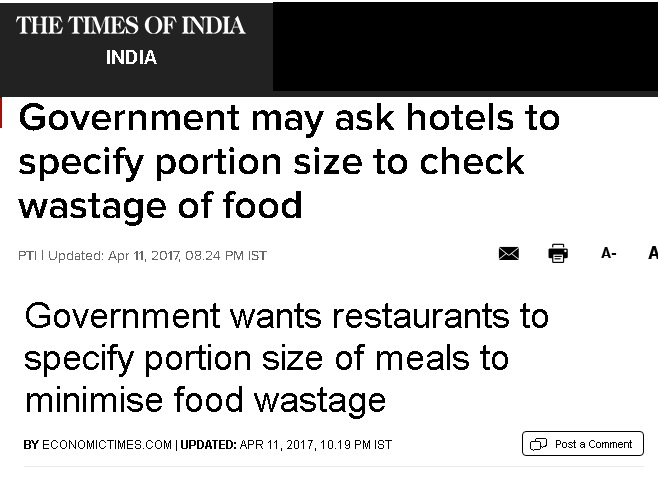
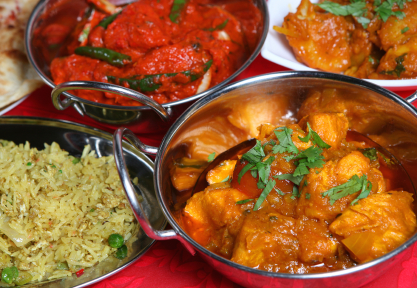
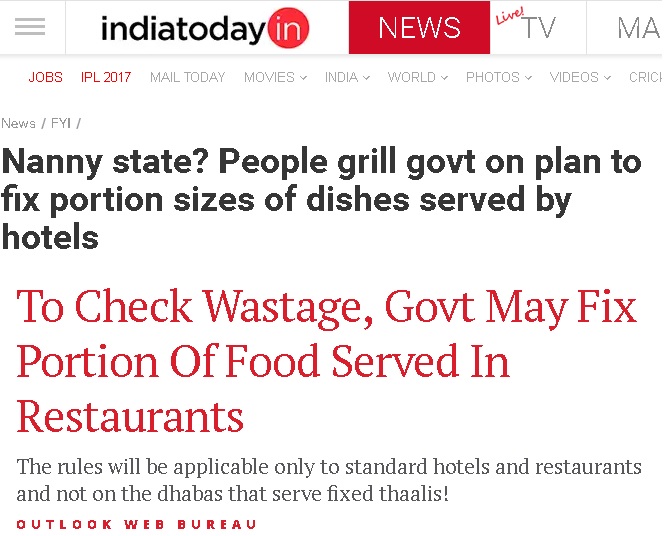
On the menu for outrage on social media yesterday, was the story titled “Eat what you order: Modi government to fix portions of food served in hotels” in the Hindustan Times. Expectedly, social media users across the political spectrum trashed the proposal and other media houses curated the story too:

This overreach of the Government had disturbed people, especially since it came soon after the (fake) news that thanks to a Government suggestion, petrol pumps would shut down on Sundays.

But is that the truth? If one goes by the statement given by Union Food Minister Ram Vilas Paswan (video below), it appears that the Government has no intention to “fix the portion size of food” served at restaurants:

Instead, this is what Mr Paswan said (emphasis added):

When we go to have food in restaurants, and when we see the wastage of food which takes place, then we feel such wastage is unjustified in a country where the poor remain hungry. Hence we have taken this step in the interest of the consumer, wherein we will ask the industry, whether they are willing to do it voluntarily, or they need a law to mandate it: that when they serve a portion of food to a person, they should mention in writing how much quantity of food would be served in the portion, whether one piece or two piece, whether one chapati or two chapatis, whether on idli or two idlis . We don’t want to control anything. We are doing this in the interest of consumers. Where are we saying that you should keep only so much quantity in one portion, we are only saying you should mention the quantity being served in each portion.

Quite clearly, the proposal seems to be in an early stage where discussions with the industry are going on. And importantly, rather than “fixing portion size”, the idea is to make restaurants declare the size of the portions they are serving. This was made very clear by the minister.

In fact, if one sees the video, one can see the NDTV reporter Sunetra Choudhury trying to force fit words like “uniformity” but the minister sticks to his statement. The move may be in line with the practice of sale of packaged items, where the net weight / quantity etc has to be specified on a product.

Hence, the initial report by Hindustan Times may not be giving a complete picture. In fact later in the day, media reports correctly reported the statement of Mr Paswan:

While the merits of the idea maybe debatable, it is certainly wrong to claim that the Government wants to fix the portion size of food in restaurants, especially since the minister has explicitly ruled it out.

National Conference toeing dangerous separatist line in Kashmir

0

The mainstream political parties of Jammu & Kashmir, especially the National Conference (NC) was supposed to oppose separatist and Jihadi elements and work towards a solution to the Kashmir insurgency, but looks like hunger for political power has blinded the party and its leadership.

Yesterday, the entire nation was shocked when Pakistan decided to award death penalty to Indian national Kulbushan Jadhav for allegedly indulging in espionage activities in Balochistan. Both Indian and international agencies are questioning the lack of evidence and possible lack of procedures during the whole matter. We had also reported how there were glaring contradictions in the alleged confession statement of Jadhav and in the statements of various Pak authorities.

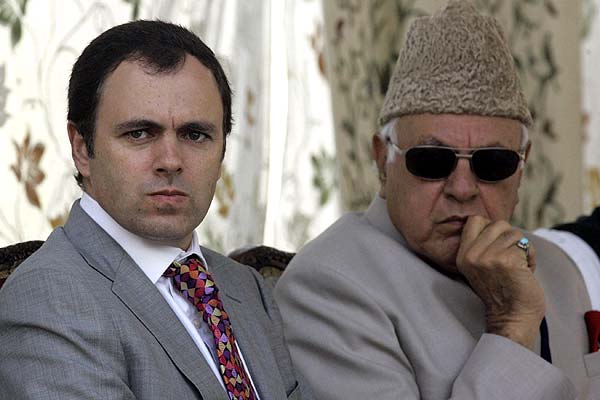
But even after all the reports, National Conference leader and brother of former J&K CM Farooq Abdullah, Mustafa Kamal stated that it wasn’t correct for India to point fingers at Pakistan regarding this issue:


Such respect for (Pakistani) laws and procedures was totally missing in Kamal when in 2012 he had questioned the Indian legal system for awarding capital punishment to terrorist Afzal Guru in the Parliament attack case.

What signal is a senior NC leader sending out by questioning judgments of the Supreme Court of India but accepting judgment of a court of Pakistan?

If this was not enough, NC members today openly shouted anti-India slogans in the valley today. What was worse is that they were joined by the members of the Congress party:


The situation in the Kashmir valley has worsened in recent days with only 7% voter turnout and 200 instances of violence reported during the Kashmir by-elections. In view of that, it was decided to defer the elections in the Anantnag parliamentary constituency. But instead of helping the situation, NC decided to stoke the fire.

It raises the question again if the party of Abdullahs have now decided to go rogue. In 2012, when his brother had questioned the hanging of terrorist Afzal Guru, Farooq Abdullah had condemned his statement. But it turns out that after going out of power, the Abdullah father-son duo too seem to have started whipping up separatist and Jihadi sentiments.

In December last year, Senior Abdullah was quoted as extending his party’s full support to the Hurryat to aid their separatist struggle for the Kashmiri Azadi cause while addressing his party workers at the mausoleum of his father and founder of the National Conference, late Sheikh Abdullah. A couple of weeks before that, he had commented on India’s claim over Pakistan Occupied Kashmir by saying ‘Kya ye (POK) tumhare baap ka hai?

Senior Abdullah has continued his separatist juggernaut and on 5th April was quoted as saying that stone pelters were giving up their lives for the resolution of the Kashmiri issue. He also claimed that the stone pelter was pelting stones for his nation. What resolution and what nation is he talking about was something that intrigued everyone.

Even junior Abdullah has been recorded making controversial and extremist statements such as:


Earlier he had also made comments terming hanging of Afzal Guru a ‘political‘ move, thus hinting that it was not a fair judgment.

Whatever political mileage Abdullahs are trying to derive for their party through these utterings, it surely is at the cost of Indian interests.

Poster War grips Delhi ahead of the MCD polls

Delhi will have elections to elect councillors to MCD on 23rd April, and the political temperature is rising ahead of it. For AAP, it’s a bid to stay relevant in the Indian politics after a crushing defeat in Goa and Punjab. For the BJP, defeating AAP is a huge prestige issue after it was badly hammered in the Delhi Assembly elections, where AAP one 67 out of 70 seats. While for Congress, victory in MCD after winning Punjab will make them believe that the worst phase is over.

With stakes high for every party, the polls are being keenly contested. It has also attracted some controversy after the State Election Commission (SEC) found the AAP govt guilty of using its official position to influence voters and for making promises which many believe it wouldn’t be able to keep.

A new controversy was added to the list when BJP leader Vijender Gupta objected to a poster put up by the Aam Aadmi Party:


Similar posters were put by AAP ahead of 2015 Delhi assembly elections too, where they had pitted Kejriwal against BJP leader Jagdish Mukhi, even though he was not the CM candidate of BJP. The party had termed the act of AAP “childish” then, but this time, they decided to act against it:


In his letter [1][2], Gupta began by expressing his disgust at AAP and Kejriwal indulging in bad practices and breaching election rules. He claimed that his distorted picture was shown in the posters and claimed that the party had no permission to use his poster, distorted or otherwise. He asked the MCD to ensure that such posters were immediately removed.

The SEC seems to have addressed Vijender Gupta’s demands and has now sent a notice [1][2] to the AAP pointing out a clause in the model code of conduct, which mentions that parties should refrain from criticism based on a politicians private life, unverified allegations and distortions. The SEC has given AAP 48 hrs to respond to the commission.

In the meantime, BJP has put up its own posters.

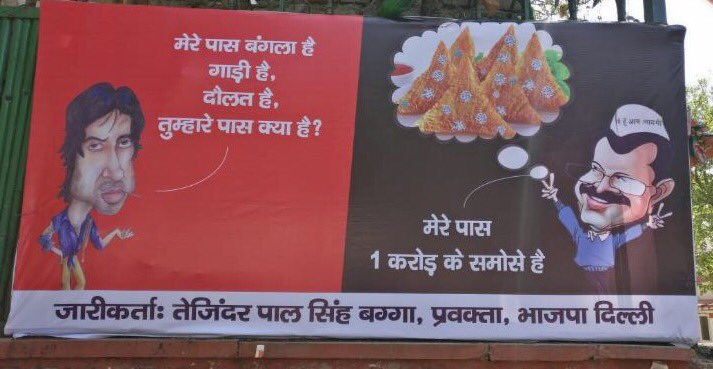
In one such poster put up by Delhi BJP’s spokesperson Tajender Bagga, Arvind Kejriwal’s alleged samosa bill of 1 crore is highlighted:

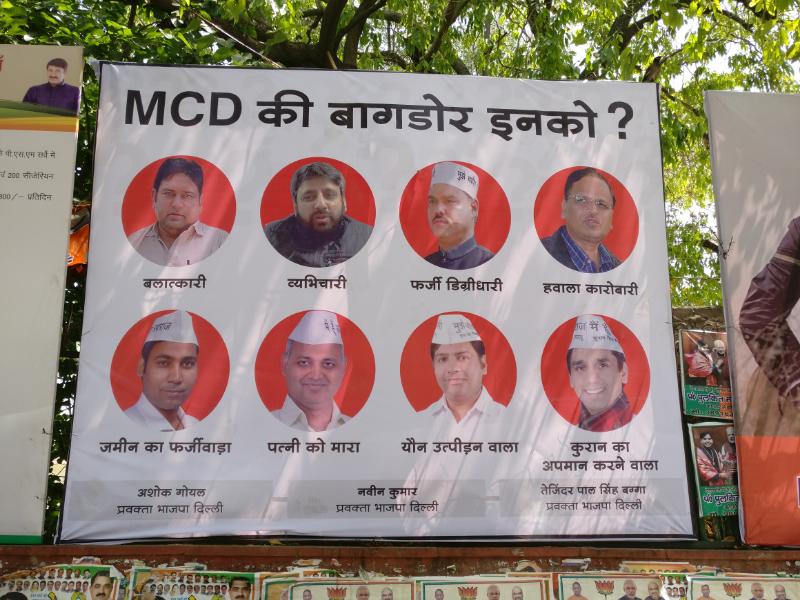
In another poster, real images are used as against a cartoon for Kejriwal. Real images of various AAP leaders accused of various crimes have been highlighted in this poster:

AAP is yet to respond to these posters with new ones.

This isn’t the only time the posters created during elections have drawn widespread attention. Two Congress party workers named Haseeb Ahmad and Shreesh Chandra Dubey from Allahabad have elicited praise for the innovative posters they have been putting out.

Tulsidas wrote Hanuman Chalisa, but do you know who composed its popular music?

Today is the full-moon day of Chaitra, the first month of the Hindu calendar. Today is Hanuman Jayanti, or the appearance day of Hanuman, as per the Skanda Purana and Ananda Ramayana. Hanuman is the quintessential character without whom the Ramayana is incomplete. He figures prominently in all major versions of Ramayana, starting from the original Ramayana by Valmiki, where he is described as the knower of the three Veda-s and the nine grammars, to the Ramcharitmanas by Tulsidas, where he is remembered as the ‘kapishvara’ along with the ‘kavishvara’ Valmiki in the epic’s very fourth verse.

Apart from popularizing the Ramayana in the vernacular Awadhi, Tulsidas is also credited with popularizing the independent worship of Hanuman in northern parts of India. He is traditionally believed to be the founder of the Sankat Mochan Hanuman temple in Varanasi and the author of the ‘Hanuman Chalisa’, the celebrated prayer to Hanuman.

The Hanuman Chalisa is written in Awadhi, a language spoken in central Uttar Pradesh by just around three percent of India’s population. And yet, its popularity in India transcends all conceivable boundaries of language and geography. In November 2015, I compiled a mix of forty different renditions of the Chalisa in one video. The performers in the compilation included native speakers of as many as 16 Indian languages and speakers of even Guyanese Creole, Ga/Akan, and English:

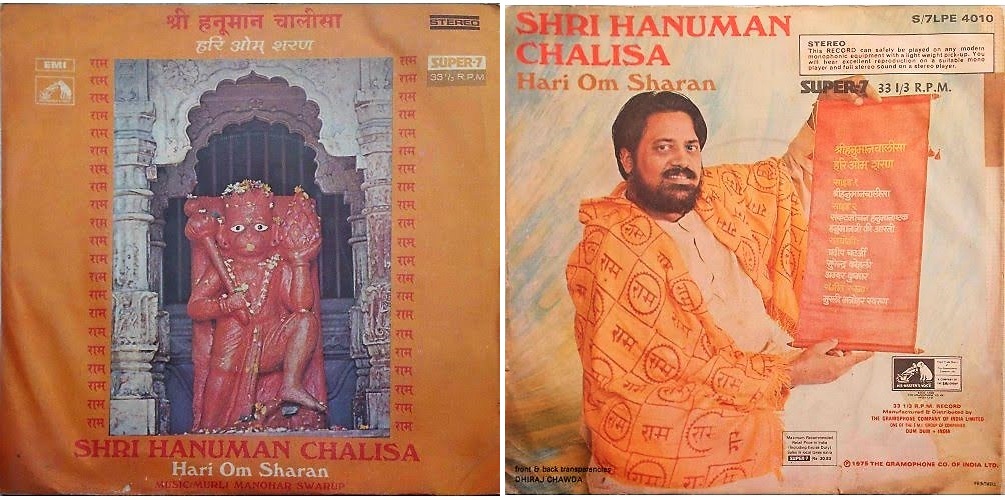
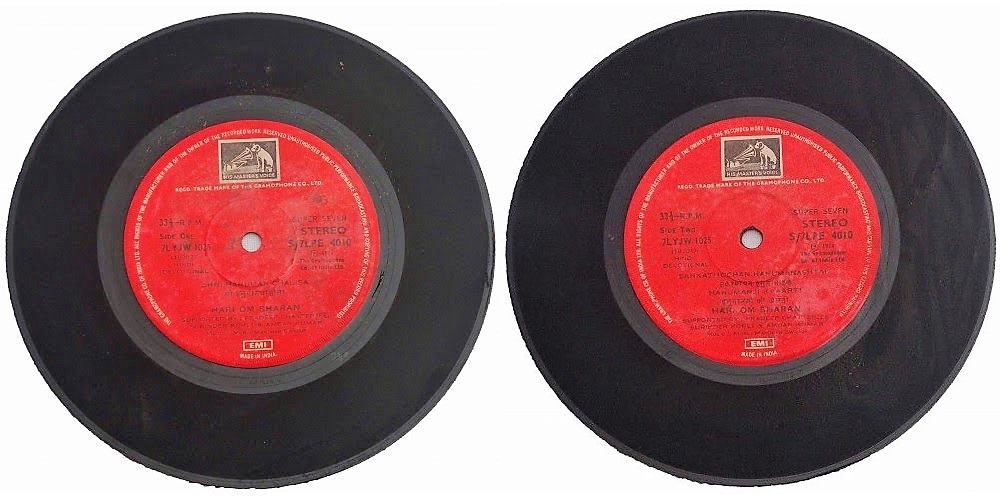
While there are many musical renditions of the Chalisa, arguably the most popular one is by the late Hari Om Sharan (1932–2007), fondly known as ‘Dadaji’ to his fans. The ‘original’ rendition by Hari Om Sharan was released in 1974 as an LP recording on vinyl discs by The Gramophone Company of India Ltd (popularly known as HMV, which was later rebranded as Saregama).

This LP had only three songs — the Hanuman Chalisa, the Hanuman-Ashtak (also attributed to Tulsidas), and the Hanuman Aarti. For the Hanuman Chalisa track, the two introductory doha-s and all the forty chaupai-s were sung solo by Hari Om Sharan, while the concluding ‘doha’ was sung by Pradeep Chaterjee, Surinder Kohli, and Amber Kumar. These are the images of this legendary LP release:

Since 1974, this rendition by Hari Om Sharan has been played in millions of homes and thousands of temples from vinyl discs, audio cassettes, CDs, mp3s, and streaming websites. It became the target of countless imitations over the years. It made Hari Om Sharan a ‘rockstar’ wherever he went. I was told by his wife, the Guyana-born Ms Nandini Sharan, that during his tours to the Caribbean in the 1970s and 1980s, stadia would be filled with people of Indian descent cheering Hari Om Sharan and shouting “We want Hanuman Chalisa.”

In 2015, when I was working on the annotated and expanded English translation of the ‘Mahaviri’ commentary by Swami Rambhadracharya on the Hanuman Chalisa, I wanted to include an appendix on musical notation. Going by its popularity, I decided on the version by Hari Om Sharan for engraving using the Western staff notation. Since music as well as any form of graphical musical notation, whether recorded or not, are both copyrighted under the Indian Copyright Act, I had to take the permission of the copyright holder before I could include the notation in my book.

While searching for who owns the copyright, I realized that in addition to the countless imitation releases by street artistes, recordings with the same musical tunes (except for a few changes in a note or two here and there) as the 1974 Hari Om Sharan version were released by major record labels. As an example, although the music composer is credited differently, the music of the following three releases is almost entirely the same:

1) The ‘original’ Hari Om Sharan version: The 1974 LP by The Gramophone Company of India credits the music to Murli Manohar Swaroop, who composed the score for the abridged Ramcharitmanas sung by the Bollywood singer Mukesh. The version can be heard online here (track number 6).

2) The Hariharan version: The 1992 music video featuring Gulshan Kumar was released by Super Cassettes Industries Limited and credited Chander and Lalit Sen as the music composers. The official YouTube video of this version has had more than 37 million views as of today.

3) The ‘new’ Hari Om Sharan version: The 1995 audio CD release by Super Cassettes Industries Limited credited Hari Om Sharan himself as the music composer. Hari Om Sharan later also acted in a music video for the recording. The official YouTube video has had less than half a million views, but an unofficial YouTube upload has amassed more than 2 million views.

To complicate the matters further, I was told by Ms. Nandini Sharan that it was Hari Om Sharan himself who came up with the tunes for the 1974 release, while Murli Manohar Swaroop ‘arranged’ the music and got credited as the composer.

I contacted one of the record labels on the copyrights for the notation, explaining that I needed to include the notation in a book and needed their permission. The officials were reluctant to say anything on the record on the matter. I first got responses like “We have never seen such a request earlier” and “We do not have the notation, there is no practice of recording it”.

When I made further requests over several weeks, I was told off the record by the officials that most likely the tunes are traditional, and since several record labels have released recordings with the same music, they are themselves not sure who owns the copyright.

While it cannot be confirmed, it is likely that the 1974 Hari Om Sharan rendition was based on traditional tunes. I do not know much about Murli Manohar Swaroop’s influences, but Hari Om Sharan was inspired by folk music. Ms. Nandini Sharan once narrated to me that her Lahore-born late husband was separated from his family during the cross-border migration in 1947 and spent several years wandering as a vagabond in the Himalayas, learning music from bards and picking up tunes from folk musicians.

My search for the owner of the copyright had hit a dead end. I finally wrote the 12-page musical notation myself. stating that it was “based on traditional melodies which have been used in three popular renditions.” Rohit Sinha in Mumbai and Chandramouli Rotti in Gandhinagar were kind enough to proofread the notation and suggest some edits. The musical notation can be downloaded from here.

(Nityanand Misra is an IIM-Bangalore graduate who works in the investment banking industry. He has edited six books in Hindi and Sanskrit, and has authored the English book ‘Mahaviri: Hanuman-Chalisa Demystified’, which is an expanded and annotated translation of the Mahaviri commentary on the Hanuman Chalisa. The English version of the book is available here, and the original one in Hindi here.)

Will petrol pumps now be closed every Sunday to realize PM Modi’s vision?

0

Late evening on Monday, the 10th of April, social media was sent into a tizzy by one tweet by newspaper Business Standard:


Many who read this tweet and the accompanying headline, interpreted this move of shutting down petrol pumps on Sundays, to be a move aimed at reducing fuel consumption, which was suggested by the Prime Minister Narendra Modi in his radio address Mann Ki Baat a couple of weeks back. PM had appealed that people should try to avoid using vehicles for a day in week. Thus, readers assumed that either this (petrol pumps to be closed on Sundays) was a decision by the Government or it was based on a nudge by the Government.

Interestingly, Times of India too, among other media houses, reported this issue in a post titled ”Petrol pumps may take off on Sundays”. But the main reason given here was that the pumps were looking at this option if the Central Government didn’t hike the commission dealers get for fuel purchase. The article quoted a certain Ravi Shinde of the Petrol Dealers’ Association who claimed that the oil marketing companies had assured them of a revision in January but nothing had happened in that regard. It was a short piece and had no mention of Modi’s appeal for lower fuel consumption.

The Times of India post was very short and the complete story was available in the Business Standard report itself. The (original) report claimed that an organization called Consortium of Indian Petroleum Dealers (CIPD) had asked its members to shut shop. This organisation claims to have an influence on 25,000 petrol pumps in Maharashtra and Southern India. The report also mentioned that the president of All India Petroleum Dealers’ Association Ajay Bansal said that they weren’t in favour of this decision as it might lead to widespread panic. He though reiterated that they had the same demands, i.e. to increase the dealer’s commission.

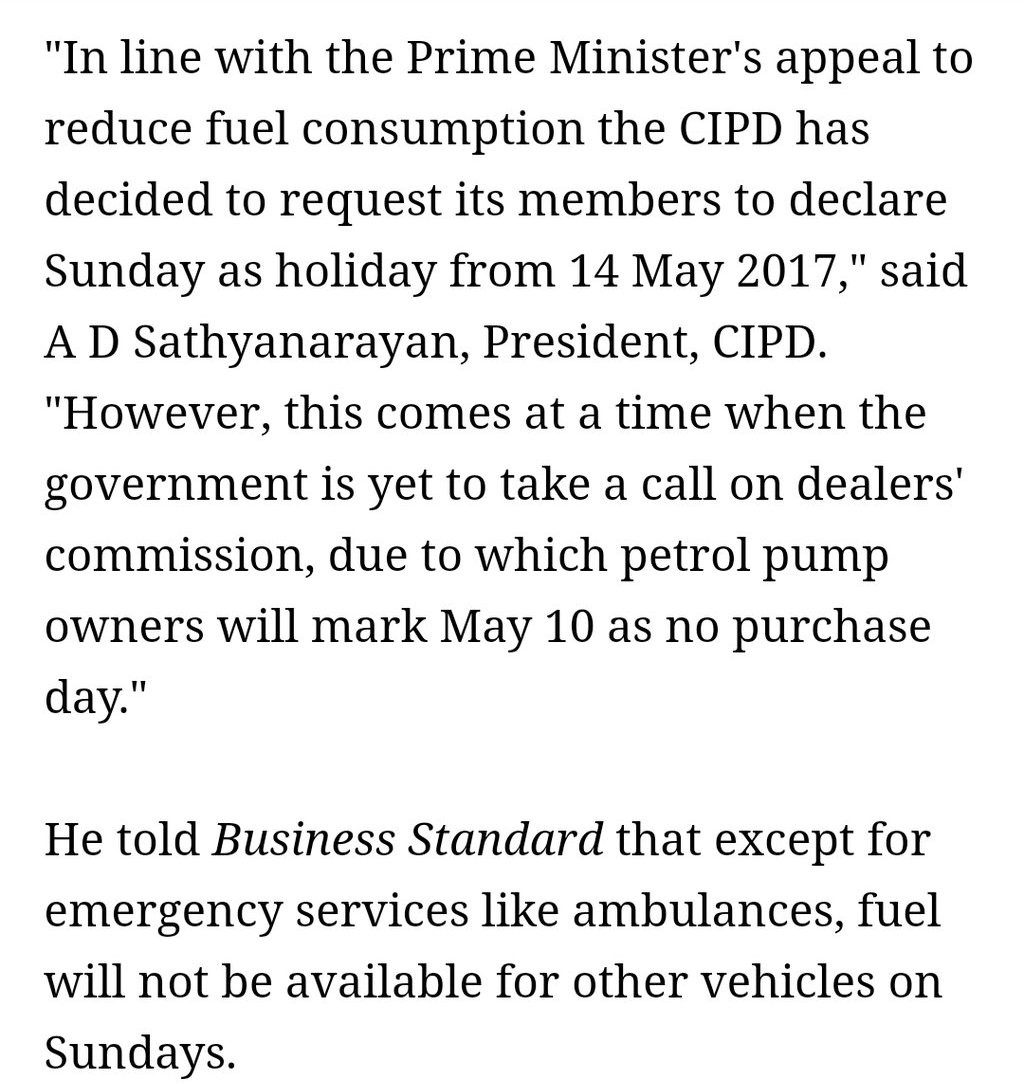
So where did PM Modi come into this? Business Standard carried a direct quote of the CIPD president A D Sathyanarayan, in which he reportedly had claimed that the move came in light of PM’s appeal. The issue about the demand for additional commission was also mentioned, but the main cause for the Sunday shut-down was given as PM Modi’s call.

Screenshot of original article

But strangely, as of today morning, the Business Standard report was “updated”. The opening paragraph now said this (emphasis added):

A section of petroleum dealers said they would shut their retail outlets every Sunday starting May 14. Many see this as a tactic to pressure government for higher commission.

The tweet and the headline of the original post had linked the move to PM’s appeal, but now the first paragraph itself alluded that this move could be a pressure tactic.

Moving further, the direct quote of CIPD president A D Sathyanarayan, where he had reportedly said the move is linked to the PM’s appeal was missing. Instead, the report now stated that the CIPD had stated the same:

The Consortium of Indian Petroleum Dealers (CIPD) on Monday asked members to shut shop on Sundays, in line with the prime minister’s vision to reduce fuel consumption.

This raises the question as to why was the direct quote made indirect? Why was the quote, which was initially attributed to a specific person, now attributed to the organisation? Was it not really a direct quote or did the quote have no basis in the 1st place?

It may be noted that the entire basis of linking this shut-down on Sundays to PM Modi was this very quote by Mr A D Sathyanarayan. Incidentally neither TOI nor any other media houses [1][2] which put out a report on the same issue, have any mention of this angle or the quote.

Also according to other reports A D Sathyanarayan hardly appears interested in fulfilling any sort of vision by the PM. Sathyanarayan has been quoted to be concerned about dealers getting some margin money based on a Apurva Chandra Committee report which was overlooked since 2011. The same man was at the helm of an agitation in January against accepting cards at Petrol Pumps as the dealers not the consumers had to bear merchant discount rate first levied by the HDFC.

To summarise, the Business Standard:

  1. Had initially promoted the Sunday shut-down linking it directly to the PM’s appeal, but has now “updated” the piece to now allude that this may be a pressure tactic
  2. Had initially claimed that a direct quote by Mr A D Sathyanarayan was the basis of this angle, has all but deleted the direct quote, and now attributes the same, indirectly, to the organisation rather than the person.

While the quote (which has not been reported by any other media house independently) may or may not be true, it appears even Business Standard agrees that their initial report was misleading, to put it mildly.

Know more about the Indian ‘spy’ Pakistan has decided to execute

The Inter Service Public Relations (ISPR) Pakistan, which is the media wing of the Pakistani Armed Forces, on Monday announced that an Indian national named Kulbushan Sudhir Jadhav had been awarded the death penalty after being tried through the Field General Court Martial (FGCM) under Pakistan Army Act (PAA). This death sentence was also confirmed by Pakistani COAS Gen Bajwa.

Pakistan has alleged that Jadhav was tasked by the RAW to plan, coordinate and organize espionage/sabotage activities aiming to destabilize and wage war against Pakistan by impeding the efforts of Law Enforcement Agencies for restoring peace in Balochistan and Karachi. Pakistan reportedly found him guilty based on their supposed claim that he had confessed before a court and magistrate. Jadhav was arrested on 3rd March 2016 from Mashkel, Balochistan but his arrest was not announced until 24th March.

So moving away from the Pakistani army’s propaganda, let’s try look at the issue via another lens, the response by the Indian establishment to the whole affair. The Indian Govt even though had acknowledged that he was a retired Navy officer, it had categorically denied that he was in any way connected to the govt or on any ‘spying’ mission in Pakistan.

What casts further aspersions over the Pakistan’s ‘trial’ is the fact that the Indian officials were denied access to Jadhav throughout the process. It was reported that the New Delhi had sought consular access to Jadhav by issuing as many as six note verbales (letters of protest) to the Pakistan foreign ministry.

Based on available information, Jadhav was born on 16 April 1970 and joined the NDA in 1987. He was commissioned in the Engineering branch of the Navy in 1991. His family currently resides in the Hiranandani complex in Powai. Jadhav’s father Sudhir Jadhav retired as the ACP in Mumbai.

At the time of his arrest, Jadhav was reportedly carrying a passport with the name Hussein Mubarak Patel, this according to Indian officials meant that he wasn’t a spy, for had he been one he wouldn’t have been carrying an Indian passport.

After Jadhav was arrested, it was reported that Jadhav’s family members had claimed that he had quit the Navy and was engaged in a legitimate business of cargo transportation, ferrying cargo between ports in Iran. The family after hearing of Jadhav’s arrest had flown to Delhi to meet with the MEA officials about a possible course of action.

Reports claimed that Pakistani authorities arrested Jadhav after they caught him talking fluently in Marathi with his family even though he was posing as Husain Mubarak Patel, a Muslim of non-Marathi origin.

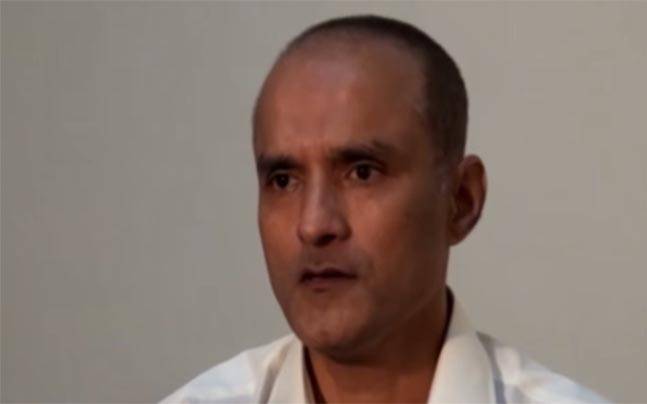
Pakistan around that time also released an alleged video of Kulbushan Jadhav where he is seen confessing about him being a RAW agent who was in Balochistan to destabilize the region. Though reports have stated that a forensic examination of the video conducted by the Indian intelligence agencies had found the video to be heavily edited with the audio being spliced up is several places. There were also instances where Jadhav’s facial expression didn’t match the voice over. The three-week gap between the arrest and the announcement also led to the speculation of Pakistanis using coercive measures for extracting the so-called confession statement.

What raised further red flags was the fact that the video was released by the Pakistanis on 29th March last year, which was incidentally the same day a Pakistani team was in Pathankot to investigate the attack on the Indian Air base.

There were also inconsistencies in the statements by the Pakistani officials. The Home Minister of Pakistan’s Balochistan province, Sarfaraz Bugti had first announced that Jadhav was picked up from Chaman but General Asim Bajwa announced that Jadhav was arrested from Saravan. The distance between Chaman and Saravan is about 873 KM. There were also reports which claimed that Jadhav, who had a valid residential permit in the Chabahar Free Trade Zone till June of last year, might have been lured into Pakistan and arrested thereafter.

In response to the Pakistan’s decision to award death penalty, India has responded by calling the proceedings as farcical and stated that if the sentence is indeed carried out, it would amount to premeditated murder. It remains to be seen what would be India’s response be in the coming days and whether there’s any glimmer of hope that Jadhav might return alive to the Indian shores again.

How colour code for app based taxis in Maharashtra was given a communal spin

0

What do you get when an organisation, some in the media, and a political party unite? A heady mix of half-truths and whole lies, which lead to a “surge” in emotions, based completely on un”fare” arguments.

It starts with a report in the tabloid Mid-Day, which screams:

Mumbai: Uber, Ola cabbies don’t want their vehicles painted saffron 

Drivers and owners of Uber and Ola taxis have written to the Shiv Sena chief expressing their displeasure over the transport minister’s decision to get their vehicles painted saffron

Shiv Sena, “saffronisation”, sounds believable. The report further says (emphasis added):

The drivers and owners of Uber and Ola taxis are angry with Cabinet Minister of Transport Diwakar Raote’s out of the blue decision to paint their vehicles bhagwa (saffron), or what the government has coined, daffodil yellow. They have questioned Shiv Sena chief Uddhav about this. In a four-page letter sent to Thackeray on April 6, they have raised their concerns and have threatened to boycott the Sena. The letter sent by Maharashtra Tourist Permit Sanghatana, states how the new Maharashtra City Taxi Rules, 2017, have made life miserable for the drivers operating taxis for app-based operators Uber and Ola………One of the important points highlighted in this letter was the decision to choose ‘bhagwa’ colour for all cabs operating as taxis for Uber and Ola. “Here all religions are equal. Then why has the government selected bhagwa colour, we want to know from minister Raote,” said Praful Shinde, a member of this sanghatana.

Jumping on this, discarded Congress spokesperson Sanjay Jha tried to create a storm on Twitter:


So is this true? As always, let’s go to the source of the information and not any other media report.

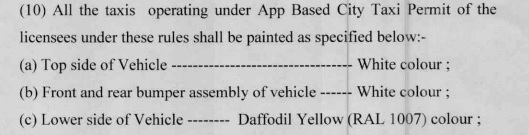
The order to “saffronize” has to come from the recently passed Maharashtra City Taxi Rules, 2017. A full copy of the notification can be accessed here (pdf link). Skipping to the relevant part, the rules do mandate a colour code for app based taxis:

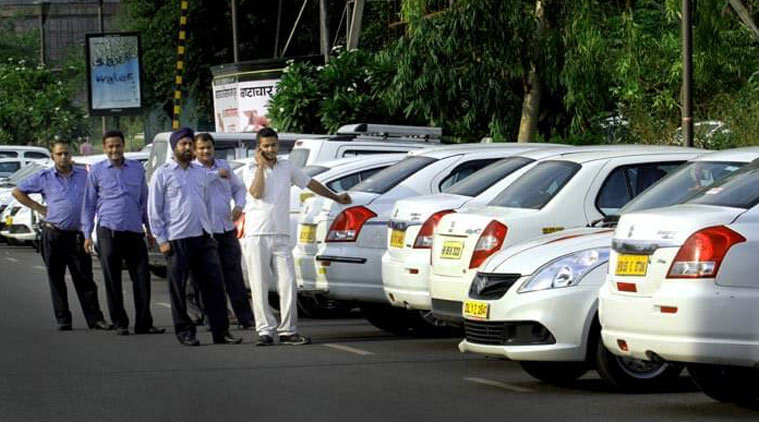
So this is what “saffronization” looks like: A White and Yellow coloured cab.

The rules even prescribe the code of the shade, and the shade card on a paints site shows that “saffron yellow” is a distinct shade from “daffodil yellow”. So if the attempt was to “saffronize” app based taxis, then the state transport minister has failed woefully on 2 counts: Firstly, only a portion of the car is to be painted “bhagwa” and worse, the colour may not even be the actual “bhagwa” or “saffron”.

Some might argue that these are technicalities and the colour yellow in any variant is close enough to saffron, and thus, the Government’s move to choose yellow is clearly based on “communal” principles. Those people then would have to agree that taxis the world over have been “saffronized”. Yellow cabs are found the world over, right from USA (pre-Trump era) to London (pre-Brexit era).

And there is a scientific reason for taxis to be yellow in colour: John Hertz, founder of the Hertz Rent-a-Car System, read a University of Chicago study that suggested the colour yellow with a bit of red mixed in was the colour most visible from a distance, and so he proceeded to paint all his taxis the colour that would eventually come to be known as ‘taxi yellow’. This may be a grand conspiracy but “yellow with a bit of red mixed in” is almost saffron!

To be fair to Mid-Day, they have quoted a member of the Maharashtra Tourist Permit Sanghatana who has given a communal spin to the colour code for app-based taxis. Provided this quote is genuine, this may be an elaborate plan by the Sanghatana to scuttle the Taxi Rules, which have far more stricter rules for app based taxis, which for the time being have no regulations to bind to. The “communal” bogey can help them get support from “sympathetic” media houses and also the opposition, which is desperate to be “secular”.

Madhu Kishwar – A victim of Kashmiriyat

0

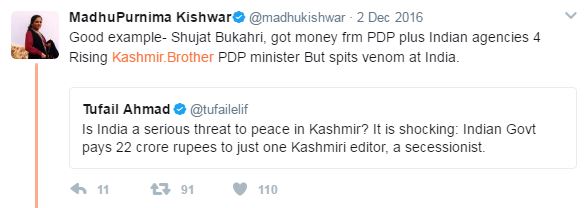
Twitter is witness to innumerable differences of opinion every day that translate into allegations and counter-allegations. In one such instance, the well-known scholar and activist, Madhu Kishwar accused Shujaat Bukhari, the editor-in-chief of ‘Rising Kashmir’, a local daily in the valley, of getting money from the Indian state agencies and yet spitting venom at India. This prompted the ‘award-winning editor’ to file a defamation case against Kishwar in December 2016.

Madhu Kishwar’s tweet that led to the legal proceedings against her.

Now there is nothing especially revelatory in the above tweet, given that the Indian government, right from 1947, has been extremely generous in allocating funds and resources to the valley, even while meting out a step-motherly treatment to the other two parts of the state, Jammu and Ladakh. But even in the specific context of the newspaper in question, Madhu Kishwar’s single tweet thrice hits the nail on its head even without straying into the ‘controversial’ zone:

  1. ‘Rising Kashmir’ enjoys regular patronage from the state government in the form of advertisements.
  2. Shujaat Bukhari’s brother, Basharat Bukhari, is a minister in the state cabinet.
  3. The editorial stance of Rising Kashmir is decisively pro-separatist.

It can be argued that Kishwar’s tweet was indeed controversial, even to the extent of being defamatory, and it is only in a court of law that the real intent and consequences of Kishwar’s action may be ascertained. But as soon as one takes a cursory interest in the proceedings of the case, it becomes clear that battle is not being fought on a level playing field.

For one, the speed with which the case has progressed makes one wonder why the same alacrity is missing in open-and-shut cases against hardcore terrorists of Kashmir. Secondly, the eagerness with which arrest warrants (not mere summons) have been issued against the accused makes her question the soundness of the legal proceedings.

However, the intent of this piece is not to question the sovereign majesty of the courts and invite their holy wrath. Rather, the idea is to draw attention to the pattern common between the general contours of Kashmiri separatism, of which Bukhari is a passionate adherent, with the particulars of the defamation suit against Madhu Kishwar.

The pattern has a name – Kashmiriyat, and the fact that Kishwar herself has endorsed this hoax in the recent past is indicative of its sway on the Indian intelligentsia. Kashmiriyat, as we shall see, makes Kashmiri separatism a resilient variety of Muslim separatism, one that survives by disguising itself as a righteous fight against imagined oppression and by co-opting its very victims.

Victim unsuspectingly endorsing the oppressor

Historical Roots

It is a truism that Kashmir is an integral part of India’s ancient civilization and there is simply no rationale for it to claim separateness. Kashmiriyat softly works at undermining this fact. It is another name for Kashmiri sub-nationalism.

Sheikh Abdullah coined the term in the 1930s so as to claim a greater degree of influence in the ever-shifting power dynamics of the subcontinent in the years just preceding independence. The coinage had the blessings of Abdullah’s good friend, Jawahar Lal Nehru, who saw it as a clever way of undermining Jinnah’s efforts to seek Kashmir’s merger with the soon to be Pakistan. Unfortunately, this disingenuous foray into manufactured identity politics turned into a Frankenstein monster that continues to harass the Indian establishment to this day.

Kashmiriyat blends in with the politically correct cultural vocabulary of secular India but the following attributes reveal its insidious agenda in diverse settings, whether it is affecting an entire society or just random individuals.

Anti-India

In the absence of a genuine positive definition of itself, Kashmiriyat seeks legitimacy and vitality from a vehement denial of its adherents’ natural identity. Therefore, Kashmiriyat is, by definition, a denial of Kashmir’s ancient Indic past and consequently, its politics is inherently anti-India.

In the hatred for India, it finds common cause with Pakistan, which was founded on the same principle of denial and accordingly, Kashmiriyat is another name for the Islamization of Kashmir. Consequently, the distinction between the demand for azaadi and a merger with Pakistan is one of political expediency.

“Pakistan se rishta kya, La illah ilallah” (How are we related to Pakistan? There is no other God but Allah)

In the late eighties, many such slogans were raised in the valley that left no room for any doubt whatsoever about the real nature of the movement. The extremist violence finally led to the exodus of the Kashmiri Hindus, who were eyesores in the grand hallucination of Kashmir’s Islamic future as a province of Pakistan. However, after the exodus of the Hindus, the movement came to be associated with religious extremism and risked distancing potential allies in the global Human Rights industry. Kashmiriyat saved the day.

Shujaat Bukhari is thus an exemplar of Kashmiriyat. He maintains a carefully crafted façade of neutrality and appears to be equidistant from the cynicism of Indian and Pakistani establishment. His newspaper carries elaborate apologia for terrorism on a regular basis, rationalizing Geelani’s bigotry one day, squarely blaming India for the failures of Kashmiri society the next and drawing false parallels with Palestinian intifada on another.

Make no mistake, beneath the shimmering pretense of stoic neutrality, packaged as the right to self-determination, is the visceral hatred for pluralistic ethos.

Subversion of instruments of the state

For all its anti-establishment oratory, the duplicity of Kashmiriyat cannot be effective if it refuses to make use of the resources of the same establishment that it despises. All arms of the state are ultimately controlled by people and it becomes important that the right people are placed in the right positions.

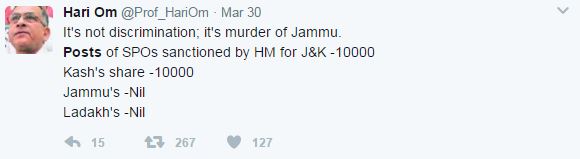
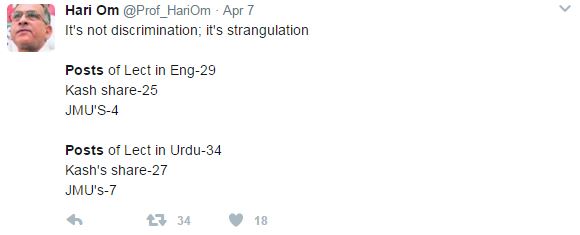
It is in this respect that an equitable representation from all parts of J&K would create insurmountable hurdles in the way of achieving the end goals of Kashmiriyat. As Professor Hari Om demonstrates:

What happens when ideologically motivated officials occupy positions of power? They ally with their comrades and misuse their authority to further their narrow collective agenda.

It is common knowledge that many Kashmiri doctors, blatantly defying the Hippocratic Oath, refuse to treat army jawans admitted in civil hospitals. The writer’s own grandmother suffered at the hands of Kashmiriyat when as a victim of a bomb explosion, she was admitted at a leading government hospital in Kashmir. The deliberate delay in treatment by the doctor in-charge played a crucial part in her untimely death.

One cannot but marvel at the disturbing enthusiasm with which the legal case against Madhu Kishwar has been taken up. In the Kashmiriyat infiltrated institutions of the state of Jammu and Kashmir, such efficiency is only visible when Kashmiriyat is threatened or as they say in the pro-Pak rallies, “Islam khatray mein hai”.

Reverse Victimhood

The real genius of Kashmiriyat lies in turning victimhood on its head. As mentioned earlier, after the people of the valley were successful in driving out the minority Hindus from their ancestral homeland, they began to be seen as violent extremists. This was an existential threat to the separatist struggle and sure enough, Kashmiriyat came to their rescue.

An outlandish theory was floated that declared that the central government had conspired with the Hindus and by facilitating the exodus of the minority community, had prepared the grounds for the genocide of Muslims. Of course, the genocide never happened but the use of force by the security apparatus to contain the large-scale rioting and violence on the streets was marketed as one. Thus by projecting the jihadi violence as a struggle for the right to self-determination, the ruthless bully mutated overnight into the weakling looking for support and solidarity.

A similar pattern is hard to miss in the current imbroglio that Madhu Kishwar finds herself in. Shujaat, a man of position and influence, realized that his two-faced politics of covert separatism was being exposed and questioned by a fiercely independent woman activist. The threat to this veneer of neutrality resulted in the defamation suit.

It is easy to identify the victim between a man accused of supporting separatism while benefiting from state patronage and a woman battling health issues and travelling to another state to defend herself, all by herself, in a court of law over a careless set of tweets at worst. Yet, the non-bailable warrant that was recently issued against Kishwar makes it evident that Kashmiriyat has turned her into the aggressor here.

Consequences of Kashmiriyat – Friends turning foes

The mass departure of Kashmiri Hindus from Kashmir was followed by the deafening silence of the people outside the valley, who were blissfully unaware of the violence and bloodshed in virtually their backyard. This was the era of government-controlled mass media and internet was not even a word in the dictionary. In time, Kashmiri Hindus settled in different parts of the world and many political parties showed lip service solidarity with them.

By and large, Kashmiri separatism was associated with moral depravity of the worst kind, the soft appeasement of the Indian state notwithstanding. However, things changed in the first few years of the new millennium with the then PM, Atal Bihari Vajpayee invoking Kashmiriyat as the way to the hearts of the alienated Kashmiris.

This whitewashing of the past by a PM from the BJP, the only party that calls for the abrogation of article 370, was ironic, to say the least, and this marked a new era of the central government’s relationship with separatists. Where people like Yasin Malik were earlier rightly treated as criminals and terrorists, now the Hurriyat conference was given the highest seat at the table. In the process, the question of the return of Kashmiri Hindus to the valley turned into a cruel practical joke on the displaced community.

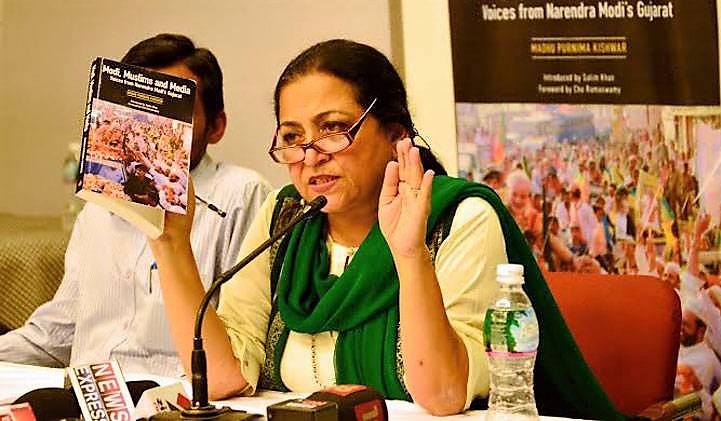
Madhu Kishwar was one of the very few independent and credible voices that stood up for Narendra Modi in the run-up to the 2014 general elections. Further, her well-researched book on the relationship between Modi and Muslims cleared the air around many a rumour spread by the sensationalist sections of the mainstream media.

To state it plainly, she was one credible voice on the side of the BJP that arguably helped them gain acceptance among the fence-sitting voters. But today, not one BJP leader has come out in her defense in the open, not to mention the deafening silence of the champions of freedom of expression in the liberal media. Her activist friends from the left as well as the politicians who clicked pictures with her book have deserted her. Truly in line with the demands of Kashmiriyat, the BJP leaders look the other way as their coalition partner patronizes a separatist rag.

Conclusion

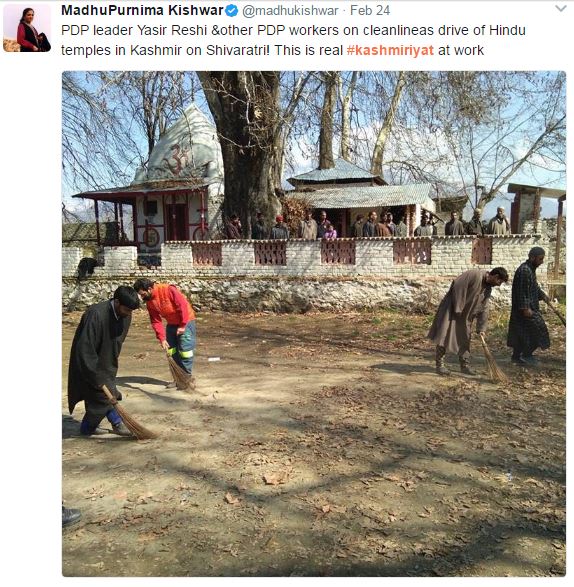
The amount of attention that Rising Kashmir gave to Yogi Adityanath’s rise to power in Uttar Pradesh could erroneously be taken to mean that the paper is published in Uttar Pradesh. Like any bully, Kashmiriyat is scared of a challenging confrontation and thus perceives a mortal threat in the rise of the Hindu consciousness in India.

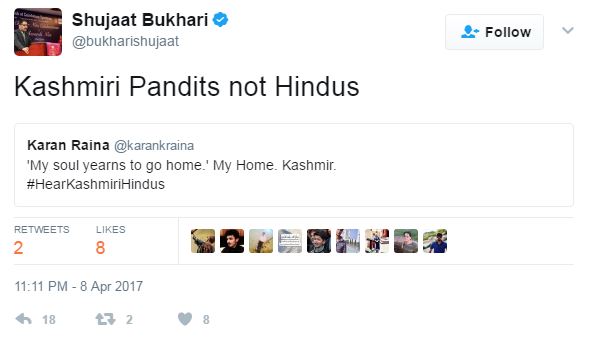
As the above tweet illustrates, the shelf life of the Kashmiriyat hoax is over. The more fanatic believers have started making absurd statements that no one is going to sue them for, but which go on to show nevertheless that they have hit the panic button.

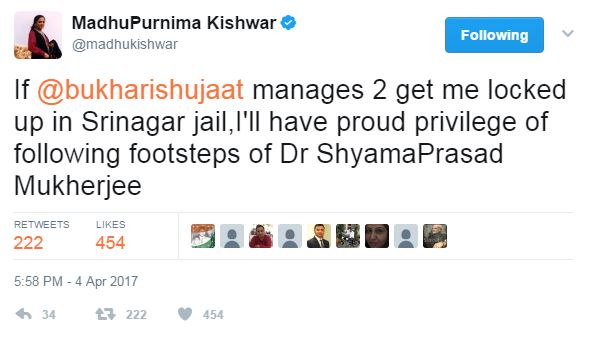
Madhu Kishwar need not worry. The ordinary ‘nationalist’ Indian stands with her and they won’t be able to pull a Syama Prasad Mukherjee all over again.

Jai Hind!

Madhu Kishwar responds to arrest warrant against her for criticising pro-separatist elements in Kashmir

0

Madhu Kishwar, social activist, professor and the founder of Women’s Rights organization Manushi, has been served with non-bailable arrest warrants reportedly for speaking against a journalist, whom she had accused of having a pro-Pakistan tilt in reportage of the newspaper he edits. She has issued a statement about the same.

The journalist in question is a person named Shujaat Bukhari, who is currently the editor of a newspaper called Rising Kashmir. Earlier he was reported to be with the left-leaning newspaper The Hindu, and Ms. Kishwar terms him someone who finds favour with the leftists as he pretends to stand for Human Rights, albeit only those of the terrorists.

She alleges that even though Bukhari took money from various State and Central government agencies via ads and DAVP (Directorate of Advertising and Visual Publicity), he continued to parrot the Pakistani script around the unrest in Kashmir valley.

This reportedly irked Bukhari and he filed a criminal defamation suit against Ms. Kishwar in December last year. Kishwar, in her statement, has alleged that when it comes to the court proceedings, she has been meted out an exceptionally harsh treatment, possibly because of the people she was speaking against.

She informs that Shujaat’s brother Basharat Bukhari is a senior cabinet minister in the Jammu & Kashmir government and his family is part of the power establishment of Kashmir. Not only that, he is well connected with the separatist groups.

On 3rd Dec 2016, the Criminal defamation against her was listed as the first case in the court of Chief Judicial Magistrate (CJM), Srinagar and CJM Masarat Shaheen issued a bailable warrants against her on the same day. She argues that as per the IPC and the Ranbir penal Code operative in Kashmir, she should at best have been issued summons.

She also argues that it was not required of her to personally appear in the case as per a precedent set by the Supreme Court, which says that personal appearance can be exempted when the accused is a woman and/or living far away in another city or state and/or is a senior citizen and/or is in poor health. She meets these criteria.

Apart from that, she lists another reason for not appearing in the court; her safety would have been in danger had she visited the valley. But on 20th March this year, the CJM ended up disposing off her application seeking permanent exemption and directed her to appear before court on or before 3rd April. Kishwar decided not to comply due to the aforementioned reasons and fears, and now the CJM has served non-bailable arrest warrants against her.

She has pointed out that Bukhari has not denied her charge that his paper was pro-separatist and followed the Pak agenda. She also asked as to who paid for his multiple trips abroad and helped him set up three newspapers. She says that Manushi keep a transparent record of donations and earnings, and thus she expects Bukhari to do the same.

Ms. Kishwar now has option of petitioning the J&K High Court for a stay order against the arrest warrants and a plea to transfer the cases away from the state as she fears not only for her safety, but a lack of fair trial to her given how the CJM had behaved.

As she rightly points out, the incident has not attracted any outrage from those who claim to be for freedom of expression and free speech. The lot that screams at top of their voices when a left-leaning or anti-Hindutva person faces heat of the law is now keeping a strategic silence. In fact, “Emergency” and “attack on free speech” was claimed when a case related to financial misdeeds was registered against anti-Modi activist Teesta Setalvad, but the same lot is now busy looking other way.

Her case only reinforces who and what is the real establishment in India.