Home Blog Page 858

Balochistan: Major attack against Pakistani military personnel, multiple vehicles targeted on highway, dozens shot dead. Read about Baloch rebels’ Operation Herof

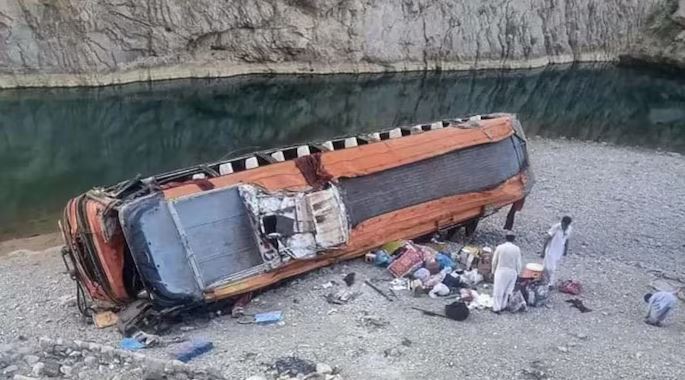
At least 23 passengers from Punjab have been killed in Balochistan’s Musakhail district on Monday (26th August). As per Pakistani media reports, gunmen stopped several buses, trucks, and vans that were coming from Pakistan’s Punjab province. They forced the passengers out of their vehicles and fatally shot at least 23 persons after checking their identities. The dead passengers belonged to Punjabi ethnicity. 

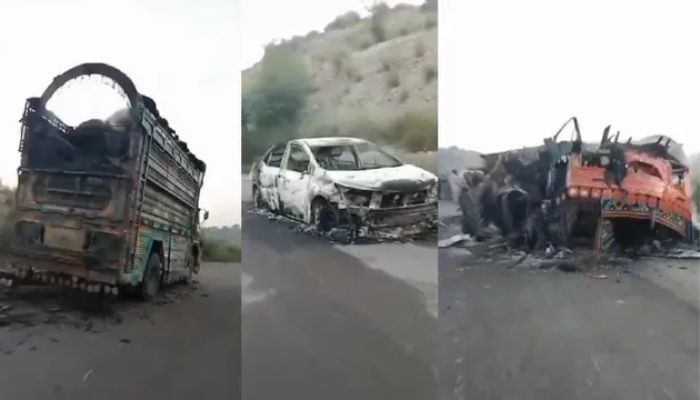
(Gunmen forced passengers to deboard buses, trucks and vans and shot them after checking their IDs, Image Source – India Today)

Following the attack, the Pakistani officials alleged that the armed men checked identity documents, singled out Punjabis, and shot them. According to Pakistan’s Dawn newspaper, they also set fire to 10 vehicles.
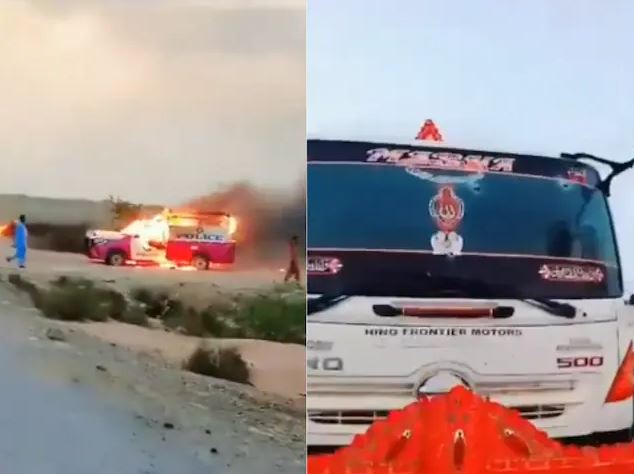
(Image Source – News18)

According to Assistant Commissioner Musakhail Najeeb Kakar, armed men blocked the inter-provincial highway and offloaded passengers from buses.

A local official, Najibullah Kakar stated that around 30 to 40 militants were involved in this attack. He told AFP news agency, “They stopped 22 vehicles. Vehicles traveling to and from Punjab were inspected, and individuals from Punjab were identified and shot.”

The attack happened overnight on a highway in Balochistan province where Baloch groups have been accusing the Pakistani military of ethnic cleansing, persecution, and targeted killings in the name of counter-terror operations.

While clashes have been ongoing between ethnic Baloch groups and the Pakistani army, major clashes were reported on 26th August with BLA claiming that it has killed over 100 Pakistani army personnel under Operation Herof. They have also claimed control over several highways and army camps. 

Conspicuously, while Pakistan has dubbed the Mushakhail incident as a ‘terrorist attack’, the Baloch Liberation Army (BLA) said that the deceased passengers were Pakistani military servicemen who were disguised in civilian clothes. Notably, while claiming responsibility for the attack in the Mushakail district, BLA said that their fighters identified and subsequently killed Pakistani military servicemen. 

It is pertinent to note that it has been reported that two paramilitary soldiers were among the two dozen people killed in this attack. 

According to the news agency Reuters, the BLA has said it was targeting military personnel travelling in civilian clothes. According to reports, before the attack, BLA had issued a warning to the Baloch public and asked them to stay away from the highway. They added that their “fight is against the occupying Pakistani military”. 

It added, “We have taken full control of all major highways across Balochistan, blocking them completely.” 

Baloch groups accuse and fight against the Pakistani military for carrying out ethnic cleansing and resource plundering in the name of counter-terror operations

Incidentally, Balochistan is the largest province in Pakistan. Though it has an abundance of resources, it is the least developed region in Pakistan. Over the years, the BLA and other Baloch ethnicity groups have intensified attacks on Punjabis and Sindhis, especially military personnel from elsewhere in Pakistan working in the region. 

Additionally, they have also targeted foreign energy firms to exploit the region without sharing profits. 

Earlier, a similar incident was reported in April this year. Nine passengers were removed from a bus near the Noshki area in Balochistan and they were shot dead after the gunmen checked their IDs. In another incident, unidentified gunmen shot six labourers who belonged to Punjab in Turbat in Balochistan’s Kech district. 

Police had said these were targeted killings and these people were killed because of their ethnic background, Dawn reported.

Earlier, OpIndia reported how Pakistan launched ‘Operation Azm-e-Istehkam’ military offensive after it was armed-twisted by Beijing to launch a brutal crackdown in the Balochistan area in the wake of rampant attacks on Chinese nationals. The report highlighted how Pakistan had earned notoriety for its “counter-terror operations” like the infamous ‘Operation Zarb-e-Azb’.

While Pakistan claims that these are counter-terror operations, several questions have been raised about their effectiveness and exacerbating Human suffering in the region including increased allegations of extra-judicial killings, forced displacements, and allowing pro-Pakistani Jihadi groups to flourish.

Several experts have stated there was a fundamental contradiction in the Pakistani military’s counter-terrorism approach. They pointed out that while the army goes after the terrorists who carried out attacks in Pakistan, it patronised those who attack its enemies. 

A US-based expert on political Islam, Arif Jamal said that the military operation was never launched to target home-grown jihadists.

Pashtun and Baloch rebels fight against discrimination, resource exploitation and military coercion

Additionally, Pashtuns and Baloch nationals witnessed repressive measures (such as extra-judicial killings, enforced disappearances, discrimination, subjugation of non-Punjabi ethnicities, and surveillance) by the country’s security forces under such programs. 

The infamous history of Pakistani “counter-terrorism” operations has gained prominence once again as it is carrying out repression in the Balochistan area in the name of ‘Operation Azm-e-Istehkam’. In response, the BLA has launched a series of attacks on multiple government installations – including police stations and security forces’ camps across the province in the last 24 hours. 

The BLA has reportedly claimed responsibility for killing 102 Pakistani soldiers in ongoing attacks targeting an army camp and military checkpoints along major highways in Balochistan, just six hours after it launched “Operation Herof”.

According to a statement issued by BLA, over 40 soldiers were killed during an attack on the main Army camp in Bela. The statement said that the BLA’s fidayeen unit has maintained control over a significant portion of the camp for the last six hours.

However on their part, the Pakistani officials claimed that it has neutralised 12 ‘terrorists’ as security forces responded to attacks carried out at several places across Balochistan, state-run Radio Pakistan reported on Monday.
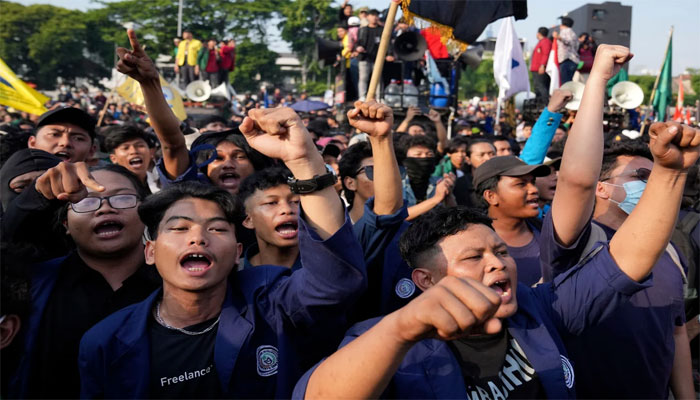

Massive protests in Indonesia after Widodo govt tries to overturn court order to amend eligibility for election candidates: All you need to know

0

On 22nd August, the legislatures in Indonesia cancelled plans to approve revisions to election laws after thousands of people took to the streets in protest. Several thousand protesters gathered outside the parliament building, sending a clear message to the legislature that they would not accept the revisions.

Proposed revisions to overturn court ruling

The Parliament was set to revise election laws following a Constitutional Court judgment on candidate age requirements, which rendered President Joko Widodo’s youngest son, 29-year-old Kaesang Pangarep, ineligible to contest elections. The legislature planned to make revisions to reverse this judgment.

A plea was filed in the Constitutional Court challenging the age limit, which prevents candidates under 30 from contesting regional governorships. The court dismissed the plea, making it clear that anyone under 30 years of age cannot contest elections.

Concerns over political influence and nepotism in Indonesia

If implemented, the changes would have potentially increased the outgoing president’s political influence in the country. Critics argued that the revisions could have led to the establishment of a political dynasty in Indonesia. Kaesang was scheduled to contest the regional elections in November 2024, but he would turn 30 only in December 2024, one month after the elections.

This was not the first time allegations of nepotism have tainted Indonesia’s political landscape. Widodo’s eldest son, Gobran Rakabuming Raka, was elected as Indonesia’s youngest vice president just a few months ago. Additionally, Widodo has been accused of favouring his ally, Defence Chief Prabowo Subianto, as his successor.

Protests force government to withdraw revisions

As soon as the legislature announced the proposed revisions, thousands of Indonesians gathered outside the Parliament building in protest. In response to the protests, Deputy Speaker Sufmi Dasco Ahmad announced that the proposed changes were dropped from the current election period. He stated, “It was officially decided that the revision of the Regional Election Law could not proceed. This means that the revision today was cancelled.”

Experts believe that had the proposed revision been implemented, it would have made it difficult for smaller parties to field candidates in key regional elections.

Protests and police response in Indonesia

The protesters burnt tyres and set off firecrackers in opposition to Widodo. In retaliation, Indonesian police used tear gas and water cannon to disperse the crowds. Protesters pelted stones at police personnel and tore down the fence around the building.

Said Iqbal, president of the Labour Party, warned of further protests if the legislature attempted to renew its efforts to reverse the court ruling. He remarked, “What the parliament did was not just a setback for democracy; it was a hijacking of democracy. Parliament is a high state institution — if it had passed it yesterday, it would have been an abuse of power, exceeding its authority.”

Expert opinions on political implications

Vedi Hadiz, a professor of Asian Studies and director of the Asia Institute at the University of Melbourne, commented, “We let you off when you had your eldest become vice president-elect. You’re asking for a lot if you think that we’d be happy with such blatant abuse of power in order to allow your 29-year-old son to also hold a position of power.”

Political turmoil in Asia

The recent protests in Indonesia share some similarities with the situation in Bangladesh. In Bangladesh, widespread protests against the government have led to significant political turmoil. Similarly, in Indonesia, people took to the streets to oppose potential government overreach. In Bangladesh, citizens challenged the job quota system, resulting in a tense and unstable political climate. On the other hand, the Indonesian protests centred around concerns of a potential political dynasty. These events highlight the growing political unrest and public resistance to government decisions in both countries.

However, unlike in Bangladesh, where Prime Minister Sheikh Hasina was forced to resign and flee the country, leading to an interim government being installed by the Bangladeshi Army, Indonesia seems to have managed to control the situation. The proposed revisions in Indonesia have already been scrapped.

Joshua Project running conversion racket in MP, Jharkhand, Odisha, and Chhattisgarh, 6 crore people reached under drive for large scale conversion to Christianity: Details

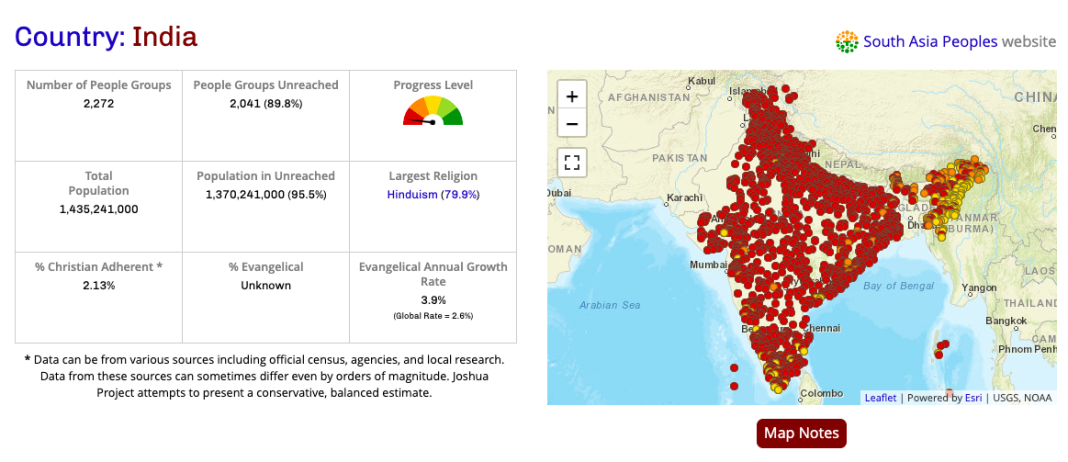
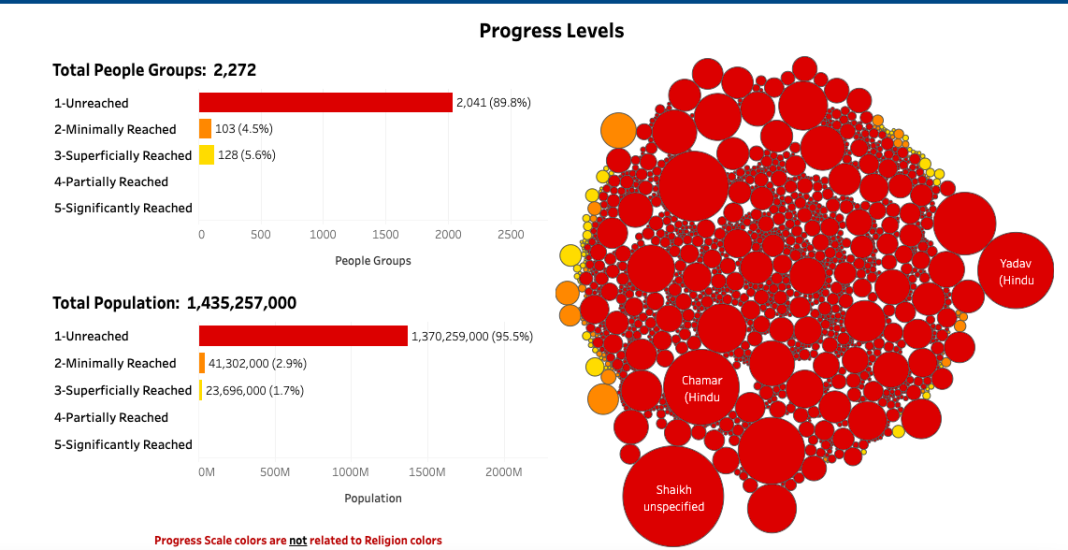
Every year, 24 lakh people are being converted to Christianity, according to the data available on the website of The Joshua Project, a Christian conversion ‘research’ initiative. There are a total of 2272 caste groups of which 2041 are ‘unreached’ as per their website.

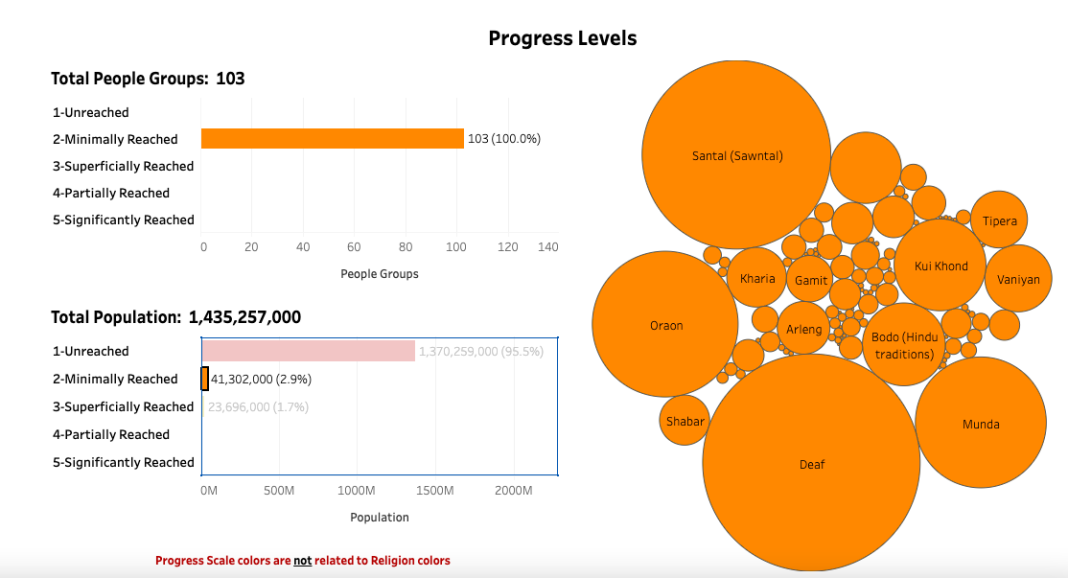
Out of these, 4.5% are “minimally reached” and 5.6% are superficially reached. Of the total population of India, 95.5% of the population remains ‘unreached’ with 2.9% minimally reached and 1.7% superficially reached, as per The Joshua Project.

Minimally reached groups

Shockingly, the conversion rate in India is 3.9% while the global average is 2.6%. So far, The Joshua Project has reached 6 crore people, with 4 out of 100 people converting to Christianity.

Unreached groups (All images via The Joshua Project’s website)

Santal, Kui Khond, Oraon, Shabar, Bodo, Arieng, Tipera, Deaf, Munda, Vaniyan, Gamit and Kharia castes among others are “minimally reached” as per Joshua Project.

For each caste group, an agent is appointed across the country. A Dainik Bhaskar report, based on an investigation in Madhya Pradesh, Jharkhand, Chhattisgarh, and Odisha, found that those who converted to Christianity claimed to have received financial assistance after going to church.

Alarmingly, while Hindus and other religious, and ethnic groups, are being targeted for conversion to Christianity, Chhattisgarh Home Minister Vijay Sharma, Jharkhand-Odisha DGP, Madhya Pradesh IG (Law and Order) said that they have no information about Joshua Project and its activities.

The “agents” are provided seal stamps and literature to propagate Christianity and are paid Rs 1500 for getting people married to Christians and Rs 2000 for conversion. Then there are priests who report to “Father” and have fixed salaries. They are appointed as head of some school or hospital to provide them Rs 1 lakh as monthly salary. The main job of these priests is to clear any obstruction arising in conversion activities.

Moreover, there are salaried pastors who are tasked with finding appropriate locations to build churches and bring in more non-Christians to Christianity. They get Rs 10,000 to 20,000 salary for this alongside Bolero car.

In its survey conducted across 110 villages in Madhya Pradesh, Chhattisgarh, Jharkhand and Odisha, Bhaskar found 82 villages to be Christian majority. The missionary agents find poor, vulnerable and sick people to bring them to their prayer meetings. It is alleged that black magic-type occult practices are employed in these meetings to ‘cure’ the illnesses of the targets.

In Madhya Pradesh, several churches have been erected in Jhabua and Alirajpur. Here, the Christian missionary distributes “Amrit Jal” to the targets who are then converted to Christianity. A Hindu Jagran Manch leader said that the missionaries are luring non-Christians by offering free education.

Meanwhile, in Chhattisgarh, a local-level survey revealed that in the last decade, over 50,000 people have been converted to Christianity.

In Jharkhand, people are being lured with the promise of getting housing under Pradhan Mantri Awas Yojana. It is said that out of 250 houses in Meral village of Gumla district, 150 have converted to Christianity. Alongside PM Awas, the missionaries are providing jobs to the gullible people.

In Odisha, churches are being constructed and free health camps are being organised to lure people into Christianity. In Balishankara of Sundargarh, the church was renovated with Rs 4 lakh in 2023-24 under the Chief Minister’s Special Assistance Scheme. Notably, the missionaries set up free health camps to identify diseases and single out sick people who were then converted to Christianity in the garb of offering treatment.

A former Joshua Project agent told Bhaskar that the agents are taken to Believers’ churches where they receive Christianity-related education for two years and then are deployed for fieldwork. These salaried agents collect caste and other data in villages in addition to propagating Christianity.

OpIndia has time and again raised alarms about the conversion activities of the Joshua Project. Back in 2018, it was reported that The Joshua Project is a ‘research initiative’ that seeks to ‘highlight the ethnic people groups of the world with the fewest followers of Christ’. They further state, “Accurate, updated ethnic people group information is critical for understanding and completing the Great Commission. Revelation 5:9 and 7:9-10 show that there will be some from every tribe, tongue, nation and people before the Throne.” The Great Commission refers to Jesus’ instruction to his apostles to spread Christianity among all nations across the world.

Ghaziabad: Hindu residents suspect madrasa functioning in a residential apartment, Muslim ‘guests’ assault guard for objecting to Quran recitation

On Sunday night (25th August), chaos erupted in a high-rise society in Ghaziabad after some outsiders brutally assaulted the security guard of the society. They had assembled at a woman’s flat in the society for ‘Quran Path’ (recitation). The development sparked controversy as other residents of the society said that a conspiracy was going on to convert the woman’s flat into a Madrassa. They added that the religious gathering took place there without permission. 

Later, the society members confronted outsiders when they started going out of the society following the completion of the Quran recitation. Angry at being confronted, the Muslim outsiders assaulted the society members and the security guard. Based on the guard’s complaint, the Police have registered a case in this matter and initiated an investigation.

According to reports, the incident unfolded in the Chitravan Society located in the Crossing Republic Police station area in Ghaziabad. Notably, the incident came into the spotlight after a tweet started doing rounds in which it was stated that an attempt was being made to convert the flat into a Madrassa. The society members objected to the woman living in the flat running Madrassa activities without permission.

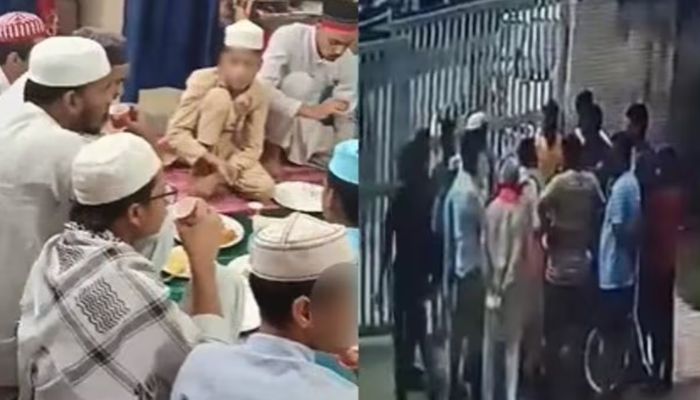
Strikingly, the video recorded the gathering inside the flat which is now going viral on social media. In the viral video, people can be seen eating food together in the flat. Many children and minors are also seen among them. The CCTV footage also shows the commotion at the gate.

The woman who organised the ‘Quran Path’ at her flat in the Chitravan Society claimed that she did it for the good health of her ailing daughter. 

Based on CCTV footage and statements of the residents, the Police found that the woman had called some people to her house to recite the Quran citing that her daughter was ill. 

Some of the society members objected to such religious activity without permission. Later, when the Quran recitation was over, the outsiders were confronted by the society members as they started going out of the society. Subsequently, the Muslim guests had a verbal altercation with the society members and started assaulting the society members. When the security guard tried to intervene, they assaulted him as well.   

Assistant Commissioner of Police (ACP) Wave City Poonam Mishra informed that the society’s security guard filed a written complaint in this matter on Sunday night stating that some people from another community assaulted him.

ACP Mishra said, “Police went to the society and investigated the entire incident, recorded the statements of the people, and then saw the CCTV footage. It was revealed that a woman in the society had organized a Quran recitation in her flat for her ailing daughter. Some people participated in this. During this time, other residents of the society objected that organising such an event in the society without permission was not appropriate.”

ACP Mishra added that when the people reciting the Quran started going back after the completion of the event, the security guard stopped them and started asking questions from them. During this, they assaulted the guard. The guard has filed a case in this entire incident. All aspects are being investigated and legal action will be taken.

It is pertinent to note that a few days ago, a case of forced religious conversion of a school teacher came to light from the Kavinagar police station area of Ghaziabad. As per reports, it was said that the HR working in the same school brainwashed the teacher and inspired the victim to convert to Islam. The police have arrested the accused.

Rahul Gandhi extends greetings on Janmashtami without Lord Krishna’s image: Why has he been avoiding using pictures of Hindu Gods?

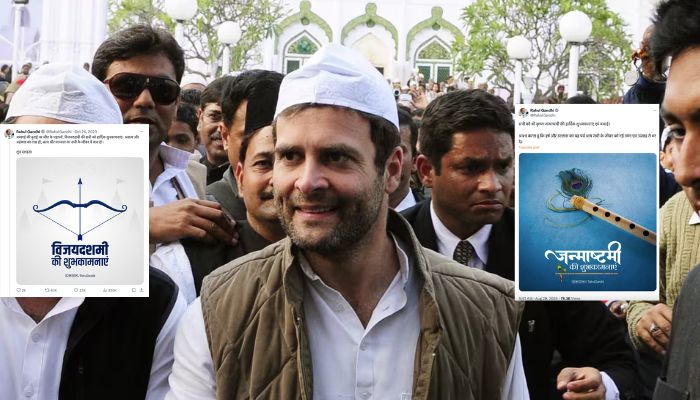
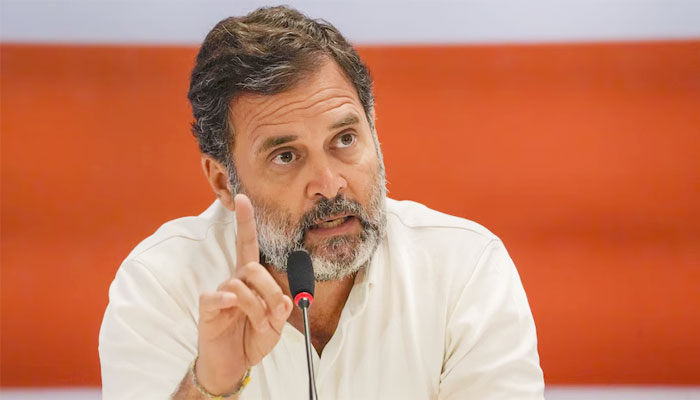
Another Hindu festival where Congress prince Rahul Gandhi chose to omit Hindu iconography. On the 26th of August, as the nation celebrated the birthday of Lord Krishna, Rahul Gandhi wished the nation on the Hindu festival in his usual style of leaving out the image of the Hindu god as if wishing for the sake of wishing. The Gandhi scion extended his hearty wishes to the people on Krishna Janmashtami without the image of Lord Krishna but only a flute.

“Hearty wishes and congratulations to everyone on Shri Krishna Janmashtami. I hope that this festival of joy and happiness fills the life of all of you with new enthusiasm and excitement,” Rahul Gandhi posted on X.

This, however, is not the first time that Rahul Gandhi deliberately omitted Hindu iconography from his posts wishing on Hindu festivals.

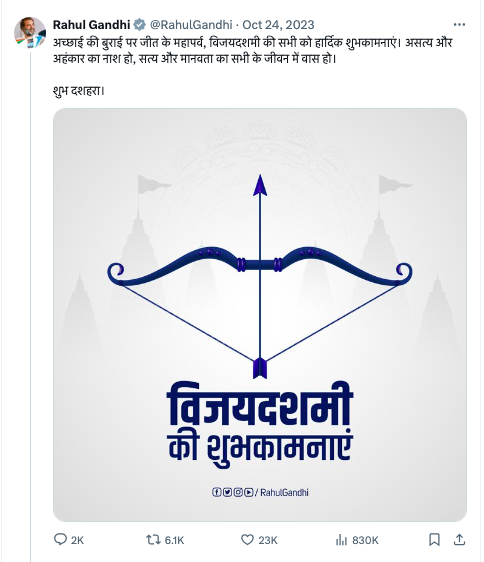
On the occasion of Vijay Dashmi or Dussehra last year, Rahul Gandhi shared a picture showing a bow and arrow avoiding Lord Ram’s picture.

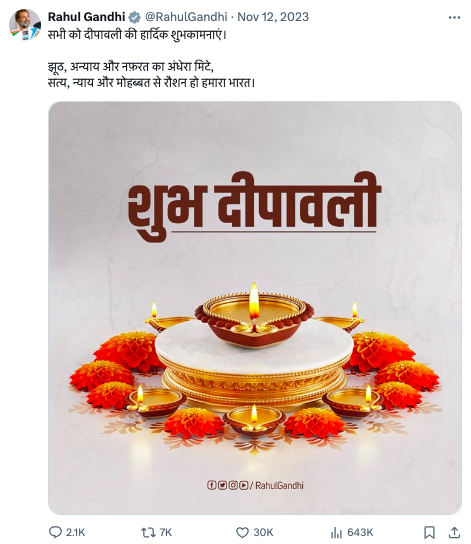
Similarly, on the Hindu festival of Diwali [Deepawali], which marks the return of Lord Ram, his brother Laxman, and Goddess Sita to Ayodhya, Gandhi chose not to include their images marking their joyous return.

Rahul Gandhi’s ‘tradition’ of avoiding images of Hindu deities when extending wishes on Hindu festivals has been going on for many years. In 2022, he shared his greetings on Dussehra without using images of Hindu deities.

In his 2022 Rath Yatra post, Gandhi avoided using Lord Jagannath, Devi Subhadra, and Lord Balabhadra’s images. In 2020, he wished Ram Navami with the image of Lord Ram absent.

In 2021, Gandhi shared greetings on Ganesh Chaturthi with the image of Lord Ganesh missing.

During Maha Shivarathri, Rahul Gandhi put out an image of the Kailash mountains instead of posting Lord Shiva’s images or his symbols in his tweet.

Rahul Gandhi’s subtle messaging behind skipping images of Hindu deities in posts related to Hindu festivals

Despite the Congress party’s Muslim appeasement policy over the decades, Rahul Gandhi has consistently positioned the party and himself as ‘secular’, avoiding Hindu religious iconography to preserve a farcical ‘inclusive’ appeal. By excluding images of Hindu gods, he perhaps intends to create a neutral or impartial image that respects all religions equitably. This, however, is an outright secularisation of Hinduism. Religion is the only aspect that is not and should not be secular; however, the prince of the grand old party is secularising Hindu festivals solely to strengthen his secular credentials. This attempt to selectively portray Hindu festivals as ‘inclusive’ probably has a subtle motive of diluting the religious essence of Hindu festivals making it more of a cultural thing than Dharmic.

Probably, Rahul Gandhi is attempting to secularise Hindu festivals by avoiding images of Hindu deities or using imagery focusing on cultural aspects rather than religious fearing his party’s anti-Hindu votebank might get offended or perceive Gandhi as a Hindu leader, a perception due to which a large section of Muslims and other anti-Hindutva elements hate BJP calling them Hindu ‘hardliners’.

The very attempt to downplay the religiosity of Hindu festivals either to assert political correctness or out of fear of backlash from the Hindu-disdaining voter base alongside intended secularisation, is a blatant politicisation of Hindu festivals.

This mistreatment of Hindu festivals also appears to be an attempt to confirm certain Abrahamic beliefs, with no image of God being a prominent one. A lack of images of Hindu deities in Rahul Gandhi’s Hindu festival-related social media posts suggests that the Gandhi scion is laying emphasis on the Abrahamic notion that God is formless and without any image, in absolute contradiction to the Hindu beliefs wherein the “Nirarakar Brahma” [God’s formless state] takes “Saakaar” [God’s manifest and perceptible state] forms from time to time for varied reasons.

Rahul Gandhi uses Hindu imagery and symbols for political mileage

Interestingly, over the last decade, Rahul Gandhi has adopted a Janusian approach. On one hand, Gandhi is seen conducting electoral temple runs to establish his ‘Hinduness’ ahead of elections, on the other, he also does not want to be seen as a Hindu leader by highlighting the religiosity of the Hindu festivals. On one hand, Rahul Gandhi claims to be a Shiv Bhakt ‘tapasvi’ on the other, he claims to be fighting against “Shakti”. Similarly, the Congress party claims that Lord Ram is in their hearts but Rahul Gandhi loses his cool over people raising “Jai Shri Ram” slogans in the glory of Bhagwan Ram. Not to forget, he once said that “those who go to temples molest women”.

In 2022, Rahul Gandhi used the occasion of Saraswati Puja, to extend his support to Muslim girls hell-bent on wearing Hijab in school in Karnataka defying the dress code. Politicising the Hindu festival, Gandhi asserted that Saraswati Maa gives knowledge to all and doesn’t discriminate. Gandhi, however, failed to mention what Allah or the Islamic text says about polytheist Hindus.

Rahul Gandhi also has a record of patronising anti-Hindu elements be it Hinduphobic pastor George Ponnaiah who told Gandhi during Bharat Jodo Yatra that Jesus is the real God unlike Shakti, or Rijil Makkuty who slaughtered a cow in broad daylight in 2017 to mock Hindu sentiments. Moreover, Gandhi once said that OBC MPs of the NDA have been filled in the party like Murtis [Vigraha/idols] without any power implying that Murtis are powerless.

While the Gandhi scion has left no opportunity to mock Hindu belief in some way or the other, he uses the same randomly to make a political point. In his social media posts, Rahul Gandhi strictly avoids using images of Hindu gods when sharing greetings on Hindu festivals but has no qualms about bringing the image of Lord Shiva to parliament to use it as a weapon to attack the ruling dispensation. In July this year, it was seen how Rahul Gandhi shamelessly used the image of Lord Shiva to peddle his distorted narrative of non-violence associating Bhagwan Shiv’s Trishul [trident] with Ahimsa even as the trident symbolises power, authority and destruction of evil alongside the “Tri Gunas”—Sattva, Rajas and Tamas.

Besides peddling false and malicious narratives around the beliefs and aspects of Hindu Dharma in his attempt to establish that BJP’s idea of Hindutva is bad and his corrupted understanding of Hinduism is good, Rahul Gandhi also takes delight in mocking the struggle of Hindus to reclaim Ram Janmbhoomi as he recently said that I.N.D.I. Alliance defeated the Ram Janmabhoomi Movement in Ayodhya. Clearly, the political compulsion may have compelled Congress to at least not appear “anti-Hindu”, its mindset remains the very same that denied the existence of Lord Ram in 2007.

Even as Hindus are being persecuted in Bangladesh with their temples attacked, the self-proclaimed “Janeudhari” did not speak a word in support of Bangladeshi Hindus. Why? The Congress party fears that it untangle their meticulously constructed warp and weft of perpetual Muslim victimhood which led them to table the communal violence bill, which if passed would have made sure that only minorities and SCs/STs could be “victims” and the perpetrators of communal violence would always be Hindus.

In a nutshell, Rahul Gandhi uses and will continue to use Hindu Dharma for electoral gains. He also ensures that his core vote bank, which harbours deep disdain for Hindus and their Dharma, does not see him as a pro-Hindu leader. His use of subtle imagery, avoiding images of Hindu gods in his Hindu festival-related social media posts, indicates the same. Since Hindus still [emphasis added] form the majority, complete neglect of the community could be disastrous for the party, so the party’s unannounced supreme leader does the humbugging by extending wishes on Hindu festivals but keeping them devoid of its religiosity.  


Some supporters of Congress have shown old tweets of Rahul Gandhi and a couple of recent ones where images of Hindu gods are visible, but it doesn’t negate the fact that a recurring feature of Rahul Gandhi’s posts on Hindu festivals have been missing photos of Hindu gods and goddesses, which has led people to question this pattern.

Bangladesh: ‘Student body’ hounds teachers opposed to hijab, unleashes Islamic lynch mob against them by making names public

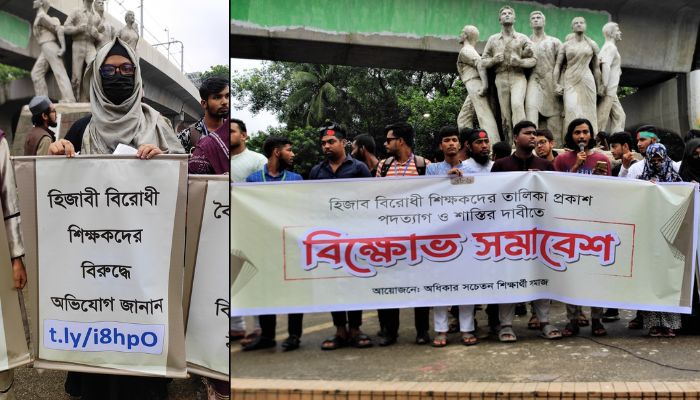
On Thursday (22nd August), a controversial student body in Bangladesh dubbed ‘Odhikar Sochetan Shikharti Samaj’ (Rights awareness student society) released a list of 100 teachers and accused them of being ‘anti-hijab.’

The comprehensive list featured educators from all prominent institutions in the Islamic Republic, including the University of Dhaka.

According to a report by Kalbela, the so-called students demanded the immediate dismal of the ‘anti-hijab’ teachers from their respective institutes in Bangladesh.

One of the convenors of the controversial student body, Muhiuddin Rahat alleged that women who wear hijab and niqab ‘suffer’ the most discrimination and oppression in educational institutes.

‘Odhikar Sochetan Shikharti Samaj’ claimed that a group of teachers regularly harassed hijab-wearing students during classes, exams and viva. Soon after, the demand extended to wearing of niqab and burqa.

While speaking to Kalbela, he claimed, “In today’s discrimination-free Bangladesh, the oppression of hijab-wearing girls needs to end. So, we students will stand by our oppressed sisters. We demand dismissal and punishment for all teachers who have discriminated against students wearing hijab, niqab or burqa.”

Hindus suffer at the hands of Islamists

OpIndia analysed the names of 100 teachers who were labelled ‘anti-hijab’ by the ‘Odhikar Sochetan Shikharti Samaj’. We found that at least 21 of them are Hindus while 5 of them are Christians.

We previously reported how Muslim students have forced as many as 60 Hindu teachers, professors and government officials to resign from their positions.

On 5th August, Bangladesh descended into chaos after a successful coup ousted Prime Minister Sheikh Hasina, forcing her to flee the country. In the aftermath, Islamists took advantage of the situation to carry out violent attacks on the Hindu community.

Rahul Gandhi’s caste representation rhetoric is more preaching and less practice: CWC is proof, with only 5 out of 39 SC leaders

Congress leader Rahul Gandhi has been projecting himself as a vocal advocate for caste representation in various sectors. Recently, he questioned why SC/ST and OBC participants did not win the Miss India pageant. Not going into how incorrect he was, it is a fact that the Congress Party seems to have created a strategy to make Rahul the frontline leader to stress the need for inclusivity and diversity across all platforms and sectors.

Since before the Lok Sabha Elections 2024, he has been making calls for a caste census and has claimed that “no power can stop caste census.” He asserts that his demand is focused on ensuring every community has a stake in the nation’s governance. However, OpIndia’s close examination of the composition of the Congress Working Committee (CWC) revealed a stark contrast to these ideals.

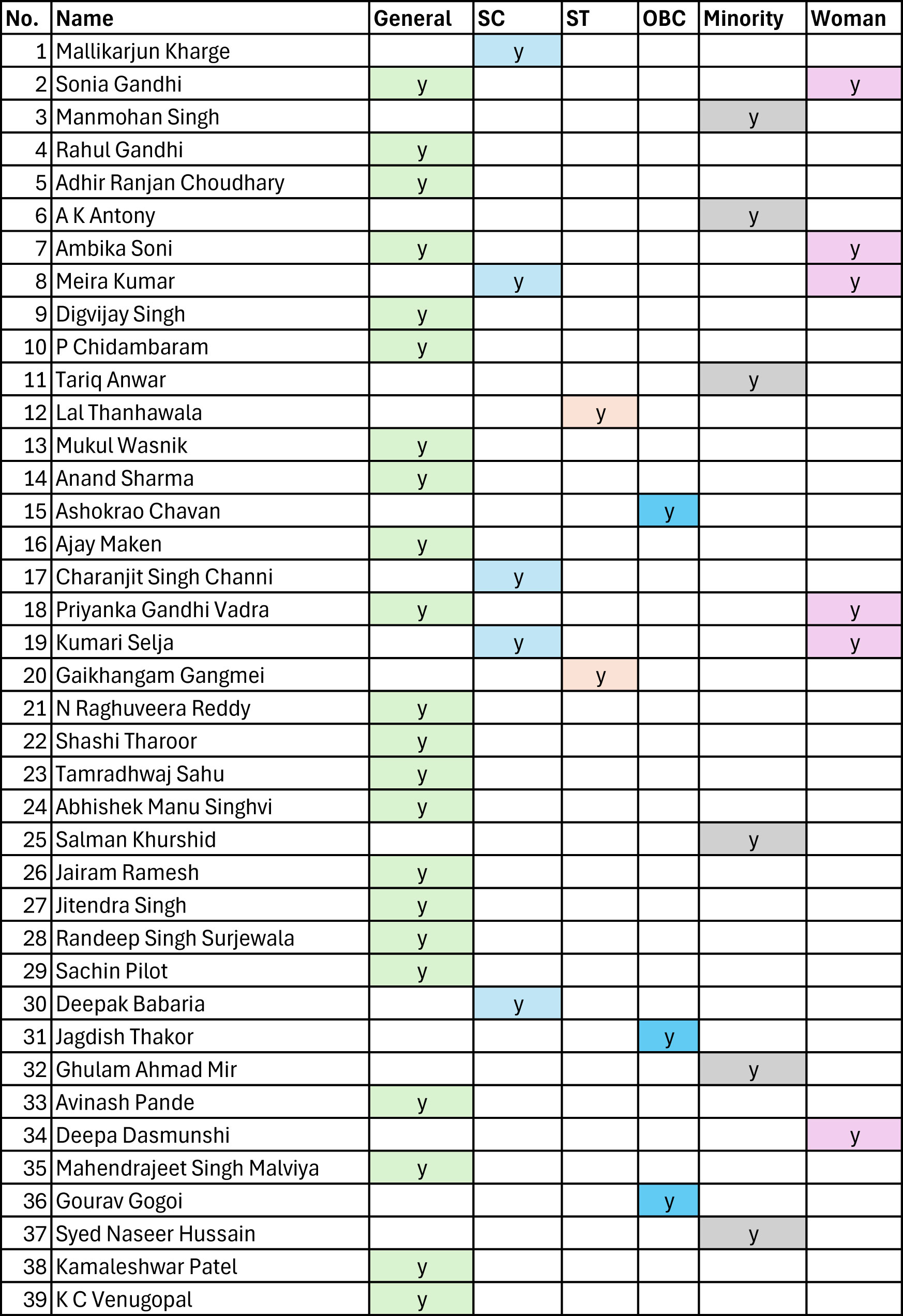
List of CWC members and their caste division.

The CWC composition: Upper castes dominate

There are 39 members listed in the recent CWC composition, out of which at least 20 belong to the General category or Upper Caste. This highlights a significant bias towards the upper echelons of the caste hierarchy in the party leadership itself. Prominent figures in the CWC, including Sonia Gandhi, Rahul Gandhi, P. Chidambaram, and Abhishek Manu Singhvi, are part of the most privileged communities in the country.

On deeper analysis, we found that only five members of the CWC belong to the Scheduled Caste (SC) category, including leaders like Mallikarjun Kharge and Meira Kumar.

Only six members represent minority communities, including Salman Khurshid. Women form a crucial demographic in the voter base of the Congress Party; however, only six women have been given representation, including Sonia Gandhi. Representation of Scheduled Tribes is limited to two members in the CWC and OBC is limited to three.

Caste overlap and dual categories

There are some individuals who fall into multiple categories, but this does not have much effect on the overall representation of the marginalised communities. For instance, Sonia Gandhi belongs to the General Category and is a woman. The same goes for Meira Kumar, who belongs to the SC community and is a woman. Such instances highlight the intersectional identities of the leaders but have an almost negligible effect on the overwhelming dominance of the upper caste in the CWC.

The hypocrisy of caste division politics

Rahul Gandhi is consistently demanding a caste census and greater representation of marginalised communities in every sector, even in trivial events like Miss India. He has raised questions almost every day since the Congress Party discovered that speaking on caste can keep him in the headlines. However, his demands contrast sharply with the party’s practices. The very structure of the Congress Party’s leadership and its historical choices of leaders suggest there is a deep-rooted resistance to true power-sharing with marginalised communities.

The not-so-subtle disparity between what Rahul Gandhi has been demanding and what the Congress Party practices in its internal caste dynamics raises many questions about his integrity and ethics as a leader. The dominance of the upper caste in the CWC suggests that the party’s commitment to caste representation is only an eyewash. The hypocrisy of the Congress Party leaders is clear in the disconnect between the words and actions of Rahul Gandhi and the party.

The debate over caste representation and the caste census is not going to end, as it gives political mileage to leaders. However, it is high time that questions are asked of those who present themselves as the messiahs of the marginalised.

Mumbai-based Amin arrested for posing as PA of BJP leader Ashish Shelar and duping kin of prison inmates

0

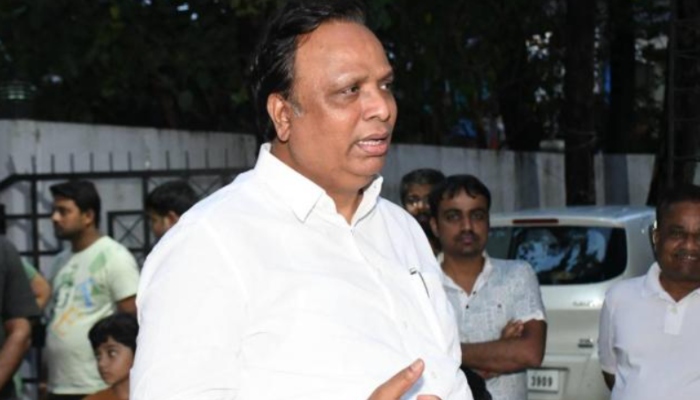
On Monday, 26th August, the Bandra police in Maharashtra’s Mumbai district nabbed a man for tricking families of jail inmates by acting as BJP MLA Ashish Shelar’s assistant (PA). According to the reports, the accused, Amin Irfan Bendrekar, 24, allegedly approached lawyers and obtained information on their clients before extorting money by offering assistance from the Maharashtra government.

According to the Bandra police, Advocates Vijendra Roy and Yasmin Wankhede, among others, approached Shelar and informed him that they had been contacted by one Sharma, who pretended to be the MLA’s PA and Mantralaya secretary. They also stated that the impostor indicated that the administration intended to release certain prisoners owing to congestion in cells.

On this foundation, he asked advocates for information about their jailed clients and their relatives. The victims said that they trusted the con because he sounded like Shelar’s PA and supplied the information.

Bendrekar then allegedly reached the relative of an accused, disguised as Shelar’s PA, telling them that the convict had fallen in prison and needed money for medical treatment. According to the FIR, a relative paid Rs 8,000 to the accused through their lawyer, Arfin, and Bendrekar employed a similar strategy to deceive others. However, the lawyers grew increasingly suspicious and eventually approached Shelar.

A case initially was brought against an anonymous individual under sections 204 (impersonation of a public servant), 318 (cheating), 319 (cheating by impersonation), and 356 (defamation) of the Bharatiya Nyaya Sanhita, based on the charge of MLA’s actual PA, Navnath Satpute. However, the accused was identified as Amin Irfan Bendrekar and arrested.

Further investigations are underway.

Flights restricted, infrastructure damaged: Ukranian drone crashes into high-rise building in Russia’s Saratov in 9/11 style

On Monday, 26th August, a drone crashed into a 38-storey high-rise building in Russia’s Saratov region, damaging homes and restricting flights in the region. Russian officials confirmed the incident and affirmed that it was a Ukrainian drone. A woman, as a result of the attack, has been injured and is being treated at the hospital.

As per regional governor Roman Basurgin’s confirmation to Reuters, a residential complex in Saratov has also been damaged by falling debris from drones destroyed by Russia’s air defense systems. “A woman was hospitalized in serious condition. Doctors are fighting for her life,” he said.

Saratov is about 900 kilometers (560 miles) from the Ukrainian border. According to Russia’s RIA news agencies, flights at the provincial Saratov airport have been prohibited, citing the airport’s press service.

Earlier, Basurgin stated that emergency services had been deployed to impacted areas in Saratov and Engels, two significant cities in the region located several hundred kilometers southeast of the capital. Russia maintains a key bomber military station in Engels, which Ukraine has repeatedly attacked since February 2022.

As of now, it is difficult to state to what extent the damages have occurred as a result of the drone crash. A video of the incident is making rounds on social media in which a high-rise residential building in Saratov can be seen damaged on one side and several windows have been blown out on three other levels.

According to the report, the top story of a residential building in Engels is also said to have been damaged. OpIndia could not independently confirm the stories. Meanwhile, no comment has been made by Ukraine. Both sides deny targeting civilians in their assaults, which they claim are intended to damage critical infrastructure supporting war activities.

200 people killed by Al Qaeda-affiliated terrorist group Jama’at Nusrat al-Islam wal-Muslimin (JNIM) in Burkina Faso

On 24th August, at least 200 people were killed, including civilians and armed personnel, and 140 were reported injured in a terrorist attack in central Burkina Faso. The terrorist group linked to al-Qaeda, Jama’at Nusrat al-Islam wal-Muslimin (JNIM), has claimed responsibility for the attack. The incident took place in Barsalogho, located 40 km north of the strategic town of Kaya. According to reports, Barsalogho is home to the last standing force protecting the capital of Burkina Faso, Ouagadougou.

The terrorists opened fire on a group of people who were digging trenches designed to protect security outposts. Following the attack, several soldiers went missing, and the terrorists seized their weapons along with a military ambulance. JNIM also posted some horrifying videos of the aftermath of the attack to claim responsibility.

Al Jazeera’s Nicholas Haque, reporting from Dakar, Senegal, said in a statement, “We see men, women, and children lying inside the trenches they were digging themselves. Effectively, they have turned into mass graves.” Medical teams were called from Kaya to treat the injured. Reportedly, the Burkina Faso Army was aware of the possible attack and had called on the people to help dig trenches.

So far, Burkina Faso forces have lost control of half of their territory to JNIM and other terrorist groups linked to al-Qaeda. According to News Central Africa, the Burkina Faso forces said in a statement that despite the severity of the attack and the high number of deaths due to the terrorist attack, the armed forces managed to counter the attack and neutralised several terrorists, which prevented an even greater tragedy.

In 2022, the military leaders of Burkina Faso came to power in a coup. However, since then, they have faced several attempted coups due to discontent over the way these leaders have fought against the terrorist groups. Thousands of people have been killed, and over two million people have been displaced in Burkina Faso over more than a decade. The situation is so severe in the country that it topped the recent Norwegian Refugee Council (NRC) list of the world’s most neglected displacement crises.

When the military leaders took over the country, France and other Western countries were helping Burkina Faso tackle the terrorist groups. However, after coming to power, the military leaders severed ties with them, resulting in a rapid loss of territory. Now, Burkina Faso has called for help from Russian mercenary fighters for support to help put an end to attacks by terrorist groups.

In 2023 alone, 8,400 people were killed, which was double the number compared to 2022. Al-Qaeda and Islamic State-linked terrorist groups have been initiating attacks in Burkina Faso since 2015.