Home Blog Page 1700

Why 52% of Muslim voters want Rahul Gandhi as their PM while Indians in general prefer PM Modi

0

The Indian General Election is likely to be held in India between April and May 2024 to elect the members of the 18th Lok Sabha. Ahead of the 2024 Lok Sabha elections, India TV-CNX conducted an opinion poll. The poll results revealed that while 61% of general voters and 70% of Forward Caste voters want PM Modi to continue as the Prime Minister of the country, 52% of the Muslims in India want the Congress scion Rahul Gandhi to take up the position.

The survey was performed in 48 Lok Sabha seats across 12 states in the country post-Bihar’s caste census. 

The survey conducted by India TV-CNX further stated that 14% of Muslims think that Arvind Kejriwal should become the Prime Minister of the country while 8% would vote for West Bengal CM Mamata Banerjee, 6% for Nitish Kumar, 8% for Akhilesh Yadav and 5% to Asaduddin Owaisi. Meanwhile, only 3% of the Muslims want current Prime Minister Narendra Modi to continue as the PM.

Speaking of the Forward Caste voters, 70% of them want PM Modi to continue as the Prime Minister of the country while only 12% of them want to see Rahul Gandhi as the PM. Furthermore, 4%, 6%, and 1% of forward caste voters wish to see Mamata Banerjee, Arvind Kejriwal, and Nitish Kumar as the PM. Nobody wants to see the President of the Samajwadi Party Akhilesh Yadav and President of the All India Majlis-e-Ittehadul Muslimeen (AIMIM) Asaduddin Owaisi as India’s PM in the upcoming elections.
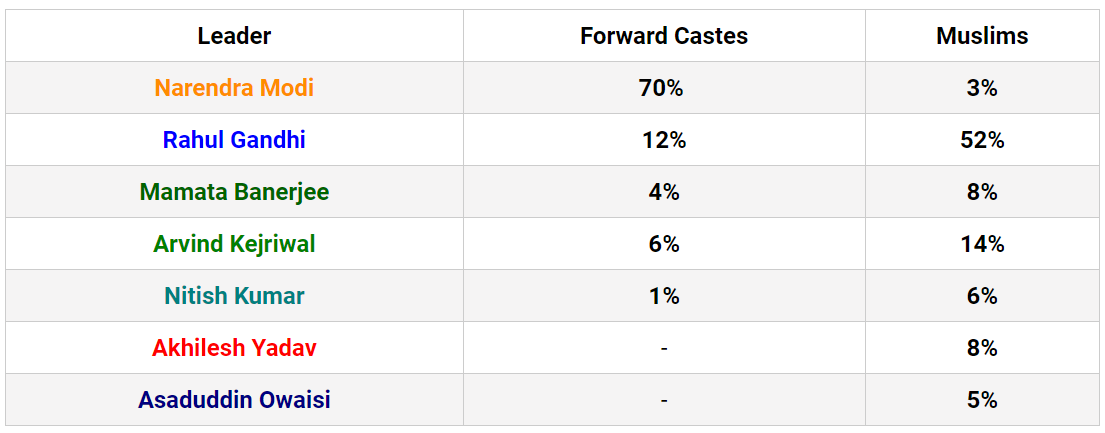
Image courtesy: India TV

According to the poll, 61% of overall voters want Narendra Modi to serve as Prime Minister again. Among the other options, 21% want Rahul Gandhi, 3% each want Mamata Banerjee and Arvind Kejriwal, 2% each voted for Nitish Kumar and Mayawati, and 6% want some other leader as the future Prime Minister.

Muslims supporting Congress in Karnataka and Telangana

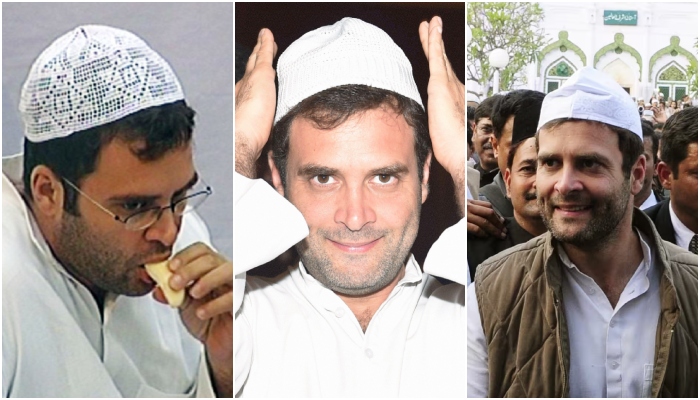
Notably, the Congress party has always used Muslims and favoured them as they assisted them in the elections by becoming a strong vote bank. This was evident in the recently happened Karnataka elections in which the Congress party emerged as the single-largest party with 135 seats—well past the majority mark—to form a government in the state.

While the campaign for election saw alarming levels of polarisation, with opposition parties raising the matter of hijab and the Congress party declaring to ban the Hindu activist group, Bajrang Dal, it is worth taking into account how polarisation helped Congress to consolidate Muslim voters and divide Hindu votes in order to win the assembly elections in May this year.

The Muslim communities also banded together behind the Congress party, possibly to protect their religious interests, and voted en masse for the great old party’s candidates. During the election campaigns, the SDPI which is the political wing of the banned PFI had clearly stated their intention of campaigning for the Congress Party. Earlier it had decided to field 100 candidates, but a few days before the elections, the party said that it would field only 16 seats. The SDPI also later asked its workers to go door to door and campaign for Congress.

Also, in Telangana, the Muslims are firmly backing the Congress party. Md Ali Shabbir, a senior Congress leader in June this year stated that Muslims of Telangana were firmly backing the party and that the AIMIM would fail to make a dent in that vote bank.

Rahul Gandhi furthering anti-India stance at global level

The entire Congress party has been using Muslim voters to win the elections in the country, whether the general or assembly elections. Congress leader Rahul Gandhi especially has always favoured and extended support to the Muslim community. He has several times defamed India and Hindus on global platforms peddling lies that ‘Minority communities in India are under attack’. He made such statements against India in Washington, the Cambridge University, and also in New Delhi recently in September this year.

Rahul Gandhi and the Congress Party have long sought to maintain the “minorities are in danger” rhetoric in order to solidify minority votes in an increasingly fragmented opposition, where each party is trying to build up its own vote bank in order to take on the Modi juggernaut, which draws its strength from broad support from all sections of society.

Aside from polarising the country’s political climate, the ‘minorities are in danger’ narrative is also used to portray the Centre as communal. Ordinary crimes are given a religious spin in order to either discredit and demean the Centre or consolidate the minority vote bank.

Non-Muslims, for example, accounted for more than 80% of those killed during the Nuh conflict. The violence began after Hindu pilgrims of the Jalabhishek Yatra were attacked by Islamists in Nuh, which is located in Haryana’s Muslim-majority area of Mewat. Even Hindus who did not take part in the parade were victims of the horrific dance of death that took place in Nuh and surrounding areas in late July and early August of this year.

Nonetheless, Congress, armed with its well-oiled ecosystem and an army of online trolls and supporting journalists, many of whom have turned into YouTubers after being unceremoniously fired for peddling propaganda under the guise of honest and upright journalism, blamed the Centre and Hindus for inciting the violence.

Congress has historically been a pro-Muslim party

Despite, donning the ‘pro-Hindutva’ hat from time to time, as per convenience, the Congress has historically been pro-Muslim, with appeasement programs topping the priority chart of the party. After all, it was the Nehruvian ‘visionary policy’ of Islamism in Congress that gave birth to the unwanted problem child called ‘Muslim Minority’.

Islamism in Congress politics started in a big way just after independence around 1950, when Congress started inducting, in its fold, the Muslim League leaders, members and supporters who did not migrate to Pakistan. Many of those ex-Muslim Leaguers rose to the level of Cabinet Minister at Central and State levels under Congress rule later.

Under Congress Rule, the ‘Waqf Act’ first came into being in India in 1954 and in 1964 Central Waqf Council was constituted under that Act. In August 2022, it came to light that the Congress-led-UPA government gifted 123 government properties in Lutyens’ Delhi to Waqf.

Rajiv Gandhi’s handling of the Shah Bano case (1986), to appease Muslim clerics, was another strong assertion of Islamism in Congress politics. In the Shah Bano case, Rajiv Gandhi allowed Sharia to crush the Indian Judiciary. 

In the recent past one of the most glaring glimpses of the Congress party’s submission to Islamism was its decision to review AFSPA should it come to power in 2019.

Notably, the demand for the removal of AFSPA has long been the focus of radical Islamic organizations and far-left institutions inimical to Indian interests. These organizations have peddled the most nefarious of propaganda which has only served as a tool to radicalize the youth of Kashmir.

In addition to this, the 2019 Congress manifesto made other promises to the Muslim community as well. It said on page 42, “The Waqf Properties (Eviction of Unauthorized Occupants) Bill, 2014 will be re-introduced and passed. Waqf properties will be restored to the legal trustees.” In addition to that, “Congress promises to uphold the character of Aligarh Muslim University and Jamia Millia Islamia as minority educational institutions.”

Additionally, Congress’ support in Wayanad emanates from the Indian Union Muslim League (IUML) which in turn is tied up with Jammat-e-Islami and Social Democratic Party of India (SDPI), both accused by the National Investigation Agency (NIA) of conducting arms training camps across the state under the pretence of health awareness camps. In several police raids in the offices of PFI and SDPI in Kerala, weapons and arms stockpiling came to light in 2014. As many as 24 accused arrested belonged to these two parties.

Given all these incidents, it is clearly evident why around 52% of Muslims want to see Congress’ Rahul Gandhi as India’s next Prime Minister and why only 3% of them think that PM Modi should continue to serve in the position.

The next Indian general election in India is expected to be held between April and May 2024 to elect the members of the 18th Lok Sabha.
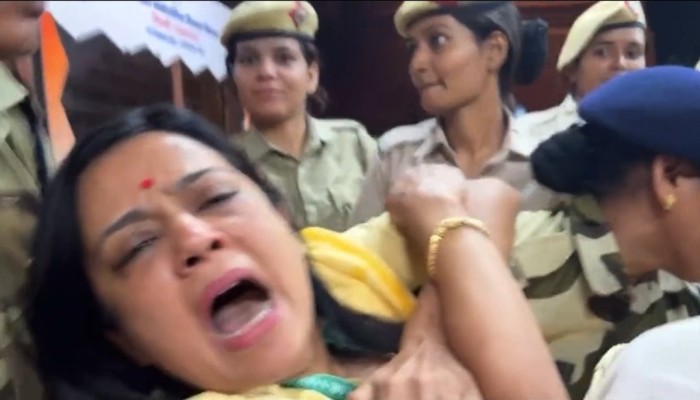
TMC leaders detained during dramatic nighttime protests, Mahua Moitra carried out by policewomen, cry foul as MNREGA funds blocked over corruption charges

Leaders of the Trinamool Congress (TMC) were detained on Tuesday night (3rd October) while staging protests at the Union Rural Development Ministry office in Delhi. The TMC was staging dramatic protests demanding a meeting with the Rural Development Minister over MNREGA funds to West Bengal.

As reported by Times Now, the TMC leader Abhishek Banerjee had demanded to meet MoS Rural Development Sadhvi Niranjan Jyoti at Krishi Bhavan along with a large group of over 40 TMC leaders. However, the MoS stated that she would meet only 5 leaders. On this, the TMC leaders got agitated and demanded to meet her with the entire group of 40+ people. TMC leaders sat on a Dharna when the MoS didn’t give in to their demands and created a ruckus. Following this, they were escorted out by security personnel stationed at the premises of Krishi Bhavan.

As per the latest reports, MoS Sadhvi Niranjan Jyoti has stated that she did want to meet the TMC leaders, but they chose to waste her time by staging Dharna and not agreeing to sending a delegation of fewer people instead of all 40+ of them.

TMC general secretary Abhishek Banerjee alleged that the TMC MPs were manhandled by the Delhi Police. He termed the detention of TMC leaders as a “black day for Indian democracy”. Furthermore, the TMC leader called for a campaign “Raj Bhavan Abhiyan” in Kolkata on 5th October.

MP Mahua Moitra posted a video of herself being carried by women security personnel while she thrashes around and shrieks.

The matter pertains to the blocking of MNREGA funds by the Centre to West Bengal. Abhishek Banerjee claimed that Union Minister Sadhvi Niranjan Jyoti did not meet them even after giving an appointment. The detained TMC delegation was released after three hours.

Taking to X, formerly Twitter, West Bengal Chief Minister, Mamata Banerjee accused the Central government of “withholding funds for the poor of Bengal” and of brutality against its delegation.

On October 2, TMC leaders had tried to stage a Dharna at Raj Ghat as a part of their strategy to blame the Centre for withholding funds in the face of rampant corruption in Bengal. As a response to the claims of manhandling made by TMC, the Delhi Police had stated that the TMC leaders had refused to vacate the place despite repeated requests.

In a statement, the Delhi police said that the TMC leaders were requested to vacate the Samadhi Sthal peacefully. “On this very important day of the birth anniversary of the Father of the Nation Mahatma Gandhi, thousands of people were visiting Rajghat – the Samadhi Sthal – to pay homage,” it noted.

“TMC leaders were requested not to sit at Samadhi Sthal. Despite repeated requests, they were not listening. Due to that public entry was affected and that resulted in a gathering of people around Samadhi Sthal. Therefore, to avoid public inconvenience as well as in the interest of their own safety, TMC leaders were requested to vacate the samadhi Sthal peacefully,” the statement read.

Marred with allegations of large-scale corruption linked to MNREGA funds, Mamata targeted the BJP for “abandonment of democratic values”. On 6th September, the Bengal government had written to the Delhi police seeking to hold a protest rally in the national capital against the Centre’s decision to hold back MNREGA funds.

Meanwhile, the BJP has alleged that TMC did not turn up for the meeting with the Minister at the scheduled time. BJP leader Amit Malviya wrote on X, “the Central Govt is not holding back any funds. It is because of widespread corruption in the implementation of MNREGA and lack of compliance with guidelines, that the funds have been held up. Despite several reminders, since 2019, Govt of West Bengal failed to submit a satisfactory compliance or Action Taken Report. No steps have been taken to eliminate corruption and ensure transparency.”

Why has the Centre withheld MGNREGS funds from West Bengal?

In March this year, the Union Rural Development Ministry decided to withhold Mahatma Gandhi National Rural Employment Guarantee Scheme (MGNREGS) funds for West Bengal for the fiscal year 2023-24.

The Ministry extended the imposition of Section 27 of MNREGA, which allows for the suspension of funds for violations of rules in the implementation of the scheme by the state. West Bengal is the only State in the country against whom this Section 27 of the MNREGA was invoked.

The MNREGA funds to West Bengal were halted owing to large-scale anomalies in the implementation of the Central welfare schemes by Trinamool Congress (TMC) functionaries, especially in the rural areas.

A large number of TMC officials in rural areas of Bengal have been accused of placing ineligible people including family members on PMAY beneficiary lists.

The list of PMAY beneficiaries in Bengal was discovered to be filled with wealthy individuals with ties to the ruling party, as well as children, wives, and close relatives of Trinamool functionaries.

Similarly, Trinamool employees in rural organizations have been accused of distorting MGNREGA beneficiary lists, generating bogus job cards, and misrepresenting records of assets produced under the scheme in order to siphon off funds, among other violations. The union administration suspended fund disbursement after central audit teams discovered these large-scale errors and malfeasance.

In 2022, BJP leader Suvendu Adhikari had written to Union Rural Development Minister Griraj Singh seeking an investigation against Mamata Banerjee administration in West Bengal.

Asking for a CBI probe or a probe by any central agency, the BJP leader alleged that the WB Govt was creating ‘fake’ jobs and misusing the job holder details to create false employment data.

Alleging that the details of the Job Card holders are being used arbitrarily and at whim by the Mamata Banerjee administration, the BJP leader listed the charges which he said would emerge if an audit is conducted.

  • The Jobs/Works against such “so-called employment” that have been generated are mostly fake. The Administration won’t be able to provide the Work Orders or Tender Details of the Jobs/Works to tally such employment.
  • The mode of payment to the labourers is questionable & lacks clarity. An inquiry must be done whether the payment has been made in cash. If so, then who made such payment & for which job? Whether the person/agency making such payment has been actually assigned to execute such a job. And if the payment has been made through account transfer, in that scenario the Administration must come clean regarding the money trail.
  • A large number of Job Card holders’ details seem to be fake. The figures for the Job Card holders are hugely exaggerated. If compared to the 2011 Census it would be found that the job cards issued in a Block seem to outnumber the people residing in that area.

Moreover, in 2019, Mamata Banerjee herself had inadvertently admitted that ‘cut money’ was taken by members of her own party, for implementing the welfare schemes of the government.

Mamata Banerjee’s MNREGA lie

In 2013, two years into office, Mamata Banerjee made big claims of development, especially about providing 100 days of work to unemployed adults under the Mahatma Gandhi National Rural Employment Guarantee Act (MGNREGA).

Her government claimed that the state topped the chart in 2012-13 with the implementation of projects worth Rs 4475.80 crore, which is the highest in the country and generated employment for 57.76 lakh families.

TMC government’s ad in a local newspaper made tall claims of topping the development scale. This also turned out to be nothing but a deception. The national statistics then suggested that West Bengal ranked 24th on the list.

The then Union Minister of State for Urban Development Deepa Dasmunsi had said in a statement: “The state has ranked 24th on the list, whereas the (Trinamool) government very boastfully claimed otherwise. It easily nailed the lie of the state administration as they are misleading people with wrong information ahead of the panchayat elections”.

The national statistics also suggested that West Bengal dipped to the 35th position in the list in the year 2019.

West Bengal also always has the highest percentage of delayed MGNREGA payments and it is plagued by TMC’s cut-money across the state, where workers are forced to pay hefty sums to avail work under the scheme.

PUCL, with links to Urban Naxals, comes out in support of China-funded NewsClick, had earlier supported Jihadi PFI as well: Details

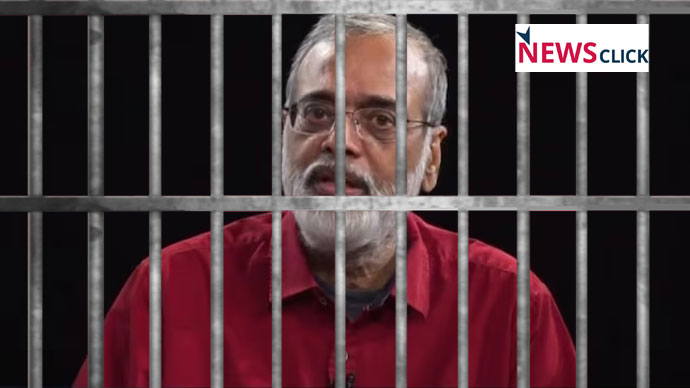
After raiding 30 locations connected to China-funded NewsClick and interrogating 43 employees for hours, the Delhi Police arrested NewsClick founder and its editor-in-chief Prabir Purkayastha and Amit Chakravarty, the organisation’s human resources head, under the Unlawful Activities (Prevention) Act (UAPA).

Before the arrests were made under UAPA, the Delhi Police had raided several locations and seized the laptops and phones of journalists involved with NewsClick. The raids and arrests come after an investigation into illicit foreign funds received by the portal. The investigation by the Enforcement Directorate started in the year 2021 and subsequently, there was evidence that NewsClick also got funds from China for pro-China, anti-India propaganda.

After the raids and subsequent arrests, several Leftists and Islamists have come out in support of NewsClick – calling the investigation an assault on the freedom of the press. Interestingly, none of these ‘journalists’ who came out in support of NewsClick bothered to talk about the assault on the democratic process of India when a hostile power funds a so-called news platform to undermine national interest and indulge in pro-China propaganda.

Keeping in tune with the propaganda that was unleashed after the investigation against NewsClick and its employees, The People’s Union for Civil Liberties (PUCL), an organisation linked to Urban Naxals, Maoists and Jihadis like PFI came out in support of the China-funded propaganda outlet.

According to a report in The Hindu, PUCL leaders Kavita Srivastava and V. Suresh condemned the search on journalists connected with Newsclick and other media professionals. “It is shocking that the police are investigating a case under draconian terror sections 13,16, 17, 18 and 22C of the UAPA and sec. 153 (A) (hate speech) and 120 (B) (conspiracy) of IPC against media professionals. The searches have happened in more than 30 locations in Delhi, Mumbai and Hyderabad today (Tuesday),” the statement said. 

The statement further said that these raids and arrests were a part of a larger witchhunt that had been unleashed against NewsClick by the government of India. It also said that the raids and have arrests have taken place a week before the cases are listed in the Delhi High Court in order to influence public opinion on the matter.

“What is alarming is the manner in which the Delhi Police seized all the data in the journalists’ electronic devices, in several instances, without even providing a hash value, thereby compromising the integrity of their data and violating their privacy and the identity of their sources. This is an egregious assault on the right to privacy, the right to dignity, as well as the freedom of journalists to practice their profession fearlessly,” it added. 

PUCL and its antecedents – Links to Urban Naxals, Maoists and Jihadis

PUCL is a fraternal organization of the People’s Union for Democratic Rights (PUDR). The People’s Union for Civil Liberties is the same organisation that has extensive links to Maoists. ‘Urban Naxals’ who were arrested in the Elgar Parishad case and in connection with an alleged assassination plot against the Prime Minister are intimately linked with the PUCL. 

The PUCL and its associate organisations have a history of ties to Naxals and separatists in Kashmir as well as Manipur. Over the years, numerous members of the organisations have been arrested for their links to Maoists. One of those raided in connection with the violence at Bhima Koregaon, Sudha Bharadwaj, is the General Secretary of the Chhattisgarh unit of the People’s Union for Civil Liberties (PUCL). 

Father Stan Swamy was also associated with the PUCL. The narrative that PUCL propagates is quite often antithetical to a layman’s idea of civil society. On the website of the organization, it can be seen that it condemned the hanging of the Islamic terrorist Afzal Guru.

As per the report of Delhi PUCL for 2016-17, they assisted Islamist outfit PFI “in the matter relating to violation of their right to protest and their freedom of speech violated by the Delhi police on 5th Nov. 2017 in Delhi”.

‘Naxalite’ Binayak Sen was also the Vice President of the PUCL even after his conviction by the Raipur Sessions Court. The West Bengal unit of PUCL also published a book exonerating Sen of all his crimes and branded him a “victim of state atrocity”.

Also recently, the organization published an article in which it condemned the killings of gangster Atiq Ahmed and his brother in law and slammed the UP police for not assuring proper security measures during the incident. Ahmed and his brother in law were shot dead by three persons who posed as media individuals and fired around 22 bullets at the gangster. “PUCL is outraged by and strongly condemns the cold-blooded shooting down by a 3-member gang of politician and former minister, Atiq Ahmed and his brother, Ashraf Ahmed,” the article read. 

Further downplaying the criminal activities of the gangster, PUCL wrote, “The killing is not just a security lapse on the part of the police, who failed to check the identity of the killers posing as media persons; a much more disturbing issue is how the killer gang knew that a media meeting would be held in the open, outside the hospital.

“Equally worrisome is the question why Atiq Ahmed and his brother were not transported by ambulance, why the medical check-up was at such an unusual time late at night and why despite the security concerns, the police permitted such a media meet in an open space and in public.  The other question is as to why the police did not seek police custody of those who did the shooting. The answer to these questions will tell us whether it was a question of mere negligence by the UP police or a deeper conspiracy by the UP police and the UP administration, in the murders themselves?” it added. 

It is rather evident that PUCL not only has inextricable links with Naxals and Maoists but Jihadi elements as well. After the Jihadi outfit PFI was banned by the Government of India, PUCL had gone on the record demanding a revocation of the ban. The PUCL stated in a release that a dialogue with the PFI should be started. The organisation demanded that the authorities refrain from using their arrest powers arbitrarily to target Muslim youths based on their involvement or support of the PFI and its affiliates.

The statement by PUCL reads, “The PUCL is deeply concerned about the implications for democracy and the constitutional rights of freedom of speech and association in the light of the ongoing ‘Operation Octopus’ which is being carried out against the Popular Front of India (PFI) and its affiliates, across the country as a joint operation of the CRPF, the home ministry, ATS, NIA, ED, RAW, State police, and other agencies. It has consisted of mass raids being carried out in two rounds, in more than 16 states of India over hundreds of locations and with over 300 arrests.” 

“The raids, which have been conducted as a media spectacle showcasing massive state power, bodes ill for a constitutional democracy based on the rule of law, pushing the Muslim community further into fear, intimidation, alienation, and silence,” it further adds.

NewsClick founder-editor Prabir Purkayastha and HR Amit Chakravarty arrested after interrogation, sent to 7-day custody in UAPA case

On 3rd October (late at night), a Delhi court sent Newsclick founder and editor Prabir Purkayastha to a 7-day police remand. HR head of the controversial news portal, Amit Chakravarty, has also been sent to police custody for seven days after being quizzed for hours.

The Delhi Police arrested both of them on 3rd October under the Unlawful Activities (Prevention) Act (UAPA). The special cell of the Delhi Police had registered an FIR in the matter on 17th August under Sections 13, 16, 17, 18, and 22 of the UAPA and Sections 153A and 120B of the Indian Penal Code (IPC) against the news portal.

Reportedly, they were produced before the court on the night of 3rd October, after which they were sent to police custody.

Delhi Police raided the Newsclick office and journalists

On 3rd October, the NewsClick office was raided and sealed by Delhi Police in connection to the case regarding foreign funding from China to propagate anti-India narratives. Apart from locations linked to NewsClick, the residences of 40 journalists and activists were also raided by Delhi Police across the country as they were connected to the news portal. Teesta Setalvad, Abhisar Sharma, Paranjoy Guha Thakurta, CPI(M) leader Sitaram Yetchury, Sanjay Rajoura, and others were among those who faced action by the Delhi Police.

Reports suggest that around 46 people were questioned by the Delhi police, and their electronic devices and documents were seized during the raids for examination. The investigation against Newsclick for allegedly receiving funds from China started in 2021. In August 2023, a New York Times investigation also revealed that the portal received funds from China via businessman Neville Roy Singham.

Sikkim: Glacial lake outburst causes flash floods, 23 Army personnel missing in Lachen Valley

0

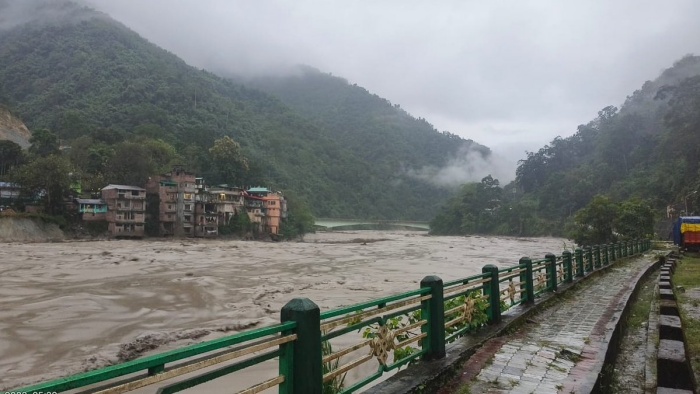
The South Lhonak Lake, situated in North West Sikkim experienced a glacial lake outburst and triggered flash floods due to incessant rainfall in the region on Wednesday morning. Areas near River Teesta have been put on high alert, said an official.

According to the Legislator of Tumin–Lingee Assembly constituency, Sikkim, Ugyen Tshering Gyatso Bhutia, “The South Lhonak lake situated in North West Sikkim experienced an outburst in the early hours of Wednesday morning due to incessant monsoon rainfall. Areas near River Teesta have been put on high alert.”

Giving information about the outburst, the Gangtok District Administration said, “The flash flood made its way through River Teesta sweeping Indreni Bridge in Singtam town, some 30 kilometres from Gangtok. A connecting bridge of the Balutar hamlet was also swept away around 4 am.”

So far, 23 army jawans have been reported missing. As per sources, army and paramilitary personnel, as well as labourers working in low-lying areas may have been swept by the flash flood taking the course of the river.

As per information from Mangan District Administration, Chungthang town, some 90 kilometres north of Gangtok, houses the Teesta Stage 3 Dam. Upon high alert, the local residents have been evacuated in the area.

“Similarly, the Teesta Stage 5 dam at Dikchu in Mangan district was opened up for water disbursement after a high alert. It is reported that the control room of the dam has been severely damaged,” they informed.

Many homes near the River Teesta, situated in Gangtok’s Singtam have been evacuated. Additionally, temporary relief facilities have been established in the town’s Singtam Senior Secondary School, added officials.

(This news report is published from a syndicated feed. Except for the headline, the content has not been written or edited by OpIndia staff)

Liquor scam case: ED raids AAP MP Sanjay Singh’s Delhi house a day after Dinesh Arora turns approver

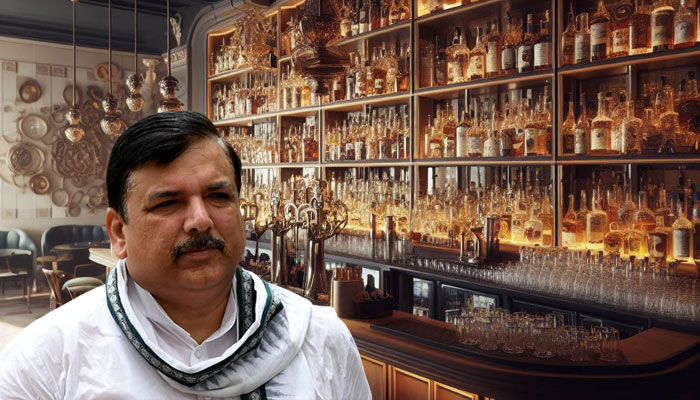
On 4th October, the Enforcement Directorate raided the Delhi house of Aam Aadmi Party Rajya Sabha MP Sanjay Singh. According to news agency ANI, the raids were conducted concerning the liquor scam case. Notably, ED raided Sanjay Singh’s house on the day the Supreme Court was scheduled to hear the bail plea of former Delhi deputy chief minister Manish Sisodia.

Times Now report suggested that the ED was conducting raids on multiple locations apart from Sanjay Singh’s residence. The ED team reached the house of the MP at around 7 AM. Notably, Sanjay Singh’s name had appeared multiple times in the charge sheet filed by the ED.

According to the charge sheet, Dinesh Arora, who has turned approver, had met Arvind Kejriwal in the presence of Singh. In a statement, Arora told ED he met Singh at an event and later came in touch with Sisodia. ED said, “He (Dinesh Arora) initially met Sanjay Singh through whom he came in contact with Manish Sisodia during a party at his own restaurant, namely Unplugged Courtyard. On request of Sanjay Singh, he spoke with many of the restaurant owners and arranged cheques amounting to Rs 32 lakh (handed over to Sisodia) for collection of party funds for upcoming elections in Delhi.” ED further noted that Singh helped Arora resolve one of the long-pending issues with the liquor department.

Speaking to the media, national spokesperson of AAP Reena Gupta targeted Prime Minister Narendra Modi for the raids and claimed the raids were conducted as Singh raised questions over links between PM Modi and business tycoon Gautam Adani. She said, “Since Sanjay Singh was continuously raising questions on the issue of PM Modi and Adani, this is the reason why raids are being conducted at his residence. Nothing was found earlier, and nothing will be found today. Raids were conducted yesterday at the residence of some journalists, and today raids are conducted at the residence of Sanjay Singh…”

A day before raids on Sanjay Singh, it was reported that a Delhi court allowed the son of YSR Congress Party Lok Sabha MP Magunta Srinivasulu Reddy’s son and a Delhi-based businessman, Dinesh Arora, to become approvers in the ED case linked to an excise policy scam.

Arora had expressed his desire to turn approver in November 2022, which the court has finally approved. During the hearing, Arora sought pardon in the case and said he had made the confessional statement under Section 164 of the CrPC. Asked if there is any pressure from the Central Bureau of Investigation (CBI), Arora replied in the negative. “I am ready to give voluntary disclosure about my involvement in the alleged offences. I have earlier cooperated during the investigation of the case by the CBI. I am doing this without any pressure or undue influence upon me by the CBI or any other person,” said Arora.

Assam: More than 1000 people arrested in the second phase of the crackdown against child marriage

The state-wide crackdown against child marriage continues in full swing as the Assam police on Tuesday, 3rd October, arrested more than 800 accused persons.

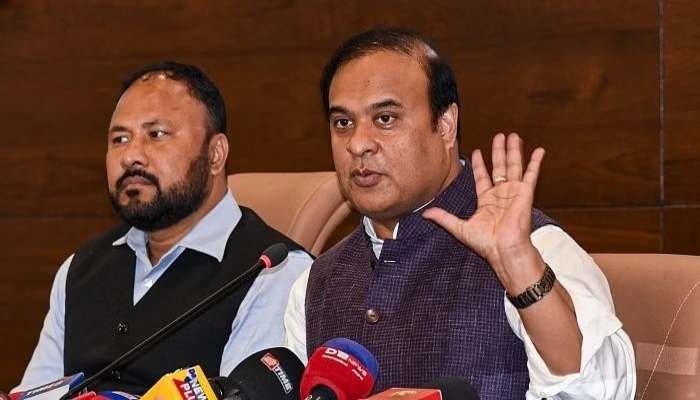
Giving details, Assam Chief Minister Himanta Biswa Sarma wrote on X, “In a massive crackdown against child marriage, Assam Police has arrested over 800 accused persons in a special operation which began in the early hours of dawn. The number of arrests is likely to rise.”

A few hours later, CM Sarma revealed the updated numbers regarding the arrests and wrote on X, “The number now stands at 1,039.”

The Additional Superintendent of Police of Morigaon District, Samiran Baishya, said the operation against child marriage started in Morigaon District last night. Under the special operation, police have arrested 34 people in Cachar district, 20 in Kamrup and parts of Barpeta district, and 34 in Morigaon district, as reported by ANI.

“So far, we have arrested 34 people during this operation and registered 26 cases. Our operation is still on. After launching the first leg of the operation against child marriage, people are now aware of it,” Samiran Baishya told ANI.

It is worth noting that the Assam government led by CM Himanta Biswa Sarma has been actively working to eradicate child marriages from the state. In February this year, it was reported that the state police arrested over 3,000 people as a part of its crackdown on child marriages. As per ANI, in the initial phase of this operation, Assam Police had already arrested approximately 5,000 individuals, including 15 clerics suspected of involvement in child marriages.

Reaffirming his government’s resolve to end the menace of child marriages, CM Sarma had earlier this year said that severe measures in this regard have been taken and by the end of 2026, the government aims to eradicate child marriages from the state. CM Sarma had informed that an operation will be launched against the menace of child marriages in the state and arrest people every 2-3 months.

It is pertinent to recall that on January 23 of this year, the cabinet passed legislation to outlaw child marriages in the state. The chief minister had announced that his administration would launch a statewide drive against child marriage under the Prohibition of Child Marriage Act (PCMA) and the Protection of Children from Sexual Offences (POCSO) Act.

The state government also allocated a budget of Rs 200 crore to handle the sensitive issue and enabled the appointment of a special attorney for each case involving child marriage to prosecute the criminals.

The Assam CM had earlier said that over 1 lakh minor girls were married off in recent years and that many of them became child mothers.

CM Sarma had announced that the police would take action against the families and priests or Qazis involved in performing illegal marriages in the state. In February this year, around 60 Qazis were arrested for their alleged involvement in conducting child marriages. Moreover, in September this year, the Assam police arrested 17 persons who were masquerading as qazis in the Hailakandi region.

Anandotsav: How a new Bharatanatyam festival in Mumbai gave a sneak peek into the future of one of India’s ancient dance forms

On a drizzly Saturday evening (30 September), when the maximum city generally turns into one big ball of blinding disco lights, the new seeds of Bharat’s ancient art and culture were sprouting in one of the suburbs of Mumbai. Chimes of ghungroos echoing with every taalam (rhythm) reverberated through the alleys of Vile Parle.

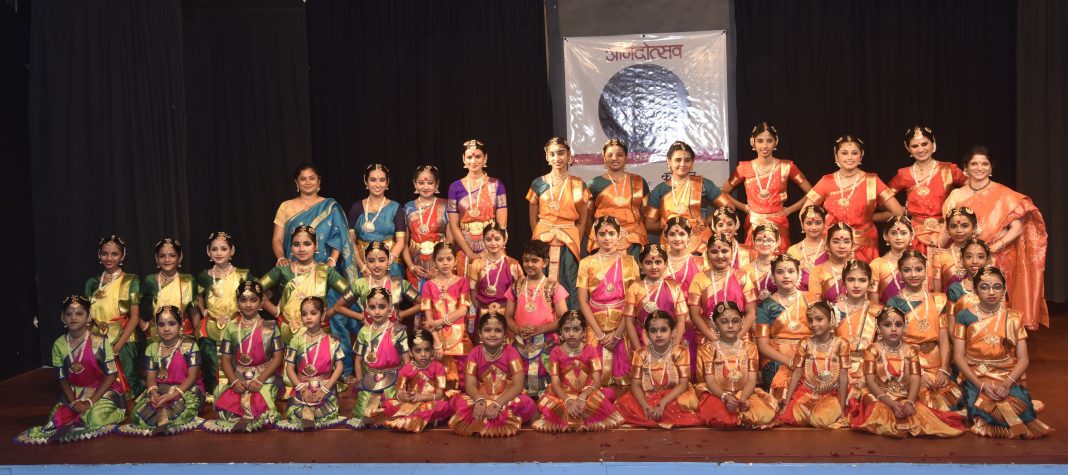
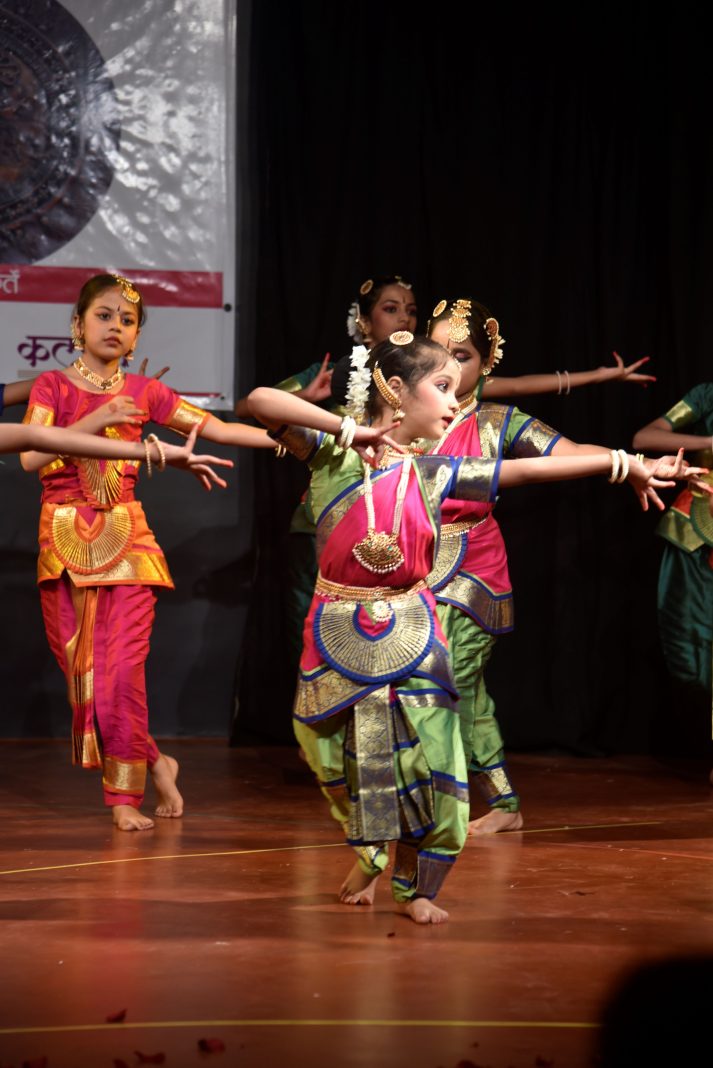
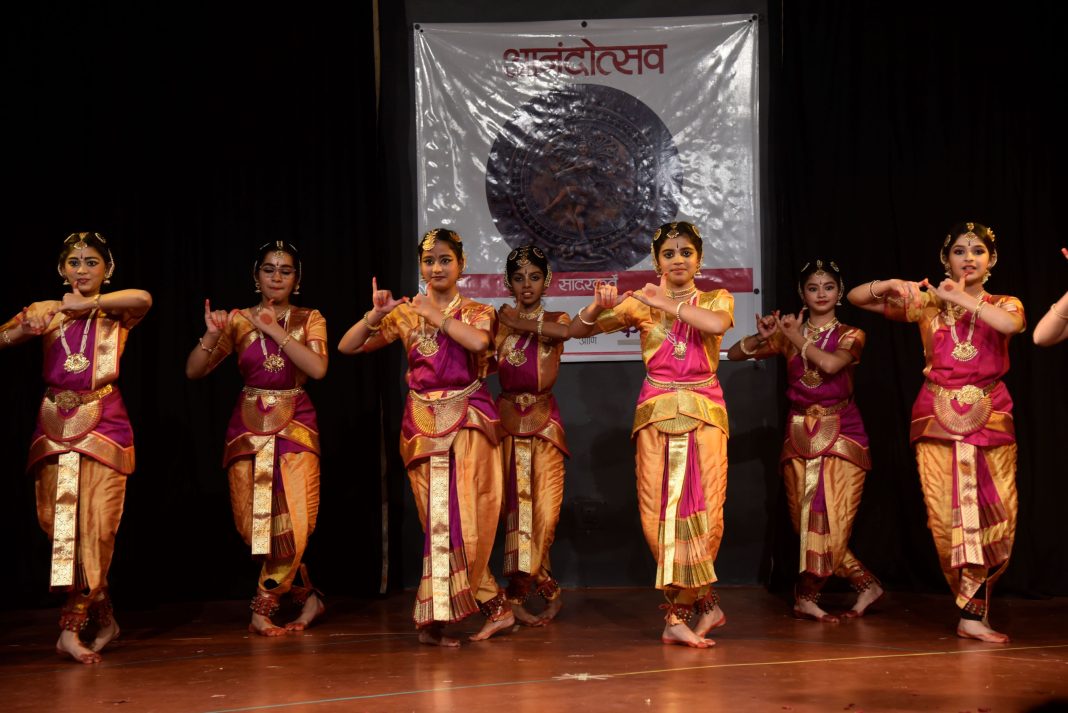
“Aanandotsav”, the first annual Bharatanatyam festival organised by Kalaadnya Dance Academy in partnership with Nrityankur, marked the arrival of a new generation of Bharatanatyam performers. Both Kalaadnya and Nrityankur are affiliated with the Akhil Bharatiya Gandharva Mahavidyalaya till Alankar Poorna (the final stage of Bharatanatyam training).

Students of Kalaadnya and Nrityankur

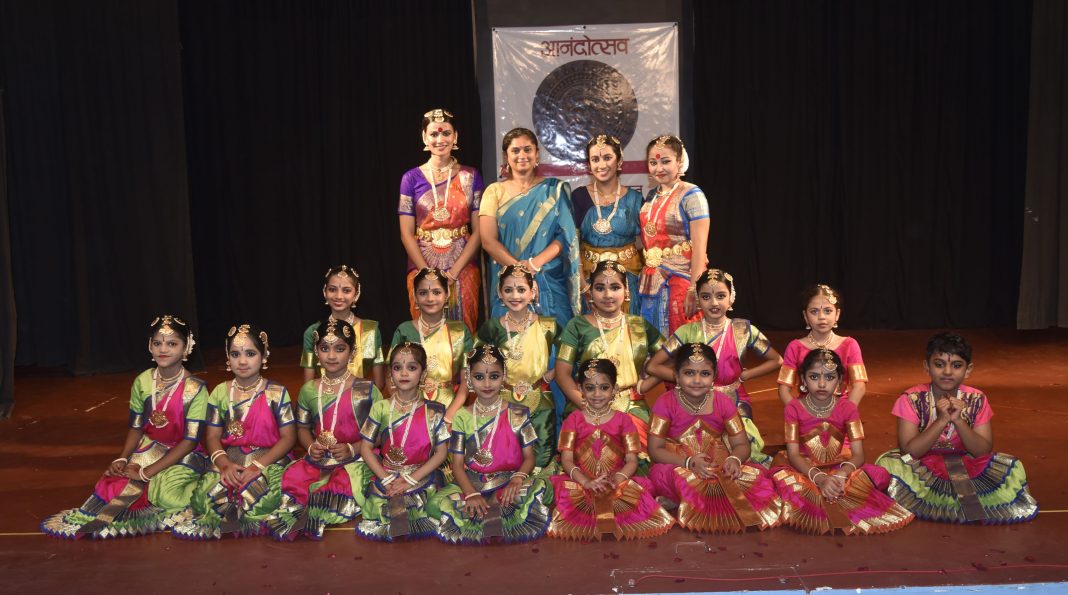
Kalaadnya was founded in 2016 by Sayali Sutar, a Girnar Ratna awardee and Master in Bharatanatyam, who has performed across cities in and outside India. Sayali Sutar is a disciple of the great Vaibhav Arekar, founder of Sankhya Dance Company.

Students of Kalaadnya with their Guru Sayali Sutar

The 163-seater auditorium of Sathye College was fully occupied by guests, friends and families of Devis, most of whom were delivering their debut performance. Gracing the occasion amongst the guests were Gautam Marathe, ace Bharatanatyam dancer and founder of Angika, and Pooja Pant, ace Kathak dancer and founder of Pooja Pant Dance Company.

The show began with three young girls presenting their first piece called Todaimangalam, an invocation piece in praise of Shri Ganesha. The young performers were still just tracing their steps from the training but attempted to put their best foot forward aspiring to give a physical form to the Shlokas dedicated to Gajanana, Maa Saraswati, Mahalakshmi, and Bhagwan Shiva.

The nervousness in the budding talent was evident even as their beautiful red costumes and vibrant shringar (make-up) enthralled the audience. This was the first time that many among the audience were witnessing their daughters perform Bharatanatyam, which many pursue as nothing more than an extra-curricular activity or a hobby but only a rare jewel makes it to the global stage.

The show took the spectators through the journey of Bharatanatyam training. How yogic steps including sukshma vyayam (light exercises) are practised by Bharatanatyam dancers for muscle strengthening and toning to get the perfect posture were expressed with a tinge of humour in the performance called Natyobics.

From hereon began the introduction to Bharatanatyam through Bharatanatyam. The youngest to the eldest dancers of Kalaadnya performed a piece called Adavumala, meaning a chain of basic movements of Bharatanatyam, choreographed by Sayali Sutar. The performance was followed by another piece called Alarippu, a flowering bud, which aptly describes the performers themselves.

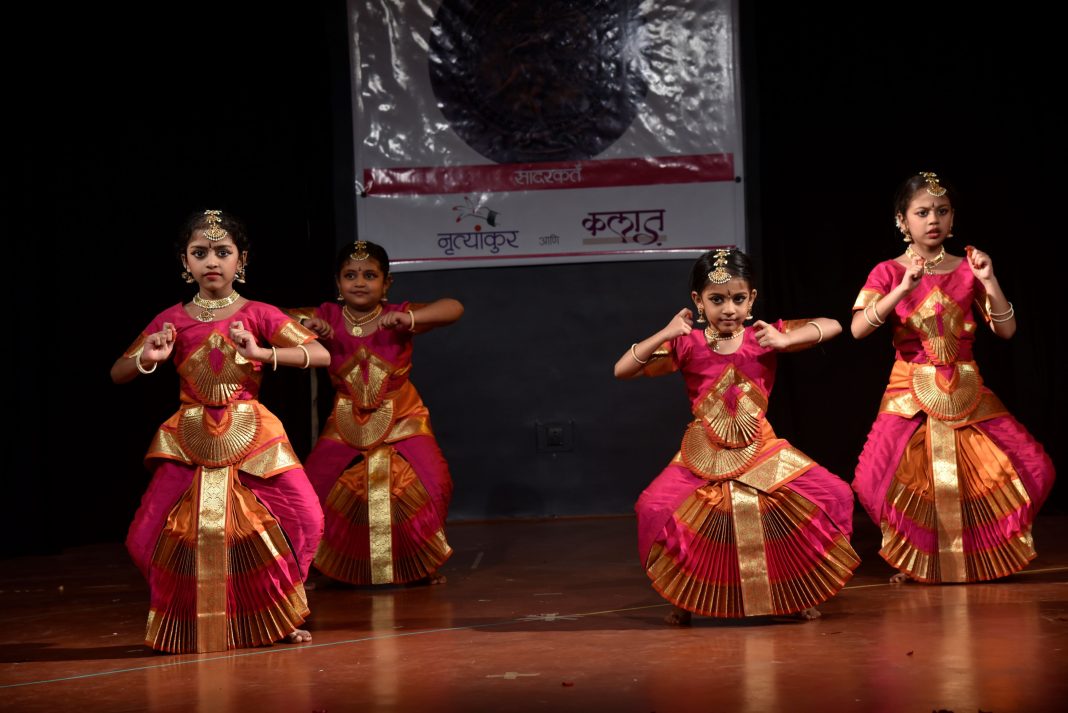
Nrityankur students performing to Kasturi Tilakam

Vatsalya Padam, performed to the melodious bhajan ‘Krishna Ne Begane Baaro’ in Kannada language in Ragam Yamuna Kalyani and Talam Mishra Chapu, showed how Maa Yashoda is enchanted by the divinity of playing hide and seek with her son, Krishna, The Jagadguru. The blissful and wholesome choreography is credited to Vaibhav Arekar. It was performed by Kalaadnya student Mrunmayi Malpekar.

Kalaadnya student Mrunmayi Malpekar performing Vatsalya Padam

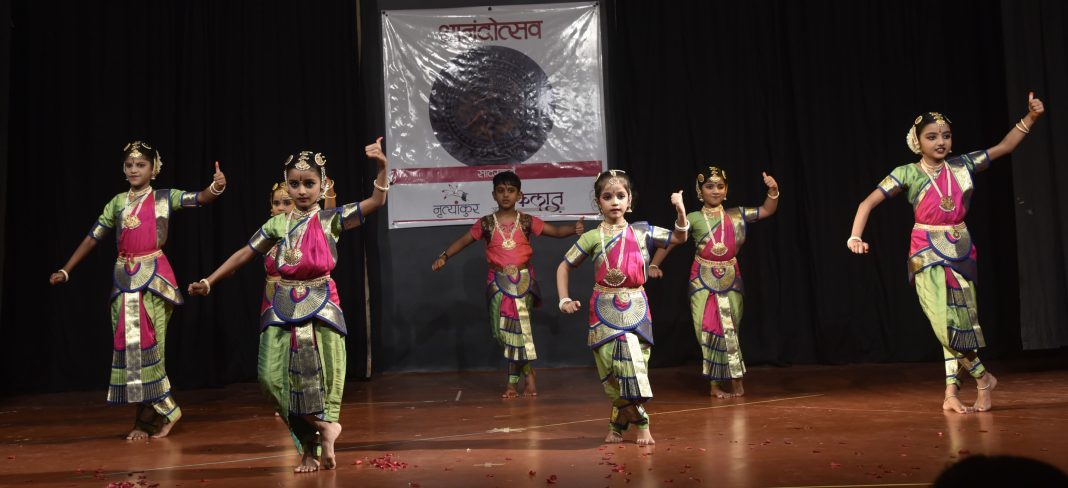
The show then dives deeper into Bhakti, a state of divine trance if you will, with group performances to Achyutam Keshavam – a Hindi bhajan translated from the original Sanskrit rendition by Shri Adi Shankaracharya; Shri Ram Stuti, written by the supreme devotee of Bhagwan Ram, Goswami Tulsidas and choreographed by Sayali; and Kasturi Tilakam. Special mention goes to the sole boy dancer amongst a large group of girl dancers, like Krishna among Gopis.

Kalaadnya students performing Shri Ram Stuti

The Mallari performance was like a grand Ganesh Chaturthi celebration taking centre stage. It added a fun twist to this journey of performances dedicated to Devis and Devatas. The rendition conveyed India’s vibrant and magnificent religious processions when a temple deity is carried by an ocean of devotees out of His and Her humble abode on special occasions.

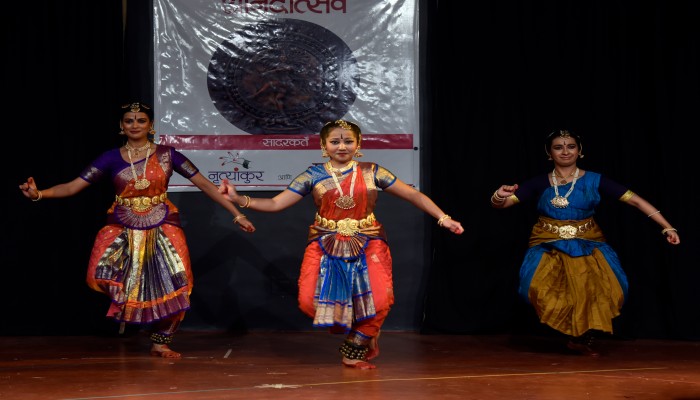
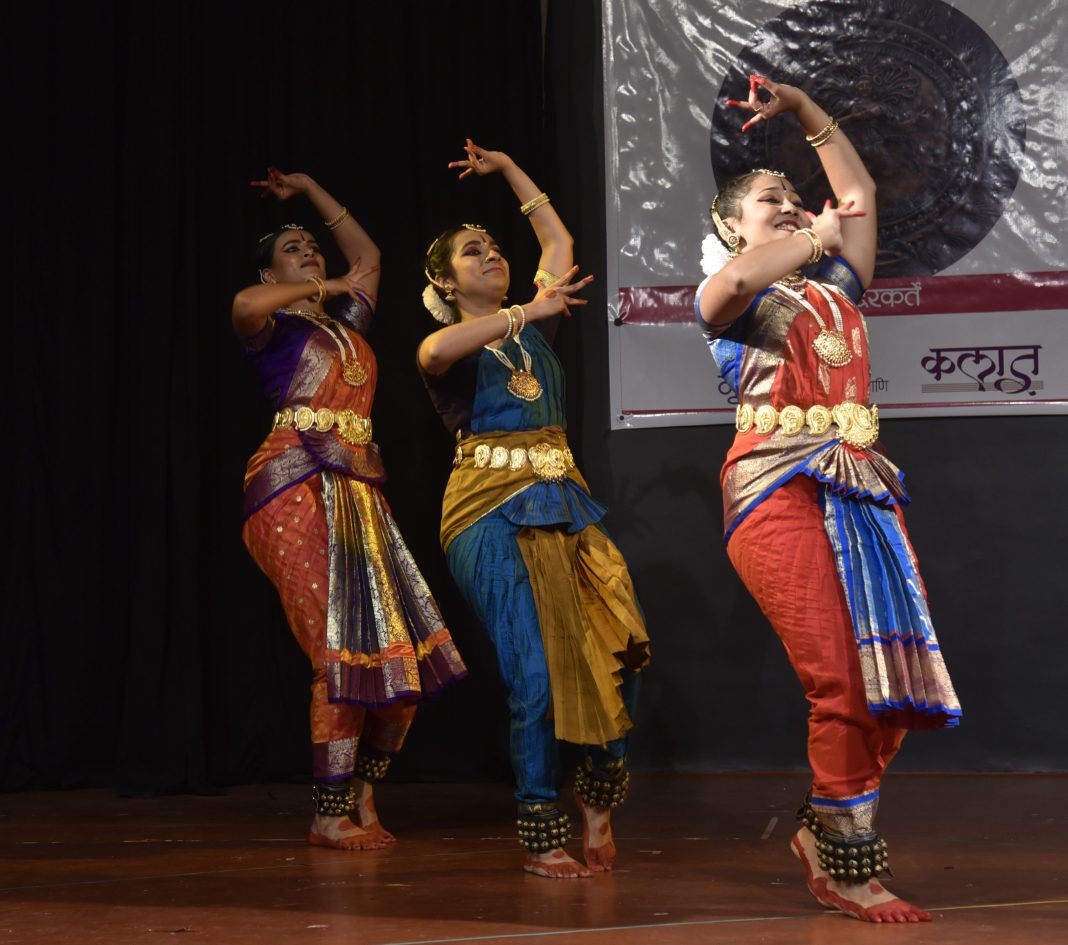
Kalaadnya students Pritha Bakshi (L), Srishti Ganesh (C), and Mrunmayi Malpekar (R) performing Mallari

Performed in Raga Nattai, Tala Aadi, this piece – performed by the terrific trio Srishti Ganesh, Pritha Bakshi, and Mrunmayi Malpekar – through Bharatanatyam, beautifully packaged the colours and excitement that Hindu religious processions bring to society.

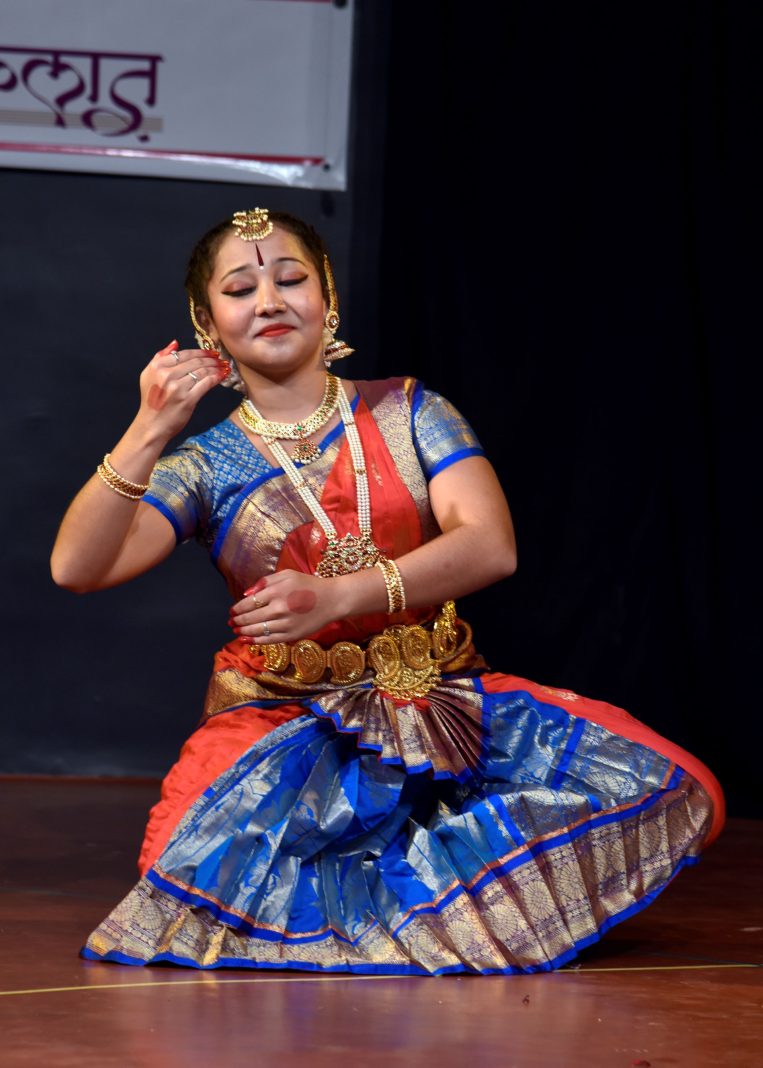
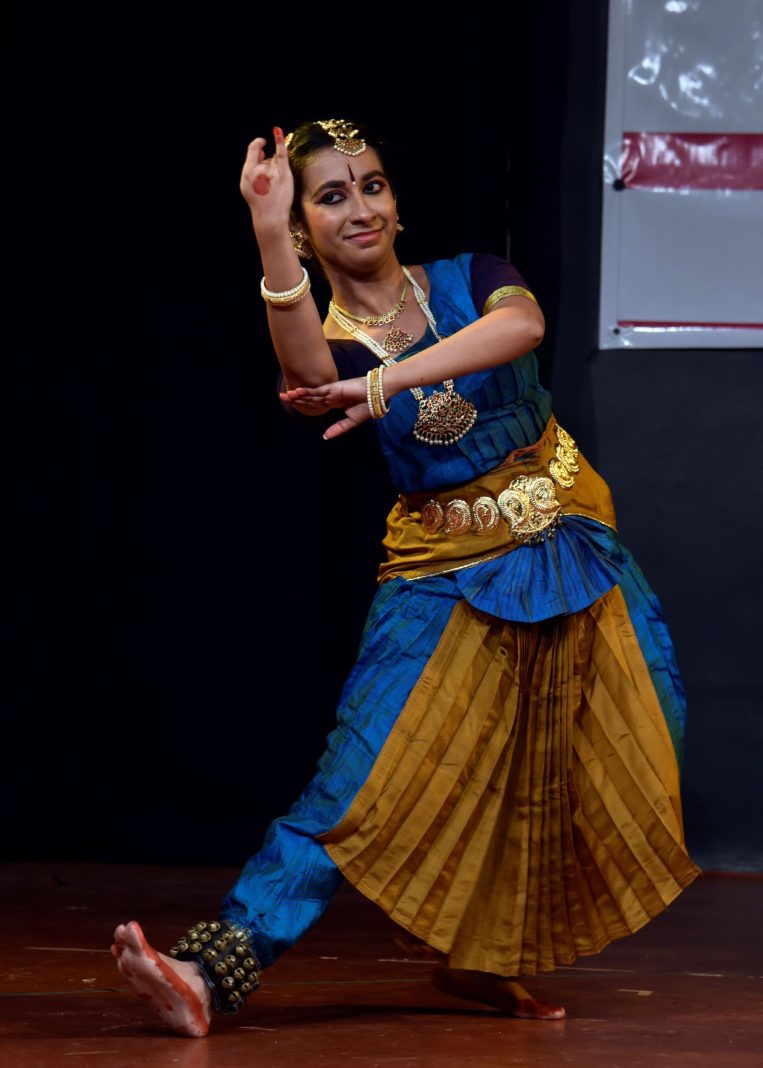
What came next was the show-stopper of the evening. From the music to the Bhakti in the performances listed above, there was a sense of familiarity. But the most intense aspect of Bharatanatyam revealed itself when Kalaadnya’s Srishti Ganesh performed Javali, a light classical love song with strokes of romantic gestures, something that the layman is used to witnessing only in movies most times. Such renditions are not easy to guage and understand unless the performer has used their expressions and mannerisms with precision. Srishti Ganesh achieved that beautifully.

Kalaadnya student Srishti Ganesh performing Javali

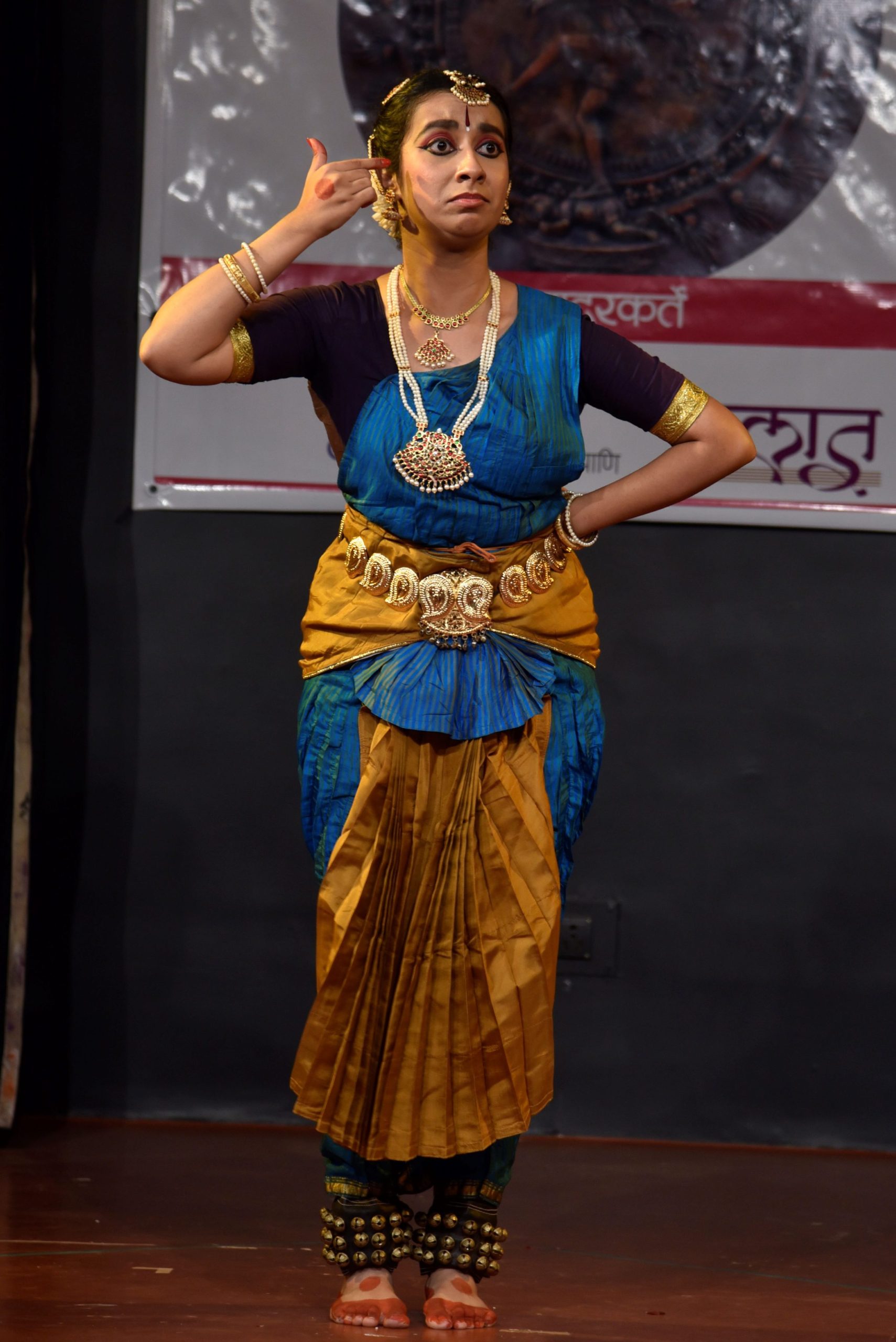
When she entered the stage, Srishti seemed to be on the backfoot owing to her light make-up, but from the very first to the last movement of her performance, Srishti had captured the attention of the spectators in its entirety. Her poetic mannerisms and the effortless ease with which she expressed a woman in love, being teased by and getting lost in the thoughts of her lover would make anyone want to fall in love.

Kalaadnya student Srishti Ganesh performing Javali

The order of the performances designed by the organisers deserves appreciation. The Jatiswaram performance, a purely Bharatanatyam recital sans abhinay, ensured that the flow of the show remained undisturbed as did the sentiments evoked by the previous performances.

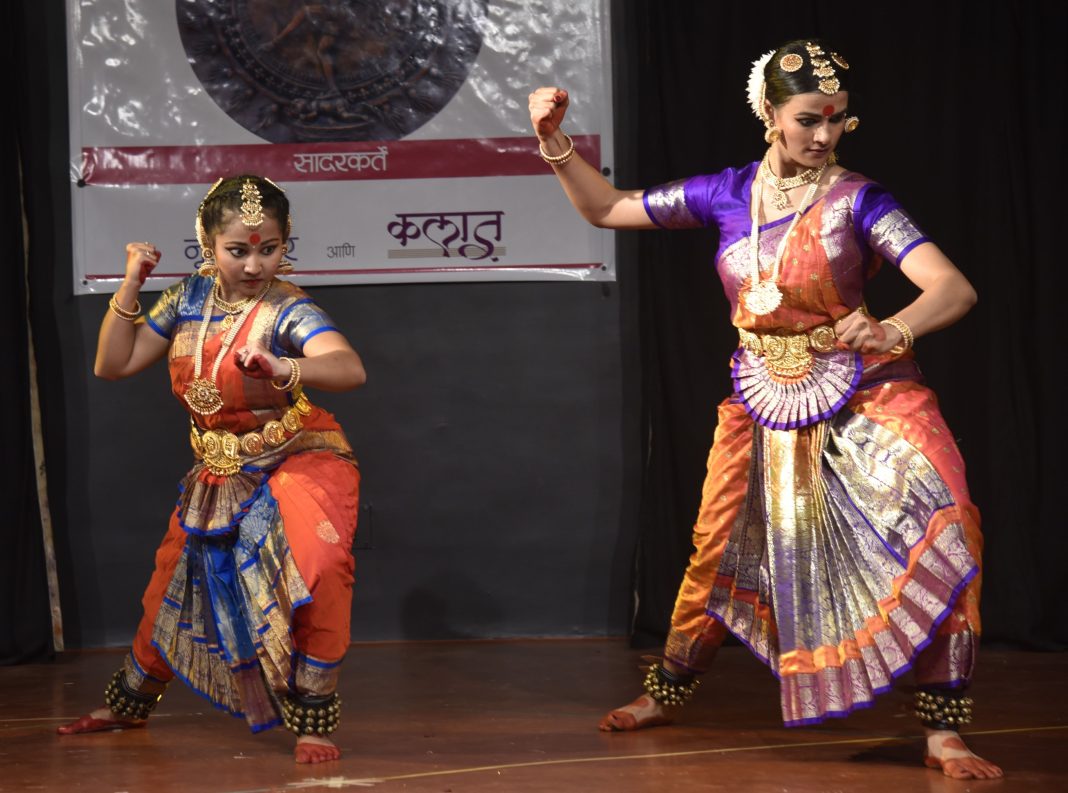
Instead of bringing the evening to a close, the festival concluded by welcoming Navratri and paying obeisance to Mahishasur Mardini and the ever-existing and all-knowing forms of Maha Shakti. The best part was the battle between Maa Durga and demon Mahishasur followed by the various forms of Devi Shakti.

Kalaadnya students Mrunmayi Malpekar (left) and Pritha Bakshi (right) performing to Ambashambhavi

To be able to resonate with the common man, even when they may or may not understand the intricacies of an ancient dance and art form like Bharatanatyam, is an achievement in itself. That Kalaadnya’s Sayali and Nrityankur’s Arundhati through Anandotsav have taken it upon themselves to realise the aspirations of young and bright Bharatanatyam performers assures that the best of Indian culture is nowhere nearly lost and there’s surely more to come.

Congress leader Abhishek Singhvi schools Rahul Gandhi on ‘Jitni Abadi Utna Haq’ remark, deletes tweet as Jairam Ramesh hits back

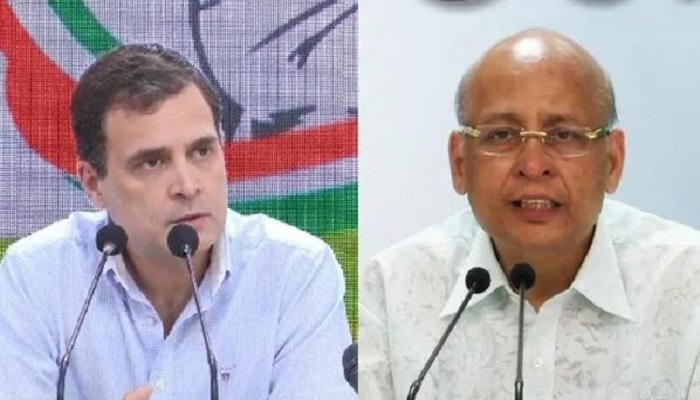
On 3rd October (Tuesday), Senior Congress leader and Supreme Court advocate Abhishek Manu Singhvi publicly took a divergent line from the Congress party on the issue of proportionate representation. Singhvi schooled his party leader Rahul Gandhi for making the remark ‘Jitni Abadi Utna Haq’ and advised him to fully comprehend the “consequences” of it.  

Notably, at a time when Wayanad MP Rahul Gandhi asserted that ‘jitni abadi utna haq’ is the pledge of the Congress party, Abhishek Singhvi reminded him that the idea would ultimately culminate in “majoritarianism“. He highlighted that equality of opportunity is not the same as equality of outcomes.  

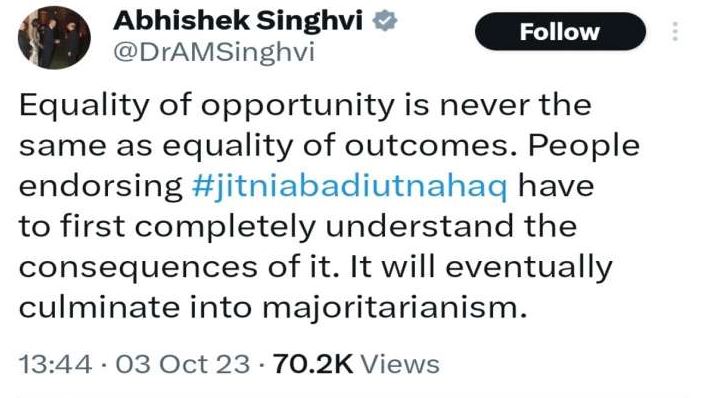
Taking to X, he wrote, “Equality of opportunity is never the same as equality of outcomes. People endorsing ‘Jitni Abadi Utna haq’ have to first completely understand the consequences of it. It will eventually culminate into majoritarianism.”  

Abhishek Manu Singhvi’s deleted tweet highlighting flaws in “Jitni Aabadi Utna haq”

After his tweet started making rounds, the Congress party distanced itself from Singhvi’s tweet. Evidently, Congress’ General Secretary in-charge communication, Jairam Ramesh issued a clarification claiming that Singhvi’s opinions don’t reflect the stance of the Congress party.

Consequently, after facing backlash, Singhvi deleted his tweet. Responding to a media query in connection with the contents of his deleted tweet, Singhvi claimed that he did not take a different stand from the party. He added that he supports the Congress party’s demand to have a caste-based census. 

He said, “I didn’t take a different stand. We have supported it and we will continue to support it. All the Court orders that have come in say that the decision has to be taken on the basis of facts. How will that happen if there are no facts? So, for facts, it is essential for the caste census to take place..” 

Meanwhile, earlier in the day (3rd October), Prime Minister Narendra Modi lambasted Congress for dividing Hindu community in caste lines and asserted that for him, the biggest population is of the poor and it is his aim that the poor has the first priority to resources. 

PM Modi also recalled former Prime Minister Manmohan Singh’s infamous speech where he insinuated that Muslims have the first right to the Country’s resources. 

Addressing a public meeting at Jagdalpur in Chhattisgarh, he said, “However, I cannot help but wonder what the former Prime Minister, Manmohan Singh, would think of this new approach. He used to say that the minorities has the primary right to the country’s resources, and among the minorities, Muslims have the first right. But now, Congress is saying that the population of a community will determine who has the first right to the country’s resources.”

Hinduphobia in the West: Khalistani extremists pour gau mutra over the Indian flag and ask UK PM Rishi Sunak to drink it, video goes viral

0

In an act of brazen Hinduphobia, Khalistani extremists, presumably in the United Kingdom, poured gau mutra on the Indian flag and asked PM Rishi Sunak to drink it, a video of which has gone viral on the internet.

In the undated video, a Khalistani extremist is seen sprinkling gau mutra over the Indian flag and derisively asking the UK PM Rishi Sunak, who has been unapologetic about his Hindu roots, to have it if he wants to drink it.

While when the video was shot and uploaded on the internet is not yet known, it is worth noting that the clip surfaced on X, formerly known as Twitter, in the wake of Canada’s allegations against India over the killing of Khalistani terrorist Hardeep Singh Nijjar. Canadian PM Justin Trudeau had alleged that the Indian government had authorised the killing of Nijjar, touching off an escalating diplomatic row between Ontario and New Delhi. India has rejected the allegations.

But the tensions between the two countries have brought to the fore the chronic issue of Khalistani terrorists finding safe havens in Western countries that pontificate the world over fighting terrorism while turning a blind eye, and sometimes actively sheltering anti-social elements involved in secessionist activities in their native countries.

Nijjar, one of India’s most wanted terrorists, with a Rs 10 lakh cash reward on his head, was shot dead on June 18 by two unidentified shooters outside a gurudwara in Surrey. He was the Khalistan Tiger Force’s (KTF) commander. Months later, Trudeau claimed that India had authorised the killing, without offering supporting evidence to back his claim.

In a strongly worded statement, India said that Canada’s claims appeared to be “politically motivated” and urged the Trudeau government to crack down hard on terrorists and anti-India elements operating on its soil. As a result of the diplomatic blockade over Nijjar’s murder, India has now suspended visa services for Canadians.

The incident also reflects the alarming rise in Hinduphobia in the West, with Khalistani extremists, Islamists, and their intellectual supporters routinely indulging in ridiculing, dehumanising, and demonising Hindus to promote their vested interests.