Home Blog Page 1878

Vishwa Hindu Parishad to go ahead with its ‘Jal abhishek Yatra’ in Nuh, says permission not needed

On Saturday (August 26), the Vishwa Hindu Parishad (VHP) announced that it would take out its ‘Jal Abhishek Yatra’ on Monday (August 28) in Nuh district (Mewat region) of Haryana.

The development comes amidst the denial of permission to hold such a religious procession by the Haryana government. While speaking about the matter, VHP’s general secretary Surendra Jain said, “Permission for religious rally is not required…”

“Does anyone take permission to offer Namaz, for Tazia, or for Hanuman Jayanti?” he inquired.

Vishwa Hindu Parishad leader Vinod Bansal informed, “Jal Abhishek Yatra will be taken out at 11 am tomorrow. Since it is a pilgrimage, there is no need to take permission for this.”

It must be mentioned that the Nuh district administration denied permission to VHP for the ‘Jal Abhishek Yatra’, claiming that a meeting of the G20 Sherap Group is scheduled to take place in Nuh between September 3-7.

The local administration also cited the law and order situation in the region, where Islamists went on a rampage on July 31 this year.

The Haryana government had decided to imposes Section 144 of the Code of Criminal Procedure (CrPC) in Nuh between August 26-28 and suspend mobile internet and bulk SMS services.

An order by the Additional Chief Secretary (Home) T V S N Prasad said, “This order is issued to prevent disturbance of peace and public order in the jurisdiction of district Nuh and shall be in force with effect from August 26, 1200 hrs, to August 28, 2359 hrs.

Violence in Nuh

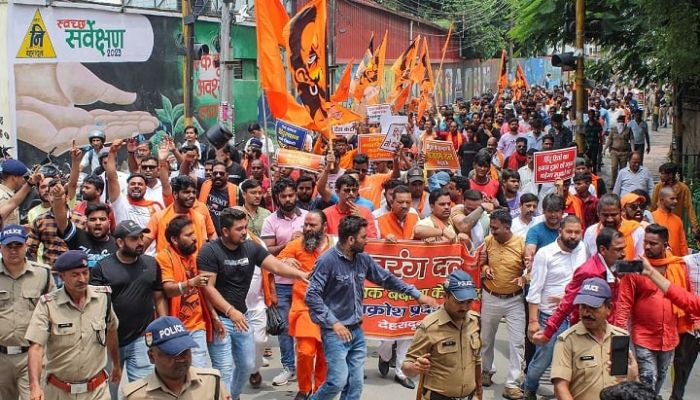
On July 31, violence broke out in Haryana’s Nuh district during the ‘Brij Mandal Jalabhishek Yatra,’ which was organized by Vishwa Hindu Parishad and Bajrang Dal.

Vehicles were burnt and stones pelted at the Vishwa Hindu Parishad’s Jalabhishek Yatra as clashes erupted between two communities in the Muslim-majority region of Mewat in Haryana.

Gujarat: Hindu organisations and local leaders oppose the VIP Darshan fees introduced in a Dakor temple by management committee

0

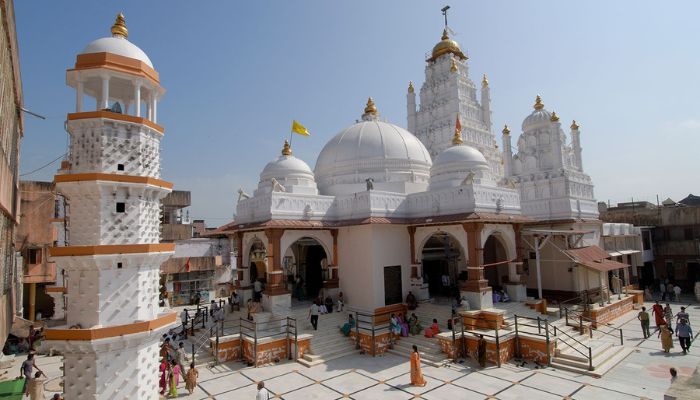
On August 26, 2023, a day following the announcement made by the Shri Ranchhodraiji Maharaj Mandir management in Dakor, Gujarat to introduce charges for VIP darshan, various Hindu organisations and local village sarpanchs submitted formal appeals to the temple administration. Their pleas urged a reconsideration of this decision. The protestors have issued a stern warning of initiating a robust agitation should the temple management fail to retract their decision.

On Thursday, August 24, 2023, the temple administration introduced a fee of 500 per person for individuals desiring VIP Darshan, which offers a closer view of the Thakorji deity. Furthermore, in accordance with this ruling, male devotees have the option to join the female queue by paying a charge of 250. This recent initiative has elicited a varied reaction, with a multitude of devotees voicing their dissatisfaction with the decree.

Amidst a protest opposing the decision of the Dakor Temple Committee, devotees resounded slogans such as “God is hungry for love; you are hungry for money”. Young members of Hindu organisations and representatives from the Sarpanch Association of Thasara Taluk visited the temple premises to articulate their concerns. Their primary emphasis was that devotion should remain untouched by financial concerns. They delivered a written petition to the temple manager, asserting their dissent unequivocally.

Labelling the decision as irrational, Akshay Parmar, the vice president of the Yuva Kshatriya Samaj Kheda district and a representative of Khijalpur sarpanch, underscored the temple administration’s stance. He highlighted that while the temple administration claims the fees are for those seeking a closer view of the deity, there’s apprehension that this might create the impression that people can purchase a more intimate connection with God. He went on to mention that if the decision remains unchanged, they have issued a collective warning to observe a fast in protest.

Critics of the decision argue that the temple possesses substantial donations and funds, further bolstered by contributions from the Gujarat Pavitra Yatradham Board, a State government entity. They point out that the temple lacks adequate parking facilities for devotees, with a privately managed parking area situated at a distance from the temple premises, where parking fees are imposed.

Complaints also extend to issues of cleanliness. A noteworthy contrast is highlighted, drawing attention to the Siddhivinayak Temple in Mumbai, an affluent city, where a fee of Rs. 50 grants access to a shorter queue and quicker darshan. In contrast, the Dakor temple administration has introduced a charge of Rs. 500.

In the midst of this controversy, the chairman of Dakor Temple Trust held a press conference in Ahmedabad. He clarified that the word VIP has not been used anywhere in the decision of the Dakor Committee. The term has been used by some people. Addressing a press conference, the chairman of the temple trust said that a special arrangement for this darshan has been made keeping in mind the demand of the people and all the money will be used only for the special convenience of the pilgrims.

Afghanistan: Sikh woman says she is forced to wear Burqa, look Muslim, so she cannot be identified as ‘Sikh’, hasn’t celebrated festivals since Taliban took over

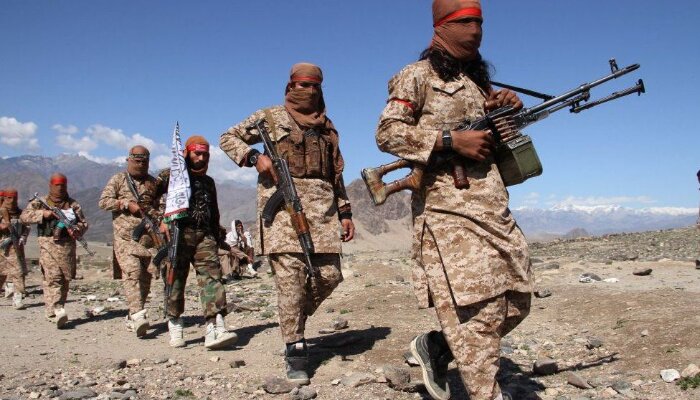
Two years after the Taliban took over Afghanistan, the last remaining Hindus and Sikhs in the nation continue to face severe religious persecution as the Taliban imposes strict Islamic laws (Sharia). While the country’s last Jew escaped soon after the fall of Kabul, only a few Sikh and Hindu families continue to live under the Islamic regime.

Fari Kaur, one of the last remaining Sikhs in the capital, Kabul stated, “I cannot go anywhere freely.” She made reference to the Taliban’s directive that all women must wear the all-encompassing burqa or niqab when they are outside. “When I go out, I’m forced to dress like a Muslim so that I can’t be identified as a Sikh,” she said. Essentially, Fari Kaur said that she has to wear a full burqa when she goes out in public so she is unrecognisable as a ‘Sikh’.

A suicide attack in the eastern city of Jalalabad in 2018 that targeted Sikhs and Hindus resulted in the demise of her father. According to accounts, up to 1,500 Sikhs, including Kaur’s mother and sisters left Afghanistan as a result of the incident. However, she was unwilling to leave and remained in Kabul to complete her education which was her father’s dream.

When Islamic State-Khorasan (IS-K) terrorists attacked a Sikh temple in Kabul in March 2020, twenty-five worshippers were massacred. Most of the minority’s survivors departed the country after the brutal episode. Fari Kaur continued to stay there, but now, more than two years after the Taliban seized power, she noted that the lack of religious freedom imposed by the Islamic regime forced her to look for asylum abroad.

Kaur revealed, “We have not celebrated our key festivals since the Taliban returned to power. We have very few community members left behind in Afghanistan. We cannot even look after our temples.”

There were around 100,000 Hindus and Sikhs in Afghanistan in the 1980s. However, many were driven out by the war that started in 1979 and the escalating persecution. The Taliban and rival Islamist organisations vowed to defend minorities throughout the civil war in the 1990s, but many Sikhs and Hindus came to India after their homes and businesses were lost.

When the Taliban initially came to power between 1996 to 2001, they proclaimed that all Sikhs and Hindus in the nation would have to wear yellow badges which sparked outrage around the world. They were forbidden from constructing new temples and were also required to pay a specific tax known as jaziya which was historically levied on non-Muslim subjects by Muslim monarchs.

However, the minorities were provided with the same rights as other Afghan nationals after the United States-led invasion in 2001 and they also received seats in the country’s parliament.

The Taliban made an effort to allay the concerns of Afghans who were not Muslims after gaining authority for the second time. Their members visited Sikh and Hindu temples in an effort to try and reassure those who managed to survive in the communities of their commitment to their safety and well-being. However, the harsh constraints on them have compelled many to leave their country of origin.

Many of the Sikhs and Hindus from Afghanistan who have emigrated to India now live in abject poverty. Chabul Singh, a 57-year-old Sikh man who left his homeland with his wife and two sons some years ago said, “We abandoned our country out of extreme desperation.” The family currently resides outside of New Delhi, where he and his kids work odd jobs to make ends meet.

Singh said, “In Afghanistan, our distinctive turbans gave us away, and we were killed both by the Taliban and Daesh (Arabic moniker of IS-K).”

The situation for religious minorities in Afghanistan, including Hindus and Sikhs has deteriorated under the Taliban government, according to Niala Mohammad, director of policy and strategy at the nonprofit Muslim Public Affairs Council in Washington. She was earlier the South Asia analyst for the U.S. Commission on International Religious Freedom.

She voiced, “The situation continues to deteriorate as political extremist factions that claim to represent Islam, such as the Taliban, ascend to power in the region. This exodus of diverse religious groups has left a void in the country’s social fabric.”

Afghanistan has world’s second most displaced population

According to a report by the United Nations Development Programme (UNDP), Afghanistan currently has an astonishing 6.55 million internally displaced people (IDPs) placing it second behind Syria when it comes to displaced population.

As of December 31, 2022, there are about 4.39 million people who have been forced to escape because of conflict and violence, compared to 2.16 million people who have been relocated because of natural disasters.

The research also issued caution over the probable increase in worldwide displacement during the following 30 years. Additionally, Afghan people have been leaving their homes because of poverty, insecurity and turmoil in the country


Madras High Court Judge refuses to pursue contempt of court case against DMK leader who said that the judge had ‘malafide intention’

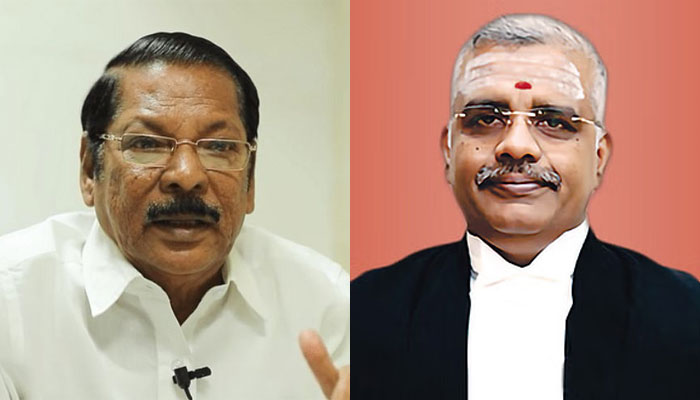
On 25th August, Justice N Anand Venkatesh of the Madras High Court declined to pursue contempt of court charges against RS Bharathi, the Dravida Munnetra Kazhagam (DMK) organisation secretary, and others who criticised him for reviewing the acquittal and discharge of three sitting DMK Ministers in disproportionate assets cases against them.

Advocate R Krishnamurthy had urged him to take action against Bharathi. However, Justice Venkatesh said, “Those who cannot tolerate criticism are unfit to hold public office.” Adv Krishnamurthy contended that the DMK member’s criticism of the judge and accusations of mala fides in the suo motu revision proceedings amounted to contempt of Court.

Justice Venkatesh said, “Let anyone talk anything. I know that I have been acting true to my conscience. I am sitting in this office consciously and performing my duties, knowing very well that I would get brickbats, too, for my work, but that will never prevent me from working effectively as a judge of this Court.”

While speaking in Tamil, he stated that only they know if they have acted honestly. They mentioned that others may have multiple interpretations but will not get involved in those discussions. Their priority is taking care of the last litigant standing before the Court, and they are more concerned about that than anything else.

Justice Venkatesh oversees cases against Members of Parliament and the Legislative Assembly (MPs and MLAs). Recently, he took it upon himself to review the acquittal of Tamil Nadu Higher Education Minister K Ponmudi and his wife, as well as the discharge of State Finance and Revenue ministers Thangam Thennarasu and KSSR Ramachandran in cases involving disproportionate assets.

Justice Venkatesh expressed his concern about handling the cases involving Tamil Nadu Higher Education Minister K Ponmudi, his wife and State Finance and Revenue ministers Thangam Thennarasu and KSSR Ramachandran. He suggested that the courts, the defence, and the prosecution may have worked together to protect the accused Ministers. Following the verdict, Bharathi accused the judge of being selective in taking up cases related to DMK ministers.

Speaking to media persons at the DMK headquarters, Anna Arivalayam said that though the courts have the authority to take suo motu cognisance of the cases, the said judge appeared to have “acted with a malafide intention”. When asked if DMK was seeing it as a political intervention, he said, “I will not call it political intervention, but justice Anand Venkatesh has acted with a malafide intention. The judge had selected the case on a “pick and choose” basis. Already when he took up a case in a similar fashion in 2022, the Supreme Court pulled him up.”

Uttar Pradesh: Muslim mob pelts stones, attacks Hindu man & his family for removing bricks lying outside a mosque in Bareilly, 11 arrested

On Thursday, 24th August, tensions erupted in a village in Bareilly after a group of Muslim men indulged in stone pelting after a man tried to remove bricks lying outside a mosque. In the Memudpur village of Aonla Tehsil in Bareilly district, a Hindu man named Nempal was clearing the bricks lying outside the mosque when Saddique, a frequent visitor to the mosque, reportedly began hurling abuses at Nempal’s mother. A verbal fight ensued between the two sides which was placated temporarily after bystanders intervened.

However, sometime later, a mob of Muslim men began pelting stones at Nempal’s shop and beat up his family too. Several people were reportedly injured. A video of the incident has gone viral on social media and policy is attempting to identify more accused from the same.

A case was filed against 18 people from both communities on a complaint made by Nempal. 11 people have been arrested. Bareilly ADG PC Meena reached the police station and inquired about the entire incident and said that the culprits would not be spared at any cost. Police say that action will be taken against whoever is guilty in this case.

A counter-complaint was lodged by the Muslim community against individuals from the Hindu community. As a result, cops have apprehended a total of 11 individuals from both groups including Siddique Atiq, Rehman Shah, Imam Shah, Nawab Shah, Ashraf Amar Ali, and Munne Ali from the Muslim side and Nempal Ravi and Vivek from the Hindu side.

Police are conducting raids at the residences of the accused, who are currently evading capture. Additionally, the Provincial Armed Constabulary (PAC) has been deployed in the village. In the aftermath of this incident, the police are exhibiting a proactive stance, relentlessly pursuing the culprits. Identification of the accused is being facilitated through the video evidence.

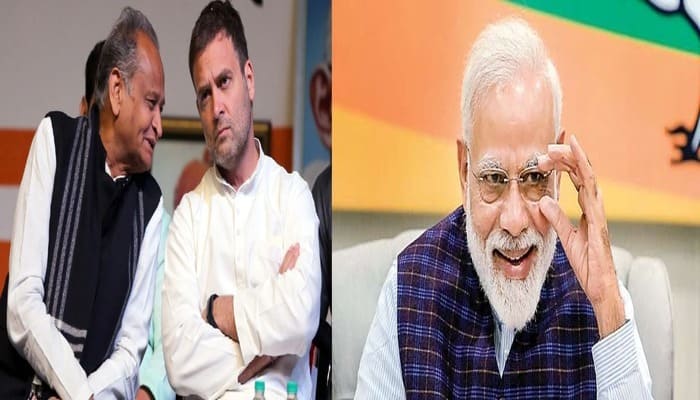
Rahul Gandhi will be the PM candidate of Congress in 2024 – Rajasthan CM Ashok Gehlot

On Saturday, August 26, Rajasthan Chief Minister Ashok Gehlot announced that Rahul Gandhi is the prime ministerial candidate for the upcoming Lok Sabha elections in 2024. CM Gehlot claimed that Rahul Gandhi was decided as the leader of the I.N.D.I.A. bloc by all the 26 opposition parties after holding discussions in this regard.

Speaking to India Today, Gehlot said that the opposition parties have decided to make Rahul Gandhi their prime ministerial candidate. He added that certain local factors play a crucial role, however, the public has created much pressure compelling all the parties opposed to the ruling BJP-led government to form an alliance.

Gehlot also stated that Prime Minister Narendra Modi should not be “arrogant.” “PM Modi should not be arrogant, given that the BJP won power with only 31% of the vote in 2014. The other 69% were against him,” he continued while talking about the 2014 elections.

Gehlot also claimed that the NDA was “scared” when the I.N.D.I.A. coalition parties met in Bengaluru in July this year.

When asked about claims that the NDA is planning to win 50% of the vote in the 2024 general election, he responded, “PM Modi will never be able to achieve that. When Modi was at his peak popularity, he couldn’t get 50% of the vote. His vote share would fall, and the outcome of the 2024 elections will determine who becomes Prime Minister”, Gehlot said.

The Gandhi family loyalist did not stop here, as he went on to assert that the BJP could win the 2014 elections only because of Congress.

Meanwhile, BJP national spokesperson Shehzad Poonawalla said that Congress has made a smart move by positioning Rahul Gandhi as the face of the I.N.D.I.A. bloc. He added that Rahul Gandhi’s name as the opposition’s prime ministerial candidate is pushed at the behest of the Gandhi family.

Taking to X (formerly known as Twitter), Poonawalla raised questions over where the other PM aspirants like Nitish Kumar, Sharad Pawar, and Mamata Banerjee stand since Congress has unilaterally declared Rahul Gandhi as the PM candidate. He also pointed out that the Aam Aadmi Party has already opposed the idea of projecting Rahul Gandhi as a ‘united’ opposition face against Prime Minister Narendra Modi.

“Even though there is no vacancy in 2024, the mere projection of Rahul over others pretty much settles the fact that Congress considers Rahul to be above Mamata, Sharad Pawar, Nitish & Arvind Kejriwal – all of whom have served or are serving as CMs !!” Poonawalla posted.

“Did you ever imagine a person staying at 10 Downing Street would say ‘Jai Shri Ram’? Lord Curzon would’ve choked,” says UK envoy to India

0

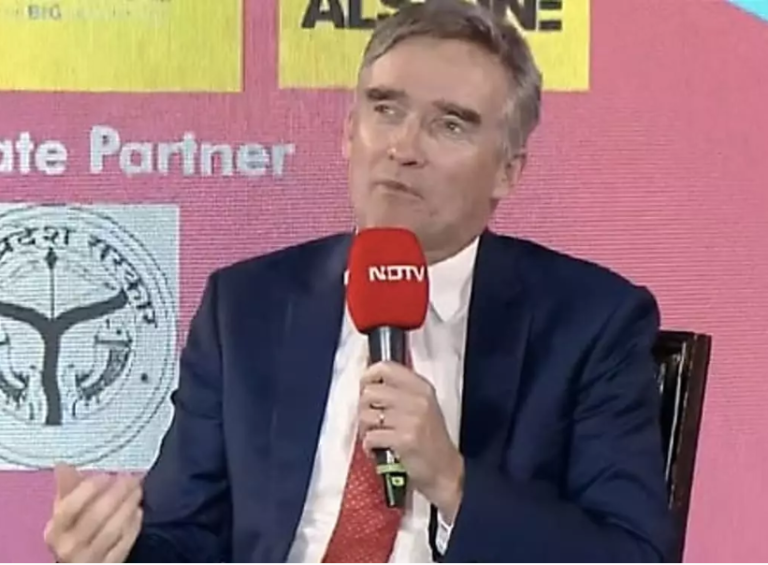
At the ongoing NDTV G20 Conclave in the Indian capital Delhi, Alex Ellis, UK envoy to India spoke at length about various topics. In addition to other things, the UK Ambassador to India said, “Did you ever imagine one day a person staying at 10 Downing Street, on August 15, would say Jai Shri Ram? Lord Curzon would have choked.”

The UK envoy was referring to the Viceroy of India Lord Curzon who oversaw the Bengal Partition in 1905 on religious and ethnic lines.

Ellis was speaking at the NDTV G20 Conclave. Highlighting India’s rising reputation on the global stage, Ellis said that India tops three visa categories in the UK including students, visitors, and skilled workers. He said that India’s rise in the global order can be measured by the benchmark it has set in conducting the G20 presidency and the Indian-origin UK Prime Minister Rishi Sunak saying ‘Jai Shri Ram’ on Indian Independence Day.

On 15th August, British Prime Minister Rishi Sunak attended the Ram Katha recital by spiritual Guru Morari Bapu at Jesus College, University of Cambridge. Sunak made a floral offering to Morari Bapu’s Vyas Peeth, chanting “Jai Siya Ram”. He also highlighted that when he was a Chancellor, he lit diyas outside during the auspicious occasion of Diwali.

Sunak said that it was an honour for him to be present at Morari Bapu’s Ram Katha on Indian Independence Day. “It is truly an honour and pleasure to be here today at Morari Bapu’s Ram Katha at the University of Cambridge on Indian Independence Day. Bapu, I am here today not as a Prime Minister but as a Hindu. For me, faith is very personal. It guides me in every aspect of my life. Being Prime Minister is a great honour, but it is not an easy job. There are difficult decisions to make, hard choices to confront and our faith gives me courage, strength, and resilience to do the best that I can for our country.”

The address by an Indian-origin UK PM on British soil became a talking point all over India and amongst Indians abroad. He further stated that he was proud of his national as well as religious identity and is proud to be Hindu. “Our values and what I see Bapu does each day of his life are the values of selfless service, devotion, and keeping the faith. But perhaps the greatest value is duty or seva, as we know it. These Hindu values are very much shared British values.”

All you need to know about Aditya-L1, India’s mission to the Sun

After a successful Chandrayaan-3 mission, India will study the Sun. Aditya L1 will be the first space-based Indian mission to study the Sun. The spacecraft will be placed in a halo orbit around the Sun at Lagrange point 1 or L1 of the Sun-Earch system. This point is located 1.5 million kilometres from Earth, allowing for continuous observation of solar activities. Notably, the position will help Aditya L1 study the Sun without hindrance from occultations or eclipses.

The satellite will be equipped with seven different instruments or payloads that will be used to study various aspects of the Sun, including the photosphere, chromosphere, and corona. These observations will help scientists better understand our nearest star’s behaviour and how it affects our planet.

Source: ISRO

Objectives of the solar mission

As per the Indian Space Research Organisation’s (ISRO) website, the main objectives of the mission include:

  1. Study the upper atmospheric dynamics (chromospheres and corona) of the Sun.
  2. Study the chromospheric and coronal heating, physics of the partially ionised plasma and initiation of coronal mass ejections and flares.
  3. Observe the in-situ particle and plasma environment, providing data for studying particle dynamics from the Sun.
  4. Study the physics of solar corona and its heating mechanism.
  5. Diagnostics of the coronal and coronal loops plasma are Temperature, velocity and density.
  6. Development, dynamics and origin of CMEs.
  7. Identifying the sequence of processes that occur at multiple layers (chromosphere, base and extended corona) eventually leads to solar eruptive events.
  8. Study of magnetic field topology and magnetic field measurements in the solar corona.
  9. Study of the drivers for space weather (origin, composition and dynamics) of solar wind.

Seven payloads of the ISRO program

The mission will have two types of payloads, Remote Sensing Payloads and In-situ Payloads. Remote Sensing Payloads will include four payloads. The first one will be the Visible Emission Line Coronagraph(VELC), capable of Corona/Imaging and Spectroscopy. The second payload will be the Solar Ultraviolet Imaging Telescope (SUIT), which can gather information on the Photosphere and Chromosphere Imaging (Narrow and Broadband). The third payload will be a high-energy L1 Orbiting X-ray Spectrometer(HEL1OS) capable of a Hard X-ray spectrometer that will observe Sun-as-a-star.

Source: ISRO

In-situ Payloads will include three payloads. The first will be the Aditya Solar Wind Particle Experiment(ASPEX), equipped with Solar wind/Particle Analyzer Protons and heavier Ions with directions. The second payload will be the Plasma Analyser Package For Aditya (PAPA), capable of analysing Solar wind/Particle Analyzer Electrons and heavier Ions with directions. The third and last payload will be Advanced Tri-axial High-Resolution Digital Magnetometers capable of analysing In-situ magnetic field (Bx, By and Bz).

What are Lagrange Points

There are five Lagrange points where a small object can stay with reduced fuel consumption for a two-body gravitational system. The two large bodies’ gravitational pull equals the centripetal force required for a small thing to move with them. The five Lagrange points are L1, L2, L3, L4, and L5. L1 lies between the Sun-Earth line and is approximately 1% of the Earth-Sun distance away from Earth.

Trajectory of L1

The Aditya-L1 mission will be launched from Sriharikota by ISRO’s PSLV XL rocket. The spacecraft will first be placed in a Low Earth Orbit and then moved towards the Lagrange point (L1) using onboard propulsion. The total travel time from launch to L1 would take about four months.

Why is it important to study the Sun from space?

To conduct precise measurements in the vast expanse of interplanetary space, it is essential to gather observations from a location beyond the reach of Earth’s magnetic field and atmosphere. This is because the Sun emits various forms of radiation and magnetic fields that are not detectable from the surface of our planet but can be extensively studied in the vast, open expanse of space. By conducting research in this way, scientists can gain a deeper understanding of the complex dynamics that govern our solar system and ultimately advance our knowledge of the Universe.

Is Aditya L1 a complete mission to study the Sun?

The simple answer is no. However, it is a first step. No space mission can be termed a “complete mission” owing to the size of the Solar System, even if not considering the Universe as a whole.

The scientific payloads carried by spacecraft in space are limited by mass, power, and volume, so only a few instruments can be sent on a spacecraft. For example, Aditya-L1 will measure everything from the Lagrange point L1. However, studying phenomena like the directional energy distribution of explosive/eruptive phenomena requires more instruments and viewpoints. L5 is a good vantage point for studying Earth-directed CME events and assessing space weather.

Further, the Sun’s polar regions are not well studied due to the technological challenges of achieving spacecraft orbits for such studies. The Sun’s polar dynamics and magnetic fields play an important role in deriving solar cycles, and studying polarisation measurements of solar radiations at different wavelengths is required to understand the various processes occurring in and around the Sun.

United States: White supremacist goes on a shooting spree in Florida, kills 3 African Americans, was earlier evaluated for mental health crisis

On Saturday (August 26, US local time) at noon, a gunman went on a shooting spree and killed three African-Americans in Jacksonville city in Florida State of the United States.

As per reports, the incident took place inside a Dollar General Store. The attacker was identified as a 21-year-old white supremacist, Ryan Palmeter. While speaking about the matter, Jacksonville Sheriff K. Waters said, “This shooting was racially motivated and he hated Black people.”

Palmeter shot himself with his assault rifle after killing three victims (two men and a woman). He had left behind a manifesto, detailing his hatred for the Black community.

The gunman reportedly lived with his parents in the Clay County of Florida. He asked his father to check his computer, following which the man found ‘manifestos’ and called the police. By the time the authorities were alerted, Ryan Palmeter had already begun killing people at the Dollar General store.

He was earlier spotted on the campus of a historically black school named Edward Waters University. The attacker was refused entry after he failed to identify himself.

Jacksonville Sheriff K Waters informed, “He took that opportunity to put his bulletproof vest on outside and to put his mask on outside and then proceed to the store where he committed this horrible act.”

According to the investigators, Ryan Palmeter was a lone-wolf attacker, who was in possession of a tactical vest, mask, handgun and an AR-15-style rifle. FBI’s special agent Sherri Onks assured that the incident would be pursued as a hate crime incident.

It has now come to light that the Jacksonville attacker was previously evaluated for a mental health crisis in 2017. He was involuntarily detained under the Baker Act of Florida, which allows law enforcement authorities to subject an individual to mental health examination for up to 72 hours.

An individual detained under the Baker Act is ineligible to purchase firearms. It remains unknown as to how Ryan Palmeter was able to procure a handgun and an assault rifle. He coincided the attack with another mass shooting at a Jacksonville gaming event, which took place exactly 5 years ago and killed 2 people.

While condemning the incident, Florida Governor De Santis said, “This shooting based on the manifesto that they discovered from the scumbag that did this was racially motivated…He was targeting people based on their race. That is totally unacceptable.”

“This guy killed himself rather than face the music and accept responsibility for his actions, and so he took the coward’s way out. But we condemn what happened in the strongest possible terms,” he further added.

According to the data posted by the Gun Violence Archive, there have been 471 mass shootings since January 2023 in the United States.

Kathua: Teacher Farooq Ahmed arrested for thrashing student over ‘Jai Shri Ram’ slogan, Principal Mohd Hafiz still absconding

On Saturday, August 26, police arrested Farooq Ahmed, the teacher from Kathua who thrashed a Hindu student for writing Jai Shri Ram in the Government Higher Secondary School (Bani). The principal of the school, Mohammed Hafiz, is reportedly absconding till now. As per reports, Ahmed thrashed a Class 10 student for writing ‘Jai Shri Ram’ on the classroom blackboard, leading to widespread protests against him.

The principal is also an accused in the matter. The victim, a teenage student, is currently in the hospital for treatment. According to the reports, the victim’s father, Kuldeep Singh, submitted a complaint against Ahmed and Hafiz at the police station on August 25, alleging they beat up his son. Based on his complaint, an FIR was registered against the duo at Police Station Bani under relevant Sections of the Juvenile Justice Act. A local SHO headed a team that visited the school premises and arrested the teacher.

A senior police official said, “The principal is absconding, and a search is going on to arrest him while further investigation is underway.” Deputy Commissioner of Kathua Rakesh Minhas formed a three-member committee to investigate the matter. Sub Divisional Magistrate (Bani), Deputy Chief Education Officer (Kathua) and Principal of Government High Secondary School (Kharote) are members of the committee.

In his order, while forming the committee, Minhas said, “The committee members are directed to inquire into the matter and submit the fact-finding report along with specific comments and recommendations to this office within two days positively in order to proceed further in the matter. Moreover, the committee is also directed to fix the responsibility against the culprit regarding the incident.”

The incident triggered protests in Kathua

A video of the victim narrating the incident had gone viral on social media. In the video, the minor student (class X) is seen narrating the incident. Explaining why he is in the hospital, he stated that his teacher, Farooq, and the school principal brutally thrashed him for writing Jai Shri Ram on the blackboard. Speaking with OpIndia, Kathua Police stated that the incident took place on the 25th of August. The police confirmed that the minor schoolboy was beaten for writing ‘Jai Shri Ram’ on the blackboard. Following the incident, Hindu organisations launched a protest against the teacher and the principal, demanding strict action by the police and the administration.

They added that they had filed an FIR in the case against two accused under Sections 323 (deals with punishment for voluntarily causing hurt), 342 (wrongful confinement), 504(intentional insult with intent to provoke breach of peace), and 506 (criminal intimidation) of the Indian Penal Code (IPC). Additionally, they have charged the accused under Section 75 (which provides for punishment if any person having control of the child assaults, abandons, abuses or willfully neglects the child) of the Juvenile Justice Act. The accused have been identified as school Principal Mohammed Hafiz and lecturer Farooq Ahmed.