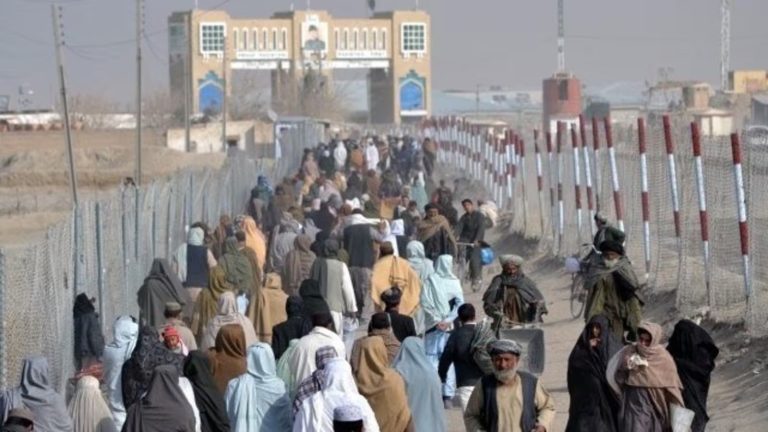
More than 1.055 million Afghan citizens have returned from Pakistan to Afghanistan between October 2023 and May 2025, marking an unprecedented trend in recent years, according to the United Nations High Commissioner for Refugees (UNHCR), Tolo News reported.
UNHCR Assistant Communications Officer Faramarz Barzin said, “From October 1, 2023, to May 31, 2025, more than 1.055 million people have returned from Pakistan to Afghanistan. UNHCR is present both at the border and in the settlement areas and where we have cash centers, providing a wide range of services to them.”
In 2025 alone, since the beginning of April, an average of around 3,500 people have been crossing daily from Pakistan into Afghanistan, Tolo News stated.
Many of these families, forced to leave Pakistan after decades, are now grappling with serious challenges including lack of shelter, employment opportunities, and limited access to health and education services.
Deported migrants have also raised concerns about their treatment in Pakistan. Torkhal, one such returnee, said: “We are suffering at Torkham. I swear, we are facing hardship. The Pakistani police expelled us with great disrespect.”
Another returnee, Arefullah, said, “House owners in Pakistan treated us very badly, and the Pakistani government should not disgrace the people.”
The World Food Programme (WFP) has reported assisting more than 600,000 migrants returning from Iran and Pakistan since October 2023.
Zia Safi, WFP Communications Officer, said: “At the borders, families are provided with special nutritious foods to prevent malnutrition among pregnant and breastfeeding mothers.”
Meanwhile, the Pakistani government has announced its plans to deport around three million Afghan migrants this year, Tolo News reported.
(This news report is published from a syndicated feed. Except for the headline, the content has not been written or edited by OpIndia staff)
In India, the anti-Hindu gang often conspires to sow division within the Hindu community, and for this, their first weapon is to incite Dalits. The anti-Hindu cabal employs myriad tactics to make Dalits feel that they are not a part of Hindu community.
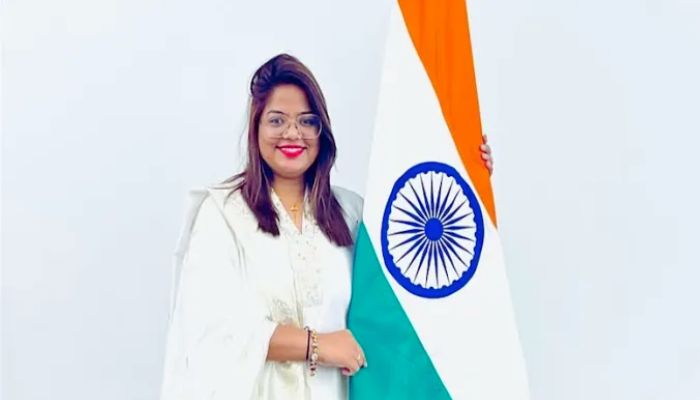
In such a case, if a Dalit Hindu girl starts her speech in the United Nations with ‘Jai Shri Ram’, then it is natural for self-declared ‘Thekedars’ of Dalits to fear that their foundations will be shaken. This, however, is not a hypothetical scenario but a real incident involving a Dalit Hindu girl, Rohini Ghavari Valmiki.
Rohini’s father was a sanitation worker in Indore, however, she received a scholarship of Rs 1 crore for PhD in Switzerland. Dr Rohini Ghavari Valmiki, who runs ‘Janpower Foundation’, is also a social worker. Rohini, however, is in news these days not for her academic achievements but for some other reason.
Rohini is quite vocal against a Member of Parliament. The said MP is known for the blue gamchha (scarf), runs his own political party in the name of India’s most famous Dalit icon and enjoys Y+ security. If you go through Dr Rohini Ghavari Valmiki’s social media handle, you will know very well about that newly elected MP.
Rohini has also released several videos of the MP, in some of which he is seen lying on the ground and apologizing, while in some he is seen crying. Many chats have also gone viral, in which he is not tired of praising Rohini.
Rohini Ghavari Valmiki set to file FIR against blue gamchhadhari MP
In an exclusive conversation with OpIndia, Rohini said that due to legal advice, she is not able to connect with media organizations through video, but after the FIR is filed, she will soon speak out and make some new revelations. She is also going to knock the doors of the court. Dr. Rohini Ghavari has been vocal against the said MP even before this and has accused him of ruining the lives of many girls.
Rohini had told how the MP (he was not an MP then, he was an activist) played with the dignity of many girls by hiding the fact of his marriage . While talking to OpIndia, Dr. Rohini Ghavari also divulged how all sorts of tactics were used to defame her and to prove her a liar in front of the Valmiki society and by putting pressure on her, those posts were deleted from X. She told that she is still being threatened, the MP is telling his people that nothing will happen to him, the girl will ruin her own career.
However, Rohini remains adamant and said that even if she has to go to jail, she is not sad, she wants to become an example for all the women of this country that you have to fight against the atrocities happening to you without getting scared. Rohini says that initially she thought that this matter should not be given much importance because she had the idea of Dalit unity in mind, she was afraid that this will break the Dalit unity. Let us tell you that while the accused MP belongs to the Jatav community, Rohini belongs to the Valmiki community.
Dr Rohini Ghavari aggressively backs her allegations against the blue gamchhadhari MP
Rohini has been quite aggressive for the past one week. She has used all these words for the MP – deceptive, traitor, tainted, mean, impotent, useless. You can understand from this how aggressively she is fighting her battle. While talking to OpIndia, Dr Rohini that she is angry, and the Valmiki community stands with her. She said that the public judges everyone, earlier she thought that the society itself will do justice, that is why she did not adopt any legal process – but, not anymore. During this time, she also seems angry with the because she feels that in this struggle till now she has been defamed, slandered and many unpleasant things have been said about her.
What is Dr. Rohini Ghavari’s ideology? When OpIndia questioned Dr Rohini about her ideology, she called herself an Ambedkarite, but at the same time says that she does not divide the people of India into different castes. When she looks from abroad, she feels every Indian is her own. She is irritated by words like ‘Manuvadi’ and looks at Brahmins with respect. She has once told that it was a Brahmin teacher of hers who informed her about the scholarship in Switzerland, when she was new there, it was a Brahmin friend who made her comfortable, it was also a Brahmin who showed her the way to the UN. She says that dedication and unity are important for her, when she can live and eat comfortably with foreign friends abroad – then why not with countrymen?
Which ‘big parties’ support the MP?
Dr. Rohini Ghavari feels that the said MP has the support of some big political parties as well. However, she is confident that once his real character is revealed, these political parties will be ashamed of associating themselves with such a tainted person and they will distance themselves from him. Many people from India have called her and asked her to file an FIR so that they can raise their voice for justice. Protests will start as soon after an FIR is filed against the blue gamchhadhari MP. Many activists from the Brahmin community have also assured her of support. Rohini, who has once represented India thrice in the UN’s ‘World Parliament’, had given many arguments defending the construction of the Ram temple.
चंद्रशेखर की राजनीति से ख़ुद चंद्रशेखर के अलावा आज तक किसी को कोई फ़ायदा नहीं हुआ बल्कि हज़ारो युवाओं का भविष्य बर्बाद हुआ है जो रोते रहते है यह फ़ोन तक नहीं उठाता !! इसकी राजनीति से समाज का बहुत नुक़सान हुआ है यह ख़ुद जानता है !! एक अच्छा लीडर लोगो का हित पहले देखता है ख़ुद का… pic.twitter.com/XBOm1lA7Hg
— Dr. Rohini Ghavari ( रोहिणी ) (@DrRohinighavari) June 8, 2025
While what happens after Dr Rohini Ghavari Valmiki files a police complaint against the said MP and approaches the court remains to be seen, it is clear that the newly-elected MP is not having a good time. Dr Rohini is also sharing the stories of some other girls on social media so that she can confirm her allegations. She is not in a mood to back down now. Rohini expressed her anger about Indian laws as well because she believes that in Switzerland, even if someone stares at her in a wrong way, action will be taken against him. But Rohini does not want to discuss this by saying that she does not want to say anything negative about her country.
Have you had the good fortune to visit the Shri Banke Bihari Mandir situated in Uttar Pradesh’s Vrindavan? If you have, then you likely navigated through the narrow streets. You must have experienced the crowded pathways and the jostling crowds. You must have observed the surrounding chaos. Furthermore, you may even have sensed the necessity for the development of this area to make things easier for the devotees.
The last few years have showcased examples like Kashi, Ujjain and Ayodhya to the Hindu community, illustrating how the image of sacred locations can be positively altered by constructing a corridor around the holy temples. The problems of mismanagement and accompanying misery for the devotees could soon be behind us. The Supreme Court’s verdict has also cleared the path for the creation of the corridor at the Shri Banke Bihari temple.
However, parties such as Samajwadi Party and Congress are engaging in petty politics regarding this decision while the local Goswami community is also expressing their opposition. The motives of SP and Congress are clear that they want to get some political benefit out of it. NMeanwhile, OpIndia visited the location to understand the reasons behind the objection from those connected to the temple.
We interacted with all involved parties to provide readers with an accurate picture of the matter, including both, the opposition and the support. This will also help end the propaganda being pushed by the media in the name of opposition from the Goswami community.
Why is Banke Bihari Temple Corridor necessary
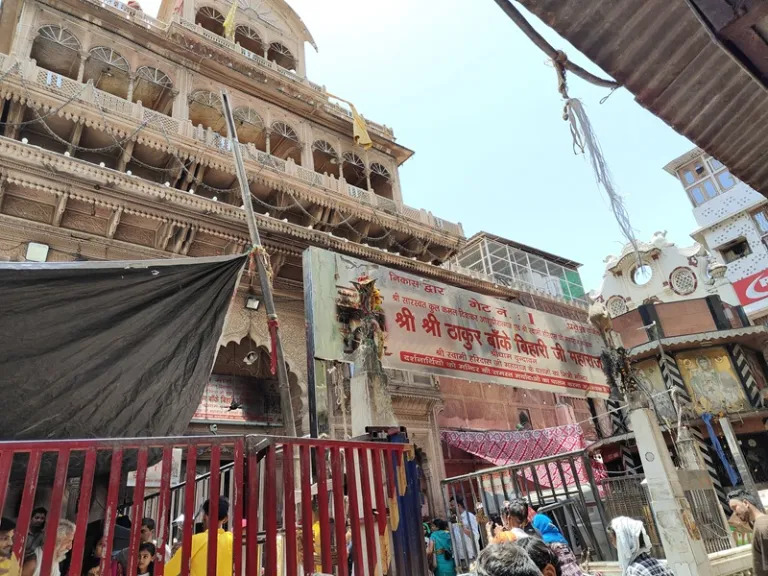
We arrived in Vrindavan, located approximately 150 kilometre from Delhi, on 5th June. As soon as we arrived, a Home Guard personnel stopped our vehicle and asked us to leave our vehicle in the parking area. However, once he learned we were from the media, he allowed us to continue. We arrived at the Gautam Pada crossing, navigating through the congested e-rickshaw traffic. The Banke Bihari temple is about 500 meters from this location, but it was not possible to drive the car any further. We then parked in the designated area and proceeded on foot.
We walked approximately 500 metres and arrived at the main street of the temple which is close to the Banke Bihari police post at around 11 am. There were shoes and slippers in front of the majority of shops that sold pedas. Many areas had clogged drains and litter was strewn everywhere. The situation was similar at the temple’s gate number 1 and 2. The stairs were full with the scattered footwear of the devotees.
There is no management: Devotees
AP Pandey from Ayodhya was returning after praying to the deity. He retrieved shoes from the lower section of a store and remarked to OpIndia, “What to do? There is no arrangement. A corridor should be developed here.” A fellow devotee named Ashok Kumar Gupta commented, “There are many problems while having darshan in the temple. Darshan is carried out properly in Ayodhya. Our children were crushed amidst the crowd here.”
A female devotee accompanying him voiced, “Some individuals are charged 501 rupees while others are asked for 1001 rupees, in the name of VIP darshan. The crowd was overwhelming, causing distress to the children. They came outside without having darshan. What could be more heartbreaking than coming such a long way and not being able to perform darshan? The behavior of the guards inside is quite unacceptable. A corridor should be built here too.”
A corridor should be built for Banke Bihari temple: Devotees
A young devotee who returned after the darshan stated, “If a corridor is constructed here similar to those in Kashi, Ujjain and Ayodhya, it would greatly benefit the devotees. Currently, there is no drinking water or resting area available for them here.” Another devotee conveyed, “We would come every day in the past, but we now visit only once a month. We frequently turn back after observing the massive crowd. The construction of the corridor is necessary.”
A devotee from Haridwar who was seated at a shop near the entrance of the temple’s gate number 1 while enjoying rabri, complained, “Just as there are provisions for devotees in Gurdwaras, such amenities are lacking in our religious places. The situation in Vrindavan is similar. Temple committees are driven by greed for money. If a corridor were constructed here, the influx of devotees would increase tenfold along with the employment.”
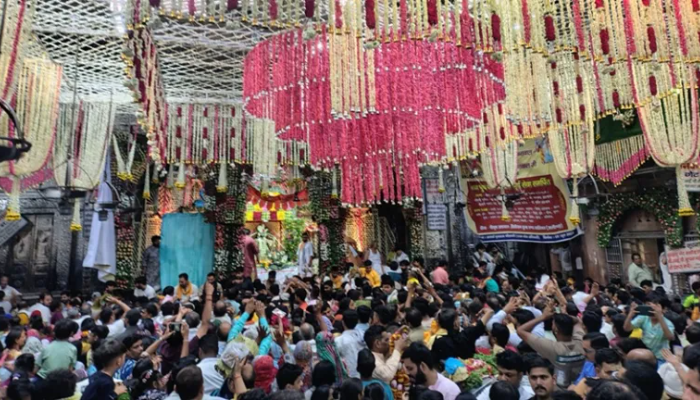
Devotees gathered for darshan at Banke Bihari temple. (Source: OpIndia Hindi)
The temple doors were scheduled to open at 5:30 pm. However, devotees began arriving as early as 3 o’clock and hence a line of devotees nearly 250 meters long had formed by the time it was 5:30 pm. Meanwhile, the devotees were seated on the ground at Gate No. 1 under the intense sun, fanning themselves as they awaited the opening of the temple doors. Upon noticing the camera, they started chanting “Radhe-Radhe” in unison and declared their support for the development of the corridor during conversation.
Temple committee did not make any arrangements: Business community
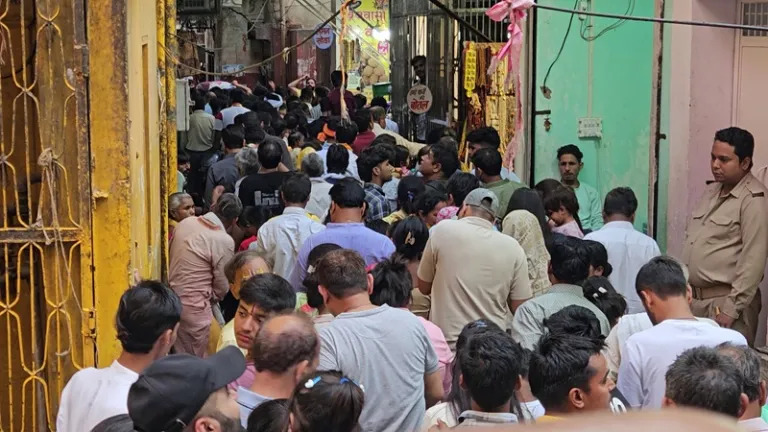
Rajkumar Khandelwal’s shop is on the main lane of the temple since 1948. “The corridor needs to be constructed. However, the owners of the shop and houses should be compensated,” he asserted. “The situation here is extremely poor. The drains are blocked. There is filth everywhere. Shoes and slippers are scattered about. Facilities such as a locker room or toilets for the devotees are nonexistent. Even drinking water is unavailable,” he highlighted while pointing down the lane.
He added, “Whether you attribute this to the administration’s failure or the temple committee’s negligence, there is no space for the devotees to sit. The accident that took place in 2022 was due to the temple committee’s shortcomings.”
Image via OpIndia Hindi
Businessman Govind is also in favor of the corridor’s construction. He emphasised, “It is essential at this time. We even approached the high court for this issue. However, it is important to ensure that the construction does not undermine the significance of the Kunj lanes in Vrindavan and their historical importance.” He further mentioned that the government should prioritize crowd management before the corridor’s construction.
“We are not against the development of the corridor. Nevertheless, the character of Vrindavan should not be altered,” insisted a businessman, Naveen Gautam. He referred to the Goswami community and stated that the government should act decisively against any threat. “No one can take away our Thakur ji,” he pointed out.
Not all businessmen are in favor of the corridor. Some are opposed to it and we discovered that many were reluctant to speak candidly about this issue in front of the camera.
Why is Goswami Samaj opposing the Banke Bihari Corridor
Shrinath Goswami, a sevadar inside the premises of the temple informed OpIndia, “There is no need for a corridor in this area. We had proposed two alternative options to the government. However, the government disregarded those suggestions. When Akhilesh Yadav suggested a similar corridor in 2016, Yogi Adityanath opposed it. It is unclear why he is now endorsing this corridor himself.”
Goswami community is opposing the corridor. (Source: OpIndia Hindi)
OpIndia also talked to Gopesh Goswami who serves as the spokesperson for the temple committee and holds the position of Shayanbhog Sevadhikari at the temple. He initially referred to the statements regarding the “increasing crowd in Vrindavan” as hard to believe when we inquired about his opposition to the corridor. He claimed that the escalating number of devotees in Vrindavan does not warrant any changes to the temple or its surrounding area. He attributed the entire controversy to “Tirtha Vikas Parishad” Chief Minister Yogi Adityanath government’s initiative.
“The panel was founded with the aim of guiding devotees to various temples in Vrindavan. However, it did not succeed in its mission. The vice-president Shailjakant Mishra has regularly sought government involvement in the temple’s operations. The corridor is a product of collaboration between certain officials and land mafias,” he charged.
Rajyoga Sevadhikari Gyanendra Kishore Goswami stated, “We are now confronted with two possibilities. We can either run away or be forced into suicide. This corridor is intended only for the VIPs. As long as we were in charge of the temple, there was no chaos.”
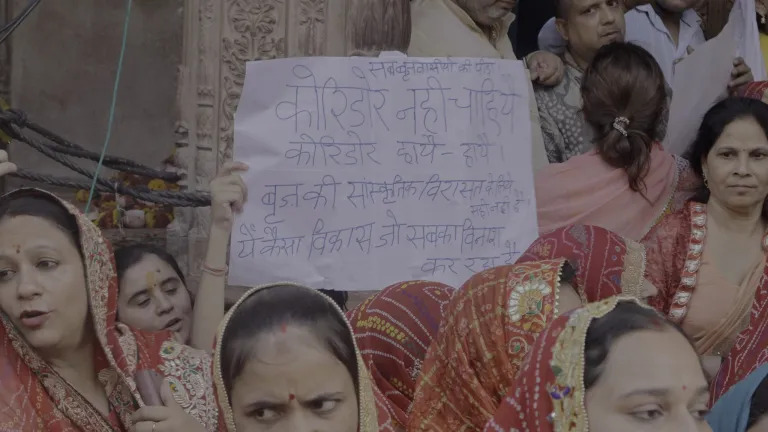
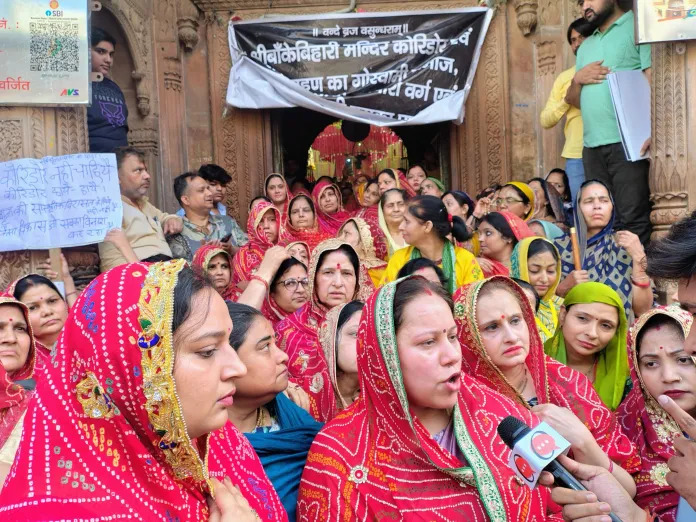
Women of Goswami community gathered to protest against Banke Bihari Corridor. (Source: OpIndia Hindi)
During our conversation with the members of the Goswami community, their women also assembled to demonstrate outside the Banke Bihari temple. They expressed that Yogi Adityanath has been ignoring their concerns despite his position as Mahant of Gorakhnath Temple. They cited the example of adulterated laddus at the renowned Sri Venkateswara temple in Tirupati and warned that similar problems could occur here as well.
Supreme Court has authorized the Uttar Pradesh government to acquire land for the development of the corridor. The land will be registered under the name of Banke Bihari. The government will have the ability to utilize temple funds for this purpose. It is anticipated that following the completion of the corridor, over 10,000 devotees will be able to visit the place at the same time. The state government has also formed a trust for the Banke Bihari temple.
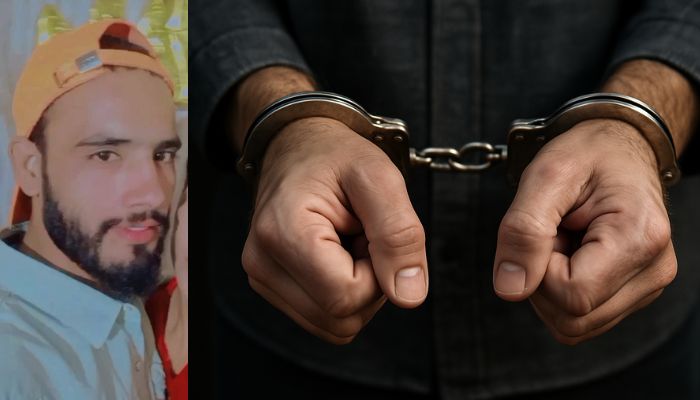
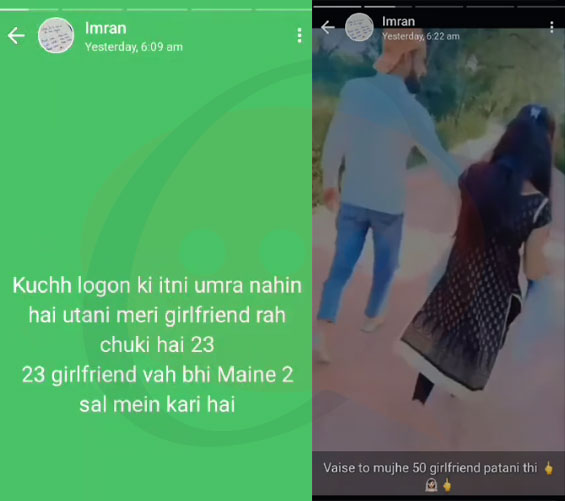
On 8th June, Mathura Police arrested an auto driver named Imran for trapping Hindu college girls under a false Hindu identity, filming obscene videos of them, and later blackmailing them. According to police sources and local Hindu organisations, his phone contained dozens of such explicit videos and chats. The accused reportedly had a target of trapping at least 50 girls, specifically Hindu minors and college-goers.
Hindu organisations stage protest after inflammatory posts surface online
Tensions in the matter escalated after provocative social media posts featuring obscene images of Hindu girls started circulating online. The accused behind the posts was soon identified as Imran, a resident of Machhli Mohalla in Kotwali Police Station limits.
Reportedly, he posed as a Hindu boy and gained the trust of school and college girls while offering them free rides in his auto and gradually trapped them in fake romantic relationships. Under pressure and deceit, he recorded their intimate moments and later used the content for blackmail.
As the information about the matter reached Hindu organisations, members of Bajrang Dal, Dharma Jagran Samnvay, and Banke Bihari Gau Seva Sansthan held a protest late Saturday night outside Bharatpur Gate Police outpost. They demanded immediate action and submitted a formal complaint against the accused.
Targeted 50 girls, blackmailed 23 so far: Hindu groups allege love jihad
Police officials have confirmed that the accused had saved several obscene videos and chats with multiple girls on his phone. Many of his victims are suspected to be minors. Hindu groups said that Imran had set a personal target of trapping 50 girls and had already manipulated at least 23.
The Hindu Raksha Dal has termed the incident a clear case of love jihad and demanded that the matter must be investigated with due seriousness.
OpIndia accessed recordings of his social media stories where he openly claimed trapping 23 victims and said his target was 50.
Source: VHP
In a recent video, he was heard threatening Hindus warning them not to go out on Bakrid. He said, “As Muslims were asked not to go out on Holi by someone, you [Hindus] should not go out on Eid. This is “bhaichara”. Who ever has a problem with blood and qurbani, should not go out. There will be blood [on the streets].” With that story, he also shared a video of woman dicing meat and blood flowing on streets.
Source: VHP
Details of FIR
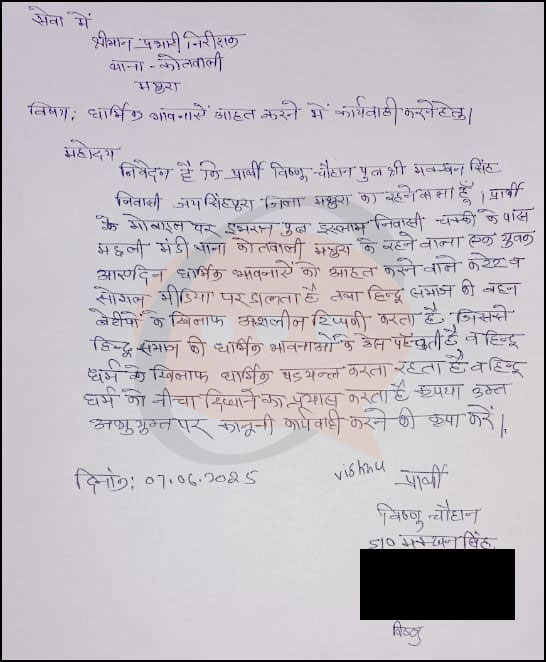
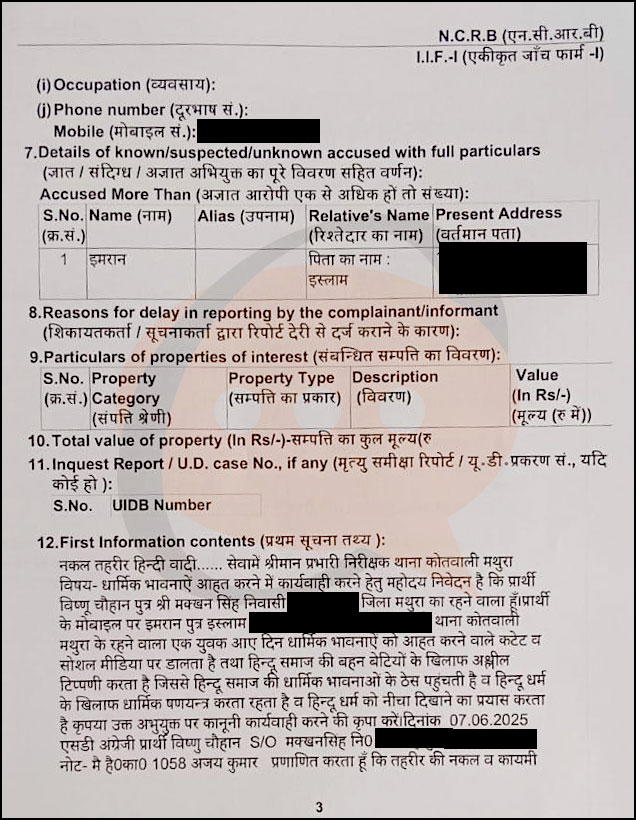
OpIndia accessed a copy of the complaint and FIR in the matter. The complaint was filed by Vishnu Chauhan, Gau Raksha Pramukh. He is affiliated with Vishwa Hindu Parishad, Mathura. In his complaint, Vishnu said that Imran consistently posts provocative social media posts against the Hindu community. He also accused Imran of posting obscene comments on Hindu girls, demanding strict action against him.
Source: VHP
Based on his complaint, an FIR was registered at Kotwali Police Station under Sections 296 and 299 of Bharatiya Nyaya Sanhita (BNS).
Source: VHP
Speaking to the media, Circle Officer Bhushan Verma confirmed that Imran was arrested near Bharatpur Gate on Sunday at around 4 PM. According to reports, the police have seized his mobile phone and other digital devices. Investigation is ongoing to identify all the victims and uncover the extent of his network.
In a video statement, CO Verma confirmed that Imran has been arrested and is being questioned by the police.
Speaking to OpIndia, Vishnu Chauhan accused the police of showing leniency in investigating the case and tempering with the evidence. He said, “We saw videos and photos of multiple victims on Imran’s phone. However, when we went again demanding strict action against him, the police said the data was wiped. Now police is saying that his phone will be sent to forensics to recover the data.” Vishnu demanded a serious investigation into the matter, fearing many of his victims were minors.
Muslim gang targeting Hindu girls busted in MP
In Bhopal, a Muslim gang led by Farhan targeted and raped Hindu girls, considering it a virtuous act and Jihad, as revealed during police interrogation. The gang, hiding their identities with Hindu names, used expensive cars to lure girls, made obscene videos to blackmail them, and planned to sell these on porn sites. Eleven members, including Farhan, Ali, Saad, Sahil, and Nabeel, were arrested in May, with Abrar still at large. The police are investigating, contacting potential victims, and an SIT has been formed. Chief Minister Mohan Yadav has promised strict legal action.
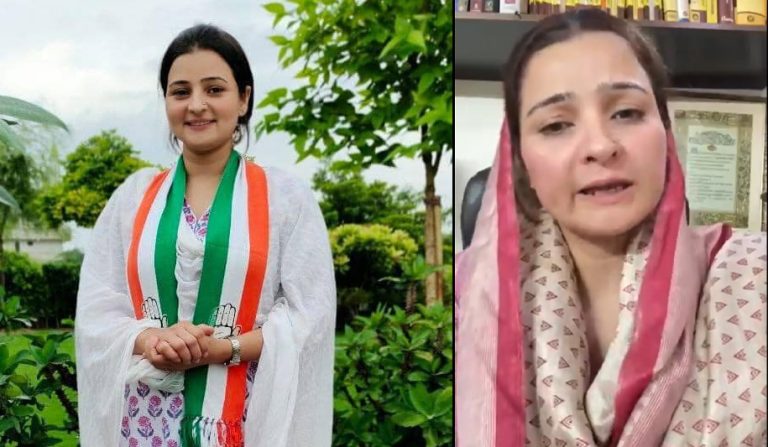
The hashtag #ArrestAarfaKhanam has been trending on top on X for over 24 hours, amassing approximately 500,000 posts, as netizens demand action against Okhla-based Supreme Court advocate and Congress leader Aarfa Khanam for a now-deleted Eid-Al-Adha post that hurt religious sentiments of Hindus.
The controversy began when Khanam shared a post on X related to Eid-Al-Adha, which was clearly offensive to Hindu sentiments. She posted an illustration of a Muslim kid in skullcap with a cow, with the message Eid-Ul-Adha Mubarak on it. It clearly meant that the cow was being taken for slaughter as part of the Bakrid or Eid-Ul-Adha, the Islamic festival where animals are sacrificed in the name of the messenger of Allah.
— Vikram Pratap Singh (@VIKRAMPRATAPSIN) June 7, 2025
Screenshots of the deleted post spread rapidly, fuelling outrage and prompting the hashtag to surge to the top of India’s trending topics by Saturday afternoon.
— Gaurav Bhatia गौरव भाटिया ?? (@gauravbhatiabjp) June 7, 2025
X users urged the police to register an FIR against Aarfa Khanam for hurting Hindu sentiments.
In response to the outrage, Khanam issued a public apology on Saturday, claiming that she had no intention of hurting the sentiments of any religion including Hindus. She said that she removed the post immediately after she realised her ‘mistake’.
ईद-उल-अज़हा के अवसर पर मेरे साथ x अकाउंट से एक पोस्ट साझा हुई थी, जिसमें किसी भी धर्म या समुदाय की भावनाओं को ठेस पहुँचाने का कोई उद्देश्य नहीं था। लेकिन अगर उस पोस्ट से किसी को ठेस पहुँची हो — विशेष रूप से हिन्दू समुदाय के किसी भी सदस्य की भावना आहत हुई हो — तो मैं उसके लिए दिल… pic.twitter.com/PZq4BNB4Y9
She posted, “On the occasion of Eid-ul-Azha, a post was shared with me from x account, which had no intention of hurting the sentiments of any religion or community. But if that post has hurt anyone – especially the sentiments of any member of the Hindu community – then I sincerely apologize for that. I have full respect for all religions and beliefs. As soon as I realised my mistake, I removed it immediately. My intention was only to share festival wishes and not to hurt anyone’s religious sentiments. Let us all join together to promote harmony, peace and mutual respect.”
She accompanied the apology with a video message, reiterating her lack of intent to offend.
But, despite the ‘apology’ and saying the post was a mistake, she reposted several posts claiming that the image was not offensive.
An FIR has been filed against HDFC Bank’s MD and CEO by a certain Mehta family that defaulted on a bank loan provided back in 1995. The private lender informed stock exchanges on Sunday evening, as it vowed to continue all lawful remedies to recover the dues from the defaulter.
In 2001, Splendour Gems Limited, owned by the Mehta family, defaulted on loan facilities granted in 1995 by HDFC Bank along with the other consortium banks, the HDFC Bank informed stock exchanges.
Despite a recovery certificate issued by the Debt Recovery Tribunal in 2004 and subsequent enforcement actions, the dues remain substantially unpaid, the bank said.
The outstanding dues towards HDFC Bank, including interest, amount to approximately Rs 65.22 crore as on May 31, 2025.
“In response to ongoing recovery proceedings, members of the Mehta family have initiated multiple legal actions and complaints against HDFC Bank and its senior officials. These include criminal complaints, minority rights petitions, and representations to regulatory authorities–all of which have been dismissed or are under legal challenge. HDFC Bank firmly believes that these allegations are retaliatory in nature and have mala fide intention solely at evading repayment of long-standing dues,” the bank said in its statement.
Mehta Family, once again, through Lilavati Kirtilal Medical Trust, has filed a complaint against HDFC Bank’s MD and CEO.
HDFC Bank unequivocally “rejects and strongly condemns the malicious and baseless allegations levelled and maintains that these allegations are completely false, outrageous and constitute a gross misuse of the legal process.”
HDFC Bank firmly believes that “these actions (by Mehta family) are a deliberate attempt to obstruct and undermine legitimate recovery proceedings related to substantial long-outstanding dues owed by Splendour Gems Limited.”
“Having exhausted all legal avenues without success, these individuals have now resorted to launching personal attacks against HDFC Bank and its MD and CEO in a clear attempt to malign their reputation and intimidate HDFC Bank into halting its recovery actions. These actions appear to be a calculated distraction from their own failures and liabilities,” the bank added.
In the statement, HDFC Bank reiterates its commitment to the highest standards of corporate governance.
HDFC Bank said it has robust internal controls and compliance mechanisms to ensure adherence to legal and regulatory requirements.
“HDFC Bank’s governance framework is designed to uphold transparency, accountability, and ethical conduct in all its operations. HDFC Bank believes in fostering a culture of ethics and integrity ensuring that the highest standards of corporate governance are maintained. HDFC Bank’s commitment to ethical conduct is reflected in its policies, procedures and actions,” HDFC Bank said.
“HDFC Bank will continue to pursue all lawful remedies to recover public funds and address the retaliatory actions taken by the Mehta family as well as to defend the reputation and integrity of the Bank, its Directors and other employees. HDFC Bank remains dedicated to upholding its reputation for corporate governance and ethical conduct,” HDFC Bank concluded its statement.
(This news report is published from a syndicated feed. Except for the headline, the content has not been written or edited by OpIndia staff)
The World Malayalee Council (WMC), an organization representing the global Malayali diaspora, has sparked controversy by announcing its 2025 Global Conference in Baku, Azerbaijan, on June 28-29. The decision has drawn sharp criticism due to Azerbaijan’s support for Pakistan during India’s Operation Sindoor, the counter-terrorism military operation in May 2025.
World Malayalee Council is holding its 14th Biennial Conference in Baku, and the promotion for the event on its website looks like a tourism promo for the country. The ‘Exciting WMC global conference package’ includes Luxurious Hotel Stay, Guided City Tour, Daily Breakfast, Lunch and Dinner, Airport Transfer, E Visa, Gala Dinner with Fellowship, Sight Seeing at Iconic Landmarks Like Fountain Square, Fire Temple, Blazing Mountains, Boulevard Walking Tour, Old Baku Walking Tour Etc., DJ Party, Arabic & Western Dances. Basically, it sounds like the promo for a tour package to Azerbaijan, not a conference.
Azerbaijan, alongside Turkey, had publicly backed Pakistan following the Pahalgam terror attack on April 22, 2025, which claimed 26 lives, and condemned India’s retaliatory strikes under Operation Sindoor. Azerbaijan issued statements of solidarity with Islamabad and reportedly supplied arms to Pakistan, prompting many Indians to boycott tourism to both nations. Pakistan also used a larger number Turkish weapons against India, including drones.
Despite this, the WMC is actively promoting the conference, urging Malayalis worldwide to “visit and experience Azerbaijan”. This prompted outrage against the organisation, with critics saying that WMC is promoting tourism to Azerbaijan when Indians are calling for boycott of the country for supporting Pakistan.
Social media platforms, particularly X, have been abuzz with outrage. A post by user @junjunjitweets
called the WMC’s decision “shameful,” accusing the group of aligning with an “anti-India state” and urging a boycott of the event.
Shame on World Malayalee Council for hosting the 2025 meet in Azerbaijan — a Pakistan ally & anti-India state. NRIs and foreign Malayalees should be ashamed of themselves for betraying their motherland. This isn't global unity — it's betrayal. #BoycottBaku2025#AntiIndiaEventhttps://t.co/2C2y6RpuOX
Another user The Rightwave wrote that Azerbaijan’s foreign policy has always been written in favour of Pakistan, whether it is on the Kashmir issue or on the terrorism issue. They suspected that Pakistan is targeting Malayalis for their diplomatic success.
It has been argued that the organization’s decision to host the conference in Azerbaijan could sway public opinion and undermine the ongoing boycott of nations perceived as hostile to India.
ലോക മലയാളി അസോസിയേഷൻ അസർബൈജനിൽ അവരുടെ കോൺഫറൻസ് നടത്താൻ പോകുന്നു. ഈ മാസം 27 മുതൽ 30 വരെയാണ് പരിപാടി. അസർബെയ്ജാൻ വിദേശനയം എന്നും പാകിസ്ഥാന് അനുകൂലമായി എഴുതപ്പെട്ടതാണ്. കശ്മീർ വിഷയത്തിൽ ആയാലും തീവ്രവാദ വിഷയത്തിൽ ആയാലും അവർ എന്നും പാകിസ്ഥാനെ പിന്തുണയ്ച്ചിട്ടെ ഉള്ളൂ. CUBAA ക്ക്… pic.twitter.com/1SzypE7rik
The WMC’s influence within the Malayali community is significant, as evidenced by the attendance of Kerala Chief Minister Pinarayi Vijayan at one of its events in August 2024. The CM had attended the the inauguration of the 14th Biennial Global Conference of World Malayalee Council in Thiruvananthapuram.
Shri Pinarayi Vijayan , the Honorable Chief Minister of Kerala, Chief guest for the inauguration of the 14th Biennial Global Conference, World Malayalee Council – The inauguration ceremony to take place on 2nd August at 5:30 PM at Hyatt Regency Trivandrum Kerala Tourism Kerala pic.twitter.com/Y1xwIVzF1a
— World Malayalee Council – Global (@wmcglobal1) July 25, 2024
This controversy follows a similar incident last month involving Cochin University B.Tech Alumni Association (CUBAA), which faced backlash for inviting Pakistani cricketer Shahid Afridi to a cultural event in Dubai on May 25, 2025. Afridi, known for his anti-India remarks, had criticized Indian security forces after the Pahalgam attack, calling them “inefficient” and leading a car rally celebrating Pakistan’s “victory” post-Operation Sindoor.
The CUBAA ater apologized after widespread outrage, claiming Afridi’s appearance was “unannounced and unsolicited.”
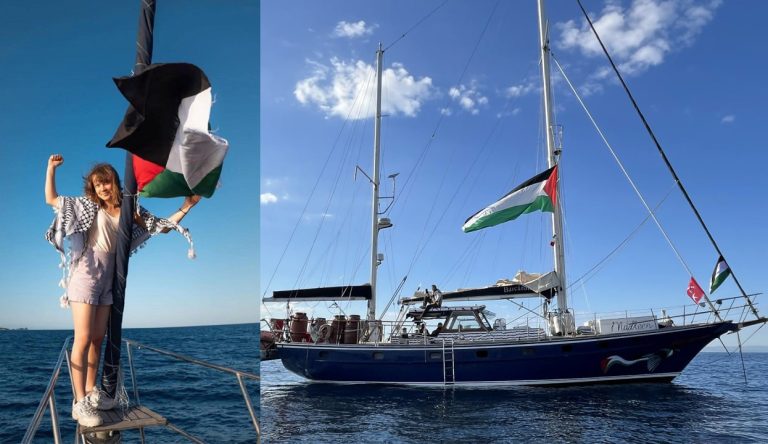
Israel has issued a clear warning against the ship Madleen carrying Swedish controversial activist Greta Thunberg and 11 other pro-Palestinian campaigners to Gaza Strip. Israel has said that the vessel will not be allowed to breach the naval blockade.
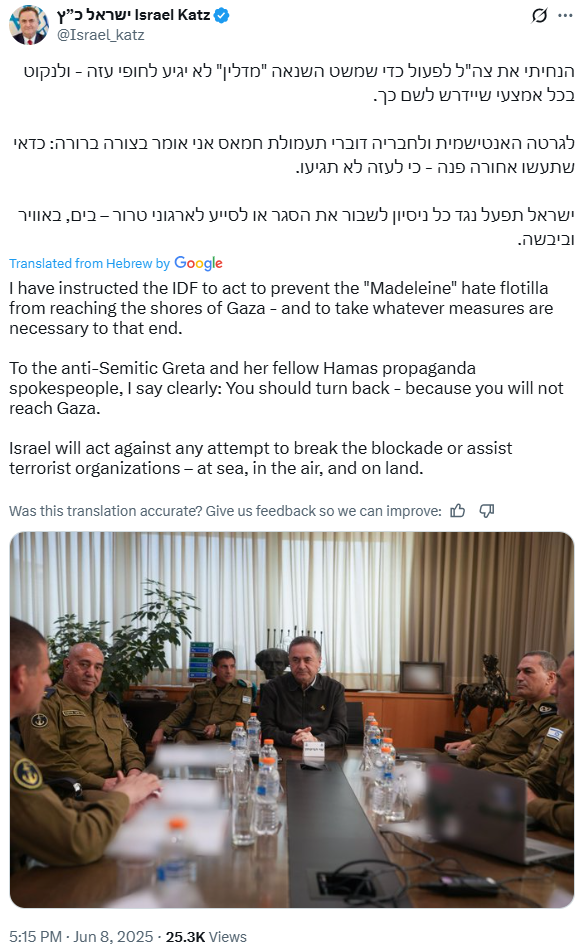
Defence Minister Israel Katz stated that the Israel Defence Force has been ordered to stop the flotilla “at any cost”. He labelled it a reckless act of provocation masquerading as humanitarian aid. The ship is currently approaching Gaza’s coast from Egyptian waters.
The so-called Freedom Flotilla left Sicily last week claiming to deliver relief supplies to Gaza, which include flour, medical kits and baby food. However, Israeli officials and analysts say the voyage is more about political optics than genuine humanitarian concerns. Minister of Defence, Israel Katz, went further and called the passengers “anti-Semitic propagandists”. He specifically named Thunberg in his rebuke, calling her anti-semitic.
Source: X
He wrote in Hebrew, “I have instructed the IDF to act to prevent the “Madeleine” hate flotilla from reaching the shores of Gaza – and to take whatever measures are necessary to that end. To the anti-Semitic Greta and her fellow Hamas propaganda spokespeople, I say clearly: You should turn back – because you will not reach Gaza. Israel will act against any attempt to break the blockade or assist terrorist organizations – at sea, in the air, and on land.”
The defence minister also posted a photo of him with senior military officials.
Ship of activists or ship of agitators?
Apart from Greta, among the most controversial figures on board is French MEP Rima Hassan. Notably, she had previously defended Hamas’s 7 October terror attack on Israel as “legitimate” and has been barred from entering Israel for promoting the BDS campaign and glorifying violence. Despite these red flags, Hassan was warmly embraced by the flotilla, whose organisers say they aim to “break the silence in the face of genocide.”
Meanwhile, Thunberg has continued her shift from climate activism to far-left and Islamist international causes. She has accused Israel of committing genocide and called on the world to act. The 21-year-old so-called activist is being used as a poster child for a dangerous, one-sided narrative and possibly has little understanding of the regional complexities.
Madleen is sailing under a UK flag. However, the UK govt rejected Israeli requests to prevent the boat from reaching Israeli waters. While the ship has saliled from Egypt towards Gaza coast, Israeli Navy is expected to block the vessel if it enters Israel’s territorial waters.
Israel draws the line
The IDF has confirmed plans to intercept the vessel before it enters Israeli waters, with Shayetet 13 commandos on standby. Any resistance will be met with firm action, the army said, and all passengers will be detained and deported.
Israeli sources say previous attempts by similar flotillas resulted in violence and propaganda wins for Hamas. The current voyage, they argue, is no different, a highly orchestrated media spectacle using humanitarian language to shield radical agendas.
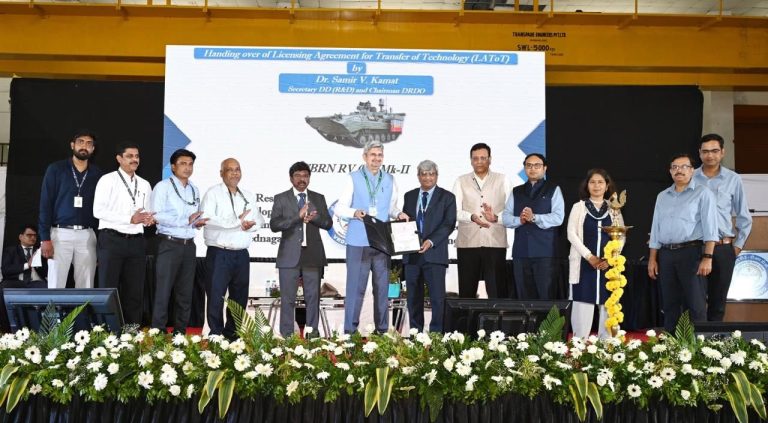
In a significant step towards empowering private and public sector units in defence manufactory, the DRDO is transferring technologies related to nine crucial systems to 10 industrial units. The technologies are being transferred by the Vehicles Research & Development Establishment (VRDE), a DRDO laboratory located in Ahilyanagar, Maharashtra.
The licensing agreements were handed over in the presence of Secretary, Department of Defence R&D and Chairman, DRDO Dr Samir V Kamat during an event organised at VRDE on June 07, 2025. The technologies transferred to the industry are as follows:
Chemical, Biological, Radiological, Nuclear (CBRN) Recce Vehicle (Tracked) Mk-II transferred to Bharat Electronics Limited, the public sector aerospace and defence electronics company.
Mounted Gun System technology transferred to Bharat Forge Limited of Kalyani Group.
Anti-Terrorist Vehicle – Tracked Version, technology transferred to Metaltech Motor Bodies Private Limited, a Delhi based company specialising in customized vehicle bodies.
Technology for Full Trailer of 70t Tank Transporter for Main Battle Tank (MBT) Arjun Mk-1A has been given to four companies- BEML Limited, Tata International Vehicle Applications, SDR Auto Private Limited and John Galt International.
While Bharat Electronics Limited has given the tech for Expandable Mobile Shelter.
Another Tata group company Tata Advanced Systems Limited received the technology for Vajra-Riot Control Vehicle.
Public sector BEML has been given two more technologies, Unit Maintenance Vehicle for Main Battle Tank Arjun and Unit Repair Vehicle for MBT Arjun.
Two other companies, Dass Hitachi Limited and Goma Engineering Private Limited, have been allotted the technology for Multi-Purpose Decontamination System.
DRDO’s Vehicles Research & Development Establishment also signed an MoU with COEP Technological University, Pune to jointly work on cutting-edge technologies and emerging areas.
Speaking on the occasion, DRDO chairman Dr Kamat complimented DRDO and the industry for the exceptional performance of indigenous systems during Operation Sindoor. He also suggested the industry to plan for surge capacity. He appreciated the efforts of VRDE in providing high-end technological solutions for land systems and weapon platforms.
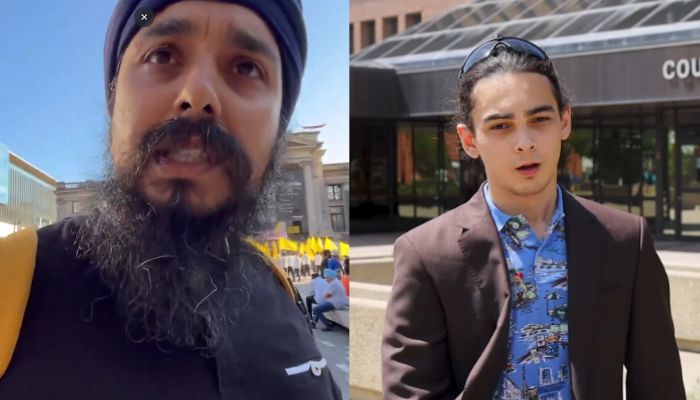
On 8th June (local time), independent Canadian investigative journalist Mocha Bezirgan was assaulted, threatened, and had his phone snatched by pro-Khalistani elements while covering a rally in Vancouver, British Columbia. Bezirgan is known for his sharp coverage of Khalistani elements in Canada. He took to social media platform X to narrate his ordeal and later spoke to ANI about the incident. While speaking to the news agency, he called it “thuggery” and a direct attack on press freedom.
In his post on X, he wrote, “Today in Vancouver at a Khalistan rally, a foreign activist who has been doxing my whereabouts approached me for an “interview.” But he refused to keep his distance from my face and began making threats of violence if I were to touch him. I kept walking away from him but his harassing behavior wouldn’t stop. He grabbed my phone out of my hand and continued his harassing behavior even after a police warning. He is a foreign activist from Britain and self admittedly not a Canadian citizen, interfering with my ability to do my job as a citizen journalist covering a topic concerning Canadians and the upcoming G7 meeting in Alberta.”
‘Still shaking’ – Bezirgan recounts incident
In a telephonic interview with ANI, Bezirgan said, “It just happened two hours ago and I am still shaking.” He added, “They acted like thugs, crowding in on me, grabbing my phone, trying to stop me recording.” He had been covering a rally organised by pro-Khalistani elements in downtown Vancouver when the incident occurred.
In a post on X, he wrote, “I’ve been surrounded by a group of Khalistanis who grabbed my phone out of my hand and threatened me. Naturally I’m a bit shaken but not deterred.” He reiterated that such intimidation tactics are now routine at Khalistani gatherings.
I’ve been surrounded by a group of Khalistanis who grabbed my phone out of my hand and threatened me.
In another post, he wrote, ““What’s up now bro!?” Here’s the view from my main camera of two Khalistani thugs blocking my exit as I try to get away from a serial harasser who can’t keep his distance from me. These intimidation tactics won’t stop me or influence my editorial independence.”
“What’s up now bro!?” Here’s the view from my main camera of two Khalistani thugs blocking my exit as I try to get away from a serial harasser who can’t keep his distance from me.
These intimidation tactics won’t stop me or influence my editorial independence. pic.twitter.com/jXU1uTZDmV
Bezirgan said that while the movement does not represent the larger Sikh community, it has increasingly resorted to vandalism, intimidation, and violent rhetoric. He said, “This is a movement headed by Sikhs for Justice (SFJ). They mobilise the same people through local Gurdwaras for protests in Ontario, British Columbia, the US, UK, and even New Zealand.”
He further warned that organisations including the World Sikh Organisation (WSO) offer political cover within Canada. He said, “Their executives include current and former MPs and ministers, who have spread influence across Canadian institutions.”
Canadian leaders under scrutiny
Bezirgan criticised political figures across party lines as they failed to condemn these violent extremist groups. He added, “Conservative leader Pierre Poilievre, the NDP, and some Liberal MPs recently attended a Nagar Kirtan in Surrey, BC, which had significant Khalistani influence. They shared the stage with Santokh Singh Kelha, a convicted conspirator in an airline bombing.”
He also condemned the glorification of political violence and noted that pro-Khalistani groups openly celebrate the assassins of former Prime Minister of India, Indira Gandhi. He added, “They say they are the descendants of her killers and are openly discussing ambushing and killing Prime Minister Modi. This is not just free speech, it is incitement.”
Bezirgan urges political accountability
He highlighted the Canadian media’s silence and the state’s inaction and said, “It is disturbing that politicians continue to associate with such extremists despite their violent history. As a citizen, I expect my representatives to distance themselves from such individuals.”
Bezirgan stressed that ignoring the problem would further embolden extremist elements and worsen Indo-Canadian ties. He pointed out that this was not the first time he had been attacked by pro-Khalistani elements. In a March 2024 protest in Edmonton, Alberta, he was attacked outside the High Commission of India.
PM Modi to attend G7 summit despite tensions
The assault on Bezirgan came days before the G7 summit, where Prime Minister Narendra Modi is set to represent India. PM Modi confirmed on 6th June that he would be participating in the summit following an invitation from Canadian PM Mark Carney during a telephonic exchange.
Notably, Khalistani elements, including Khalistani terrorist Gurpatwant Singh Pannun, have warned of plans to ambush PM Modi during his visit to Canada, raising serious concerns about the security of the Indian Prime Minister in a country where such elements are provided shelter.