Home Blog Page 550

UK: Rotherham grooming gang victim turned activist says police asked her to delete posts on child sexual abuse

As the Labour government in the UK is facing the heat after the Pakistani Grooming Gangs scandal resurfaced, the British authorities seem to be making every effort to dodge accountability by suppressing free voices talking about the exploitation of British children that went on for decades.

Recently, a victim of the Rotherham child sexual abuse scandal alleged that she was asked by police authorities to take down her posts about the scandal. Sammy Woodhouse, a 39-year-old woman, posted on X (Twitter) that she was asked by South Yorkshire Police to delete her posts and not to report on Rotherham professionals. She said that the information she posted was received directly from the South Yorkshire Police over 6 months ago yet she was asked to delete it.

Woodhouse is herself a grooming survivor. She fell victim to the grooming gangs in Rotherham at the age of 14 when he met her abuser named Arshid Hussain. At that time, Woodhouse was not aware that Hussain was the ringleader of a drug-dealing criminal gang that abused teenage girls. Hussain groomed Woodhouse and made her believe that he loved her.

However, the relationship soon turned abusive. According to Woodhouse, Hussain used to beat and rape her and even threatened to kill her if she dared tell anyone. He impregnated her at the age of 15. She was only able to escape after Hussain got arrested for an offence. Woodhouse accused police of having a ‘lazy attitude’ when she went to them to report Hussain.

Several victims of the Pakistani Grooming gangs like Sammy Woodhouse have come out with their testimonies accusing police of apathy and inaction in relation to complaints of sexual abuse by the Pakistani Grooming gangs across cities in the UK. The Grooming gangs comprising largely of men of Pakistani descent, were active in several cities of the UK including Rochdale, Rotherham, Oxford, Telford, Leeds, Birmingham, Norwich, Burnley, High Wycombe, Leicester, Dewsbury, Middlesbrough, Peterborough, Bristol, Halifax, Newcastle, Huddersfield, and Hull.

The terror of these grooming gangs that began in the 1980s continues till date. These gangs worked in an organised manner targeting young, impressionable girls. They manipulated them and gained their trust. These innocent girls were then abused by sexual predators en masse and were supplied across chains of abusers.

The grooming gangs sexual abuse scandal has stirred a global debate compelling the ruling Labour Party government to address the issue. The issue caught the global eye after business tycoon Elon Musk, targeted British Prime Minister Keir Starmer accusing him of being complicit in the sexual abuse of British children. Musk criticised the British government for failing to act in cases of child sexual abuse.

A bill was introduced by the opposition in Parliament on Thursday demanding an inquiry into the grooming gangs scandal. However, it failed to go through due to a lack of support from the government.

Faridabad: Mutilated body of Hindu youth found, family says Fakruddin, Anwar, Idris and others killed him because he was witness in a rape case

In Faridabad, the mutilated body of a missing Hindu youth was found on Wednesday, 8 January. The young man’s body was identified as that of a man named Deepak Kumar, who was reported missing by his family since December 16. Deepak’s body was abandoned in the bushes near Sector 62, and as per reports, the body had been badly mutilated and was in a decomposed condition. Some fingers and toes were also missing.

The victim’s family lives in the same Sector 62 area. The victim’s brother Dileep has informed that Deepak was last seen on December 16. They have been searching for him for weeks. Upon information about the body, the family came and confirmed the victim’s identity.

Police spokesperson Yashpal Singh informed that a missing person case had been filed, and police were searching for Deepak since December 16. As of now, Deepak’s body has been sent for postmortem in the Badhshah Khan Civil Hospital.

Deepak was witness in a case involving a minor girl, says family

A copy of the complaint by Deepak’s brother, Dileep, was shared on social media. In the complaint, Dileep has mentioned that he has complained against some persons named Fakruddin, Idris, Anwar, Azad, Sohail, and others. They had an enmity with Deepak because, as per Dileep’s complaint, Deepak was the main witness in a case involving a minor girl where the above persons were accused.

Replying to the post, Faridabad Police stated that they have taken cognisance of the issue and have constituted teams to search for the accused persons.

Some media reports had also reported that Deepak’s body was found beheaded.

Sambhal Jama Masjid committee moves Supreme Court seeking to prevent use of well outside the mosque for Hindu religious purposes

0

The Committee of Management, Shahi Jama Masjid, Sambhal, on Thursday moved the Supreme Court seeking direction to the District Magistrate to ensure that the status quo is maintained with respect to the private well situated near the stairs/entrance of the mosque.

The mosque committee urged the top court to issue directions to the DM and not to take any steps/actions with regard to the investigation of the well, and open the well-constructed outside the structure without due permission from this court.

“District Administration, Sambhal is conducting a purported drive to revive old temples and wells in the city with reports indicating that at least 32 old unused temples have been revived and 19 wells have been identified which are being made operational for public prayers/use,” the application stated.

“The District Administration, in its purported drive for the so-called revival of old temples and wells, is giving publicity to the proposed public access being granted to the use of the well, claiming the said wells to have religious significance,” it added.

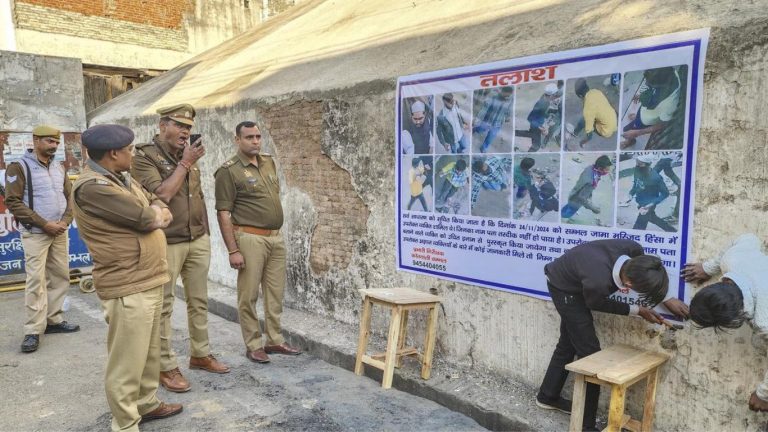
It also stated that posters have also been put up around Sambhal and near the mosque indicating purportedly the location of historical wells and therein the mosque has been shown as a temple.

The mosque committee said that it has apprehensions and has already given a legal notice on December 16, 2024 to the District Administration in this regard.

“The District Magistrate has stated, as per news reports, that the well is not within the mosque and the interim order passed by this court is only with respect to things inside the mosque. While the petitioner disputes this, what is apparent is that the said private well is situated at the entrance of the mosque and partly inside it, and opening the same for Hindu prayers will result in mischief and disturb the fragile harmony and peace in the area at the moment,” added the application.

Actions of the District Administration are in no manner aimed towards maintaining peace and harmony as directed by this court, although an assurance in this regard was given by the state, as reflected in the order of November 29, 2024, the Mosque Committee said.

The petitioner urged the top court to direct the District Administration to not disturb the status quo as prevailing with regard to the private well of the mosque and not to open the same to Hindu prayers.

In November 2024, the top court had stayed the trial court proceedings in the case, directing it to not to hear the matter until the petition filed by the mosque committee against the survey order is listed in the Allahabad High Court.

Tensions in Sambhal had simmered after the local court ordered a survey of the mosque on November 19. Opposing the court-ordered survey of the Jama Masjid people clashed with police, resulting in the death of four persons.

The survey followed a petition filed by some persons in the local court, claiming that the site of the mosque was previously a Harihar temple, dedicated to Kalki, the last incarnation of Lord Vishnu, and built in 1526 after demolishing the temple.


(This news report is published from a syndicated feed. Except for the headline, the content has not been written or edited by OpIndia staff)

Canada: All four Indians arrested for killing Hardeep Singh Nijjar released by court as case stayed on Canada govt’s request. Here is the procedural reason

Over a year after Canada’s Justin Trudeau government killed diplomatic relations with India by accusing the Modi government of killing Khalistani leader Hardeep Singh Nijjar, all four accused arrested for the murder in June 2023 have been released from jail. As per documents from Surrey Provincial Court made available on the official website of the Government of British Columbia, they are no longer in custody.

The court record shows that for all four, the ‘In custody’ field is marked as ‘N’, which means they are not in custody.

Surrey Provincial Court record

The four accused arrested on the charges of murdering Nijjar are Karanpreet Singh, Karan Brar, Amandeep Singh, and Kamalpreet Singh, all of Indian origin. The court records, posted on ? by user Brattani, show that the four accused were released on SOP on 18 November 2024. According to Canadian govt definitions, SOP stands for Stay of Proceedings directed by the Crown. This means the case against the four accused has been stayed on an order by the govt.

Further, the records mention the reason for release as DSP, which is short for disposition. This means that the matter is being disposed of. The result is mentioned as END, which means the matter has been concluded by the court.

Surrey Provincial Court record

The records also show that during the hearings before 18 November, the matter was adjourned at the request of the prosecutor.

However, while the matter has been stayed at the Surrey Provincial Court, the case will continue at the British Columbia Supreme Court. As per reports, the trial has been moved to the BC Supreme Court at the request of the govt.

The prosecution has requested a direct indictment in the case, skipping a preliminary inquiry, in order to expedite the trial. The 4 accused appeared in the first hearing at the Supreme Court on 18 November, while the next hearing is scheduled on 11 February.

The four accused were arrested by Canadian police in May 2024, and they are allegedly members of the Lawrence Bishnoi group. The Canadian media had alleged that the Lawrence Bishnoi group was targeting Khalistani activists in Canada on behalf of Indian govt.

While Canada accuses an Indian hand behind Nijjar’s murder, it is yet to provide any evidence for the same. Justin Trudeau had only mentioned ‘credible allegations’ against India. The Indian government has strongly refuted the claims.

1921 Munshiganj massacre: How British forces mercilessly killed over 700 peacefully protesting farmers in Raebareli

With 78 years having passed since its independence, India joyfully commemorates the triumphs that have defined its journey to freedom. Many movements have been documented in the annals of history that contributed to the attainment of independence from British rule. The struggle of Munshiganj farmers in Raebareli district of Uttar Pradesh is a prime example of the same. Infact, Munshiganj, is known for the farmers’ movement and the massacre perpetrated by the colonial power.

The Jallianwala Bagh incident of 1919 stands as a grim episode during the freedom struggle and a similar instance was recorded in Munshiganj. 104 years ago, Imperial Police fired upon over 2,000 unarmed farmers in this area. A memorial has been erected to honor their memory, reminding us of the severe atrocities and inhumanity committed by the British. Many experts even believe that it surpassed the Jallianwala Bagh tragedy in scale.

Image via Dainik Bhaskar

The fateful occurrence took place on 7th Jauary 1921 and encapsulated a tale of sacrifice and renunciation, as farmers bravely resisted the oppressive and cruel actions of the British regime. The origins of this incident can be traced back to Bhagwantpur Chandniha hamlet, located within the Deenshah Gaura development block. Police, under the command of the oppressive government, shot hundreds of unarmed and innocent farmers. As a result, the waters of the Sai River ran red with the blood of the farmers, many of whom gave their lives and made the supreme sacrifice for the country.

During British rule, the landlords and ration dealers exerted significant influence over Raebareli. They granted land to the farmers and were responsible for collecting taxes for the Britishers. On 5th January 1921, farmers, distressed by the tormenting actions of the talukdar Tribhuvan Bahadur Singh at the time, convened a public meeting led by Pandit Amol Sharma and Baba Jankidas. The agitated farmers from the village attended the public meeting and encircled the residence of the talukdar. Alarmed by the sight of thousands of farmers surrounding his place, he promptly notified the District Magistrate AG Sharif of the situation.

Sharif arrived at the scene with a police contingent and summoned the leaders of the Kisan Sabha, including Pandit Amol Sharma, Baba Jankidas and Badri Narayan Singh, into the palace to negotiate a resolution. However, it was a conspiracy and they were subsequently detained and transported to Rae Bareli jail, from where they were swiftly moved to Lucknow, in a bid to thwart the gathering. Despite Baba Ram Chandra’s (a trade unionist who organised the farmers of Awadh into forming a united front to fight against the abuses of landlords in 1920s and 1930s) absence at that time, the farmers began their march towards Rae Bareli to liberate their beloved leaders, arriving at Munshiganj on the evening of 6th January.

Martyr’s memorial in Munshiganj. (Source: Dainik Bhaskar)

The news of the arrest of the influential leaders rapidly disseminated throughout the Awadh province and people began to converge on Raebareli. Workers and farmers flocked to the town from all directions. The District Magistrate, witnessing the encirclement of the town, became anxious and sought to prevent further influx. He blocked the road to Munshiganj bridge with bullock carts to impede their progress. The farmers’ unwavering attitude prompted the British authorities to step in and halt them at the Sai River. The farmers sent a telegram to Martand Vaidya, informing him of the matter and requesting the presence of Pandit Motilal Nehru. His son Pandit Jawaharlal Nehru received the message in his absence and left for Raebareli immidiately.

The following day, rumors circulated throughout the village claiming that the jail administration in Lucknow had murdered both leaders. A considerable number of farmers began to assemble on the banks of the Sai River 7th January, to show their solidarity with their leaders. A large police force was deployed on the river bank, in response to the growing crowd. Observing the escalating situation, Pandit Jawaharlal Nehru made his way towards Munshiganj, however, he was intercepted near the collectorate premises and prevented from reaching the location.

The British authorities had already formulated a plan to use firearms. They were apprehensive that Nehru’s presence at the riverbank could lead to an assassination attempt, which would exacerbate the already tense atmosphere and he was placed under house arrest. The protests commenced, and the police responded by firing upon the farmers. A farmer was struck by a bullet fired by Sardar Birpal Singh. The moment Badlu Gaur collapsed to the ground, the British soldiers interpreted this as a signal to unleash their assault. It is reported that many of the victims fell into the Sai River after being shot, causing the water to turn crimson with their blood.

The farmers were vociferously expressing their dissent against the British government. They raised slogans demanding an end to unlawful tax collection and the cessation of abuses directed at farmers. The sight instilled fear in the British government officials who ordered the bloodshed in their panic. Over ten thousand rounds of ammunition were fired. This incident claimed the lives of at least 750 farmers farmers and injured more than 1500, yet the gunfire continued unabated. Those who were captured were subjected to a fine of Rs 100 and a rigorous six-month labor sentence.

Premises of the memorial. (Source: Dainik Bhaskar)

According to Anil Mishra, who oversees the organization dedicated to the legacy of freedom fighters, the Munshiganj firing incident represents a pivotal episode in the historical framework of the Indian freedom struggle, enriched by the sacrifices of numerous farmers. As a result, this incident has transformed into a timeless tale of the freedom movement from that period. Vijay Vidrohi, a local political authority, emphasized that the Munshiganj firing incident is remarkable in several ways. It is not fitting to compare it with other movements. However, it is true that this incident did not achieve the historical significance it merited within the freedom struggle. Nonetheless, it was instrumental in shifting the focus and direction of the movement.

The aftermath of the Munshiganj firing incident led to a transformation within the Congress party. The party evolved from being an entity primarily representing talukdars and landlords to one that embraced the interests of farmers and laborers. This movement catalyzed greater involvement of ordinary citizens in the freedom struggle.

What is Miyawaki technique, the Japanese approach used to create 56,000 square meters of dense forest in Prayagraj ahead of Maha Kumbh Mela

The preparations for Maha Kumbh 2025 are going on in full swing. Besides the special arrangements in the Kumbh Kshetra concerning infrastructure and health facilities for the devotees, the administration has also focused on the environmental front. In this vein, the Ministry of Culture said on Wednesday (8th January) that dense forests have been developed at various locations across Prayagraj through the Miyawaki technique, to ensure pure air and a healthy atmosphere for the millions of devotees expected to visit the city.

Over the past two years, the Prayagraj Municipal Corporation has established many oxygen banks using the Japanese Miyawaki approach, resulting in lush green woods. These efforts have improved both greenery and air quality, making them vital for environmental conservation.

Chandra Mohan Garg, Commissioner of Prayagraj Municipal Corporation, stated that the Miyawaki Technique is being used to grow dense forests around the city. Over the last two years, the Corporation has planted trees in more than ten locations throughout the city, totalling 55,800 square meters.

Dense forest in Prayagraj created through the Miyawaki technique (All images via PIB)

The greatest plantation, with over 1.2 lakh trees of 63 species, was completed in the Naini industrial region, while 27,000 trees of 27 different species were planted in Baswar following the cleanup of the city’s largest garbage yard. This project not only helps to eliminate industrial waste, but it also reduces dust, dirt, and foul odours. In addition, it improves the city’s air quality. Miyawaki forests provide numerous benefits, including prevention of soil erosion, reduction of water and air pollution and enhanced biodiversity.

According to Dr NB Singh, a former Botany professor at Allahabad Central University, the rapid growth of dense forests using this method helps reduce the temperature difference between day and night Maha Kumbh 2025 dense forests during summers. These forests also boost biodiversity, improve soil fertility, and create habitats for animals and birds. Additionally, large forests developed through this technique can lower the temperature by 4 to 7 degrees Celsius, offering significant environmental benefits.

The project includes a wide variety of species, ranging from fruit-bearing trees to medicinal and ornamental plants. Key species planted under this project include mango, mahua, neem, peepal, tamarind, arjuna, teak, tulsi, amla, and ber. Additionally, ornamental and medicinal plants like hibiscus, kadamba, gulmohar, jungle jalebi, bougainvillea, and brahmi have been incorporated. Other species include Sheesham, bamboo, Kaner (red and yellow), Tecoma, kachnar, mahogany, lemon, and drumstick (sahjan).

The Miyawaki technique was developed by noted Japanese botanist Akira Miyawaki in the 1970s. This technique is a revolutionary method for creating dense forests in limited spaces. This involves planting trees and shrubs close to one another to accelerate their growth which is why it is also called the “pot plantation method”.

Source: SUGi Project

With the Miyawaki technique, plants grow 10 times faster. This method mimics natural forests by using a mix of native species planted densely and also improves soil quality, enhances biodiversity, and accelerates forest development.

Trees planted using the Miyawaki technique absorb more carbon, grow faster, and support richer biodiversity compared to traditional forests. In urban settings, this technique has transformed polluted, barren lands into green ecosystems. It has successfully managed industrial waste, reduced dust and foul odours, and curbed air and water pollution. Additionally, it prevents soil erosion and promotes ecological balance, making it an effective tool for environmental restoration.

Uttarakhand: Illegal mosque being constructed in Haridwar sealed by authorities

Taking advantage of the upcoming local body elections in Uttarakhand, a mosque was illegally constructed in Jamalpur Kalan near Haridwar. According to a report of Panchjanya, the illegal mosque was constructed on Sarai Marg in Jamalpur Kalan without obtaining necessary permission from the authorities.

As per the report, the mosque, which was a makeshift structure earlier, stands on an illegally occupied land. No permission was taken from the authorities to change it into a permanent structure as that would have required furnishing the papers of the land. Therefore, the mosque was constructed in a rushed manner to escape any scrutiny by the authorities.

A complaint was reportedly filed by the leader of a local Hindu organisation against the illegal construction in the Haridwar Roorkee Development Authority. As as soon as the authorities came to know about the illegal construction, a team of Haridwar Roorkee Development Authority reached the spot and sealed the illegal construction. A notice prohibiting the construction of the mosque was served by the authorities earlier but it was ignored. However, this time the authorities have warned that if the construction is resumed, legal action will be taken against those responsible.

According to the direction of the Supreme Court, the construction or renovation of any religious structure cannot be carried out without prior permission of the District Magistrate or the concerned authorities.

Noticeably, recently the authorities had demolished the gate of a mosque in Jwalapur which was being constructed illegally in a similar manner during Manglaur Legislative Assembly bye-elections.

The preparations for the upcoming local body elections are in full swing in Uttarakhand. The Election Commission has fixed the date of election on January 23.

India’s first Muslim teacher Fatima Sheikh never existed? Writer-activist Dilip Mandal says he invented the ‘fictional character’

In a sensational claim, author and activist Dilip Mandal has claimed that Fatima Sheikh, celebrated as India’s first Muslim school teacher, never existed. In a post on X on 9 January, Mandal claimed that Fatima Sheikh is a fictional character created by him, and that she was never a real person or historical figure.

He also said that that is why there is no photograph of Fatima Sheikh, and the sketch being used is also fictional. In the post titled Confession, Dilip Mandal wrote, “I had created a myth or a fabricated character and named her Fatima Sheikh. Please forgive me. The truth is that “Fatima Sheikh” never existed; she is not a historical figure. Not a real person. It is my mistake that, during a particular phase, I created this name out of nothing—essentially from thin air. I did that knowingly.”

He claimed that here is not a single entry for her in a Google search earlier, saying “No article, no book, no mention. Nothing.” Mandal added that his interest in her vanished in 2022 when he abandoned the story of Fatima Sheikh. She came in social media narrative and just vanished, he said.

However, he didn’t give any specific reason on why he created the ‘fictional character’, saying “Do not ask why I did it. It was a matter of time and circumstance. A figure needed to be constructed for a purpose, and so I crafted one. Thousands of people can attest to this—most of them heard this name from me for the first time.”

Mandal further claimed, “I know the art of creating narratives, of building images. I have mastered this craft, so it was not difficult for me. A fictional sketch was created because there were no old photographs. I spun many stories about her. And thus, Fatima Sheikh came into being. The story spread. Those who needed this narrative for political and ideological purposes amplified it.”

He also said that the name of Fatima Sheikh is not found in the writings of Jyotiba Phule and Savitribai Phule. Notably, Sheikh has been described as a colleague of social reformers Jyotirao Phule (also known as Jyotiba Phule) and Savitribai Phule in Maharashtra.

Dilip Mandal wrote, “The complete writings of Jyotiba Phule and Savitribai Phule have been published, and nowhere is the name Fatima Sheikh mentioned as someone who taught alongside them. Even Babasaheb Ambedkar never referred to such a name. No biographer of Mahatma Phule or Savitribai Phule has mentioned Fatima Sheikh. No Muslim scholar referenced this name until 15 years ago. British documents that discuss the educational efforts of the Phule couple make no mention of Fatima Sheikh either.”

She is nowhere to be found—absolutely nowhere, he said, adding at the end, “I have mentioned Fatima Sheikh’s name the most. I admit to this. But she never existed”.

As evidence that reference to Fatima Sheikh didn’t exist before he ‘created’ her 15 years ago, he posted a screenshot of a Google Trends chart for the term Fatima Sheikh since 2004, which shows that it search for the term peaked in January 2022.

He later posted several other tweets relating to the matter, and retweeted a 2023 tweet by Ambedkarite Central with a letter by Savitribai Phule, saying this was the only instance when Fatima was mentioned. The tweet added that nowhere it is mentioned or even there’s a single hint which claims that she was also a teacher and helped to establish school for Dalits.

When a person alleged that he is lying, Dilip Mandal said that Savitribai Phule is not from from Harappa era, she is from our times and there are records of her. He said that old newspapers can be seen libraries. He also challenged to find a mention of Fatima’s birthday celebration before 2006, saying that he would accept that he didn’t create the character if such a reference is found.

If the claims of Dilip Mandal are true, this will mean he has been successful in inserting a fictitious character in India’s history. Numerous articles on Fatima Sheikh have been published in media, describing her as a pioneering teacher, anti-caste activist, proponent of girls’ education, and social reformer. She has been regarded as a feminist icon from British India.

In fact, there is a Wikipedia article on Fatima Sheikh, and Google celebrated her 191st birthday on 9th January 2022 with a doodle.  

The references cited in the Wikipedia article are recent, therefore it aligns with Mandal’s claims. However, a book titled Women Writing in India: 600 B.C. to the early twentieth century, published in 1991, is also mentioned in the references. The book mentions that Fatima Sheikh was a colleague of Jyotiba Phule and Savitribai Phule when they opened schools, especially for lower caster girls.

The book published by Feminist Press at the City University of New York is a collection of over 200 articles from eleven languages.

However, the book mentions the name only once, saying, “The schools Jotiba and Savithribai Phule started in Pune were meant especially for lower-caste girls. Their colleague, Fatima Sheikh, was a Muslim woman.” There is no other mention in the book. Therefore, it is possible that while there was a coworker of Phules named Fatima Sheikh, she was not a prominent activist as claimed now.

While Fatima Sheikh indeed may have existed and worked in schools set up by Jyotiba Phule and Savitribai Phule, Shri Mandal is insistent that she is fictitious. Further, it’s true that much of the glorification of Sheikh has happened only in the last decade or so, and her mention on the internet was almost non-existent before that.

Dima Hasao coal mine tragedy: Indian Navy divers descend into 300-foot deep shaft at 3 Kilo, only one body found so far

Assam Mines and Minerals Minister Kaushik Rai confirmed on Wednesday that so far only one body has been recovered from the mine, as teams from the Army and Navy work to rescue trapped miners. Efforts are underway to dewater the mine to determine the number of people trapped inside.

Speaking to ANI on Wednesday, Rai said, “One body is recovered. An Army team has again dived in (in the mine). The Navy team will also go. We have started the process of dewatering the mine… A few people are saying that 10-12 people are trapped. When the water level decreases, we will be in the position to tell the exact number.”

HPS Kandari, Commandant of the 1st Battalion, NDRF, said, “A deep-diver team of the Indian Navy has entered into the 300-foot-deep coal mine.” The NDRF commandant further informed that a heavy water pump from Coal India has arrived at Silchar airport and will move to the site soon.

Earlier today, Inspector Roshan Kumar Singh, team commander of the National Disaster Response Force (NDRF), confirmed that despite searching the vertical area and using heavy pumps to remove water, the water level has not decreased at the mining accident site. The operation, supported by Sonar equipment, is ongoing as water continues to flow into the mine, hindering progress.

Speaking to ANI, Singh said, “We have searched the vertical area but haven’t been able to find anything. We are proceeding further with taking out water from the mine… The water level has only increased and not decreased. This is a joint operation of the Navy, NDRF, and Indian Army.”

He also added, “The Indian Navy team, Indian army and NDRF have jointly started the search & rescue operation with the help of sonar equipment for the third day at the coal mine site.”

The NDRF said that two pumps were being used to drain water from the site and the process will continue allowing a manual search to begin once the water is removed.

A joint rescue operation of the Indian Army, Assam Rifles, NDRF, SDRF teams and other agencies has been underway to rescue 8 people who have been trapped in a coal mine at 3 Kilo, Umrangso area since January 6. 

As Justin Trudeau is set to resign as PM, here is how his father Pierre Trudeau was accused of child sex abuse

On the 6th of January 2025, Canadian Prime Minister Justin Trudeau finally announced his resignation as PM and the leader of the Liberal Party amidst dwindling popularity. Justin Trudeau’s tenure has been so scandalous that the Canadian people celebrated Trudeau’s decision to step down. While the controversies and failures linked to Justin Trudeau’s nearly decade in power are being widely discussed and critiqued, allegations of child sex abuse by his father and former Prime Minister Pierre Trudeau have resurfaced.

These allegations emerged from the disturbing revelations made by Anneke Lucas, a sex trafficking survivor who has publicly discussed her experiences. Lucas claimed Pierre Trudeau was one of her abusers during an interview on the PBD podcast in November 2024, in which she described terrible experiences, including abuse by Pierre Trudeau when she was around 9 or 10 years old.

When asked about how was her interaction with Pierre Trudeau, Lucas said, “Scary”. However, she added that it was years later that she realised that her alleged abuser was Pierre Trudeau.

“I could never please him [Pierre Trudeau] as long as I was alive. That’s how scary it was. He couldn’t kill me because at that point I was not a throw-away child and he scared me enough so then I can tell Rockefeller that that’s what he wants. A child to kill…” Lucas said on the PBD podcast.

Lucas, who was born in Belgium, said that her mentally ill mother sold her into a paedophile network when she was six years old, in 1969. Her abuse transpired in what she defines as an elite paedophile ring that included powerful figures from various sectors of society, including politicians, media personalities and aristocrats.

Anneke Lucas described the abuse she suffered as both physical and sexual, not without a psychological dimension. In her testimony, Lucas claimed that she was raped, tortured, and make to partake in what she describes as Satanic rituals. She has spoken out about being forced to participate in acts of severe cruelty, such as animal slaughter and the consumption of human remains. A detailed account of the horrors she endured is described in her memoir Quest for Love: Memoir of a Child Sex Slave.

Lucas claimed that the network she was a part of was not only local but also worldwide. Lucas has named certain high-profile figures, including Pierre Trudeau, Canada’s former Prime Minister and father of Justin Trudeau, as one of her abusers when she was around 9 or 10 years old.

In an even more unsettling disclosure, Lucas claimed billionaire David Rockefeller groomed her as a sex slave and to spy for him under the supervision of financier Evelyn de Rothschild.

In the PBD podcast, Lucas said, “David Rockefeller had trained me as a spy so I was a sex slave, of course, and I was trained as a spy through mind control training and so that week, I was sleeping with men and then I would go report on their weaknesses or their sexual preferences to David Rockefeller.”