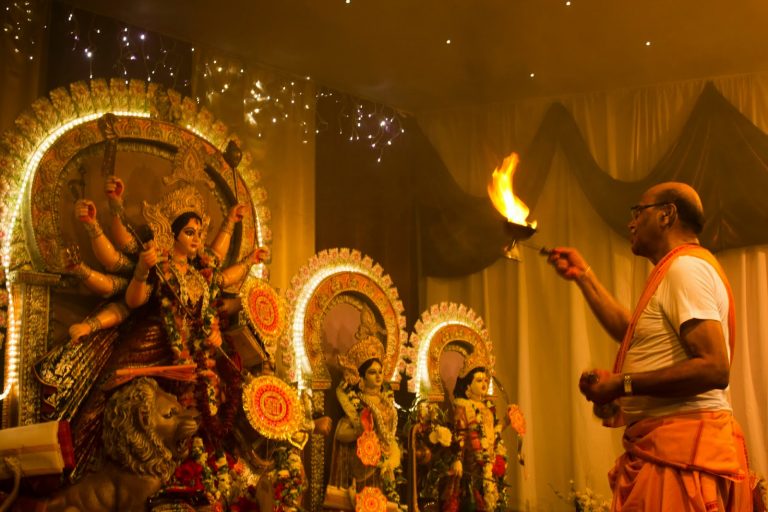
The far-left propaganda media outlet, The Telegraph, is now coming for our religious rituals. It is now running a campaign to alter the words of the Puspanjali offered during Durga Pujo. It’s asking its readers to chant ‘Santanan Dehi’ instead of ‘Putran Dehi’ during prayers.
The Telegraph is under the impression that Putran Dehi conveys a desire to be gifted a male child. However, in reality, the word in Sanskrit signifies a child, regardless of his or her gender. As Nityanand Misra, author in the field of Hinduism and Indology, explains in the Swarajya Mag, “The words ‘putrān dehi’ means both “give [us] sons” and “give [us] daughters and sons”. To understand this, we need to know the principle of ‘ekaśeṣa’ in Sanskrit grammar, by which the masculine dual can also stand for a female and a male, and the masculine plural can also stand for females and males collectively. In other words, the masculine dual in Sanskrit also serves as ‘mixed dual’ (a female and a male) and the masculine plural also serves as a ‘mixed plural’ (females and males).”
The Telegraph, in its campaign against Putran Dehi, has found support from equally harebrained progressives. Ananda Gupta, the chairperson of the 56-year-old Camden puja, told The Telegraph, “We learnt about the campaign quite late but took no time to come on board. The initiative to seek a child irrespective of gender from the goddess finds synergy with our theme of Tomar Durga, Amar Durga, which encompasses not only the affluent daughters but also the impoverished ones who jump into the river post-immersion to salvage coins or bamboo structures or seek food in dustbins. We are welcoming the LGBTQ community to our puja.”
“The mantra dates back to an age when people wanted sons rather than daughters. But we are not in that age any more,” said Parimal Dey, president of Beliaghata 33 No. Palli Bashi Brinda. “Ma-er pujo korbo ar chaibo sudhu chhele? (We’d worship the Mother Goddess but seek only son)?” said Sandipan Banerjee, puja committee convener of Behala Nutan Dal. “There is no harm if the mantra is changed,” said Bappaditya Mukherjee, who has been conducting the puja for 19 years according to the Devipuran.
The extremely little regard and the contempt the progressives reserve for traditions is revealed in the manner in which they tinker and twist essential Mantras and modes of worship without even bothering to understand the fundamentals of it. Changing the words of the prayer will have no impact at all in the manner in which society functions. The entire charade is merely an exercise in virtue-signalling.
If the progressives are hell-bent on destroying a prayer even as benign as ‘Putran Dehi’ which does not refer to a child of a particular gender at all, one wonders what else they want to destroy. It won’t take them too long to remove ‘Santanan Dehi’ from the prayer altogether as they will argue that wishing for a child itself is deeply sexist and misogynistic as the burden of pregnancy always falls on women.
The only effect changing the words will ever have is that a tradition and a mode of worship that has survived centuries and millennia will be lost to the vagaries of modernity. It also highlights that in many ways, progressivism is even more dangerous to Hindu traditions and culture than Radical Islam itself. Traditions and modes of worship that survived the atrocities of the Radical Islam empires during the ancient and the medieval era are now facing the threat of extinction due to the unhindered march of progressivism.
The e-commerce giants led by Amazon and Flipkart have achieved a record $3 billion or Rs 19,000 crores of Gross Merchandise Value (GMV) in the first six days of the festive sale from September 29-October 4 in India.
According to the reports, e-commerce websites such as Walmart owned Flipkart and Amazon managed to own 90 per cent of the market share during the six-day sale event, said Bengaluru-based research firm RedSeer Consultancy.
Interestingly, given the momentum received during the first part of the festive season sale, the entire month of October is expected to generate up to $6 billion or Rs.39,000 crores in online sales, driven mostly by Amazon and Flipkart.
“The first wave of the festive sale event has seen record GMV of almost $3 billion despite the challenging macro environment, indicating that consumer sentiment on online shopping remains bullish,” said Anil Kumar, Founder, and CEO, RedSeer Consulting.
The consulting group stated that the year-on-year (YoY) growth during the festive sale period was 30 per cent, with significant share coming from customers in tier II and III cities.
Mobile was the category leader, contributing to over 55 per cent of GMV in festive days. Reportedly, consumers delayed their mobile purchases for the festive sale season, indicating the strong “value shopping” proposition of festive days.
In GMV sale, Flipkart continued to lead with 60-62 per cent standalone gross GMV share during the sale event, and nearly 63 per cent share along with its other group entities like Myntra and Jabong, said the report.
“Strong performance across categories including mobiles was the key reason for Flipkart leadership. This was, in turn, enabled by strong value prices, high EMIs adoption and diverse selection across categories, all marketed aggressively to reach customers widely,” the RedSeer report said.
The GMV growth of e-commerce giant Amazon in India was 22 per cent (YoY). However, its volume growth rate was more than 30 per cent (YoY).
“The larger push has come from non-metro ‘Bharat’ customers, migrating to online shopping driven by the strong value provided from the online retailers across categories including mobiles, which have shown a strong surge during sale event despite having a relatively slow-growing first half of 2019,” Kumar noted.
Earlier, two big e-commerce players Amazon.in and Flipkart had announced record transactions on their respective platforms, along with adding new customers, especially from the tier II and III cities in the September 29-October 4 sale period.
Consumer electronics, smartphones, fashion and large appliances were among the top gainers as the demand surged from smaller cities and towns this year, indicating that the consumer spending has only increased in the country despite slowdown fears.
According to Amazon.in, the e-commerce company saw 65,000 sellers from more than 500 cities receive orders in just five days of the first edition of its “Great Indian Festival” sale. Nearly 15,000 sellers more than doubled the sales while millionaire sellers including “crorepati” sellers exceeded 21,000 sellers in the sale.
Targetting to bring the next 200 million consumers into the e-commerce fold, Flipkart said that “The Big Billion Days” sale witnessed almost 50 per cent growth in the number of new customers compared to last year, with 70 billion views in six days of the sale.
Flipkart added that more than 50 per cent of Flipkart Plus shoppers were from smaller cities and towns, while sales from tier 3 cities grew by 100 per cent (YoY). Nearly 50 per cent of top sellers on Flipkart witnessed three times growth and over 40 per cent of transacting sellers during the sale were from Tier 2 and beyond towns.
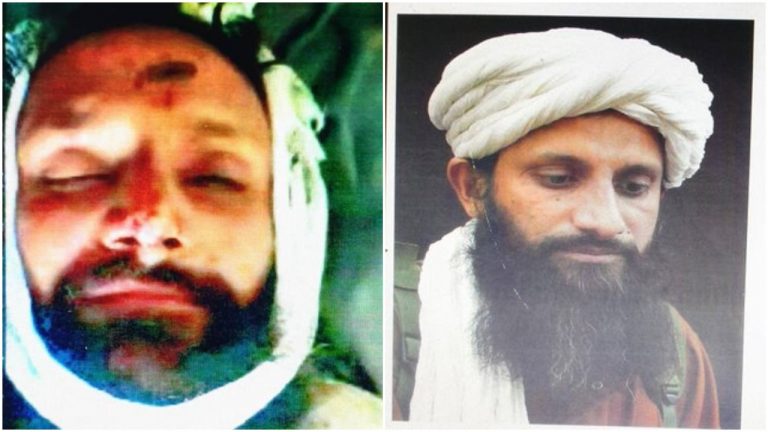
Asim Omar, the dreaded terrorist and the Al-Qaeda chief of South Asia region has been killed in Afghanistan in a joint US-Afghanistan commando raid on 23 September. According to the reports, Asim Omar, the leader of Al-Qaeda’s South Asian branch, was killed in a US-Afghan joint airstrike in Musa Qala district in Afghanistan’s southern Helmand province in September.
The India-born head of Al-Qaeda in the Indian Subcontinent (AQIS) was killed along with six other Al-Qaeda members in the southern Helmand province. According to US government, Maulana Asim Omar was a resident of Sambhal, Uttar Pradesh in India. He had then migrated to Pakistan in 1990.
According to a report in the AFP, Asim Omar led Al-Qaeda in the Indian Subcontinent (AQIS) from its inception in 2014.
Confirming the killing of Asim Omar, Afghanistan’s National Directorate of Security tweeted, “NDS can now confirm the death of Asim Omar, leader of Al-Qaeda in the Indian Subcontinent (AQIS), in a joint US-Afghan raid on a Taliban compound in Musa Qala district of Helmand province on Sep. 23.”
1/2: BREAKING: #NDS can now confirm the death of Asim Omar, leader of #Al_Qaeda in the #Indian Subcontinent (AQIS), in a joint US-Afghan raid on a Taliban compound in Musa Qala district of Helmand province on Sep. 23. pic.twitter.com/sFKi38M6MC
“Omar, a Pakistani citizen, was killed along with six other AQIS members, most of them Pakistani. Among them was Raihan, Omar’s courier to Ayman Al-Zawahiri. They had been embedded inside the Taliban compound in the Taliban stronghold of Musa Qala,” Afghanistan’s National Directorate of Security further tweeted.
2/2: Omar, a #Pakistani citizen, was #killed along with six other AQIS members, most of them Pakistani. Among them was Raihan, Omar’s courier to Ayman #Al_Zawahiri. They had been embedded inside the Taliban compound in the #Taliban stronghold of Musa Qala. pic.twitter.com/7jQF7bK7aD
Reportedly, the joint US-Afghan operations also resulted in collateral damage with at least 40 people attending a wedding party in the area were killed.
Nearly 22 Taliban fighters were killed during the operation while 14 people were arrested, including five Pakistani nationals and one Bangladeshi citizen. A large warehouse of supplies and equipment was also destroyed during the joint raid.
A case was registered recently, on the directions of the Court, against 49 ’eminent personalities’ who had written an open letter to Prime Minister Narendra Modi calling Jai Shri Ram a ‘provocative warcry’ and registering a protest against the ‘increased atrocities’ against Muslims and Dalits in India. The complaint was filed by an advocate.
Following the registration of the case, Congress MP Shashi Tharoor had written an open letter to Prime Minister Modi asking him to condemn the filing of the FIR against the ’eminent personalities’ on the direction of the Court, in the name of protection of ‘dissent’. Now, it appears more than 180 ’eminent personalities’ have come out and endorsed the original letter to the Prime Minister and condemned the charges it attracted.
The statement reads, “Can this be called an act of sedition? Or is harassment by misusing the courts a ploy to silence citizens’ voices? All of us, as members of the Indian cultural community, as citizens of conscience, condemn such harassment. We do more: we endorse every word of the letter our colleagues wrote to the Prime Minister. This is why we share their letter here once again and appeal to the cultural, academic and legal communities to do the same. This is why more of us will speak every day. Against mob lynching. Against the silencing of people’s voices. Against the misuse of courts to harass citizens.”
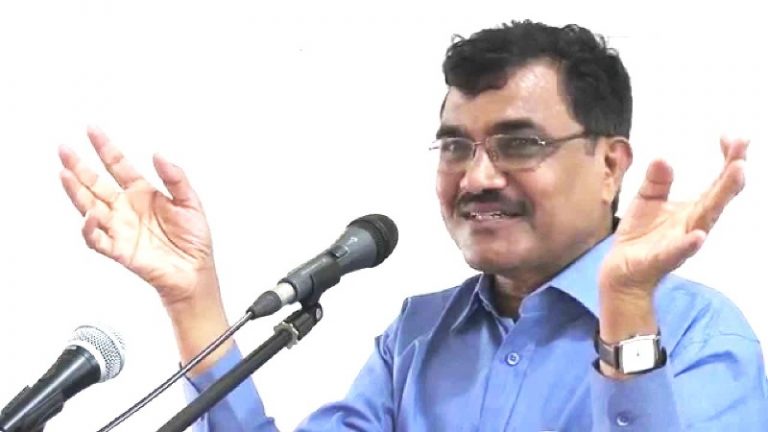
Interestingly enough, one person who is greatly concerned about the ‘misuse of courts’ to silence ‘voices’ is Anand Teltumbde, an alleged Urban Naxal accused in the Elgar Parishad case. He was arrested in the matter in February but was later released on a technicality. The Supreme Court, in the past, has refused to quash the FIR against him despite several requests.
Anand Teltumbde’s brother, Milind Teltumbde, was named in the FIR regarding the blast at Gadricholi that led to the death of 15 police personnel. Milind Teltumbde who handles the operations of the CPI(M) is also accused in the Bhima Koregaon case.
Amusingly enough, the controversial letter which attracted a case against the signatories in the first place boasted among its signatories a convicted Naxalite. Binayak Sen was convicted in 2010 on charges of sedition for his links to Naxals and sentenced to life imprisonment under sections 124A and 120(B) of the IPC. He was also found guilty under section 8(1) of the Chhattisgarh Special Public Security Act. He was given bail by the Supreme Court in 2011. It is rather ironic that a man convicted of sedition for helping Naxalites was taking the moral high ground in the letter that referred to the signatories as “peace-loving and proud Indians”.
Thus, we have ’eminent personalities’ like Naseeruddin Shah, dancer Mallika Sarabhai, authors Ashok Vajpeyi, Nayantara Sahgal and Shashi Deshpande, historian Romila Thapar, singer T.M. Krishna, and artist Vivan Sundaram collaborating with an alleged Urban Naxal to condemn an open letter to the Prime Minister that had among its signatories a convicted Naxalite. One would have expected ’eminent personalities’ to be more careful about the company they kept but apparently, support from every quarter is justified as long as it’s in opposition to Narendra Modi.
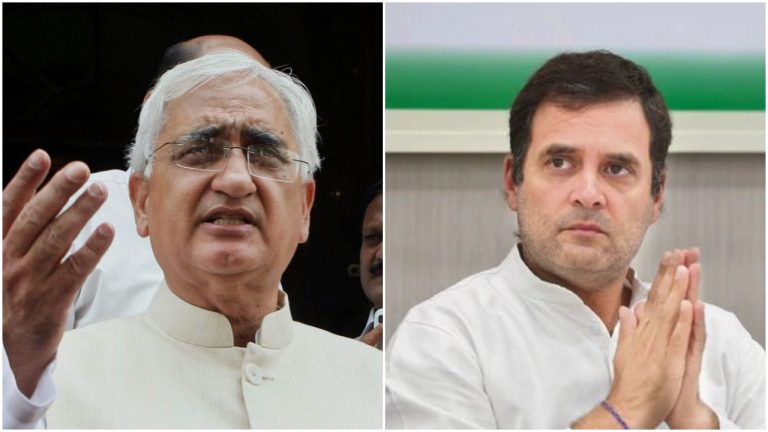
As the Congress party struggling for its survival after its humiliating defeat in 2019 Lok Sabha elections and followed by rebellion within the party in several states, senior leader Salman Khurshid has put the blame on Rahul Gandhi for the current crisis stating that the “biggest problem” is that Rahul Gandhi “walked away”.
According to the reports, former union minister Salman Khurshid on Tuesday stated that the 49-year-old former Congress President “left in a huff” and his mother Sonia Gandhi appears to be treating herself as a stand-in arrangement until a new Congress chief is selected.
“We haven’t really got together to analyze why we got defeated. Our biggest problem is our leader has walked away,” Khurshid was quoted as saying in the AP report and adding that Rahul Gandhi still retained the allegiance of the party.
“It’s kind of left a vacuum. Sonia Gandhi stepped in, but there is more than an indication that she is treating herself as a stop-gap arrangement. I wish it wasn’t so,” Khurshid reportedly said. Sonia Gandhi was selected as interim president of the Congress party in August this year after Rahul Gandhi refused to take back his resignation, she is expected to lead the party till the time a full time president is found.
Reportedly, senior Congress leader Salman Khurshid also said the struggles of the Congress party are such that it is unlikely to win the upcoming assembly elections in Haryana and Maharashtra. The former External Affairs Minister said that the struggles of the Congress party are at the point that it may not “ensure its own future”.
Salman Khurshid added that the Congress is facing attrition because it is “taking too long to come to terms” with its defeat in the 2019 Lok Sabha elections.
The Congress party were able to win only 52 of the 542 parliamentary seats in the 2019 Lok Sabha elections, compared to 303 won by the Bharatiya Janata Party. After the defeat in May, Rahul Gandhi resigned as Congress president and his mother, Sonia Gandhi stepped in on an interim basis.
The party is facing an existential crisis ahead of crucial state assembly elections in Haryana and Maharashtra that are scheduled to be held on October 21. With so much infighting, rebellion and a mass exodus of the leaders in various states, the Congress party has already given up on securing victory in the upcoming state elections.
In a shocking incident, a VHP functionary named Yuvraj Singh Chauhan was shot dead in Mandsaur of Madhya Pradesh by three bike-borne assailants. Besides being associated with VHP and other Hindutva organisations, Yuvraj also headed SRM cable network. The attackers are currently on the run.
#Breaking | Madhya Pradesh: VHP functionary has been shot dead. Sources suggest that assailants are on the run.
According to news reports, the three assailants came on bike and attacked Yuvraj when he was out to pay the electricity bill. As per eyewitness account, three youths on a motorcycle encircled Yuvraj when he was heading towards a tea stall near abhinandan square and then shot him dead.
After the assassination of the VHP leader on Wednesday morning, the situation in the district has turned tense. The police have deployed forces as a precautionary measure to avoid any unforeseen incident.
The police has launched an investigation into the murder by sealing off the entries and exits of the district and is on the lookout for the miscreants. According to preliminary reports, the real motive for killing Yuvraj has not been established yet. However, the police is also probing the possibility of a personal animosity of the deceased with the assailants as reason for his murder.
It is noteworthy to mention that this is second murder in 2 months of functionaries having links with Hindutva organisations.
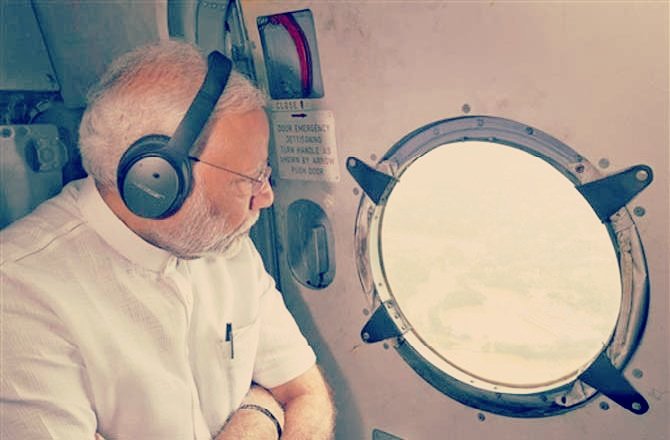
Starting with the Kerala floods of 2018, every time a natural calamity strikes, it has become almost fashionable to blame the Modi government for not giving enough money for disaster relief or at times, not even tweeting about the disaster! The WhatsApp group of “Self-declared Eminent Citizens” are typically at the forefront of spreading these rumours. At first, I did a cursory search in the Lok Sabha website and surprisingly found out that 1000s of crores of money was indeed given by the Central government to various state governments just in the past couple of years. Very curious, I dug further.
Under the Disaster Management Act, 2005, there are two kinds of funds set up exclusively for disaster relief – the National Disaster Relief Fund (NDRF) and the State Disaster Relief Fund (SDRF). In addition to maintaining the NDRF, the central government also used to contribute 75% of the funds of SDRF. So each state had to only contribute 25% to the SDRF (In the case of Special Category states, 90% came from the central government).
After the Modi government came into power, the total value of funds made available in SDRF for the period of the 14th Finance Commission (2015 to 2020) was increased from the previous INR 33,580 crores to INR 61,220 crores. That’s a startling 88% more money available for any kind of disaster relief. Additionally, starting April 1st, 2018, the Modi government has increased the centre’s contribution to the SDRF to 90%. Now, all states of the country get 90% of their SDRF funds from the central government itself.
The funds available in the SDRF are entirely at the disposal of the state government only. There is no need for the states to get the permission of the centre to use this money for all designated disasters. In case additional funds are needed, an Inter-Ministerial Team meets regularly to decide on how much to allot from the NDRF.
When the Kerala floods happened in August 2018, this WhatsApp group were at the forefront of this charade that while UAE was offering INR 700 crores for relief, our government had given only INR 600 crores. When the UAE offer turned out to be a big lie, this group went totally silent. And in December 2018, the centre released a whopping INR 3048 croresfor the Kerala Floods. This is in addition to the INR 790 crores already available in the SDRF, and also in addition to many other thingsdone at that time.
When the Titli cyclone hit the coasts of Odisha and Andhra Pradesh, the then AP CM, Shri N.Chandrababu Naidu was on the forefront of complaining that the centre was not giving him enough funds. Those were the days when he used to complain that the centre was not funding a new handkerchief each time he sneezes, but those were also the days when many people believed his propaganda. The cyclone hit the coast in October 2018. In addition to released INR 230 crores in October itself, the central government had given a totalof INR 539.52 crores for Titli relief from the NDRF. Do note here that the state government already has INR458 crores in the SDRF, 90% of which came from the centre only! By the way, Odisha received additional assistance of INR 1023 crores from the NDRF for Titli relief measures.
Similar noise was made when cyclone Fani hit the coast and impacted AP, Odisha and West Bengal on April 2019. In a shocking move, Mamta Banerjee did not even talk to the PM when the PM himself called to assess the damage. Yet, advance assistance of INR 1086 crore was released to the three states. An additional INR 1000 crores were given to Odisha only after the PM visited the cyclone ravaged state. People who wanted to call this an election gimmick could not do so, for the simple reason that the cyclone hit Odisha and AP *after* the election was over!
There was yet another outrage after the recent Karnataka floods. The centre has now released 1200 crores for rehabilitation efforts in Karnataka.
The expectation that as soon as calamity strikes, the central government should simply give as much money as is being demanded, is a totally unfair one. In all their responses to the various questions in the Parliament, the central government has a standard paragraph. It is important that we read it carefully (emphasis mine):
“Though the primary responsibility for disaster management rests with the State Governments, Central Government extends all possible logistics and financial supports to the States to supplement their efforts to meet the situation effectively. The concerned State Governments undertake an assessment of damage and provide financial relief in the wake of natural disasters including cyclone, from the State Disaster Response Fund (SDRF) already placed at their disposal. Additional financial assistance is extended from the National Disaster Response Fund (NDRF) by following the laid down procedure, which includes an assessment based on the visit of an Inter-Ministerial Central Team (IMCT).”
While we speak so much about money, there are many things that the Government of India provides as logistics support that doesn’t get counted into all the above amounts I have mentioned. Like the thousands of metric tonnes of relief material (Rice, water, milk etc); Like the helicopters/aircrafts the Indian defence forces have deployed; like the boats, the Navy deploys; like the occasional tax sops; like the additional trains run; like rebuilding the national highways and so on.
While it is indeed a fashion to blame Modi for everything, it is pertinent to note that the state governments usually tend to get away with this blame game. The state governments must be held more responsible for all the rebuilding efforts. With so much relief material that pours in from various parts of the country when disasters happen, what exact reason do the state governments have to not co-ordinate exemplary rebuilding efforts?
As for the lies propagated by the usual suspects, it is a shame that they simply dust it off when their cheap propaganda is pointed out.
For decades Pakistan’s all-powerful military has been in control of the country, whether directly as in military dictatorships or indirectly by the installation of a ‘puppet’ head of the government. Recently the Pakistan military has been quite reluctant in getting what it wants, jumping like a ping pong: its ‘selected’ candidate as Prime minister, its media critics hounded into compliance, creating a domestic ruckus from Kashmir issue and a reason to tighten its grip on the nation.
In their effort to wrest control and power from every possible institution, Pakistan’s military has so ruthless in crushing all forms of dissent that, at times, picking up the fight and challenging the brass seemed a fight not worth picking. On the contrary, the military has also been reluctant in ‘championing’ themselves as saviours of ‘humanity’ for every crisis outside the boundaries of Pakistan.
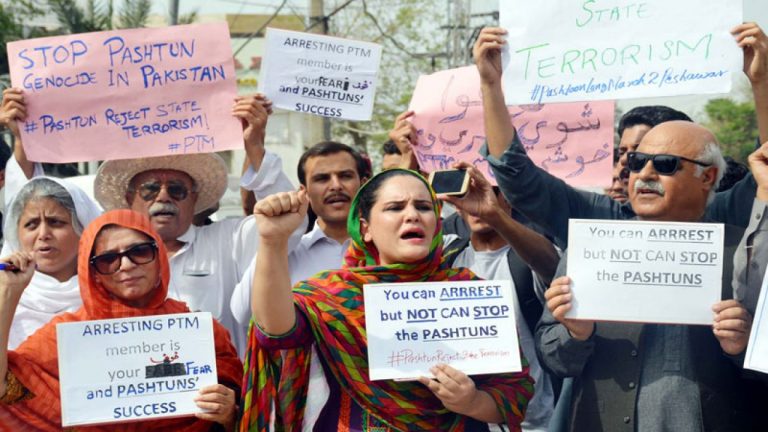
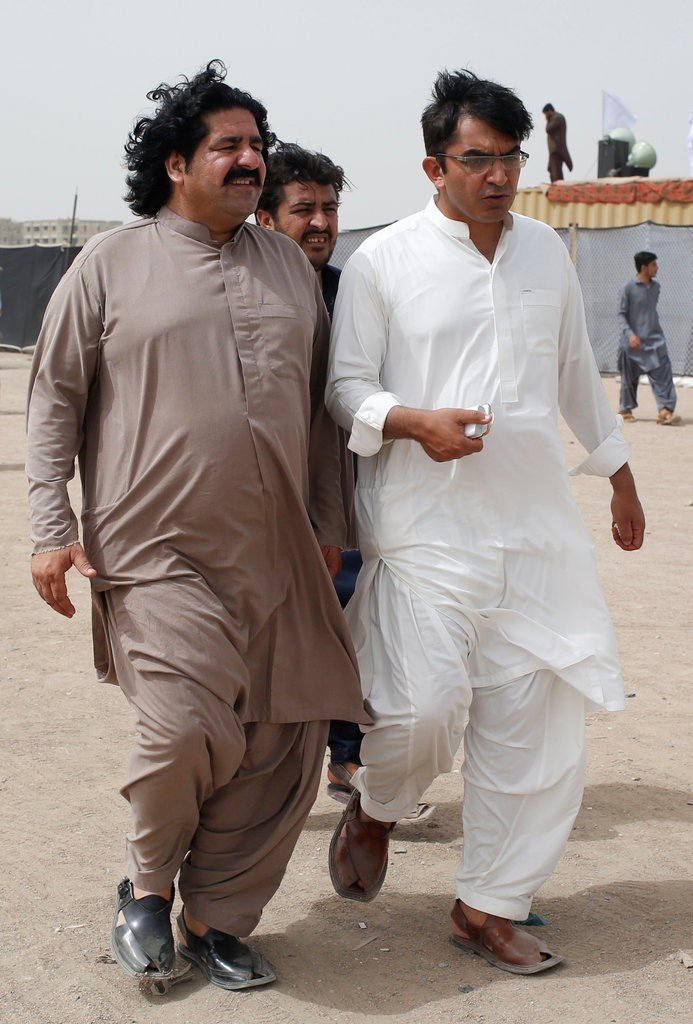
One more demonstration of Pakistani military’s authoritarianism and cellularly absolutists character was seen this year on May 26 when Pakistan tried to suppress a rights demonstration in the troubled region of Waziristan. At a peaceful protest organised by Pashtun Tahafuz Movement (PTM) – an umbrella organisation and a political movement for the protection of basic rights of Pashtuns in Pakistan – at Khar Kamar checkpoint in northern Waziristan, Pakistan’s dictatorial military initiated violent confrontation that left at least 13 people dead and 25 others wounded. The protest was led by two members of parliament — Ali Wazir and Mohsin Dawar — who are members of the Pashtun Tahafuz Movement (PTM). The military, being true to its suppressing tactics, arrested the Pashtun parliamentarian Ali Wazir for allegedly attacking the Khar Kamar checkpoint. “Their time is up,” Maj. Gen. Asif Ghafoor, the spokesman, said of the P.T.M. at a news conference insinuating about an ever harder approach towards PTM. “North Waziristan has become a black hole since the incident,” said Mohsin Dawar, post-arrest of his fellow Ali Wazir. “Curfew has been imposed. Phones are not working. Roads are closed. The entire district has become a jail.”
Ali Wazir and Mohsin Dawar
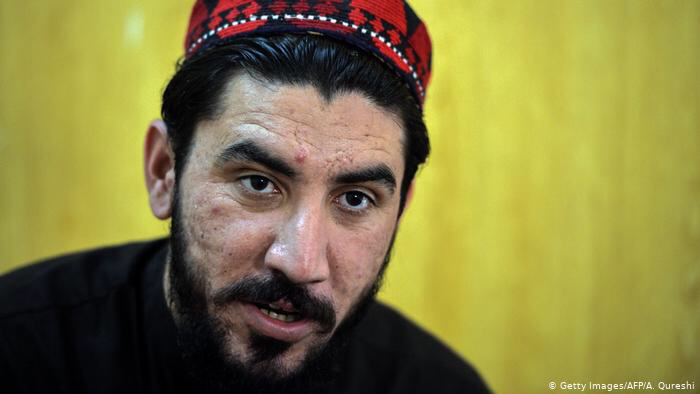
The protest was in reaction to a series of severe human rights abuses by Pakistan Army in the Pashtun tribal regions, predominantly the small region of Waziristan close to the Afghan border. The suppression was another failed attempt at crushing a voice of dissent, a movement gaining ground in Pakhtunkhwa. PTM movement is steered by a 26-year-old young dynamic leader from the improvised tribal background of Waziristan – Manzoor Pashteen – in a place where dissent is crushed, suppressed, silenced and censored as anti-state, anti-Islam or as a product of nefarious foreign influence.
Despite all cryptic attempts by Pak establishment, PTM rose to prominence from a small university in the remote outpost ranges of Waziristan in early 2018. Although the grievances PTM tapped into—discrimination against tribal people, violence by the Taliban, and military presence in the area—were long-standing, the trigger for the group’s recent explosion was the extrajudicial killing of an aspiring model and artist from Waziristan – Naqeebullah Mehsud –in the city of Karachi in January 2018.
Manzoor Pashteen
Months ago I wrote about the rise of Pashtuns against the state encouraged and deeply embedded discriminatory attitude of Pakistan Army towards Pashtuns. The situation hasn’t improved a bit, only subjecting to further deteriorations in Pashtun life. Naqeebullah’s killing was a quintessential example of Pakistan’s state espoused system of extrajudicial killings and human rights violations. The young boy’s death bought back all the dark memories of Pakistan’s discrimination against Pashtuns in the past.
Pashtuns in Pakistan have been governed through draconian colonial laws for years and upon that came Pakistan military with its ever-authoritarian oppressive character. Military pillorying collective punishment to all villagers for the crime of one person was the most frequent tactic, particularly in the Waziristan of FATA.
In suspicion of any Taliban links in the village, the Pakistani Army completely decimated the entire villages, bulldozing the homes of family members of suspected militants and inflicting collective punishments to entire community/village.
No Pashtunwali practices including Jirga were allowed by Pakistan forces in these cases. Landmines were installed in community areas of Pashtuns in villages in Waziristan of Khyber Pakhtunkhwa province. Instead of Taliban terrorists, these landmines used to affect average civilians, children and women.
Pakistani forces – an epitome of desuetude and egregious banality – used its well-versed tactic of arresting, kidnapping and extra-judicial killings of dissenting voices who dare to challenge the brass. Pakistan has a history of using these tactics and inflicting severe punishments on Pashtuns. One such heinous incident from the history was ‘Babrra Massacre’ of 12th August, 1948, when 600 unarmed Pashtuns supporters of Khudai Khidmatgar Movement, gathered on Babrra ground Hashtnagar, were brutally killed on the orders of Muslim League leader Abdul Qayyum Khan Kashmiri (the then C.M. of NWFP).
Even after this horrendous mass shooting of innocent civilians, neither A. Q. K. Kashmiri nor the Pakistan authorities, showed any grievances or atonement. Speaking at provincial assembly A.Q. Khan disparagingly said “They were lucky that the police ammunition ran out; otherwise not a single soul would have survived.”
There have been punishments meted out to students who support PTM and professors are forced to identify students attending rallies so authorities can take actions. Pashteen has been called a ‘traitor’ and a ‘terrorist’ by Pakistani establishments and PTM has been labelled as a foreign-funded organisation. Media coverage of PTM and Pashteen has been blocked and no media is allowed to air news about them.
“Punishment is all about sending a message to keep silent” told Pashteen to the Associated Press. Pashteen told “One thousand percent we were sure we would be killed”. Pakistan is a construct of preposterous institutions – a personification of fallacy – deeply enmeshed in extremism and hugely reliant on fawning. Impugning the Army spawns a series of severe punishments and sometimes extrajudicial killings.
“The military has become a state within a state”. “PTM leader Pashteen doesn’t mince his words and has made it clear who he holds responsible for the Pashtun suffering: “We have to identify the place that destroyed us,” Pashteen said at a recent rally. “It is GHQ!” he said, referring to the Pakistani military headquarters in Rawalpindi, cited a DW article.
One slogan that PTM regularly uses to highlight the misdeed of Pakistani forces is “Yeh jo dehshatgardi hai, is ke peechay wardi hai” (behind this terrorism, is the [military] uniform).
Pashtuns – who have been subjected to gross human rights abuses in their own land – are quickly morphing into an Achtung force for justice. The unremittingly difficult condition of Pashtuns in Pakistan is a gonged reminder to the world to wake up to reality and leave the bed of banality it is sleeping into for years now. Pashtun Tahafuz Movement is not an encoring performance steered for scoring brownie points, rather it is a strong rebuttal to the embedded world order, a chance of conformity towards realism for the entire global intelligentsia. The plight of Pashtuns in Pakistan must make the world to mirror Pakistan – when it ping pongs in every external conflict pufferying itself as the global human rights champion – that it needs to see no further than inside to exercise it’s supposed champion finesse.
Akeel Pathan, a murder convict in Gwalior jail has taken up reading the Shrimad Bhagwat Gita. He believes that religions teach unity, not divisions.
As per a report published in India Today, Pathan, who is a murder convict lodged in the Gwalior jail, has taken up reading the Bhagwat Gita after receiving a copy through an awareness campaign launched by ADG Gwalior Zone Raja Babu Singh.
Akeel has stated that he believes that religions always teach good things. He has been reading books in jail and being a Muslim, he has been reading books on his religion. But now that he has found a Bhagwat Gita, he has expressed a desire to read it and says he will try to understand the teachings and will implement them if he likes them.
As per the India Today report, Gwalior zone Additional Director General of Police Raja Babu Singh has started a campaign to create awareness about the Gita among various sections of the society. He even goes to schools to talk about the “Gita Gyan” with the children. Raja Babu Singh is often seen participating in spiritual talks and events. On the day of Dusshera, Singh distributed the copies along with rosary in the jail premises.
Speaking to India Today, Singh stated that he believes people become criminals and face jail due to their bad karma. He added that the Gita will show the path towards spiritual awakening and righteousness to those who have wavered.
The event saw a spiritual guru from Vrindavan, Anandeshwar Das Chaitanya, teach the inmates about the virtues of a righteous life. “The Gita is not just a religious book, it is a spiritual growth that a human being should accept as the life’s constitution. One who goes against this constitution of the country, lands in jail. Similarly, one who violates the spiritual constitution gets stuck in this life-cycle”, explained the guru.
The report states that many of the inmates, irrespective of their religion, have shown willingness to read the Gita.
The Gwalior jail has 3,396 inmates including 164 women. The women inmates have 21 children with them.
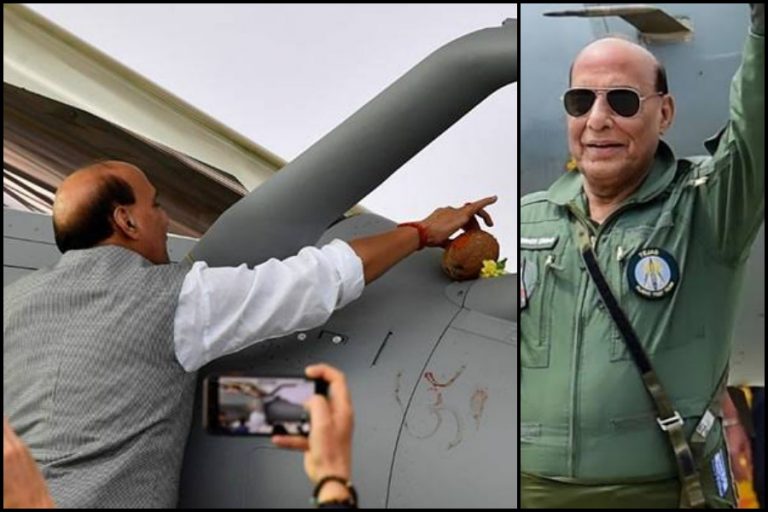
It’s a small gesture, but a strong assertion of identity. India’s Defence Minister Rajnath Singh performed Shastra Puja right before taking ownership of Rafale fighter jet.
Some years ago, when BJP was still in the opposition, there was a firestorm over purported comments from Rajnath Singh about how much damage the English language had done to the nation. The media of the day, a wholly-owned subsidiary of the government of the day, joined in the mockery: is it not regressive to turn our backs on English, the global language of science and commerce?
Except, the media had (deliberately?) missed the nuance in what Rajnath Singh had said. He had not blamed English (Angrezi) itself; rather he had blamed “Angreziyat” which could probably be translated as something like “Englishness.” He was referring to a worldview, one that demeans anything and everything Indian and imports everything from accents to superstitions from abroad.
An American friend who took a deep interest in India once asked me, my Indian news anchors, speaking in English, tend to mispronounce Indian names. This was around 2008.
As a result of this “Angreziyat”, the vast majority of Indians were cut out from the mainstream and all positions of power and privilege came to be occupied by a tiny elite. In doing so, we ended up wasting perhaps 99% of our human capital.
You will see much of the same attitudes play out over the Rafale induction ceremony from yesterday. Hundreds of millions of Indians will feel happy to see the several thousand years old Om symbol on the side of the ultra-modern Rafale. A few thousand people, perhaps even a few hundred people, will pooh pooh this, make all sorts of jokes about it and cry that India is going ‘backwards.’ The same people, however, would not grudge watching British royalty in their funny hats, carrying out all sorts of their arcane traditions.
Actually, without the rising tide of Hindu assertion, India will go nowhere. Because self-hatred has never been a successful way to develop a nation.
Imagine how amused the Germans would be if they found out that Indian elites are lamenting that our kids might not be learning enough German in schools. Lamenting that they might end up learning Sanskrit instead. Without German, how will Indian kids compete in the modern world? Who knows, maybe the way the French do just fine without knowing German, even though they live next door to Germany!
This pathetic self-hatred of our elites would be funny, except for all the real damage it has done.
The Chinese tried the cultural revolution. They wanted to get rid of everything in ancient Chinese culture and replace it with stuff that was “modern.” It ended in genocide and ruin. Then, they had a change of heart. Today, China upholds its ancient culture with pride. As China’s global power increases, they are able to export their culture and get the whole world to regard it with the respect and admiration it deserves.
The same goes for Israel. After the Second World War, the Jewish people finally had their own state. Their ancient Hebrew language was nearly dead by then. Most Jewish people coming into Israel from all over the world had lost the language generations ago. But Israel began a national project for reviving their lost tongue and today the language thrives in their country. At the same time, Israel has established itself as the only democracy in the Middle East and as a global technological power. All of it against seemingly impossible odds.
The British don’t get into bouts of self loathing about their kings and queens and funny-sounding hats and crowns and titles. They thrive on it. They see it as a treasured marker of British identity. People come from all over the world to see the wonder and the pageantry.
And there’s, of course, the French, from whom we purchased the Rafale itself. The French are unrelenting and unapologetic in the ideals of their revolution. The French insist on the complete removal of religion from the public sphere. That’s why the face veil is banned in France. No apologies. When in France, be like the French. Remember that France is the most visited country in the world. The world appreciates those who are authentic and true to their identity.
The world rarely appreciates rootless elites who have nothing to offer from their own culture but get by on pale imitations of those of others. Except when it needs them as useful idiots.
The election of 2014 brought about a deep churn in Indian society. The classes left out from “Angreziyat” came to the fore and took control of their own destiny.
And you may have noticed that Indian news anchors no longer mispronounce Indian names.
I don’t know about you, but I’m actually looking forward to Indian elites making fools of themselves hating on the Om symbol on the side of the Rafale.