The Union Cabinet has approved the inclusion of 5,300 Displaced Person (DP) families of Jammu & Kashmir-1947 who initially opted to move outside the state of Jammu & Kashmir but later on returned and settled in the state, in the Rehabilitation Package for Displaced Families of PoJK and Chhamb under the PM’s Development Package 2015 for Jammu & Kashmir. Initially, these families were kept out of the Rehabilitation Package approved by the Union Cabinet on 30.11.2016. The families will receive ₹5.5 lakh as compensation under the package.
The government stated that in the wake of the 1947 Pakistani aggression in J&K, 31,619 families migrated from Pakistan Occupied Areas of J&K (PoJK) to the state of J&K. Of these, 26,319 families settled in the state of J&K and 5300 families initially opted to move out of the state to other parts of the country. Furthermore, during the Indo-Pak wars of 1965 and 1971 10,065 more families were displaced from the Chhamb Niabat area. Of these 3,500 families were displaced during the 1965 war and 6,565 families were displaced during the 1971 war.
The government further stated that 36,384 displaced families covered under the package approved by the Cabinet on the 30th of November, 2016 included 26,319 displaced families from PoJK settled in J&K and 10,065 Displaced Families displaced from Chhamb Niabat area. The 5,300 DP families of PoJK who had initially opted to move out of the state of J&K to other parts of the country were not included in the approved package. Now those DP families who had moved out of the State but later returned and settled in the state are being included in the package.
The government said that the inclusion of these Families in the existing scheme will enable them to earn a reasonable monthly income and become a part of mainstream economic activities. It will also improve the Government’s capacity to respond effectively to such families who are in need of financial assistance. The requirement of funds will be met out of the already sanctioned funds for the existing scheme.
After the abrogation of Article 370 and the decision of the Union government to bifurcate the state into two Union Territories, the government has announced various administrative reforms directed towards improving the circumstances in the state. The latest move towards the inclusion of DP families in the rehabilitation package is further directed towards improving the living conditions of people in the state.
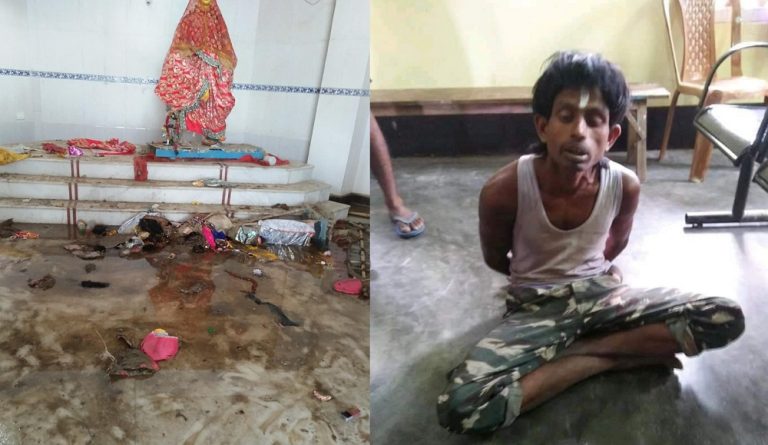
High tension prevailed in Barpeta town in Assam after a Lakshmi temple was vandalised and looted by a Muslim man today. Apart from vandalising the temple, it was also torched by the man.
According to reports, the idol of Goddess Lakshmi at the historical temple in Keotkuchi area in Barpeta was damaged by one Rafiqul Ali in the early morning on 9th October. He had also looted the temple and damaged the floor tiles and other items kept at the temple. Rafiqul also tore banners and posters, and damaged decorations, which were put up at the temple for the upcoming Lakshmi Puja on 13th October (in Assam and some other eastern states Lakshmi puja is celebrated on the full moon after the Vijaya Dashami, while Kali Puja is celebrated on Diwali after a fortnight).
After vandalising the temple, Rafiqul Ali had proceeded to torch various items of the temple, along with cloths of the Lakshmi idol. Seeing fire coming out of the temple, locals arrived at the scene and caught the perpetrator red-handed, who was hiding in a corner of the temple. Gold and silver jewellery and other valuables were found with him which he had looted from the temple. A dagger was also found which he was carrying.
The local people have handed over the man to the police, who surprisingly remained in the temple after vandalising and looting it, instead of attempting to flee. He was identified as Rafiqul Ali, a resident of Shantipur in Bhella area of the Barpeta town.
Additional police forces have been deployed at the area to prevent any communal conflict as a result of the incident.
As Durga Puja, which is celebrated with fanfare by Hindus across the country came to a close, a visarjan procession in the bylanes of Balrampur, Uttar Pradesh came under siege by the Muslim residents of the area. Stones were pelted, Hindus were attacked and injured, some, allegedly even with swords.
The police have arrested 8 Muslim residents who were actively involved in the stone-pelting. Several others are absconding and the Balrampur police have deployed 4 units to look for the miscreants.
When OpIndia spoke to the police, the Additional Superintendent of Police expressed suspicion that the entire thing may have been pre-planned. When one looks at the video, one is convinced that the scale of mobilisation cannot be spontaneous. The police believe that the attack may have happened because the procession did not switch the music off while passing the local Mosque.
Suraj Pandey, one of the Hindu victims, however, has a different take. Suraj says that he was attacked with a sword and is currently injured. Speaking to OpIndia, Suraj was convinced that the Muslim residents of the locality had meticulously pre-planned this entire siege and the attack had nothing to do with the music not being stopped near the Mosque.
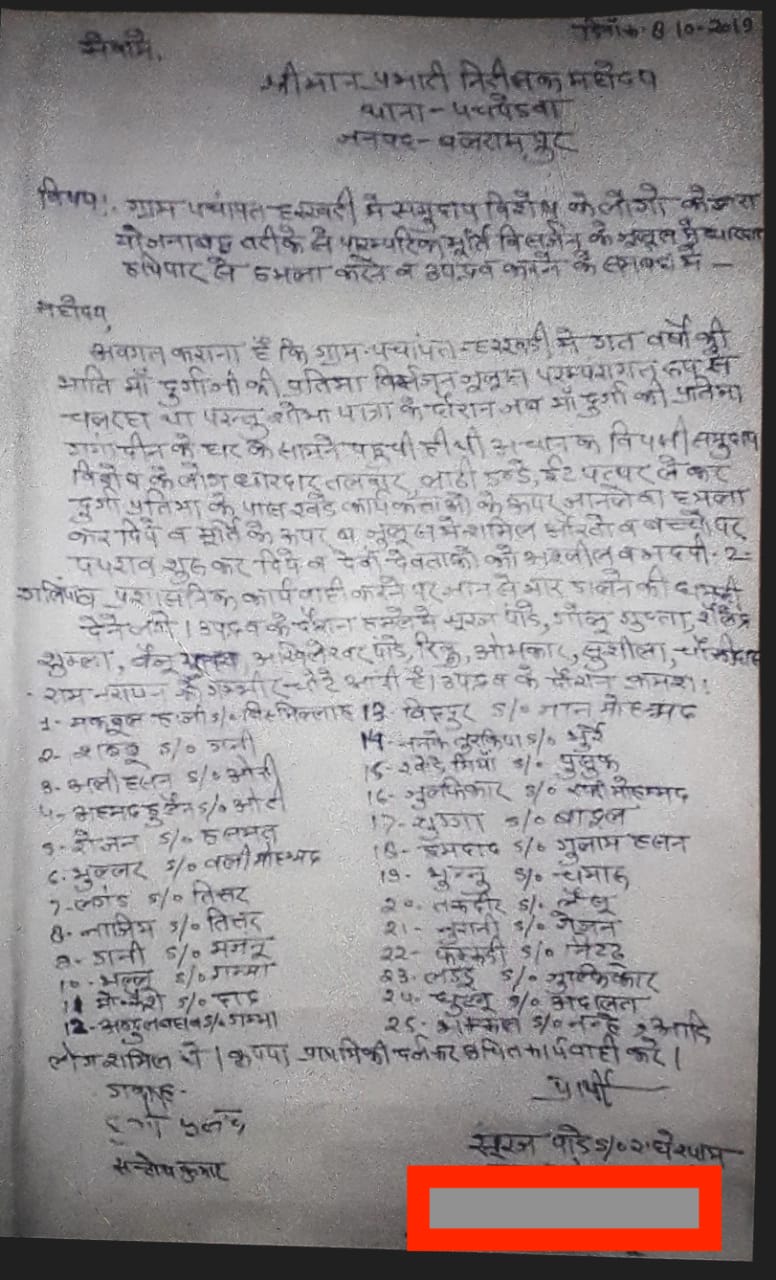
Suraj Pandey, a resident of the area is the one who had filed the complaint against 25 members of the Muslim community who had allegedly instigated and orchestrated this attack against the Hindu community.
Complaint filed by Suraj
According to Suraj, on the day the Hindus came under siege, he was walking through the same lane much before the procession was taken out. Suraj was walking through the same lane and was crossing house where a certain Zulfikar stays. According to him, while he crossed the house in the morning, Zulfikar threw a stone at him. This ensued in a mild argument which was then calmed down by Zulfikar’s old mother who asked Suraj to forgive the ‘young boys’ who were just doing mischief.
Suraj on his part paid heed to what Zulfikar’s mother was saying and did not make much of the incident. He proceeded home to prepare for the visarjan procession that was to be taken out later that day. “If I had told my people about this, maybe we would not have come under attack later. This was all pre-planned”, Suraj said. When the mother pleaded with Suraj to let go of the incident, he thought it must have been really been young boys were simply playing mischief, but the doubts were sowed. In retrospect, Suraj seems to believe that the incident was the first indication that the Muslim community was planning to attack the Hindu community and had started collecting stones and weapons in a pre-planned manner.
Suraj says that every year for the past several years, the Durga Puja visarjan procession has followed the same route with no deviation whatsoever. In the previous years, there has been no animosity between the Hindus and Muslims of the areas other than minor arguments that have always been resolved and ignored. Flummoxed as to why this year, the Muslim community decided to attack the Hindus, Suraj tells a scary tale of what ensued that fateful evening.
He claims that before the procession, the members of the Muslim community pretended to support the Hindus and display ‘brotherhood’, as they do every year. He says that in that locality, the Hindus and Muslims used to sit together and the Hindus used to even share ‘prasad’ with the Muslims. In fact, this time too, before they started pelting stones at the Hindus, several Muslims had walked with the Maa Durga murti till they started attacking the Hindus.
This year, however, the story was different as per Suraj’s claims. As soon as the procession turned the corner, at first the Muslim community started allegedly throwing garbage at the Hindus who were participating in the Durga Puja procession. Within minutes of throwing garbage, they started throwing stones, sticks and rods. Suraj says the stones were not just small stones, but heavy bolsters too.
Recalling the ordeal, Suraj tells OpIndia that in the process, he was attacked with a sword. Allegedly chanting ‘Pakistan Zindabad’, stones and sticks came raining down on the Hindus from all quarters including the roof of the Mosque. While Muslim men, women and children, including “Mullas from the Mosques” continued to rain stones on the Hindus, the Hindus hid for their lives. “We had nothing except Maa Durga’s murti, what could we do”, says Suraj.
Upon being asked whether the Muslim community was enraged because the Hindus did not stop the music while crossing the Mosque, Suraj rubbishes the claims flatly.
He says that every year, the Hindus ensure that the music is stopped while crossing the Mosque out of respect. They have set up a divider near the Mosque. He says that while the procession is away from the divider, the Hindus usually dance and sing to their heart’s content. Upon reaching the divider, the music is switched off and then resumed once the Mosque is crossed. This time, however, the Hindus did not get the opportunity to switch the music off at all. Even before the Hindus could switch the music off, the Muslim community allegedly started throwing garbage at the Hindus and soon, started raining stones.
Suraj names three Muslim locals as the masterminds of the attack. Maqbool Haji, Najim and Langad. He says there are several others from the same area, but he doesn’t know them too well.
Suraj Pandey claims that he and his fellow villagers have no idea why the Muslims did what they did this year. “If they chant Hindustan Murdabad won’t we feel bad”, he says. “Nobody knows what is in the other person’s heart. We still don’t know why they attacked us”, he says.
Suraj, however, is satisfied with the action taken by Balrampur police. He says they are doing their job adequately and have arrested 8 people thus far, with others being on the run.
The police had released a press note that said that a complaint had been filed against 24 named people and several unnamed individuals. There are 4 units of the police who are currently looking for the absconding accused. The police have also said that the law and order situation is under control in the area and the visarjan was conducted peacefully after police intervention.
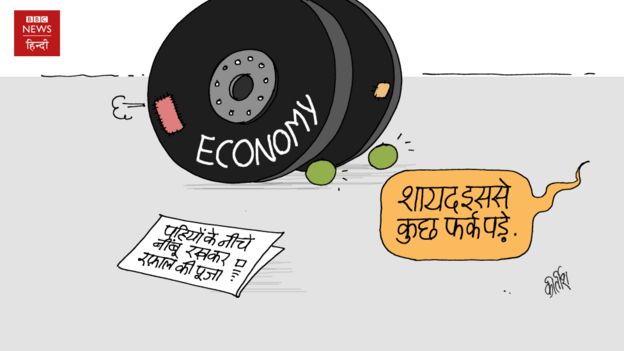
The BBC is back again with its overt display of Hinduphobia. In a cartoon mocking the Shastra Puja ritual conducted by Defence Minister Rajnath Singh while receiving the Rafale jets in France, the Hindi branch of the news organization took a dig at the thousands of years old Hindu ritual in its efforts to take potshots at the Indian economy.
As part of the Shastra Puja ritual, two lemons were placed in front of the wheels of the aircraft. In the cartoon, two lemons were placed in front of the wheels which had ‘economy’ written on them. The cartoon carried the caption ‘Shayad isse kuch fark padh jaaye (maybe this could change the fortunes)’.
It is rather unthinkable that the BBC will dare to mock the religious traditions of any other religious community in such a manner. For a news organization that helped create an entire business out of the Islamophobia hoax, it is extremely revolting that they are attacking the sacred religious traditions of Hindus. The BBC, which hasn’t even made any effort to counter the ‘Hijab is a choice’ narrative, is busy mocking the religious faith of Hindus.
Such differential treatment of religious communities has become the hallmark of the Western media. While they mollycoddle radical Islamists and the fundamentalist sections of the Islamic community, they go out of their way to mock the religious traditions of other communities. Such differential treatment only further drives home the narrative that the western media has become the propaganda wing of Radical Islam.
Recently, the BBC Radio said that veteran show host Lord Singh talking about Sikhism would offend Muslims following which he quit in protest. Not too long ago, a producer at NPR was forced to resign after her Hinduphobic tweet went viral on social media. US Congresswoman Tulsi Gabbard has often been attacked by western media due to her Hindu identity as well. The conduct of western media in recent times only shows that Hinduphobia is endemic in Western Media and it is making no effort at all to address the problem.
As for the BBC, it has a problem with anything that unites Hindus. Our readers would remember they had published a ‘research‘ linking Hindu Nationalism with the rise of Fake News in India, which ironically, was the biggest example of Fake News.
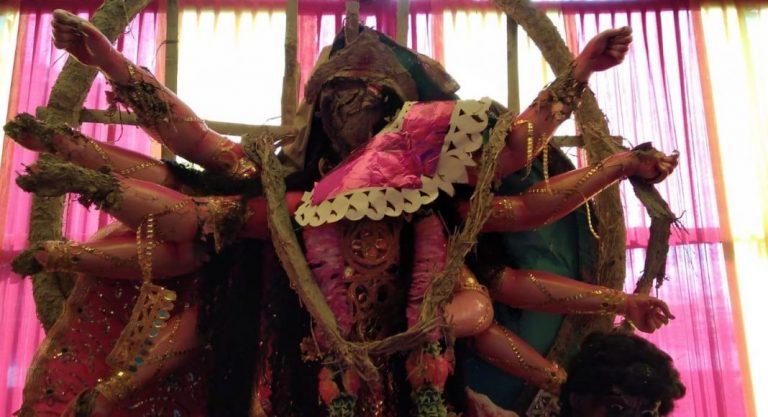
Several idols of Maa Durga were vandalized in Doimukh, Arunachal Pradesh. As per reports, some miscreants had on the intervening night between the 5th and 6th of October, had damaged several Durga idols of the Doimukh Bazaar Welfare Committee’s pandal.
The idols were decapitated and defaced. President of the welfare committee Dobum Robi said that the attack was unprecedented in the town’s history. The organisers of the puja committee have appealed for peace and requested people not to communalise the incident.
The Police have thus far arrested three miscreants for the hate crime. “The group of miscreants vandalized the idols of Goddess Durga and fled from the spot. They escaped in a Tata Tiago car which later helped police to identify and apprehend them,” SP Yupia said. The incident has created a furore on social media. Some people have pointed out that all the perpetrators in the incident belonged to the Christian community.
Papum Pare Superintended of Police Jimmy Chiram claimed that the issue was not communal in nature and was related to a personal dispute. “An FIR (u/s 295/448/427/34 IPC) was registered, statements were taken, and investigation initiated,” the SP said. “They entered the pandal and got into an altercation with the guard and vandalized the idols. They escaped in a Tata Tiago car. The police were able to identify the car and were able to apprehend the trio. The police have found no evidence to indicate a communal issue in the crime,” he added.
An appeal has been made to not communalize the issue. “The issue should not be communalized. We have organized different fairs and festivals involving all tribes and communities. Such an incident has not happened earlier. The enthusiasm is still the same among the devotees. We have managed to get small idols to continue the puja,” one of Puja committee members told the media.
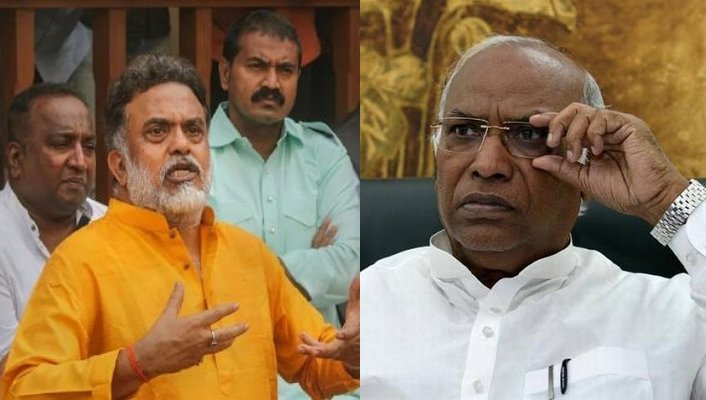
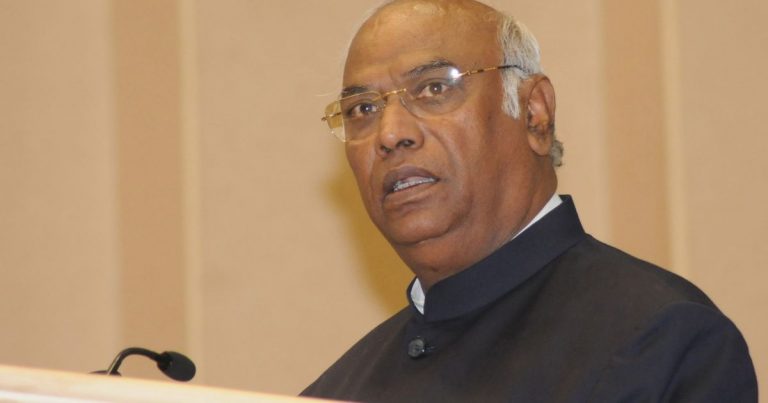
Congress leader Sanjay Nirupam, who is in rebel mode these days as he is dissatisfied over ticket distribution in Maharashtra assembly election, has yet again criticised veteran party leader Mallikarjun Kharge. Nirupam said that Shastra Puja (weapon worship) is an old tradition and it can’t be called tamasha, but the problem is that Kharge is an atheist.
Sanjay Nirupam, Congress: ‘Shastra puja’ cannot be called a tamasha. There has been an old tradition of ‘shastra puja’ in our country. The problem is that Kharge Ji (Congress leader Mallikarjun Kharge) is an atheist. In the Congress party, not everyone is an atheist. https://t.co/xFMmsXSTJjpic.twitter.com/0yEYC3RuGM
Sanjay Nirupam was referring to Mallikarjun Kharge’s comments today where he had criticised Defence Minister Rajnath Singh for doing Shastra Puja of the 1st Rafale jet built by Dassault. The defence minister had performed the traditional rituals for the jet in France on 8th October, on the occasion of Dusshera and Vijaya Dashami.
Reacting to that, Kharge had said there is not need for such ‘tamasha’, adding that Congress government didn’t show-off the Bofors gun. The veteran Congress leader had made a massive self-goal in the process, as invoking the Bofors gun also leads to reminding people about the Bofors scam.
And now he is being criticised by his own party leader for the same. Sanjay Niruman said that the Shastra Puja cann’t be termed as Tamasha as Kharge claims, as there has been an old tradition of Shastra Puja in our country. He added that the problem is that Kharge is an atheist, but not everyone in Congress is an atheist.
Today Home Minister Amit Shah also hit back at Congress for criticising the Shashtra Puja, saying that the party should introspect the things that need to be criticised. “Rajnath Singh performed ‘shastra puja’ of Rafale yesterday in France. The Congress did not like it. Is ‘shastra pujan’ not performed on Vijayadashami? They should ponder over what needs to be criticised and what not,” Shah said in an election rally in Haryana.
Congress has problems with:
Air Force modernisation.
Indian customs and traditions.
For a Party used to worshiping Quattrocchi, ‘Shastra Puja’ is naturally a problem.
BJP also said that the Congress party has problems with Air Force modernisation and Indian customs and traditions. “For a Party used to worshipping Quattrocchi, ‘Shastra Puja’ is naturally a problem. And, Kharge Ji, thank you for reminding us about the Bofors Scam,” said the party in a tweet posted from its official Twitter handle.
Nirupam had attacked Kharge on Monday also, when he said that Kharge is a strategist suffering from malafide intent. He had accused Kharge of calling a meeting to formulate strategy but denying others the opportunity to speak. He said that Khage spoke in the meeting and then made fun of him.
Time and again the country has seen that various agencies and departments within the same state are not able to coordinate with each other, interact with each other hence there is considerable delay in delivery of essential services and or escalation in time and cost. This problem becomes even bigger if we talk about coordination between a state government and the central government. A typical example of this is rescue operations during a natural calamity. If this was not enough then add a lot of politics into this and what we have on the platter is a big disaster. Yes, the same types that we are so used to watching. The country hasn’t forgotten the fact that truckloads of relief material were waiting to move during Uttarakhand floods because President of Indian National Congress and her son were yet to flag off the trucks.
However, an example of the state government and the central government working together to fulfil the mandate they have been given is seen in Maharashtra. Since the last five years, both these bodies have worked so efficiently and seamlessly that the development work that would usually take decades to plan was not just started but was commissioned as well within 5 years.
These facts can be compared based on authentic and verifiable data. 1.2 million homes were supposed to be built in Maharashtra state under the Aawas Yojana scheme for rural poor housing. This objective was completed 2 years before the due date. Like I said before we aren’t used to achieving targets, forget about being on time and cost limit. Another such example is the Mundra Scheme where 100% of households in Maharashtra now have access to a bank account as 2,59,66,776 accounts were opened in the state. Cumulatively these accounts have a net balance of INR 6,199 Cr approx as well.
Similar is the case with Mudra Loan beneficiaries which total to about 1.05 crores with a total loan disbursal amount of INR 54,000 crores. With such a scheme lacking earlier I wonder how the small businesses used to manage their credit requirements. That’s when you figure out the ill’s of money lenders were so prevalent in the country. No need to mention the harassment and high cost of credit attached to this. We don’t realise the effect Mudra loan has had on the social welfare and job creation front. Nobody likes to borrow for getting harassed. Rural folks do appreciate this for both the central and the state government efforts. No wonder the CM has won every election held in the state since 2014 and has delivered a bigger mandate in the 2019 general elections as well for the BJP.
Under the Atal Pension Yojana launched by the Prime Minister during his first term as PM, Maharashtra has been one of the biggest beneficiaries. 7,58,695 workers are now availing the benefits thereof. If you ask me about a recent example of what happens when two different governments are in power in state and centre and one of them is into politics and not governance? Then I draw your attention to the plight of the farmers in Madhu’s Pradesh who are not availing the PM Kisan Nidhi Yojana benefits because their state government did not opt for it. This had no financial burden on the state. All they had to do was send a list of beneficiary farmers to the centre and money would have gotten credited to the farmer accounts directly but then politics came in between. Whereas the farmers in Maharashtra are enjoying the direct credit of pension from the centre.
Similar efficiency gains and committed efforts can be seen in other fields like farm Sadak Yojana which aims for providing all-weather piccata roads to the rural folks. The funding agency, in this case, is the centre but the implementation agency is the state. When the central government decided to work on the ease of doing business rankings then many of the parameters on which the country is gauged were to be completed by the states as well. For eg: access to electricity or the land reforms. These rankings do not cover the entire country but cover the states of Delhi and Maharashtra. Data clearly points out that the Maharashtra state-aligned very well with the central government’s vision and improved its ranking manifold.
The best part about these things is the awareness of the new age voters. They are understanding these issues and are voting based on them instead of the age-old politics of regional caste factors.
“There were some things I couldn’t live with. While you were gone, I had some very intense spiritual experiences which I cannot explain to you. Those experiences made me take certain actions. I am emailing you to let you know that I am perfectly alright,” read the email that the mother of Vrushti Kothari received from her daughter days after she went missing.
No one’s sure yet if the email was indeed sent by Vrushti herself. The police, meanwhile, are trying to verify the identity of the person who sent it and is trying to ascertain the IP address of the computer from which it was sent. The email was sent on the 7th of October at 3.22 p.m. in the afternoon.
Vrushti (24) went missing on the 1st of October along with her friend Shivam Patel (25). Vrushti is a fashion designer who lives with her family in Bodakdev, Ahmedabad. She had gone to visit her childhood friend and her driver had dropped her off at Shivam’s house in Vasant Vihar near H L Commerce College on the 30th of September. Her phone remained untraceable for the next two days following which her mother took to social media for help.
Her mother succeeded in attracting the attention of actress Soha Ali Khan whose post on the matter pushed the Police into action. Authorities suspect that the two could have eloped, however, it doesn’t make much sense as the two were well acquainted with each other and they visited each other at their respective homes often.
On Saturday, the Police claimed to have spotted Vrushti Kothari and Shivam at Ahmedabad Railway Station carrying bags. The guy was wearing a light blue collared Tshirt, jeans and a cap while the girl was in a maroon polka-dot dress. However, Vrushti’s family refused to accept that the woman seen in the CCTV footage was the missing girl.
DCP (Zone-1) P L Maal said, “Based on the features of two people caught on CCTV cameras near Shivam’s residence, we scanned CCTV footage at different locations in the city. We spotted two persons with similar features boarding a train at Kalupur railway station. However, Vrushti’s mother has refused to accept the girl as her daughter.”
Maal added, “Primary investigation reveals that the two had kept their bags in the luggage room earlier. And, collected it later. We are also trying to find out which train did the two board. They could have got onto a train headed for Gwalior in Madhya Pradesh or some city in Rajasthan. Once we figure out their destination, teams will be dispatched in that direction.”
The maternal grandfather of Vrushti Kothari, Abhay Kothari told Mirror, “Police showed the footage from the railway station to my daughter. She told them that the person is not Vrushti. My grand-daughter is 4 feet and 11 inches tall, while the girl in the CCTV footage looked taller. The girl had a darker skin tone compared to Vrushti. Her hairstyle was different, too. The girl’s forehead was clearly visible. Vrushti’s forehead was not, due to her hair cut. Vrushti would have had to tie her hair above her head to expose her forehead.”
Meanwhile, the Police discovered bottles of alcohol at Shivam’s place. The Police asserted that a case will be registered against the missing boy if the alcohol was not purchased through a permit.
Thus, we have a couple of childhood friends who went missing without any apparent reason. The mother of the missing child receives an email from someone who claims to be her daughter, could very well be her daughter, which speaks of the missing girl going through some intense spiritual experiences.
Then, we have CCTV footage which the Police thinks shows the missing girl but her family denies strongly. In the midst of it all, we have two very worried families who have no idea what has happened to their children. The Police, meanwhile, doesn’t have much clue about the whereabouts of the two missing people. Investigations are currently on and headway into the matter could be made soon.
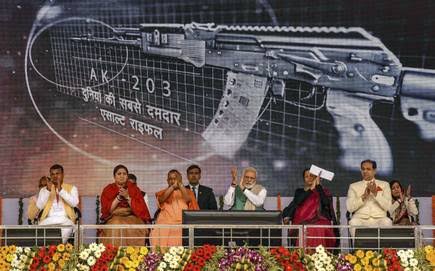
Following the Army’s technical clearance and a commercial bid likely to be submitted by next month, the rifles factory in Amethi which was inaugurated in March is all set to receive an order to manufacture 6.7 lakh Kalashnikov assault rifles soon.
The joint venture Indo-Russian Rifles Private Limited for production of AK 203 assault rifles is all set to get an approval at an acquisition meeting later this month and will move to the subsequent stage of the inking of the contract to start manufacturing.
Initially, during the first phase, 6.7 lakh rifles will be manufactured for the Army and the count will soar to at least 7.5 lakh depending on the requirements of other forces. The technology transfer clause of the deal will be fulfilled after the first one lakh rifles are manufactured, following which all components of the weapon system will be produced in India. The project is expected to produce AK 203 rifles that will cost about $1000 each.
Though the Amethi factory was officially inaugurated earlier in March, it was yet to get orders as they had to go through the acquisition process of negotiating technical and commercial terms. As per sources, the deal inked with Russia mandates complete transfer of technology on modern assault rifles to India.
Hailing the joint venture, a top Army officer said that it is an epitome of how India has gained technology transfer through planned acquisitions. The joint venture for manufacturing of Kalashnikov rifles has been acclaimed as one of the ‘fastest’ ones brought about by Russia for an Indian venture.
In addition to this, the factory is getting operational with the supplied equipment to manufacture weapons and armaments procured. Besides, a serving Major General from the Army is been assigned the job of supervising the development.
In yet another massive self-goal scored by Congress party, senior Congress leader and former Leader of Congress in Lok Sabha – Mallikarjun Kharge on Wednesday called the ‘Shastra Puja’ as a ‘tamasha’ and attacked Defence Minister Rajnath Singh for performing it as he received the first Rafale aircraft on the day of Vijayadashami.
Mallikarjun Khage, Congress on Defence Minister officially receiving Rafale aircraft in France & performing ‘Shastra Puja’: There is no need to do such ‘tamasha’ (drama). When we bought weapons-like the Bofors gun previously purchased, no one went & brought them while showing off pic.twitter.com/ITM0IpSMw6
Calling Shastra Puja as a ‘tamasha’, Kharge further said that the previous Congress government bought weapons like the Bofors guns, but no one went and brought them by showing off. In a hurry to attack the Modi government, Kharge recalled the Bofors scam to compare it with the Rafale deal.
“Our Air Force officers judge whether they are good or not. These people go, show off, sit inside (the aircraft),” said Kharge.
Interestingly, while the quality of Bofors and Rafale have never been questioned, Kharge also indirectly hinted that the quality of the Rafale will be judged by the Air Force. Kharge seems to forget that the IAF had wanted to Rafale even during the Congress tenure but the Congress had asserted that they had no money to buy the jets. In fact, there was also speculation that the Congress party had not purchased the Rafale because they wanted to buy the Eurofighter. Christian Michel, Congress era middleman in the Agusta Westland case was also a middleman for Eurofighter as was Defence Dalal Sanjay Bhandari who has close links with Robert Vadra.
The controversial Bofors deal, which is known to be the first inter-continent defence scam had linked former Prime Minister Rajiv Gandhi. There were exclusive investigative reports that had questioned Sonia Gandhi’s Italian family involvement in the Bofors scam. OpIndia had earlier accessed evidence to show that Sonia Gandhi’s Italian family could have been involved in the Bofors scandal, with their names carefully hidden from the public eye.
The Bofors deal for 155 mm field howitzers which Kharge referenced became a big scandal during the erstwhile Rajiv Gandhi government, with senior government functionaries accused of taking kickbacks in exchange of approving the deal.
Since yesterday, the Congress party has been continuously attacking the Modi government after Defence Minister Rajnath Singh performed the Shastra Puja on Rafale aircraft and wrote ‘Om’ on it. Union Defence Minister Rajnath Singh had visited France to receive the first unit of Indian Air Force’s Rafale fighter jet from France which also coincided with Vijayadashami and also Indian Airforce day.
Shashtra puja, the weapons’ worship as part of Dussehra celebrations, came under attack from the Opposition parties especially the Congress party. Congress leader Sandeep Dikshit accused the Narendra Modi government of saffronising the Rafale handover. “This religious context of Vijayadashami and the Rafale aircraft doesn’t match. A festival that all of us celebrate, why should it be linked with an aircraft?” said Sandeep Dikshit courting a controversy.
Former AAP leader Alka Lamba, who recently joined the Congress brought in communal references to attack Modi government for performing Shastra Puja. “If former Defence Minister AK Antony would have been the Minister of Defence or former President Dr APJ Abdul Kalam had this fortune today, what would have happened had taken Bible and Quran as per their religion like Rajnath Singh?” Alka Lamba wrote on Twitter.
Alka Lamba went on to mock Rajnath Singh as she tweeted a photo of lemons placed under the wheels of the jet. “France made Rafale has not even reached India and India has already achieved its first major success by squashing two green lemons and saved the country from the eyes of the evil.”
Meanwhile, Union Home Minister Amit Shah has hit back at Congress party after they criticised Rafale Shastra Puja performed by Defence Minister Rajnath Singh. Home Minister Shah said that the sole purpose of Congress was to oppose the Bharatiya Janata Party (BJP) and stated that the puja was performed by the Defence Minister as per Indian traditions.
“Congress did not like it. Is Shastra puja not performed on Vijayadashami? They should ponder over what needs to be criticised and what not,” Amit Shah said a rally in Haryana on Wednesday.