Home Blog Page 6054

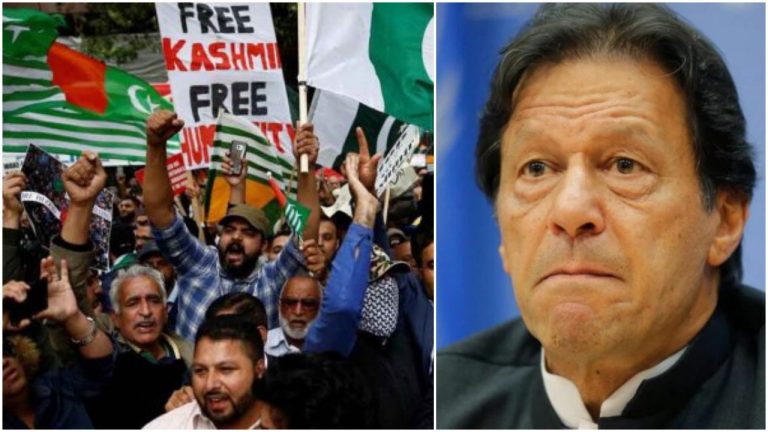
Imran Khan’s party PTI and organisation linked to Hizbul Mujahideen behind anti-India protests at Houston

0

A desperate and isolated Pakistan facing humiliation across the world for its state-sponsored terror policy attempted to create chaos as their proxies – radical Islamists and pro-Khalistani terrorists had thronged to the NRG stadium, the venue of the “Howdy, Modi!” to try and disrupt the community event to be addressed by PM Modi. An OpIndia investigation has revealed the protest organisers’ relationship with these radical Islamist and pro-Khalistani elements earlier.

An investigation conducted by India Today has revealed that there have been direct links between Imran Khan’s Pakistan Tehreek-e-Insaaf and Khalistani and radical Islamist groups that had created chaos at the NRG stadium during the “Howdy, Modi!” event on September 24. Shockingly, the shabby plan of Pakistan to disrupt the “Howdy, Modi” rally was devised directly while keeping Pakistan Prime Minister Imran Khan in the loop.

According to the Sunday Guardian investigation, the protests also got support from Islamic organisations linked to terror group Hizbul-Mujahideen.

The visit of Pakistan Prime Minister Imran Khan to the US and the subsequent propaganda carried out by the Pakistani establishment against India since the abrogation of Article 370 was aided by massively funded “Pakistan friendly” media coverage in the US and global press on the issue of Kashmir. The India Today Open Source Investigation (OSINT) has now threw light on the methods and characters employed during this campaign by the Pakistani deep state.

Behind the Imran Khan’s propaganda in the United States, the investigation reveals that a shell NGO and an advertising blitzkrieg backed by PR firms in the US was responsible for anti-India protests that were carried out by pro-Pakistan groups with the support of Tehreek-i-Insaf and organisation linked to Hizbul Mujahideen.

The NGO – International Humanitarian Foundation Inc

An NGO named International Humanitarian Foundation Inc. (IHF) was behind the Pakistani campaign, which was the main organiser of the anti-India protest in Houston on September 22 at the NRG Stadium in Houston. On September 27, the New York Times ran a full-page ad with false and misleading headlines like “The Seizing of Kashmir is Blatant Racism,” and “8 Million Under Siege by a Million Soldiers Since August 5th.” The sponsor for the advertisement was listed as the International Humanitarian Foundation.

According to advertising rates of the New York Times, this advertisement alone would have cost at least $100,000 to the IHF.

Further, the website of International Humanitarian Foundation, which is managed by a resident of Houston but who is originally from Rawalpindi, became active in July-August this year. IHF which claims to be an international humanitarian non-profit has no visible body of humanitarian work in any other region of the world on any other issue. The NGO was brought into existence in July, after the announcement of the “Howdy, Modi!” event specifically with a purpose to disrupt the event.
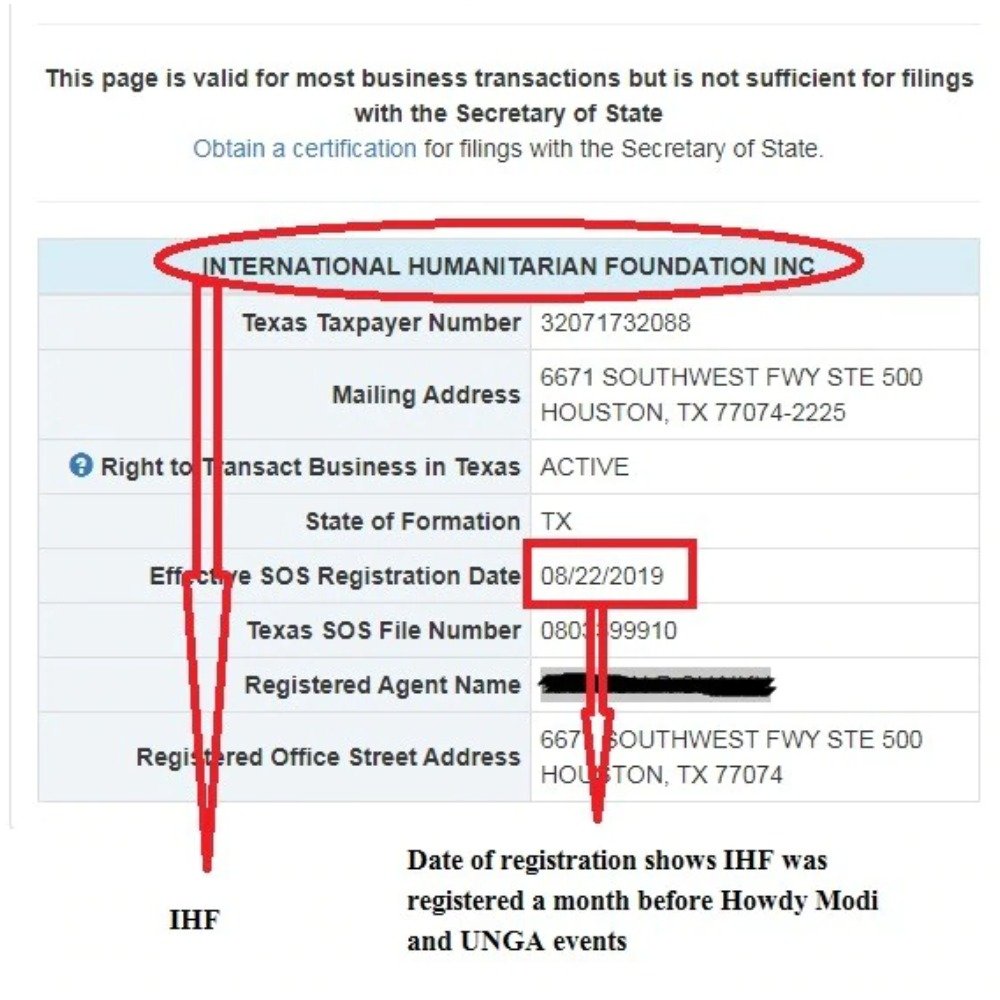
Image Source: India Today

Reportedly, the individual behind the website and the Facebook page also runs a Twitter handle of the “Overseas affairs of Pakistan Tehreek-e-Insaf (PTI)” and is a prominent PTI voice of Houston. A major gathering to discuss on how to disrupt the Modi event was held on September 4 at a restaurant in Houston where PTI leaders, along with Khalistani faces, met to raise funds for the anti-Modi protests.

Among those who were present in the meeting was one Atif Khan who is the President of PTI, Houston Chapter. Later, his efforts to disrupt the “Howdy, Modi!” was praised by Imran Khan who met him personally on September 24.

Pakistan Federal Minister Ali Amin Gandapur was also present at a similar event attended by the same group of people which was held just one day before the “Howdy, Modi!” event, to make sure that everything was in order. We had reported how the terror state of Pakistan had put its dirty hand to ransack the event after Pakistan’s federal minister for Kashmir affairs, Ali Amin Gandapur was seen outside the venue of Houston event.

The Sunday Guardian investigation states that other prominent stakeholders of a local news channel owned by Pakistani nationals were a part of these strategy meetings. The event was also attended by Sajjad Burki, who is a senior leader of the PTI overseas wing.

Further, a major part of the funding for the protests was arranged by the Islamic Circle of North America (ICNA), whose Houston unit president, Sultan Salahuddin, was himself present in the meeting and was given special attention because of the hold he has over the Muslim population of the area.

The Islamic Circle of North America (ICNA) is a “domestic affiliate” of the terrorist organisation of Jamaat-e-Islami (JI), which is a banned organisation in India. The Jamaat’s terror wing is Hizbul Mujahideen. With PTI and ICNA behind the protest event to disrupt the event, elaborate planning was put in place. The mosques in the area were used by the protesters to broadcast messages asking people to enrol themselves in large numbers for the protests.

The Khalistani terror sympathisers of the notorious “2020 Punjab referendum”, which calls for a separate Khalistan, was also involved in the protest rally at the Houston. The organisers arranged free bus rides for protesters from many religious sites, including the Miskah Islamic Center, a Houston-based organisation that works towards conserving and promoting Islamic culture.

At least 20 prescribed points of shuttle service, comprising 120 buses were arranged by the organisers to carry the protesters and drop at the venue of the protest. More than 700 volunteers were engaged in this process.

The OpIndia investigation earlier had also revealed details regarding how radical Islamists and Khalistanis backed by IHF in Houston had organised anti-Modi protests ahead of ‘Howdy, Modi!’ event.

The PR Firm pushing Pakistan’s anti-India agenda:

A report published by the O’Dwyer PR, a US-based platform which publishes rankings of the PR companies in the United States, stated that IHF had signed a $50,000 contract with a US-based PR firm Fenton Communications.

Pakistan’s newspaper Dawn had reported that Imran Khan even held a meeting with David Fenton, the founder of Fenton communication in New York during the visit.

The O’Dwyer report further claims that the IHF is run by representatives of Imran Khan’s Pakistan Tehreek-e-Insaaf (PTI). Atif Iqbal Khan who is also president of Houston chapter of PTI and very close to Imran Khan is linked to IHF, who had reportedly posted a message on his social media page thanking the designer for preparing the NYT ad-design on short notice.

Interestingly, the terror state of Pakistan backed IHF spent money worth $150,000 for advertising and PR over 12 days alone. In addition to these costs, the cost of logistics which includes “free park and ride” in Houston and New York could take the expenditure amount by the purported humanitarian organization to its double.

The details of the investigations reveal how deeply the anti-India lobby abroad is connected with Pakistan and terror organisations that find support and shelter in Pakistan. The anti-India lobby, be it pro-Khalistani elements or the groups claiming to be concerned about Kashmir invariably find support and backing from the Pakistani government. The extent of the expenses, PR campaign and depth only show how far Pakistan is willing to go to protray a negative image of India to the world.
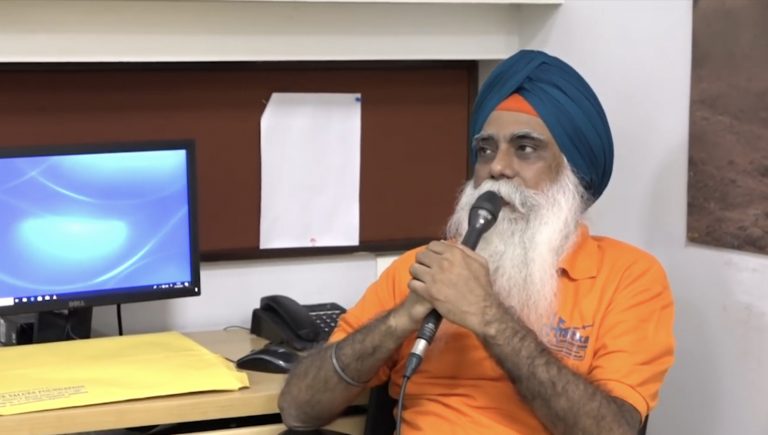
Halalonomics is a deeper conspiracy than it seems: OpIndia talks to Ravi Ranjan Singh, Chairman of Jhatka Certification Authority

Popularly hailed as Dr Jhatka and King of Jhatka evolution on Social Media, Ravi Ranjan Singh, the chairman of Jhatka Certification Authority, amidst the raging debate over halal  and jhatka meats, explained in detail the conceptual difference between the two and the underlying deeper shenanigans associated with the sale of halal meat.

[youtube https://www.youtube.com/watch?v=ws2bMLFPeak]

In an exclusive interview to OpIndia, Singh stated that halal is a broader Arabian concept which means “Permissible Legitimate” and meat is simply a minuscule part of it. The concept of halal extends to many more things. Singh said that the faith of Islam is based on the beliefs of halal and haram which is different from the ancient understanding of halal. He further added that the halal certified food is Islamic halal and it is in accordance with the Islamic beliefs, but it usually perceived as universal halal. “Islamic halal is permissible according to Islam but it may not be permissible to others who are not Muslims,” Singh said.

Singh argues that a restaurant or a food outlet should offer consumers with the option of having halal or jhatka meat and not just cravenly submit to the Muslim diktat of serving only halal meat, that may flout the beliefs of non-Muslims. Singh said that the Jhatka ritual demands an instant sacrifice of the animal, sparing it the torture of slow and painful death, a characteristic of halal way of killing animals.

Singh expounded that in the Jhatka ritual, the connection between the spinal cord and brain is instantly snapped, resulting in the  instant death of the animal while in the halal ritual, the animal’s jugular vein is slit and it is left to bleed to death.

The chairman of Jhatka Certification Authority mentions that he or his organisation is not against the halal type of meat but against the imposition of halal on non-Muslims who do not particularly believe in the ideal cherished in Islam. Citing Indian parliament and Indian Railways who only serve halal meat, Singh said that a customer should have a choice of opting for halal meat or jhatka meat instead of only having the option of choosing halal meat.

A petition filed by Singh in 2009 in the parliament seeking inclusion of jhatka meat alongside halal meat in the Indian parliament and Indian Railways is still pending. “It is Indian parliament and Indian railways, not a Muslim parliament or Muslim railways. We are not sitting in Syria. If you want to serve meat, serve both types of meat or else stop serving meat altogether. You cannot force me or anybody to else to consume meat procured through Islamic procedures,” Singh asserted.

Update: Indian Railway and IRCTC have denied the claim that only halal meat is served on trains, read the detail response bellow.

When questioned about other dimensions that determine a product to be halal, Singh replied that there are multiple phases through which halal had gained prominence in the world. “Before Islam, Jews propounded halal in form of Kosher. The method of painfully slaughtering the animal is similar so I disapprove it. However, I don’t oppose it because no Jew is going to be killing for not having kosher,” Singh said.

“There are umpteen conditions to be adhered too for a product to be halal certified. One of them being animal has to be face Mecca while being slaughtered. I have no objection with this stipulation as i believe either it is sinful to consume meat or it is not, it is not going to be virtuous depending on the direction in which it faces,” Singh added.

However, one of the most objectionable conditions that accompanies halal, according to Singh, is “no employment or financial benefit granted to a Kafir (non-Muslim)”. Singh listed another contentious condition which said that a certain part of profit made by halal products goes towards financing jihads. “When I’m buying halal certified products, I’m directly funding my own death. Any halal certified product-chips, chocolate, meat, purchased by me is financing my death. Even vegeterian products are halal certified. It has no relation with the meat but a part of it goes into supporting jihad,” Singh said.

According to Singh, halal supporters claim that the amount earmarked for jihad is basically zakat that goes into religious charity. However, there is no mechanism to check how this religious charity is used by Islamic institutions, contends Singh. “This jihad is nothing but a fight against the non-believers until they embrace Islam. This is not halal, this is halalonomics aimed at converting non-Muslims into Muslims,” Singh affirmed.

In an explosive revelation, Singh asserted that the Municipal outsourced Jhatka slaughterhouse plant in Delhi’s Ghazipur area continues to provide halal meat as the outsourcing company is owned by a Muslim. “There are 3 plants for procuring raw meat in Delhi. 1 is halal plant, the other one is jhatka and the third one is for big animals like buffalo. However, cow meat can be easily mixed with buffalo meat. All the three are owned by Muslim outsourcing company and halal continues to be the mode of slaughter in all three of them. There should be a mechanism in place to check the operations of such plants,” Singh said.

Singh claims that his fight is not against halal products but against the forceful foisting of halal meat on the consumers. He asserted that many people who have joined in his campaign to make jhatka meat easily available for public consumption were the ones who had never had meat in their life but they understood the logicality of his arguments and thus stood behind him in his demand to have jhatka meat.

Singh admitted that the limitations attached to jhatka are more profound than halal as halal is now pervasive across the world with anyone living in Brazil or in Tamil Nadu would instantly realise what halal stands for. Besides meat, there are halal airways, halal medicines, halal hospitals etc. In contrast to this, Singh said that there certification of jhatka upholds the idea of torture-less death of animals throughout the value chain and no support or monetary donation to terror groups.

Update: Although Ravi Ranjan Singh claimed that Indian Railway serves only Halal meat, IRCTC, which supplies food on Indian Railway trains, has rejected this claim. When OpIndia reached out to Railways for their comments on the issue, an official in Railway Ministry said that IRCTC does not specify Halal or Jhatka for the meat they serve. They informed that IRCTC follows ISO and HACCP guidelines for selecting suppliers of poultry and meat. The ministry also informed that this issue was raised earlier also in 2010, when IRCTC had issued a detailed explanation.

OpIndia has accessed a copy of the statement issued by IRCTC, which states that IRCTC does not have any specific guidelines issued by the railway ministry regarding dietary preferences of various religious and social communities. It informs that IRCTC does not mention the type of meat like Halal and Jhatka for poultry or meat served to railway passengers, nor such specifications are mentioned in its tenders for procuring the same. The IRCTC statement says that it sources meat only from HACCP certified suppliers through tenders, and FS&SAI has also not specified any coding in regard to method of slaughter.

Ahead of Block Development Council elections, Jammu leaders released from preventive detention

0

The Jammu and Kashmir administration has freed almost all local leaders in Jammu who were kept in house arrest following the abrogation of Article 270. Almost all leaders of Conference (NC), Congress and Jammu and Kashmir National Panthers Party (JKNPP) in the Jammu region has been released from their detention. They were under preventive detention since August 5 when the Articles 370 and 35A were abrogated by the union government.

NC leaders Devender Rana and SS Salathia, Congress leader Raman Bhalla and JKNPP leader Harshdev Singh are some of the prominent leaders to be released from house arrest.

Prominent leaders from the Kashmir region continues to be under preventing detention in Srinagar, including former CMs Farooq Abdullah, Ohousemar Abdullah and Mehbooba Mufti.

The decision to end the detention of the leaders came after the government announced elections for Block Development Council in the state, the second tier of the Panchayati Raj system. According to reports, since the Jammu region remained peaceful, and the situation has come back to normalcy in the state, the decision to end the preventive detentions was taken.

On 29th September, Jammu and Kashmir Chief Electoral Officer had announced that the Block Development Council election will take place on 24th October in the state. Elections will be conducted in 310 out of 316 blocks in Jammu and Kashmir, across Jammu, Kashmir and Ladakh regions. Counting will take place on the same after the voting is over on 24th. The entire process of election will be completed before 5th November. It may be noted that the state will get divided into two union territories, Jammu & Kashmir and Ladakh, on 31st October.

J&K chief election commissioner Shailendra Kumar had also informed that electoral rolls will be revised after BDC polls, and new voters will be added to the roll as many people will be eligible to vote in local body elections after the abrogation of Article 370. The Panchayat elections for vacant seats in the state will be conducted using the revised electoral list.

Assistant Director of Doordarshan’s Tamil channel suspended for blacking out address of PM Modi at IIT-Madras

Assistant Director of Doordarshan Podhigai TV, the Tamil channel of DD, R Vasumathi, has been suspended for dereliction of duty. She had reportedly blacked out the speech of Prime Minister Narendra Modi. He was addressing IIT-Madras during the Convocation.


Doordarshan is a public service broadcaster found by the Government of India. Though autonomous, it does not have the liberty to blackout the speech of the Prime Minister of India as any private channel has the liberty to do.

As per reports, the Prime Minister’s office sought an explanation from Union Minister for Information and Broadcasting Prakash Javadekar on why Doordarshan Podhigai, the Tamil channel of DD in Chennai had not telecast live the speech of PM Modi on Monday.

Reportedly, DD Podhigai was busy telecasting a Tamil song and a drama when Prime Minister Modi was delivering a speech at the prize distribution ceremony of the Singapore-India Hackathon and the 56th annual convocation of IIT-Madras.

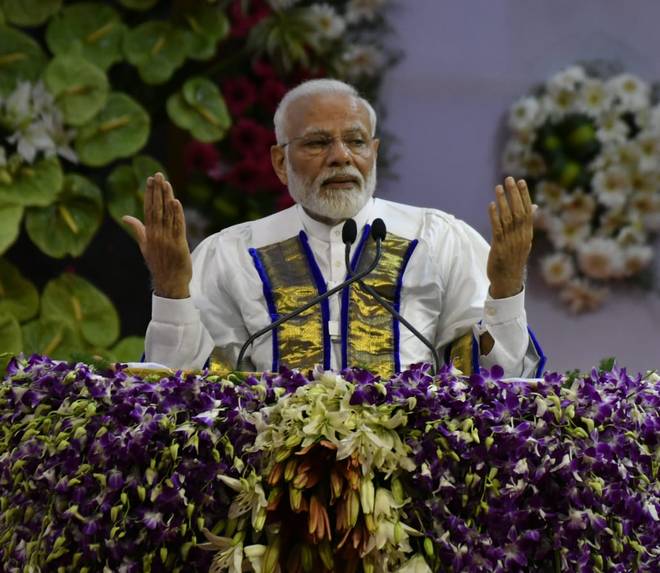
Narendra Modi had attended the convocation ceremony on the 30th of September where he addressed the students. Addressing the gathering, the Prime Minister said, “In front of me is both a mini-India and the spirit of New India. There is energy, vibrancy and positivity. I could see dreams of the future in your eyes. I could see the destiny of India in your eyes”.

Congratulating the parents and teachers of the graduating students, Narendra Modi also lauded the support staff. “I also want to highlight the role of the support staff. The silent, behind the scenes people who prepared your food, kept the classes clean, kept the hostels clean”.

Twitter and Tweetdeck face global outage, Twitter says it is working on a fix

Popular social media site Twitter is facing outage across the world today, with many users unable to post updates and images. Twitter dashboard management app Tweetdeck is most affected as it has stopped working for most users, while Twitter web interface and phone apps were working intermittently.


Twitter said that they are aware of the outages across Twitter and Tweetdeck, and working on a fix. They said that the microblogging should be back to normal soon.

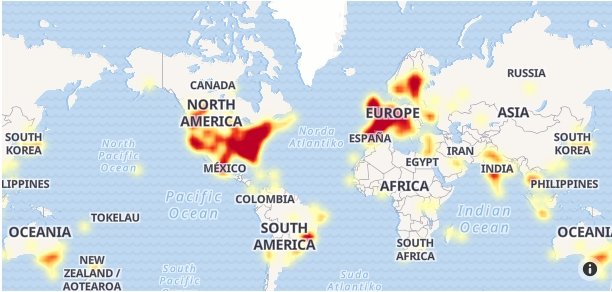
A Tweetdeck outage map shows that the app is down across the globe, particularly in North America, Europe, India etc regions. This map is based on people reporting about the outage they are facing.

Initially, when users tried to log into Tweetdeck, they were redirected to Twitter web interface. After some time, Tweetdeck started loading, and while it loaded tweets, most people are not able to post tweets and direct messages through the app. Users are also unable to share webpages using the Twitter share button on such sites.

‘My dear friend’: Read the letters Mahatma Gandhi wrote to Adolf Hitler, the ‘ultimate monster’

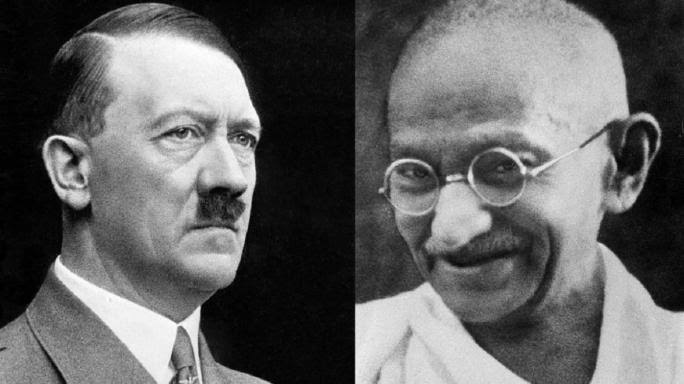
Mohandas Karamchand Gandhi or Mahatma Gandhi as he is fondly called the world over, wrote two letters to the German Dictator Adolf Hitler, one in 1939 and the other, in 1940. Both letters were addressed to ‘My friend’. In his book ‘Why I Killed The Mahatma’, Koenraad Elst makes a pertinent observation. He says that for anyone else to call the ‘ultimate monster’ a friend would be considered strange given the circumstances.

According to Elst, Hitler had given rather shocking advice to the British on how to maintain its oppression of the Indian people and also, how to suppress to freedom movement that was, by 1937, in full bloom. In a 1937 meeting with Government envoy Lord Edward Halifax (with whom Gandhi had signed the Irwin pact) Hitler had suggested shooting Gandhi to suppress the Freedom movement. If that did not work, Elst says, he had suggested shooting other leaders of Indian National Congress and then, shoot more freedom fighters if necessary. The plan by Hitler became progressively worse. Elst says that while it would be considered strange to call Hitler a ‘dear friend’, it was patently Gandhian to remain friendly with one’s would-be killer.

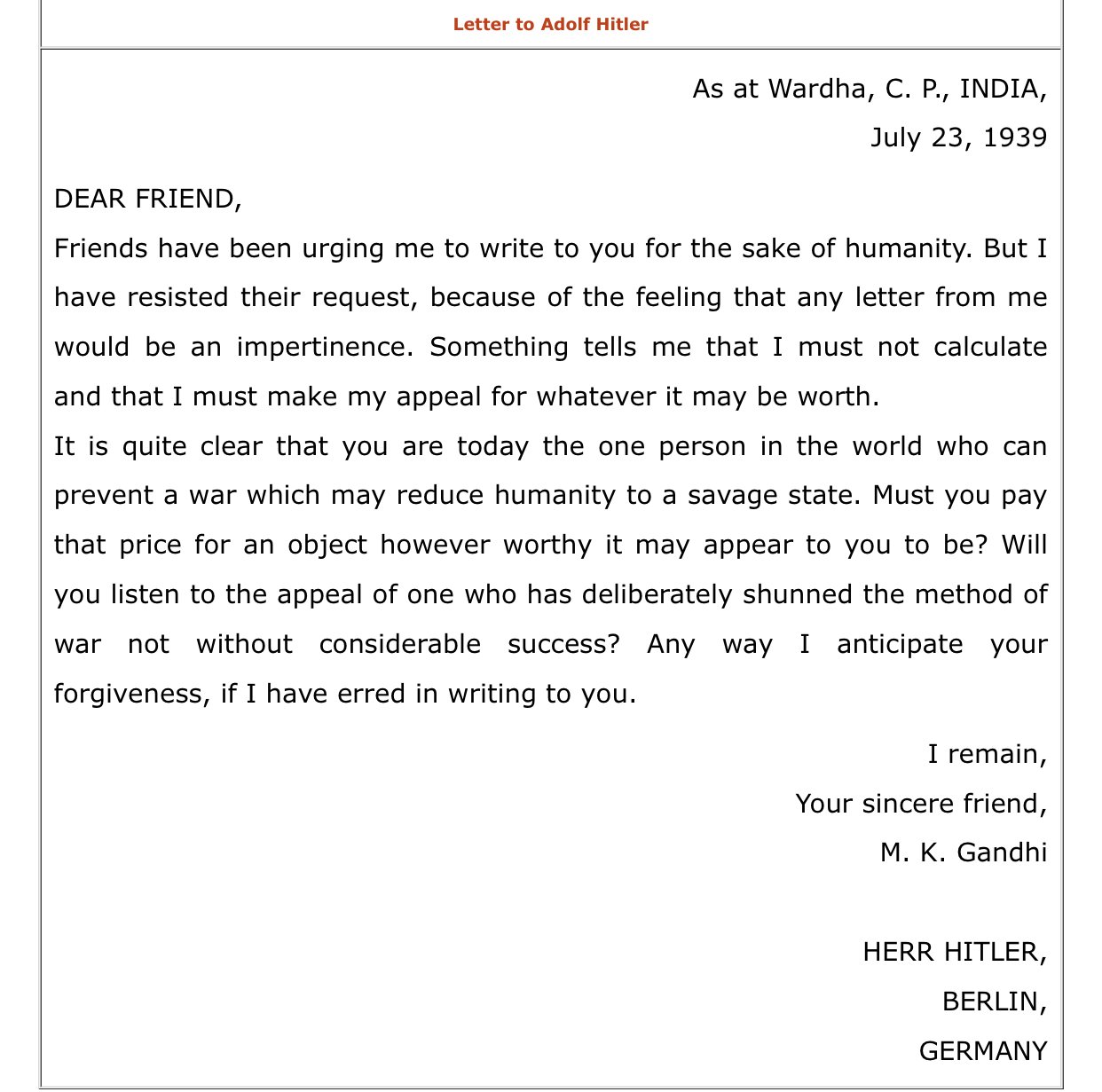
The first letter by MK Gandhi to Adolf Hitler was written on 23rd July 1939.

The first letter written by MK Gandhi to Adolf Hitler

Koenraad Elst says in his book that in his first letter (of the two letters), Gandhi appears to be circumspect in referring the Hitler as his friend when he writes that his friends have been urging him to write to Hitler for the sake of humanity but he has resisted so far as he felt that any letter would be an ‘impertinence’. However, the noted scholar also says that this circumspection on Gandhi’s part was not bourn out of abhorrence for Hitler, but modesty. The last line of his letter where he asks for forgiveness if he erred by writing to him is also considered modesty and scruples by Elst. Elst also says that while this approach of Gandhi is condemned by many, and several believe that it provided Hitler with a carte blanche option, had Gandhi’s method worked, it would have stopped the deportation and genocide of Jews since what happened then was a consequence of wartime.

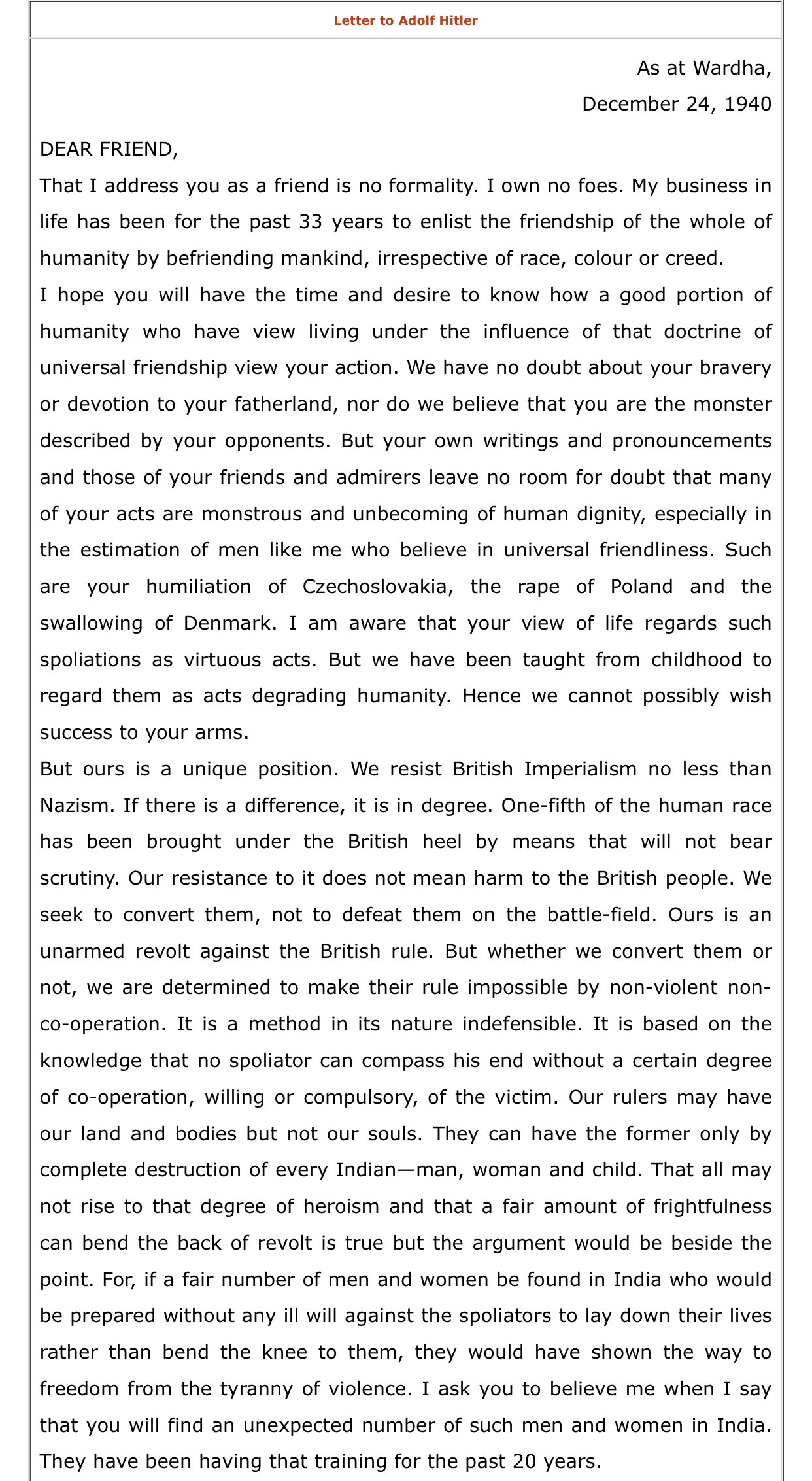
Mahatma Gandhi’s second letter to Hitler came on the Christmas even of 1940. On 24th December 1940, Gandhi wrote a lengthy letter to Hitler. At this time, Germany and Italy controlled most of Europe, the German-Soviet pact was still in place under Churchill and Great Britain was continuing its war against Germany for the invasion of Poland in 1939.

Part 1 of the second letter written to Adolf Hitler by MK Gandhi
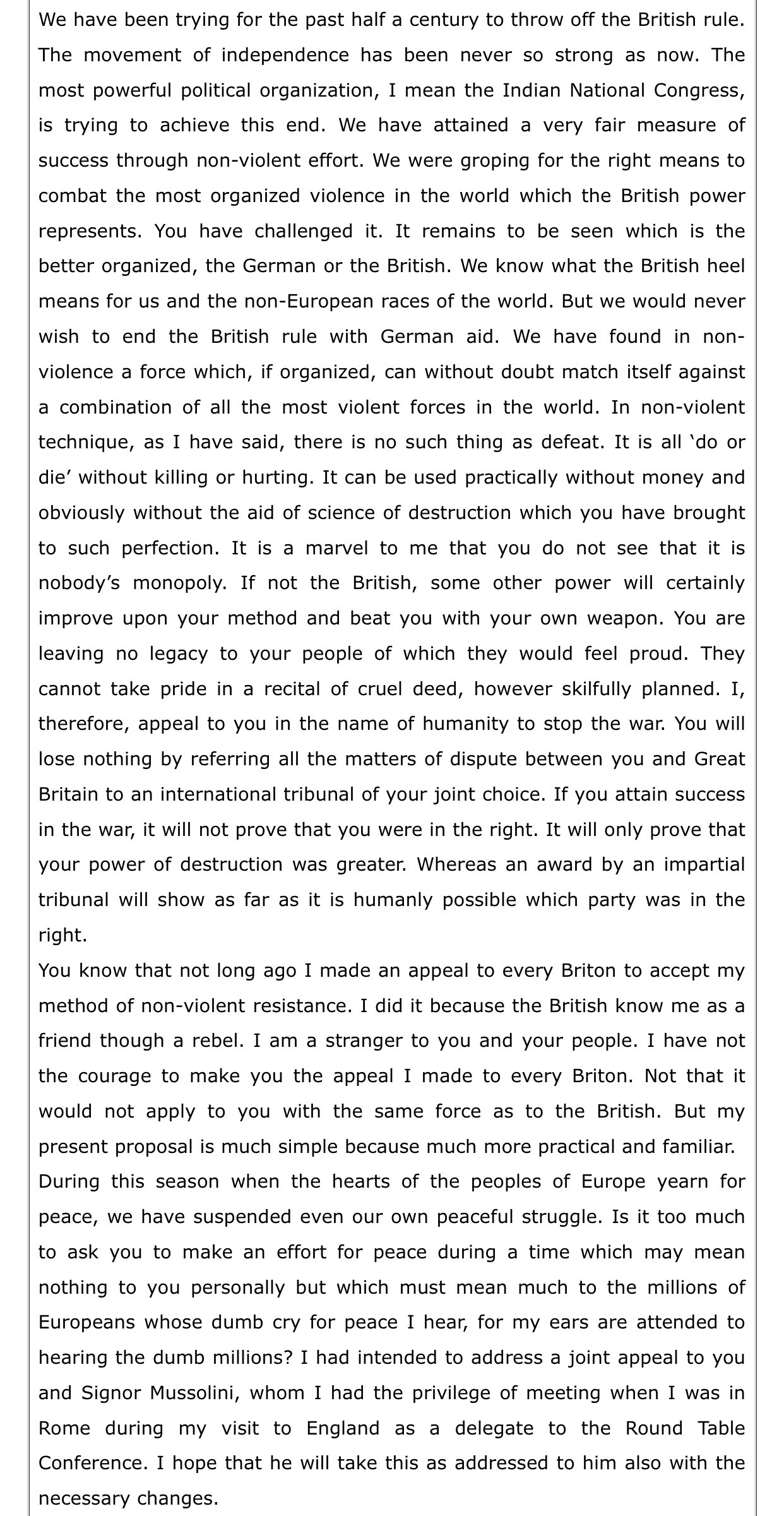
Part 2 of the second letter written to Adolf Hitler by MK Gandhi

In this letter, Gandhi explains in details his reasons for referring to Hitler as ‘my friend’ and signing both the letters off with ‘Your Sincere Friend’. Gandhi says that the fact that he addresses Hitler as a ‘dear friend’ is no formality because he owns no foes and that his business in 33 years has been to earn the friendship of entire humanity irrespective of caste, colour, creed, religion and race. Gandhi had gone on to call this approach the ‘doctrine of universal friendship’.

It is no surprise that a large part of the criticism that is accrued to Gandhi is regarding his strict tenets of ‘non-violence’ and ‘universal friendship’. Many believe that Gandhi’s adherence to these principles almost bordered on cowardice.

Gandhi vehemently reiterates that he has no doubts on Hitler’s bravery or his commitment to his motherland. He also shuns the popular public opinion that Hitler was a ‘monster’ as described by his opponents. However, he says that some of his acts and writing are monstrous, especially, to someone like Gandhi who considers the principle of universal friendship a way of life.

Talking about the revolt against the British, Gandhi in his letter to Hitler says that the Indian struggle against the British is an unarmed one.

OpIndia had once written:

George Orwell, the great author, once said, “Those who ‘abjure’ violence can do so only because others are committing violence on their behalf.” Gandhi could afford to abstain from violence because there were other great men who had embraced violence for the cause of Indian independence.

The deification of Gandhi has relegated many significant events of the Indian struggle for Independence to historical obscurity. The one event which suffered the most was perhaps the British Indian Royal Navy uprising of 1946. Protests against the poor quality of food and racism by the British which began at HMIS Talwar soon spread to Castle and Fort barracks onshore and 22 other ships and other naval establishments. They demanded the release of political prisoners and the Indian National Army (INA) personnel.

The mutineers had widespread support among the public. They carried aloft a portrait of Netaji Subhash as they took out a procession in Bombay and flew flags of different hues which signalled the unmitigated desire for independence that had gripped the nation. Ultimately, an army battalion had to be inducted to save the situation for the British. After many dead and injured civilians and following assurances of sympathetic treatment by senior leaders of the Congress who were against the mutiny from the very beginning, the mutineers eventually surrendered.

It is thus unfair to say that the Indian struggle against the British was purely an unarmed one, thus, belittling the valour of many other freedom fighters.

Gandhi, however, did not judge Hitler mildly. He did refuse German help in securing freedom from the British and those reasons too are written off in the letter. “We would never wish to end the British rule with German aid”, Gandhi wrote.

Elst in his book supports the method adopted by Gandhi, however, says that Gandhi was wrong in assuming that to disarm the enemy one needs to disarm himself. He writes that while preparing for war is necessary, the target should be bloodless crisis management.

Nehru did not learn ‘Tyaag’ from Gandhi, Shastri did: Film maker Vivek Agnihotri pays tribute to Lal Bahadur Shastri on his birth anniversary

As the nation celebrates the birth anniversary of Lal Bahadur Shastri, India’s second Prime Minister’s on October 2, coinciding with Mahatma Gandhi’s birth anniversary, Filmmaker Vivek Agnihotri paid his tributes to former Prime Minister by calling him a ‘Tyagi’ and India’s first economic reformer.

In a tribute published today in DNA, Vivek Agnihotri, who recently directed the critically acclaimed movie – ‘The Tashkent Files’, based on the suspicious death of Lal Bahadur Shastri, writes that there was a silence of disbelief, not just by the political supporters but mostly by common people, including all sections of India who waited as if their own family member’s body was going to arrive after the untimely death of Lal Bahadur Shastri.

“When Lal Bahadur Shastri’s body reached the Palam airport on the freezing morning of January 11, 1966, thousands of people lined up for his ‘antim darshan’. People loved Lal Bahadur Shastri who, in a short period, had won everyone’s heart and respect with his honesty, sincerity and passionate dedication to serving the downtrodden,” writes Vivek Agnihotri.

According to the filmmaker, Former PM Shastri not only brought back the lost glory of the country by winning in the 1965 war against Pakistan but also revived the pride of forgotten people, especially, farmers.

While India was engulfed in corruption during the Nehru’s era, Shastri showed a humble way of life-based on Tyaga or sacrifice, opines Vivek Agnihotri. He writes that people of the country were aware that Shastri did not even have the money to buy a personal car and had to take a bank loan to get one.

The mysterious death of Lal Bahadur Shastri in Tashkent followed obituaries from across the world reflecting the respect he had garnered in such a short time. “Lal Bahadur Shastri died at a pinnacle of popularity that no one in India believed possible when he succeeded the late Jawaharlal Nehru as Prime Minister barely nineteen months ago,” the New York Times had written.

“It was said that Nehru died too late and Shastri’s death came too early. Though it is widely believed that his popularity had raised because of his response to the war with Pakistan in 1965, Shastri introduced unprecedented reforms in the economy.”

Agnihotri asserts that it will not be wrong to say that he was India’s first economic reformer as he realised certain Nehruvian model of economics was inimical to national development. The writer states that Shasti was expected to follow Nehruvian economics of emphasis on physical controls instead of prices, focus on industry instead of agriculture and crushing web of controls, however, he did not.

Instead, in a very short period of time, Shastri dismantled it piece by piece. The then Prime Minister pumped in fresh thinking into India’s development strategy. People understood that Shastri wore no ideological blinkers. Instead, Shastri chose to see facts as they were in reality and emphasised on tackling them with practical solutions to help the downtrodden.

“Unlike Nehru, he went about his job in quietly, without any showmanship,” writes filmmaker-turned-author Agnihotri.

The article cites Myron Weiner, a professor in Political Science at MIT, who had praised Shastri’s policies to improve Indian agriculture and to increase the production of consumer goods. Shastri’s growing dependence on the free market mechanism and removal of government control from the steel industry relieved many Indian economists and businessmen, observed Weiner.

Agnihotri quotes John Kenneth Galbraith, the then American ambassador to India, who had said that Shastri’s ability to manage Indian affairs during “one of the most difficult periods in Indian history” was a “very considerable achievement.” He cited Shastri’s skill in dealing with India’s food and border problems and in substituting Hindi for English as the official language.

Expressing his deep admiration to Lal Bahadur Shastri, Agnihotri wrote that the former Prime Minister exuded courage, conviction and gave hope to people and he was a symbol of ‘Tyaag’. He personified the Hindu philosophy of ‘Sada jeevan, uchchvichar’ (simple living, high thinking), he writes further.

Shastri, in his personal life, was very simple, against wastage of resources and was fanatic about honesty in public life. As AICC general secretary, he used to give his wife Lalitaji a monthly allowance of Rs 40. When he came to know that she had managed to save Rs 10 out of it, he felt he was overpaying her and cut ten rupees from her allowance!

“Therefore, there remain legitimate grounds to speculate how the Indian economy would have developed had Shastri lived longer. India went on to adopt similar reform measures 25 years later, which put the economy on a higher growth trajectory. The little man was just way ahead of his times,” the article reads.

According to the writer, Nehru did not learn Tyaag from Gandhi but Shastri did. Tyaag is the highest quality a man can possess, a door to Shuddhi or cleansing. Without Shuddhi there is no transformation, noted filmmaker writes.

During the 1965 Indo-Pak war, when Lal Bahadur appealed for a voluntary Vrat (fasting), India was going through a food crisis. “Shashtri used ‘Tyaag’ as a political Shashtra (weapon) to address it besides sowing the seeds of a Green Revolution. Politics needs optics, and optics which are ingrained in the Indian ethos, are always most effective. Vrat is part of Indian culture. Shastri used it to make a point about the food crisis,” reads the tribute piece.

As Shastri deviated from Nehruvian ideology, the media, people and intellectuals, who were patronised by Nehru and became the beneficiaries of the seeping corruption, called Shastri’s call for ‘Jai Jawan, Jai Kisan’ a political gimmick. Agnihotri claims that the so-called intellectuals were not prepared to sacrifice one meal and intellectualised their lack of commitment to the national cause instead. However, millions of Indians did fast on Sundays.

“If we entrust our destiny in a leader’s hands, we must be prepared to be led by him on the path of change. If that path requires sacrifice then why shouldn’t the true followers be ready to sacrifice? If Bharat has to become truly independent then Tyaag has to be mutual. Citizens must always choose Tyaag- based leadership over leaders with egos”, writes Agnihotri.

Lastly, Agnihotri writes that he believes that he was destined to make a film on Lal Bahadur Shastri’s mysterious death. Agnihotri states that it gives him immense satisfaction that children all over India will learn that October 2 is not only Gandhi Jayanti, but also Lal Bahadur Shastri’s Jayanti. What can be a more fitting tribute to this great ‘tyaagi’ son of the soil of India? he noted.

Read details: Juvenile Justice Committee report on ‘minor boys arrested in Kashmir’ calls out lies of Quint, Scroll, and Washington Post

The Juvenile Justice Committee (JJC) from the Jammu and Kashmir High Court comprising of four High Court judges has submitted its report to the Supreme Court giving the details of 144 minor boys ‘arrested’ in Jammu and Kashmir since August 5.

As per a report in the Times Of India, the committee, in its report has submitted that all the boys have been released except only two who were in juvenile homes. The JJC was tasked to examine the cases after several media outlets in India and abroad reported that underage boys have been detained by Indian security forces and are being tortured.

The JJC, comprising of HC judges Ali Mohammad Magrey, Dhiraj Singh Thakur, Sanjeev Kumar and Rashid Ali Dar has submitted its report to the SC after individually examining each of the detention cases and has concluded that except two, all boys were released on the same day.

‘Child rights activists’ Eenakshi Ganguly and Shanta Sinha were the petitioners on whose plea the JJC was tasked by CJI Ranjan Gogoi to file a detailed report. Interestingly, the ‘activists’ had based their petition not on actual complains but on reports by news portals such as The Quint, The Scroll, Caravan and Washington Post.

The JJC has specified that till now, they “have not recieved a single complaint or representation or anything like that from any individual, lawyer, human rights activists, group persons, organisations, civil society members or any other person complainging about the arrest of any juvenile.”

The detailed report has included data not only from police stations but also from juvenile homes in the state.

The police report cited by the JJC states,” Child welfare committees are effectively working in the state and the petition is only an exaggeration to settle some political score and to demoralise the state action which has only been within the parameters of Law.”

After a detailed inspection and follow up of individual cases, the JJC’s report has demolished the claims made by portals like The Quint, The Scroll, Carvan and Washington Post. The JJC has also cited individuals claims by these media houses to demonstrate how they had created a false narrative to mislead the public and create an environment of fear based on nothing.

As per the JJC report:

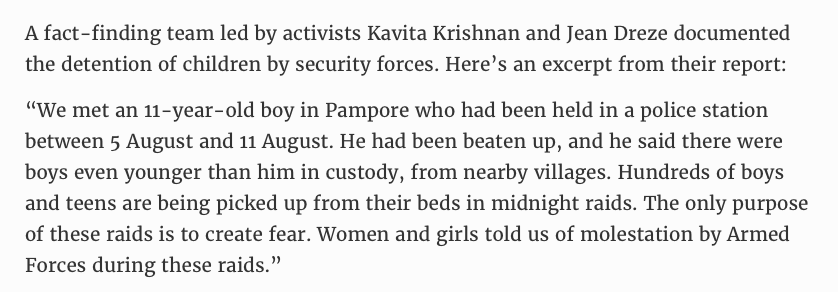
  •  “Detention of 11-year-old from Pampore is factually not correct. It has been ‘generated’ with an intention to malign the police and to create a story with an element of sensationalism,” says the JJC report. The story was published in The Quint quoting the ‘fact finding team’ by leftist Kavita Krishnan and Jean Dreze. It is notable here that Krishnan and Dreze’s ‘report’ on Kashmir was also denied screening by the Press Club of India, calling it propaganda.
The Quint’s report called out as ‘sensationalism’ by the JJC
  • The incident of Saura in Srinagar that was published by the Washington Post has also been criticised. Though the police have admitted to some violence and protests from the area, the report does not quote the sources, Hence the JJC found nothing to check the veracity of the claims.
  • Also, the August 30 report by Washington Post on Kashmir is called ‘wrong reporting’ by the JJC as no specifics of the alleged incidents were provided. The report was widely shared by Indian opposition politicians and ‘left-liberals’ to allege human rights violations in Kashmir and detention of children by security forces.
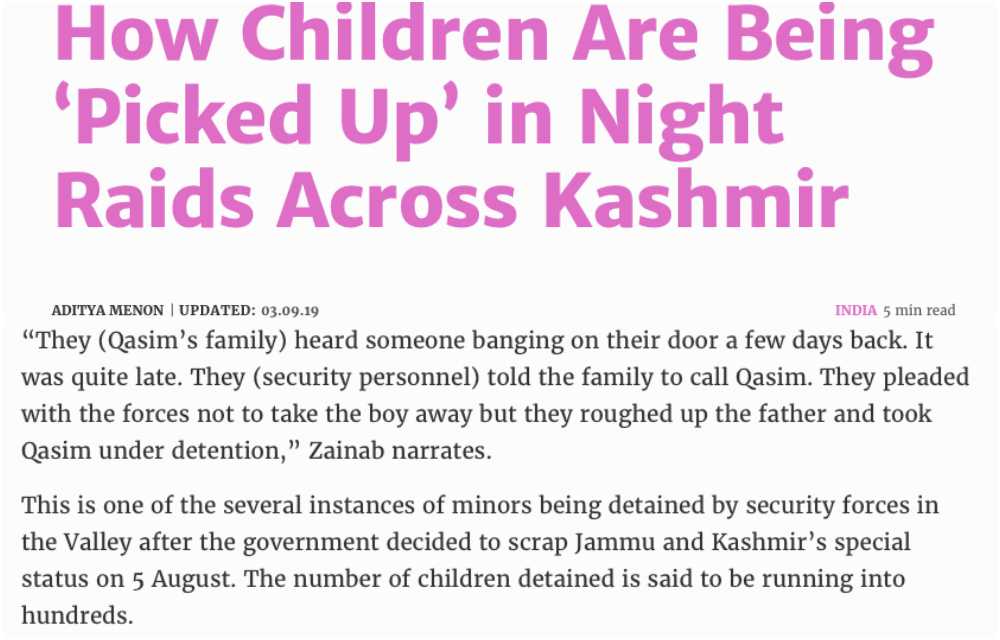
  • The JJC has called The Quint’s report of minors in Baramulla being detained for days by police as a “fictional imagination”.
The report by ‘The Quint’ alleging detention of minors has been termed ‘fictional imagination’ by the JJC
  • The JJC states that the two boys who were picked up in the Rajbagh police station area on August 22 were let go after a proper counselling by the SHO. They were handed over to their parents on the same day.
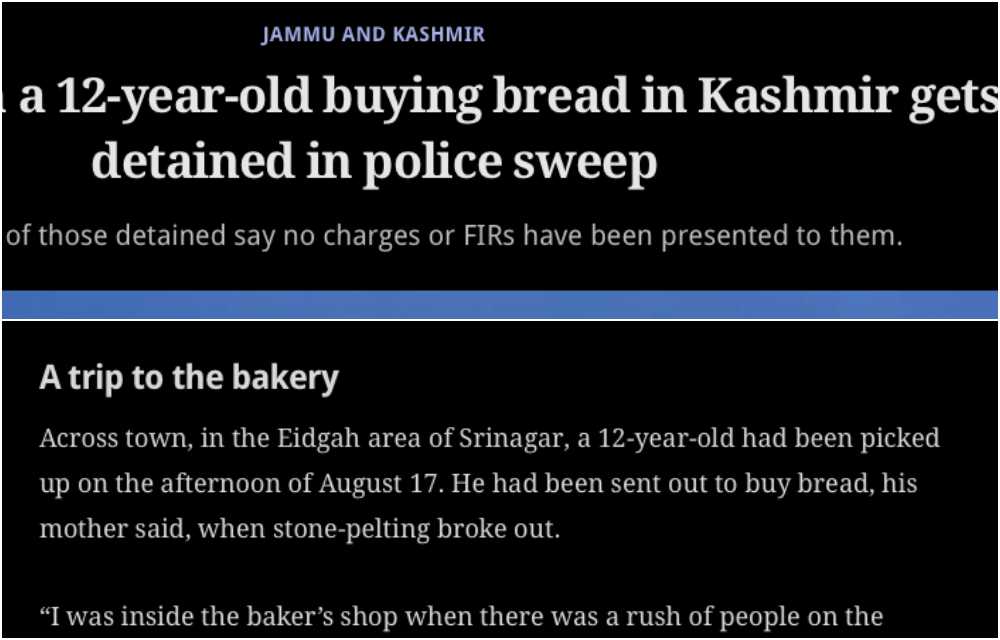
  • A report on The Scroll had claimed that a boy on his way to the hospital with bread and tea was picked up by the police. The JJC report cites The Scroll’s report and states that it defies ‘common sense’ and it only aims to paint the security forces as ‘predators on the prowl’. Dismissing the claims, the JJC report states that it was nothing but an attempt to demoralise the police personnel.
The Scroll’s report slammed by the JJC

The J and K police’s report to the JJC has also asked how foreign publications and digital media portals have ‘reported’ incidents that were nowhere to be found on local media and have no evidentiary value.

It is notable here that since the government abrogated Article 370 in Jammu and Kashmir, leftist media and their patrons have been on a misinformation overdrive. Several false claims, and lies are being peddled. From medicine shortage to imaginary stories of torture and extreme violence, some media portals seem to be peddling the lines perpetrated by Pakistan over the Kashmir issue.

Times of India has done a massive disservice to the memory of freedom fighter Bhagat Singh

Bhagat Singh is a hero to all Indians. He made sure he was caught and hanged to death in 1931 in the hope it would help countless youth rise against the British yoke. He was only 23 and arguably a bigger legend than both Mahatma Gandhi and Jawaharlal Nehru in his closing days. The nation hoped as one he would be pardoned, and not executed.

As we celebrated his 112th birth anniversary (September 28, 1907), the cacophony is back to own him up. Marxists claim him to be one of their own; Congress cite countless instances of how much Pt. Nehru admired the revolutionary in public and his atheism is cited as a rebuff to RSS and communal politics.

Times of India today had a middle in its edit page where a Bhagat Singh researcher, Prof Chaman Lal has been interviewed by one Manimugdha Sharma. The piece begins and ends with Bhagat Singh being a proud son of Marxist/socialist ideology but doesn’t miss out in rubbishing Veer Savarkar for his silence on the martyr. Predictably, Bhagat Singh’s distaste for casteism is showcased too.

Is this the binary we want Bhagat Singh to be reduced to where everyone is apportioning a piece of his corpse? Where facts are twisted to suit an ideology? Where Bhagat Singh is revealed a Marxist but hidden is the fact that he never joined Communist Party of India? Where Savarkar is demonized for his silence but cloaked is the truth that Bhagat Singh never said a word against Savarkar and indeed completely read the latter’s work, “Hindu Pad Padshahi”? Where Bhagat Singh is mentioned as an atheist but masked is the evidence that Swami Dayanand Saraswati and Arya Samaj exerted a great influence on him? Where Mahatma Gandhi is cited by Prof Chaman Lal to have “made efforts” for Bhagat Singh’s release but veiled is the historical reality that Gandhi faced black flag demonstrations by angry youths in Karachi who shouted “Down With Gandhi” in the wake of latter not demanding clemency for the condemned revolutionary? Where Jawaharlal Nehru is shown to be an unabashed admirer of Bhagat Singh but disguised is the truth that Pt. Nehru snubbed revolutionary Chandrashekhar Azad when the latter sought his help that Bhagat Singh not be hanged?

To satisfy their conscience—DoubleThink is the hallmark of Commies as George Orwell famously told us in Nineteen Eighty-Four—the interview does have a question on why Mahatma Gandhi never sought a pardon for Bhagat Singh which the nation prayed for. Prof Chaman Lal tells us that “Even if Gandhi had made it a point not to have the Gandhi-Irwin Pact without the commutation of their death sentences, the revolutionaries would not have accepted and compromised at their end.”

There is this wonderful piece in Swarajyamag where Prof Irfan Habib is shown indulging in similar skullduggery on Bhagat Singh. Since we can’t show Prof Chaman Lal and Manimugdha Sharma a mirror on the folly of their concert, let’s urge them to read it. Let’s not assume they have no shame. (Even though I firmly believe the edit pages of Times of India is now the bastion of Marxists).

The oversell of Prof Irfan Habib, a JNU professor like our very dear Chaman Lal, was the soft corner Pt. Nehru had on Bhagat Singh. He cited countless instances when Pt. Nehru was effusive in his praise for the nationalist. The Swarajymag piece laid bare the fact that Nehru never put his foot down when Gandhi-Irwin Pact was being ratified by the Congress Working Committee to which he was the president. Subhas Chandra Bose didn’t mince his words: “The responsibility of Pandit Nehru is very great. Besides being the President of the Indian National Congress, he was the only member of the Working Committee who could be expected to understand and advocate the Left-wing point of view…”

Non-partisan historians believe that if Gandhi had wanted he could’ve persuaded Irwin—with whom he shared a good rapport—to release Bhagat Singh. There are elaborate mentions of Gandhi-Irwin dialogue on Bhagat Singh in the Swarajyamag piece. Also, Nehru defended Bhagat Singh in public but in reality left him on wolves’ table. (We in NewsBred have an archived piece where Bhagat Singh’s nephew lambasts Congress for treating revolutionaries as terrorists!).

Those who are innocents would be startled on how disappointed Chandrashekhar Azad was when he sought out Nehru on Bhagat Singh’s clemency. The Swarajymag piece also details the version of Manmathanath Gupta, a fellow revolutionary of Bhagat Singh, on the attitude of the Congress leaders, including Gandhi and Nehru. Gupta mentions the betrayal by the two leaders and is quoted thus: “…Nehru completely misrepresented the revolutionaries, charging them with fascist tendencies” So Nehru viewed Bhagat Singh and his fellow revolutionaries as fascists! But Chaman Lal tells us that the martyr approved of Nehru above Bose!

The headline in Times of India doesn’t reflect the piece; as the piece doesn’t reflect the legendary Bhagat Singh. It’s a work of small men committing sacrilege on a deity of sacrifice and courage. It’s a disservice to Bhagat Singh’s memory.

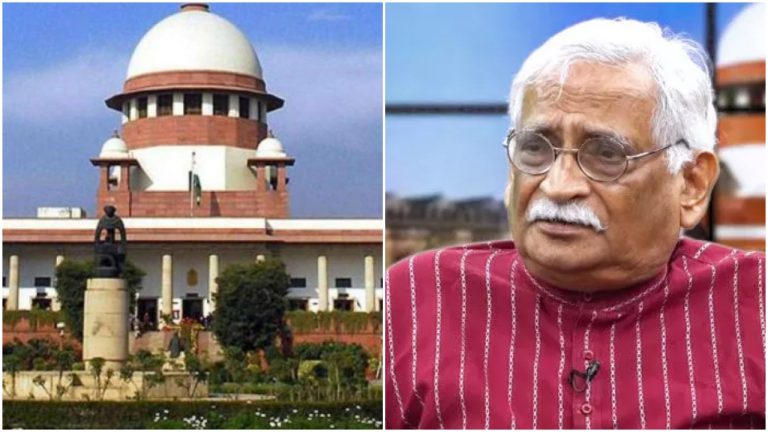
Ram Mandir case: SC reprimands Muslim parties for constantly repeating same argument, Rajeev Dhavan apologises for interruptions

0

On Tuesday, the Supreme Court of India lost its patience with the counsel representing parties in the Ram Janmabhoomi-Babri Masjid case and reprimanded them, particularly Rajeev Dhavan representing the Muslim parties for constantly repeating their arguments. The Supreme Court also directed all sides to stick to the schedule for completion of arguments in the Ram Mandir case.

According to the reports, the Muslim parties in the Ram Mandir case represented by senior advocate Rajeev Dhavan and Meenakshi Arora received the wrath of the apex court after they constantly interrupted the Hindu parties’ counsel senior advocates K Parasaran and C S Vaidyanathan from making any arguments.

The interruptions upset the Supreme Court bench consisting of Chief Justice Ranjan Gogoi and Justices SA Bobde, DY Chandrachud, Ashok Bhushan and S Abdul Nazeer, which said, “We are being told the same thing again and again as if there is no application of mind on this side (by the judges). This is no way to argue the case. It is impossible to complete arguments if it continues in this manner.”

Following this, Rajeev Dhavan apologised for interrupting the other side from making any arguments. Rajeev Dhavan had tried to drown Vaidyanathan’s arguments by interrupting through the microphone. An irritated Vaidyanathan countered by increasing his voice, to protest Dhavan’s constant interruptions. As a result, it became difficult to decipher the arguments.

The Supreme Court bench advised Vaidyanathan to switch off his microphone to help bring back sanity in the proceedings and said, “it is adding to the problem”. Vaidyanathan complied and sanity returned.

Chaos broke out in the Supreme Court in the Ram Mandir case over the Archaeological Survey of India (ASI) report, which states that there was a massive structure resembling North Indian temples directly beneath the disputed structure. This report has become the bone of contention between Hindu parties, who rely on it and the Muslim parties, who reject it as mere conjecture on part of the archaeologists.

Senior Advocate Vaidyanathan said Hindus had from time immemorial considered the disputed site the birthplace of Lord Ram and had a right over it, even though the mosque over it came into existence just 500 years ago. Refuting Sunni Waqf Board’s argument that an Idgah existed beneath the Babri Masjid, Vaidyanathan said that the claims by Muslim parties were both ridiculous and an attempt to trivialise the importance of the ASI report prepared by experts.

“Muslims had never argued during the trial of title suits before the Allahabad High Court that an Idgah existed beneath the disputed structure. The HC meticulously examined the ASI report including the video recording of the excavation which was carried out in the presence of a large number of persons. Muslim parties gave up their right to cross-examine the archaeologists before the HC. Hence, the ASI report is now admissible evidence and Muslim parties cannot doubt its veracity before the Supreme Court,” said Vaidyanathan.

Recently, senior advocate Rajeev Dhavan representing the Muslim parties in the Ram Mandir case had to apologise before the top court after another advocate representing Muslim parties – Meenakshi Arora had questioned the ASI report. The Muslim parties had questioned the credibility of the ASI report and had raised her doubts on the authorship of the Archeological Survey of India’s (ASI) report. She had questioned the credibility of archaeology as a scientific discipline.