Home Blog Page 6454

Ayodhya Dispute: Feasibility of mediation around religious conundrums

Shortly after partition and the Independence of India, in December 1949, idols of Ram and Sita appeared at the ‘Janmasthan’. The Hindus claim that this was a miracle, and proof of their claim that the place was the birthplace of Lord Rama. Contrary to this theory, the FIR recorded at Ayodhya police station on December 23 states that three individuals (Abhiram Das, Ram Shukla Das, and Sudarshan Das), along with some 50-60 people, had trespassed the mosque in order to install the idol.

In January 1950, one Gopal Singh Visharad (a member of the Hindu Mahasabha) filed a civil suit, asking for worship without obstruction and a perpetual injunction against the removal of the idols. In 1959, the Nirmohi Akhara filed a suit praying that the entire mosque be handed over to it. A suit claiming right over the mosque was filed by the Sunni Central Waqf Board in 1961. These cases have meandered through the Indian legal maze over the past five decades and are now before the Supreme Court.

On March 8, 2019, a Constitution Bench of the Supreme Court led by the Chief Justice of India, Ranjan Gogoi, directed that the batch of appeals in the Ramjanmabhoomi-Babri Masjid dispute be sent to a three-member mediation panel to explore the possibility of an amicable resolution.

The mediation proceedings, to be held in Faizabad, was expected to commence by March 15, 2019 as per the order of courtroom no. 1 of the apex court and the mediating panel headed by a former judge of the Supreme Court, Justice Fakkir Mohamed Ibrahim Kalifulla, with spiritual and humanitarian leader Sri Sri Ravi Shankar and senior advocate Sriram Panchu has been directed to send a report of the progress of the mediation within four weeks from that date.

It is interesting to note that the order directing mediation in the matter also records the objections raised by the litigants to the legality of mediation in a case which is representative in nature i.e. a case whose outcome affects not just the litigants but also those who the litigants claim to represent. This objection, perhaps, captures the essence of the “long-standing dispute”.

Mediation is not simply arriving at a negotiated consensus over a piece of land. The process involves a resolution of underlying emotions and sentiments. The land dispute in question has emotional overtones that threaten future peace if they are not resolved in a wholesome manner. Hindus must walk away with a sense that their hurts from a bygone era have been assuaged. Muslims must walk away with a sense of not having been coerced by majoritarian bullying, but having secured an equal stake in the safety of their lives, property, and places of worship. There cannot be a perceived loser, but a peaceful India must emerge as the winner as a result!

But the question at stake is the “viability” of mediation as a possible recourse in a protracted case of religious differences. On the legal side the whole recourse as a substitute sets on the requirements that give possible drift to such Alternative Dispute Resolutions. Section 89 of the CPC (Code of Civil Procedure), 1908 embodies the legislative mandate to the court to refer sub- judice disputes to various ADR mechanisms enunciated therein where it finds it appropriate to do so, in order to enable the parties to finally resolve their pending cases through well-established dispute resolution methods other than litigation.

The object behind the application of S. 89, CPC, 1908 lies in the promotion of alternative methods of dispute resolution which may be bound by any specific procedure and further resolves the dispute expeditiously.

While referring any case for the purpose of mediation, elements of settlement and acceptability to the parties are kept in concern. Court herein following the due process formulates the terms of the settlement, give them to the respective parties for their observations, record their observations and thereafter may reformulate the terms of a possible settlement and refer the same to a panel subscribing interests of sides for the alternative resolution process. If it appears to the settlement forum that the settlement of the dispute through that possible method is not in the interest of justice then it shall refer the matter once again to the court and hence cause further delay.

Despite Hindu groups opposing a negotiated settlement, the Supreme Court made it clear that an attempt should be made to settle the dispute by mediation. It overruled their objections by invoking Section 89 of CPC, 1908, arbitrarily without giving due consideration to the concern of both the side.

The viability of mediation may also be questioned on a representative basis as the issue in contention is representing larger communities and the settling forum is not inclusive of all of them. Also, locus standi of parties involved is also questionable as there is a difference in opinion regarding the construction of Mandir within the Muslim community itself.

In a two-judge bench Supreme Court judgment in Afcons infrastructure and Ors. v. Cherian Verkay Construction and Ors. [2010 (8) SCC 24], it was held that mediation cannot be done in a representative suit which involves public interest or the interest of a large number of persons who are not represented in the court.

While legally the dispute is in the nature of a conventional title dispute, nothing about the case is conventional. The case is a veritable crucible where history, religion, politics, and law meet, and in the absence of a formal institutionalised mechanism in this country for truth and reconciliation, it falls upon courts of law to determine the truth and dispense justice.

And yet, the Apex Court has directed mediation in a dispute which has a recorded legal history of 164 years at the very least and has been pending before the Supreme Court since 2010. Ironically, the Court’s approach, in this case, is in stark contrast to its approach to intervening in religious practices and traditions which have been preserved by communities and institutions for centuries, the Sabarimala judgment being a case in point.

Further, given the prolonged and convulsive history of the Ayodhya dispute through decades and the deep fissures it has caused and continues to cause because it is yet to be resolved, it would not be out of place to assume that there is an unbridgeable chasm between the litigating parties which too, is perhaps representative in nature. This means that to hope for an amicable resolution of the dispute through mediation is at best judicial optimism at work, which may not yield much particularly when this is not the first attempt at mediation in the dispute.

Secondly, there still exist chances of referring the same to the court for intermediate or final disposal by the settlement forum and more delay in justice.
It would be great if the case beforehand is redressed objectively by the highest court of the land on the basis of rigorous available evidence and civilised jurisprudence so that neither party can play the victim card and claim that it was shortchanged either by majoritarian coercion or minority appeasement, as the case may see afterward.

The matter must be decided on merits so that sustainability of the decision is maintained and respected amicably now or in the near future.

If observed from a more practical, subtle standpoint, the 4,300- page, 2:1 verdict of the three-judge Bench of the Allahabad High Court which decided the dispute in favour of the Ram Janmabhoomi has already reduced the workload of the Apex to a significant extent by performing the most burdensome and strenuous task of exercises in such disputes, namely identifying the specific issues of disagreement between the parties, receiving and examining evidence, including archaeological and historical, and fractionating the principles of law which apply to the case beforehand.

Putting plausibly, the legal silhouettes of the dispute have already been cleared out in sufficient detail by the honourable Allahabad High Court. Therefore, the Supreme Court need not reinvent the wheel and go through the process of the trial once again but has to primarily examine the High Court’s verdict for patent perversity, or gross misappreciation or non-appreciation of material evidence.

Given this limited mandate, and given the fact that all procedural formalities in the Supreme Court were nearly complete in December 2017 when the case was ripe for final arguments, there was little left to do except to commence hearings in the matter.

And then the red- herring of Ismail Faruqui v. Union of India, AIR 1995 SC 605 A, was raised by one of the parties to the case. This red- herring too was addressed in September 2018, when a three-judge Bench led by the then Honourable Chief Justice of India, J. Dipak Mishra, concluded that there was no need to refer the matter to a constitution bench since it held that Ismail Faruqui did not come in the way of adjudication of the title dispute. Therefore, as of September 2018, there were no further procedural or substantive hurdles left to the commencement of fresh hearings in the case.

Despite having arrived at the conclusion that there was no need to refer the case to a larger bench, the court then constituted a larger bench. Once again, the matter was ripe for final arguments. Now, it has been referred to mediation. Notwithstanding the hedonistic interests of some sections of the so-called Liberals at mollifying the nature of the dispute and what it represents substantially, it would be ignorant and offensive to deny that the dispute revolves around faith and dignity of faith for all the parties involved matter equally.

Keeping everything under due consideration, therefore, as self-serving as it may be, as an ardent believer in justice delivery through constitutional means, especially through courts of law, one sincerely hopes that the Apex Court does not let go of this opportunity to open a new chapter in the history of the Indian Republic by deciding the dispute one way or the other with expedition and put an end to this long- age tussle that has been one of the many reasons behind several communal discords throughout the history of India.

*Vishal Kumar is a student of Law at Campus Law Centre, University of Delhi.

JNU freelance protestor turned full-time politician retweets an old video being passed off as recent one to show BJP in bad light

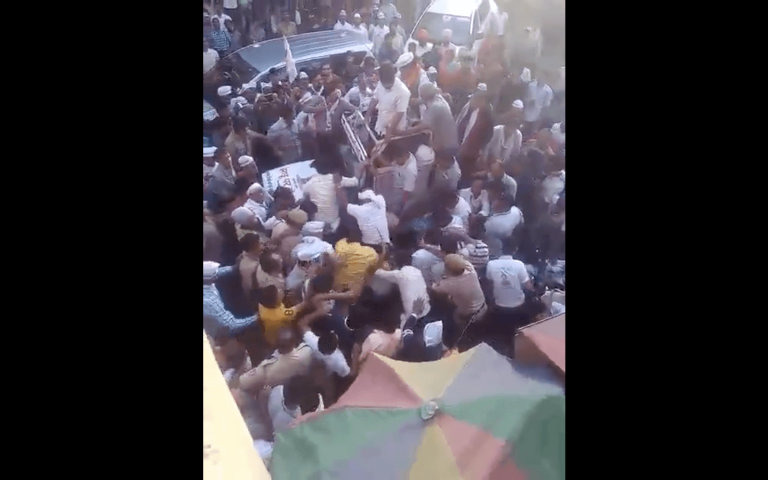
Activist for hire, Shehla Rashid, who had recently shunned being a freelance protestor and took the plunge in the politics by joining the political party floated by controversial former Indian bureaucrat Shah Faesal today retweeted an old video from Surat which was being passed off as a recent one to cast the BJP government in a bad light.

An old video retweeted by Shehla Rashid

The post uploaded by a Twitter user alleged that a massive bike rally is being organised by the BJP today in Hisar Bazar area of Surat as a part of their election campaign. In the video, it can be seen that the people surrounding the bikers were visibly angry at them and tried to manhandle the bikers. The Twitter user who uploaded the video also insinuates that none of the mainstream media outlets has picked this up because it is seemingly against the BJP. Shehla Rashid retweeted the Tweet, thereby lending legitimacy to the claims made by the Twitter user.

However, the claims made by the Twitter user are entirely unfounded and baseless. The fact that no media covered it is because there was no bike rally by the BJP supporters in Surat today and the video uploaded is an old video from December 2017. In a smear campaign against the BJP, an old video from December 2017 was passed off as a recent one by people hostile to the BJP government. Shehla Rashid, who was tagged by the notorious Twitter user in his post, promptly obliged him by retweeting the tweet and being a party to the proliferation of fake news on Social Media platforms.

[youtube https://www.youtube.com/watch?v=s5OR8zfSOYs]

This is not the first time that Shehla Rashid has been caught red-handed purveying fake news and rumours on Social Media platforms. An FIR was filed against Shehla Rashid recently for spreading rumours after the Pulwama attack. Before that, a complaint was filed against Shehla Rashid for posting a tweet accusing Nitin Gadkari of plotting to assassinate PM Modi. When Gadkari threatened her of legal action, she claimed the tweet was merely sarcasm and played the ‘Islamophobia’ card to get herself out of trouble.

EC serves show cause notice to ABVP for book launch in JNU claiming a violation of poll code

Returning Officer (RO), South Delhi district, Nidhi Srivastava on Saturday issued a show cause notice to the JNU unit of the ABVP for allegedly violating the Model Code of Conduct (MCC) by organizing a book launch on campus without permission, The Indian Express has reported.

The ABVP had planned to launch #ModiAgain by author Aabhas Maldahiyar and Saffron Swords by Manoshi Sinha Rawal on 15th April. The event has now been cancelled. Earlier, the Election Commission had stalled the release of PM Narendra Modi, a biopic on the Prime Minister featuring Vivek Oberoi in the lead, claiming it was a threat to a ‘level playing field’ and ‘free and fair elections’.

The same Election Commission had served a show cause notice to officials for banning the release of a book on the Rafale Deal for violation of the MCC. However, the ban was subsequently revoked and the book was released.

Meanwhile, according to the organizers, the cancellation had nothing to do with the show cause notice. Durgesh Kumar and Manish Jangid, President and General Secretary of the JNU Unit of ABVP respectively, told The Indian Express that they cancelled the event on April 12 because the authors were unavailable.

Kumar said, “We wrote to them saying it had been cancelled and that we were not aware it’s a violation.” He added, “It was an academic discussion… It wasn’t a political discussion; no leaders were called.”

Srivastava, however, said that the programme was a violation of MCC since it seemed to be advertising a particular political leader and that permission for the event had not been sought.

While the EC is busy serving show-cause notices for book launch events and stalling the release of movies, rampant polling malpractice and violence was reported in West Bengal during the first phase of the elections. The constitutional body was criticized by many for failing to secure a conducive environment for polling to occur.

A Bangladeshi actor, too, was seen recently campaigning for Trinamool. While the BJP has alleged an MCC violation and a foreign citizen actively campaigning for Trinamool on the ground does not appear entirely legal, the Election Commission continues to maintain a stoic silence on the matter.

Mumbai: Accused Akhtar Shaikh who allegedly raped the minor kept her in a Dargah and then at a friend’s place

As per a report by Swarajya, the Mumbai Police refused to add the accused Akhtar Sheikh’s name in the FIR lodged against him, for allegedly raping a minor girl in Ghatkopar, Mumbai. The Mumbai Police reportedly not only declined to mention Akhtar Sheikh’s name in the FIR but also ignored invoking the crucial POCSO (Protection of Children from Sexual Offences) Act, though this being an ideal case to qualify under the Act.

Not invoking POCSO, not invoking SC/ST Act, giving the matter to a sub-inspector when the law clearly states that such cases are to be handled by a DSP or ACP level officer and not recording the victim’s statement under Section 164 are few amongst the many lapses laid out by the Mumbai police in handling this sensitive case. The commission has asked the Mumbai police commissioner to respond in the matter.

As per Swarajya report, on 14 March, a minor girl went missing from Ghatkopar area in Mumbai. When she did not return all night, her parents approached the Ghatkopar police station the next day to file a first information report (FIR). Though the police did register the FIR but messed up the case at the very first level.

Firstly the police chose not to add the name of the accused, Akhtar Sheikh, in the FIR despite the girl’s mother naming him as a suspect repeatedly. The mother’s statement recorded in the FIR simply says that her daughter, aged 17 years, went without her will after being lured by an “unknown person”. Secondly, the police did not add the POCSO Act despite the victim being a minor.

The girl remained missing for four days.

The girl’s mother, who’s a domestic help, has alleged that the police officer who took up her case shouted at her. She even mentioned that the police officer simply ignored Sheikh’s mention.”

The officer named, sub-inspector Sheetal Kanadkhedkar is facing the fury of the National Commission for Scheduled Castes (NCSC), as the victim happens to be a Dalit Hindu.

The victim, who was found on March 19, was sent to a juvenile home, where she continues to stay till date. The mother said that she is allowed to meet her daughter once in three-four days.

“My daughter has been revealing details slowly. She told me that Akhtar Sheikh first kept her overnight in a dargah and then at a friend’s house for three days,” the girl’s mother said.

She furthered that after her daughter’s recovery when they went to the police station to ask the police for further inquiry, sub-inspector Sheetal, hushed them saying that they were trying to give the case a communal colour by making it a Hindu-Muslim issue. This time too, sub-inspector, Sheetal refused to add accused Akhtar Sheikh’s name to the FIR, confirmed the victim’s mother.

Sheikh was arrested only after 10 days on 28 March and was soon freed on bail.

The news was not picked up by any media house and came to the foreground only after a Twitter user wrote about it in a series of tweets.


The mother told Swarajya, “it’s evident that Sheikh lured the girl into going with him. What if he takes her away again after 22 April? She will be forced to give her consent and, as a major, we will have no hope of getting her back.”

A rights organisation named Agniveer took notice of the case and escalated it to the NCSC. On 15 April, the commission sent a letter to the Mumbai police pulling it up for ignoring the due process.

A local activist named Sitaram Juwatkar told Swarajya that when he learnt of the matter, he went to the police with the girl’s mother on April 2, asking for POCSO to be added in the FIR. “Sheetal simply refused. She said we shouldn’t escalate the matter now that the girl has been found,” he said.

However, this is not the first time when such biased cases, where the police have displayed callousness and such indifference in matters of kidnappings of minor girls, especially when the accused is from different religion have occurred.

Swarjya identified two such cases, one from New Delhi and one from Uttar Pradesh — where minor girls were kidnapped in a similar way but the police, in both cases, refused to add the accused’s name and POCSO ACT in the FIRs.

Tamil Nadu Lok Sabha 2019 Opinion Polls: Take them with not just a pinch but a sack full of salt

If you accept the numbers on face value, the opinion polls done by the “Political Pundits who sit in the Air Conditioning rooms” as PM Modi refers to them as, one would think that NDA is heading for a massive drubbing in Tamil Nadu. Tamil Nadu is one state where the pollsters have ended with egg on their faces more often than not and they just may add another feather to their cap in the upcoming Lok Sabha elections in this crucial state that sends fifth largest contingent of MP’s to the parliament only behind UP, Maharashtra, West Bengal & Bihar.

So, what are the latest opinion polls forecasting for the upcoming elections & let’s look at why we may need to take them with not just a pinch but a bag full of salt.

Opinion polls for 2019 Lok Sabha Elections: Tamil Nadu

Let’s begin by understanding the electoral zones and the caste demographics of the state in a little more detail. Tamil Nadu can be divided broadly into 4 different electoral zones viz. North TN, Kongu region in the west, Cauvery delta region and South TN. Contrary to what many think, each of these regions has its own set of issues, caste dynamics and over a period of time, the main regional political parties have established their own foothold in each of these regions primarily based on caste polarization.

Despite changing social configurations, the DMK continues to be a largely urban-based party with strongholds in the northern districts among organised workers, backward classes and parts of Cauvery delta region and the AIADMK, from the time of its inception, remains a distinctly rural party with a base in the south & west  among the uneducated, unorganised labour, women and Dalits. Emergence of Dravidian identity, caste based parties like PMK (vanniyars), Viduthalai Siruthaigal( Dalits) a party with dalit base have dramatically reduced the support base of both the national parties Congress & BJP barring a few pockets.

Source: The Hindu

After the demise of Kalaignar Karunanidhi & Puratchi Thalaivi Jayalalitha, virtually no single party can claim to be strong across the entire state & the alliance arithmetic takes precedence over other logical issues including governance.  As we all know, no one knows this game better than Mr Amit Shah who swung into action early this year to bring together seemingly warring parties not long ago and stitched an umbrella NDA coalition led by  CM Mr Edapadi Palaniswamy. The NDA alliance not only looks formidable arithmetically but more importantly complimenting each other in different regions. To put this in context, the NDA alliance had combined vote share exceeding 50% in 31 out of the 39 constituencies across the state in 2014 polls! 

The exact line up of the National Democratic Alliance includes BJP, ADMK, Pattali Makkal Katchi led by Ramadoss, Desiya Murpokku Dravida Kazhagam led by Captain Vijayakanth and a couple more smaller caste parties. The DMK, Congress & the left parties who have been together for a while now make up the UPA coalition led by Mr Stalin. CPI, CPM and a couple more caste parties make up the rest of the coalition. So why are the National pollsters forecasting a rout for NDA despite very strong arithmetic for the NDA? Lack of understanding of the caste dynamics, seeming double anti-incumbency for the ADMK in the state as well as the BJP in the centre & buying into the massive propaganda blaming BJP & MODI for all the ills of the state unleashed in the Tamil MSM, majority which is controlled by the DMK & the social media could be some reasons for this. 

Based on the analysis of the opinion polls conducted by Chanakya TV owned by Mr. Rangaraj Pandey & a couple more local agencies who have feet on the ground, talking to neutral analysts and applying my own logic, am presenting my view on how I see things are stacked up in TN with just over a week to go for the polls. 

So, with almost half of the seats falling in the too close to call category & well within the margin of error, the NDA, after all, may not fare as badly as its widely believed in the MSM. But this shouldn’t come as a big surprise given the huge swing needed by the UPA in 80% of the seats to beat the arithmetic. So, what are the factors in these elections that could swing the too close to call seats?

1. Top of the list has to be the “last minute” voter management which has now become institutionalized in TN elections. Given the past track record, whichever party have wider election war chest & organization support to manage the logistics can get a handsome share of the 19 too close to call seats. Given that most of the too close to call seats have strong arithmetic in favour of NDA & the fact that both ADMK & BJP are power in both state and centre respectively, NDA has a clear advantage in this factor.

2. votes that got split in 2014 between ADMK & DMK are now sure to consolidate against NDA for obvious reasons, counter consolidation of the majority communities in favour of NDA may help it convert some of the too close to call seats.

3. Several Hindu rhetoric & policies of DMK and their partners have enraged the Hindu community all over TN. There has been a widespread protest in many parts of the state over the recent utterances by the Dravida Kazhagam idealogue demeaning Lord Krishna and blatant appeasement of minority community by the DMK in their manifesto promising have only added to the anger. 

4. Tamil Nadu has been one of the two states, other one being Kerala, in the country where Mr Rahul Gandhi has been consistently leading ahead of Mr Modi in popularity votes and much of it is also because of the anti-Modi sentiment whipped up by the Tamil MSM majority of which is controlled by DMK. Even if a small fraction of the people vote for choosing a PM rather than local parties and issues, it could impact many of them too close to call seats.


5. Performance of AMMK, the rebel faction of the ADMK led by Mr TTV Dhinakaran, Makkal Nidhi Maiyam led by Kamalhaasan and Tamil nationalistic party Naam Thamizhar Katchi led by Seeman who are contesting in all of the 39 seats. Even though they won’t be able to win any seats, they are expected to get a good chunk of votes and the unknown factor is whose votes will they take away! As these parties are untested, it’s any body’s guess on how this factor may play out in each of the 19 close seats. 

Even though it’s a head to head contest in many of the seats across 39, the issues at play are multi-dimensional and the vote share difference is within the margin of error, any predictions based on howsoever scientifically done survey can be off by a long way. Tamil Nadu CM Mr Edapadi Palanisamy has surprised many including this columnist with his shrewd political management skills outmanoeuvring not just heavyweights within his party like Ms Sasikala, Dy. CM Mr O. Paneerselvam and Mr T.T.V. Dhinakaran in the internal power struggle that ensued following the demise of Ms J. Jayalalitha but also warded off attempts by Mr M.K.Stalin from DMK & the Congress ecosystem over the last two years to unseat him from the CM’s chair.

Having consolidated his position as the first among equals in ADMK, the CM has been leading from the front in the campaign and working hard to establish himself as also a leader with the mass base. Given the organizational strength of ADMK in South TN & Cauvery delta region where a majority of the too close to call seats are from, NDA, after all, may end up with much higher seats than what’s being predicted by the pollsters.

109 eminent Tamil intellectuals appeal to Tamil Nadu voters to reelect Narendra Modi

Ever since the Narendra Modi Government came to the center, the seemingly improbable started happening to the BJP as a party. Right from forming a BJP coalition government in the state of Jammu & Kashmir to sweeping the North East India with BJP or BJP alliances ruling all the 8/8 states in North East the BJP has proved itself not to be an untouchable party anymore.

Well, Tamil Nadu is no exception to this trend. For the first time in the history of BJP in Tamil Nadu 109 eminent intellectuals from the field of Tamil literature, Tamil scholars, scientists, writers, jurists, educationalists have given a joint appeal to voters of Tamil Nadu to reelect Prime Minister Modi and listed out the reasons for appealing so.

The Appeal reads out as follows:

An Appeal to Tamil Nadu voters

  • Narendra Modi’s Government completed its tenure of five years in center.
  • In this five-year tenure of Modi Government, various sectors had seen development. Ujjwala(Free Gas) scheme, increasing maternity leave to 26 weeks and constructing toilets throughout the country had created a positive impact on the life of women.
  • Measures taken by this Government to eliminate corruption had started to harvest benefits.
  • Ayushman Bharat is turning out to be the biggest healthcare social security scheme in the world.
  • India is transformed into the sixth largest economy from the state of economic crisis.
  • National OBC Commission is given the constitutional status for the first time in the history.
  • Kanchipuram and Velankanni from Tamil Nadu were announced as holy tourist circuit cities by Ministry of Culture.
  • Steps were taken to establish the first AIIMS hospital and college in Tamil Nadu.
  • Internal and external security is handled in the best possible way.
  • Number of Haj pilgrimages had seen steep increase.
  • Housing for All before 2022 under Prime Minister Awas Yojana Scheme is rolling out in an effective way reaching the right beneficiaries.
  • Hence, all of us named below wish Narendra Modi Government to come back to power again because of its exceptional performance in various sectors.
  • All of us named below appeal Tamil Nadu voters to re-elect Prime Minister Narendra Modi because of his care towards the nation, because of having zero accusation under his name and because of his selfless work for the nation to progress in global arena.

Addressing the media, senior journalist Maalan listed out the reasons why they want reelection of Prime Minister. Noted senior Tamil scholar Dr Saraswathi Ramanathan said how millions of women have benefited from Narendra Modi’s pathbreaking schemes like Ujjwala(Free Gas), Swachh Bharath(Toilets) & various other schemes.

Chennai Press Club where the Tamil intellectuals appealed to voters to reelect PM Modi

The following are the signatories of the the petition. The first 9 petitioners were present in the Chennai Press Club and appealed to the Tamil Nadu voters on behalf of the 109 eminent intellectuals to vote for PM Modi.

Signatories:

  1. Dr.Smt.Saraswathi Ramanathan- Tamil Scholar
  2. Major General.Thiru.Padmanabhan
  3. Thiru.Balachandar IPS, Ex-DGP
  4. Thiru.Maalan- Writer
  5. Thiru.Badri Seshadri – Publisher
  6. Thiru.CMK Reddy – President of Tamil Nadu Medical Association
  7. Dr.Muhammad Feroz Khan – President, Tamil Nadu Islam Jamath
  8. Thiru.Subbu – Senior Journalist
  9. Dr.Aandal.P.Sokkalimgam
  10. Padmabushan Dr. Thiru.R.Nagasamy
  11. Padmashri Srimathi.Vijayalakshmi Navaneethakrishnan
  12. Thiru.Anbazhagan – Fishermen Association president

Scientists:

  1. Thiru.G.Krishnan (ISRO)
  2. Thiru.Prof.Durairaj (ISRO)
  3. Thiru.Prof.Ramanathan (DRDO)

Judges:

  1. Justice Thiru.Ko.Su.Arumugam,
  2. Thiru.Satish Kumar,
  3. Thiru.T.P.Vishwanathan.

Tamil Scholars:

  1. Dr.Thiru.T.N.Ramachandran,
  2. Thiru.Ma.Ve.Pasupathi,
  3. Thiru.Sami.Thiyaraasan,
  4. Thiru.Pallathoor.Pazha.Pazhaniyappan,
  5. Thiru.Poet.Ra.Ramamoorthy,
  6. Thiru.Poet.Ramachandran,
  7. Thiru.T.Rajkumar,
  8. Thiru.Thillai Karthikeyam Sivam,
  9. Thiru.R.Ramasamy,
  10. Thiru.Prof.Jagannathan,
  11. Thiru.T.S.Thiyagarajan,
  12. Thiru.K.S.Sampath,
  13. Thiru.Dr.T.Chandrakumar,
  14. Thiru.Dr.Ra.Maadhu

Educationalist:

  1. Thiru.Va.Ve.Subramanian,
  2. Thiru.P.K.Balasubramanian,
  3. Thiru.U.Sundar,
  4. Thiru.Prof.R. Ramachandran,
  5. Dr.Srimathi.Usha Mahadevan
  6. Srimathi.Thirumamagal Kannan,
  7. Thiru.Subbarayaalu,
  8. Thiru.Kannan (Kumbakonam),
  9. Thiru.T.Chakravarthy,
  10. Thiru.Ganesh Sokkalingam,
  11. Prof. Thiru.N.K.Udhaya Prakash,
  12. Prof. Srimathi.S Bhuvaneshwari
  13. Thiru.S Chandrasekar, Rasipuram
  14. Srimathi.V Kausalya Senji
  15. Prof. Thiru.A.Udhayakumar
  16. Prof. Thiru.Ganapathy Subramanian
  17. Prof. Thiru.Kanagaraj Easwaran
  18. Prof. Thiru.A Parivazhagan
  19. Prof. Thiru.R Rajagopalan
  20. Prof. Thiru.K Sampath Kumar
  21. Prof. Thiru.U Sundara Rajan
  22. Prof. Thiru.S Gurusamy
  23. Thiru.D Lokraj Madhuraanthakam

Media Persons:

  1. Thiru.Kizhaampur Sankara Subramanian,
  2. Thiru.R.Natarajan,
  3. Thiru.Kolagala Srinivas,
  4. Thiru.Senkottai Sriram,
  5. Thiru.Pa.Krishnan,
  6. Thiru.Jeyakrishnan
  7. Thiru.Srivenkatesh

Poets:

  1. Thiru.Sedhu Gopinath,
  2. Thiru.Nandalala,
  3. Thiru.Pa.Veera Raghavan

Political Commentators:

  1. Srimathy. Banu Gomes,
  2. Thiru.Ariya Tamilan,
  3. Thiru.S.Ranganathan.

Archeologists:

  1. Thiru.S.Ramachandran
  2. Thiru.T Sathyamoorthy

Writers:

  1. Smt.Sivasankari – Writer
  2. Thiru.B.R.Mahadevan,
  3. Thiru.Aadhalayur Surya Kumar,
  4. Thiru. Umari Kasivelu,
  5. Dr.Thiru.Sivasakthi Balan,
  6. Thiru.Haran Prasanna,
  7. Thiru.Thanjai Ve.Gopalan,
  8. Thiru.Thanjai T.K.Gurunathan,
  9. Thiru.S.P.Sokkalingam,
  10. Thiru.Aravindan Neelakantan,
  11. Thiru.Jataayu,
  12. Thiru.Aamaruvi Devanathan,
  13. Thiru.Sudaahar Kasturi,
  14. Thiru.Pachaiappan.K,
  15. Thiru.Gaandhamani Narayanan,
  16. Thiru.Krishnan Subramanian,
  17. Srimathy.Latha Ragunathan,
  18. Thiru.Laxmana Perumal,
  19. Thiru.K R A Narasayya,
  20. Thiru.K R Murali,
  21. Thiru.Java Kumar

Social Activists:

  1. Thiru.N.Muthuraman,
  2. Thiru.M.Rajaram
  3. Thiru.B N Thiyagarajan
  4. Thiru.Chitti Venugopal
  5. Thiru.Chella
  6. Thiru.N Harihara Subramanian
  7. Srimathy.Padmavathy Mahesh

Lawyers:

  1. Thiru.Vijayashree Ramesh

Carnatic Musicians:

  1. Thiru.T N Seshagopalan
  2. Thiru.Santhanakrishnan
  3. Srimathy.Gayatri Venkatraghavan
  4. Thiru.Keyboard Sathya

Film artists:

  1. Thiru.ARS
  2. Srimathy.Madhuvanthi Arun

Others

  1. Astrologer Thiru.Selvi
  2. Thiru.Veeramani Raju
  3. Thiru.S.Sriprakash – Social activist
  4. Thiru.Erode Nagaraj – Mirudhangam artist

EC puts a ban on Yogi Adityanath campaigning, the UP CM visits Hanuman Setu Mandir in Lucknow, recites Hanuman Chalisa

Uttar Pradesh Chief Minister Yogi Adityanath on Tuesday visited the Hanuman Setu temple at Lucknow to offer prayers after he was barred from campaigning for 72 hours by the Election Commission on Monday for allegedly making objectionable statements in his speeches.


According to the reports, the Uttar Pradesh Chief Minister reached the temple of Bajrang Bali at Hanuman Setu in the middle of the city at around 9.30 on Tuesday morning and worshipped the Lord Hanuman by reading Hanuman Chalisa.

Yogi Adityanath was present at the temple for about 20 minutes. However, during his visit to the temple, he did not speak to the media present there.

Home Minister Rajnath Singh also visited the temple before filing his nomination to contest as a BJP candidate in Lucknow, but after Yogi Adityanath left. Reportedly, the Chief Minister was supposed to accompany him for the nomination but decided to drop the plans after the Election Commission banned him from campaigning for 72 hours. His ban came into effect on Tuesday morning.

Hanuman Setu Mandir

On Monday, the Election Commission had banned UP CM Yogi Adityanath for 72 hours and BSP chief Mayawati for 48 hours starting from 6 am tomorrow, for violating Model Code of Conduct by making objectionable statements in their speeches.

The Election Commission had barred Uttar Pradesh Chief Minister Yogi Adityanath for his “Ali and Bajrang Bali” response to BSP supremo Mayawati’s appeal asking Muslims to vote for the opposition alliance in the state. At a public rally at Deoband on April 7, Mayawati was openly polarising votes by asking Muslims not to split their vote between Congress and SP-BSP alliance and rather consolidate their vote in favour of the alliance candidate.

Darjeeling is just one of many troubles for West Bengal CM Mamata Banerjee

Darjeeling goes to poll on Thursday and the troubles of Mamata Banerjee seem to be converging on most counts.

The hill station which has been a stronghold of Bharatiya Janata Party (BJP) since 2009 holds a grudge against Mamata Banerjee and her party Trinamool Congress (TMC) for causing unprecedented violence in the quaint little town.

The 2017 firing led to the death of 11 Gurkhas and there is a palpable hostility against Mamata Banerjee and TMC goons.

The 104-day strike in 2017 was called by the Gurkha Janmukti Morcha in protest against Mamata’s decision to include Bengali as a medium of instruction in the schools of the hills. It says 11 people killed at the hands of the police.

Darjeeling is not just the only storm brewing in Mamata’s cup of woes. The West Bengal chief minister is falling foul of every institution of this country—be it CBI, Election Commission or Supreme Court. It’s another matter though that it still has not evoked any censure from the so-called watchdogs of democracy, the media.

Supreme Court has noted with concern that “something serious was going on” in West Bengal after customs officials alleged that state police stopped them from screening the luggage of wife of Abhishek Banerjee, nephew of Mamata Banerjee.

Election Commission is already doing its bit by stretching the elections in West Bengal to each and every seven phase of the poll and relieving police officials from poll duty allegedly due to their proximity to the Trinamool Congress (TMC) state government.

Election Commission (EC) is also reconsidering re-elections in Cooch Behar, one of the two constituencies in West Bengal which went to polls in the first phase on April 11, the other being Alipurduar, after incidents of violence and rigged polling emerged via independent sources.

TMC goons have attacked BJP workers during Cooch Behar elections a few days ago and devised novel ways to ensure majority vote in favour of their party. Reports have emerged that either TMC intimidators stand behind a voter and ensure he/she votes for no other than TMC or have applied nail-polish on BJP button so as to identify who has voted for the “lotus”.

While the shameful conduct against working CBI officials in February in Kolkata is still fresh, it seems TMC is pulling no stops to ensure it’s a law into its own and is not adherent to the practices of democracy in India.

BJP is putting up a spirited fight despite its leaders being denied to land in the state for electioneering, intimidation and brazen muscle-flexing during elections, be it panchayat, assembly or now Lok Sabha polls.

Everyone understands the situation in West Bengal is spiralling out of control. Paramilitary forces were present only in 40 out of 100 polling booths in Cooch Behar and incidents were reported throughout the polling day on April 11.

OpIndia has reported an alleged audio clip of a TMC leader in Cooch Behar who is asking his cadres to ensure 100 per cent votes in favour of the party. He is allegedly heard asking workers to rig votes openly. BJP has submitted this clip to Election Commission for review. They sat on a dharna outside the Election Commission office in the wake of Cooch Behar polling.

These early indicators apparently point at a violence-ridden election in rest of the 39 Lok Sabha seats in West Bengal in the coming days and weeks. As said, Cooch Behar and Alipurduar, have already gone to polls. The details of seats and elections dates in the remaining six phases in West Bengal are as below:

  • Three constituencies — Jalpaigudi, Darjeeling and Raigunge — will go to polls in phase 2 on April 18.
  • Four constituencies — Balurghat, Malda Uttar, Malda Dakshin, Jangipur and Murshidabad — will go to polls in phase 3 on April 23.
  • Eight constituencies — Behrampore, Krishnanagar, Bolpur, Birbhum, Ranaghat, Burwan Durgapur, Burdwan Purba and Birbhum — will go to polls in phase 4 on April 29.
  • Seven Constituencies —Bongaon, Barackpur Howrah, Uluberia, Hoogly, Srirampore, Hoogly and Arambag — will go to polls in phase 5 on May 6.
  • Eight constituencies — Tamluk, Kanthi, Ghatal, Purulia, Bakuda, Jhargram, Medinipur and Bishnupur – will go to polls in phase 6 on May 12.
  • Nine constituencies — Dumdum, Barasat, Basirhat, Joynagar, Mathurapur, Diamond Harbour, Jadavpur, Kol Dakshin and Kol Uttar — will go to polls in phase 7 on May 19.

Meanwhile, our Lutyens Media which leaves no stone unturned on reporting any alleged Model Code Conduct (MCC) violation in the ongoing polls, have nothing to write in editorials against TMC and its party leader for open murder of democracy in the state of West Bengal.

Karnataka: I-T raids on close aides of CM Kumaraswamy and his brother Revanna ahead of April 18 elections

The Income Tax department has carried out a series of raids on close aides of Janata Dal-Secular leaders in Mandya and Hassan districts of Karnataka ahead of the second phase of the Lok Sabha elections.

According to reports, on the early hours of Tuesday, the IT officers carried out raids on at least five people known to be close aides of JDS strongman HD Revanna, brother of Karnataka CM HD Kumaraswamy and Minister CS Puttaraju. The IT officials have also conducted raids on the residence of a close relative of the HD Devegowda family in Haradanahalli village.

A team of 15 IT officials has also raided HD Revanna’s close aides Karle Indresh and former MLC Patel Shivaram in the Hassan city. Reportedly, another team has also conducted raids on the saw-mill in Pandavapura, Mandya belonging to a close aide of the minister CS Puttaraju. It is being reported that the raids are being carried out on contractors related to JD(S) leaders over allegations of laundering money.

Raids are also being carried out in Maddur, at the residence, and business premises of Zilla Parishad President and CM Kumaraswamy’s close aide Nagarathna Swamy and that of Zilla Parishad member Timme Swamy.

The IT raid at Hassan and Mandya comes at the backdrop of a recent audio clip that had gone viral, in which two people allegedly belonging to JDS were discussing strategies to win the Mandya Lok Sabha elections. In the audio, one of the JDS leaders was caught saying that JDS was intended to distribute at least Rs.5 lakh per booth, which amounted to an election expense of about Rs.150 crores to secure the victory JDS candidate Nikhil Kumaraswamy against actor-turned-politician Sumalatha Ambareesh.

Following these reports, the IT officials seem to have taken precautionary measures against the use of money power in the Lok Sabha elections. Earlier in this month, the IT officials had also carried out similar raids on the close aides of HD Revanna in Hassan and CS Puttaraju in Mandya.

The JDS headed by Chief Minister HD Kumaraswamy is facing an uphill task in both Hassan and Mandya Lok Sabha constituency. Kumaraswamy’s son Nikhil Kumaraswamy is contesting from Mandya while HD Revanna’s son Prajwal Revanna is contesting against BJP candidate A Manju from Hassan.

Uttar Pradesh: Huge cache of illegal weapons and liquor seized from Bulandshahr

Ahead of the 2nd phase of Lok Sabha elections, the Uttar Pradesh Police have seized a huge cache of weapons, live cartridges and liquor during regular checking in the Bulandshahr district.


SSP N Kolanchi said, “405 illegal weapons, 739 cartridges, liquor worth Rs 2 crore, Rs 1.5 crore cash have been seized. We will continue checking like this.”

In the wake of ongoing Lok Sabha Election, the Uttar Pradesh police have issued a notice saying, whoever found with illegal weapons with them would go behind the bars.

Bulandshahr will go to polls on April 18 and counting of votes will take place on May 23.

In the wake of the Lok Sabha election, strict actions have been taken to curb illegal weapons, illegal liquor and drug trafficking and criminal elements.

Under the Special Campaign across the State to conduct fear-free and fair Lok Sabha elections after the imposition of the Model Code of Conduct in the past one and a half months, Madhya Pradesh Police also seized 3,483 illegally possessed weapons and 1,300 cartridges including 722 firearms.

Apart from this, in the same period, the police seized 2.14 lakh litres of illegally transported liquor worth Rs 4.91 lakh and drugs worth Rs 6.78. Across the State, police action has been taken against 25,844 persons involved in criminal and anti-social activities and in addition to this, preventive action has also been taken against 32,919 people.

Under the special drive by the police, during the period February 15 to March 31, 2019, under Gwalior, Chambal, Indore, Ujjain, Jabalpur, Balaghat, Sagar, Rewa, Bhopal, Hoshangabad, Shahdol, STF and Rail Zone in the police action 32,919 persons have been booked under preventive action.