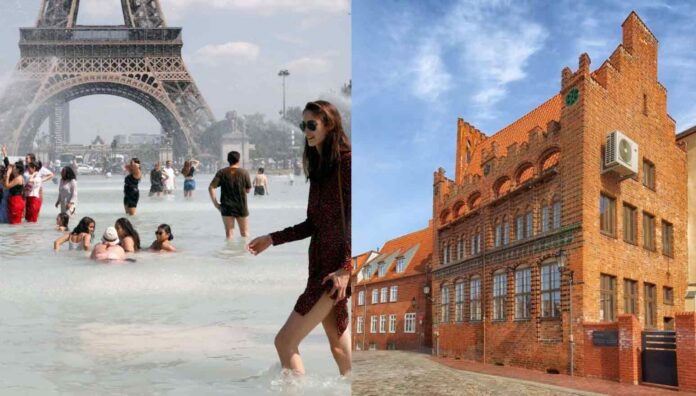
Europe is experiencing a severe heatwave with temperatures exceeding 40°C in some countries. Since 17th June, a more intense phase began due to a persistent Omega block weather pattern trapping hot air. However, Europeans are finding it difficult to seek relief from the scorching heat through air conditioning.
Europe grapples with scorching heatwaves
In France’s Pissos, around 44.3 °C (111.7°F) was recorded on 23rd June. This was the hottest day since records began in 1947. Meanwhile, Paris hit a June record of 40.9°C. In Spain and the United Kingdom, temperature record highs. In parts of Italy, Germany, Belgium, and elsewhere in Europe, temperatures are exceeding 38–40°C.
The impact of the Omega block is so severe that around 282 people have lost their lives, with 209 deaths reported in Spain, 58 in France, and around 15 in the UK. There are reports of additional heat-related incidents, including cardiac arrests.
At least 40 people have drowned in France while swimming in unsupervised areas to seek relief from a heatwave gripping the country and other parts of Europe.
— Al Jazeera English (@AJEnglish) June 23, 2026
Forecasters warn that the extreme heat is likely to persist through the week.
Al Jazeera’s Natacha Butler reports. pic.twitter.com/wqJGHrdoTc
The heatwave has led to an increase in emergency visits, leaving children and the elderly the most affected.
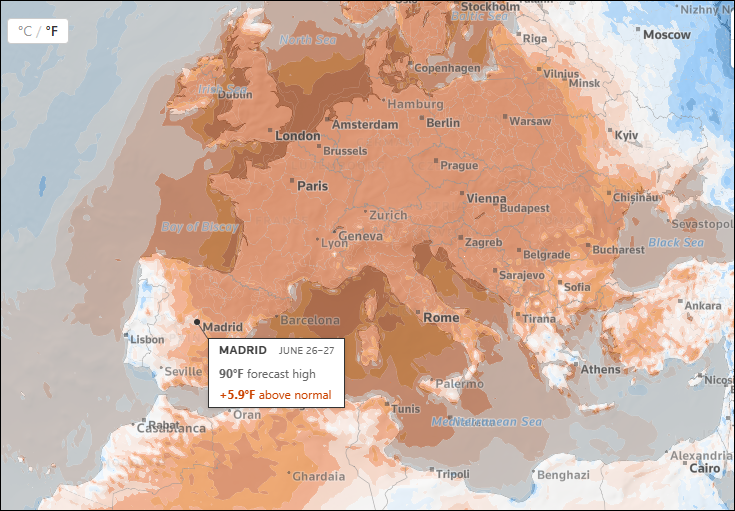
In France and some other European countries, schools have been either closed or had their timings adjusted to avoid peak daytime heat. Thousands of households in France are suffering power outages due to high demand and infrastructure stress.
In the UK, railway services have been suspended in several places as intense heat has deformed the rail tracks. In areas where the services are still running, trains are running slowly due to the effects of heat on rails, overhead power cables, signalling etc. Extreme heat cause rails to expand and buckle, and as a result, trains have to run slowly on such tracks.
People have been advised to stay indoors if travelling is not necessary, and have been advised to travel before midday if possible. Consumption and sale of alcohol in public has been banned in Paris due to the heatwave, to ease pressure on the city’s hospitals.
With rising temperatures, electricity prices are also increasing. However, the obvious resort to relief in peak summers, Air Conditioners are not that easily available in Europe.
EU regulations, high costs and a low historical usage: Why air conditioners remain a luxury in Europe
Historically, Europe has had a lower air conditioning penetration, with only 20% of European households having AC units. Europe has usually witnessed milder temperatures in what they describe as peak summer heatwaves compared to other parts of the world. In the UK, if the temperature reaches or exceeds 26°C, the authorities declare a heatwave and take necessary measures. In South Asia, a temperature of 26°C is considered a rather pleasant day.
Even to tackle milder summers, Europe had in place effective passive cooling methods, ranging from thick walls, shutters, small windows, especially in southern Europe, natural ventilation, etc.
In Europe, buildings were never designed with a view to tackling extreme heat, since the region hardly ever witnessed extreme heat. There was never really a need for mechanical cooling. The houses on the continent are designed to combat intense winter, not summer. Most houses in European nations are connected to centralised heating systems, and they never felt the need for a cooling system. During the summer, fans are generally effective.
Moreover, the high electricity prices make running ACs expensive; thus, Europeans usually avoided air conditioning until recently. However, with climate change amplifying the frequency, intensity, and duration of heatwaves in Europe, the region is warming faster than the global average.
With European summers moving from being milder to harsher, the cultural view of ACs is changing in the region from luxury to necessity.
Brian Motherway, head of the Office of Energy Efficiency and Inclusive Transitions at the International Energy Agency (IEA), told CNN, “In Europe… we simply don’t have the tradition of air conditioning… because up to relatively recently, it hasn’t been a major need. We haven’t been in the habit … of thinking about how we stay cool in the summer. It really is a relatively recent phenomenon.”
Although the European Union rules do not ban the purchase of air conditioners, the revised F-Gas Regulation, which came into effect in 2024, makes AC purchases a bit difficult in the region where governments already view air conditioning with caution.
The EU’s F-Gas regulation, which heavily taxes or bans refrigerants with high global warming potential, causes shortages of AC units.
The European Union has imposed strict mandates to phase down hydrofluorocarbons (HFCs) by 95% by 2050. The revised F-Gas regulations ban the sale and installation of certain domestic systems and restrict refrigerants like R-410A and R-134a, due to their high climate-warming impact. This requires the HVAC industry to shift to climate-friendly alternatives.
This has temporarily constrained supply and driven up prices. Although compliant models using low-GWP alternatives like hydrocarbon R290/propane, CO₂, or certain HFOs are already on the market and scaling up, it will take time to change the cultural view of ACs, and since demand is high and supply is limited, prices are higher.
The EU countries have stricter rules on minimum efficiency (SEER/SCOP), standby power limits, and design requirements. Only compliant units can be placed on the EU market, directly restricting inefficient or noisy models available for domestic installation. Cheaper, inefficient models cannot be sold in the zone.
Reports say that in the UK, the authorities also reject applications to install AC based on the visual appearance of the outdoor condenser unit, especially in conservation areas or on listed buildings. While a separate planning approval is not required for installing domestic AC units in UK in general, the city council may not allow certain AC units considering factors such as visual impact, effect on neighbours, noise, environmental considerations and overall character of the area.
If the noise generated by the outdoor unit disturbs neighbours, authorities may order relocation of the unit or noise mitigation measures. In London, the visual impact factor is important, and if it is considered that the impact is overwhelming, the authorities may not allow it.
European nations insist on passive cooling, and building designs must incorporate measures to cool the houses through better insulation, shading, and ventilation, without using ACs. What further adds to the troubles is Europe’s pledge to become “climate neutral” by 2050. The installation of AC units on a mass scale would prevent the fulfilment of Europe’s self-imposed imperative.
Overall, building and planning rules, high AC purchase, installation and electricity bills, demand spikes, and grid strains are exacerbating Europe’s heatwave crisis.
However, AC sales have increased in the region despite these hurdles. And as Europe is not a traditional AC market, Asian AC manufacturers are taking most of the benefits of the new high demand in the region. Korean, Japanese and Chinese AC makers are enjoying a boom in sales in Europe, and have increased their shipments.