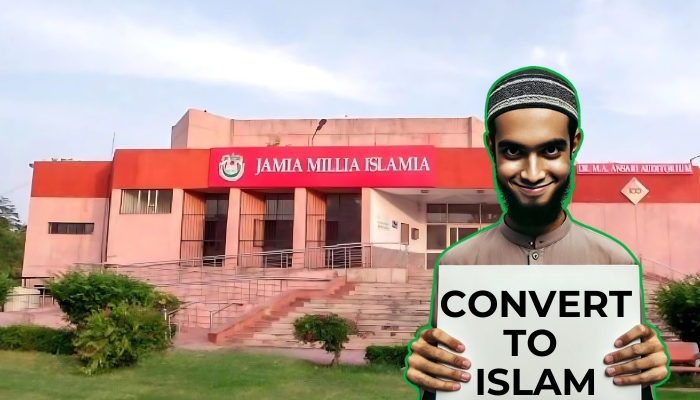
On 15th November, a Fact-Finding Committee (FFC) constituted by the Delhi-based NGO Call for Justice brought to light serious allegations of religious discrimination and forced conversions at Jamia Millia Islamia, a minority institution in Delhi. The committee was chaired by Justice (Retd) Shiv Narayan Dhingra and included Delhi High Court Advocate Rajeev Kumari as Secretary, along with Former Secretary to the Delhi Government IAS Narendra Kumar, Former Commissioner of Delhi Police SN Srivastava, Assistant Professor at Kirori Mal College, Delhi University, Dr Nadeem Ahmad, and Delhi High Court Advocate Purnima as members. The committee was established following complaints from students and staff members about systematic harassment and bias against non-Muslims within the university.
The committee recorded testimonies from 27 witnesses, ranging from teaching and non-teaching staff to students and former students of the university. These witnesses described a problematic environment of discrimination and alleged coercion to convert to Islam. Several witnesses expressed fear of further victimisation, due to which their identities were kept confidential by the committee.
The report highlighted several cases of non-Muslim staff being denied promotions, students facing academic bias, and a culture of pressure to renounce their faith. It raised concerns about the worsening situation since JMI attained minority status in 2011. Since then, according to the report, there has been a sharp decline in the number of non-Muslim students and employees at the university.
Scope of the committee’s enquiry
The committee was tasked with investigating key issues related to discrimination and coercion at Jamia Millia Islamia. The terms of reference included examining cases of harassment and victimisation of non-Muslims, understanding the reasons behind the decline in the number of non-Muslim students and staff since 2011, and identifying the role of university officials in fostering a hostile atmosphere. Furthermore, the committee was directed to investigate any anti-national activities allegedly taking place on the university campus and to address incidental matters arising during the investigation.
Testimonies of the witnesses
Witness number 1, referred to as CW-1 in the report, told the committee that she experienced bias and harassment for being a non-Muslim since the beginning of her tenure at JMI. She is an assistant professor at the university and alleged that her Muslim colleagues frequently misbehaved, taunted, and discriminated against her. During her academic progression, she faced hurdles, including the initial refusal to extend her study leave for pursuing a PhD, despite the availability of guest faculty to cover her duties.
She further informed the committee that when she eventually completed her PhD and applied for promotion to Associate Professor, her application was blocked by a Muslim clerk. The clerk allegedly mocked her qualifications. She filed complaints with the Registrar and sought an appointment with the Vice-Chancellor, but no action was taken. She was denied promotion while her less-qualified Muslim juniors progressed in their careers without any issues.
She testified that she faced continuous pressure to convert to Islam. Her colleagues frequently criticised Hindu faith and customs, urging her to adopt Islam for “safety and dignity.” When she refused, incidents of harassment increased, including being overburdened with work, professional isolation, and being bypassed for opportunities. She alleged that such practices were common against non-Muslims within the university.
Witness number 2, referred to as CW-2, told the committee that being a non-Muslim, and from the Scheduled Caste (SC), subjected him to severe discrimination at Jamia Millia Islamia. He joined the university as a teaching faculty member but was denied basic facilities such as a sitting space and a cabin. The same facilities were provided to his Muslim colleagues who joined after him. When he filed complaints with the Head of the Department and the Vice-Chancellor, no action was taken. Higher officials allegedly submitted fake reports to the Vice-Chancellor claiming that facilities had been provided to him.
When he threatened to file an FIR under the SC/ST Act, the university hurriedly constituted a committee and persuaded him not to file the FIR. Eventually, he was allocated workspace, but it was taken back when the Vice-Chancellor changed. It was only after he was made Assistant Controller of Examination that he received a cabin. After this, he faced abuses such as, “How could a Deputy Registrar’s office be given to a Kafir.” He also faced derogatory remarks about his attire and Hindu religious symbols, such as wearing a tilak or kalawa.
Furthermore, he was denied key responsibilities, such as supervising PhD students or preparing examination papers. However, his Muslim colleagues faced no such issues in securing these responsibilities. He alleged that his promotion was blocked due to his religion, and one Muslim staff member reportedly said that the post “should not go to a Kafir.”
Witness number 3, referred to as CW-3 in the report, recounted the harassment and discrimination she faced at the university. She described instances of being pressured to convert to Islam during her tenure as a teaching faculty member. She alleged that professors openly favoured Muslim students and staff while threatening and harassing Hindus who resisted conversion efforts.
In a further shocking testimony, she informed the committee that a senior faculty member, Professor Amutul Halim, threatened her with acid attacks and rape if she did not embrace Islam. Her work assignments were reportedly manipulated to overburden her. Maternity leave was initially denied despite health complications. Her promotion was delayed, and she had to fight for interviews, including seeking judicial intervention to secure her professional rights. She named several faculty members, including Sara Begum and Farhana Khatun, who attempted to force her to convert, but she did not relent.
Witness number 4, or CW-4, told the committee that he was repeatedly pressured by his Muslim colleague, Dr Saiyad Shahid Ali, to read the Quran and embrace Islamic teachings. Dr Ali would call him every 2–3 weeks to enquire about his progress, after which CW-4 began avoiding him. He experienced delays in routine promotions and was subjected to discriminatory behaviour. He was accused of website errors despite having no control over them. He alleged that this treatment was a direct consequence of his refusal to convert to Islam.
He mentioned that his routine promotions were delayed while his Muslim colleagues received theirs on time. When he protested, no action was taken. He also cited derogatory remarks from Muslim colleagues regarding his Hindu beliefs and rituals, describing the university atmosphere as hostile to non-Muslims.
Witness number 5, or CW-5, told the committee that soon after joining the university as an assistant professor, he received three copies of the Quran from different Muslim colleagues. They persistently made efforts to influence him towards Islam. When he resisted, he faced false allegations of being absent from classes. He was denied grants released by the Government of India for assistant professors, while his department colleagues received them.
CW-5 further alleged that his promotions were delayed by five years, causing him significant financial loss, and attributed this bias to his refusal to convert to Islam. When he complained to the Registrar, Nazim Husain Aljafri, about not promoting him from the date of eligibility, he was reportedly told this was because he lacked ‘IMAN’ (adherence to Islamic religion and values).
Witness number 6, or CW-6, told the committee that soon after joining Jamia Millia Islamia as an administrative staff member, he was given books containing Islamic teachings, which he returned within two days. He faced constant pressure to embrace Islam. After the university was granted minority status in 2011, a mandatory Urdu examination reportedly became a tool to fail Hindu students and staff members and to further encourage conversion. He alleged delays in his promotion and sarcastic remarks by Muslim colleagues about his caste and religion.
Witness number 7, or CW-7, told the committee that he faced persistent harassment and caste-based discrimination during his tenure as a student and later as a guest faculty member at JMI. After joining the university, his Headmaster, Mohammed Murshalim, openly expressed surprise that a Hindu teacher had been hired. He subjected him to degrading tasks, including washing dirty cups, while abusing him with casteist slurs intended to demean him as a member of the Scheduled Caste (SC). He pointed out that the ratio of Hindu students to Muslim students drastically changed post 2011 when the university got minority status.
Although CW-7 performed his duties perfectly, he was overburdened by the headmaster and denied leave during Hindu festivals. He was consistently pressured to convert to Islam. He further added that he was accused of misconduct based on fabricated complaints and was compelled to sign an apology letter under duress.
When he sought intervention from higher authorities, his complaints were ignored. He approached the National Commission for Scheduled Castes (NCSC) and sought legal recourse, but these steps led to heightened harassment, including threats from senior university officials. CW-7 revealed that his attempts to lodge an FIR against his harassers were initially obstructed by the local police, prompting him to seek a court order to have the case registered.
He recounted how the headmaster categorically warned him that unless he converted to Islam, he would be terminated based on false allegations. Despite obtaining an inquiry report exonerating him, no action was taken against the headmaster for making baseless complaints. CW-7 described the atmosphere at Jamia Millia Islamia as overwhelmingly hostile towards non-Muslims, with systemic efforts to coerce individuals like him into religious conversion through fear and harassment.
Witness number 8, or CW-8, told the committee about the continuous harassment and professional discrimination he faced as a Hindu faculty member. He testified that his troubles began in 2009 when he played the national song Vande Mataram on the university’s community radio. His actions angered senior staff, leading to targeted hostility. He said he was later denied a No Objection Certificate to join a government position despite being selected. He was subjected to fabricated misconduct allegations, including inappropriate behaviour with a student, without any evidence or opportunity to cross-examine witnesses.
CW-8 further detailed how his PhD registration at Jamia Millia Islamia was cancelled on dubious grounds after exceeding the prescribed time limit, while Muslim colleagues were granted extensions. He eventually completed his PhD at another institution but continued to face discrimination, including delays in granting increments and the denial of promotions. He alleged that his transfers to irrelevant departments, such as being moved from the Radio Department to the Hindi Department, were deliberate attempts to stifle his career growth. CW-8 claimed that university officials regularly hinted that his problems would be resolved if he converted to Islam, underscoring the systemic bias faced by non-Muslims.
Furthermore, CW-8 revealed that he suffered financial losses due to withheld increments and was threatened with compulsory retirement when he sought redress. He was consistently persuaded to convert to Islam. CW-8 cited examples of Muslim colleagues with lesser qualifications being fast-tracked for promotions, further highlighting the discriminatory practices entrenched within the university. His testimony shed light on the institutionalised hostility towards non-Muslims at JMI.
Witness number 9, or CW-9, told the committee that he worked as a security guard at Jamia Millia Islamia and was pressured by colleagues to convert to Islam. After refusing, he was falsely implicated in a rape case and subsequently jailed. During his imprisonment, his family was coerced into conversion, with his wife and daughter reportedly embracing Islam under duress. His wife died under mysterious circumstances, and despite being acquitted, CW-9 was not reinstated at the university due to his religion.
Witness number 10, or CW-10, told the committee that he faced relentless harassment and discrimination as a Hindu student at Jamia Millia Islamia (JMI). He alleged that after he shared a social media post praising Prime Minister Narendra Modi, he became a target of mockery and ridicule by Muslim students. CW-10 stated that he was frequently taunted for wearing Hindu symbols like kalawa and was accused of using “cow dung” and “gaumutra.” This atmosphere of hostility forced him to withdraw from public gatherings and social activities within the campus.
CW-10 testified that Hindu students at JMI were often pressured to convert to Islam and were targeted during Hindu festivals. He recounted incidents where Muslim students disrupted Diwali celebrations, and those participating were physically attacked. In one instance, Hindu students Ajay Kumar Jha and Manish Mishra were assaulted while returning from lighting diyas during Diwali. CW-10 also reported that Hindu students were deliberately failed in examinations or denied opportunities, with faculty members allegedly complicit in fostering this bias. He further noted that several Hindu students abandoned their studies due to escalating harassment.
CW-10 highlighted an incident where a B.Tech student, Mukesh, was assaulted for posting about a Hindu girl allegedly raped by a cleric. Instead of addressing the attackers, the university initiated an enquiry against Mukesh. CW-10 alleged that Hindu students were often subjected to threats and intimidation for participating in peaceful protests or questioning discrimination. He also mentioned a case of a Hindu girl, Bhawna Vashisht, who was sexually and mentally harassed to force her into converting to Islam and marrying a Muslim student.
Witness number 11, or CW-11, told the committee that as a Scheduled Caste (SC) clerical staff member at Jamia Millia Islamia (JMI), he faced persistent caste-based discrimination and religious harassment. Shortly after joining in 2007, he was pressured by Muslim colleagues to convert to Islam, with promises of greater respect and honour. When he refused, the workplace environment became increasingly hostile. CW-11 testified that his attempts to secure a permanent post or promotions were deliberately obstructed by senior officials.
He recounted that in 2023, when he challenged the university’s minority status and demanded reservation benefits in court, the harassment intensified. CW-11 alleged that the registrar and other senior staff used derogatory casteist slurs like “Bhangi” and “Chamar” and threatened to falsely implicate him in a sexual harassment case to terminate his employment. He further stated that his work assignments were manipulated, and he was transferred to departments where he had no tasks, isolating him professionally.
CW-11 also disclosed that senior officials pressured him to withdraw his court case and convert to Islam, warning him that his career at Jamia Millia Islamia would be ruined otherwise. He eventually filed an FIR against the registrar and other officials for casteist abuse and harassment, which was only registered after a prolonged struggle. CW-11’s testimony underscores the dual discrimination faced by non-Muslim and Scheduled Caste employees, with systemic efforts to coerce conversion and suppress dissent within the university.
Witness number 12 or CW-12, told the committee that as a Jain student, he was repeatedly pressured to convert to Islam by Muslim peers and external individuals visiting the campus. CW-12 reported threats and abuse after resisting these efforts, including a physical assault by a group of students. He also testified about religious discrimination during festivals, with Hindu celebrations being restricted or denied, while Muslim festivals were openly promoted on campus.
Witness number 13 or CW-13, told the committee that as a non-Muslim staff member in the exam controller’s office, he was subjected to differential treatment, including being barred from eating in the office during lunch hours while Muslim colleagues performed namaz without restriction. CW-13 faced obstacles in securing NOCs for external opportunities and alleged that promotions were granted preferentially to Muslim employees. He also highlighted cases where Hindu girls who converted to Islam were given permanent jobs, further indicating a systemic bias.
Witness number 14 or CW-14, told the committee that as a law student, he witnessed frequent discrimination against Hindu students. He alleged that Muslim students were allowed to deviate from the dress code, while Hindu students faced penalties for doing the same. CW-14 recounted incidents where patriotic songs were banned during cultural events, and Hindu students were openly mocked or targeted for their religious practices. He also highlighted attempts to lure Hindu girls into conversion and relationships with Muslim peers.
Witness number 15 or CW-15, told the committee that he was targeted for protesting against anti-Hindu social media posts. He alleged that members of the Tablighi Jamaat regularly visited hostels to influence Hindu students to convert to Islam. CW-15 claimed that Muslim students and faculty often labelled Hindu students as “Sanghis” or fascists, creating a hostile environment that led many to abandon their courses or remain silent about the harassment.
Witness number 16 or CW-16, told the committee that as a PhD student, he faced discrimination in fellowship allocation. While Muslim students were routinely granted fellowships, CW-16’s application was denied without explanation. He was frequently assigned menial tasks, such as grading papers and relocating laboratory equipment, which were not required of his Muslim peers. CW-16 stated that he refrained from raising concerns, fearing repercussions that could delay his degree completion.
Witness number 17 or CW-17, told the committee that he observed a systematic effort by radical groups at Jamia Millia Islamia to convert non-Muslims to Islam. As a Muslim staff member, CW-17 highlighted the existence of organisations like the Popular Front of India (PFI) and Jamat-e-Islami operating within the campus, allegedly targeting Hindu students and promoting radical ideologies. He revealed that Hindu students were often denied accommodation in hostels and were subjected to discrimination during elections and social activities. CW-17 also alleged that certain professors were complicit in creating a hostile environment against non-Muslims.
Witness number 18 or CW-18, told the committee that as an undergraduate student, he experienced blatant religious bias during coursework. He stated that courses on Indian religions disproportionately focused on Islam, with Hinduism and other faiths dismissed as inferior. CW-18 also alleged that a Hindu classmate was pressured to convert to Islam, and Muslim students criticised Hindu festivals while discouraging participation in celebrations like Holi and Diwali.
Witness number 19 or CW-19, told the committee that Muslim students frequently tried to impose Islamic practices on non-Muslims. He highlighted instances where Hindu students were forced to adhere to Muslim traditions, including namaz and dress codes. CW-19 also alleged that special privileges, such as extended lunch breaks for Friday prayers, were granted to Muslim students and staff, while non-Muslim festivals were ignored. He noted that Hindu students felt increasingly unsafe due to the rise of radical elements on campus.
Witness number 20 or CW-20, told the committee that as a postgraduate student, he faced harassment for resisting religious coercion. He alleged that he was denied admission to a PhD programme despite being qualified, attributing this exclusion to religious bias. CW-20 also testified about receiving threats for not conforming to Islamic practices and noted that several professors openly discriminated against non-Muslim students in academic and administrative matters.
Witness number 21 or CW-21, told the committee that she faced targeted discrimination as a Hindu faculty member. She alleged that her workload was manipulated to make her responsibilities disproportionately heavy compared to her Muslim peers. CW-21 testified about instances where her professional growth was hindered, including being passed over for promotions. She also cited an environment of religious intolerance, where Hindu beliefs were ridiculed, and Islamic practices were overtly encouraged.
Witness number 22 or CW-22, told the committee that he witnessed systematic discrimination against non-Muslim staff. He alleged that important positions and promotions were reserved for Muslim employees, with non-Muslims being excluded from key decisions. CW-22 highlighted specific cases of Hindu staff members being pressured to convert to Islam to gain professional advantages, with some eventually succumbing to these pressures.
Witness number 23 or CW-23, told the committee that as an administrative staff member, he faced delays in promotions and frequent harassment for not adopting Islamic practices. He testified that even routine approvals were made difficult for non-Muslims, while Muslim colleagues enjoyed preferential treatment. CW-23 also alleged that the university administration often ignored complaints by non-Muslims, further enabling a culture of bias.
Witness number 24 or CW-24, told the committee that she observed blatant favouritism towards Muslim students and staff in academic and extracurricular activities. She cited instances where Hindu students were penalised for minor infractions while Muslim students were let off for similar or more serious violations. CW-24 also testified about covert attempts by university faculty to influence Hindu students to convert to Islam.
Witness number 25 or CW-25, told the committee that as a non-Muslim student, he faced ongoing harassment from both peers and faculty. He alleged that Hindu students were pressured to abandon their cultural and religious practices, and those who resisted were ostracised. CW-25 recounted being ridiculed for wearing traditional Hindu symbols like a tilak and kalawa and stated that such hostility discouraged many Hindu students from continuing their education at JMI.
Witness number 26 or CW-26, told the committee that he observed a sharp decline in the enrolment of non-Muslim students at Jamia Millia Islamia, attributing it to the hostile environment fostered on campus. He testified that Hindu students were frequently targeted during religious festivals and faced relentless pressure to adopt Islamic customs. CW-26 also alleged that the administration actively ignored or suppressed complaints by non-Muslims.
Witness number 27 or CW-27, told the committee that he faced workplace discrimination as a non-Muslim faculty member. He alleged that Muslim colleagues enjoyed undue privileges, such as preferential access to research grants and promotions, while non-Muslims were systematically sidelined. CW-27 testified that even minor administrative tasks were complicated for non-Muslims, creating an environment of exclusion and frustration.
Why was the committee constituted?
The Fact-Finding Committee (FFC) was established by the NGO Call For Justice in response to escalating allegations of discrimination and forced conversions at Jamia Millia Islamia (JMI). The catalyst for this investigation was the case of Mr. Ram Niwas Singh, a Dalit employee at JMI, who filed a First Information Report (FIR) against senior university officials, including Professor Nazim Hussain Al Jafri, Mohammad Nasim Haidar, and Professor Shahid Tasleem. Singh accused them of caste-based harassment and attempts to coerce him into converting to Islam. More details about the case can be checked here.
In his complaint, Singh detailed a series of discriminatory actions, such as being denied No Objection Certificates (NOCs) for career advancement and facing multiple unwarranted transfers within the university. He also reported being subjected to derogatory casteist slurs and threats of false allegations to jeopardize his employment. Singh alleged that university officials pressured him to convert to Islam, promising to resolve his professional issues and secure his children’s future upon conversion.
Findings of the fact-finding committee
The committee uncovered systematic discrimination and harassment of non-Muslim students and staff at JMI. The report revealed continuous efforts to convert non-Muslims to Islam through psychological pressure, professional setbacks, and even threats. It documented widespread bias, including the denial of promotions, caste-based slurs, isolation in academic settings, and unwarranted accusations. The report also highlighted the role of certain university officials and radical elements in creating a hostile atmosphere for non-Muslims.
Reasons for the sharp decline in the number of non-Muslim students and staff at JMI
The committee noted a sharp decline in the number of non-Muslim students and staff members at the university over the past decade. The report attributed this change to an increasingly hostile and discriminatory atmosphere at JMI. Non-Muslims reportedly faced religious and caste-based discrimination. The introduction of mandatory Urdu exams after the university gained minority status in 2011 became an indirect tool to discourage non-Muslims from enrolling or continuing their education. Hindu students and staff also cited persistent coercion to convert to Islam as a significant factor for their withdrawal.
Anti-national activities at JMI
In addition to the issues mentioned above, the report raised serious concerns about alleged anti-national activities at JMI. It noted that such activities were facilitated by radical elements within the university. The report documented instances where student and faculty organisations collaborated with groups such as the now-banned terrorist outfit Popular Front of India (PFI) and Jamat-e-Islami to promote divisive and extremist ideologies.
Witnesses informed the committee that these groups targeted non-Muslim students for conversion and trained individuals in radical doctrines. The committee also highlighted protests against the Citizenship Amendment Act (CAA) and the National Register of Citizens (NRC), noting the involvement of JMI’s faculty and administration in mobilising demonstrations and raising funds. Such activities were allegedly used to foster anti-national sentiments.
The Fact-Finding Committee’s findings reveal serious issues of discrimination, harassment, and pressure to convert to Islam at Jamia Millia Islamia. Testimonies show a hostile environment for non-Muslim students and staff, with examples of caste-based discrimination and unfair treatment in academics and jobs. The report highlights the urgent need for action to ensure justice and equality for everyone at the university.