Home Blog Page 7073

Panel formed to conduct inquiry into Rajya Sabha TV operations since its inception

0

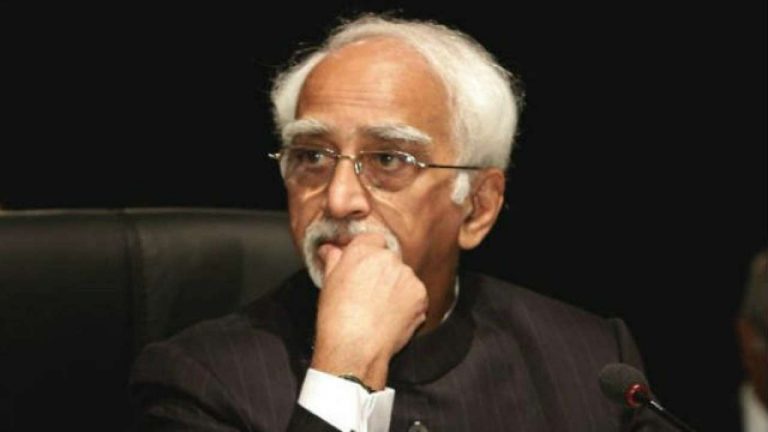
As reported by Indian Express, The Rajya Sabha Secretariat has decided to probe the alleged irregularities in the functioning of the Rajya Sabha Television (RSTV). The RS secretariat has formed a one-man inquiry committee to look into the allegations since its inception, specifically the expenditure incurred on the production of a film called “Raag Desh”.

Raag Desh, a film made during the end of Ansari’s tenure as the Vice President was produced by the then CEO and editor-in-chief of RSTV Gurdeep Sappal and was directed by Tigmanshu Dhulia. The expenditure of Rs 13 crore was incurred on the movie and had raised questions after its release, as it did not make any profit at the box office.

The RS secretariat has now formed a one-man panel under Dr P P K Ramacharyulu and assisted by D K Mishra, to probe into the irregularities occurred during the production of the movie. The panel has been asked to submit its report within three months.

Rajya Sabha TV, which began in 2011 under Ansari, is owned and operated by the Rajya Sabha. The channel was setup to broadcast the live coverage of the Rajya Sabha proceedings. Before the advent of RSTV, the Lok Sabha TV would telecast the proceeding of the Rajya Sabha, but in 2011 Ansari led Rajya Sabha made efforts to setup a separate channel using Parliament’s Sansad Cable Network with a modest budget of Rs.1.55 crore.

It is reported that the RSTV, since its inception has spent a huge amount of Rs 1,700 crore of taxpayers money till 2015 to operate the channel. The budget for RSTV is bigger than any government channel and also doesn’t generate any revenue, as the channel has not made any profits out of advertising.

Gurdeep Singh Sappal, former CEO of the RSTV was picked by Ansari without any procedure for selection unlike LSTV, which advertise to fill the post of its CEO. Sappal, despite having zero experience as a journalist was picked up by Ansari and granted lifetime access to the Central Hall during the end of Ansari’s tenure. Addition to that, Sappal was provided with other perks and lavish accommodations and a distinguished pass for Parliament’s Central Hall.

Sappal speaking to India Express said that all due procedures were duly followed and no lapse was identified at any level. “As far as Raag Desh is concerned, it was produced with the approval of the Content Advisory Committee of RSTV, comprising leaders of all major parties in Rajya Sabha. The film earned critical acclaim and was well received by media pundits and reviews,” Sappal said.

The management of the Rajya Sabha television under Hamid Ansari has been extremely controversial and often accused of mishandling the channel. Hamid Ansari, who was also the head of the RSTV, is often accused of promoting nepotism by hiring journalists, who are loyal to the Congress party. The infamous opinion makers like M K Venu and Siddharth Varadarajan, founding editors of The Wire, were paid handsomely, Rs. 15,000 per appearance, totalling to Rs. 33 lakh and Rs. 14.70 lakh respectively, of the taxpayers’ money in the last few years to spread their agenda using the channel’s resources.

Vice President M Venkaiah Naidu, soon after taking charge as the ex-officio chairman of the Rajya Sabha had ordered the expenditure and manpower audit of the channel. It was reported that the Vice President had questioned the nature of expenditures incurred by the channel on renting office premises, hiring cabs and producing a feature film.

Rape accused Talib Hussain injured in jail, police say attempted suicide, media says plot to escape

0

Talib Hussain, the previously hailed ‘social activist’ who is in custody on charges of an attempted rape by a female relative, has been injured in Samba jail. According to reports, Hussain suffered a head injury and was taken to the Samba District hospital. He was discharged after treatment and sent back to police remand.

There have been conflicting reports about the cause of his injury. While many media reports have quoted the Samba Police as saying that Talib caused self-harm in an attempt to commit suicide. He reportedly banged his head on the walls of the lock-up.

Attempting suicide is a criminal act under the law and the Samba police have reportedly lodged an FIR under section 309 of the Ranbir Penal Code. Several reports have stated that Hussain had created a ruckus inside the police custody and banged his head. He had reportedly created mayhem in the hospital too. The Samba police have denied all reports of assault by inmates and maintained that he has caused self-harm.

The Amar Ujala report claims that this entire episode was a drama that was created by Talib Hussain because he wanted to be admitted to the Hospital. According to Amar Ujala, Talib Hussain was planning to escape from the hospital but was returned to jail after his treatment.

A Kashmir based media outlet Raising Kashmir has reported that Lawyer Deepika Rajawat has claimed Talib was assaulted by inmates inside lock-up and later he had hit his own head in anger. While rape accused getting beaten up in jails is a recurring incident, the Samba Police have maintained that he was neither assaulted by inmates or police. The injuries he suffered were minor and he was discharged from hospital after primary treatment.

Many people in social media, however, have been circulating the story of assault by inmates. Supreme court lawyer Indira Jaising claimed that Talib Hussain ‘has been tortured in Samba police station while on police remand’. She insinuated that Talib Hussain was a victim of police brutality. However, no local report has thus indicated that he might have been a victim of police torture.

Tweet by Indira Jaising

Talib Hussain was in the forefront of the protests against the rape and murder of an 8-year-old girl in Rasana earlier this year. Recently, his wife had brought charges of domestic violence against him, claiming Hussain had been demanding dowry and harassing her since she had given birth to two girl children. One of Talib’s female relatives recently claimed that he attempted to rape her in a local forest and threatened her with a weapon. Hussain had been arrested under the charges of attempted rape possessing an illegal weapon.

Journalist who interviewed RVS Mani, man who exposed Congress’ ‘Hindu Terror’ plot, gets beheading threat

0

A Times Now journalist, Aditi Ananthanarayanan, who had interviewed former under-secretary in the Ministry of Home Affairs in the UPA RVS Mani, has claimed that a beheading threat has been issued against her for interviewing RVS Mani earlier this year.


RVS Mani had recently written a book busting lies and propaganda around the ‘Hindu Terror’ conspiracy by Congress, for which, he too claimed to have received threats to his life.

Aditi even shared a video of her interview with RVS Mani, which she says could have triggered the threat against her.


We had earlier written about the explosive interview by Times Now which revealed how the then UPA government went to great lengths to create the false narrative of Hindu terror and falsely blame Lt Col Shrikant Purohit for the Malegaon blasts.

The interview aired in March this year with the former undersecretary in the Ministry of External affairs RVS Mani revealed details about how the narrative was created around the Malegaon blasts case, the Samjhauta Express blast case and the Batla House encounter case to paint a picture of ‘saffron terror’.

RVS Mani, who served as undersecretary in the Ministry of Home Affairs from February 2006 to August 2010 has revealed several details and stated that Col Purohit was framed by the UPA government because he was breaking the back of the groups involved in Islamic radicalisation.

The following points were raised by the former under-secretary in the interview:

  1. Col Purohit was deliberately framed by the Congress government
  2. Within barely a month of the Malegaon blast, a serving Army Officers (Col Purohit) was arrested. Also, how did the case get transferred from the local police to the ATS within 4-5 day? The blasts happened at the end of September and Col Purohit was arrested on 4th November.
  3. Col Purohit was deliberately hounded and tortured because he was breaking the back of groups like SIMI. He was exposing the links between the terror groups involved with radicalisation and politicians and powerful individuals.

In the interview with Aditi, the journalist who has claimed to have received threats of beheading, he had talked about Samjhauta Blast case. He stated that a Pakistani national named Arf Kasmani from a Karachi based group claimed the responsibility for the blasts. Also, later links to SIMI and other such organisations were exposed. He states in all the years of his service he has never come across a single actionable input regarding Hindu Terror and the term was deliberately coined.

Rijiju, Himanta Biswa Sarma condemn Tharoor’s comment on Naga head dress, demand apology

0

Shashi Tharoor’s contentious remark on the Prime Minister’s choice of headgears and calling the Northeastern headgear ‘outlandish’ was not received well by many including dignitaries like Kiren Rijiju, current Union Minister of State for Home Affairs from Arunachal Pradesh and Himanta Biswa Sarma, minister, with the government of Assam.

Speaking in a seminar in Thiruvananthapuram earlier today over the topic of ‘Standing up to hatred: Violence and intolerance in contemporary India’, Tharoor reportedly stated,” Why does our Prime Minister, who wears all sorts of outlandish headgear wherever he goes around the country, refuse to wear a Muslim skull cap? You’ve seen him in hilarious Naga headdress, feathers, and various kinds of extraordinary outfits. Why does he refuse to wear the green?”

Tharoor’s branding of traditional headgears as ‘outlandish’ has drawn severe criticism on social media. Amongst the various people who voiced their displeasure, Kiran Rijiju took to Twitter demanding apology from the Congress party for insulting the people of India’s North East & Tribals.

Himanta Biswa Sarma, on the other hand, took a step ahead blaming the Congress of mocking the people of Northeast for the last 70 years, wondering whether Rahul Gandhi would come forward and apologize for such an abhorring statement made by his fellow party member.


It is notable that the Naga headgear that Tharoor has called hilarious, is a traditional Naga headdress adorned by the native tribes in Nagaland and it is a part of their cultural heritage. Tharoor, however, showcasing his double-standards, had chosen not to comment on the recent event where his own party President Rahul Gandhi had refused to wear the traditional Mysuru Peta, the traditional headgear of Karnataka. Earlier, propagandist masquerading as a comedian, Kunal Kamra, too, mocked the hat-like headgear, Jaapi, which is a cultural icon of Assam.

JK DGP rubbishes NDTV’s claims of a possible ‘police revolt’ if article 35A scrapped

0

The Supreme Court was hearing a petition on the article 35-A today. The article 35-A defines the ‘permanent residents of Jammu and Kashmir’ and prevents Indians from other states from buying property there and settle. There was a shutdown call in the valley over the issue and many media outlets reported it, However, NDTV, as usual, took the rumour-mongering and misinformation spreading to a step ahead.

An NDTV report, titled “Police revolt in Kashmir if top court scraps article 35-A, Agencies warn”, claimed that they have learned from ‘intelligence agencies’ that there is going to be an ‘internal revolt’ and massive unrest in Kashmir if the Supreme Court passes any ‘adverse order’ regarding article 35-A. The claim was not backed by any name or fact. In the short interview of the Jammu and Kashmir DGP SP Vaid aired, an NDTV reporter is seen asking DGP Vaid about the possibility of such a revolt. DGP Vaid asserts that the Jammu Kashmir police is a valiant and honourable force and for them, duty comes first.

The reporter goes ahead to twist the question and asks what if there is actually a revolt within the ranks of the J&K police, to which the DGP explicitly states that he does not see any possibility of any such thing. He further asserts that every resident of the state might have a view, including himself, but for police officers, duty comes first and the order of the Supreme Court will be honoured by all.

Despite the express denial of the DGP, NDTV ran the sensationalist headline and crafted the entire news report about the ‘claims of revolt’, without any substantiation.

KnsKashmir.com, a news portal of Kashmir, quoted the DGP dismissing any such claims as ‘rubbish’ and they carried no credibility. He reportedly added that media outlets are making false claims and there has been no such intelligence report.

Though, as claimed in reports, the DGP did admit that the standing council of the state government has submitted in the Supreme Court to defer hearing on the issue till October after the Local body and Panchayat elections are held in the state. The DGP stated that there was a shut down in the valley but sparing a few minor incidents of stone pelting, it has been peaceful so far.

The NDTV report claiming ‘intelligence agencies’ sending report of possible revolt within the state police did not have any factual base. This is not the first time that NDTV has concocted news. In the past, they have invented theories and have told deliberate lies to create confusion among the masses. But lies about a non-existent report on a possible revolt seems to be a new low especially considering the delicate situation in Kashmir and the risks security forces take to maintain peace in the region.

Tilak, Nationalism and the Forgetful Prince

0

A week has gone past, a blip on the life of the nation which has to its credit the honour of being the cradle of civilization. A week is a very short time in the life of a nation, but many things can happen within even a shorter span of time when the nation is in a state of flux.

India has been in a state of flux ever since Congress lost power and the current Congress leadership, which always looked at the right to rule this great nation as their divine and dynastic right has not been able to come to terms with the democratic churn which threw them out of power. This has made Congress and the ecosystem they created over the decades extremely uneasy, angry and violent. Amid hugs, pretentious platitudes of moralities and half-hearted proclamation of love towards art, culture and history of this nation; Congress leadership has been lackadaisical about matters of historical importance at its best, and vile and scheming at its worst.

In an effort to keep the first family of the Congress as the last and only hope for the nation as intellectual giants destined to offer intellectual anchor to an otherwise directionless nation of pygmies, they worked systematically to reduce all great minds, all great events to a level where remembering them becomes difficult than forgetting them.

The tribute of Congress Chief Rahul Gandhi to one of the greatest India writer of the modern time, Munshi Premchand, three days after his birthday could be a lazy oversight, but then, not being able to recollect the memories of one of the tallest socio-political intellectual of all times, and one of the founding leaders of Congress, Lokmanya Bal Gangadhar Tilak cannot be innocent mistake.

When we look at how the creator of the Indian constitution, Dr BR Ambedkar has been reduced to ill-made, statues in blue themes dotting mostly the irregular colonies and slums of the nation, with his thoughts and ideas are hidden away behind rhetoric and slogans; we understand the pattern.

We can almost see how systematically the events of national importance were erased out of the minds of the masses unless they added to the political theory of hereditary right to rule of the Congress’ first family. The memories of great men cannot be conserved through idols and statues (though they may help), but the presence of past heroes in our life can only be perpetuated by the preservation of their thoughts.

Modern-day Congress with their new-found allies in the leftist, worked diligently to banish Bismil, wipe out Ashfaqullah, Ambedkar (who had to wait for a non-congress Government to come into being to be awarded Bharat Ratna, compare that with the stage in life when say, a cricketer got it) from public memory. The efforts to limit our understanding of Indian History to Nehru-Gandhi family has been disgustingly blatant.

This is not a modern design. The British did employ this technique for their own good. The only way to rule with absolute power over a large nation of several millions of people with a battery of few thousand soldiers of their own was to mess up with the sense of the history of the people of the nation. To ensure that people never seek to rule over their own nation and object to foreign rule, the first thing was to deny that there was a nation to be ruled in existence, the second was to ensure that the people lost their sense of history and heritage which went contrary to the first contention.

Haven’t we all seen the modern-day intellectuals trying to create a narrative that before the British walked in with their white man’s burden of civilizing the pagans, India never existed as a nation? “The most effective way to destroy people is to deny and obliterate their own understanding of their history,” wrote George Orwell. This is what we see in action when we notice the stubborn refusal of the Congress to celebrate Indian victory in Kargil or when we find the forgetful prince of the Congress missing the death anniversary of Lokmanya Tilak on the 1st of August.

The routine guffaws of Social media team of Rahul Gandhi notwithstanding, looking at the way Congress went about reducing all non- Nehru family leaders of past into mere caricature over the years, this forgetting of Tilak is not innocent. Tilak not only represents a great freedom-fighter and the first man to proclaim independence and self-rule as a birthright, he is also one of the first among the historians and intellectuals to establish our national identity as a nation.

Our national identity which Tilak put forth through his painstakingly researched work went beyond the British and Mughal rule. His telling of our history took us back to the banks of Saraswati, to the days when the beginning of Bharat merged with the saffron strains of the Sanatana. No wonder, that the current Congress has been feeling uneasy with this since it began its post-independence journey under Nehru, an atheist socialist and thereafter with Indira who discovered her Muslim votebank after large-scale excesses against the Muslims during the emergency and later with Sonia Gandhi, who dithered for a decade before opting for Indian citizenship (Sonia Gandhi married Rajiv in 1968 and surrendered her Italian passport to obtain Indian citizenship only in 1983, year before the death of Indira Gandhi, the then Prime Minister). The memories the tallest first leaders of the Congress, affectionately called as Lal-Bal-Pal was relegated to the past on account of this discomfiture of modern day Indian National Congress.

Attempts have been made by modern day politicians to classify leaders like Lala Lajpat Rai and Tilak as Hindutva leaders. This idea of our and their freedom-fighters gained much currency in the last five years, ever since a non-Congress government came into power. It is appropriate and necessary for the government of the day to celebrate our past leaders in a non-partisan manner without attempting to pigeon-hole them. It is unfortunate that instead of being happy about it, Congress calls it an attempt by the BJP to appropriate the history. Congress SM mouthpiece has gone on record comparing and denigrating Veer Savarkar, a freedom-fighter who suffered a lot at the hands of the British. In the foreword to the biography of Tilak by Shri DV Athalye, published in 1921, I came across an interesting quote by CR Das, which should be guiding principle while writing about great men who shaped our nation, whether it be Savarkar, or Bismil or Nehru. Shri CR Das wrote, “The character of a truly great man defies classification.” 

Shri Athalye writes in the preface of his book which pretty much captures the essence of Bal Gangadhar Tilak, who received overwhelming affection from all the sections of society, (a particular section in the section of Autobiography of Ram Prasad Bismil refers to the episode of Lucknow Convention of Congress where there were huge protests by students who wanted counter deliberate attempt of the reception committee to sideline the event to honor the public reception of Tilak and is testimony to the huge devotion of younger lot for the great leader).

Shri Athaylye writes and I quote, “The unique feature of Mr Tilak’s career is that like a magnet, it draws all. While the populace claims him as one of their own, aristocrats recognize that he represented, in his intellectual and spiritual eminence, a nobler aristocracy than has fallen their lot.” At the age when being more British than the British were touted as the sole way of salvation, the trio of Tilak, Vishnushastri Chiplunkar and Gopal Ganesh Agarkar embarked on the idea of Indian way towards modernism and social reforms.

Tilak believed that a truly Indian social reformer ought to be a lover of Indian civilization and culture. His idea of social reform was not in contradiction to the prevalent public faith, rather derived its legitimacy from historicity and rational cultural arguments. In his speech supporting social reforms, he said in a meeting held on 1st of November, 1890, “…In reforming society, care ought to be taken to avoid the creation of any gulf between the people on one hand and the reformers on the other. We must carry public opinion with us; and this can be done, inter alia, by securing for our reforms the sanction of religion.” His reformist ideas evolved by embracing the roots of Indian spiritualism and religion, not by thwarting, maligning and ridiculing it.

Another important instance in this period which could possibly explain the antipathy of the seasonally Hindu leadership of current Congress leadership towards this great leader of Congress. Tilak, always in favour of modern education, supported Mrs Ramabhai, a Christian lady to start a resident school for Hindu Girls. His only condition was that the education was supposed to be truly secular. However, when in 1889 it came to light that four of the school students were trained on Christianity, Mrs Ramabai faced stiff opposition from Tilak. This incidence saw his earlier comrade Agarkar parting ways in support of Mrs Ramabai. They did come back to Tilak regretting their failure to notice the proselytizing and missionary nature of the organization by 1893 but by then the whole reform movement was discredited in the public eyes.

Lokmanya Tilak joined the Congress in 1889, for was largely ignored by national leadership. Shri Athalye writes that it was so because “the group of politicians who held the Congress in leading strings was rather exclusive and would not admit into the inner sanctuary an element of alien type. The qualities that then were considered to belong to a statesman were eloquence of speech, suppleness of conduct, European habits and association with the bureaucracy. Mr Tilak had none of these ‘rare’ gifts.” Not much seem to have changed between the Congress of then and the Congress of today, if at all, it seems to have gone worse.

In the backdrop of Plague in Pune, Chapekar murdered Plague Commissioner Rand in protest of excessive powers given to the British police allowing them to enter the households, stripping down people including women in public on suspicion of Plague. Tilak was picked up on the charge of promoting violence which resulted in the murder of Mr. Rand, based on one evidence being a poem by some obscure poet in which Shivaji urged the fellow Marathas to fight against the Islamic rule and another being a speech of Tilak at the end of Shivaji festival, where justifying the killing of Afzal Khan by Shivaji, Tilak had said that No copper plate was given to the Malechhas to rule over Hindustan. 

The media then and even political opponents (largely Indians) came together to call these statements as a call for political murders. Tilak was sentenced to rigorous imprisonment for 18 months. While his sentence was later reduced by six months at the behest of Professor Max Muller, as a fellow indologist and writer of a treatise like The Orion and Arctic Home in the Vedas. It was Tilak through his scholarly work brought us back to acknowledge our glory as world’s oldest civilization. He brought a sense of pride in the heart of an average Indian, while on the other hand he was being made to feel ashamed and embarrassed for who he was, and from where he came.

While in delirium, on his deathbed, on 28th of July, Tilak was heard murmuring- “1818- 1918- One hundred years- what a life of servitude!” On 29th of July, 1920, came is last words at around 1 PM – unless Swaraj is achieved- India shall not prosper. It is required for our very existence. One of the greatest sons of India breathed it last at 1 AM, at the midnight, 1st of August, 1920. And when the morning broke, one of Tilak’s contemporary wrote – people found that the vigilant watchman of India’s cause has disappeared from their midst…the news of his death gave a shock to the people, it stunned them, they looked at each other with blank eyes and they knew not what to do…In the funeral procession were seen Mr Gandhi, Mr Shaukat Ali, Dr Kitchlew, Mr Jamnadas and other prominent citizens of Bombay…His body was seated in a palanquin and the pall-bearers included Mr Gandhi, Mr Shaukat Ali, Dr Kitchlew and many others. 

The Tilak Swaraj Fund created by Mahatma Gandhi in the memory of Tilak, become until then the biggest fundraising campaign in three short months, collecting around One Crore in three Months. It is truly sad that the Congress of today has forgotten such a great Congressman. It is even sadder that this forgetfulness gets deeper and appears more and more evil with every passing day. Let us remember our leaders, let us learn from their wisdom on how to serve our motherland, where ever we are.

Let us not be men and women of empty rhetoric. Let us be worthy sons and daughters of this great land, for even love has to be earned. Love, of all things, is not something which your surname or accident of birth gets you, even if you go around forcefully hugging people. Not everyone is “acceptable and revered by all”; not everyone can become “Lokmanya”. It would be a pity if we are fooled by our political leadership into forgetting our great hero, our Lokmanya.

Government constructs bunkers for safety of the civilians in Jammu and Kashmir

0

With regards to the security concern of the locals during the cross-border firing along the LOC, the government of India has constructed community bunkers in Rajouri’s Nowshera city. This laudable initiative is taken to ensure that daily life and education is not disrupted in areas surrounding the borders.

Rajouri District Development Commissioner, Mohammad Aijaz Asad while speaking to ANI said, “Some bunkers have already been constructed and many more will be completed soon here in Rajouri. The project by the Government will be wrapped up soon. Schooling facility will be provided in the bunkers so that students’ time isn’t wasted and their schooling is completed on time.”

As many as 102 bunkers out of the sanctioned 14,000 bunkers have already been completed providing respite to the locals especially at the time of ceasefire violation by Pakistan.

Locals are gratified by the bunkers which provide shelter during the firing. Some have even installed light bulbs and fans inside the bunkers for comfort. Taking into account the 1252 ceasefire violation from across the border, Home Minister Rajnath Singh, in May this year had called for accelerating the construction of bunkers along the International Border (IB) and LoC to protect the border residents.

The Centre recently sanctioned the construction of 14,460 individual and community bunkers costing Rs 415.73 crore for people living along the borders. Out of the total sanctioned, 13,029 bunkers would be of 160 square feet individual bunkers with a capacity to hold 8 persons while the rest 372 would be community bunkers of 800 square feet with a capacity to hold up to 80 people. These bunkers would spread across Kathua, Samba, Jammu, Rajouri, and Poonch districts.

The fake story created by liberals making Buta Malik a hero for discovering Amarnath Shrine

0

“The famous Amarnath Yatra which leads to the cave is of great religious significance to the Hindus. However, according to folklore, its discovery dates back many years when the sacred cave of Amarnath was first supposedly discovered by a Muslim shepherd from Batakot. The shepherd, Buta Malik, stumbled upon the sacred spot after his flock strayed amidst the mountains. Over time, the shrine of Amarnath has become a holy pilgrimage that attracts people from all over the country. It is said that the family of Buta Malik, the man credited with the discovery of the caves, stays in Batakot till now. As per reports, the shepherd took shelter in the cave where a Sufi saint gave him a Kangri, a small pot filled with burning coal that is held close to the body to keep it warm. When he went home, he saw that the pot of coal had turned into a pot of gold. Overjoyed, he went back to the cave to thank the saint. But instead, he found only the cave and the Shiva Linga. As per a report in The Indian Express, his descendants were the custodians of the shrine for a long time. However, now it is looked after by the Amarnath Shrine Board headed by the Governor of the state.”

The folklore of Buta Malik is being told by his descendants and local Kashmiris, the legend is an amalgamation of Hindu religious traditions and its relation to local Kashmiri Muslim population. It creates a perfect picture of Hindu Muslim unity where Kashmiri Muslims are protectors and discoverers of a shrine which Hindus worship. As a local folklore its good to have such stories told (like various other folk stories in India). The problem arises when such stories are mainstreamed by eminent historians and celebrated liberals as a historical fact.

The fake story of the discovery of Amarnath caves was so superficial that a few internet searches can bust this lie, as many texts available have mentioned this pilgrimage, which proves it to be an ancient tradition and has continued uninterrupted till today. Instead of accepting the truth our liberals fabricated another lie that the caves were “rediscovered” by the shepherd boy in 1850s after a natural calamity which led this pilgrimage to discontinue.

The pilgrimage to Amarnath caves is an old tradition mentioned in Kalhana’s Rajtaringini, Nilmat Puran, Ain-e-Akbari, accounts of Francois Bernier, and many more. The mentions in aforesaid texts establish the fact that the tradition is an ancient one and has both religious and historical importance. But citing these texts doesn’t serve the purpose of busting this myth since the folklore of Buta Malik is dated around 1850, hence I will produce excerpts only from writings of travellers who travelled Kashmir from 1830’s till 1870’s to find out if any such story is mentioned in books or accounts of such travellers. The texts I have used are:-

  • Journals kept in Hyderabad, Kasmir, Sikkim and Nepal by Sir Richard Temple (published in 1887) a Britisher who travelled Kashmir twice, in 1859 and 1871
  • Travels in Kashmir and The Panjab, A Particular account of the government and character of the Sikhs, (Printed IN 1845) by a German traveller Baron Charles Hugel (originally printed in German)
  • Travels in Kashmir, Ladak, Iskardo, by G T Vigne vol 1 and vol 2 (printed in 1844) an Englishman who travelled Kashmir extensively and has beautifully described life and times of Kashmir.

Baron Charles Hugel and Godfrey Thomas Vigne both travelled in the year 1835 and in his book Hugel has many times described his meeting with G T Vigne on various occasions. Surprisingly, Baron Charles Hugel does mention a Malik boy being his guide to the peak of a mountain and the place of boy’s residence is same as claimed by Malik descendants today. During his meeting with Malik of Banderpoor GT Vigne too was present.

The travelogues I cited also counter the lie that the Yatra was ever interrupted due to famine or any other natural calamity and that the caves were later on rediscovered by a shepherd named ‘Buta Malik”. I have used aforementioned travelogues to put forward the truth behind the claims which are mainly

  1. Amarnath caves were discovered/re-discovered by Buta Malik
  2. His descendants are protectors of the shrine.
  3. if any such person named “Buta Malik” ever existed.

Various excerpts from travelogue between 1830’s and 1870’s are as follows: –

 Journals kept in Hyderabad, Kasmir, Sikkim and Nepal by Sir Richard Temple

Diary of a Journey into Jammu and Kashmir between 8th June and 8th July 1859

While describing Anantnag he wrote in his diary on June 19th  1859 “…I was told there were some six or seven hundred liris, or families, which at the rate of five to a family, would give a population of from 3,000 to 4,000 souls; but in this, as in other parts of Kashmir, there had not been any census up to that time. There is a fair-shawl manufacture carried on, but beyond this, there is no trade worth mentioning. The environs are pretty, and we had a lovely view of the snowy hills bounding the broad valley which leads up to Amarnath, the famous place of pilgrimage”[1]

June 20th  1859 “After breakfast we went out, as the weather had cleared, to visit Martand. At first, the road wound around the Islamabad hill, for about five miles, commanding a nice of the valley leading to Amarnath. Then we reached the village of Matan or Bawan, which is remarkable for its sacred tank, formed by a spring gushing up from the ground, and filled with little fishes innumerable.”[2]

July 3rd1859 “I arrived at Islamabad by four in the afternoon, having started at ten the previous night. That evening I rode on to Lukhbawan, about nine miles on the Vernag road. The hills of Amarnath, of the Wardwan Valley, and of the Kishtwar Range could be jar better seen than from Islamabad.”[3]

Diary of a Journey into Jammu and Kashmir between 9th April and 5th May 1871

April 20th1871 “…Tile curtain suddenly falls again, and all is comparative darkness; but in a moment it rises, and a far-off group of snowy peaks is visible, with a blue background; then again the curtain falls, and once more it is all darkness. Thus it was for some time, and the effect on the eye was quite fascinating. The grand, sacred, snow-clad mount of Amarnath, distant some fifty miles and more, seen in this way, -a picture in a framework of mist and clouds-had a wonderful appearance.”[4]

April 21st1871 “During the day, there was an amusing discussion about Amarnath Mountain, in the eternal snow, in a cavern of which pious Hindus have a celebrated pilgrimage-resort. Wazir Pannun, being a gentleman of the old school, said that every year at that spot there was framed, by supernatural agency, imitations in the ice of the linga, the well-known phallic emblem of the Hindus. However, Pandit Bhadrinath, a man of the new school, with a tincture of education, said that no doubt the lingas were there, as attested yearly by the enraptured gaze of thousands of pilgrims, but they arose from natural causes-being simply icicles assuming a particular form, as was the case in many countries. Pandit Bhadrinrith’s explanation, probably the true one, seemed to cause much displeasure to Wazir Pannun.”[5]

The above excerpt needs a special mention because wazir punnu was the governor of Kashmir under Gulab Singh and pandit Badrinath a high ranking official, in the conversation both, were talking of Amarnath caves but discuss no such legend of “Buta Malik”.

April 28th1871 “I passed by Verang without stopping and made straight for the Banihal pass. When I reached the ridge I found the horizon still cloudless, and had a superb view of the Amarnath Range; this being the best view of that range obtainable anywhere.”[6]

Travels in Kashmir and the Panjab, A Particular account of the Government and character of the Sikhs,(Printed in 1845) From the German of Baron Charles Hugel.

While describing Maliks, Hugel says

“The place of Malik of Kashmir, first appointed by Akbar, was formerly one of considerable power and influence, and the Malik was almost independent, being subject only to the authority of the distant Emperor of Delhi. By degrees, this place has sunk into insignificance, although the present officer, living on the borders of the yet unconquered Ahmed Shah’s territory, is a person of some consequence, his office would speedily be suppressed altogether if Ranjit Singh were to seize on Iskardu. The Maliks were intended to keep watch on the frontiers; but as Ranjit has already extended his dominions on every side beyond them, this single conquest would render the office quite superfluous. There are nominally 500 armed men in the district of Banderpoor; but here, as in most places about the country, famine and sickness have so depopulated the town, that the Malik could not muster the half of that number. Henderson travelled through this pass, but he did not praise the reception given him by the Malik, nor could he expect anything better in such a garb as his. He ought to have taken the coldness of his reception as a compliment to the skill with which he played the part of a fakir.”[7]

Malik is not a surname but a title (given by Akbar) which stuck to descendants of Malik of Kashmir who was appointed by Akbar to keep watch on frontiers, so the current malik claiming protectors of the shrine can be considered as a half-truth, they were watchkeepers of the whole frontier. But they lost their grip by early nineteenth century when Kashmir was under control of Ranjit Singh and was limited to one village (mentioned by Hugel) by the 1830’s. The names of villages mentioned by both Hugel and present descendants of Malik have some striking similarities.

Sunday, December 6 1835.-“My attendants were indefatigable in keeping up a good fire during the night; and whenever I waked, I saw the Indians seated about it, and doing their best to maintain the heat on the side where I was lying. We began our preparations for departure at dawn ; and yesterday’s lesson made me cautious in choosing a horse for the mountains, provided with a saddle-cloth instead of the more picturesque but very inconvenient saddle of Turkistan, which, at best, is only adapted to a level country: Malik’s son was deputed to be our guide. We commenced our journey by several steep mountains inferior only to the Pir Panjal, to a height which is reckoned to be 4000 feet; here we first entered the pine forests. Through these, we continued 1000 feet further until we stopped at a narrow slip of level ground, which was scarped perpendicularly on either side. At 6000 feet we could distinguish the highest summits of the Nanenwara mountain before us. We had still 1000 feet to climb. The ascent was made on horseback until we were within 300 feet of the top, and thus far I observed the juniper and saxifrage growing, but the peaks were quite destitute of vegetation, and in the clefts, snow was still lying in small quantities. I never shall forget the cold I felt on the summit of that mountain. The north wind cut my face as with a knife, and my very bones seemed turned to ice; my thermometer, notwithstanding, was not lower than 31deg. All around me was an utter desolation, not a living creature, not a tree, nor sign of vegetation, as far as the eye could reach. Nought else in fact but rocks and ice, and masses of snow-clouds. I had brought everything necessary to kindle a fire, that I might ascertain the boiling point; and while they were preparing it under rock 100 feet below the highest peak, I ascended it again to look around me. Diamril, or Nangaparvat, the highest of the chain, rises out of it like a vast pyramid and was now veiled in clouds, showing little more than its prodigious base. This bounded the prospect towards the N.N.W. and N.E.; further west and W.S.W. the Gosieh mountains stretch to the Baramulla chain, and beyond this again was the snowy ridge which joins the Hindu Kush. Southwards and S.W. lay the valley, only distinguished by 3 low stripes of mist, above which appeared the snowy peaks of Pir Panjal, which seemed to form but one part of the great Panjal of Tibet. Between 34deg and 35deg of latitude, the air is generally most transparent, and this, together with the great elevation of my present position, may account for the apparently interminable distance to which the view reached. Towards the S.W. the prospect was bounded by the Pir Panjal: of course, the Indian plain beyond it cannot be reached by the naked eye. In every other direction, mountains towering above mountains were seen to an immense distance.”[8]

Mentioned above is the only excerpt which says something about a malik boy who climbed a mountain range (not Amarnath) with Baron Charles Hugel.

Travels in Kashmir, Ladak, Iskardo, by G T Vigne vol 1

While describing passes in Kashmir Vigne describes Amarnath pass & period of its opening as

[9]

While writing about Gangabul, Vigne writes

[10]

 Travels in Kashmir, Ladak, Iskardo, by G T Vigne Vol 2

“A stream descends from it to Palgam, and there joins the Lidur, which comes rattling down the larger valley on the right, at the end of which are seen the snowy mountains on the way to Umur Nath.”[11]

“The ceremony at the cave of Umur Nath* takes place on the 15th of the Hindu month Sawun (28thof July). Previously to that day not only the Hindus of Kashmir, but those from Hindustan, of every rank and caste, may be seen collecting together, and travelling- up the valley of the Lidur towards this celebrated cave,—which, from his description, must have been the place that Bernier intended to visit, but was prevented.”[12]

Vigne’s description of Amarnath caves “The last encamping-place of the pilgrims is an elevated plain, distant one day’s march from the Shisha Nag; after which they cross another ridge, and descend to Umur Nath. A vast multitude of men, women, and children advance towards the cave, at an hour appointed by the attendant, the Brahmins first divesting themselves of all clothing, excepting some pieces of birch-bark which do duty for fig-leaves. The cave is of gypsum (I am in possession of specimens brought thence), and shaped like a divided cone, facing to the south, and being (so I was informed) about 30 yards in height, and 15 or 20 in depth. I rather believe that there are stalactites in it and that large icicles are formed from them, so as to connect the bottom of the cave with the roof. When the pilgrims arrive there they commence shouting, clapping their hands, and calling upon the Deity (Siva). Asra durshun payareh—” Show yourself to us,” is the universal and simultaneous exclamation and prayer of prostrate thousands. The cave is much frequented by rock pigeons, who are affrighted by the noise, rush out tumultuously, and are the answer to the prayer. In the body of one or other of these, resides the person of their divinity, and Shur or Siva, the destroyer, and the all-powerful are considered to be present and incarnate as the harmless dove. If there happens to be no pigeon in the cave at the time, the pilgrims are much disappointed.”[13]

the above excerpts not only describes the importance of Amarnath for Hindus but also the continuity of the pilgrimage to the shrine. One important aspect of all three travelogues is that though written by three different travellers, they all observe the importance of Amarnath to Hindus, yet in none of the accounts, the story as we hear today is mentioned. we know as a fact that pilgrimage to Amarnath caves is as old as humanity….it has survived nature’s fury, medieval Islamic period and terrorists in independent India because of the sheer grit of Hindus, who despite all difficulties, climb those terrains. It’s their devotion to Lord Shiva which has maintained its identity for centuries. Sadly our liberals always find a way to appropriate things according to their whims, this time they didn’t even spare barfani baba, they had to fake a story to propagate their secular “Ganga Jamuna” culture. Such attempts by liberals to create their own version of facts is distasteful, earlier too they did it with Krishna moon painting which was later proved to be a deliberate propagated lie. They will not stop appropriating symbols of Hindu significance according to their idea of secularism. They must keep this simple thought in mind “Peaceful coexistence doesn’t come from deliberate lies, it’s the truth that unites people.”

References:-

[1] In journals by Sir Richard Temple on Kashmir, page 34

[2] Ibid, page 35

[3] Ibid, page 77

[4] Ibid, page 113

[5] Ibid, page 115-116

[6] Ibid, page 129

[7] Travels in Kashmir and The Panjab, A Particular account of the government and character of the Sikhs,(Printed in 1845) by Baron Charles Hugel, page 165

[8] Ibid, page 165-166

[9] Travels in Kashmir, Ladak, Iskardo, by G T Vigne vol 1, page no. 148

[10] Ibid, page no. 295

[11] Travels in Kashmir, Ladak, Iskardo, by G T Vigne Vol 2, Page 7

[12] Ibid, Page 7-8

[13] Ibid, Page 10-11

Security forces eliminate 14 Naxals in a major operation in Sukma

0

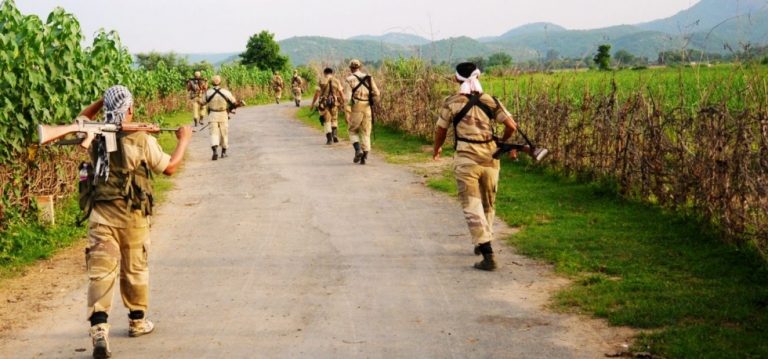
14 Naxals have been gunned down in an encounter with security in Chattisgarh’s Sukma. According to reports, the encounters took place in the Konta and Golapalli police station limits in the early hours of Monday. Apart from 14 Naxals, 1 area committee member (ACM) with a bounty of Rs 5 lakh was arrested along with a female Naxal. Special DG, Anti-Naxal Operations said that they had inputs of about 20-25 people to be in the camp. One more operation is still underway in the interiors of Sukma. 16 weapons have been recovered from the slain Naxals and search operations are still underway. This is the second operation against Naxals this week in Chattisgarh. On August 3, one Naxal was killed and two policemen were reportedly injured near a rural market in Bijapur area.

The policemen were patrolling the market area for protection when 15-20 heavily Naxalites have attacked the policemen. According to reports, On August 1, a COBRA commando was injured in an IED blast that was triggered by the Naxals in the same Bijapur area.

After massive actions by state and central security forces, Left-wing terrorism in Chhattisgarh has been driven almost to its end point. There have been numerous encounter operations against Naxals by CRPF and the state units in the state. The central government has also been pushing infrastructure development in the Naxal affected zones which have not only brought an increasing number of villagers and tribals to the mainstream but also has helped weed out Naxalism from the root.

More and more Naxals have been surrendering seeking protection and a normal life. A holistic developmental agenda with roads, schools, connectivity and accessibility to healthcare in Naxal dominated areas has brought positive results in the state. This year in May, 44 districts were removed from the list of Left Wing Terrorism affected areas.

Chattisgarh CM Raman Singh had recently announced that the Naxals will have only two options, either they will leave extremism and surrender or they will be finished by the security forces. The Home Minister had announced that Chattisgarh will soon get its own specialised anti-Naxal unit ‘Black Panthers’ in the line of the ‘Greyhound’ units of Andhra Pradesh and Telangana.

Why nobody is allowed to criticize Sonia Gandhi

0

“To learn who rules over you, simply find out who you are not allowed to criticize“ – Voltaire

Take a deep breath and reflect who you are not allowed to criticize in India. I could think of no other than Sonia Gandhi, former Congress and UPA chairperson. Run the entire gamut, pour over the worksheet of honchos of Indian media, Shekhar Gupta, Barkha Dutt, Vir Sanghvi, Rajdeep Sardesai, Sagarika Ghose etc. Google as you might. Dive into the archives of Lutyens Media like Hindustan Times, Times of India, Indian Express, The Hindu – Sonia Gandhi, much like Caesar’s wife, has been above reproach.

That’s astounding considering nobody has been the president of 134-year-old Congress longer than her (19 years). She got her party two consecutive Lok Sabha victories with a whole lot of scams were unearthed and yet not a word against her. I mean yes, BJP and its bete noire Dr Subramaniam Swamy keep pelting her windows but that’s par for course for any opposition. But what accounts for no “black sheep” within Congress bleating ever? No media house opening its edit pages for trenchant views; no historian/academician offering critiques? No scholarly paper in JNU? No diagnosis on a person out on bail?

I do recall two embarrassing Sonia interviews, that is for any self-respecting journalist, by Rajdeep Sardesai (he kept saying “fought like a tigress,” both in 2005 and 2016), as it was for Aroon Purie on another occasion, coy and adolescent. Yes Shekhar Gupta (“she keeps a formidable dynasty on her slender shoulders,”), Barkha Dutt (“she has made a public commitment to Women’s Reservation Bill”) have also interviewed her;  Vir Sanghvi has been profound in “Nobody-in-Nehru-Gandhi-Family-Has-Given-Kind-of-Authority-she-has-to Manmohan-Singh,” echoed by a gushing Sagarika Ghose (“She never undermined Manmohan Singh, always backed him up”).

Both Sanghvi and Ghose don’t touch upon how another Prime Minister, PV Narasimha Rao, was humiliated, even in death. And these clowns happily go toting about “bhakts” to everyone else. Phew.

Two books on Sonia immediately come to my mind. One is a pathetic account by a sycophant and another is “Red Sari” which was unofficially banned in India for six years due to machinations by Abhishek Sanghvi, as alleged by its author.

There was though one voice of dissent which was muzzled without much ado by this “deep state” in India. Margaret Alva, a former Union minister of state and Governor, was quite scathing in her autobiography: “Courage and Commitment:” Excerpts:

“While Pilot, Prasada and Scindia got all the honours due to them as Congress leaders—with shamianas erected at the AICC to receive their remains before the last rites—PV Narasimha Rao, the tallest of them all, was denied a state funeral in Delhi. His body was not even let into the AICC compound; instead, the gun carriage carrying the former Prime Minister and Congress President was parked on the pavement outside the gates, with chairs lined for party leaders. I was shocked…ever since, I have regretted not protesting and walking away.”– On PV Narasimha Rao’s death in 2004

Alva details that she played a peacebroker between Sonia and Rao: the latter falling out probably for deciding to appeal against the Delhi High Court’s decision to quash a complaint against the Bofors case. Sonia Gandhi once retorted to Alva: “What does the Prime Minister want to do? Send me to jail?”

Alva’s outburst about the unfair ticket distribution in Karnataka led to her ouster. She was asked to resign from the post of All-India Congress Committee (AICC) general secretary in 2009. In her resignation, Alva wrote thus:

“Times have changed and for the first time, I have come to feel like a misfit in an organization that I considered as precious as my own home. A look at our recent candidates lists show a distinct patter of patronages to the wealthy and rich lobbies like mining, education and real-estate…”

Just reflect on the above in line of recent Karnataka assembly elections and ponder why no newspaper or media celebrity ever brought this book out of the shelves to examine Congress’ candidates in 2018? Why Congress’ demise in the state is not looked through the prism which Alva afforded us?

As per one reviewer of the book: “Alva’s book offers an amazing insight into the maneuverings of 10 Janpath—the home of Congress president Sonia Gandhi. Without being too harsh, Alva clearly indicts Gandhi for lacking transparency in her manner of functioning, her penchant for surrounding herself with a handful of loyalists…”.

Alva was made to leave Delhi, appointed as she was governor of Uttarakhand. In her words: “Once I had made the mistake of saying: `The Alvas are the only political family to have a member in Parliament without a break for almost half a century.’ This statement sealed our fate.”

(As an aside, Alva was Governor of Rajasthan when Narendra Modi came to power in 2014. Alva describes her meeting with Modi thus: ‘I told him I had come to pay my respects, not plead for an extension, adding `I am not prepared to quit anytime.’ “There is no question,” He (Modi) replied. “You are doing a good job please continue where you are.” She was subsequently given additional charge of Goa and Gujarat!).