Home Blog Page 7393

Modi govt plans a bold new price support scheme to mitigate farmer distress

0

The Modi government as per reports, is in consultation with states to launch a new price support scheme for farmers, for preventing distress sales below the minimum support price (MSP).

Under this new price support scheme, the states will be free to procure all the crops which contain a MSP. This excludes wheat and rice which are already sourced by the centre for its public distribution system.

Under this scheme, the states can procure any amount of millet, pulses, oil seeds and coarse grains to support the farmers. In case a loss is incurred by the states, the centre will compensate them for up-to 30% of the total procurement cost. This number will go up to 40% for north-eastern and hilly states.

Under the current situation, even though MSPs are announced for 23 crops, the total procurement under the scheme is pegged at 33% for wheat and rice, 8% for pulse and 1% for oil seeds.

In this new scheme, the states will decide the types and quantity of procurement of crops when wholesale prices drop below the MSP. They can then choose to either use the procurement for nutrition-support programmes or sell them in the open market.

The new scheme would ensure that the farmers’ risk after the harvest is mitigated as he/she will be assured a fixed price for the crops.

We had recently reported about the various welfare schemes, which are changing the face of rural India ahead of the 2019 Lok Sabha elections.

This includes implementation of schemes like:

  • Jan Dhan Yojna ( Banks opening bank accounts of citizens with minimum documentation and zero balance)
  • The Payment of Wages (Amendment) Act 2017 ( Employers to pay wages to workers through cheque or by transferring their wage to their bank account)
  • Aadhaar ( Targeted Delivery of Financial and other Subsidies, benefits and services) Act, 2016 ( Seeding Aadhaar number for PDS and MNREGA, the foundation stone of Direct Benefit Transfer scheme)
  • Pradhan Mantri Ujjwala Yojana ( Which has ensured almost universal LPG connections in Rural India)

All these schemes as per the report are changing the dynamics of Rural India for the better, and a correct implementation of the new MSP scheme might further consolidate the rural scene in the coming years.

Urbanization and Politics – Lessons From Gujarat

0

In the recently concluded state elections of Gujarat, the stark difference in the response of urban electorate and the rural electorate to caste politics could be seen. This raises immense hope for those who subscribe to progressive politics and oppose regressive and tribal concept of caste-based vote-bank politics. It also highlights that caste-consciousness could be a huge stumbling block to a modern India. This article tries to analyse the relationship between urbanization and political discourse in the country.

Urbanization encourages individuality, a society based on an earned status of individuals as opposed to a rural society that subscribes to ascribed status of individuals. The lack of social mobility in a stagnant rural economic setup reinforces caste loyalty. The multiple social divisions of caste, religion and language tend to break down in urban and cosmopolitan areas. Most of the times, in urban areas individuals are usually respected for their personal achievements rather than their lineage or social identities.

Urbanization means different things to different people. As I am using census data in this article, I would like to quote the definition of ‘urban area’ as per Census of India :

1.  All places with a municipality, corporation, cantonment board or notified town area committee, etc.

2.  All other places which satisfied the following criteria:

  •  A minimum population of 5,000;
  •  At least 75 per cent of the male main working population engaged in non-agricultural pursuits; and
  •  A density of population of at least 400 persons per sq. km.

The rate of urbanization of India has been steadily increasing though it is not as fast as other developing countries like China and Indonesia. The census says that the percentage of urban population in India is 31.16% in 2011. There are reports of under-estimation of India’s urbanization based on satellite images, but I would like to set aside that aspect as the information is not from credible sources.

The percentage of urban population has nearly tripled from 10.8% in 1901 to 31.16% in 2011 at an average of 1.85% per decade. During the period we have seen a slow degradation of caste consciousness in the country among the general population (with the exception of Mandal politics of 90s) . From the year 1951 to 1991, an era of socialist economics and Congress domination the percentage of urban population has increased from 17.3% to 25.7% , an average rise of 2.1%  per decade.

However, in the two decades after liberalization, urban population has risen from 25.7% to 31.16% , an average  rise of 2.73% per decade. Unshackling the country from chains of Nehruvian socialism has contributed to faster urbanization in India. With growth of urban population, the tendency of people to respect dynasty and lineage is also decreasing.

According to the 2011 census, Gujarat is among the few big states that have breached 40% mark in the state wise percentage of urban population. The other big states which have more than 40% of population in urban areas are Maharashtra, Tamil Nadu and Kerala.

In such states, it will be more difficult to divide or mobilize any dominant community or caste for deciding an election in future. This is because, the urban setting forces individuals to think out of their tribal mindsets. In addition to that, it also becomes difficult for caste based leaders to ensure compliance of the community to their diktats. Compare this to Bihar, where only 11% of the population lives in urban areas. The state prefers caste based leaders like Lalu Prasad Yadav and his family even if the leader is convicted by courts for corruption.

The fact that Congress won 71 of their total 77 seats from rural areas shows that the caste factor had an important role in its victory. BJP’s victory in 36 of 42 urban seats (85% of urban seats), shows that urban areas are slowly moving away from caste-ism.

Better incomes and social mobility that urban areas offer, tend to reduce the connection to caste identity, unlike a rural area that forces people to hold on to their caste identities. A small shopkeeper in an urban area like Ahmedabad can hope to own a big store in future, but the same is usually not possible in a stagnant village. I would like to conclude by saying that faster urbanization is a good thing for society, development and the politics of India in coming years as it forces politicians to move towards development issues rather than caste based hankering for votes.

NIA to seek provisional arrest of radical Islamic preacher Zakir Naik

0

In what might be trouble for radical Islamic preacher Zakir Naik, the National Investigate Agency (NIA) as per reports is planning on moving a request for his provisional arrest. Naik is currently believed to be in Malaysia after he fled India on 1 July, 2016 after an investigation against him was initiated.

As per the extradition terms which Malaysia has agreed with India, after receiving a provisional arrest request, it has to confirm Naik’s location within its jurisdiction and arrest him, pending presentation of the formal extradition request.

Such provisional arrest requests are generally made when it is believed that a fugitive criminal may flee that particular jurisdiction. The provisional arrest can be made via diplomatic channels, via the Consular, Passport and Visa Division of the Ministry of External Affairs and by using Interpol’s facilities through the CBI.

Apart from seeking a provisional arrest, the NIA would also make a fresh plea with Interpol for the issuance of a red corner notice (RCN) against him. This notice is issued by the Interpol to seek the location or arrest a particular individual with a view to extract him/her.

Such a fresh RCN request comes after Interpol refused to issue the same on 16th December citing that when the request was made, no chargesheet was filed against Naik. It was subsequently filed in the NIA court after the request had already been made.

The initial red-corner notice request was issued on the basis of terror and money laundering charges against Naik. In order to oppose this, Naik has alleged that the case against him was related to the religious persecution of minorities in India. He also reportedly played victim by claiming that Indian agencies were unfairly targeting him because he is a Muslim.

Apart from this, the NIA had also successfully managed to revoke Zakir Naik’s passport. But Naik still continues to possess this passport and if any country is willing to let him enter its borders while carrying a valid visa, it cannot be stopped from doing so. But the issuance of a Red Corner Notice would mean that authorities would be obligated to detain him and inform Interpol of the same.

Congress must call off celebrations – verdict on 2G scam a scathing indictment of the Gandhis

0

The Congress, buoyant by the Special Court’s verdict acquitting key accused in the 2G scam has spilled into patting its back for emerging unscathed from the taint. While the party rejoices, the nation is in a state of shock and dismay as it witnessed another case where justice has been mocked by the high and mighty.

Once again, alienated from public emotion, the media groupies of the Congress are responding to the verdict in two ways. One, by completely disparaging that the scam even occurred and was mostly an opposition manufactured ploy which even the Supreme Court bought. Second, the scam happened, but it was nothing close to the 1.76 lakh crore notional figure given by the former CAG. In fact, the irregularities in the spectrum allocation were a routine bureaucratic quid-pro-quo. It cost India its growth, not because of any inherent wrongdoing that came forth, but because the opposition made such a hullaballoo about it, that it sent the dispensation into a state of policy paralysis.

But if Congress and their sympathisers take a break from their premature jubilation to analyse the verdict, they will find that the judgement leaves numerous clues to incriminate the top most leadership of their party.

The CBI botched up the evidence, to an extent that the case did not stand judicial scrutiny. Something that Judge O.P. Saini observed when he wrote:

Let me take note of the pace with which the investigation proceeded relating to examination of witnesses. The instant case was registered on 21.10.2009. However, the first statement of Sh. M. Krishnamoorthy was recorded only on 21.01.2010, that is, after full three months. The next witness Sh. Gaurav Jain of Unitech was recorded on 07.09.2010, almost one year after registration of the case. Only thereafter recording of witnesses started with some earnestness. However, an outstanding feature of the case is that the more important a witness was, the more delayed was his examination. It is surprising as to how witnesses became goldmine of information at the last stage of investigation, though they were available to the investigating agency at the earliest possible opportunity after registration of the case.

Not only this, the instant case was registered on 21.10.2009 Sh. Aseervatham Achary remained Additional PS to Sh. A. Raja till 29.10.2008. Naturally, he is an important witness and is expected to know many facts. However, his statement under Section 161 CrPC was recorded by the IO on 24.03.2011, after a long gap and only about a week before filing the charge sheet and the witness suddenly became a goldmine of information. This long delay in recording his statement alone is good enough to destroy the evidentiary value of his deposition.

Even when the investigation was initiated, the witnesses critical to the case were only approached when evidentiary value was lost. This led to oral testimonies without any documentary proof corroborating the witness account.

The fact that the CBI Director Ranjit Sinha, handpicked by the Congress, superseding the two candidates in line for the post, was indicted by the Supreme Court for colluding with accused in the Coalgate scam, shows the investigative agency was severely compromised.

It is pertinent to note that the inquiry into the matter was initiated in 2009, the special CBI court, appointed by the Supreme Court, framed charges against all accused and began trial in 2011.

Fresh documents were allowed to be submitted once in 2014 but came with the following caveat:

Having allowed the application, I may remind the prosecution that frequent and fragmentary filing of documents do cause anxiety and uncertainty in a trial, if not prejudice to the accused. As a matter of course, entire documents with list of witnesses should be filed with the charge­sheet. But an occasion may arise where this may not be possible and documents may be filed subsequently also necessitating the summoning of additional witnesses.

But this cannot become a rule. In this case, prosecution has been allowed to file documents fourteen times, though the defence has also not lagged behind as it has competed with the prosecution and has been allowed to file the documents running into about eight full size steel boxes. But prosecution should remember that Indian legal system does not cleave to be theory of hound the accused ­at ­all ­cost ­by ­all ­means ­fair ­or ­foul. An accused is also entitled to certain rights and to a fair trial. He is not a quarry to be pursued, caught and killed. He is deemed to be innocent until proved guilty and is entitled to a fair trial. Filing of documents has been repeatedly allowed on the plea of crime being of a grave magnitude in which officers are prone to inadvertence. Though, the prosecution has been successful in making out a case that the documents sought to be placed on record are essential for the just decision of the case but such practice cannot go on endlessly. It is necessary that the accused on trial should not have the feeling that he is being subjected to a trial of uncertain nature. The quest for truth cannot become a lifelong activity, and if it is so, no criminal trial would ever come to an end.

And then when the prosecution filed an application in 2015, the Court dismissed the plea. In the last, the prosecution again filed an application dated 15.04.2015 for filing certain documents accompanied by proper certification of banking and other authorities on the ground that the documents already filed and exhibited were lacking in proper certification. However, the surprise of the application was that it was accompanied by documents running into about 15,000 pages. This application was promptly dismissed vide order dated 22.12.2015.

The judgement raised vital question on the inexplicable reason for recording testimonies late into the investigation, rendering the evidence ineffectual. It was, therefore, poised to fail in the court of law.

Further, the judgement makes scathing charge on the PMO officials for misleading the then Prime Minister, categorically naming Pulok Chatterjee for covering controversial part of A. Raja’s letter regarding the issue of LOIs (Letters of Intent) for new licenses. The note that was forwarded by Pulok Chatterjee to the Principal Secretary did not mention the controversial bits of the letter of the Minister. The judgement notes that:

Thus, this note gave only a partial view of the whole issue and ignored the most important and controversial issue of new licences. Moreover, the note suffered from the vice of excessive length and technical jargon. It is lengthier than the letter of Sh. A. Raja. Prime Minister is a busy executive. Wherefrom would he find time to read such lengthy notes. Prime Minister is not expected to be immersed in files. It was much easier and better for him to read and understand the letter of Sh. A. Raja rather than this note of Sh. Pulok Chatterjee.

It further adds that:

However, it is clear that somebody from the PMO had given a go ahead to the DoT for issue of new licences and most probably it was Sh. Pulok Chatterjee himself, as his note records that he had spoken to Secretary (T). Thereafter only on the same day, the process of issue of LOIs started with the recording of notes by Sh. Nitin Jain and Sh. A. K. Srivastava. Had the PMO hinted otherwise, the DoT would not have dared to go ahead with the process of issue of LOIs as Secretary (T) had only joined on 01.01.2008 and was quite new in his job. He would not have dared to go against the PMO.

The above observation has stirred up a hornets nest. It is not clear on whose instructions was Pulok Chatterjee selectively passing on information to the Prime Minster.

However, it would be interesting to take a look at what Sanjay Baru, a former colleague of Mr. Chattejee in the PMO had to say of him in his book, “The Accidental Prime Minister”. In the book Mr. Baru describes Mr. Chatterjee as a sort of 10 Janpath mole at 7 Race Course Road and in South Block.

Following is an excerpt from Baru’s book:

Pulok, like Nair, suffered from the handicap that his own service had never regarded him as one of its bright sparks. A serving IAS officer, he had never worked in any important ministry. He was inducted into Rajiv’s PMO as a deputy secretary after having served as a district official in Amethi, his constituency in Uttar Pradesh, where he had caught Rajiv’s eye. After Rajiv’s death, he chose to work for the Rajiv Gandhi Foundation where he did some worthwhile social development work. But this meant that he was not just outside government but completely identified with the Gandhi family. When Pulok returned to government, it was to work on the personal staff of Sonia Gandhi when she was leader of the Opposition in the Lok Sabha.

Pulok, who was inducted into the Manmohan Singh PMO at the behest of Sonia Gandhi, had regular, almost daily, meetings with Sonia at which he was said to brief her on the key policy issues of the day and seek her instructions on important files to be cleared by the PM. Indeed, Pulok was the single most important point of regular contact between the PM and Sonia. He was also the PMO’s main point of contact with the National Advisory Council (NAC), a high-profile advisory body chaired by Sonia Gandhi with social activists as members. It was sometimes dubbed the Shadow Cabinet.

If one were to go by the judgement and acquittal of A. Raja, it could mean that the then Telecom Minister was actually made a scapegoat of a scam orchestrated at a much higher level. The 2012 judgement of the Supreme Court cancelling the 122 telecom licenses, proves for a fact that a scandal of unimaginable proportions did occur under UPA’s watch. While the observations made by the current CBI court verdict alludes to the point that the masterminds of the scandal have still not faced judicial examination.

Sure, the judgement seems like the wrongdoers have once again gone scot-free. But it has led to a can of worms coming undone, if only one can read between the lines.

Ecosystem still in Gujarat mode, using caste to deflect from Lalu’s corruption

0

As soon as Jairam Thakur was announced by the BJP as the new Chief Minister of Himachal Pradesh, here is the reaction from Rajdeep Sardesai.

Untitled.png

The memo from HQ is clear. Focus on caste, divide the Hindus and bring Rahul Gandhi back to power.

First of all, I want to focus for a moment on the deep wickedness in Rajdeep’s tweet. See how he talks about “Political India” at the end of his tweet, trying to give a slightly “neutral” spin to his partisan tweet. If he was talking about “Political India” why did he only do a headcount of BJP Chief Ministers? Why not ask about the caste of India’s most secular Chief Minister Mamata Banerjee? What is the caste of the vast majority of members of the Communist Politburo that makes a good living in TV studios pretending to care about social injustices in the country?

By the way, you know who raised the issue of the Communist Politburo not admitting a single Dalit for decades? Rohith Vemula! Except that this fact was conveniently forgotten by media in the storm following his death.

What is the caste of the Congress President? Hasn’t he been boasting recently about his “janeu dhari” status? How much more blatant can the casteism get?

Let us count how many of the primetime anchors in English language media come from a “lower” caste. Tell us, Rajdeep. Surely the liberal conscience keepers of the nation in English language media and the commentariat have made lots of room for accommodating the so called “lower” castes? So, when are we going to see a Dalit anchor as the face of 8, 9 or 10PM primetime show on India Today?

Don’t tell me that media in India is run by the Sardesais and Varadarajans.

Incidentally, Rajdeep has a history of jumping for joy whenever a fellow Goud Saraswat Brahmin (GSB) gets appointed to a high position.

Untitled.png

But that was before the memo from HQ, presumably.

After the “morally successful” Gujarat model of getting young people to wear their caste names on caps on their heads, liberal India is clearly asking for more.

Early on the day of the fodder scam verdict, Shekhar Gupta was ready with this.

Untitled.png

Ready with a red herring to divert public discourse in case the verdict went against the interests of the Dynasty.

Then, the verdict came in and Lalu Yadav was convicted. Or as ‘janeu-dhari’ Rahul Gandhi would say, he was “morally acquitted” by the court. Here is Shekhar Gupta’s first reaction, which is now a pinned tweet on his Twitter timeline, a big lighthouse telling liberals how to spin away the corruption of janeu-dhari Rahul Gandhi’s top ally in Bihar.

Untitled.png

As the night progressed and the media had to keep reporting on Lalu’s conviction, one by one, the entire opposition began to pick up on this line. As for Shekhar Gupta ji, he continued to spread the worst kind of insinuations about the Supreme Court itself.

Untitled.png

Of course! The “issue” here is everything except for the fact that janeu-dhari Rahul Gandhi’s top ally has just been convicted in a corruption case. Let us go on a wild goose chase looking for the caste of every defendant in every other famous criminal case, the caste of the lawyers, the caste of the judges, everything.

Let us focus on everything except for the fact that janeu-dhari Rahul Gandhi’s ally is a convicted criminal, right?

And these people still complain that Narendra Modi in 2002 had dared to say aloud the full name of Chief Election Commissioner James Michael Lyngdoh.

Some months ago, Shivam Vij of Huffington Post had written an article, explaining how liberals *must* focus on caste faultlines as the only way to derail the BJP. It was a stunning article, not because of its content (which we have always known), but because someone, an alleged “liberal”, felt both desperate and intellectually secure enough to put it out in writing before the whole world.

Untitled.png

What does this tell you? How did it become acceptable for media to publish clarion calls such as that by Shivam Vij to divide Hindus on caste lines?

Here is what it tells you : at liberal headquarters, it is a state of WAR! Absolutely anything goes as long as they can hurt their enemy : India’s Hindu nationalists.

They are sending a message, through their public pronouncements and their election campaigns. Nay, they are throwing a challenge to all Hindus :

“We will divide you by caste and we will destroy you and we will subjugate you.”

Question for Hindus is : are you up to this challenge?

‘Vypam whistleblower’ slammed for spreading vulgar lie about Smriti Irani

0

Union Minister Smriti Irani some might argue, has been at the receiving end of one of the most sustained hit jobs from her political adversaries.

It has been reported how a prominent newspaper decided to target her with a sexist headline after she was transferred to the Textile ministry from HRD in 2016. Apart from that, prominent journalists, Congress spokespersons and media houses have ganged up to carry out hit jobs against her.

Things were taken to a new low by Congress supporter Tehseen Poonawalla, who is not related to the more prominent and successful Poonawallas. Tehseen was exposed by Smriti Irani herself after she showed his offensive and misogynist tweet targeted against her on live television, following which he was forced to delete it.

Now it seems that such attacks against Smriti Irani have been revived, this time by a doctor named Anand Rai who calls himself the whistleblower of Vypam scam:


In the above tweet, Rai is seen alleging that Smriti Irani has gone to take ‘prasad’ from the ashram of a certain Baba named Virendra Dev Dikshit and also affixed an alleged photo of her with that Baba as ‘proof’.

This Baba in question has featured prominently in the news recently after UP and Delhi police raided three centres run by him to rescue 47 women and six minor girls. He has been accused of keeping these girls inhumanly confined, who as per reports, were also sexually assaulted.

So when the Vypam doctor decided to make a lewd insinuation that Smriti Irani had gone to meet this Baba to seek ‘prasad’, people decided to investigate.

Soon, Twitter users caught Rai’s lie :


Twitter user Ketan C Bhate also busted Dr. Rai’s lie. As seen in an India Today report in 2014, the picture shared by Dr. Rai is actually of Smriti Irani meeting an astrologer from Rajasthan, who claimed she was destined to become the president of India:

As clearly seen above, Smriti Irani had not met the controversial Baba and the whistleblower Doctor, seems to have raked up a three year old photo of Smriti Irani in order to try and malign her.

People as a result of this act, were very angry against Dr. Rai and decided to react:


It remains to be seen whether Smriti Irani decides to take any legal action against this doctor for maligning her, which might dissuade others from carrying out similar acts in the future.

Sabang bypoll analysis – Congress’ rout in its bastion, the saffron surge and why TMC should be worried

0

Results of Sabang by-poll, an assembly constituency in Paschim Mednipur district, was announced today. In 2016, Congress candidate Manas Bhunia had won the Sabang seat with the support of the left front. The by poll was held because Manas Bhuniya switched to TMC.

The result of this by poll wasn’t unexpected as TMC won with a margin of 49,167 votes. However, a closer look at the results of the constituency, historically, tell a tale of a major shift in voting pattern.

The Sabang constituency has traditionally been a Congress bastion. It saw the rise of Congress in 1982, and has elected a Congress candidate ever since. In 1982, with TMC nowhere in the picture, Congress had started its victory streak with a landslide.

If we look at the numbers from 1982, Congress candidate Manas Ranjan Bhunia won, by polling 46.9% of the votes. The Trinamool Congress of CPI(M) were not in the electoral picture. Janta Party however polled 2% of the votes.

NamePartyNumber of VotesPercentage of votes
Manas BhuniaCongress34,81546.9%
Hemanta Kumar JanaIndependant34,18546.0%
Suryya Kanta MahapatraJanta Party1,5182.0%

In 1987, Congress maintains its lead with a 50.8% voteshare, with CPI(M) coming in second, with a 43.3% of the pie.

NamePartyNumber of VotesPercentage of votes
Manas Ranjan BhuniaCongress45,37650.8%
Hare Krishna SamantaCPI(M)42,26143.3%
Bhushan Chandra MondalSocialist Unity Centre of India1,3501.50%

In 1991, Manas Ranjan Bhunia of the Congress party wins his third term with 50.7% of the votes. CPI(M) came in second, with a difference of 3,071 votes. BJP made a debut this year with only 1% of the votes amounting to 1028 votes.

NamePartyNumber of VotesPercentage of Votes
Manas Ranjan BhuniaCongress53,48550.7%
Gouranga SamantaCPI(M)50,41447.7%
Jana Nagendra NathBJP1,0281.0%

In 1996, Manas Ranjan Bhunia lost by a narrow margin of 825 votes. The CPI(M) candidate won, and BJP polled a paltry 594 votes (0.5%)

NamePartyNumber of VotesPercentage of Votes
Bangal MakhanlalIndependant60,45349.9%
Manas BhuniaCongress59,62849.2%
Jana NagendranathBJP5940.5%

In 2001, Congress again came second with a narrow margin. As seen, the contest between Congress and CPI(M) has always been a close one. BJP came third with 1409 votes (1.2%).

NamePartyNumber of VotesPercentage of Votes
Tushar Kanti LayaCPI(M)62,61151.2%
Manas Ranjan BhuniaCongress56,35446.0%
Nirmal Kumar BalaBJP1,4091.2%

In 2006, Manas Ranjan Bhunia of Congress regained his bastion and defeated CPI(M). This is the year TMC made inroads in Sarang, coming in third with 4,828 votes (3.5%).

NamePartyNumber of VotesPercentage of Votes
Manas Ranjan BhuniaCongress68,59249.7%
Tushar Kanti LayaCPI(M)62.07945.0%
Amulya MaityTMC4,8283.5%

In 2011, Manas Ranjan Bhunia of Congress won again with 51.3% votes. CPI(M) clocked 44.4% and BJP got 1.3% of the total votes. The TMC and Congress had fought these assembly elections together. They managed to oust CPI(M) from the state but it help maintained some hold in this constituency.

NamePartyNumber of VotesPercentage of Votes
Manas Ranjan BhuniaCongress98,75551.3%
Rampada SahooCPI(M)85,57144.4%
Sabyasachi SahooBJP2,5071.3%

In 2016, which is the last Assembly Elections and the first after BJPs 2014 win, Manas Ranjan Bhunia of Congress got 1,26,987 votes (59.7%), TMC got 77,820 votes (36.6%) and BJP got 5,610 votes, a mere 2.6% vote share. BJP couldn’t break its cycle of low vote share in this constituency, just like anywhere else in the state of West Bengal.

NamePartyNumber of VotesPercentage of Votes
Manas Ranjan BhuniaCongress1,26,98759.7%
Nirmal GhoshTMC77,82036.6%
Kashinath BasuBJP5,6102.6%

With the figures above, it is extremely evident that until 2016, TMC never managed to get a major voteshare in this constituency and the contest was always between Congress and CPI(M). The highest number of votes BJP has ever got in this constituency is 5,610 votes since West Bengal was never a state where the saffron party got much traction.

In 2017, the by polls had to be held in this constituency because Manas Ranjan Bhunia, the Congress candidate who had maintained his strong hold in the constituency since 1982, jumped ship and joined TMC. When Bhunia jumped ship, TMC fielded his wife Gita Rani Bhunia from this constituency, to represent the party. The results are collated below in a table.

NamePartyNumber of VotesPercentage of Votes
Gita Rani BhuniaTMC1,06,17952.12%
Rita MondalCPI(M)41,98720.61%
Antara BhattacharyaBJP37,47618.4%
Chiranjib BhowmickCongress18,0608.9%

It is thus essential to analyse the difference in votes that went to each party from the last assembly elections, keeping in mind that the swing in votes has happened only in the last one year. From 2016 Assembly Elections to 2017 by polls.

PartyVotes in 2016Votes in 2017+/- Difference in votes
Congress1,26,98718,060- (1,08,927)
TMC 77,8201,06,179+ 28,359
CPI(M)NA41,987+ 41,987
BJP5,61037,476+ 31,866

As seen above, Congress is the biggest loser in these by polls. The party lost a whopping 1,08,927 votes from their last tally in 2016. While the popular narrative seems to be that considering Manas Ranjan Bhunia, the then Congress candidate jumped ship to TMC, and his wife was fielded by TMC for these by polls, that all the votes lost by Congress, were transferred to TMC.

From the table above, it is evident that between TMC, CPI(M) and BJP, TMC has gained the least amount of votes since 2016 to now. The votes lost by Congress have been divided between CPI(M), TMC and BJP.

While TMC gained 28,357 votes, even though they fielded the wife of Bhunia, CPI(M) who has also had a strong base in the constituency gained 41,987 votes. The CPI(M) didn’t field a candidate in 2016 since CPI(M) and Congress had fought the 2016 assembly elections together in a bid to arrest the TMCs growing clout in the state. The BJP gained an unprecedented 31,866 votes raising their total from a paltry 2.6% in 2016, to an 18.4% in 2017.

Historically, until 2016, the highest number of votes polled by BJP in Sabang has been 5610 votes. The saffron party saw an upswing to 18.4% while fighting the parties and candidates who have always had an extremely firm hold on this constituency. And while TMC has won with an unprecedented margin in 2017, their vote upswing has been the lowest among the three parties, even after fielding the wife of a historically popular candidate, who won this seat 6 times since 1982 and came in a close second twice.

The analysis is fairly simple. While TMC has won with a huge margin, it has reason to worry. Considering its low upswing in vote from 2016 to 2017, it might have to conclude that there is already an undercurrent of disenchantment among the West Bengal population. And while TMC might need to evaluate its landslide success, BJP, by making massive inroads in just over one year, has reasons to celebrate. The saffron party seems well on its way to becoming the principal opposition in West Bengal if it can keep the momentum up.


Jignesh Mevani and Umar Khalid to take part in events celebrating British victory over Peshwas

0

In a typical JNU style celebration of ‘alternative history’, newly elected Gujarat MLA cum Dalit leader Jignesh Mevani and Kashmiri separatist cum JNU student Umar Khalid are all set to celebrate “victory” of British Imperialist forces of East India Company over an army led by Peshwa Baji Rao II of Maharashtra (then the Maratha empire).

This victory – Peshwa’s army stopped from entering Pune in 1818 – is being seen as ‘Dalit victory’ in the eyes of practitioner of alternative history, because the army of East India Company was supposed to be made of people belonging to Dalit and other lower castes while the ruling Peshwas were Brahmins.

For the practitioners of alternative history, it doesn’t matter that the British rule in India supported and strengthened zamindari system and institutionalized other oppressive socio-economic practices, which were hardly any good news for Dalits and lower castes. It also doesn’t matter that Peshwa’s army did not comprise only upper caste warriors.

This ‘Dalit victory’ is argued to have taken place on 1st January 1818, and both Mevani and Khalid have been invited to take part in the bicentennial celebrations later this month. The victory celebrations are reported to be an annual affair, but this year will see Islamic radicals and people having alleged links with Maoist organizations taking part in it, apart from Mevani and Khalid.

The attempt is being seen as furthering the Muslim-Dalit unity narrative ahead of the 2019 elections. The organizers have not tried to hide their political ambitions. Pamphlets have been reported as referring to BJP, Shiv Sena, RSS, etc. as “new Peshwas” and CBI, RAW, ATS (anti-terrorism squad) as “casteist” forces.

While one can debate such “alternative” readings of history and current affairs, it should be noted that the same liberal-secular “intelligentsia” doesn’t waste a single moment in mocking alleged Hindutva groups for not having fought against the British, while finding it entirely normal and justified to celebrate an imperialist victory that was crucial in helping establish British empire in India.

It will also be interesting to see how Janeudhari (Brahmin) Rahul Gandhi will respond to Jignesh Mevani, who won his assembly seat in Gujarat earlier this month due to Congress party’s support, taking part in celebrations that considers Brahmins as a bigger enemy block than foreigners.

RJD’s Lalu Yadav and ThePrint’s Shekhar Gupta stoke caste tensions after Lalu’s conviction

0

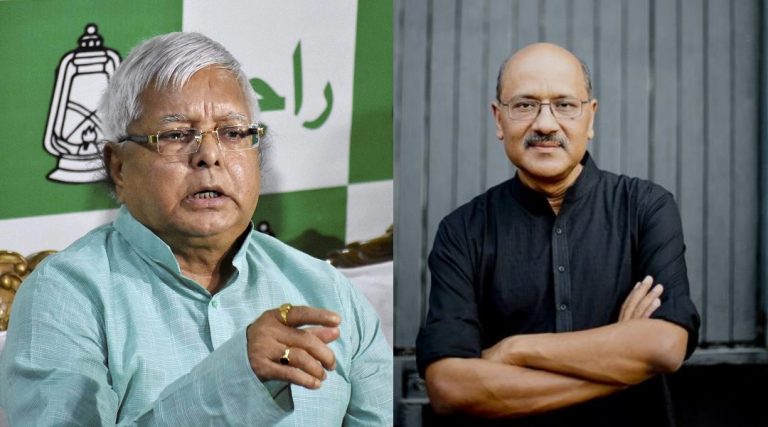
In yet another development showing how journalism and politics are on occasions not differentiable from each other, politician Lalu Yadav and journalist Shekhar Gupta joined each other to claim casteism in corruption cases in wake of a CBI court finding Lalu guilty in one of the cases related to the infamous Fodder Scam of Bihar.

The caste card was interestingly played in advance by Gupta, whose article linking caste and corruption was shared on the social media even as people waited for the verdict in the fodder scam case. Gupta’s article tried to insinuate that politicians belonging to upper castes don’t get convicted in corruption cases and only the politicians belonging to the lower caste get convicted.

Ironically, Shekhar Gupta decided to peddle this theory at a time when A Raja, a Dalit, was acquitted in 2G scam and Ashok Chavan, a Maratha – an intermediary caste group that is demanding reservations in Maharashtra – was acquitted in the Adarsh Housing scam in the last two days.

The fact that Gupta was inventing theories out of nowhere was immediately called out by many, who pointed out that there were many ‘upper caste’ politicians who were convicted for corruption. Jayalalithaa, a Brahmin, being one of the latest cases:


Since facts and figures don’t matter to most journalists in India, Shekhar Gupta decided to ignore all such criticism. He peddled his half-baked theory with renewed vigor once the CBI court pronounced Lalu Yadav guilty. What make Gupta see victory was the fact that Jagannath Mishra, former Chief Minister of Bihar and a co-accused in the scam – but most importantly a Brahmin by caste for the likes of Gupta – was acquitted. This was enough for Gupta to indulge in chest-thumping:


This casteist line was immediately lapped up by Lalu’s party RJD, whose spokespersons repeated this and in veiled tone threatened ‘agitations’ in Bihar. Not just RJD spokespersons, even Lalu Yadav himself quoted Shekhar Gupta and played the caste card on Twitter:


However, once again, Shekhar Gupta’s assertion about a Brahmin Jagannath Mishra being acquitted and a ‘lower caste’ Lalu Yadav being convicted was cherry picking of data, because there were people from lower castes too who were acquitted along with Mishra.

People on Twitter pointed out this fact to Gupta, but being a senior journalist, Gupta continued to ignore facts:


As pointed out by a Twitter user Divya, Gupta had earlier tried to stoke communal tensions by twisting Taslima Nasrin’s words, and now he was playing with caste fire. Whether this is all being done to get clicks for his new website The Print, or for triggering unrest in the society is not known, but Gupta has given Lalu and supporters a reason to go on a rampage in the streets.

One just hopes that the politicians of India are more responsible than the journalists.

Lalu convicted in Fodder Scam but he was acquitted by some news channels for a few minutes

0

In a surprising development (since judiciary has recently acquitted politicians in the 2G scam and Adarsh scam), a CBI court today found RJD leader and former Chief Minister of Bihar, Lalu Prasad Yadav guilty in the fodder scam:


Lalu specifically was convicted in a Rs 89 lakh Deogarh treasury case, which is one of the five fodder scam cases in which Lalu is an accused. It was alleged that fraudulent withdraws were made from the Deogarh treasury 1991 and 1993. Lalu’s quantum of punishment in this matter will be announced on 3rd January.

But this conviction episode wasn’t without high drama.

A few minutes before the actual conviction, the media, possibly by tapping into their telepathic instincts, jumped the gun to give Lalu supporters a reason to cheer:

Even AAP propaganda blog decided to acquit Lalu and even wrote an article on it:

A journalist who was criticised for her soft ball Rahul Gandhi interview, too touted the acquittal line:

Many common users too reacted to the misreporting:


Some media houses though soon tried to calm everyone down, by asserting that a judgement wasn’t yet passed in Lalu’s case and the whole “acquitted” proclamation was fake news.

As per the Managing Editor of ABP news, the media was fooled into carrying such reports after it mistook IPS Natranjan’s acquittal as Lalu’s:


After jumping head over heels to announce that Lalu was acquitted, Times Now possibly also decided to rapidly issue a correction, but managed to make a grammatical error there:

People were predictably amused by this whole episode and reacted:


During the triple talaq verdict too the media had prematurely announced that the Supreme Court had upheld triple talaq, simply after listening to the Chief Justice of India’s opinion over the matter, and concluding that his will have the final say. Earlier, even former Chief Minister of Tamil Nadu Jayalalithaa was pronounced acquitted by some channel when she had actually been convicted.