Home Blog Page 7404

Dear CSDS, you fooled us once, but we won’t get fooled again

0

The other day, the self-proclaimed Sachin Tendulkars at CSDS released an opinion poll on Gujarat elections that made liberals jump for joy. Leading the celebrations was India’s most spectacular loser.

Untitled.png

Excitable journalist Sagarika Ghose could not help jumping at these words, who fell back on fond memories.

Untitled.png

Which is funny, because I have here a picture of these same two people, back in the good old days when “Numero Unos” and “Numero Unees” used to rule this nation.

Untitled.png

A neck and neck battle between Congress and BJP in Gujarat? Verdict delivered by Yogendra Yadav and Sagarika Ghose. I want to party like it is 2007.

And sure enough, this was the headline they put out back then (what is News18 today was CNN-IBN in 2007):

Untitled.png

Awesome. Can I take a look at the numbers put out by CSDS showing Gujarat “swinging away from BJP”? Here, they are:

Untitled.png

CSDS gave 92-100 seats for BJP and 77–85 seats for Congress. Now remind me what were the numbers that CSDS put out the other day as projections for 2017?

Untitled.png

91-99 for BJP and 78-86 for Congress.

Nice try CSDS but republishing your 10-year-old “exit poll” of Gujarat as fresh survey from November 2017 is not going to cut ice.

On a more serious note, I have been suspicious for a while that CSDS is failing miserably for a while now because they have been unable to keep pace with the times. I found Yogendra Yadav on some television channel shortly after the CSDS survey was published, repeating the same tired old tropes about how other surveys always overestimate urban voters (who generally support BJP), about how BJP voters are more vocal, about how people are scared to speak against the incumbent government, especially against “fascist” BJP government, so on and so forth.

The problem is that CSDS is measuring elections of 2017 by the yardsticks of 1987. People of this new India are not scared of speaking their mind. Everyone speaks openly and without fear, be it Dalits or women or any other group. So when someone tells you that he/she is voting for BJP, take them at their word. Stop assuming that it is a secret Congress voter who is lying to you because of fear of persecution from BJP supporting “upper” castes.

Listen to people when you do surveys, instead of your prejudices from 3 decades ago.

Your “silent BSP voter” stopped existing about a generation ago.  You can trash that myth now and throw it into the dustbin.

Untitled.png

The final and biggest fault with CSDS is that it refuses to learn from failure. Up until the beginning of this year, I had a bit of respect for them. When CSDS polls showed BJP slipping badly in UP and Eastern UP in particular, I wrote that it should be taken very seriously.

But the conduct of CSDS after Uttar Pradesh elections has been absolutely shameful. Other than a single tweet from Sanjay Kumar claiming to be Sachin Tendulkar of surveys and arrogantly dismissing all criticism, we didn’t see even a hint of repentance. No mea culpa, no analysis of how they could have missed such a massive electoral wave and zero transparency in this regard.

Forget Uttar Pradesh, CSDS put out absolutely inane projections for Uttarakhand, where the result had been clear as daylight from Day 1. Again, the nonsense about “Congress gaining” as the election approached.

Untitled.png

Most surveys have a margin of error of 3% of the votes, so CSDS showing an upswing of 3% for Congress as election approached is hardly a forgivable form of “statistical noise.” It’s a disastrous failure. Not to mention that the BJP polled 47% of the votes in Uttarakhand, as against a mere 39% projected by CSDS. This is too far outside the margin of error.

Statistics is a science, not a job for some hack who would let their political bias play around with science. The fundamentals of statistics are as sound as the science that makes planes take off and land. And the science that makes instant communication and open heart surgeries possible.

Science cannot fail like this. Data is a very powerful tool. The same statistics that CSDS uses to make projections of seat shares is that which Amazon and Flipkart use to suggest to you the stuff you might be interested in buying. Have you noticed how good they are at it?

Have you ever typed a couple of words into Google and been stunned by how Google can complete the sentence, almost reading your mind as it were? That’s the magic of data. That is the power of statistics. And it isn’t as unreliable as CSDS makes it look.

I’ll say it straight. At least to me, it seems that there is a high likelihood of CSDS “projections” being prima facie evidence that they are cheating.

A projected victory for Akali BJP in 2017 Punjab polls? Again by CSDS.

Untitled.png

I remember even BJP supporters were in splits when they saw this poll. At that point, the anti-incumbency in Punjab was so fierce that Akalis were fighting to stay in second place.

As I said, you cannot possibly go so miserably wrong with data. Sorry CSDS, fool me once shame on you, you fool me twice, which won’t happen, shame on me.

Book Review – ‘The Sacred Sword: The Legend of Guru Gobind Singh’ By Hindol Sengupta

0

The pressing need to bring history alive and make it interesting finds more than adequate fulfilment in Hindol’s short but engaging account of the last of the ten gurus of the Sikhs, Guru Gobind Singh.

Guru Gobind Singh’s childhood was thrust into sudden adulthood by the death of his father, Guru Tegh Bahadur. The ninth Guru of the Sikhs was beheaded on the orders of the Mughal king, Aurangzeb. Guru Tegh Bahadur had taken up the cause of Kashmiri Pandits, who were being persecuted mercilessly by Aurangzeb’s governor, and given two choices – to convert or die. The Guru dared Aurangzeb to convert him instead. If the Guru converted, so would every Kashmiri Pandit. Aurangzeb failed, and Guru Tegh Bahadur was beheaded, but not before Bhai Mati Das was sawed in half by Aurangzeb’s soldiers and Bhai Dayala boiled alive in oil.

Thus begins the book. Guru Tegh Bahadur’s severed head was retrieved from where it lay in Chandni Chowk in Delhi, and Jaitha Rangretta brought it to Gobind Rai in Anandpur. The boy of nine becomes Guru Gobind Rai, and later Guru Gobind Singh, the tenth and last guru of the Sikhs.

The first battle the Guru fought also cemented the legend of his arrow, his aim, and his prowess on the battleground. In the battle against Raja Hari Chand, it was his arrow that pierced the Raja with unerring aim and unmatched power. It was also the Guru’s abiding belief in his strength that was unfortunately his undoing. Recovering from a murderous attempt on his life by Wazir Khan’s assassins, he bent an unbendable bow, rupturing his stitches.

Each chapter in the book is short and devotes itself to one event from Guru Gobind Singh’s life. Perhaps the most striking is chapter 5, titled, “The Sparrow and the Hawk”. It relives the meeting between Guru Gobind and Pir Nur-ud-Din, and the encounter between the Pir’s hawk and two pigeons. It illustrates an abiding philosophy of Sikhism, and which were enunciated by the Guru himself thus:

“Chidhiya naal mai baaz ladaawan

Geedadan toh main sher banawaan

Sawa lakh se ek ladawan

Tabe Gobind Singh naam kahaawan!”

[I shall make sparrows fight the hawk

I shall make lions out of jackals

I will teach one man to fight 1.25 lakh

Only then will I be called Gobind Singh]

And truly did the Sikh Guru inspire in the people the courage to take on the might of the brutal Mughal empire. It was Maharana Ranjit Singh who established control over the city of Lahore in 1799, marking out the Sikhs as the most hated foes of the Muslim rulers. Indeed, during the post-Partition riots and killings that took place, the Sikhs in the Punjab that was in Pakistan bore the brunt of the attacks.

It was at Anandpur that the Guru decided that it would be the Guru Granth that would become the holy book of the Sikhs. He added the wisdom of Tegh Bahadur, his father and the ninth Guru, to the Granth Sahib, and it became the guru of the Sikhs. The guru knew better than anyone else that there had always been “many conspirators for the name of the guru.” Upon hearing that the Mughal king, Aurangzeb, had ordered the grand temple of Dera Kesu Rai in Mathura to be destroyed, a mosque built at its site, the idols taken to Agra and “placed beneath the steps that lead to the mosque of Qudsia Begum“, the Guru ordered his five chosen followers to go to Kashi and learn from the wisest of the pundits in that holy city. They would come back and write about what they had learned. They would be known as nirmalas, thus helping free the mind from the darkness of ignorance. It was at the festival of Baisakhi that the Guru gave the Sikhs their battle-cry – ‘Jo Bole So Nihal, Sat Sri Akal.’ This is also the war-cry of the Sikh Regiment of the Indian Army.

The book ends with the Guru mandating the ascetic Madho Das to rise against the atrocities of the Mughals. Thus did Madho Das become Banda Bahadur.

Each chapter in the book is short, written in an engaging style, and backed with research and references. Hindol provides references to details about the events mentioned in the book, like the folklore about Gobind’s hawk, his interactions with the Rajas and the battle of Bhangani, Prithi Chand’s actions against the gurus, the blockade of Anandpur, the battles against Painda Khan, Wazir Khan, and the death of his sons. Two of the Guru’s sons, Zorawar Singh and Fateh Singh, were bricked alive on the orders of the Mughal governor, Wazir Khan (Mirza Askari). Try as he might, Guru Gobind could not bring Wazir Khan to justice for these murders. It was left to Banda Singh Bahadur to avenge the Sikhs and his Guru. Waazir Khan was ‘beheaded by the Sikh army led by Banda Singh Bahadur outside the Sirhind city in the Battle of Chappar Chiri in May 1710′.

The book’s narration is stylized and the dialogues the author’s imagination, but the events are real, as are the characters. History jumps from the pages of the book, coming alive in a way that etches itself on the minds of the reader. No longer is the import of battles abstract, characters mere names, and dates a disorganized coagulation of numbers. I highly recommend this book.

People react after Sunni Wakf Board disowns its lawyer Kapil Sibal’s demand to defer Ram Mandir trial

0

On Tuesday, senior Congress leader and lawyer Kapil Sibal created a controversy after it was revealed that he was the one representing the Sunni Wakf Board in the Ram Mandir – Babri Masjid matter.

During the trial in the Supreme Court, Sibal strangely asked the court to defer the trial until 2019 or as many inferred, until the next Lok Sabha elections. This gave out the impression that Sibal and possibly his client the Sunni Wakf board had no intention to resolve the matter and intentionally wanted to delay the issue.

This was soon picked up by PM Modi:


With Sibal being a senior congress leader, various citizens questioned as to whether the Congress party endorsed these developments. The party as a result decided to maintain that Sibal was representing the Sunni Wakf board in a personal capacity.

Now the Sunni Wakf Board has decided to throw both the Congress and Sibal under the bus by coming out to assert that they too want a speedy resolution to this issue and that Sibal’s statement yesterday was wrong:


Some might say that the Sunni Wakf board by pointing out Sibal’s political connection, seem to have tried to signal that he was furthering the Congress’ agenda by wanting to delay the trial. This angle was soon advocated by BJP leader Sambit Patra:


People too didn’t hold back from reacting to this news:


Those associated with the BJP too raised questions:


This whole episode does raise a few questions.

If the Sunni Wakf board had never asked Sibal to try and delay the trial, then on whose command was he taking such a stance? Also would the Sunni Wakf board now sever its association with Sibal considering he is clearly jeopardising their interest in the courtroom? Would this new development hurt the image of ‘janeu dhaari Brahmin’, that the Congress party is desperately trying to create? And if it does, what would the repercussions be on the upcoming Gujarat elections?

Why I quit reading the New York Times

0

Recently the New York Times published an opinion piece titled “In India, Fashion Has Become a Nationalist Cause” by Asgar Qadri in the “Fashion & Style” section. The piece had little to do with Saris but went on and on about the usual anxieties of NY Times and writers like Mr. Qadri about India, which is to say Hindutva, Prime Minister Modi and Yogi Adityanath.

Though one would be hard pressed to consider the article too dense to associate it with any kind of logical analysis, I wasn’t surprised that the New York Times had chosen to publish such a vile racist piece about India or about Hindutva. The response it evoked from the ladies in India was a splendid display of women standing up to the imbecility New York Times published as opinion. (Unsolicited Advice to New York Times: DO NOT make a negative comment about Indian women’s sarees, they don’t take it kindly).

Subsequent to the publishing of this article, every woman who liked to wear sarees and men who liked to see women dressed in sarees started thrashing the piece with the contempt it deserved. Some were even surprised, that a leading international newspaper could choose to publish such a blatantly offensive article. But if one has been reading New York Times for long enough, and is acquainted with their editorial policy about India, they have to be frank and admit that it was least surprising that the article was published.

In 2006, as a young graduate student as I stood in front of the Times building in Manhattan, I was overawed by the sight. I was watching (what I thought) the bastion of truth, the gold standard for journalism and above all the shining beacon of that simple human desire to feel liberated by speaking the truth. How wrong I was, only time was to tell.

I quit reading New York Times in May 2014, till then I had held hope that someday it would turn objective while reporting about India and on Hindus. But I was wrong, and I quit. The articles published in New York Times which cause deep revulsion are too many to list, but a few articles which deserve a stellar mention are mentioned next.

Though I am not sure even my great-grandfather was born in 1857, I came across the articles then New-York Daily Times had published. I came across these passages in “Penguin Reader of 1857” edited by Pramod K. Nayar.

Towards the end of the year 1857 on 25th November, when the First war of Independence by Indians had been or was being viciously crushed by the British, the then New-York Daily Times commented (Penguin Reader of 1857, pg.250)

“They (Indians) had challenged the superiority of rulers, to whom, for a century they and their fathers had submitted”.

A few days earlier in that same year, oozing contempt for the Hindus who had dared rise against the British, and perhaps hoping that the British would civilize them the New-York Daily Times wrote (Pengiun Reader of 1857, pg.244)

“If the British dominion in India is held by so false a tenure that the teachings of Christianity and the influence of civilization will overthrow it, pray what is its value to the subjects in India or what credit does it reflect upon its protectors in England”.

That a newspaper from USA, a country which had gained independence from the same colonial master a mere 81 years ago to speak in such a tone about the struggle for independence of another country is a bit puzzling. But this is the line which has been consistently adopted, propagated and published by the New York Times (New-York Daily Times in 1857) and it continues till date.

There are many skeptics who believe that, what an ignorant newspaper like New York Times chooses to publish in the Opinion pages of its newspaper should be mocked, citing incompetence. But such skeptics would do well to remember, that this was the newspaper or liberal outlet whose articles do have an impact in the real world.

NY Times reporting in the build-up to the Iraq war about the non-existent Weapons of Mass Destruction and the subsequent annihilation of that country is something for which New York Times has itself expressed dissatisfaction in this article. In what should have been an unconditional apology to a people besieged by a sadistic dictator, NY Times editors said, “we fully intend to continue aggressive reporting aimed at setting the record straight.” At which point, one rues about when exactly do these people start to think of the lives of people they helped destroy.

In the year 2008 though just about a decade ago, it definitely feels like a whole different era when Facebook, Twitter and other social media hadn’t yet picked up great steam. The year is unforgettable for Indians as terrorists on the 26th of November unleashed an attack which claimed 160+ lives. It was the time when India was being wounded time and again by Islamic terrorists, primarily because of motivations which are hardly non-religious. Even at such a time the Indian economy was growing, albeit with its own problems which an extremely complex society like India has to countenance.

But then how could the west gloat about its own moral superiority and legitimize its position of virtuosity if it didn’t put down a rapidly developing democratic country. The best instruments that are in the hands of the Western publications and media to fault Indians, is academics, writers with a marxist ideological bent with a virulent hatred of Hindu society as bottom line. “Useful idiots/brown sepoys” to be blunt.

Somewhere in the future when Hindus sit down to assess as to why the West could so easily preach its superiority, these marxist folks will have a lions share of the blame. It was in this year that a book called “The White Tiger” by Aravind Adiga won the Man Booker Prize.

Instinctively, I realized it didn’t bode well for India, since the previous Indian to win the booker, had been on a mission to defame India with foulest lies. In the review of this Booker Prize winning book, the NY Times published:

“Every scene, every phrase, is a blunt instrument, wielded to remind Adiga’s readers of his country’s cruelty. …..(the novel) seemed to strip away the sheen of a self-congratulatory nation and reveals instead a country where the social compact is being stretched to the breaking point”.

In 2010, again a book review was published, this time about a book called “Serious Men” by an author called Manu Joseph. The very beginning of the review went something like :

“India, we are reminded ad infinitum, is a land of contradictions. Immense wealth rubs shoulders with unimaginable poverty; soaring modernity with crude tradition; the world’s largest democracy with its most stifling caste system”.

The puzzling part about this was why was Indian society imagined as such a stoic entity unwilling to reform such that science and tradition are always at odds. Why is it necessary to imagine that every society is a mirror image of the Abrahamic societies of Europe and Middle-East whose Scientific progress bubble bursts ever so often. That Hindus themselves are actively striving to get rid of the caste system is perhaps conveniently ignored.

Reading further as the review mentions :

“These Serious Men may be clichés, but they’re thoughtfully realized, interestingly conflicted and surprisingly sympathetic clichés. For one thing, each has a higher purpose.”

The higher purpose of the protagonists maybe some abstract achievement which they care, but the lens of casteism to convey this message was horribly cliché. The only lens through which the western world tends to understand Hindus.

We also know of movies like Patther Panchali, Salam Bombay and Slumdog Millionaire which are the archetypal works of film through which the film makers bring India and Hindus to ordinary Americans. Poverty porn and in India’s case, Caste porn are two genres favoured by the western audiences. I guess all the characters are out to achieve the higher purpose, maybe to convince the Americans of how unbearable ordinary life in India is.

This same Manu Joseph, writing for the same NY Times in calling Arundhati Roy in 2012 then wrote

“If Dickens was the lament of the Victorian age, the conscience of modern India is the sentimental writer Arundhati Roy”.

If something had a conscience as ungrateful, thankless and pathologically lying as Arundhati Roy, it would be much better not to have a conscience. Arundhati Roy, a writer who has used every single forum where she has been invited, to insult India and Indians, and to call her anything close to “conscience” of modern India is perhaps a bit unflattering at best and seriously clueless about Indian society at worst (which people who write in New York Times often are).

In 2012 again, a certain William Broad, wrote a singularly stupid piece with a rather deeply offensive title “Yoga and Sex Scandals : No Surprises Here”. A few gems from this article :

“Why does yoga produce so many philanderers?” , “The rites of Tantric cults, while often steeped in symbolism, could also include group and individual sex. One text advised devotees to revere the female sex organ and enjoy vigorous intercourse.”

After reading these sickening lines, which when extrapolated seem to indicate that the whole of India which practices Yog Asanas from centuries is a land full of philandry, debauchery and unbridled licentiousness.

The pioneer of such Freudian lens for viewing cultural aspect of Hindus was none other than the great Hinduphobic “scholar” of Hindus Wendy Doniger. Who can forget the case of Wendy Doniger and her book called Hinduism : An Alternative History. After her book was withdrawn from publication, New York Times invited her to write a piece in which she wrote :

“I have devoted my entire academic career, going back to the 1960s, to the interpretation of Hinduism and Indian society, and I have long been inured to the vilification of my books by a narrow band of narrow-minded Hindus.”

For a woman who tends to portray herself as someone who admires Hindus and Hinduism, she openly admits and rather delightedly in this video (15:50 mins) that her book was being sold in India illegally. Such is her respect for the Indian law. This woman was given a chance by the New York Times to write an opinion about her book but the New York Times never cared to ask Mr. Deenanath Batra, who she contemptuously calls semi-literate, old-aged man in the video to write a piece.

Then we had the genius Ellen Barry, who quoted Teesta Setlavad as some kind of activist. An activist who cheated the people of Gulbarg society, allegedly embezzling donation money they had collected for building a museum.

But the straw that broke the camels back came in form of two pieces by the editorial boards. With a prejudiced notion of Modi, the first one published in May 2013 which said :

“Mr. Modi cannot hope to lead it (India) effectively if he inspires fear and antipathy among many of its people”.

This at a time when Modi was exonerated by the courts, and Indians had moved on from the riots of 2002. The final one published on May 16th 2014, merely two days after his electoral victory which said

“.. whether he will be the strident Hindu nationalist who might impose a sectarian agenda on a largely secular state….but he can’t achieve those goals if he exacerbates sectarian divisions, for example, by using divisive rhetoric against Muslims.”

The open prejudice and bigoted opinion about the democratically elected leader of a country was astonishing. After that there was absolutely no point in reading hopeless articles in the New York Times at a time when India was looking up to Narendra Modi with renewed hope.


Stone pelting girl turns her life around to become the captain of J&K women’s football team

0

In a positive news coming out of the Kashmir valley, a former stone pelting girl has now turner her life around to become the captain of the Jammu and Kashmir women’s football team.

Afshan Ashiq, a 23 year old girl was photographed last year pelting stones at Jammu and Kashmir police after which the media discovered that she was also passionate footballer. After getting noticed, she managed to get a meeting with Chief Minister Mehbooba Mufti who promised to promote both her and women football in the state.

This photograph was considered to be tuning point in her sporting career and she is now the captain and goalkeeper of her state’s team which competes in the Indian women league. Apart from this, she also plays for a Mumbai based club.

The efforts of the state’s women’s team were also recognised by Home Minister Rajnath Singh who met them and listened to their demands which include having a better sports infrastructure.


When asked about the stone pelting incident Afshan claims that it was a one off incident which was prompted by abusive behaviour of a policeman and an alleged slapping of a fellow team member. Now though she asserts that she wants to focus on football and make her state proud.

Another such instance was seen this November when disturbingly a 20 year old Kashimri youth named Majid Khan had joined the terror group Lashkar e Taiba. Soon after this, his mother made a tearful plea for him to return back.

Majid a former footballer who used to play for a local club thankfully decided to pay heed and surrendered to the security forces. Soon after his return, Indian footballing legend Bhaichung Bhutia offered to train him at his New Delhi based academy. As per Bhutiya, if Majid was good enough at football, he would be given a chance to become a professional.

Congress and Hindutva politics: Will the real Congress please stand up?

0

An organism which refuses to adapt to changing scenarios, changing trends, is bound to end up a loser. Evolution, is the process which allows organisms to thrive and flourish even as their surroundings or needs change. This rule applies as much to living beings as to political parties. And we are currently witnessing this in the Congress party.

As per WikiLeaks, Congress scion and soon to be President of the party, Rahul Gandhi had declared in the US in 2009, that Hindu extremists were a bigger threat to India than Islamic terrorists. The term “Hindu Terror” was coined by UPA ministers. While the world was holding Pakistan responsible for 26/11, then Congress general secretary Digvijaya Singh, then considered the mentor of Rahul Gandhi, had released a book titled “26/11 RSS Ki Saazish?” (26/11, An RSS Conspiracy?) thus exonerating Islamic terrorists.

This was Congress’ and its leaders’ public stand on such issues. Then the waterloo called 2014 came, followed by many such waterloo moments, most notable being the Uttar Pradesh assembly election in 2017. Now, we see a course correct, an evolution.

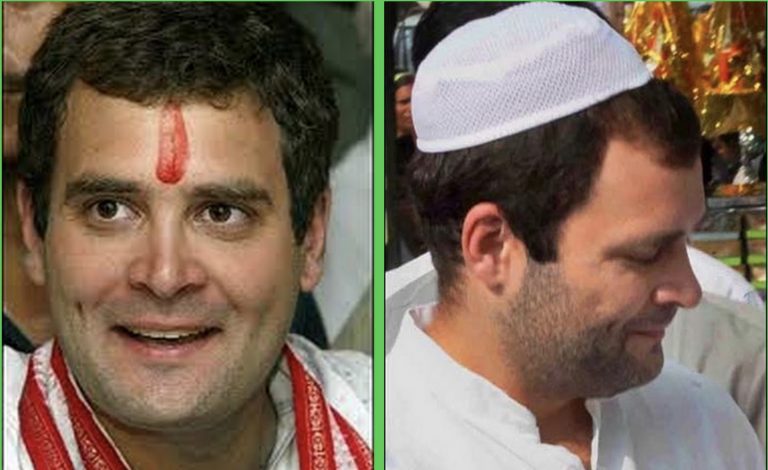
Rahul Gandhi has started visiting temples by the dozens. Even the Somnath temple, which is witness to Rahul Gandhi’s great-grandfather’s treachery. The prince now claims his family is a “Shiva Bhakt”. Once controversy broke out over Rahul’s religion, Congress leaders scrambled to declare him a devoted Hindu. Further, it was said that “not only was he a Hindu, but he was a janeu-dhari Hindu”, which was to say, not only is Rahul a Hindu, but he is a Hindu of the ‘highest order’, a Brahmin. Now we suddenly see posters of “Pandit” Rahul Gandhi, put up by Congress leaders.

All of this is in view of the Gujarat elections where perhaps Rahul Gandhi has realised (from earlier debacles in Gujarat and other places) that going for the soft-Hindutva line could be more useful. A political outfit is not barred from changing its religious thought-process before an election. But one expects consistency of view. If Congress wants to rebrand itself as a soft-Hinduva party, so be it. But then it has to consistently follow this maxim.

For starters, when in Kannur, Kerala, a Youth Congress leader had slaughtered a cow in full public view, later claiming that he had the approval of the State President for this act, Congress acted by condemning and suspending the concerned people. On the other hand, Rahul has a comment handy when it comes to condemning ‘Gau Rakshaks’ without ever commenting on ‘Cow smugglers’ and the menace it has led to. Not once does Rahul comment on murders by these smugglers. Even when action was taken against the Youth Congress leader, it was cloaked as a disciplinary action and that it wasn’t the style of protest that Congress condones. Not a word was said about Hindu sentiments being deliberately hurt and of the subject of the protest itself.

While this may be a story of the past, and the Congress and Gandhi’s can be excused for it because Rahul Gandhi had written a tweet to distance himself, will they at least explain what is a soft-Hindutva party’s senior leader Kapil Sibal, doing when he represents the Sunni Wakf Board in the Ram Mandir case in the Supreme Court? An easy answer would be that Sibal is a respected lawyer and it is his right to represent any client who comes to him, and all of this is in his personal capacity. But then why did Sibal try to delay the judgement on the Ayodhya matter, citing 2019 Lok Sabha elections? Why is he being reported as saying:

“Ayodhya is a serious matter and there are serious repercussions outside the court when the matter is heard. This entire hearing should be delayed and done after the 2019 general elections.”

How does it matter, to the Sunni Wakf Board or to an independent lawyer acting in his personal capacity, that the elections may be affected by a title dispute judgement? Or is he only a proxy for the Congress party, who by claiming to be representing the Sunni Wakf Board, is trying to further the Congress’ own ideas, in the Ram temple case? Is this then the same Congress, whose to be President is a temple hopping, “janeu dhari”, Shiva Bhakt?

The Congress’ only explanation so far is that it is Sibal’s personal case, and they have refrained from commenting further calling it a sub-judice matter. Both explanations are not convincing.

The singular question which arises in the minds of all Indians at this moment is: Will the real Congress stand up? Are you the old “secular” Congress whose Prime Minister declares that minorities have the first right over the nations resources, thereby reducing the Hindu majority to second class citizens? Or are you the new “soft-Hindutva” Congress which has a “janeu-dhari”, Shiva Bhakt for a President who loves visiting temples (which according to him, are also frequented by molesters)?

Or is the Congress of today, just a confused jigsaw puzzle of ideologies that keep fluctuating depending on the state that goes to election? Will this ‘soft Hindutva’ stand disappear once say Kerala goes to polls, just like they pandered to Muslims when Uttar Pradesh was headed for elections?

For what its worth, BJP and the Sangh has stood by their ideology come hail or high water. Regardless of elections being held and its victory or loss in those said elections, their ideological stand has been consistent through the decades.

Congress needs to take a stand on this issue once and for all, and then stick to it consistently. As said before, there is no restriction for Congress to remodel itself as a soft-Hindutva party, but at least let it be honest. In a Hindu Majority country as diverse as India, a political parties stand on the issue of ideology is an extremely important element. The voters certainly deserve all the information there is to have before making an informed decision while casting their votes.

The garbled shrieks of ‘secularism’ is clearly passe. If not, then it is clear as daylight that Rahul Gandhi and the Congress considers Hindus and Muslims to be gullible fools who will fall for temporary gimmicks and dramas, as and when is suited to the Congress party’s political needs.

UP police arrests 7 Christian preachers accused of carrying out forced conversions

0

The Mathura police arrested 7 Christian preachers on Monday night after they were accused of carrying out forced conversions in a UP village.

As per reports, these Christian preachers were active in the area named Irauli Gurjar for about a month where they were distributing Bibles to the residents. As per one of the villagers, these preachers turned aggressive and tried to forcibly convert the people on Monday night after they became exasperated with their ‘lack of success’.

These preachers have since then been produced in the court on Tuesday as a result of which they have been put in a 14 day judicial remand. This Irauli Gurjar village is predominantly inhabited by Schedule Caste families, whose total strength is considered to be about 700.

Another report has claimed that the villagers were outraged when these preachers entered a home and started praying to Jesus Christ. When people started to eye them with suspicion, they defended their actions by claiming that they were simply praying and would return back once they are done.

The villagers though, didn’t believe them and notified members of the RSS and BJP. Soon the news spread and members of various Hindu groups like VHP and Hindu Jagran Manch reached the village. The police too decided to reach the spot and took the preachers into custody.

It seems that a woman named Mamata (who had recently moved to the village after marriage) had called these preachers for a prayer on Monday. As per the family members of Mamata, apart from praying, these preachers even started insulting other deities.

SP Aditya Shukla stated that based on the complaint made by a villager, they booked these preachers under IPC’s 295A section which deals with deliberate and malicious acts intended to outrage religious feelings. The accused have been identified as Stanlee Jacob, David, Vijay Kumar, Amit, Sumit Varghese, Anita and Dinesh.

Such an arrest was also reported from Madhya Pradesh in April where three Christians were arrested on the charges of indulging in forced religious conversions.

Forced conversions allegations had also surfaced against Muslim teachers of a government residential school in Haryana, where these teachers were accused of forcing Hindu students to offer Namaz and also pressurising them to convert to Islam.

Subramanian Swamy’s discussion on ‘Why Ram Mandir in Ayodhya’ cancelled by JNU

0

The Jawaharlal Nehru University (JNU) in Delhi first attained notoriety in the eyes of the nation after reports emerged about how anti-national slogans were raised by leftists students in an event commemorating the hanging of terrorist Afzal Guru.

Soon after that, a narrative was built by the liberals, decrying the police action against the anti-national sloganeering by using phrases like, “Government is taking away the right to disagree”, “This is attack on free speech”, “Innocents students are being targeted”. 

On the face of it, such a narrative meant that the dissenting leftists of JNU have the highest regard for freedom of expression and would readily welcome any ideas and thoughts which are contrary to their ‘ideals’.

This naive assertion was soon punctured after it was reported how leftists students had forced the JNU administration to cancel an invite to Arvind Gupta, who led Prime Minister Narendra Modi’s and BJP’s digital campaign in 2014 simply because of his BJP connection.

Intolerance was on display again after some JNU students didn’t even allow their own professors to enter the offices while protesting against UGC rules, and the disappearance of fellow student Najeeb Ahmed.

Now the university is making news for the wrong reasons again, after claims have emerged about the cancellation of senior BJP leader Subramanian Swamy’s talk on, “Why Ram Mandir in Ayodhya”:


Jagdish Shetty, a close aid of Dr. Swamy attached a letter with his tweet, written under the letterhead of Jawaharlal Nehru University, Koyna Hostel. This letter stated that the competent authority has decided that no talks would take place in the hostel on 6th December. As a result of which Dr. Swamy’s talk has been cancelled:

The letter in question has been signed by the Senior warden of the Koyna hostel and a copy of it has been sent to the Dean.

Subramanian Swamy has been a vocal supporter of Ram Mandir’s construction in Ayodhya, and it might be safe to assume that this talk too would have reflected this view of his.

Such a cancellation meant that people quickly took to twitter and reacted:


With JNU’s record of fighting for ‘freedom of expression’ even for anti-India sloganeering, this event being cancelled does seem extremely odd and duplicitous.

We had warned you: Government may use GST data to track Income Tax Defaulters

0

Almost exactly a year ago, we at OpIndia.com had published an article titled:

We had mentioned how GST’s IT architecture, will make life difficult for tax evaders:

The entire GST model will be run with the IT backbone called GST Network (GSTN) which will ensure a high level of compliance. GST will form a virtually unbreakable chain of transactions right from the initial raw material, till the goods are sold to the consumer. In GST, the GSTN will automatically parse through the sales details of corporates, and reflect them in the accounts of the individual purchasers.

The only way to then avoid GST is to formulate a chain in which nobody at any level is maintaining proper record and therefore not filing any data with GSTN. While this is not impossible, it would be very hard to cobble up such a chain in most sectors because very often some or the other component has to come from a highly regulated sector.

Not only was the GSTN expected to tighten revenue losses in indirect taxes, we had envisaged that this system would help plug Income Tax leakages as well:

Further, all GST registrations will be linked to PAN, thus data will be shared between the Income Tax Department and the Indirect Taxes Departments. The beauty of GSTN would be that the IT systems would do most of this matching of sales and purchases, with minimal human interface and effort.

To reiterate, the GSTN allows the IT system to track a transaction from start to finish. For example, let us consider an MNC like Pepsi, which has bottling plants in India. It purchases many raw materials from local vendors, manufactures soft-drinks, and then sells them to local distributors etc. When Pepsi buys raw material, it will enter invoice wise details of its purchases, in the GSTN, indicating the name and GST number of the seller. The seller too will upload these transactions as sales to Pepsi. The seller in turn maybe buying his raw materials from some local vendors. Hence, he too will upload his purchases, and the original seller too will follow suit. This chain will continue till the seller is a small business who does not need to upload such details.

Coming back to Pepsi, it will upload all the sale of bottles to various distributors, identifying them by name and their GST number. The distributors will also report the purchases, and then report further sales to retailers or restaurants, again identifying them.

Thus, an unbreakable chain of data is ready which shows how the source raw material moved up the value chain to Pepsi, and then moved to the end consumer. The chain is strong since even if one party does not upload their sales or purchases, the other side will upload their own data. For example, if the distributor does not want to disclose his purchases from Pepsi, he has no choice, since Pepsi will upload its sales. And since Pepsi has declared that it has sold to the distributor “x” amount of bottles, the distributor also has to show sales for the same “x” amount, thus making it very difficult to under-report sales. This logic extends to most people in the chain.

As per media reports now, the Government is actively looking at exploiting this data-mine:

The government is setting up a mechanism wherein data obtained through GST reporting could be correlated with the income-tax filings……Unlike the earlier tax regime, GST leaves a trail, especially for the business of size, and it becomes hard to underreport income or exaggerate expenses.

This data can not only be used prospectively, but even retrospectively. Example, if a business was routinely reporting sales of Rs 2 crore in pre-GST era, and after GST its sales show an abnormal jump (due to the data tracking system), then its possible that the Tax department may be interest in opening up his past records as well, since there would be a high suspicion that he had evaded taxes in the past.

This could be a double edged sword since it could amount to tax terrorism, and hence the Government must form strict guidelines to ensure officers cannot use their “discretion” recklessly. Having said that, GST can help raise tax revenue even on the Income Tax front, if the above mechanism of Big Data analytics falls in place.

Kerala girls trolled by Muslim fundamentalists for participating in a street dance

0

Three Burkha clad Muslim women have been at the receiving end of intense trolling for participating in a street dance as part of a flash mob. Flash mob is a spontaneous assembly of people mobilised via social media for carrying out an entertaining and random activity.

In this case the flash mob was organised at the Kottakkunnu junction in Malappuram, Kerala for spreading awareness on AIDS day. This event incidentally was a part of an awareness program of the district health department.

As per the Deputy District Medical Officer of Malappuram, students of a private dental college and various girls from other institutions to participated in functions like street play, pubic rallies.

These three girls in question danced to the tune of a local song, which came back to haunt them after videos and photos of their dance started circulating on social media. This video was also shared by news websites:


The Muslim fundamentalists opposed this deed by claiming that it was immoral and against their religious beliefs. One of the users even claimed that the end times are near and people are lucky that there was no Tsunami in Mallappuram.

This isn’t the only time fundamentalists have been irked by Muslims who as per them have been indulging in non-Islamic things.

We had reported how Islamists had declared Mohammed Shami a bad Muslim for celebrating his daughter’s birthday. Mohammed Kaif was trolled for doing Surya Namaskar and Irfan Pathan was told by fundamentalists that Raksha Bandhan is against Islam.

Such a targeted harassment has also extended to the personalities belonging to West Bengal’s entertainment industry.

A famous Bengali radio and TV presenter named Mir Afsar Ali was abused for equating his father with Allah. Recently, famous Bengali actress Nusrat Jahan was also insulted on Facebook for celebrating Durga Puja.