Home Blog Page 7499

Election Commission rejects plea of AAP MLAs in the Office of Profit case

In a possible setback to Kejriwal and the Aam Aadmi Party (AAP), the Election Commission of India has decided to continue hearing the case against 20 AAP MLAs for allegedly holding an office of profit. If found guilty of the same, the AAP MLAs stand to face possible disqualification.

The case in question is a petition which was filed by Advocate Prashant Patel with the President on 19th June 2015. It was reported that the AAP MLAs in question were appointed as Parliamentary Secretaries by the Delhi government, which was not allowed as per law as it was considered an office of profit.

Kejriwal government then tried to shield its MLAs from repercussions by passing a bill to exclude the post of Parliamentary Secretary from the office of profit list, which would have given them a legal sanctity. Unfortunately for him though it was rejected by the President.

Office of profit roughly comprises of any non-political position an elected representative holds for which he is earning a salary from the government. The benefits falling under the office of profit may not just be monetary as was detailed by Advocate Prashant Patel.

In his interview to OpIndia, Advocate Patel had stated that Office of Profit also constitutes those posts that involve some position, prestige or patronage. The AAP MLAs, by accepting the position of Parliament Secretary, had placed themselves in a better position as compared to other MLAs, and that was arguably in contravention of rules. The MLAs had held the post from March 13, 2015 to September 8, 2016.

Now in today’s order by the Election Commission, it has observed that the MLAs indeed held an Office of Profit. It has dismissed their plea to quash the proceedings against them:


Earlier in September 2016, the Delhi High Court had quashed the appointment of the MLAs as Parliament Secretaries as it lacked the approval of L-G. The MLAs had incidentally tried to interpret the order of the Delhi Hight Court to mean that they had never held any office of profit as the court found the appointment invalid, and asked the EC to stop the proceedings against them. The EC has now refused the same by stating that their interpretation was legally untenable.

Originally, 21 AAP MLAs were involved in the case but one of the MLAs, Jarnail Singh resigned from his Rajouri Garden seat to contest the Punjab elections. Incidentally Jarnail Singh ended up losing his deposit in Punjab and the resultant AAP candidate also lost his deposit in the Rajouri Garden by-poll.

Presidential poll : Liberals are fighting on the wrong side of history

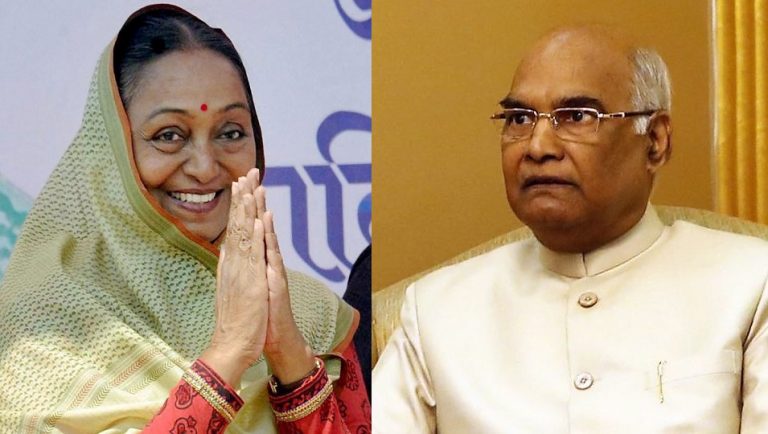
The BJP  fielded Bihar Governor Ramnath Kovind as its candidate for the President of India. The BJP’s continued Dalit outreach unnerved the Congress, which decided to field Babu Jagjivan Ram’s daughter Meira Kumar.

The difference could not be more stark or more fitting : on the one side, a Dalit born in an ordinary family who rose to become a Supreme Court lawyer, not to mention holding several other legislative and constitutional posts. On the other side, the daughter of a powerful politician with her many flatterers in media and Lutyens’ Delhi.

What a way for the Congress and liberals to give a thumbs down to the aspirations of Indian youth. When it comes to the secular establishment, privilege attained purely by birth is the only thing that ultimately matters. Pretty much exactly like caste.

It is quite understandable therefore that the Congress, a party of political feudal lords, would field one of their own high born political princesses for the highest Constitutional post in India.

On the other hand, it is quite laughable that the Congress thinks elevating a political princess who just happens to belong to the Dalit caste, is somehow an answer to the BJP’s sustained engagement with Dalits.

Quite simply, the Congress and its retinue of liberal flatterers don’t see the difference. And even if they knew the difference, it wouldn’t matter because they are simply fighting on the wrong side of history.

Whether India’s so called secular left likes it or not, the RSS/BJP today is offering to Dalits a very powerful narrative of Hindus coming together to reclaim the greatness of their nation. Why was there a Dalit cascade in favor of Modi in 2014? Why is it, that despite every possible propaganda effort from the establishment to throw the Modi government out of favor with Dalits, the results of Uttar Pradesh 2017 were an exact replica of the results of May 2014?

The ‘secular’ left consoles itself with the belief that somehow the Sangh Parivar is full of closet casteists and it is only a matter of time before they get exposed in the eyes of Dalits. The ecosystem is always in a hurry to spread every real or imagined ‘news’ story that seems to show that such a phenomenon is finally happening.

Their fatal weakness is that they have never considered the possibility that they might be wrong. When Modi came to the holy city of Varanasi and replaced a powerful Brahmin leader as Murli Manohar Joshi, a message was sent.

What was the message? The message was that the BJP would make room for merit, no matter what caste or background the person might come from. The same message has been sent today with Ramnath Kovind : that the BJP is a vehicle by which a person of humble background can reach the greatest heights.

But what did the Congress expect? They convinced themselves for a while that the BJP’s new focus on OBCs and Dalits would lead to “Brahmin anger”.

But that never happened. The Brahmins stuck with BJP as always. And the OBCs and Dalits came to the BJP fold in large numbers.

Today it is Modi, an OBC. Before this it used to be Vajpayee, a Brahmin. Who knows who will lead the BJP tomorrow? It could be a Dalit or a Brahmin or maybe a tribal. Whoever leads will have to rise through the ranks instead of being born with a golden ticket. That’s what people see today.

The Congress party and its political zamindars are missing the fatal weakening of the caste system.

In the eyes of the Congress party, the typical Dalit is a person who is full of hatred towards other Hindus. In their eyes, a typical Dalit goes to lots and lots of beef parties. And their economics is supposed to be essentially Communist. Because, for some mysterious reason, Dr. Ambedkar chose to posthumously join the Communist party after despising it all his life.

But the “Dalit” that the liberals think they are speaking to barely exists in this country, if at all. A simple calculation based on NSSO data shows that only about 3% of India’s 300 million Dalits and tribals actually consume beef. To put this number in perspective, let us take the fact that surveys generally show about 5-6% of Muslims voting for BJP. In other words, the BJP does a better job of representing Indian Muslims than the liberal beef lobby is doing of representing Dalits and tribals! The hysterical protesters for “social justice” on the left may kindly take note…

Liberals have to realize that they can’t use caste as some kind of card against Indian nationalism. In fact, for historical reasons, the so called “lower” castes are farthest from the rootless liberalism that creates useful idiots for Pakistan. The “lower” castes never collaborated with British Empire, never enjoyed its patronage and were never socialized into its mode of thinking.

And so if Dalits today see the liberals trying to use caste as a card against Indian nationalism, they will severely punish such elements. Dalits will stand with India much before they stand with elements such as Mani Shankar Aiyar.

The secular establishment should ask itself why BJP manages constantly to expand its base. Each time they try to box in the BJP as a party limited to this group or that group, it manages to expand its base far outside that group. The BJP is able to keep adding Brahmins to OBCs to non-Hindi speakers and more and more.

On the other hand, trying to add Dalit to  Muslim always results in a flop. Mayawati wasn’t the first to try this math and she won’t be the last. This is what happens when you believe a fake version of history and try to add up apples and oranges.

Perhaps India’s secular liberals should consider the possibility that a Dalit is, first and foremost, a Hindu. He/she has no sympathy for Communist movements or for a Pakistani design to tear India into pieces. And so, if the Hindu right manages to communicate a larger design for Hindu unity that goes beyond caste, Dalits will happily join the flow.

India’s secular liberals are fighting on the wrong side of history; now it is on the Hindu Right to be on the right side and not get trapped in the narrative being pushed by the left.

‘Bihar ki beti’ Meira Kumar has been chosen only to lose: Nitish Kumar

Making it clear that there is no question of re-considering support to Ram Nath Kovind in the race of Raisina Hill, JD-U president Nitish Kumar said that Bihar Ki Beti Meira Kumar has been nominated as a Presidential candidate by the Congress-led opposition only to lose.

Earlier RJD supremo had termed JD-U’s support to NDA nominee Ram Nath Kovind for the Presidential election “aetihask bhool (historical blunder)”. Describing Meira Kumar as “Bihar ki Beti”, Lalu had appealed Nitish to mend the “historic blunder.”

It could be noted that Ram Nath Kovind is comfortably placed in the Electoral College after JD-U and other non-NDA parties backed his candidature. Kovind’s election to the top post should go smooth unless there is cross voting on mass scale.

“There is no doubt about the result. I have great respect for ‘Bihar Ki Beti’ (Meira Kumar). But the Bihar Ki Beti has been nominated only to lose,” Nitish said.

“We have taken this decision after thinking on all aspects. And as far as JD-U is concerned, it has always taken independent decisions,” the Bihar Chief Minister said.

It could be noted that during the last Presidential election in 2012 when the JD-U was a NDA constituent, the party had supported UPA candidate Pranab Mukherjee.

Showering praise on NDA’s Presidential nominee and former Bihar Governor Ram Nath Kovind, Kumar said, “Ram Nath Kovind does not originally hails from the RSS; rather he started his political journey under the guidance of Morarji Desai. I personally like the way his discharged his duties in an unbiased manner in the capacity of governor of Bihar. It is a matter of pride for us that governor of Bihar would become president of India.”

The Bihar Chief Minister said the Presidential election should not be made into a political battle. Kumar said difference in opinion on Presidential will no way have impact on the Grand Alliance in Bihar. “The alliance is very much intact,” he said.

Kumar said the decision of the Congress-led block to choose former Lok Sabha speaker Meira Kumar as the Presidential candidate against former Bihar Governor Ram Nath Kovind will have impact on 2019 Parliamentary elections.

“The preparation for 2019 elections should have started with a strategy for winning but they (opposition) have started only with a strategy, which would lead to failure. The opposition is going to face defeat with such a strategy,” he said.

Some interesting facts about Presidential Elections of India you may not be knowing

The battle for the election of a new President of India is all set with the opposition announcing former Lok Sabha speaker Ms. Meira Kumar as its candidate. Earlier this week on Monday, ruling BJP had announced former Bihar governor Mr. Ram Nath Kovind as its candidate. The voting will take place on 17th July and the counting of votes will be take place on 20th July.

This election, which will be the 15th Presidential election of India, is going to be one of the most keenly and closely contested elections in the recent past, although Mr. Kovind appears to have an upper hand right now. However, as we will see, this might not be as close as once witnessed in the history of presidential elections.

So here are some bits of information about the Presidential elections and earlier incidents that we think you will find interesting:

MLAs of different states have different values of their votes

This is something you must already be knowing. When we common citizens vote in any general or assembly elections, our individual votes have the value of one vote each, but it is not the same when MPs and MLAs vote in the Presidential elections.

The President is elected through the votes of all MPs (of both Rajya Sabha and Lok Sabha) and MLAs (of all States and UTs of India), who are jointly known as the “Electoral College” and individually referred to as “Electors”. While every MP has the same value of his or her vote (regardless of size of his parliamentary constituency) the value of the vote of an MLA depends upon the relative population strength and total number of assembly constituencies in that state. The following formula is used to calculate the value of vote of an MLA:

To give an idea, value of a single vote of an MLA from Uttar Pradesh is 208, which is the highest, while the value of a single vote of an MLA from Sikkim is 7, which is the lowest among all India. The total value of votes of all MLAs from all the States and UTs combined (4120 MLAs) comes out to be 549495.

The value of a single vote of every MP (543 Lok Sabha MPs and 233 Rajya Sabha MPs) comes out to be 708, based on the following formula:

Thus the maximum value of total votes polled in a presidential election is [549495 + 708x(543+233)] = 1098903.

The population strength of different states has been fixed as per 1971 census

To ensure that states performing better at population control are not ‘punished’, it was decided to fix the 1971 census data in the aforementioned formula to calculate the value of vote of an MLA till 2026, even though population figures have changed considerably over time.

For example, if we take the 2011 census data, the value of vote of an Uttar Pradesh MLA will become 259 (currently 208) while that of a Sikkim MLA will become 19 (currently 7).

Here is a table of 10 states, which indicates how strengths of different states could change if 2011 census data is used instead of the population recorded in the 1971 census.

Presidential election involves preferential voting system

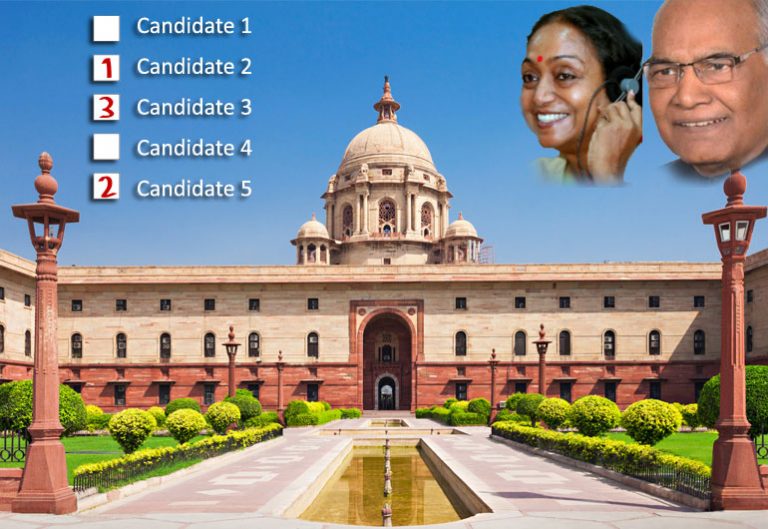
This is another crucial difference between the way we common citizens vote in regular elections and how our elected representatives vote in the presidential elections. While we are supposed to vote for only one candidate, electors in a presidential election are supposed to indicate ‘preferences’ against one or more candidates. Yes, our presidential election follows a “preferential voting system”.

Ever since the Presidential election of 1997, we have seen only 2 candidates fighting it out for the apex post, hence the preferential voting has not been in effect or action, but the electors are supposed to mark their preference – in digits only – against the names of the candidates. Any other form of voting, say a tick mark or writing “one” in any language will lead to an invalid vote.

In the upcoming elections too, an elector will be supposed to write “1” against the name of Ram Nath Kovind or Meira Kumar to register his or her vote. Writing “2” against the remaining candidate is not compulsory (and in the current case, where just two candidates are expected, it is not even needed). According to the rules, marking only “1” is compulsory even if there are more than two candidates in the fray.

Theoretically, if no one gets more than half of the total value of valid votes with all the “1” preferences counted against their names, the candidate who got the least value of “1” preference is eliminated and it is seen as to which candidates were marked “2” in those ballot papers (if marked so); these values are then added to the rest of the candidates, and the sequence is repeated till we have a winner.

In one presidential election, there were 17 candidates in the final fray!

Although most of us would remember only 2 candidates (as has been happening in the last 20 years), there have been elections with over a dozen candidates too. Yes, we are talking about final list of candidates who were listed to be voted for, not nominations/applications that usually run into scores (and most of them are rejected after evaluation of papers).

The record of maximum number of candidates was made in the fourth presidential election of 1967, when there were a total of 17 candidates in the fray. Out of these, 9 candidates failed to get even a single vote. Another 4 of them received votes whose value was less than 250 each, which means that no MP voted for them and there could have been a handful of MLAs voting them.

In the presidential election of 1969, which had to be held in just 2 years after the previous one as President Zakir Husain passed away while in office, there were 15 candidates again in the final fray, out of which 5 failed to poll even a single vote. Rules were made tougher after this election to stop non-serious candidates from qualifying for the actual voting stage.

In 1974, it was mandated that a candidate will qualify for voting stage only if he or she is backed by 10 electors as proposers and another 10 as backers. One elector was supposed to propose or back only one candidate. As a result, there were only 2 candidates in the 1974 presidential elections. Currently, this number is set to 50 electors each, and we will see when it was increased.

In 1977 election, there was just one candidate, and thus he won unopposed

The only President of India who was elected without voting was Mr. Neelam Sanjiva Reddy, who won in 1977 when the Janata Party was in power and Congress in opposition for the first time thanks to Emergency imposed by Indira Gandhi earlier.

The Presidential election took place only 3 years after the previous one as the then President of India Fakhruddin Ali Ahmed had passed away while in office.

Congress decided not to give any fight in the Presidential election, possibly because of being low on confidence after losing power for the first time, and declared support for the Janata Party candidate. As a result, Reddy was elected unopposed. This was second time he had run for the office, earlier in 1969.

1969 Presidential elections were the most closely fought ever

The 1969 presidential election is the only election of India in which we witnessed the preferential voting system in action.

Ruling Congress was unable to decide its candidate on time and it resulted in two Congress leaders declaring their candidatures of their own – the then acting President of India V V Giri (who was made acting president due to death of Zakir Hussain) and Neelam Sanjiva Reddy. V V Giri had to resign from his post of acting President of India and thus the then Chief Justice of India became the acting President for a little over a month till the presidential elections were over.

There was a third candidate too – Mr. C D Deshmukh, backed by some opposition parties like Swatantra Party and Jan Sangh. A faction of Congress appealed to Swatantra Party and Jan Sangha electors to cast their 2nd preference votes in favour of Mr. Reddy – a step that was denounced by Indira Gandhi thus giving an indirect support to Mr. Giri.

It is speculated that many Congress members voted for Mr. Reddy, despite Indira’s reservations, but Mr. Giri ended up winning the elections. The results were decided after counting 2nd preference votes – the only time it has happened in the history of Indian presidential elections. Reddy had received almost 5 times more value of 2nd preference votes than Giri, but he still lost by a narrow margin.

There is no option of NOTA in the elections

Apart from aforementioned major differences, a minor difference in the way we vote and our elected representatives vote in the elections is the option of choosing NOTA. While we get the option of NOTA (None Of The Above), no such option is available for the electors in a presidential poll.

Nominated members of the house are not eligible to vote in Presidential elections

Yes, Sachin Tendulkar will not be voting in the Presidential Elections 2017.

Noted lawyer Ram Jethmalani also has been a candidate in one election

As we had seen earlier, to keep out non-serious candidates, it was mandated that a candidate must have the support of at least 20 electors (10 as proposers and 10 as backers). But this proved to be less in the 1992 Presidential elections, when noted lawyer Ram Jethmalani could qualify. Not that Jethmalani was exactly a ‘non-serious’ candidate, but it demonstrated that a well-connected and well-known person could get support of 20 electors.

Not just Ram Jethmalani, a person named Kaka Joginder Singh alias “Dharti-Pakad” could also qualify for the final round in the 1992 elections. Dharti Pakad, who is now no more, was famous for contesting hundreds of elections and losing them. It can be argued that he fitted in the category of ‘non-serious’ candidate.

Ram Jethmalani got votes worth total value of 2704, and even Dharti Pakad got 1135 in a four cornered fight. Both lost their deposits in an election that was won by Dr. Shankar Dayal Sharma by defeating Mr. G G Swell.

Earlier in 1987 presidential election, another person named Mitihilesh Kumar had qualified for the voting stage. He even demanded to make a pitch for his candidacy on Doordarshan and All India Radio, which was denied. He had received 2223 votes in the election.

Mithilesh Kumar tried to contest 1992 presidential election too, but his nomination papers were rejected. As a result, he went to Supreme Court and somehow argued that everyone’s nomination papers, except that of Dharti Pakad, should have been rejected. He demanded Dharti Pakad to be declared winner and the new President of India. Supreme Court found his petition frivolous and dismissed it.

Taking lessons from these developments, it was decided to increase the number of electors from 20 to 100 (50 as proposers and 50 as backers) from 1997 onward, and ever since then, we have not seen a third candidate in the voting stage.

Secret ballot system is used for Presidential elections

Till now we have seen how presidential elections voting system is different from ours, but this is a similarity. Just like our vote is secret, the vote of an MLA or MP in Presidential elections is also secret. This is unlike other voting – such as during law making – that happens in legislative houses, where the MLAs or MPs are supposed to follow the party whip and vote accordingly.

Anti-defection law doesn’t apply during the Presidential elections

If an MLA or MP votes against the party whip, he loses his membership of the house, but since the presidential elections happen through secret ballot, anti-defection law is not applicable here. This often results in cross voting, and thus a party’s support can not be taken for granted in a presidential election, for the party members can always vote according to their individual wishes without having to face any consequences.

All MLAs or MPs have to use the same pen during the voting

Even though anti-defection law doesn’t apply, what if a political party gives a special colour pen to its members during the voting, so that they know how many did not vote according to party line? They could guess the number of defectors or ‘traitors’ and accordingly try to zero on the ‘culprits’. This possibility has the risk of a secret ballot no longer remaining secret.

As it happens during the counting of votes in assembly or general elections, the candidates and their representatives are allowed while counting of Presidential election votes is on. The candidate and representative may make a note of this special colour and count the number of votes as per party lines, and conclude how many voted against the party line, right?

Although this sounds too Sherlock Holmes level, the Election Commission of India has factored in such possibilities and decided that everyone will use the same pen with common ink colour at every polling station (at Parliament or State assemblies). A violet ink will be used in the upcoming elections, and votes registered by using any other pen will be declared invalid.

(sources: Election Commission of India handbook [pdf], FAQs by ECI [pdf], and a letter by ECI [pdf])


Man applies for a week’s leave to eat a lot of chicken before Shravan starts

In a bizarre development from Chhattisgarh, a Railway Employee named Pankaj Raj Gound posted at Deepka in Bilaspur District decided to request his station master for a week long leave so that he could sit at home and eat as much chicken as he could before the holy month of Shravan started.

Following is the alleged application letter:

Chicken eating application

In the letter, Pankaj, a TA-II employee who works as a porter at Deepka railway station, requests the station master with folded hands that as Shravan was starting from the month of July, no chicken would be cooked at his home during the entire month. He argues that his body will get weak due to lack of chicken in his diet, which would ultimately render him unable to do his job with efficiency.

He thereby requested his station master to grant him a leave from 20th June to 27th June so that during that period he may eat so much chicken that he would cover the quota for a full month, in order to stay strong enough to work 24 hrs a day.

The letter incredibly has an acknowledgement signature and a stamp of the Deepka Station Master, giving it credence. It wasn’t immediately clear whether the authorities had approved the leave request of Pankaj, as it was laced with kilos of tandoori logic.

The month of Sharavan is considered the holiest by Hindus and many refrain from eating non-veg food during that period. Incidentally some Maharashtrians celebrate a mini-version of Pankaj’s request in the form of a Gatari Amavasya where they eat and drink to their heart’s content on an Amavasya before the Shravan starts so as to make the one month abstinence bearable.

(Reporter’s diary: I thought I would write this news report with some funny commentary, but I could not think anything funnier.)

Bangalore police arrest 4 illegally residing Bangladeshis accused of Murder

The Bangalore police on Thursday arrested 4 Bangladeshis who were living illegally in the city and have been subsequently accused of murder and running a prostitution racket. All the four people had valid Indian Identity cards like PAN card, Aadhar card, and even Voter ID card.

Even though them having Aadhar cards could be a blessing in disguise as now the authorities can use their and their suspected accomplices’ stored bio-metrics like fingerprints for crime investigation, them having voter cards is a very serious issue. It has been made clear that Aadhar card is not a proof of either Indian citizenship of a domicile but Voter Card is considered as an explicit proof of citizenship.

The Bangalore police are now trying to ascertain as to how they managed to procure the cards. The men named Obimulla (26), Moin Khan (26), Rakimulla (33), and Mohammed Kislu (35) reportedly hail from Parambishnupura Narail in Bangladesh. It is believed that they used a local contact named Janardhana Reddy, who is now absconding, to obtain the cards.

The four men were confronted by the police on late Wednesday night after they found their behaviour suspicious. When the men failed to provide proper explanation, they were taken to the Hennur police station.

Initially they submitted their ID proofs and claimed to be labourers from West Bengal, but the police inspector noticed their accent to be different from that spoken by Bengalis. After thorough questioning, they acknowledged that they were from Bangladesh and had come to Bangalore a few years ago by illegally crossing the border. They apparently used to bring women from Bangladesh to run a prostitution racket and had also allegedly murdered one of their associates named Imrul Choudary.

Currently various reports suggest that there are about 2 crore illegal Bangladeshis living in India.

This isn’t the only time Bangladeshis have come under scrutiny for perpetrating crime in India. Criminal gangs comprising of Bangladeshis had managed to sneak into India with the help of professional touts, who also help them in procuring weapons. These gangs took part in high profile robberies and then fled back to Bangladesh to wait for things to cool down. They were also known to sometimes team up with local gangs. In April 2013, one such criminal gang headed by a man called Badshah had conducted a robbery in a retired government officer’s home, which resulted in a death of the officer’s son.

How NDTV tried to whitewash lynching of Kashmiri policeman outside Mosque

On Thursday night, Mohammed Ayub Pandith, a Deputy Superintendent of Police (DSP) posted in the security wing of the Jammu & Kashmir Police, was lynched by a mob outside Jamia Masjid in Srinagar. The mob suspected him to be a non-Muslim who belonged to security agencies, and caught him while he was reportedly making a video of demonstrations in the area.

According to The Hindu, Ayub was spotted by a group of youngsters while he was making the video, who then dragged him around and beat him to death. Ayub fired from his pistol in self-defence, but the mob overpowered him. The mob raised pro-Pakistan and pro-militant slogans after stripping him naked and stoning him to death.

A gruesome incident of mob lynching was however given a ‘context’ by NDTV, which reported it with a headline that read ‘Man Opens Fire Outside Srinagar’s Jamia Masjid, Killed By Mob’.

There was no mention of the man being a cop in the headline and it suggested some ‘action-reaction’ as the reason why a person died. The snippets given alongside the headline too suggested as if the death was because an angry mob beat up a person who opened fire at them:

NDTV whitewashing crime
How NDTV descried death of a cop killed by Islamist mob

This was posted around a time when the details of the incident were already available. For example, the following tweet sent out by the Jammu & Kashmir police had clarified that a policeman on duty was killed by the mob:


The headline and description by NDTV perplexed and angered many, who argued that it was a narrative that attempted to whitewash a grave crime. Around an hour later, NDTV finally changed the headline to ‘Police Officer Beaten To Death By Mob Outside Srinagar’s Jamia Masjid’.

Now the snippets finally suggested that the cop, who was just an unknown man earlier for the NDTV, “may have opened fire in self-defence”:


This is not for the first time that the NDTV has been caught spinning information to create a counter narrative. Last month, Youth Congress workers had butchered a young cow in broad daylight in Kerala’s Kannur district. But while reporting the incident, NDTV changed the Cow to Buffalo, and finally to an Ox in its news reports, thus guaranteeing that Congress was not accused of cow-slaughter.

Tribes in Indonesia are accepting Islam to get govt facilities, and they are not the only one

According to a recent report from Indonesia, tribes in the country are slowly converting to Islam so that they would be able to get the required attention from the government. Few people of the Orang Rimba tribe featured in the report decided to convert to Islam in Jaunary this year by giving up their animist culture and lifestyle, which had already been destroyed thanks to rampant expansion of Palm oil plantations and coal mining in their native forests.

They were aided in the conversion process by an Islamic NGO, which was further assisted by the Social Welfare ministry of the Muslim majority country. One tribesman claimed that after converting, they would be able to get national identity cards which would mean they would be eligible for public services like education and health care – something that was elusive for them all thee years.

One of the new converts named Muhammad Yusuf claimed that his conversion from animism to Islam has meant that the government which earlier didn’t care about them have now started to pay attention.

A similar incident had also come to light from Malaysia, another Muslim majority country considered to be moderate one along with Indonesia. Here too the indigenous groups have alleged that the government had offered them infrastructure, provided they abandon their animistic ways and embrace Islam.

The government of Malaysia had reportedly built modern settlements equipped with electronic gadgets in their region. But according to a Indigenous rights campaigner, the facilities came with strings attached as the government officials had set a condition that in order to avail them , one has to be a Muslim. The government though denied the allegations.

Such religious conditions for facilities have also been imposed in Pakistan. According to a report, hospitals in Sindh lacked the funds that could help out the indigenous non-Muslims of the country. The report claimed that a Scheduled Caste Hindu named Sahib Bheel was running from pillar to post in order to seek monetary help for his son admitted in the hospital. He received no response from the government and had to sit on a dharna and even attempted self-immolation.

According to him, the officer of the Zakat funds (the amount earmarked in Islam for charity) had refused him a single penny as the funds were apparently in their entirety only for Muslims. Sahib isn’t the only victim of this discrimination, there are apparently a thousand others who are refused such help in Sindh.

This Zakat fund is reportedly also been used as an incentive for conversion in the United Arab Emirates. The report claimed that a hundred people who had embraced Islam in the UAE were the beneficiary of the aid which amounted to Dh1 million. The majority of the converts were Indians or Filipino.

Dhingra Commission recommends probe against former Haryana Chief Minister Hooda

Trouble is mounting for the Congress and senior party leader Bhupinder Singh Hooda. Justice (retd) SN Dhingra Commission of Inquiry has reportedly flagged several violations in granting licences for development of colonies in Haryana during the previous Bhupinder Singh Hooda government.

Emphasising that Bhupinder Singh Hooda’s conduct of giving “pecuniary advantage” to close associates comes under the purview of Prevention of Corruption Act, the Commission has called for a probe against the the then Haryana chief minister. The Dhingra Commission has recommended an audit by an independent agency and cancellation of those licences granted illegally.

Citing examples of how approvals for development of colonies were granted or denied in clear violation of law and laid-down procedures, Justice Dhingra Commission has indicted Hooda government for abuse of power and illegal gratification.

Hooda government in 2008 had granted licences to Robert Vadra’s Skylight Hospitality for building a colony in Gurgaon simply on the ground that the director of the firm was a VIP and the son-in-law of Congress president Sonia Gandhi.

Earlier the Dhingra Commission had discovered a land transaction undertaken by Congress president Sonia Gandhi’s daughter and Robert Vadra’s wife Priyanka Gandhi. Priyanka had bought 5 acres of agricultural land in Amipur village in Faridabad district of Haryana for Rs 15 lakh on April 28, 2006. That piece of land was resold to the original owner around four years later on February 17, 2010 at over five times the original price.

Justice (retd) SN Dhingra Commission of Inquiry was set up in May 2015 by the BJP government led by Manohar Lal Khattar. The Commission had submitted its report to Chief Minister Manohar Lal Khattar in August last year.

Even as the contents of the probe panel is still under wraps, Justice Dhingra has reportedly said that he has done his job and it is up to the courts to decide whether the report should be made public.

The Congress chose to challenge the constitutional validity of the Dhingra Commission and alleged that the BJP government had set up the Commission in “pursuit of a political vendetta”. “There are various irregularities with this Commission,” Hooda was quoted as saying.

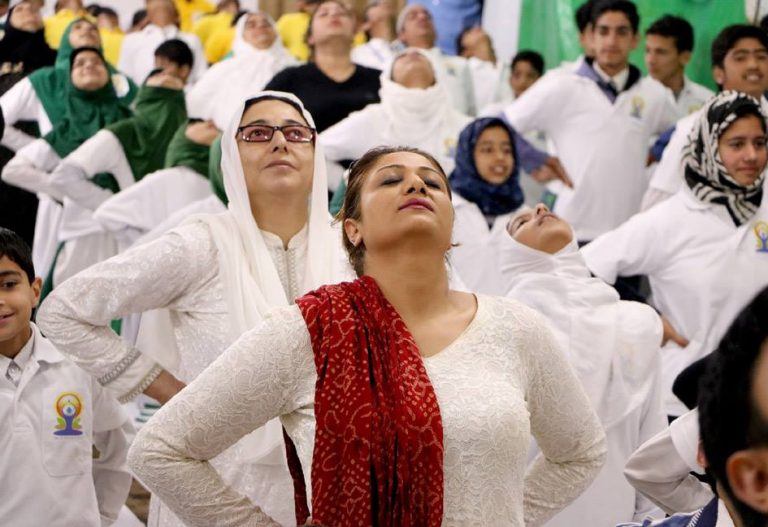
Kashmiri woman leader faces obscene comments for performing Yoga ‘despite being a Muslim’

We have recently seen how trolls viciously trolled targeted Deepika Padukone, Priyanka Chopra and Fatima Sana Shaikh among other women celebrities for not conforming to what they thought was ideal and “moral”. Not only entertainment professionals, even woman leaders like Union Minister Smriti Irani has been on the receiving end of the trolls. And now it has happened with a woman leader from Kashmir.

Dr. Hina Shafi Bhat, who is a dental surgeon and a BJP leader from Kashmir, was abused and subjected to humiliating comments just because she participated in an International Day of Yoga event in Jammu & Kashir on Wednesday.

It all began when a leading Newspaper of J&K, Daily Excelsior posted the image of Dr. Hina Bhat on their Facebook page. Hordes of trolls decided to attack her for this act, targeting her affiliation with the BJP and accusing her of being against Islam and the ‘Kashmiri struggle’.


Nearly all of the abusive comments were made by Kashmiri men, some of whom sent ‘laanat’ (curse) and ‘shame’ to Hina, while others stooped to accusing her of ‘sleeping with ministers’ and other such obscene and sexist comments. Many of these comments are still there on the Facebook page and not deleted despite it being pointed out on the social media.

It was clear from the comments that these trolls were upset by the fact that Dr. Hina was doing Yoga while being a Muslim. One comment wrote “Nimaz traweth Yoga karakh” in local language, which loosely means “she is doing yoga, leaving our faith”.

Dr. Hina had to face similar comments on another Facebook page that shares news from J&K. One user asked her to ‘drink cow urine too’ after doing yoga, while another accused her of trying to ‘shape’ her body through yoga (as if that is some vile thing to do). Another comment read “Nimaz to padti nahi yoga karti hai yeh jahnam mein jalay gi” (she doesn’t offer namaaz but does yoga, she will burn in hell fire). More than 200 comments were left on her picture with most being sexist attacks and religious sermons.

Muslim woman abused for performing yoga
A sample of vitriolic hate that Dr. Hina Bhat was subjected to for performing yoga.

Dr. Hina Bhat, whose father was an MP from J&K on National Conference ticket, had contested the assembly elections on BJP ticket from Kashmir’s AmiraKadal constituency in 2014. She was participating in a function organised on the International Day of Yoga along with Deputy Chief Minister of the state Dr Nirmal Singh and others in Srinagar.

It should be noted that many Islamic and Muslim majority countries have been participating in International Yoga Day events since 2015 when it was first organised. However, back in India, it has faced protests from ‘secular’ and some Muslim quarters for being ‘Hindutva’ agenda.