A controversy is brewing over the proposed Electricity Amendment Bill, 2025. As the bill is expected to be tabled in the Parliament during the ongoing Budget Session, the All-India Power Engineers Federation (AIPEF) staged a protest against it on 7th March 2026. A meeting was held in Uttarakhand’s Dehradun, wherein it was decided that a nationwide strike would be held on 10th March.
Modernisation of India’s private sector or its backdoor privatisation? What is the Electricity Amendment Bill 2025?
The Electricity Amendment Bill, 2025, is a proposed legislation by the Modi government aimed at amending the Electricity Act, 2003. The proposed legislation seeks to modernise and reform India’s power sector. Introduced in October 2025, in draft form by the Ministry of Power, the bill is formulated to address challenges such as inefficient distribution, fiscal losses of state-owned distribution companies (discoms), and the need for greater sustainability and competitiveness.
The Electricity Amendment Bill 2025 addresses three core concerns:
- Persistent financial losses in distribution companies (discoms) due to poor billing efficiency and high aggregate technical and commercial (AT&C) losses.
- Lack of competition in electricity supply, with consumers tied to a single discom, limits service quality and innovation.
- Cross-subsidisation distortions, where industrial users pay inflated tariffs to subsidise other categories, make Indian manufacturing less competitive.
As per the Ministry of Power, the Electricity Amendment Bill, 2025, “aims to create a future-ready electricity sector that delivers reliable, affordable, and high-quality power to every consumer: farmers and households, to shops and industries.”
The Bill, if passed, would mark a departure from the old monopoly supply model and encourage a performance-driven approach, where both public and private utilities compete fairly to improve consumer service. The proposed legislation protects subsidised tariffs for farmers and low-income households.
Building on previous reforms and an unsuccessful Electricity Amendment Bill,2022, the 2025 bill offers a platform for the Centre and States to work together, giving a big role to the states in shaping policies.
The Bill aims to bring about certain structural changes by rationalising cross-subsidy, promoting cost-reflective tariffs, and enabling direct procurement of power by industrial users.
The proposed legislation seeks to “dismantle longstanding barriers to India’s manufacturing competitiveness, making industrial power more affordable, reliable, and responsive to market demands, and at the same time protecting the subsidised tariff for farmers and other eligible consumers,” the Central government says.
Among the core changes proposed in the Electricity Amendment Bill, 2025, is the provision to allow multiple distribution licenses, both public and private, to operate in the same area. In a move towards breaking the monopoly of state discoms, give consumers a choice of suppliers, just as like telecom providers, and encourage efficiency via competition.
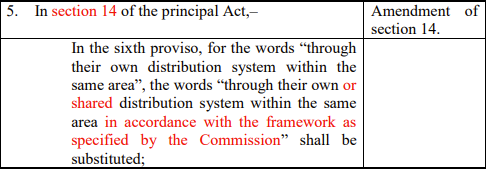
As per the amendment proposed for Section 42 to the principal Act, private companies can use the existing infrastructure, like wires and networks of state-owned discoms to supply electricity by paying a wheeling charge for network usage.
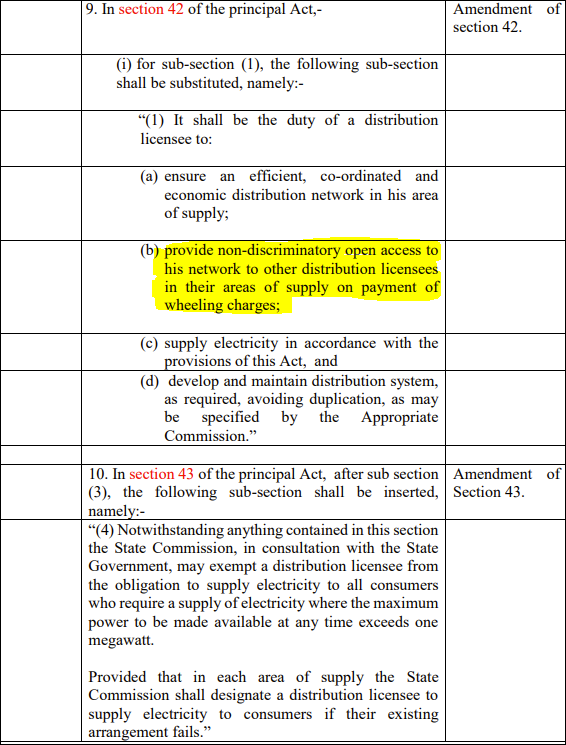
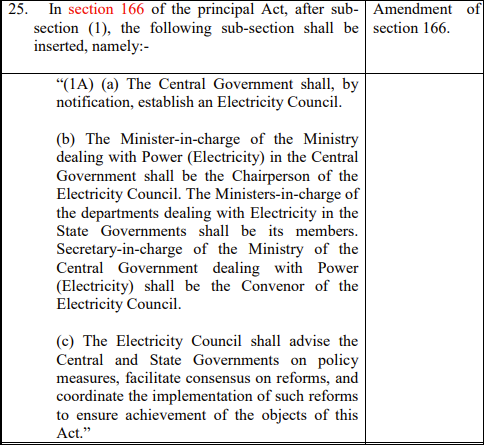
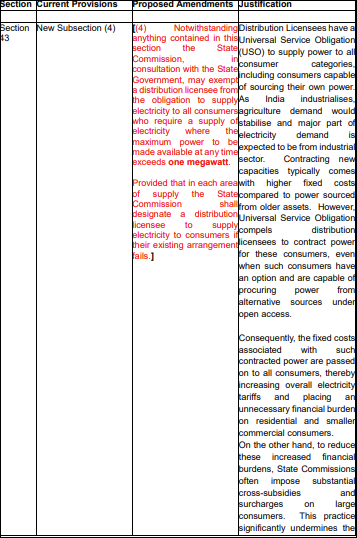
The draft bill states that licensees must develop and maintain efficient distribution systems while avoiding duplication. State Electricity Regulatory Commissions (SERCs) shall be empowered to exempt licensees from the universal supply obligation (USO) for consumers like large industries, requiring over 1 MW. The Commissions can also designate a fallback supplier in case of arrangement failure. Under Section 166, the Bill also provides for the establishment of an Electricity Council for Centre-State policy coordination and consensus-building.
“India already operates a successful Inter-State Transmission System (ISTS) built on shared infrastructure. Both public and private Transmission Service Providers (TSPs), including Powergrid (a CPSU), compete to develop ISTS assets under the oversight of the Central Electricity Regulatory Commission (CERC). Monthly payments made by users are fairly redistributed among the TSPs. This model has helped reduce costs and construction time for ISTS projects while maintaining high reliability,” the Ministry of Power states.
Regarding tariffs and subsidies, sections 61 and 64 of the Electricity Amendment Bill mandate cost-reflective tariffs to cover supply costs, with a progressive decrease in cross-subsidies. Cross-subsidies for railways, metro rail, and manufacturing enterprises must be eliminated within five years.
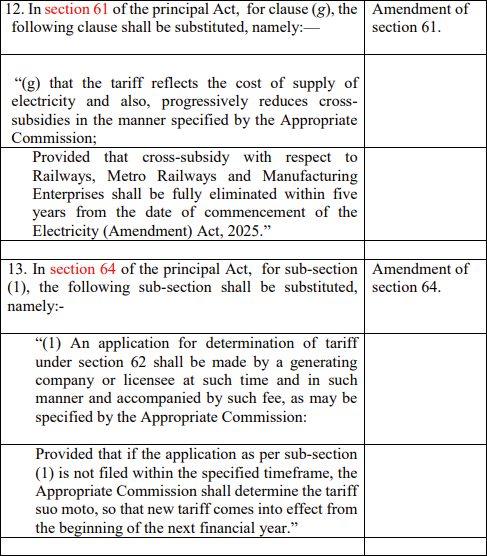
The State Electricity Regulatory Commissions (SERCs) will have the power to determine tariffs suo motu if utilities fail to file petitions. This is to ensure annual revisions from 1st April. The draft states that state governments shall retain flexibility to specific categories, like farmers and low-income households, through payments or a direct mechanism to ensure there is no undue burden on consumers.
Notably, while those opposed to the Electricity Amendment Bill 2025 allege ‘backdoor privatisation’ of the power sector, the Bill contains no mandate for privatising public assets. The framework only enables the entry of private players for the use of existing infrastructure. This, however, is not a free-of-cost arrangement. As mentioned earlier, the private suppliers can use public power supply networks only after paying wheeling charges. Moreover, the proposed legislation encourages the development and maintenance of supply infrastructure without duplication.
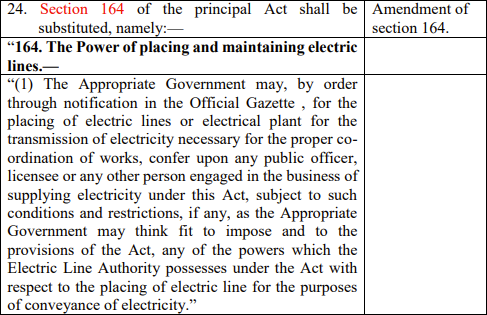
“The Appropriate Government may, by order through notification in the Official Gazette, for the placing of electric lines or electrical plant for the transmission of electricity necessary for the proper coordination of works, confer upon any public officer, licensee or any other person engaged in the business of supplying electricity under this Act, subject to such conditions and restrictions, if any, as the Appropriate Government may think fit to impose and to the provisions of the Act, any of the powers which the Electric Line Authority possesses under the Act with respect to the placing of electric line for the purposes of conveyance of electricity,” the amendment to Section 164 of the Electricity Act 2003 reads.
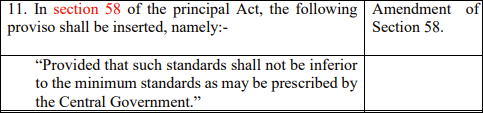
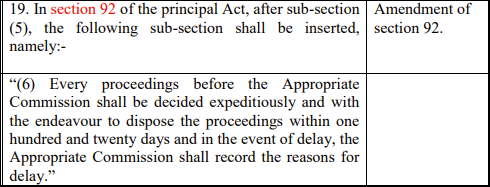
The bill also lays special emphasis on consumer protections through amendments in Sections 43, 58, and 92. It provides for enhancing reliability by requiring minimum performance standards, which would not be inferior to central guidelines, and mandating expeditious proceedings within 120 days by the Commissions.
The proposed legislation ensures that consumers with requirements above 1 MW gain supplier choice, while smaller ones stay protected under designated suppliers.
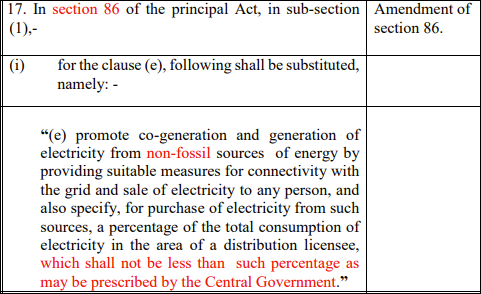
The legislation proposed by the Modi government strengthens obligations for non-fossil energy procurement, with 35-45 paise/kWh penalties for non-compliance. It also promotes power market development, including new instruments and trading platforms.
The amendment to Section 86 of the principal Act, states, “(e) promote co-generation and generation of electricity from non-fossil sources of energy by providing suitable measures for connectivity with the grid and sale of electricity to any person, and also specify, for purchase of electricity from such sources, a percentage of the total consumption of electricity in the area of a distribution licensee, which shall not be less than such percentage as may be prescribed by the Central Government.”
Besides promotion of non-fossil energy, the proposed Electricity Amendment Bill 2025 introduces definitions for energy storage systems and electric line authorities. The Bill bolsters regulatory accountability by allowing Commission members to be held liable for negligence and expands the Appellate Tribunal for Electricity (APTEL) to up to seven members.
In the draft bill, the Central government has given detailed justifications for each proposed amendment.
Why is the All-India Power Engineers Federation opposing the proposed Electricity Amendment Bill?
The All-India Power Engineers Federation, however, has raised strong objections against the proposed Electricity Amendment Bill. The AIPEF dubs the proposed legislation a move towards backdoor privatisation of the power sector.
During a media interaction on Saturday, AIPEF chairperson Shailendra Dubey alleged that despite stakeholders, including power sector employees, engineers, farmers’ organisations, and consumer groups submitting their objections, the Central government seemed to be “pushing the Bill without proper discussion and democratic consultation.”
“When views were invited on the proposed amendments, it was the responsibility of the govt to transparently disclose how those objections were examined and addressed. Ignoring these objections and rushing the legislation undermines the democratic process. If passed, the Bill will open doors to further privatisation in the power sector, which is not in the public interest,” Dubey told the media.
He further claimed that such policies would weaken the public electricity system and adversely affect electricity employees, farmers, and consumers.
The AIPEF argues that allowing private firms to further enter distribution, that too, without building their own infrastructure, would lead to “cherry-picking” of profitable industrial and commercial consumers. The Federation fears that if profitable consumers are cherry-picked by private consumers, the public discoms will be left with nothing but loss-making and agricultural segments, leading to the weakening and eventual collapse of the state utilities.
However, if we go by the justifications and explanatory notes in the draft bill, the amendments do not mandate privatisation; rather, it focusses on avoiding wastage of resources while also offering consumers diverse choices. Since allowing multiple licenses in the same area under the principal Act left a window for unnecessary duplication of distribution networks, resulting in wastage of scarce capital and land resources, the amendment allowing “own or shared networks” would ensure that “network expansion and augmentation are carried out efficiently without duplication.”
Regarding “cherry-picking” of profitable consumers by private firms, the exemption of discoms from Universal Service Obligation (USO) for r >1 MW consumers essentially unlocks massive electricity demand from industries by allowing them access to affordable power, reducing tariff distortions, and backing industrial expansion for job creation and growth. As discussed above, the proposed legislation addresses potential supply gaps by designating a fallback supplier at a “premium over the cost of supply”, preventing discom collapse.
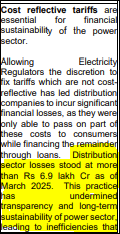
Here, the main issue is not private entry but chronic discom losses that stand at Rs 6.9 lakh crore. Private entry would relieve discoms from procuring costlier power for high-demand users, the government believes.
However, the concern that if private entities are allowed to use public infrastructure for power distribution and earn profits, there is a possibility that the private players deliberately avoid building infrastructure seems valid.
Why would private companies invest millions in poles, wire, substations, and right-of-way (ROW) acquisitions when they can just pay wheeling charges and use public infrastructure and earn wider profits? Why would private players build infrastructure of their own only where strategically necessary and rely heavily on the sharing model elsewhere?
However, since the Universal Service Obligation continues for most consumers, with exemption only for large users> 1 MW, if private players neglect obligations, SERCs would have the power to enforce standards, impose penalties, or revoke licenses.
The Centre needs to offer better explanations and, if required, safeguards; otherwise, this debate over carriage and content separation can lead to wider opposition from stakeholders.
Moving ahead, the AIPEF contends that phasing out cross-subsidies and mandating cost-reflective tariffs would lead to a significant surge in electricity bills, especially for farmers and low-income households.
The government, on the contrary, emphasises protections for vulnerable groups. In alignment with the Supreme Court judgment in the BSES Rajdhani Power Ltd. & Anr. vs. Union of India & Ors. Case, Centre states that mandating cost-reflective tariffs to cover supply costs and prevent losses; however, the explanatory note in the draft explicitly states that the State government will retain the flexibility to support specific consumer groups by providing advance subsidies on their behalf.
The AIPEF also cites the case of Mumbai and Delhi, stating that privatisation of the power sector in these places resulted in no competition or consumer choice. In Delhi, there are no alternatives to TATA Power and BSES even after more than two decades. In Mumbai, multiple licenses and the entry of private players have led to disputes and court cases between TATA and Adani, while consumers suffer.
The Central government contends that the changes proposed in the Electricity Amendment Bill 2025 will boost economic productivity, industrial competitiveness, offer consumers diverse choices, and bolster job growth without eroding public welfare or dismantling public discoms. However, the AIPEF remains adamant that any development in the power sector can be achieved effectively via public utilities, and that reliable and affordable power supply to all consumer categories is “best ensured by state-owned discoms.”
The Modi government presents the Electricity Amendment Bill 2025 as a necessary reform to modernise India’s power sector, introduce regulated competition, phase out cross-subsidies for cost-reflective tariffs, establish the Electricity Council for federal coordination, and improve transparency and accountability. The Union Ministry of Power aims to diversify supply options for consumers, curb inefficiencies in like network duplication, improve the fiscal health of discoms, bolster service quality and reliability, as well as support reliable and affordable power, in alignment with the goals of Viksit Bharat 2047.
However, there is also a strong opposition to these changes, with the All-India Power Engineers Federation (AIPEF) framing them as large-scale backdoor privatisation intended to undermine public sector dominance. Those opposed to the Electricity Amendment Bill 2025 essentially favour preserving the existing model of state-owned discoms holding often a monopoly-like responsibility for universal supply, citing social welfare to prioritise monopoly against market-driven competition. It, however, remains to be seen if and to what extent the Centre government accommodates the demands and concerns of AIPEF and others opposed to the bill.