Home Blog Page 995

Three applicants granted Indian citizenship under CAA in Madhya Pradesh, 2 from Pakistan and 1 from Bangladesh given certificates

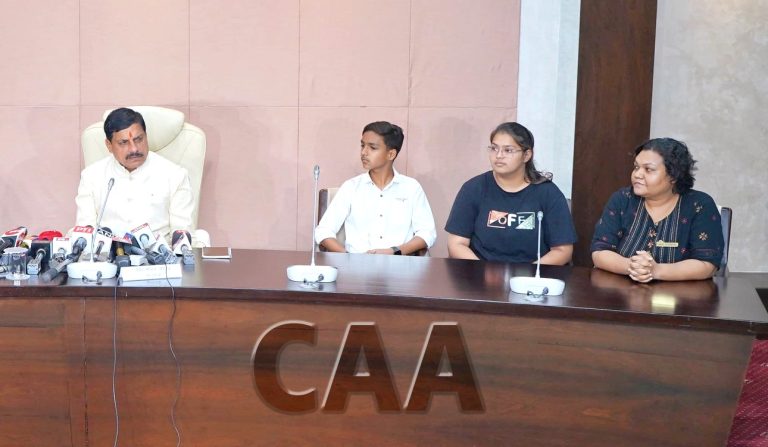
Madhya Pradesh government on Thursday granted Indian citizenship certificates to the first three applicants under Citizenship (Amendment) Act (CAA) 2019 in the state.

Chief Minister Mohan Yadav physically handed over the Citizenship certificates to two Pakistani applicants Sameer Melwani (12) and Sanjana Melwani (18) and one Bangladeshi applicant Rakhi Das at Mantralaya in the state capital Bhopal.

CM Yadav welcomed the migrants to the state and also said that they would welcome other people coming to the state as well.

“I welcome them to Madhya Pradesh. We will welcome all the others also coming here. Today we are happy that two of the youths are becoming our citizens and one of the family from Bangladesh is becoming our citizen. You will get all the help and assessment from the administration and the government,” the CM said.

Rakhi Das, one of the applicants who received citizenship certificates, expressed her happiness on receiving the certificate. She came to Bhopal from Bangladesh eight years ago to study.

“It is a very good thing for me that I got Indian citizenship. From now on, I can take examinations, and can try for a government job here. I came here from Bangladesh to pursue a PhD. I am very very happy now,” Das said.

She also talked about the challenges in Bangladesh saying there was a little problem for Hindu women and they did not get proper freedom to study and to do a job.

“Everything is fine in Bangladesh but there is a little problem for Hindu women. Actually, the freedom that I get here in India to study and for the job, I did not get that freedom in Bangladesh,” she added.

Sanjana Melwani, formerly a Pakistani national, currently residing in Bhopal, expressed gratitude towards Prime Minister Narendra Modi for receiving Indian citizenship.

“I would like to say thank you to PM Modi that I received Indian citizenship through CAA. I am happy and now I can proudly say that I am an Indian,” Sanjana said.

Sanjana’s Father Pradeep Kumar Melwani said, “I received Indian Citizenship in 2012 but children (Sanjana Melwani and Sameer Melwani) did not get the citizenship. Now, my family is complete. Earlier, it used to take a minimum 2-3 years for citizenship. We applied for the citizenship of the children last month in May and now we received the certificate. Now, the procedure has become very easy and it will benefit others as well.”

On March 11, the Government of India notified the rules of the Citizenship Amendment Act (CAA) 2019. Section 6B was added to the Citizenship Act, 1955 to grant citizenship under the CAA 2019.

The CAA, introduced by the Narendra Modi government and passed by Parliament in 2019, aims to confer Indian citizenship to persecuted non-Muslim migrants.

There are three eligibility criteria for granting citizenship under CAA which include the migrant must belong to any one of these communities–Hindu, Sikh, Buddhist, Jain, Parsi or Christian. The migrant must be migrated from Afghanistan, Bangladesh or Pakistan and arrived in India before December 31, 2014.


(This news report is published from a syndicated feed. Except for the headline, the content has not been written or edited by OpIndia staff)

NSUI president and others spread fake news by ABP News claiming CUET UG 2024 answer sheets were kept unlocked in open, NTA clarifies boxes were empty

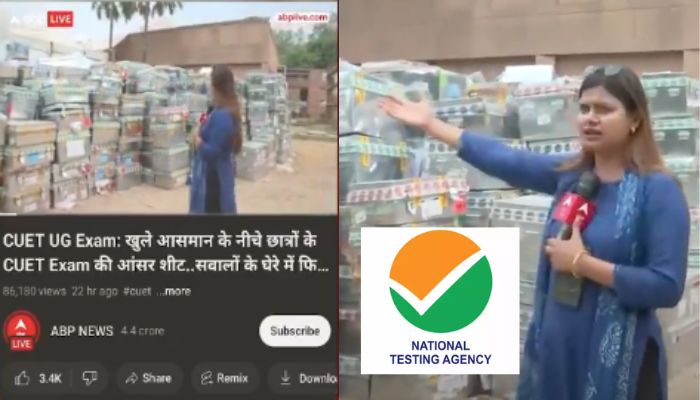
On Thursday (27th June), the National Testing Agency (NTA) refuted the claims that there was careless handling of student answer sheets for the Central University Entrance Test (CUET UG) 2024. The NTA issued a clarification after an ABP News report by its journalist Ajatika Singh claimed that CUET UG 2024 answer sheets were lying unlocked in metal trunks in the open at the NTA office.

The ABP report was amplified by many people on social media, with the allegation of another mishandling of another exam by NTA after the NEET-UG fiasco. However, the NTA has clarified that the allegations are fake, and the unlocked boxes seen in the video didn’t contain any answer sheet or any other document.

Taking to X, NTA said that the empty boxes seen in the viral video did not contain any sensitive papers and that the agency has sufficient security personnel guarding the place where the boxes are kept.

“These are empty boxes kept outside the hall at NTA and do not have any sensitive material inside them. Never did we keep these boxes in open, as being reported by the media. Also, we have sufficient number of security personnel deployed at the place where boxes are kept,” the NTA said.

NTA also posted a video where the metal trunks were opened for the camera, showing that they were empty and didn’t have any answer sheet in it.

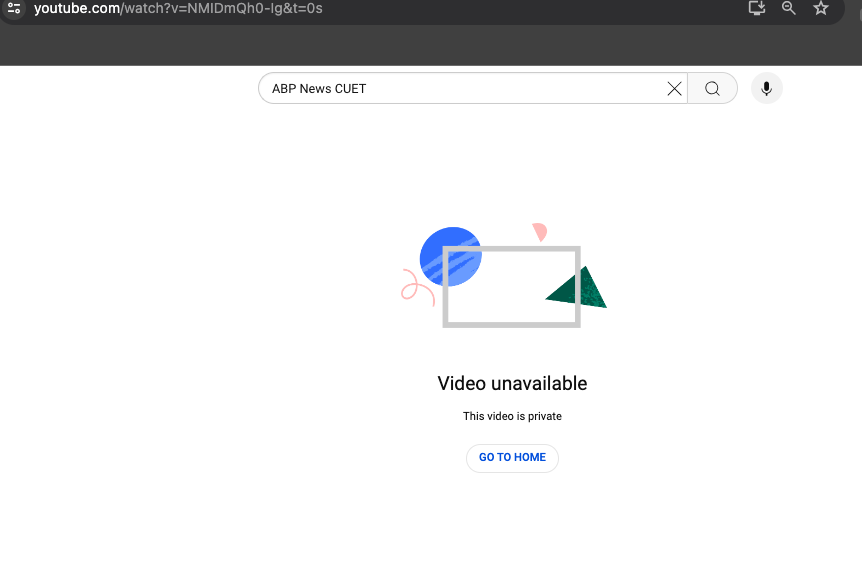
Notably, ABP News has removed its video that went viral on social media. OpIndia checked the link of the said video on YouTube, however, the video is now “unavailable”.

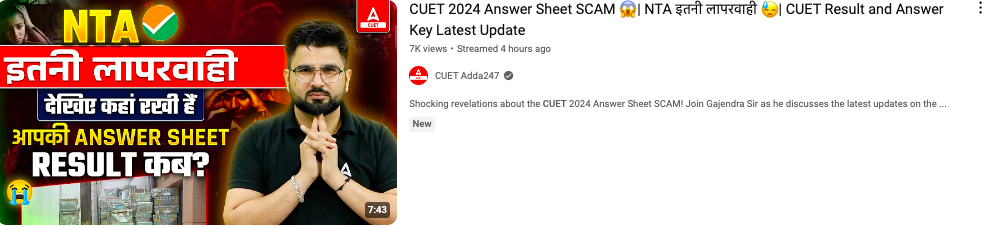
However, it has been widely shared by several educators on YouTube spreading the false claims peddled by the report in question. A YouTube channel “CUET Adda247” made a video based on ABP News’s report to assert that somehow NTA is mishandling the CUET 2024 answer sheets.

CUET Adda247

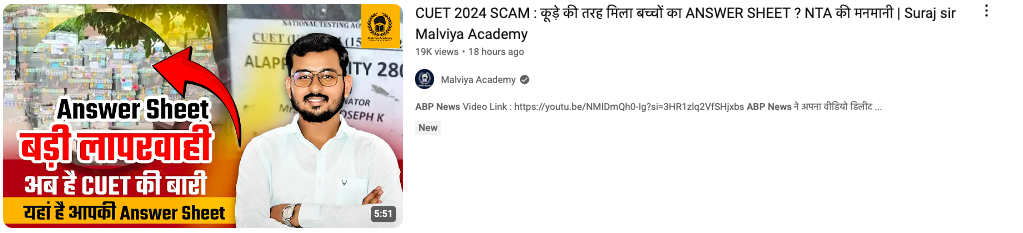
Similarly, another educational channel Malviya Academy also used the ABP News report to claim that the answer sheets of CUET candidates are lying unattended like trash. This video has received over 19 thousand views.

While ABP News’s misleading report caused panic among CUET-UG 2024 candidates, the media publication did not even care to issue an apology, especially at a time when there was already much uproar over the NEET-UG 2024 exam. Its reporter Ajatika Singh, who had filed the report, has also refrained from offering any clarification or apology.

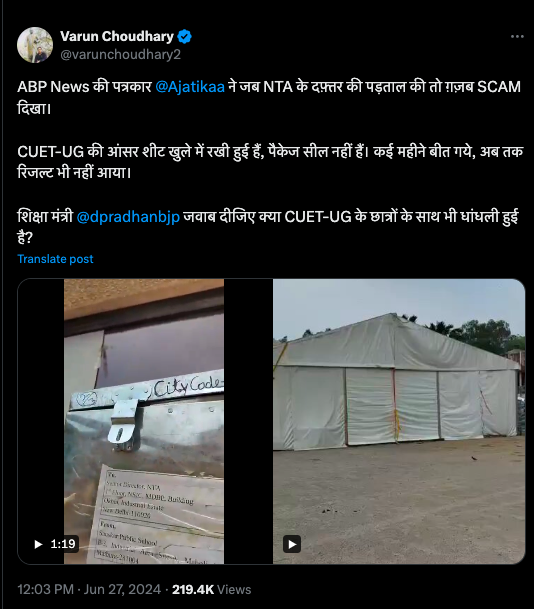
Moreover, the President of the Congress party’s student wing National Students’ Union of India (NSUI), Varun Chaudhary posted the said videos, originally posted by Ajatika, on X to attack the Central government alleging a “scam” without confirming the veracity of the claims made in the video.

“When ABP News journalist @Ajatikaa investigated the NTA office, she saw an amazing scam. CUET-UG answer sheets are lying in the open, the packages are not sealed. Many months have passed, the result has not come yet. Education Minister @dpradhanbjp please answer, has CUET-UG students also been cheated?” Chaudhary posted.

This comes just days after another misleading claim about NTA was made. It was claimed that the testing agency’s website was hacked. However, the NTA clarified later that all its portals and the website are fully secure. Similarly, several netizens recently claimed that NTA is a private organisation and it does not come under the Right to Information Act. The same claim was made by a Congress worker named Harmeet Kaur K on X. However, the claim that it is a private society and does not come under laws such as RTI are completely false.

The Central University Entrance Test for 2024, conducted by the National Testing Agency, was held on multiple dates in May this year, 15, 16, 17, 18, 21, 22, and 24 May 2024. The test took place in hybrid mode in test centres in 379 cities, including 26 cities outside India. Around 13.48 lakh students appeared in the exam.

The results for CUET UG 2024 are expected to be released on 30 June, while the NTA is expected to publish the answer keys anytime.

“Ready for legal battle”: Archana Makwana asks SGPC to withdraw FIR over performing Yoga in Golden Temple, says the FIR is baseless and police were misled

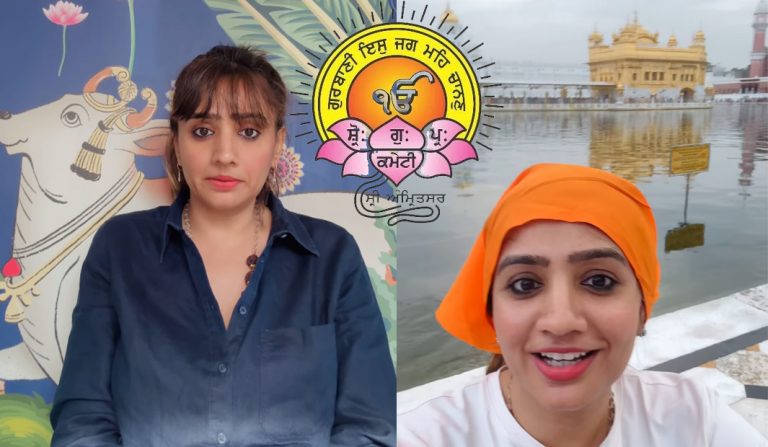
A massive controversy erupted recently after the Shiromani Gurdwara Parbandhak Committee (SGPC) filed an FIR against Instagram influencer and fashion designer Archana Makwana for performing yoga inside the Golden Temple premises. Makwana has been receiving rape and death threats following the incident. Now, Makwana has appealed to the SGPC to withdraw the FIR filed against her. She further said that if SGPC does not withdraw the FIR, she is ready for a legal battle.

Archana Makwana said in an Instagram post on Thursday (27th June) that others who witnessed her practice yoga at the location were not outraged. She further stated that one of the individuals who took her photos was a Sikh. Notably, SGPC has also taken action against three employees for not stopping the woman from performing Yoga on the Prakrama of Sri Darbar Sahib on 21 June, on the occasion of International Yoga Day.

“When I was doing Shirshasana on the 21st of June at Golden Temple Amritsar 1000 Sikh people were watching me not one person stopped me or raised an objection on it. In fact, the gentleman who took my photo was a Sardarji himself he didn’t find it offending, he didn’t stop me from doing it, and the people who were watching it Live weren’t offended then I am wondering how come it’s wrong & how has it hurt someone’s religious sentiments?” Makwana said.

She further emphasised that not everyone visiting the Golden Temple is essentially aware of the rules, in such a case, how the SGPC expects a Hindu girl coming to Punjab for the first time to know the rules, especially when none of the people present at that time stopped her.  

Makwana also asserted that she feels victimised due to the FIR filed by the SGPC against her. In addition, she said that she tried to peacefully sort out the matter, however, the SGPC is not understanding.

“I don’t know what is the propaganda of the SGPC TRUST but I feel victimised. The F.I.R. against me needs to be quashed because The F.I.R. doesn’t have any base, it’s just that because the SGPC COMMITTEE didn’t disclose the true facts to the police they accepted it. I tried to sort this issue Peacefully but they don’t seem to understand it, it’s affecting my business & that I won’t tolerate it at all…” Makwana.

Archana Makwana also urged those supporting her to raise a voice against the SGPC’s action and demand quashing of the FIR against her. “Everyone who agrees with me & wants to support me please raise a voice against them stating that the F.I.R needs to be cancelled by writing to Punjab Police,” the Instagram influencer said.

This came after the Shiromani Gurdwara Parbandhak Committee (SGPC) filed a complaint against Archana Makwana for performing Yoga inside the Sri Darbar Sahib premises, popularly known as Golden Temple, in Amritsar. The step was taken after visuals of the Instagram influencer performing Yoga in Sri Darbar Sahib Prakrama on International Yoga Day on 21st June appeared on social media. Additionally, the SGPC also ordered action against three employees of Prakrama for allegedly not performing their duties diligently. 

As her pictures doing Shirshasana inside the Golden Temple premises went viral online, the Vadodara-based influencer received countless rape and death threats over various social media platforms. Amidst the threats, Makwana was provided protection by Vadodara Police.

New Parliament building, now Sengol: How Opposition politicians have been focusing on needless controversies instead of doing their jobs

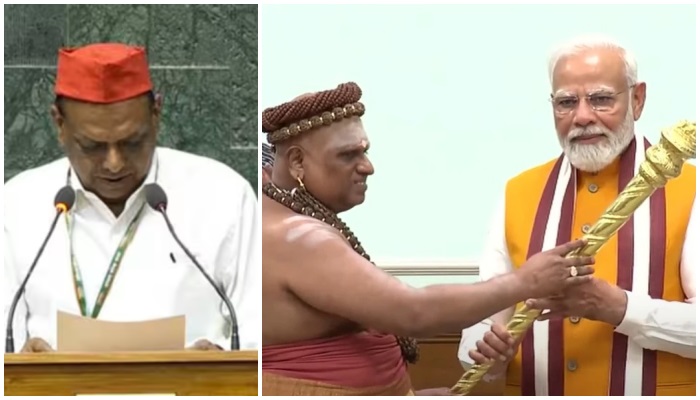
The I.N.D.I. Alliance following ten years in opposition and three unsuccessful efforts to oust Prime Minister Narendra Modi, has reverted to its old strategies of raising frivolous issues to criticize the recently elected administration, instead of making better use of their time. Now, they have picked ‘Sengol‘ which was installed next to the speaker’s chair in Lok Sabha as a symbol of India’s sovereignty to demonstrate their lack of genuine concerns and demanded its removal from the newly constructed Indian parliament.

Samajwadi Party MP RK Chaudhary wrote to pro-tem speaker Bhartruhari Mahtab on 25th June and questioned its presence in the parliament. He stated, “Today, I took oath in this honourable chamber that ‘I will bear true faith and allegiance to the constitution of India as by law established’ but I was shocked to see the ‘Sengol’ on the right side of the chair of the house. The constitution is a sacred document and the symbol of India’s democracy while ‘Sengol’ is a symbol of monarchy.”

Chaudhary added, “In its previous tenure, the BJP government under the leadership of PM Modi installed ‘Sengol’ in parliament. ‘Sengol’ means ‘Raj-Dand.’ It also means ‘Raja ka Danda.’ After ending the princely order, the country became independent. Will the country be run by ‘Raja ka Danda’ or the constitution? Our parliament is a temple of democracy, not a palace of some king or royal. I demand that ‘Sengol’ be removed from parliament and replaced by a large replica of the constitution.”

Samajwadi Party chief Akhilesh Yadav supported his party leader and claimed, “When ‘Sengol’ was installed, the Prime Minister had bowed to it but he forgot to bow while taking oath this time. I think our MP wanted to remind him about it.” Senior Congress leader and MP B Manickam Tagore echoed the same sentiment and voiced, “We have been very clear that the ‘Sengol’ symbolises kingship and the kingdom-era is over. We should celebrate the people’s democracy and the constitution.” Rashtriya Janata Dal MP and Lalu Prasad Yadav’s daughter Misa Bharti also declared, “Whosoever has demanded this, I welcome it.”

RJD Rajya Sabha MP Manoj Jha too joined the chorus and alleged, “We had protested and said that ‘Sengol’ is a symbol of the monarchy when it was being installed in the parliament. Our PM has the conduct of the kings.” He then brought up issues including jewellery, dresses, mangalsutra and mujra among others which were used by the prime minister to expose the opposition during his election campaign. The parliamentarian then added, “Now, only these topics will be discussed in the country. It is better to put a big replica of the constitution there which will run the nation.”

Notably, the Congress, its ideological sister parties and their ecosystem have historically found a profound delight in demeaning India’s cultural and historical symbols in the name of democracy, secularism, and the constitution and ‘Sengol’ was no exception. Interestingly, they never find any other religion or its symbol to be at odds with India’s democracy. 

How Congress reduced ‘Sengol’ to a mere walking stick

Lord Mountbatten asked Pandit Jawahar Lal Nehru, over the appropriate cultural symbol to signify the transfer of power when it was agreed that the British would cede control to the Indians and end their colonial rule. The latter took some time and spoke with C Rajagopalachari about the issue who informed Jawaharlal Nehru about the ‘Sengol’ after reading several books on history. The ‘Sengol’ was then sent to the first prime minister of India by the head of the Thiruvaduthurai Mutt Sri La Sri Ambalavana Desika Swamigal, who agreed to its use as a symbol of power.

The practice was evocative of the ancient customs of the Chola dynasty where it was customary for spiritual leaders known as Samayacharyas to oversee the crowning of kings and sanctify the transfer of power, a symbolic gesture of approval for the ruler. The sceptre received by Pandit Nehru was crafted from silver and plated with gold, on a special order from the Adheenam. This was handcrafted by jeweler Vummidi Bangaru Chetty in Madras and served as a replica of the original ‘Sengol’ however, it was highly revered as it symbolised the glorious tradition of the great Chola empire.

The sacred sceptre, shockingly, was soon forgotten and was housed as “Jawahar Lal Nehru’s golden walking stick” at a Prayagraj museum. The true origins and reasons for a significant artifact being displayed in a museum as a walking stick remained unknown, but it has now been rightfully recognized and honoured in the new Parliament under the Modi government. However, gauging from the actions of the Congress-led opposition in the present, it is evident how a momentous symbol was reduced to a mere footnote in the annals of history during their time as the only centre of authority in the nation.

Opposition and their persistent tendency to inflate non-issues

The opposition, in their eagerness to attack the Bharatiya Janata party-led National Democratic Alliance, has resorted to making absurd accusations instead of focusing on real problems and offering constructive criticism. The opposition even opposed PM Modi’s ambitious Central Vista redevelopment project which involved the redevelopment of Central Vista Avenue, the area between the Rashtrapati Bhavan and the India Gate. The most significant part of the project was the construction of a new parliament building. Rahul Gandhi in all his wisdom had even tweeted, “Central Vista-not essential. Central Government with a vision-essential.” Sitaram Yechury, general secretary of the Communist Party of India (Marxist) also denounced the administration, charging it with “circumventing” the shutdown.

Ironically, it was the vision of the Modi government which addressed the significant issue of the impending expansion of the parliament owing to the increased population which nearly quadrupled since independence. The Delhi High Court and Supreme Court also denied petitions against the project, further embarrassing the opposition. In another display of utter ignorance or perhaps goodwill for India’s British rulers, the opposition even slammed the government for renaming “Rajpath” which meant Kingsway to “Kartavya Path” which translates to the path of duty.

Opposition had issues with the lions in the national emblem installed over the new parliament building

The mockery of Indian voters who elected their representatives to address important matters reached new heights when opposition leaders suggested that the lions in the national emblem which was erected on top of the new parliament building were “fiercer and had sharper teeth” in comparison to the original statue in Sarnath. The politicians and their lackeys charged that the lions looked angry whereas they should be ‘peaceful’ and ‘calm’ and accused the Modi government of changing the national emblem.

They appeared to have overlooked the fact that although lions belong to the feline family, they are not ‘calm and peaceful’. They are fierce predators, endowed by nature with strong fangs, loud roar and a penchant for killing.

How can anyone disregard the Congress-led opposition’s unrelenting push against electronic voting machines (EVMs) while disregarding their own inadequacies? During the NDA parliamentary meeting in New Delhi, PM Modi also made a jab at the opposition and expressed, “When the results were being announced on 4 June, I was engrossed in work. Later, I started receiving phone calls. I asked someone if the numbers were acceptable and jokingly inquired whether the EVM was still ‘alive.’ I anticipated the opposition might declare the ‘death’ of the EVM this time”

He further remarked, “These people had resolved to undermine public confidence in India’s democracy and electoral process. They continuously criticized the EVMs. I expected they would hold a ‘funeral procession’ for the EVM. However, by the evening of 4 June, they were silenced. The EVMs shut them up.”

The never-ending drama surrounding the Dassault Rafale deal is another testament to the opposition’s thrust for wasting the country’s time and resources, both inside and outside of parliament. Unsurprisingly, the matter culminated in Rahul Gandhi’s unconditional apology to the Supreme Court for attributing his political slogan “Chowkidar Chor Hai” to the court. He shamelessly twisted the judgment to claim that the top court declared Prime Minister Narendra Modi guilty of corrupt practices in the purchase of the Rafale aircraft.

The opposition even adopted the same tactics when the Hindenburg Research Report on Gautam Adami came out. They disrupted the parliament by raising a commotion throughout the session, demanding the creation of a Joint Parliamentary Committee (JPC) on the matter. The opposition coalition, led by Rahul Gandhi, has been leading the assault against the Adani group, primarily based on reports from international media. The Gandhi scion alleges that every penny spent on anything, from power to farming, goes into the billionaire’s account while states ruled by Congress openly invite him to do business with them and offer him contracts worth millions of dollars.

Conclusion

The opposition covered every topic to malign the Modi government and gain brownie points, including the ‘Pegasus snooping’ claim, the contentious BBC documentary on PM Modi and Apple’s threat notification, which also turned out to be a dud. However, they have failed to see the wider picture for which they were appointed to parliament or their primary objective, which is to serve the public interest, in their attempt to engage in small-scale politics to advance narrow political goals or grab media headlines.

Unfortunately, the opposition leaders won’t consider having 237 MPs in the Lok Sabha as a golden opportunity to work for their constituency, rather, they will perceive it as a promotion of their divisive and corrupt politics which will only serve to reinforce their motivation to continue engaging in the same behaviour, as showcased by the Samajwadi Party MP’s recent “remove Sengol” demand.

Google Translate adds 110 new languages including Awadhi, Chhattisgarhi, Marwadi and Pakistani Punjabi using PaLM 2 AI language model

Google is adding support for 110 new languages to Google Translate, the company announced on Thursday. Till now, Google Translate supported 133 languages, so this expansion is the biggest ever, as per the company, and marks a significant jump in the number of supported languages. The company used the help of AI to add new languages for translation services.

The new languages added include Awadhi, Chhattisgarhi and Marwadi from India, and Punjabi (Shahmukhi) from Pakistan.

As per a blog post by Google’s Isaac Caswell, the company used its PaLM 2 AI language model for Google Translate to learn new languages. The company said that the AI model is good at learning new languages which are closely related to other languages. For example, the model learned Awadhi and Marwadi better because of their closeness to Hindi, which is already supported by Google Translate.

Some other major languages added include Afar, Cantonese, Manx, NKo, Tamazight (Amazigh) and Tok Pisin. The blog post said that Cantonese was one of the most requested languages to be added. It said that because Cantonese often overlaps with Mandarin in writing, it’s tricky to find data and train models.

Afar is a tonal language spoken in Djibouti, Eritrea and Ethiopia, and it had the most volunteer community contributions among the languages being added. Manx is the Celtic language of the Isle of Man which almost went extinct with the death of its last native speaker in 1974. But the language is being revived in the island. NKo is a standardized form of the West African Manding languages that unifies many dialects into a common language.

Punjabi (Shahmukhi) is the variety of Punjabi written in Perso-Arabic script (Shahmukhi), and is the most spoken language in Pakistan. Tamazight (Amazigh) language is spoken across North Africa. Tok Pisin is an English-based creole and the lingua franca of Papua New Guinea.

Isaac Caswell said that about a quarter of the new languages come from Africa, representing the company’s largest expansion of African languages to date, including Fon, Kikongo, Luo, Ga, Swati, Venda and Wolof. He wrote, “From Cantonese to Qʼeqchiʼ, these new languages represent more than 614 million speakers, opening up translations for around 8% of the world’s population.”

He told the Verge in an interview that the new languages are spoken by at least one million people, while several are spoken by hundreds of millions of people. He also wrote that some languages are spoken by small communities of Indigenous people, and a few have almost no native speakers but active revitalization efforts. 

The blog post added that there are a lot of things to consider while adding new languages to Google Translate, like what varieties to offer, what specific spellings we use etc. He said, “Languages have an immense amount of variation: regional varieties, dialects, different spelling standards. In fact, many languages have no one standard form, so it’s impossible to pick a “right” variety. Our approach has been to prioritize the most commonly used varieties of each language.”

Currently, Google Translate supports 20 Indian languages. These include Assamese, Bengali, Bhojpuri, Dogri, Gujarati, Hindi, Kannada, Konkani, Maithili, Malayalam, Marathi, Meiteilon (Manipuri), Mizo, Nepali, Odia, Punjabi, Sanskrit, Tamil, Telugu and Urdu. Seven languages including Sanskrit were added in 2022.

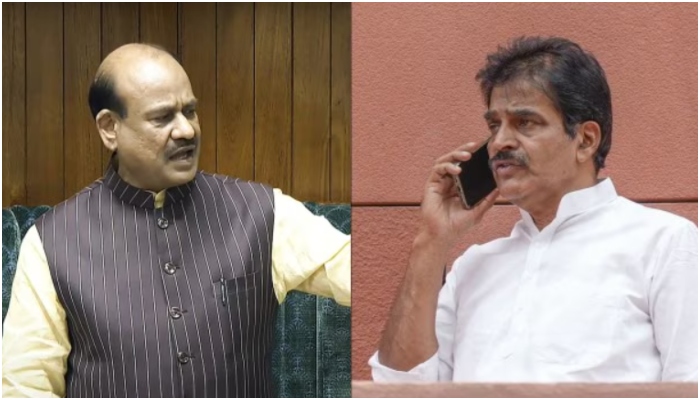
Congress’ KC Venugopal writes to Speaker Om Birla on ‘Emergency’ reference in Lok Sabha, calls it ‘deeply shocking’, ‘unprecedented’

On Thursday (27th June), Congress General Secretary in-charge and MP KC Venugopal wrote to Lok Sabha Speaker Om Birla calling the mention of the Emergency in his acceptance address on Wednesday “deeply shocking” and “unprecedented”.

According to a letter released by the Congress and sent by Venugopal to the Speaker, “Making of such a political reference from the Chair is unprecedented in the annals of history of Parliament.”

“I am writing this in the context of a very grave matter impacting upon the very credibility of the institution of Parliament. Yesterday, that is 26 June 2024, at the time of offering felicitations on your election as Speaker Lok Sabha, there was a general camaraderie in the House as such occasions generate,” he said in the letter.

“However, what followed thereafter, which is a reference from the Chair after your acceptance speech, in regard to the declaration of Emergency half a century ago, is deeply shocking. Making of such a political reference from the Chair is unprecedented in the annals of the history of Parliament. This coming from the Chair as one of the ‘first duties’ from a newly elected Speaker assumes even graver proportions,” he added.

“I, on behalf of the Indian National Congress, express our profound concern and anguish over this travesty of Parliamentary traditions,” he said.

On Wednesday (June 26th), Lok Sabha Speaker Om Birla condemned the ‘dictatorial’ proclamation of Emergency that was announced by the previous Congress government led by then PM Indira Gandhi in 1975. He described it as the black chapter in India’s history. He also asked the House to observe 2 minutes of silence to mourn the ‘murder of democracy’, a day after the country entered the 50th year of Emergency that started in June 1975.  

Addressing the Lok Sabha, Om Birla said, “This house condemns the Emergency that was imposed in 1975 in the strongest terms. We also laud the determination of all those who staunchly opposed the Emergency, struggled, and performed the duty of safeguarding India’s democracy. 25th June 1975 will always be remembered as a black chapter in Indian history. On that day, then PM Indira Gandhi imposed an Emergency in the country and made a major blow to the constitution drafted by Dr BR Ambedkar.”

The Lok Sabha speaker further slammed the erstwhile Congress-led government for imposing dictatorship on India. He also highlighted the excesses which were committed during the Emergency period.

Om Birla asserted, “Our young generation should know about the black phase of democracy. During the dark phase of the Emergency, scores of people lost their lives at the hands of Congress’ dictatorial government. We (the house) will observe 2 minutes of silence in their honor.”  

Notably, the Lok Sabha speaker made these remarks after PM Modi introduced ministers to the LS. 

UP: Dalit woman gang-raped and assaulted by seven men in Lucknow, Anwar arrested while the rest are on the run

0

On June 25th, a Dalit woman was allegedly gang-raped by seven persons in Lucknow. In her complaint, the woman said that the accused grabbed her phone and beat her. The main accused, Anwar, has been arrested while the other six accused are absconding. However, the police are conducting searches to arrest them.

The case is from the Sushant Golf City police station precinct in Lucknow. On Tuesday (25th June), the victim who is a mother of three children filed a report against seven persons, accusing them of gang-raping her. According to the complaint, the 30-year-old victim comes from a low-income household and her husband drives an auto to support the family.

The victim stated that she went to the government hospital in Sushant Golf City to get medicine when seven people who were already there near Khurdahi market abducted the victim. Among all of these, the victim has identified Anwar as the main accused. The accused persons took the victim to a nearby garden and gang-raped her one by one. When the victim protested, she was severely battered by the accused who also stole the victim’s phone. The victim eventually made it to the police station and reported the crime. The police promptly took note of the situation and left for the scene. By then, all of the accused had escaped.

Following the victim’s complaint, the police filed a case against seven people, including 30-year-old Anwar. All of them have been booked under Sections 376 (D) and 506 of the Indian Penal Code, as well as Section 3(2)(V) of the SC/ST Act. Police teams were formed and raids were launched in pursuit of the accused.

On 26th June, the main accused Anwar was apprehended on Sultanpur Road in Lucknow as he attempted to flee. Police are seeking the remand of the accused for interrogation. Meanwhile, efforts are on to arrest the absconding accused persons.

Bull Run: BSE Sensex hits historic high crossing 79,000, NSE Nifty breaks the 24,000 barrier

Today marked a historic day for India’s stock markets as the BSE Sensex surged past the 79,000 mark and the NSE Nifty breached 24,000 for the first time, setting new records in mid-day trading.

The Sensex soared 470.71 points to reach 79,159.89, while the Nifty rose by 164.10 points to stand at 24,032.90.

The day began with a mild setback as the stock market opened flat, initially showing slight declines following a record-high close in the previous trading session.

The Sensex commenced trading 94.13 points lower at 78,580.12, while the Nifty opened at 23,849.55 after a drop of 19.25 points. The early market sentiment was tempered by weaker cues from Asian markets, influencing initial trading patterns.

Throughout the morning session, the market displayed a mixed performance among Nifty-listed companies, with 21 stocks witnessing gains and 29 experiencing declines.

Investors closely monitored sectors ranging from banking and finance to technology and healthcare, contributing to the overall market dynamics.

The surge past significant milestones by both the Sensex and Nifty reflects strong investor confidence amidst favorable domestic economic indicators and global market stability.

Analysts attribute today’s record-breaking performance to renewed optimism over corporate earnings, sustained foreign institutional investments (FIIs), and positive cues from global indices.

Market experts suggest that the ongoing bullish trend underscores India’s resilience in the face of global economic uncertainties, positioning the country as a robust investment destination. As trading progresses, market participants continue to monitor sector-specific developments and policy announcements for further insights into future market trends.

The record-breaking levels achieved by the Sensex and Nifty today mark a significant milestone in India’s financial markets, highlighting their role as key drivers of economic growth and investor sentiment.


(This news report is published from a syndicated feed. Except for the headline, the content has not been written or edited by OpIndia staff)

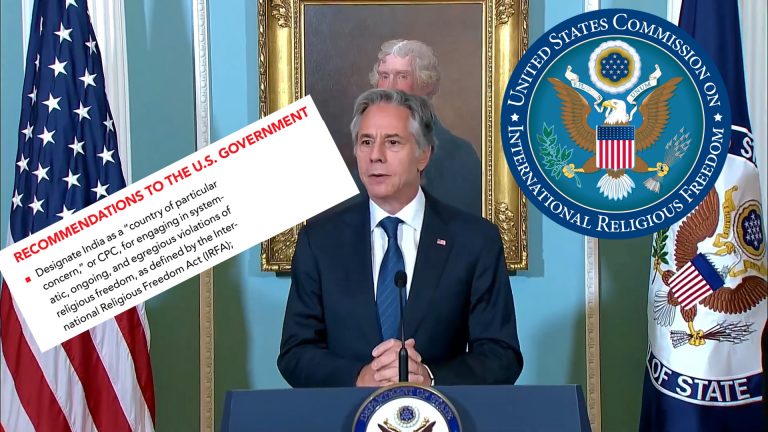
USCIRF publishes another report claiming increase in hate speech in India during Modi govt, Secretary of State Antony Blinken uses it to target India

0

The United States Commission on International Religious Freedom (USCIRF), an organisation India has strongly criticised in the past, has again raised ‘concerns’ over religious freedoms, citing the alleged rise in ‘hate speech’, demolitions and anti-conversion laws.

The report annually surveys religious freedoms around the world and aims to provide a “fact-based, comprehensive view of the state of religious freedom” in nearly 200 countries and territories.

The findings come a few weeks after Prime Minister Narendra Modi began his third term in office and India and the United States agreed to strengthen cooperation in high technology areas during a visit by White House national security adviser Jake Sullivan to New Delhi.

“In India, we see a concerning increase in anti-conversion laws, hate speech, demolitions of homes and places of worship for members of minority faith communities,” US Secretary of State Anthony Blinken told reporters at an event in Washington on Monday.

The US ambassador-at-large for international religious freedom, Rashad Hussain also expressed concerns about the situation in India.

“In India, Christian communities reported that local police aided mobs that disrupted worship services over accusations of conversion activities, or stood by while mobs attacked them and then arrested the victims on conversion charges,” he said.

Earlier in May, India rejected a similar report of the US Commission on International Religious Freedom that accused the ruling Bharatiya Janata Party (BJP) of “reinforcing discriminatory nationalist policies” and termed the organisation “biased” with “political agenda.”

“The US Commission on International Religious Freedom (USCIRF) is known as a biased organization with a political agenda. They continue to publish their propaganda on India masquerading as part of an annual report,” MEA official spokesperson Randhir Jaiswal said at a press briefing.

“We really have no expectation that USCIRF will even seek to understand India’s diverse, pluralistic and democratic ethos. Their efforts to interfere in the largest electoral exercise of the world will never succeed,” he added.

The USCIRF had then alleged that the Indian government “failed to address” communal violence disproportionately affecting Muslims, Christians, Sikhs, Dalits, Jews, and Adivasis (indigenous peoples) in 2023.

Among its key findings, the report calls out several countries including India, China, Russia, and Iran for violations of explicitly targeting members from certain faith communities.

A detailed section of the report also mentioned the alleged “targeted attacks against religious minorities in India.” The report expresses several concerns over India’s religious freedom. It claims religious conversion is “legally prohibited” in multiple states, religious minorities are “attacked on a regular basis”, and alleges that Muslims face systemic discrimination.

US Secretary of State Antony Blinken also noted that in the United States, hate crimes against both Muslims and Jews “have gone up dramatically.”

The US also raised concerns about Pakistan, where Blinken condemned blasphemy laws that “help foster a climate of intolerance and hatred that can lead to vigilantism and mob violence.”

Secretary Blinken also mentioned the imprisonment and exile of Muslim Uyghurs in China, as well as the repression of Tibetan Buddhists, Christians and Falun Gong practitioners.

(This news report is published from a syndicated feed. Except for the headline, the content has not been written or edited by OpIndia staff)

Nepal: 4% Muslim population renames village as Islam Nagar, assaults local Hindus, converts Brahma Sthan into Madrasa Chowk

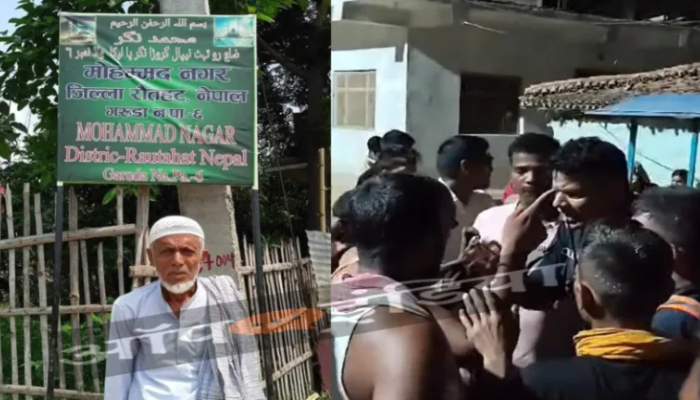
There have been reports of communal strife in Nepal’s Rautahat district where Muslims named a village Islam Nagar and erected a board with it. Hindus protested when they learned about the development and removed the sign on 23rd June after which Muslims assaulted some youths of the Hindu community. The police arrived at the location upon receiving the information.

The matter pertains to Rautahat district’s Garuda Municipality Ward No. 6. A week ago Muslims put up a board with Islam Nagar at a crossroads in the Pothiyahi village. It was painted in green colour and featured Arabic and Urdu words along with pictures of Islamic places of worship on both sides of the board. An elderly Muslim man took a selfie with it which went viral on social media. The local Mulsim community also started referring to the region as Islam Nagar. The authorities reached the spot, however, took no action against the accused and Hindus charged the administration with Muslim appeasement.

Muslim community dominates despite making up only 4% of the population

OpIndia spoke to Rajesh Yadav, the national president of Nepal’s “Hindu Samrat Sena” organization who revealed that there are only ten Muslim houses in Pothiyahi village which is just 4% of the total population there. However, they conspired to change the name of the hamlet. On 23rd June members of “Hindu Samrat Sena” along with local residents uprooted the board. He mentioned that Muslims didn’t react at the time but were secretly planning to unleash violence later. On the night of 25th June, three young Hindu men were passing through the intersection when around a dozen Muslims surrounded them. The former were accused of taking down the board. Afterwards, they were first abused and then thrashed brutally.

The victims were seriously wounded in the attack and have been hospitalised for treatment. The Muslim mob was led by Chand Diwan, Rafiq, Sirajul and Manzoor among others. The incident infuriated the Hindus in the vicinity as soon as they found out about it. They came together and opposed the occurrence. Meanwhile, officials also showed up at the scene after they learned about the unrest.

Police shielded the assailants

According to the Hindu community, the police did nothing to stop the Muslim attacker and instead provided protection to the Muslim families. Hindus added that framing the instance as a mutual argument is a ploy by the country’s government to hide the truth. The police claimed that there was no communal angle in the matter. Hindu groups, nevertheless, have dismissed it as an effort to conceal the issue. The cops have reportedly been working under pressure from the Communist Party of Nepal (Unified Marxist–Leninist). Local Hindus have blamed Prime Minister Prachanda’s (Pushpa Kamal Dahal) government and the Left party for pandering to Muslims. The area has been gripped with tension since the incident.

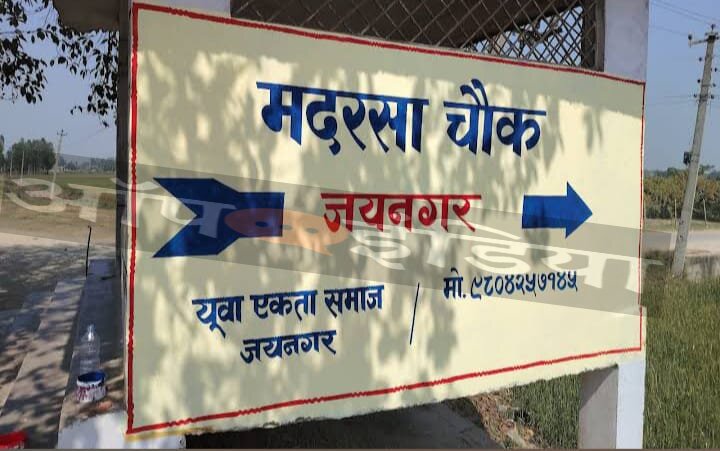
Brahma Sthan has been named Madrasa Chowk

Brahma Sthan has become Madrasa Chowk. (Source: OpIndia Hindi)

According to Rajesh Yadav on 27th June, he and his outfit together with a few other organizations would present a memorandum to the government. He declared that action against the Muslims who attacked Hindus on 25th June would be demanded in the memorandum which would also oppose the attempt to rename the village as Islam Nagar.

Furthermore, he unveiled that Muslims in the Rautahat district’s Jayanagar region of Garuda Nagar Palika had devised a similar scheme three months prior when Kadam Chowk (Brahma Sthan) was dubbed as Madrasa Chowk by some Muslims. A board was installed and stands there to this day. The chairman of the ward is a Muslim named Sheikh Wahab.