

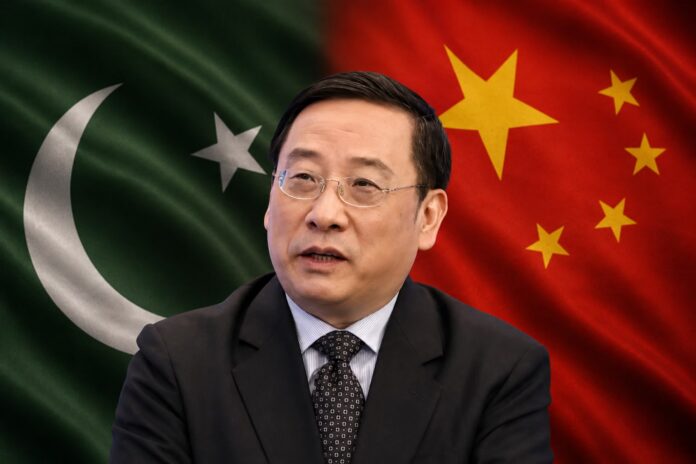
Amid Pakistan’s attempts to internationalise the debate over the suspension of the Indus Waters Treaty (IWT), a Chinese commentator has issued what many view as a veiled warning to India, invoking Beijing’s upstream advantage over the Himalayan river systems.
Speaking at a seminar in Islamabad, Victor Gao, Vice President of the Beijing-based Center for China and Globalization, suggested that if India chooses to “weaponise” water against Pakistan, China too has the capacity to influence river flows originating from Tibet.
🚨 Chinese Commentator Warns of Possible Water Leverage Against India Amid Indus Treaty Debate
— Resonant News🌍 (@Resonant_News) July 1, 2026
Chinese commentator Victor Gao said that China, rather than India, is the upstream country on parts of the broader Indus river system and suggested that if India blocks Pakistan's… https://t.co/JKva7k5DTr pic.twitter.com/kBm7f206xC
‘India Is Not the Ultimate Upstream State’
Addressing the gathering, Gao reminded India that the Indus river system ultimately originates in the Tibetan plateau, placing China at the source of several major rivers that flow into South Asia.
Quoting the ancient Chinese philosopher Confucius, he remarked, “Don’t do unto others what you don’t want others do unto you,” arguing that India should not consider using water as a geopolitical tool.
He claimed that intentionally denying water to millions of people during peacetime would amount to a “crime against humanity”, while doing so in wartime could be viewed as a “war crime”.
Gao added that China and Pakistan, as close partners, could work together to ensure the provisions of the Indus Waters Treaty are upheld.
Proposal for a Trilateral Water Arrangement
Expanding on the issue, Gao floated the idea of transforming the bilateral Indus Waters Treaty into a trilateral mechanism involving China, India and Pakistan. According to him, such an arrangement could ensure uninterrupted river flows and improve regional water governance.
He also argued that because rivers originating from the Qinghai-Tibetan Plateau sustain nearly 18 countries, there is a need for a broader United Nations-backed framework to establish common rules, standards and a code of conduct for managing shared water resources across South Asia, Central Asia and Southeast Asia.
China’s Own Record Raises Questions
While Gao advocated international norms for transboundary rivers, Beijing’s own conduct has frequently attracted criticism. China has consistently avoided entering into comprehensive water-sharing treaties with downstream countries despite controlling the headwaters of several major Asian rivers.
The Mekong River is a notable example. China has built 11 large dams on its upper reaches, giving it significant control over downstream flows. Researchers have argued that these projects have altered the river’s natural hydrology, affecting agriculture, fisheries and livelihoods in countries including Myanmar, Laos, Thailand, Cambodia and Vietnam.
Beijing has also faced criticism for selectively adhering to international law. It rejected the Permanent Court of Arbitration’s 2016 ruling on the South China Sea and continues to press its expansive “Nine-Dash Line” claims despite international objections.
A Strategic Signal to India?
Gao’s remarks underscore the growing strategic coordination between Beijing and Islamabad on issues involving India. At a time when Pakistan has repeatedly sought international backing over the Indus Waters Treaty, the Chinese commentator’s intervention appears intended to remind New Delhi that China, as the upstream power on several Himalayan rivers, also possesses considerable geographical leverage.
The comments are likely to be viewed as part of a broader strategic messaging campaign, with Beijing signalling that any attempt to use water as a geopolitical instrument could invite countervailing pressure from China’s own position at the source of key transboundary rivers.
