

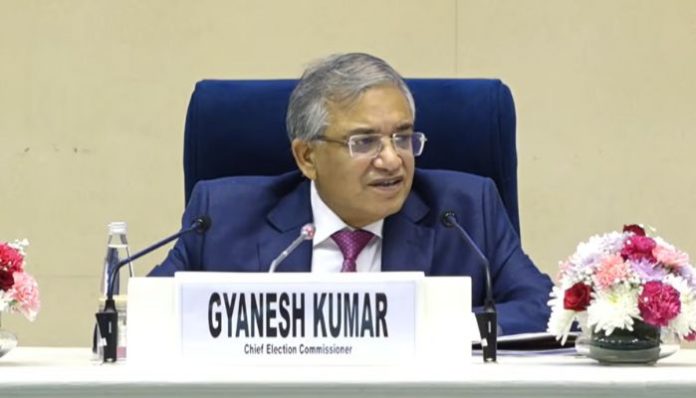
On 27th October, the Election Commission of India announced Phase 2 of the Special Intensive Revision, a comprehensive drive to update electoral rolls. The second phase will include 12 States and Union Territories that are Andaman & Nicobar Islands, Chhattisgarh, Goa, Gujarat, Kerala, Lakshadweep, Madhya Pradesh, Puducherry, Rajasthan, Tamil Nadu, Uttar Pradesh, and West Bengal. Phase 1 of the SIR was conducted in Bihar, keeping the Assembly Elections 2025 in mind, which are scheduled for November this year.
Over 51 crore electors to be covered
According to the ECI, around 51 crore electors (50,99,46,000) are covered under Phase 2 of the SIR. A total of 5,33,093 polling stations and BLOs, 7,64,419 political party BLAs, 10,448 EROs and AEROs, and 321 DEOs will oversee the process. Each polling station will have around 1,000 electors and one Booth Level Officer (BLO) in charge.
#SIR 12 States & UTs#ECI #SIRPhase2 pic.twitter.com/JA2CnyWulz
— Election Commission of India (@ECISVEEP) October 27, 2025
Functionaries and process
There are several key officials included in the process that are Electoral Registration Officers (EROs), Assistant Electoral Registration Officers (AEROs), District Magistrates (DMs), Chief Electoral Officers (CEOs), and BLOs. EROs, typically at the SDM level, prepare draft rolls, decide on claims and objections, and publish the final rolls, while AEROs assist them at the tehsil level. DMs will hear the first appeals against ERO decisions, and CEOs will handle the second appeals.
Key Processes of #SIR#ECI pic.twitter.com/47OgdJWhXa
— Election Commission of India (@ECISVEEP) October 27, 2025
EROs and AEROs will print unique Enumeration Forms (EFs) for each elector as of 27th October 2025. BLOs will distribute these, help electors link details with the previous SIR, and submit them after verification. BLOs will make at least three visits to each household, collect new applications, and identify duplicate or ineligible entries.
Key Functionaries of #SIR#ECI pic.twitter.com/kRUQPkds6p
— Election Commission of India (@ECISVEEP) October 27, 2025
Phased schedule and key dates
The Printing and Training phase will take place from 28th October to 3rd November 2025, followed by House-to-House Enumeration from 4th November to 4th December. The Draft Electoral Rolls will be published on 9th December, with claims and objections accepted until 8th January 2026. Hearings and verifications will run till 31st January, and the Final Electoral Rolls will be published on 7th February 2026.
#SIRPhase2 Schedule #ECI #SIR pic.twitter.com/dkm1VHoVgj
— Election Commission of India (@ECISVEEP) October 27, 2025
Documents required
According to the Election Commission of India, the list of acceptable documents includes government-issued identity cards, birth certificates, passports, educational certificates, permanent residence and caste certificates, and land allotment documents. Aadhaar-related directions as per the ECI’s letter dated 9th September 2025 will also apply, which means while Aadhaar cannot be considered as proof of citizenship, it can be given as proof of identity.
List of Indicative (not Exhaustive) Documents #SIR #ECI pic.twitter.com/Pjyp85XVxr
— Election Commission of India (@ECISVEEP) October 27, 2025
Why the revision was needed
The ECI has launched the revision as electoral rolls are legally required to be updated before every election or as per necessity. The last SIR was conducted over 21 years ago, between 2002 and 2004. Since then, demographic shifts, frequent migration, non-removal of deceased voters, and wrongful inclusion of foreigners have created inaccuracies. The Commission said this revision aims to ensure clean, error-free, and credible voter lists.
The aim of the SIR is to build a transparent, inclusive, and accurate voter database ahead of upcoming elections in different states. It will ensure that no eligible citizen is left out, and no ineligible name remains on the rolls.
