

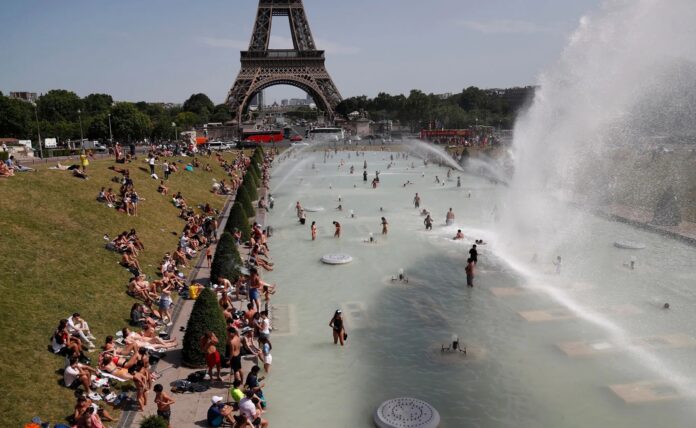
France has recorded around 1,000 additional or excess deaths since June 24 due to the ongoing record-breaking heatwave, according to preliminary figures released by Public Health France (Santé Publique France). The agency described the numbers as unconsolidated and likely an underestimate, with 85 per cent of the fatalities involving people aged 65 and above.
“Since June 24, approximately 1,000 additional deaths (unconsolidated figures) have been observed compared to the deaths recorded in previous months,” Public Health France said in a statement on Sunday.
The sharp rise has been most pronounced in regions that remained under red heat alerts for much of the week, including Île-de-France which includes Paris, Nouvelle-Aquitaine, Brittany, Centre-Val de Loire, Normandy and Pays de la Loire. Many deaths occurred at home, underscoring the risks faced by isolated or elderly residents in urban areas.
Earlier in the heatwave, authorities had reported dozens of deaths, including at least 40–55 drownings as people, especially youngsters, jumped into rivers, canals and lakes to cool off. There were also tragic cases of children dying in hot cars and elderly persons succumbing to heat-related complications. However, now the govt has said that there have been approximately 1,000 ‘excess’ deaths since 24th June compared to previous months.
Emergency services in Paris and other cities reported a massive surge in calls, with cardiac arrests and heat-related admissions far above normal levels.
The heatwave, driven by a powerful “heat dome” from North Africa, saw France record its hottest-ever June day on June 24, with the national average temperature hitting 30°C. Parts of the country crossed 40°C, shattering previous records. Hospitals and first responders came under severe strain, with some events cancelled and public alcohol bans imposed in Paris over the weekend to ease pressure on emergency services.
The heat has now eased slightly in western Europe with thunderstorms, but the focus has shifted eastward, with new temperature records in Germany, Denmark, the Czech Republic and other countries.
One major factor amplifying the human cost in France is the very low penetration of air-conditioning in homes. Only about 25 per cent of French households have AC units, significantly lower than in Spain or Italy, around 50 per cent or the United States and Japan around 90 per cent.
Several reasons explain this limited adoption. France has traditionally enjoyed milder summers, so there was little perceived need for mechanical cooling until recent years. Air-conditioning has long been viewed as a luxury or an unnecessary extravagance rather than a basic necessity. Many French people and policymakers worry that widespread AC use would increase electricity demand, raise greenhouse gas emissions mainly from refrigerants and worsen the urban heat island effect.
Energy prices in Europe are relatively high, and retrofitting older buildings, especially historic apartments in cities like Paris, is expensive and technically challenging. Strict rules on modifying heritage buildings have slowed uptake. Successive governments have emphasised passive cooling measures such as better insulation, cool roofs, urban greening, night ventilation and public cooling centres over mass AC rollout.
During this heatwave, sales of portable AC units and fans have surged dramatically as people scramble for relief, especially for children and vulnerable family members. There is now an active political debate, with some leaders calling for faster installation of AC in schools, hospitals and old-age homes, while others caution against over-reliance on energy-intensive solutions.
Health experts note that the current figures are still preliminary. Full consolidated data from Santé Publique France will provide a clearer picture in the coming weeks. With climate change making extreme heat events more frequent and intense, France, like much of Europe, is being forced to rethink its long-standing approach to cooling.
The heatwave has served as a stark reminder that even in developed nations with strong healthcare systems, a combination of extreme weather and limited cooling infrastructure can prove deadly, particularly for the most vulnerable.
