

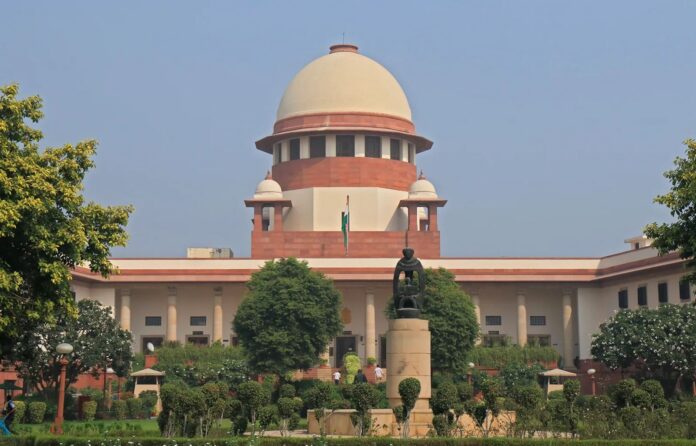
The Supreme Court on Friday asked the Union Government to consider allowing US-based Khalid Jahangir Qazi, whose Overseas Citizen of India (OCI) status was cancelled and who was blacklisted over anti-India activities, to enter the country subject to certain restrictions.
A bench comprising Justices Joymalya Bagchi and V Mohana was hearing Qazi’s plea seeking permission to visit India to meet his family. The judges suggested that he could be allowed to travel to a specific town where his sisters live, with appropriate conditions imposed on his movement.
Justice Bagchi emphasised that the matter required a humane consideration, particularly given Qazi’s advanced age, which was stated to be over 80 years. The judge also clarified that any interim arrangement permitting his entry would not prejudge the legal dispute or give either side any advantage in the pending proceedings.
The bench questioned the Centre’s opposition to Qazi’s entry, pointing out that a Single Judge of the Delhi High Court had previously set aside the orders cancelling his OCI registration and blacklisting him. Since that decision had not been stayed, Justice Bagchi asked the government, “How can we stop him from coming?”
Appearing for the Union Government, Additional Solicitor General SV Raju strongly opposed the request. He described Qazi as a “rank separatist” and contended that he had links with Pakistan’s ISI. The ASG argued that Qazi’s stated intention of visiting India to meet relatives was merely a pretext and that he could engage in activities prejudicial to India’s interests.
The government also pointed out that Qazi had initially sought permission to attend family wedding celebrations, which had since concluded.
Justice Bagchi, however, suggested that the government could address its security concerns by restricting Qazi’s visit to a particular town and requiring him to report to designated authorities. The judge observed that Qazi could be prevented from travelling elsewhere and made subject to whatever reporting conditions the government considered necessary.
When the ASG remarked that Qazi was reportedly over 90 years old and questioned why he would undertake the journey, Justice Bagchi reiterated that the Court understood the government’s concerns but believed a compassionate approach was warranted.
The Centre sought time to obtain instructions on whether Qazi could be permitted to enter India under such conditions. The Supreme Court consequently adjourned the matter by a week.
Delhi High Court had earlier set aside OCI cancellation and blacklisting
Qazi had approached the Delhi High Court challenging the cancellation of his OCI card and the blacklisting order issued by the Union Government. The action against him was based on charges that he was involved in pro-Pakistan propaganda and activities considered prejudicial to India’s sovereignty and security.
In November 2024, a Single Judge of the Delhi High Court set aside both orders, citing procedural deficiencies in the action taken against Qazi. The Union Government subsequently challenged the decision before a Division Bench, and the appeals remain pending.
The Division Bench had earlier refused to grant Qazi interim permission to enter India, including for attending family wedding celebrations, observing that the questions surrounding his entitlement to enter the country required adjudication.
The High Court appeals also raise important legal questions concerning the relationship between the Citizenship Act and the Foreigners Act, including whether safeguards available under one legislation can be applied to proceedings under the other.
The Division Bench observed that the two laws operate in separate spheres and that safeguards under Section 7D of the Citizenship Act cannot automatically be read into proceedings under the Foreigners Act.
It also referred to Section 7 of the Immigration and Foreigners Act, 2025, which is similar to Section 3 of the Foreigners Act and empowers the government to regulate or restrict the entry, departure and presence of foreign nationals in India.
Section 7D of the Citizenship Act empowers the Central Government to cancel the registration of an OCI cardholder, while provisions under the Foreigners Act provide the government with powers to regulate the entry and stay of foreigners in the country.
The Division Bench said the Single Judge’s interpretation of the interplay between the two laws required closer examination in the pending appeals, as the issue could have wider legal implications.
The Supreme Court’s latest intervention, however, is limited to exploring whether Qazi could be permitted to visit his family under a restricted arrangement while the broader legal dispute continues.
