

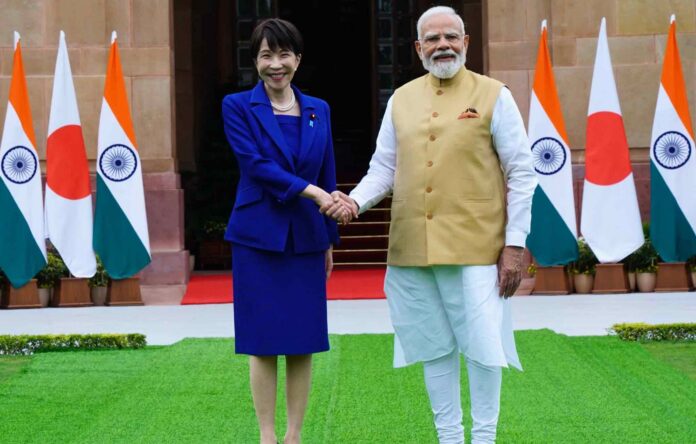
During the official visit of Japanese Prime Minister Sanae Takaichi to India, Prime Minister Narendra Modi held high-level talks with the visiting delegation that yielded 16 significant outcomes, strengthening the strategic partnership between the two nations across economic security, technology, energy, critical minerals, healthcare, mobility and scientific research. These results, reflect a shared vision for resilient supply chains, technological advancement and people-to-people ties as both countries mark 75 years of diplomatic relations.
A key highlight is the India-Japan Joint Declaration on Economic Security, which promotes collaboration in semiconductors, critical minerals, information and communications technology including artificial intelligence, clean energy and pharmaceuticals. It fosters deeper institutional and public-private partnerships while advancing key projects and diversified supply chains. Complementing this is the Joint Statement on Cooperation in the Field of Artificial Intelligence, which supports resilient AI infrastructure across the full stack and facilitates industry-academia collaboration, research and development partnerships, talent mobility and human resource exchanges between the two countries.
List of outcomes (16 in total) : Meeting between PM @narendramodi and PM @takaichi_sanae of Japan on her Official Visit to India ⬇️
— Randhir Jaiswal (@MEAIndia) July 2, 2026
🇮🇳 🇯🇵 pic.twitter.com/jgxHibuxVW
Energy security received focused attention through the Joint Statement on Energy Resilience between India’s Ministry of Petroleum and Natural Gas and Japan’s Ministry of Economy, Trade and Industry. This advances India’s energy security by supporting strategic stockpiling and reserve mechanisms for crude oil and petroleum products while promoting joint investments in maritime energy transport.
Related progress includes a Memorandum of Cooperation in the Field of Batteries, which advances India’s battery manufacturing and electric vehicle ecosystem, promotes trusted and sustainable battery supply chains, and enables Japanese investment and technical collaboration.
A separate Memorandum of Cooperation on Next-Generation Mobility Partnership further supports cleaner, safer and technology-driven infrastructure across rail, roads, urban transport, ports, aviation and logistics. It promotes technical training, human resource exchanges and capacity building while positioning India as a manufacturing and supply-chain hub for exporting mobility solutions globally under the spirit of “Make in India for the World.”
Cooperation in critical resources and healthcare stands out with the Memorandum of Cooperation in Pharmaceuticals and Medical Devices Sectors, which strengthens research and development, capacity building, business-to-business linkages and joint ventures while enhancing resilience in pharmaceutical supply chains including active pharmaceutical ingredients and key starting materials.
In the minerals domain, the Memorandum of Cooperation in the Field of Geology and Mineral Exploration advances work in geology, mineral exploration and critical minerals, promotes technical cooperation in upstream exploration capacity and supports India’s long-term resource security in strategic minerals.
Clean energy and rural development feature through the Memorandum of Cooperation on the India-Japan Cooperative Biogas for Growth Initiative. This supports cooperative-led biogas development, promotes organic fertiliser production and use, backs carbon-credit generation along with research and demonstration projects, and helps states pilot scalable clean-energy and rural-development models.
The 75th anniversary of diplomatic relations is being celebrated with 2027 declared as the “India-Japan Year of Shared Horizons.” This initiative brings together the peoples of both nations to commemorate the milestone and engages youth, businesses, scholars, sports persons and others across different walks of life in meaningful exchanges.
Several memoranda of understanding and exchanges were announced to advance research, technology and regulatory cooperation. These include an MoU between IIT Bombay, BharatGen Technology Foundation and Japan’s National Institute of Informatics to strengthen India’s large language model and AI research ecosystem, support scientific-reasoning capabilities and enable researcher and student exchanges. Another MoU links the IndiaAI Mission with Japan’s Ministry of Economy, Trade and Industry to build linkages between the AI ecosystems, support Indian startups through matchmaking and possible compute access, and facilitate skills development and internships. Private-sector AI collaboration is boosted by an MoU between SarvamAI and Preferred Networks on large language model development, opening avenues for joint innovation and market opportunities.
Life sciences and biotechnology sector is set to gain from an MoU between Japan’s RIKEN and India’s Centre for Cellular and Molecular Platforms for academic and research cooperation in life sciences, deep-tech and biotechnology, supporting joint research and startup-oriented innovation in healthcare, agriculture and environment-related areas. A parallel MoU between RIKEN and the National Centre for Biological Sciences–Tata Institute of Fundamental Research deepens collaboration in biological sciences including regenerative biology, biophysics and neuroscience while enabling researcher, staff and doctoral-student exchanges and strengthening institutional links.
Regulatory and digital infrastructure cooperation includes an exchange of letters between India’s International Financial Services Centres Authority and Japan’s Financial Services Agency to strengthen ties in fintech and regtech, support India’s international financial services ecosystem and facilitate best practices in financial technology and market regulation. Additionally, an MoU between the National Internet Exchange of India and Japan Network Information Center strengthens cooperation in internet infrastructure and governance, supports IPv6 adoption and secure practices in India, and enables capacity building in internet registry operations.
These 16 outcomes collectively chart a forward-looking roadmap that enhances India’s technological edge, supply-chain resilience and strategic autonomy while deepening trusted collaboration with Japan. They align with India’s goals of self-reliance in frontier technologies and position the bilateral relationship as a cornerstone of stability and shared progress in the Indo-Pacific and beyond. The comprehensive nature of the agreements underscores the maturing strategic partnership between the two democracies.
