

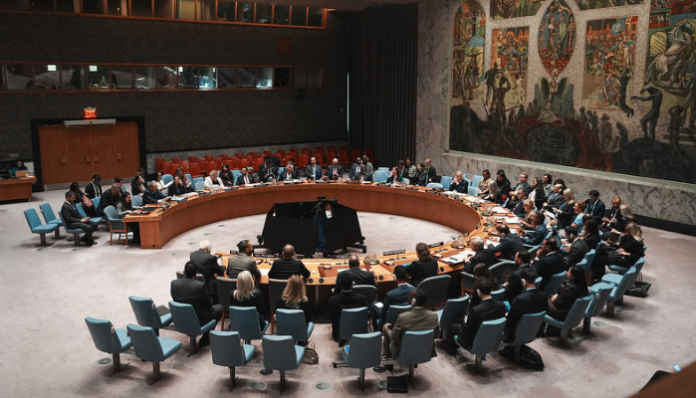
India has said on Monday (26th October) that any reform to the UN Security Council (UNSC) that creates a new category of permanent members without veto powers would relegate them to “second-class” status, leaving the existing five permanent members (P5) in complete control of the Council’s decision-making process.
Addressing a plenary of the Intergovernmental Negotiations (IGN) on the “Cluster Debate on the Question of the Veto” at the UN General Assembly, India’s Permanent Representative to the UN, Ambassador P. Harish, said the veto must be held by all permanent members of a reformed Council as long as the provision remains in place.
“India’s position on the veto is principled and well known. We reiterate that as long as the veto exists, it must be held by all permanent members of a reformed Council,” he said
In a 15-member Security Council, currently, five permanent members have veto power. The nations are China, France, Russia, the United Kingdom and the United States. 10 non-permanent members are elected for two years. India has long argued that this structure, frozen in the geopolitical realities of 1945, is no longer appropriate for the 21st century.
Delivered India’s statement at the UNGA Plenary on the use of the Veto Highlighted: ➡️ Veto is a responsibility, not a tool of narrow political expediency. We note that two of the P5 have not exercised veto for over three and a half decades. Most vetoes or threats of vetoes have emanated from three of the P5. ➡️ Piecemeal reforms will not work. All five clusters of UNSC reform must be addressed together. ➡️ Veto initiative of 2022 was seen as a harbinger of change. However, actual record of large number of vetoes cast since UNGA 76/262 tells a contrary story. ➡️ Unwritten consensus rules enable de facto vetoes in Council decisions and sanctions committees. ➡️ Consensus cannot become a disguised veto in the Inter Governmental Negotiations (IGN). ➡️ India aligns with the Common African Position: As long as the veto exists, all permanent members must enjoy equal rights. ➡️ New long-term seats without veto powers would create second-class members and perpetuate inequity. All permanent members, including new ones, must enjoy equal rights. ➡️ Begin text-based negotiations with clear timelines. The UNSC must reflect today’s realities, not those of 1945.
— Parvathaneni Harish (@AmbHarishP) October 26, 2026
Ambassador Harish argued that creating a separate tier of long-term members without veto powers would not fundamentally alter the existing power structure. “A reform that expands the Security Council by creating another category of long-term members without the veto effectively makes them ‘second-class’ members and would not change the decision-making dynamic of the P5,” he said.
India also opposed the creation of any new category of permanent members, whether with or without veto powers at UNSC, warning that such an arrangement would “entrench the very inequity we are seeking to correct”.
“Periodic elections and the concept of permanency are fundamentally contradictory,” the envoy said as he recalled that the only expansion of the Council in 1965 increased non-permanent seats from six to 10 while retaining the five permanent members.
He said the change had shifted the ratio of permanent to elected members from 5:6 to 5:10. It strengthened the relative position of the P5. The envoy called for a comprehensive approach to Security Council reform, covering membership categories, regional representation, the Council’s size, veto powers and working methods.
Beyond the veto itself, India criticised the use of consensus in the IGN process, saying that it could become a “disguised, de facto veto.” “Seventeen cycles later, we have no outcome to show for it,” Harish said, calling for negotiations based on an actual draft text with clearly defined timelines and milestones.
India has consistently maintained that reform efforts would border on “failure” if they focused solely on increasing the number of non-permanent members. New Delhi has also underscored that it rightly deserves a permanent seat at the horseshoe table.
Separately, India is seeking a non-permanent seat for the 2028–29 term, with elections scheduled for June 2027, when it will contest the sole Asia-Pacific Group seat against Tajikistan.
