India is scripting history with record goods-and-services exports even during times of global uncertainty and economic tumult. In May 2026, Union Minister of Commerce and Industry, Piyush Goyal, announced that India has set a target of achieving exports worth $1 trillion in 2026 and $2 trillion over the next five years.
Numbers indicate that India is heading on a credible path toward s $1 trillion worth of exports in FY 2026-27 with sustained momentum.
What’s the math behind India’s $1 trillion exports dream inching closer to reality
In the financial year 2025-26, India’s total exports, including merchandise and services, surged to a record $863.11 billion, jumping 4.59% from $825.25 billion the previous year.
Merchandise exports were recorded at roughly $441.8 billion, while services reached about $421.3 billion in FY 2025-26.
Reaching $1 trillion from that base necessitates around 15.86% growth. This is the figure the Modi government has set as its target for the current fiscal year, FY 2026-27.
What fuels the optimism that India will achieve the ambitious $1 trillion exports target is the performance in the first half. Indian exports in the first half of the ongoing financial year are close to the required pace.
April-September 2026-27, which is the first half or H1 of the current financial year, witnessed total exports of $476.20 billion, marking a 13.84% year-on-year (YoY) surge from $418.31 billion in the same period of the prior year. This brings the number very close to the 14% figure and already over half of the full-year $863 billion record.
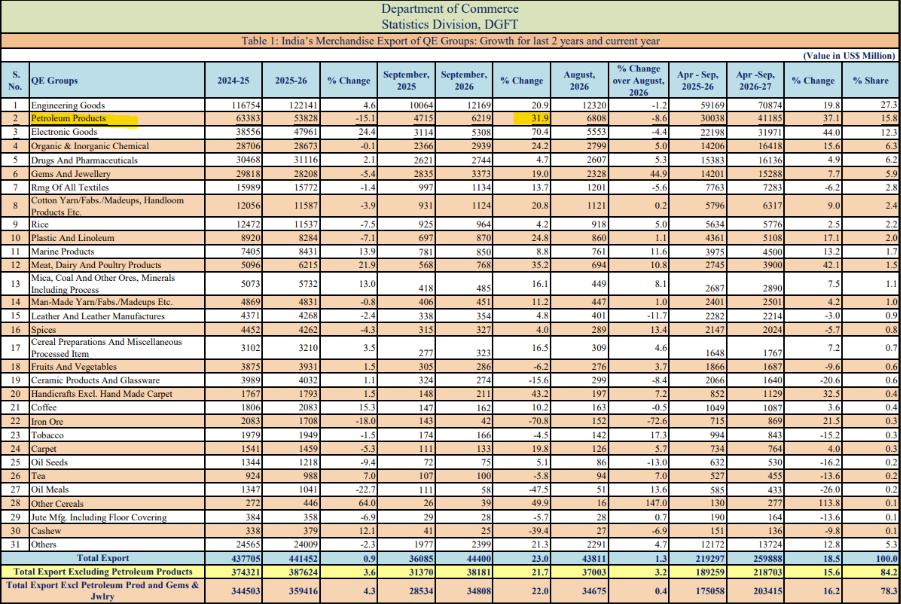
If we look at the numbers, merchandise exports in the first half increased strongly by about 18.5% to $259.89 billion as compared to US$ 219.30 billion during April-September 2025-26.
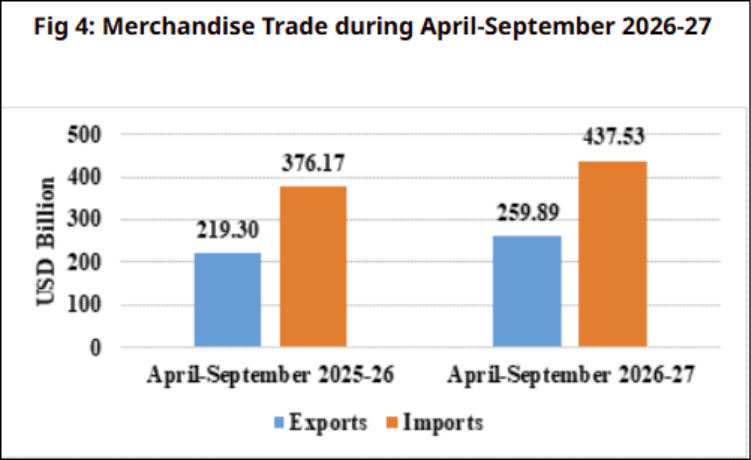
Meanwhile, services exports also demonstrated solid growth of about 8.7% to $216 billion as compared to US$ 199.02 billion in April-September 2025-26.
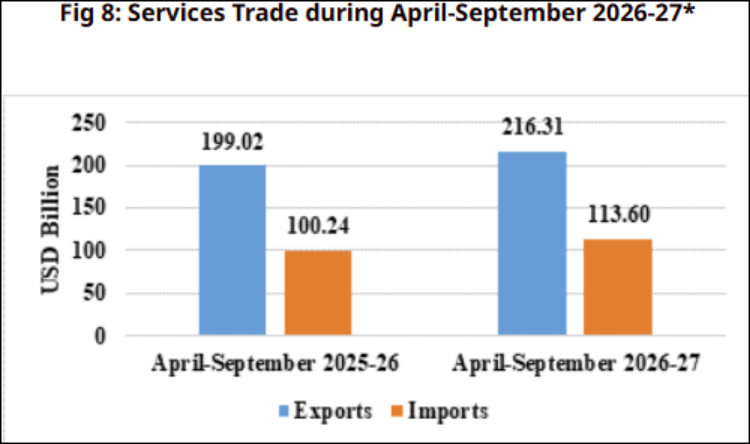
In fact, September 2026 alone saw merchandise exports skyrocketing 23% YoY to $44.4 billion.
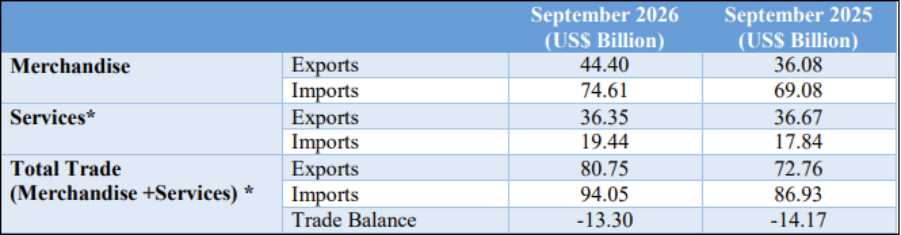
Numbers indicate that services continue to be reliable. It powered India’s FY 2025-26 export record and continues to expand, although at a relatively moderate pace compared to the recent acceleration in merchandise exports.
Interestingly, over the past 12 months, from October 2025 to September 2026, India’s total exports have hovered around $930 billion. This, plus the strong FY 2026-27 first-half run-rate, shows that the Indian economy has already been heading towards the $900+ billion annualised zone.
Petroleum products and electronics emerge as the primary engines of India’s $1 trillion exports target
Amid ongoing crisis in West Asia and the prolonged Russia-Ukraine war, and resultant uncertainties in oil markets, Indian refiners are gaining big.
As per commodity analytics firm Kpler, in September 2026, diesel exports surged to roughly 620,000 barrels per day, marking a one-year high, with a significant share heading to Europe.
Both high refining margins and supply disruptions caused by the West Asia crisis, Russian constraints, and Chinese curbs generated this “aapda mein avsar” or opportunity amid crisis for Indian refiners.
Overall, petroleum product exports increased sharply in September 2026 by 31.9% to $6.2 billion.
As global supply tightness persists for more months, this boom is expected to continue.
Meanwhile, electronics has emerged as an even more dramatic bright spot.
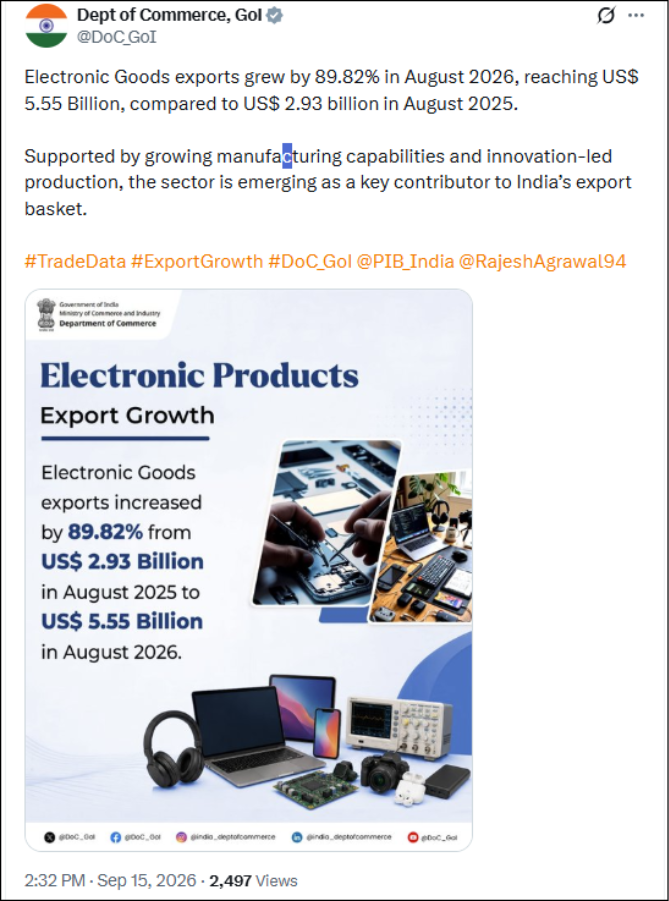
In August 2026, electronic goods exports increased from 89.8% year-on-year to $5.55 billion as compared to $2.93 billion in August 2025. In September 2026, electronics exports surged 70.4% to $5.31 billion from $3.11 billion YoY.
In its report titled India’s New Industrial Revolution, global investment bank Jefferies describes electronics as a key driver of the next phase of India’s industrial growth in the coming years.
It noted that India is focusing on domestic value addition and component manufacturing. The global investment banking company highlighted that Central government initiatives like the Electronics Component Manufacturing Scheme (ECMS) and Mobile Phone Manufacturing Scheme (MPMS) aim to deepen backward integration and reduce import dependence.
The Jefferies report forecasted that the ECMS will cover 50% of mobile component value versus 20% now.
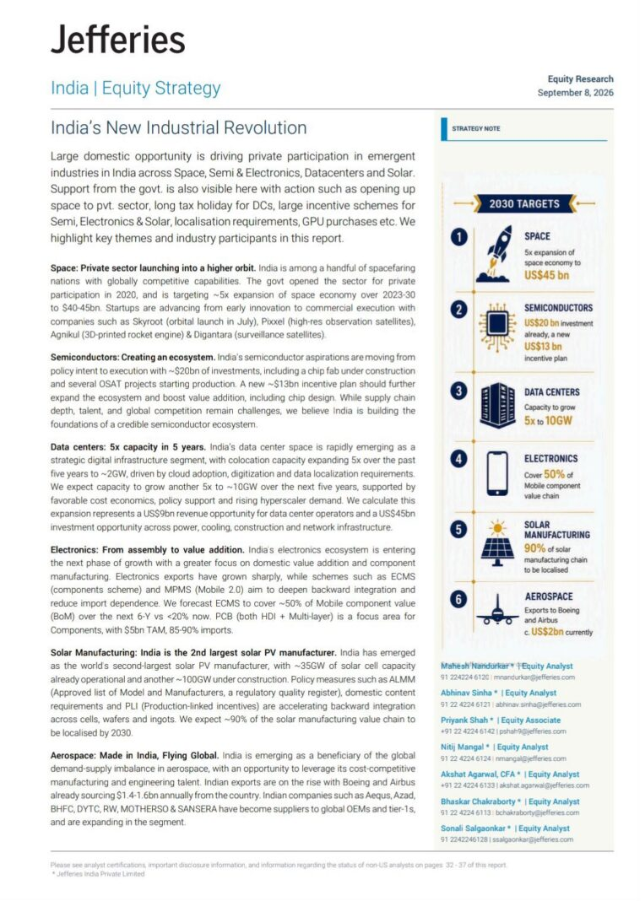
Highlighting an increase in electronics exports, the Jefferies report stated, “From assembly to value addition. India’s electronics ecosystem is entering the next phase of growth with a greater focus on domestic value addition and component manufacturing. Electronics exports have grown sharply, while schemes such as ECMS (components scheme) and MPMS (Mobile 2.0) aim to deepen backward integration and reduce import dependence. We forecast ECMS to cover ~50% of Mobile component value (BOM) over the next 6-Y vs <20% now. PCB (both HDI + Multi-layer) is a focus area for Components, with $5bn TAM, 85-90% imports.”
Apparently, engineering goods, chemicals, and other manufacturing categories have also made impressive contributions. These gains reflect production-linked incentive schemes, enhanced integration into global supply chains, particularly for the US market, and a wider manufacturing push.
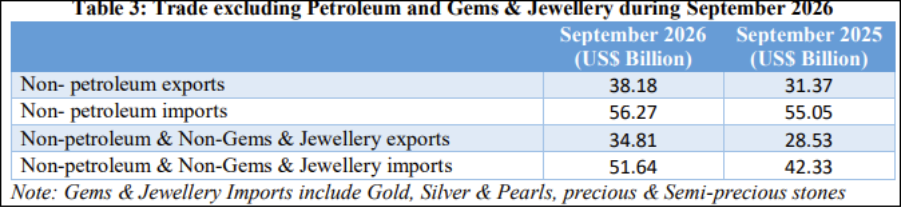
Meanwhile, non-petroleum merchandise exports have also strengthened over time, widening the base beyond energy.
India’s total exports near-doubled since the Modi government came to power in 2014
An interesting aspect to note about the story of the rise in India’s exports is that when the Modi government came to power in 2014, India’s total exports, which include goods and services, stood at $466.22 billion in 2013-14, with merchandise exports recorded as $314 billion and services exports worth $152 billion.
Since then, the Indian economy has, under the Modi government, witnessed recovery and consistent growth. In over 12 years, India’s exports witnessed a rise to the $863 billion level and a run-rate nearing or exceeding $900 billion.
Why the $1 trillion exports milestone matters for India
Reaching the $1 trillion exports milestone would position India along with a small elite group of major exporters, which currently has China, the US, and Germany at the top.
India joining this club would bolster external balances by creating more foreign-exchange earnings against persistent oil and component import requirements, supporting reserves as well as curbing vulnerability to trade deficits.
Structural supports for this are free trade agreements expanding preferential access, a competitive currency and sectoral diversification. However, some caveats remain. Overall trade deficits have remained sizable due to import growth matching or exceeding export gains.
While sustaining and slightly accelerating the pace from the first half through the second half would secure India its $1 trillion target, it is not going to be automatic.
Factors like global demand, geopolitical dynamics, and commodity prices impact the growth trajectory.
What makes the $1 trillion worth exports target realistic is the combination of electronics momentum, refining gains, stable resilience of services, and the Modi government’s policy measures with continued execution.