

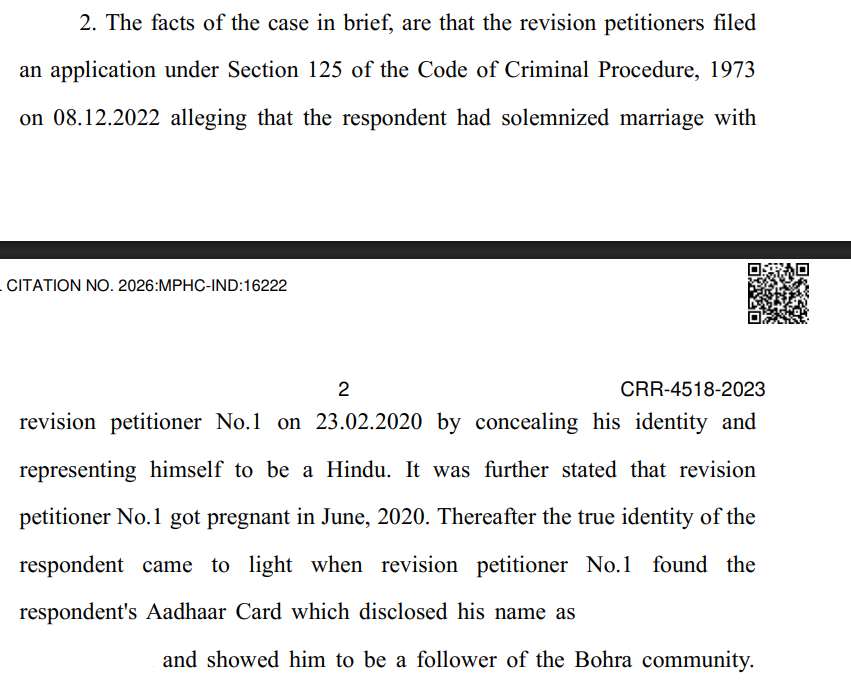
On 22nd June (Monday), the Madhya Pradesh High Court granted maintenance to a woman who was duped into marriage by a Muslim gym trainer by lying about his faith. She was also assaulted and pushed to embrace Islam. The matter pertains to 2020 when he pretended to be a Hindu, tied the knot with her and continued this deception even after she became pregnant.
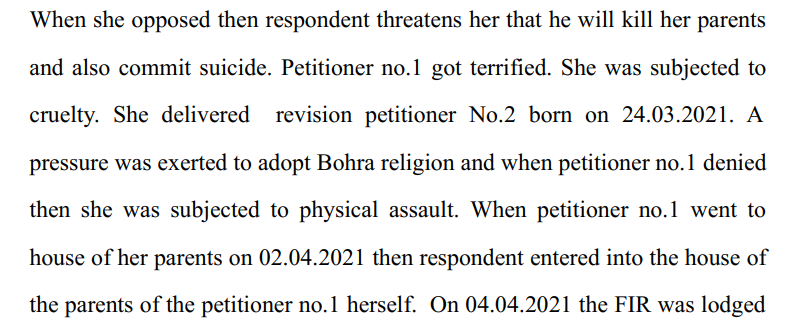
His real identity was revealed when the victim discovered his Aadhar Card, which indicated that he belonged to the Bohra community. Hence, she confronted him, but he threatened to murder her parents and then take his own life, instilling fear in her. “She was subjected to cruelty,” the order explicitly stated.
Afterwards, the woman gave birth and faced pressure to convert to his religion. She refused and had to endure physical abuse. In 2021, she visited the house of her parents, and he even followed her there, after which a First Information Report (FIR) was lodged at Dwarkapuri Police Station in Indore.
He was booked under sections 452, 498-A, 323, 294, 506 read with section 34 and section 425 of the Indian Penal Code (IPC), as well as section 5 read with section 3 of the Madhya Pradesh Dharmik Swatantrya Adhiniyam. Afterwards, he tried to kidnap her from a Shiv temple, seriously threatened and assaulted her. He also threatened the family members of the priest of the temple. She had to go to the police station to save herself.
Judge Gajendra Singh observed that the petitioners “are unable to maintain themselves,” whereas the man earns approximately Rs 1 lakh monthly through his work as a gym trainer along with other ventures and conveyed, “Each of the petitioners claiming Rs.30,000/- per month as maintenance.” On the other hand, he also failed to appear before court despite serving notice.
Trial court committed an illegality
The court mentioned, “Appreciating the evidence trial court rejected the claim of the petitioner no.1 recording the finding that petitioner no.1 is not legally wedded wife of the respondent but recorded the finding that petitioner no.2 is daughter of the respondent.” The monthly earnings of the man were estimated by the lower court to be between Rs. 10,000 and Rs. 12,000, comparable to that of a labourer, in the absence of the gym operator.
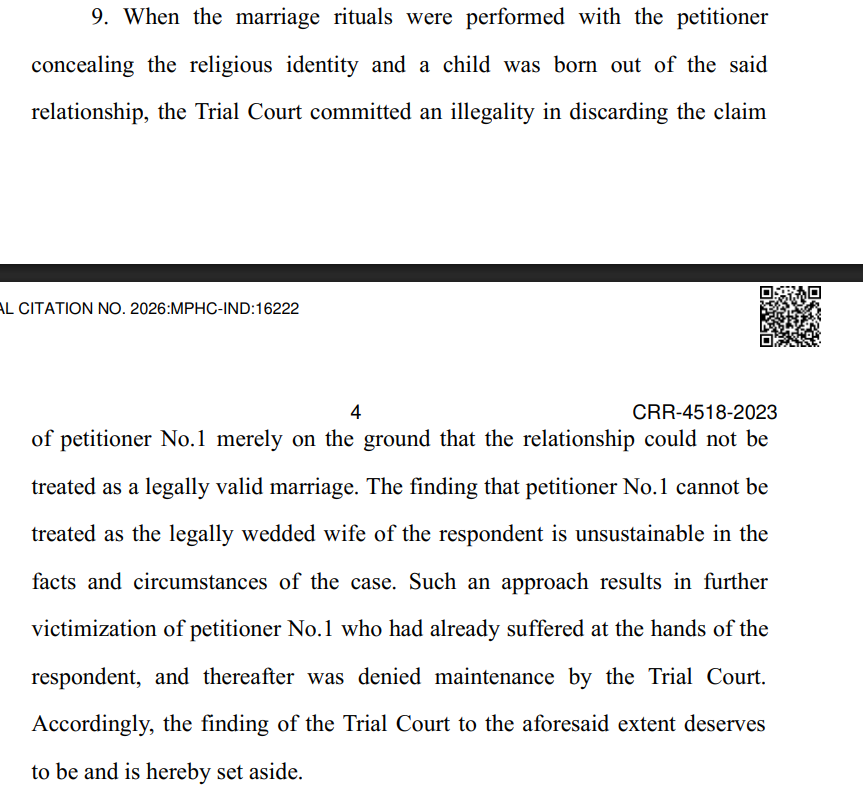
Judge Singh highlighted that the trial court “committed an illegality” by discarding the woman’s submission on the grounds that the relationship could not be regarded as a legally valid marriage when the rituals were carried out with the man hiding his religious identity, and a child was born out of the union.
He pointed out, “Such an approach results in further victimisation of petitioner no.1 who had already suffered at the hands of the respondent and thereafter was denied maintenance by the trial court. Accordingly, the finding of the trial court to the aforesaid extent deserves to be and is hereby set aside.”
On 8th January 2022, the woman had submitted a maintenance application, and the Additional Principal Judge of the Family Court rejected it in 2023. The request concerning her child was partially granted, and maintenance was set at Rs. 2,000 per month, effective from the date the application was filed. She was dissatisfied with the verdict and decided to approach the high court for revision.
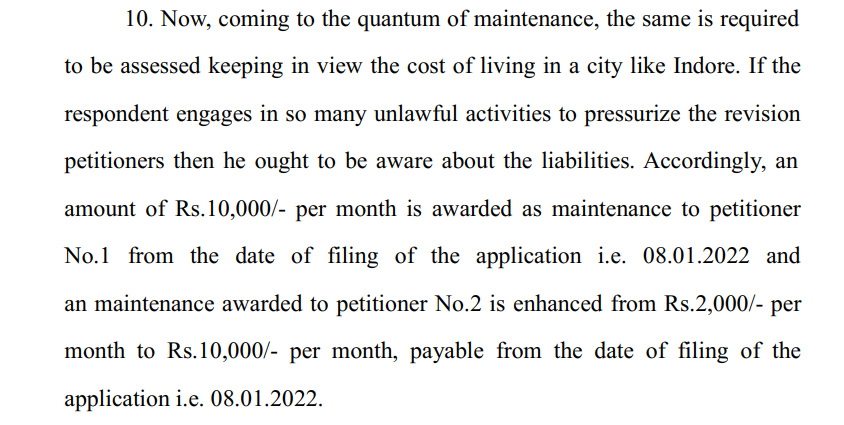
The court then stated that the cost of living in a city like Indore must be taken into consideration while determining the amount of regular maintenance. It concluded, “If the respondent engages in so many unlawful activities to pressurise the revision petitioners, then he ought to be aware about the liabilities. Accordingly, an amount of Rs. 10,000/- per month is awarded as maintenance to petitioner no.1 from the date of filing of the application and a maintenance awarded to petitioner no.2 is enhanced from Rs. 2,000/- per month to Rs.10,000/- per month, payable from the date of filing of the application.”
“With the aforesaid, this revision petition is allowed and stands disposed off,” the court outlined.
