

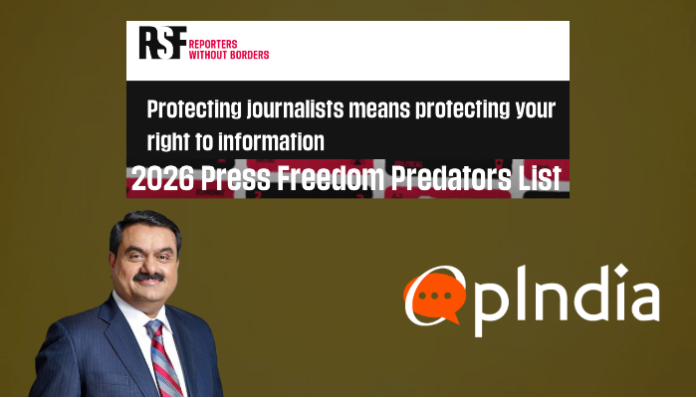
On 2nd November (Monday), “Reporters Without Borders (RSF)” published its “2026 Press Freedom Predators List,” and, predictably, OpIndia and the Adani Group once again made the cut, much like last year. OpIndia has been featured under the “Social: They smear media and promote mistrust of journalists” category, stating that the website, which was launched in 2014, “is closely aligned with the Hindu supremacist ideology of Hindutva” and blaming it for purported “repeated attacks” on allegedly “independent journalism.”
“It plays a central role in the widespread trend of discrediting reliable news media in India, portraying its content as contributing to the fight against an alleged liberal media cartel. By mobilising networks of online trolls, it amplifies narratives aimed at discrediting journalists and media outlets critical of the government, regularly accusing them of being propagandists working for foreign powers, or forming part of a Soros ecosystem – a reference to US billionaire philanthropist George Soros – or an anti-India lobby,” it complained.
Notably, Soros has consistently advocated regime change and has openly expressed his desire to see a similar political shift in India, with the Modi government being ousted. RSF further claimed, “Dozens of articles targeting journalists and media outlets in 2026, sometimes followed by waves of online harassment against the journalists named.”
It then went on to defend Chinese propagandist Helle Lyng, a Norwegian “journalist” associated with Dagsavisen, who recently gained notoriety for heckling Prime Minister Narendra Modi. She later admitted that journalists were specifically asked not to pose any questions during the joint press briefing with his Norwegian counterpart. Lyng has been regularly targeting the government ever since.
“In a profile published in May 2026, OpIndia described her as a Chinese propaganda agent and accused her of asking loaded questions and engaging in grandstanding while suggesting that she was a controversial figure. The articles helped fuel a massive online hate campaign against her, driven by accounts associated with the Hindu nationalist far right,” the release read.
The Adani Group has been included in the “Legal: They subject journalists to judicial harassment” section, which referred to “Gautam Adani, as India’s richest man and an ally of Prime Minister Narendra Modi.” It added, “The powerful Adani Group has, together with its subsidiaries, brought around ten legal actions against more than 15 critical journalists and media outlets since 2017. These cases form part of a systematic use of gag suits, combining civil and criminal defamation lawsuits, to silence independent journalism.”
It claimed, “The arrest and week-long detention of investigative journalist Ravi Nair in September 2026 in connection with a criminal defamation case brought by the Adani Group. Released on bail, he faces a total of three defamation lawsuits related to his reporting and social media posts about the conglomerate, and 11 ongoing civil and criminal proceedings against journalists in India over their reporting on the Adani Group and its subsidiaries.”
It also carried a court submission by the company, which outlined, “[T]he Plaintiff is aggrieved by the actions of certain reporters, activists and organisations, who, with malicious intent, have damaged the Adani Group’s reputation and also cost its stakeholders billions of dollars and also caused massive loss to the image, brand equity and credibility of India’s brand as a country. […] [T]he Defendants, by aligning with anti-India interests and continuously targeting the Plaintiff’s Infrastructure and energy projects, which are critical to India’s infrastructure and energy security, have disrupted these projects with ulterior motives.”
Notably, in early February 2026, a magistrate court in Gujarat’s Gandhinagar district convicted Ravi Nair in a criminal defamation case filed by Adani Enterprises Limited (AEL). The court sentenced Nair to one year’s simple imprisonment and imposed a fine of Rs 5,000. The verdict was delivered by the Court of the Judicial Magistrate First Class in Mansa taluka. The case was filed against Nair in September 2021 under Section 500 of the Indian Penal Code (IPC).
According to the company, the posts were aimed at eroding public trust and shaking investor confidence in the conglomerate. According to the prosecution, the tweets in question were published between October 2020 and July 2021 from Nair’s social media handle on Twitter (now X) and a website. The court held that the publications went beyond fair comment or permissible criticism and amounted to categorical assertions accusing the company of corruption, manipulation of laws, misuse of government agencies and undue political patronage.
RSF receives substantial backing from Western governments and quasi-governmental democracy promotion organisations, according to its public statements and independent investigations. Large US foundations like the Ford Foundation, which has a lengthy and contentious history of supporting political action and lobbying in India, including organisations later charged with financial irregularities and anti-India campaigns, are also connected to RSF.
RSF has consistently adopted tough positions against governments targeted by US-EU regime change initiatives, such as Venezuela, while showing support for US-funded organisations and oligarch-owned opposition media in those nations.
This donor profile clearly places RSF within the well-known “democracy promotion” network. NGOs, media initiatives, indices, and lobbying campaigns that selectively highlight “authoritarianism” in regimes at odds with Western geopolitical preferences, of which India is increasingly one, are funded by Western governments and affiliated institutions.
