

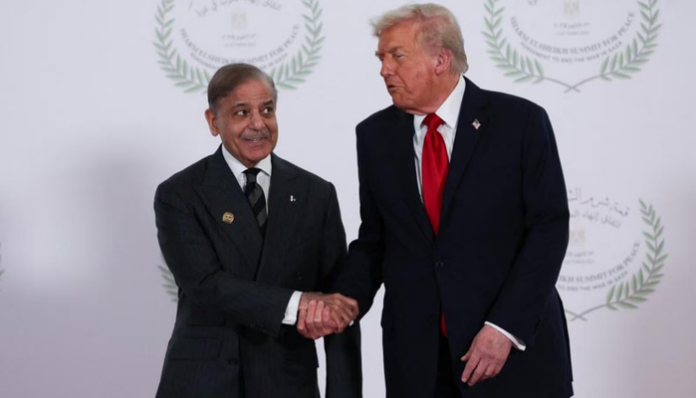
Pakistan’s efforts to establish itself as a global peacemaker, amid the ongoing US-Israel-Iran war, seem to have been in vain, as it turns out that the entire scenario, including the ceasefire proposal and Pakistan’s volunteering to be a peacemaker, was staged by the White House. According to a report in the Financial Times, even as the United States was giving open threats and deadlines to Iran to pressure it to open the Strait of Hormuz, behind the scenes, it was pushing Pakistan to convince Iran for a temporary ceasefire.
As per the report, the Trump administration had been pursuing Pakistan for weeks, asking it to get Iran to agree to a temporary ceasefire and the opening of the Strait of Hormuz. The White House hoped that if the ceasefire proposal came from a Muslim-majority country like Pakistan, Iran was more likely to accept this. The revelation comes as a setback to Pakistan’s attempts to project itself as a global peacemaker and exposes how Pakistan was used by the US as a channel to mount pressure on Iran.
Acting in the White House’s instructions, Pakistan’s Field Marshal Asim Munir reportedly made back-channel efforts to broker a ceasefire, which resulted in a two-week ceasefire announcement by the US, Iran and Israel on Tuesday (7th April). Interestingly, the announcement came hours after Trump threatened the “whole civilisation” of Iran if it didn’t agree to the US’s terms. While Trump was perturbed by surging oil prices and the unexpected Iranian resilience, he did not want the US to be seen as the one calling for a ceasefire. Therefore, it used its all-time loyalist, Pakistan, to make it happen.
Then came the ultimate blunder, which further exposed the White House script in action. Pakistan’s Prime Minister made the two-week proposal public on social media after Munir spoke with Iranian Foreign Minister Abbas Araghchi. Sharif, who portrayed the deal as Pakistan’s initiative, mistakenly included a subject line at the top of his post: “draft — Pakistan’s PM message on X”. Sharif quickly deleted the social media post, but the damage had already been done. The post triggered speculations that the message was not written by Sharif or his staff but was likely written either by the US or Israel.
The report states that shortly after Trump issued his first ultimatum to Iran, Pakistan’s top officials inclduing Asim Munir, started passing messages between Iranian political and military figures and the White House, pitching Islamabad as a venue for a peace summit. They shared the US’s 15-point proposal and Iran’s five and 10-point responses. They also mediated a discussion on the period of temporary ceasefire, ranging from 45 days to two weeks.
While initially, both sides stuck to their demands, subsequently, Iran reportedly became compliant on diluting and accepting limits on its stockpile of uranium. Later on, Araghchi and other Iranian leaders agreed to a temporary ceasefire-for-Hormuz deal in principle days ago, following weeks of heavy US and Israeli strikes. However, Iran’s Islamic Revolutionary Guard Corps (IRGC) resisted a ceasefire, as some IRGC officials were not in favour of ending the war and loosening control of the strait.
The situation deteriorated after an Iranian drone strike hit the Saudi petrochemical hub in Jubail on Tuesday, raising concerns over the ongoing peace efforts. Apart from that, the ongoing Israel-Hezbollah escalations and the resistance within the IRGS could further derail the peace negotiations.
