

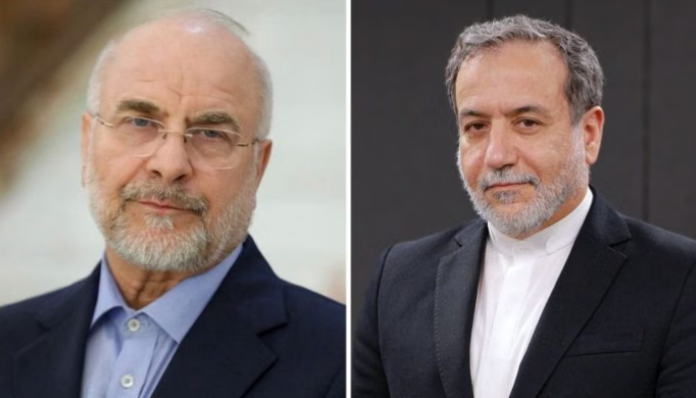
United States suspected that Israel was planning to eliminate Iran’s top negotiators during the critical cease-fire discussions that began in April, reported The New York Times. The Jewish state has been involved in the assassination of key leaders of the Islamic regime since the conflict erupted in February. However, Washington was specifically worried about Iran’s foreign minister Abbas Araghchi and Parliament speaker Mohammad Bagher Ghalibaf, as the truce talks were underway.
The US even requested other Middle East nations to alert Iran to the likelihood of an Israeli attack on the two leaders because it feared that the move would end the efforts to reach a peace deal. American authorities admitted that senior government officials Araghchi and Ghalibaf would have been prime targets for Israel, which was determined to overthrow the Islamist government.
They were concerned that any such attempt would rekindle hostilities and completely jeopardise the negotiations. Araghchi and Ghalibaf have been working with various countries in the region to negotiate a ceasefire and subsequently a more sustainable peace with Washington. Notably, they were temporarily removed from the Israeli target list when the United States explored launching discussions with Iran.
The Trump administration uncovered about the plan against at least Ghalibaf at the time and asked Israel not to proceed. Meanwhile, he was nearly killed in both the 12-day war in June 2025 and again this year, when Israel hit a secret gathering of senior government leaders in a bunker under a mountain and had to be pulled from beneath the debris in both cases.
During the negotiations, Iran had taken security measures to protect its senior leaders. In April, Ghalibaf was set to land in Islamabad to hold talks with Vice President JD Vance, but Iranian security officials had reservations that Israel might seize the opportunity to kill him or Araghchi.
Hence, 70-member delegation was escorted by fighter jets of the host country to Islamabad and back. However, Israel wanted to strike the aircraft carrying Ghalibaf on the return trip and two Israeli fighter jets even entered Iranian airspace from its western border close to Iraq.
This was also verified by Mahdi Mohammadi, his top aide who travelled with him to Islamabad. The jet made an emergency landing in Mashhad, and the Iranian group had to complete the approximately 8 hours journey via road.
The rift in the goals of the United States and Israel
In the early stages of the confrontation, Israel prioritised attacking the leadership with the goal of killing as many senior people as possible, while US strikes concentrated on Iran’s naval and missile weapons. This included executing former Iranian foreign minister Kamal Kharazi and senior national security official Ali Larijani who were a part of the negotiations.
The Trump administration wanted them on the discussion table, as per reports. The reports of a potential Israeli plot to target the senior Iranian officials demonstrate how the US and Israeli military intentions, which were similar at the start of the war, soon drastically differed.
Israel has been dubious since the initial end of operations despite the US desire for a peace accord. Israeli officials reluctantly accepted the first two-week cease-fire in April as the country believed that US concluded the war too early. On the contrary, Islamic Revolutionary Guards Corps strengthened its hold over Iran, and the regime became even more radical instead of their ouster from power.
A framework deal between the US and Iran was struck in June with the goal of opening the Strait of Hormuz and laying the groundwork for further negotiations about Tehran’s nuclear program.
The original agreement was regarded as a debacle by officials and commentators in Israel, as it did not meet objectives of replacing the government in Iran, defeating its proxy forces and inflicting considerable damage on its missile program. Israeli leaders were also worried that the agreement would provide Iran with billions of dollars, facilitating a quick recovery without effectively curtailing its nuclear goals.
The tensions in West Asia broke out after Israel killed multiple senior Iranian officials, including Supreme Leader Ayatollah Ali Khamenei with the help of US intelligence on 28th February.
